







Abstract
While previous research has shown that high syllable frequency can facilitate speech production at the level of phonological/phonetic encoding, little is known about its influence on prephonological processes, specifically lexical selection. The current study used a picture–word interference (PWI) task to (a) shed light on the stages of lexical access where syllable frequency is relevant, and (b) inform as to whether lexical selection is accomplished via competition among activated word options. Participants named pictures whose names had high-frequency (HF) and low-frequency (LF) first syllables while ignoring phonologically related (same first syllable) or unrelated distractor words that were presented simultaneously. Word frequency was also manipulated, as half of the targets were HF words, and half were LF words. Results revealed inhibitory syllable frequency effects in all conditions, such that targets with HF first syllables were named more slowly than targets with LF first syllables. However, inhibitory syllable frequency effects were exacerbated in conditions thought to reflect heightened lexical competition, specifically in the presence of phonologically related distractors and for targets with low word frequency. These findings reveal novel evidence for first-syllable frequency effects on lexical selection and offer further support for models proposing delays at lexical selection due to activation of nontarget competitors.
The limitless semantic potential of human language relies on an extensive catalogue of symbols that signify meaning, a storehouse referred to as the mental lexicon. The average person's lexicon contains 50,000–100,000 unique words (Levelt, 1999), and the act of producing even a single item requires the speaker to access semantic (meaning-based), lexical (syntax-based), and phonological (sound-based) information (e.g., Dell, 1986; Levelt, Roelofs, & Meyer, 1999; MacKay, 1987). Given the vastness of the lexicon and the complexity of speech production processes, it seems a functional necessity that the lexicon be structured in a way that allows for efficient retrieval of the word or words needed to express a concept. Several word characteristics have been suggested as potential designators for the stratification of the lexicon, including syntactic features such as grammatical category and semantic features such as level of concreteness (e.g., Rapp & Goldrick, 2006), factors that are often difficult to dissociate from one another. More recently, psycholinguistic research has begun focusing on how words relate to one another at the phonological level, providing insight into the organization of the speech output lexicon. The present study examined the influence of first-syllable “neighbours” (e.g., words with overlapping first syllables) on multiple stages of lexical access and word production.
Previous research has shown that words consisting of common phonological representations are produced faster and more accurately than words containing infrequent sound structures (e.g., Vitevitch, 2002; Vitevitch, Armbrüster, & Chu, 2004; Vitevitch & Luce, 2005). The most prevalent measures used in English are phonotactic probability (the probability of phonemes or phoneme combinations in specific word positions) and phonological neighbourhood density (the network of words sharing all but one phoneme), both of which have been shown to influence the efficiency of speech production. However, these studies have used mostly monosyllabic stimuli, challenging the extent to which these findings can be extended to more complex, multisyllabic words. One possibility is that multisyllabic words are organized via overlapping phonological structures of a larger size than phonemes—namely, syllables. Syllable frequency refers to the rate with which a specific syllable is used within a language. The frequency of a syllable's use can be measured by calculating the number of unique words that contain the syllable—that is, type frequency—as well as the summed frequency of all words containing that syllable—that is, token frequency (e.g., Cholin, Levelt, & Schiller, 2006). Syllable frequency effects have been demonstrated in Spanish (e.g., Carreiras & Perea, 2004), French (e.g., Laganaro & Alario, 2006), Dutch (e.g., Cholin et al., 2006), and German (Aichert & Ziegler, 2004), where words and pseudowords consisting of high-frequency (HF) syllables are read aloud more quickly than those consisting of low-frequency (LF) syllables.
The majority of recent evidence suggests that English speakers are also responsive to manipulations of syllable frequency, at least in certain contexts (Cholin, Dell, & Levelt, 2011; Farrell & Abrams, 2011; Macizo & Van Petten, 2007). For example, Cholin et al. (2011) reported significant effects of first- and second-syllable frequency on production latencies when speakers produced monosyllabic and disyllabic pseudowords (see also Macizo & Van Petten, 2007, for similar syllable frequency effects on word naming times). Syllable frequency has also been shown to reduce instances of failed phonological encoding, specifically, the rate of tip-of-the-tongue (TOT) states (Farrell & Abrams, 2011). In this study, older adults, a population known for exacerbated difficulties with phonological retrieval, experienced fewer TOTs for words with HF first syllables than for words with LF first syllables.
Facilitative syllable frequency effects are thought to occur at late stages of the word production process—that is, when the speaker assembles the phonological or phonetic units contained within a word (e.g., Cholin et al., 2011; Farrell & Abrams, 2011; Levelt et al., 1999). According to the most developed interpretation (e.g., Levelt et al., 1999; Levelt & Wheeldon, 1994), HF syllables are produced more efficiently because their motor programmes are stored within a repository of phonetic syllables referred to as the mental syllabary. The syllabary has a finite amount of storage space available, so HF but not LF syllables have a reserved slot in the syllabary. Because the retrieval of stored motor programmes is less demanding than online assembly, HF syllables are produced faster and/or more accurately than LF syllables. Alternatively, others have argued that facilitation from HF syllables stems from a long-term practice effect during phonological encoding (Farrell & Abrams, 2011). Central to this perspective is the assumption of bidirectional connectivity between the lexical representations of words and their corresponding syllable-sized phonological representations (e.g., Dell, 1986; MacKay, 1987). This two-way connectivity causes activation to cycle back and forth between the lexical and phonological levels, thereby strengthening connections for words and sounds produced most often. Because HF syllables are found in more words and/or more frequently used words than LF syllables, they are more often engaged in this reinforcing activity. Over time, connections to the phonological representations of HF syllables are strengthened and are therefore retrieved more easily and produced more efficiently than LF syllables.
While the evidence suggests consistent facilitation from HF syllables at later stages in word production, the aim of the current study is to examine whether syllable frequency may also affect the speed of prephonological processes—namely, lexical selection. Lexical selection is the process by which a speaker chooses the specific word or “lemma” that best embodies the semantic and syntactic features of a to-be-expressed concept (e.g., Levelt et al., 1999). Because multiple words may meet the speaker's basic semantic and syntactic demands, a cohort of related words may become simultaneously activated. By necessity, only one word can be produced at a time, so some selection mechanism is needed to choose a single lemma at the expense of all other words in the lexicon. Models diverge on whether they assume that lexical selection relies on competition among partially activated lemmas (e.g., La Heij, Kuipers, & Starreveld, 2006; Levelt et al., 1999; Schriefers, Meyer, & Levelt, 1990; Starreveld & La Heij, 1995, 1996), or is achieved through an attentional bottleneck that filters out less relevant or less appropriate word choices (e.g., Dhooge & Hartsuiker, 2011, 2012; Mahon, Costa, Peterson, Vargas, & Caramazza, 2007).
The picture–word interference (PWI) task is a useful methodology for examining the influence of other activated words on the ease of lexical access. Within this paradigm, participants are asked to name pictures while ignoring visual or auditory distractor words. Because words are processed faster than pictures, their lexical representations are presumed to be activated before the target's lexical representation; therefore, the PWI task provides a direct test of the influence of activated alternative words on the speed of lexical selection and word production. According to lexical selection-by-competition models, the time required to complete lexical selection is sensitive to the relative activation levels among competing lemmas. In other words, the more comparable a target's activation level is to other activated lemmas, the longer it takes to complete lexical selection. As such, the competition account would posit longer response latencies when pictures are named in the context of a distractor word that has strong activation (i.e., if it is related to the to-be-named picture), or if the distractor word activates a large cohort of potential competitors.
Conversely, noncompetitive models propose that only the activation level of the target lemma is relevant for the speed of lexical selection, but that picture naming is slowed by distractors because they temporarily block the target word from entering the “verbal response buffer” after lexical selection has been completed. One of the most popular accounts of distractor processing in the PWI paradigm is the response exclusion hypothesis (REH), whose central feature is a single-item response buffer that can only accommodate a single word at a time (e.g., Mahon et al., 2007). Because the target word can only enter the buffer once the distractor has been cleared, two factors influence the amount of interference from distractors: the speed with which a distractor enters the buffer and the speed with which it is removed from the buffer (Dhooge & Hartsuiker, 2011). The time it takes for a distractor word to enter the buffer is related to its baseline activation level as well as any priming it may receive from the target picture. The time required to remove an item from the buffer is directly linked to its “response relevance”: how appropriate this word is given the context of the task. The more relevant a distractor word to the task (i.e., due to semantic or syntactic overlap with the target picture), the longer it takes for the word to be removed from the buffer and hence the longer it takes to name the picture. An important feature of the REH is that items that enter the buffer are phonologically well-formed representations ready for production (Mahon et al., 2007), so the effects of the distractor occur after the point of lexical selection.
Although different terminology is used, a related noncompetitive model suggests that distractor words are excluded from naming through the action of the verbal self-monitor, the device used to error check one's own overt and covert speech (Dhooge & Harsuiker, 2012). Although it is usually discussed in the context of speech error data, Dhooge and Harstuiker (2012) suggest that the verbal self-monitoring system can also influence the time course of speech production. As with the buffer proposed by REH, the more similar the distractor is to the target and the more relevant it is for the speaker's context, the more difficulty the self-monitoring system has in excluding the distractor. In sum, two different mechanisms have been proposed to account for interference from distractors in the PWI task: competition from lexical competitors and attention-based delays at the response exclusion buffer/verbal self-monitor. Importantly, the two accounts differ in regards to the locus of interference effects in that the former presumes that distractor interference occurs during lexical selection of the target due to direct competition among lexical candidates; the latter two perspectives argue for an indirect and postlexical locus of distractor interference due to delayed production of the target from the attentional output buffer.
Thus far, all three models have primarily been used to explain interference effects observed during PWI, when related distractor words slow naming latencies relative to unrelated distractors. Most notable is the semantic interference effect, the phenomenon that semantically related distractors (TIGER–lion) slow picture naming relative to unrelated distractors (TABLE–lion; e.g., Abdel Rahman & Melinger, 2007; Damian, Vigliocco, & Levelt, 2001; Kroll & Stewart, 1994; Schriefers et al., 1990; Starreveld & La Heij, 1995, 1996). However, unlike semantically related words, phonologically related distractors consistently facilitate picture naming latencies compared to unrelated words (e.g., Cutting & Ferreira, 1999; Damian & Martin, 1999; Meyer & Schriefers, 1991; Schriefers et al., 1990; Taylor & Burke, 2002). Most accounts of phonological facilitation in PWI attribute the effect to the phonological encoding level: The distractor activates the phonemes and/or syllables it shares with the target picture and therefore reduces the time spent on phonological retrieval of the target.
However, phonological activation can also exert an influence on lexical selection in some situations, suggesting that the influence of phonologically related distractors could potentially be relevant to the debate on lexical competition. A handful of studies have documented evidence for phonological influences on lexical selection using priming (e.g., Ferreira & Griffin, 2003; Humphreys, Boyd, & Watter, 2010; Navarrete, Basagni, Alario, & Costa, 2006; Navarrete & Costa, 2009; Starreveld & La Heij, 2004). For example, facilitation from a phonologically related prime word can occur in tasks requiring lexical selection but not overt production of the target, such as when participants are asked to access the grammatical gender of a target picture as opposed its name (e.g., Navarrete et al., 2006). Because this task requires lexical access (to identify the gender) but not phonological retrieval (as required in naming), it suggests that facilitation from a phonologically related prime word can extend beyond the phonological encoding level to affect lexical-level processes. Assuming that phonological feedback activation does have the potential to influence lexical selection, there is less clarity about how the frequency of phonological structures, such as syllables, influences the activation of their corresponding lexical representations. In regard to syllable frequency, bottom-up activation from a HF syllable would result in a larger cohort of partially activated lemmas because more words in the lexicon contain that syllable. As a result, competitive models would hypothesize that HF syllables would inhibit (slow down) lexical selection relative to LF syllables. Conversely, noncompetitive models would posit no effect of syllable frequency on lexical selection because the relative activation levels of other words in the lexicon do not influence the speed of lexical access.
The current research aimed to clarify several conceptual issues in the speech production literature using the PWI task. At a fundamental level, we set out to identify the stage(s) of lexical access wherein syllable frequency becomes relevant and to shed light on the selection mechanisms used to produce a specific target word while excluding other activated competitor words. Participants named pictures of words with HF and LF first syllables while ignoring an unrelated or phonologically related distractor word. To further explore the hypothesis that syllable frequency effects are expressed during lexical selection, we also examined syllable frequency effects as a function of the target's whole word frequency. Lexical selection is known to be sensitive to word frequency, where lemmas corresponding to HF words are retrieved faster than lemmas representing LF words (e.g., Navarrete et al., 2006). The assumption behind the word frequency effect is that HF words have higher baseline activation than LF words, so they require less activation to achieve a selection threshold. Therefore, interactivity between word frequency and syllable frequency might provide further evidence in favour of a syllable frequency effect prior to phonological encoding. Overall, predictions regarding the magnitude and direction of a syllable frequency effect were contingent on two theoretical issues: (a) whether the activation of shared phonological components influences lexical selection as well as phonological encoding, and (b) whether lexical selection relies on competition among activated competitors.
If the effect of syllable frequency extends to prephonological processes—namely, lexical selection—then lexical selection-by-competition models would posit inhibitory influences of syllable frequency in certain contexts. Because lexical selection is sensitive to the number of activated competitors, slower naming latencies would be predicted for words with HF syllables, especially in the presence of a phonologically related distractor. Phonologically related distractors that share a HF syllable with the target would activate a larger cohort of competitors than LF distractors, therefore delaying selection of the target. The inhibitory influence of high syllable frequency would be exacerbated in conditions when competition for lexical selection is high, resulting in larger inhibitory syllable frequency effects in the phonologically related distractor condition than in the unrelated distractor condition. Further, targets with low word frequency would be more vulnerable to competition from phonologically related words because their resting level activation is low, requiring more time for a LF word to achieve the highest level of activation among competitors and be selected for production. As such, inhibitory syllable frequency effects would be more pronounced for LF targets than for HF targets.
In contrast, noncompetitive models would predict a uniformly facilitative influence of high syllable frequency on naming latencies. Phonological encoding of HF syllable targets would occur more rapidly than encoding of LF syllable targets, so with all else being equal, faster naming should occur for HF syllable targets than for LF syllable targets in the presence of an unrelated distractor. When presented with a phonologically related distractor, participants would encode HF syllable distractors more rapidly than LF syllable distractors, allowing HF syllable distractors to enter and exit the response buffer/verbal self-monitor prior to LF syllable distractors. Because lexical selection of the target is unaffected by the activation of alternative words, noncompetitive models would also posit facilitatory word frequency effects but no interactivity with first-syllable frequency.
Method
Participants
Forty-four participants (aged 18–22 years, M = 19.5, SD = 1.13) were recruited from introductory psychology courses at the University of Florida and received partial course credit for participation. All were native English speakers who reported normal or corrected-to-normal vision and no history of learning disability.
Materials
The experiment was performed on PC-compatible computers using a program written in Visual Basic 5.0. Target pictures consisted of 80 black-and-white line drawings converted to JPEG images. Pictures were taken from the Peabody Picture Vocabulary Test–Third Edition (PPVT–III; Dunn & Dunn, 1997) or Boston Naming test (Kaplan, Goodglass, & Weintraub, 1983), or were similar in artistic style to the pictures from those sources (see Appendix for list of targets and distractors). First-syllable frequency was defined as the summed frequency of words containing that particular syllable in the onset position (i.e., positional token frequency) based on the CELEX database (Baayen, Piepenbrock, & Gulikers, 1995), a corpus of 17.9 million words in English. For example, the syllable /bi/ of the target word beaver occurs as the first syllable in words that have a combined frequency of 171 occurrences per million. Forty target pictures were classified as having a high-frequency (HF) first syllable (M = 2350.2, SD = 3634.9), and 40 target pictures were classified as having a low-frequency (LF) first syllable (M = 102.8, SD = 106.5), based on a median (= 341.5) split of all stimuli.
Because a number of linguistic variables are known to be correlated with syllable frequency and could potentially confound its results, we determined each target word's number of phonological and orthographic neighbours (excluding homophones), length in letters, length in phonemes, number of syllables (all taken from the English Lexicon Project database; Balota et al., 2007), word frequency (Francis & Kucera, 1982), and the length (in phonemes) of each target word's first syllable, displayed in Table 1. Additionally, HF and LF first syllables were compared for first phoneme and first biphone frequency in order to confirm that empirical effects were exclusive to the frequency of syllable-sized units, as opposed to the frequency of smaller phonological segments contained within the syllable (provided by the phonotactic probability calculator; Vitevitch & Luce, 2004). Independent-samples t tests indicated that HF first-syllable targets contained more syllables (p = .03) and also began with shorter first syllables (p < .001) than LF first-syllable targets, but were equivalent on all other measures (ps > .128). To rule out the possibility that differences in these variables might confound the effect of syllable frequency, (a) number of syllables, and (b) length of first syllable were added as covariates in the overall item analyses. Neither covariate was significant, nor did covariates have an influence on the syllable frequency effect. Finally, it has been proposed that the representation of a syllable might differ for stressed versus unstressed syllables (e.g., Cholin et al., 2011; Levelt, 1989). Within our set of target stimuli, nearly 90% of items placed stress on the first syllable. Importantly, HF and LF syllable targets did not differ in terms of their stress patterns (p = .13) or the proportion of items that stressed the second or later syllable within the word (p = .215).
Characteristics of targets with HF and LF first syllables
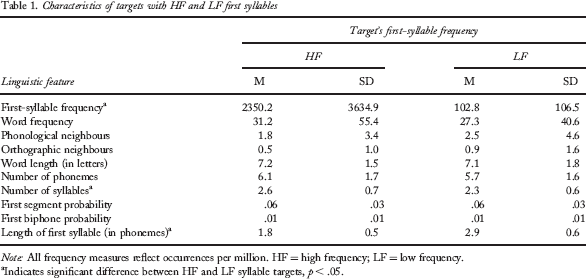
Note: All frequency measures reflect occurrences per million. HF = high frequency; LF = low frequency.
Indicates significant difference between HF and LF syllable targets, p < .05.
Half of the targets within each syllable frequency category were classified as having high word frequency (M = 55.6, SD = 57. 3), and half were classified as having low word frequency (M = 2.9, SD = 3.6; Francis & Kucera, 1982). The orthogonal combination of word and syllable frequency resulted in four within-subjects cells in the design, consisting of 20 HF word/HF first syllable targets, 20 HF word/LF first syllable targets, 20 LF word/HF first syllable targets, and 20 LF word/LF first syllable targets. For the picture–word interference task, targets (e.g., beaver) were paired with two phonologically related distractors that began with the same first syllable as the target (e.g., beaker, beaten) and two unrelated distractors that held no semantic or phonological relation to the target (e.g., falcon, porous). 1
Half of the distractors were nouns, and half were a different part of speech. The distractor part of speech manipulation was relevant for a different manuscript and is not discussed here.
Characteristics of distractors paired with HF- and LF-syllable targets
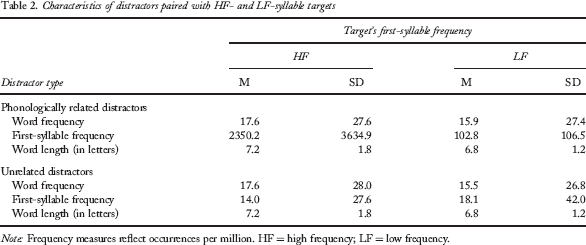
Note: Frequency measures reflect occurrences per million. HF = high frequency; LF = low frequency.
Procedure
Picture name familiarization
In order to maximize picture name agreement during the picture–word interference trials, participants first completed a familiarization phase where they were asked to name each of the 80 targets without a distractor. Each trial began with a question mark signalling participants to press the space bar when they were ready to view the picture. The key press brought on a 500-ms fixation point (+) followed by the presentation of the target picture, which remained on screen for 5000 ms or until a verbal response was made. Participants were shown all target pictures one at a time in a random order and were asked to produce their names as quickly as possible. The experimenter indicated via mouse click whether the participant's verbal response was correct or incorrect, and participants received a visual feedback message that either confirmed correct responses or stated the correct target name for incorrect responses. After participants went through all 80 targets, any pictures not named correctly on the first presentation were displayed in random order until participants produced the intended name.
Picture–word interference
Participants were instructed that they would be naming the same target pictures as those seen during the previous phase but that now there would be a written word superimposed on the picture that they were to ignore. Four practice trials were administered to accustom participants to the task. Each experimental trial began with a question mark in the centre of the screen that remained until participants pressed the space bar, followed by a 500-ms fixation cross. The picture and distractor word were displayed simultaneously and remained on screen for 3000 ms or until the participant named the picture. Trials were separated by a 1000-ms blank screen, followed by a question mark to ready participants for the subsequent trial. The fixation cross and distractor words were always displayed in the same location, which varied slightly in a random manner from trial to trial in order to prevent the distractor's location from becoming predictable and therefore more easily ignored. The 80 target pictures and 20 fillers (pictures of monosyllabic words paired with an unrelated distractor) were presented in four blocks of 100 pictures for a total of 400 trials. Each picture was presented four times paired with a different distractor in each block (2 phonologically related, 2 unrelated), the order of which was counterbalanced across participants. Within each block, target pictures were presented at random with a filler trial occurring between every four targets.
Results
All wavefiles were processed with a separate voice onset program (Jennings & Abrams, 2013) that extracted the onset time (in ms) of the naming response from each wavefile. When external noise (e.g., the participant kicking the table) prevented the computer from extracting the correct voice onsets, onset times were manually coded by trained research assistants to prevent the loss of these data. Among the data used in the statistical analyses, approximately 17% of trials were manually coded. Estimates of effect size (r) are reported for main effects and focused contrasts. Erroneous responses (4.5% of trials) consisting of incorrect picture names (0.9%), verbal dysfluencies (1.7%), excess talking (0.2%), time out responses (1.1%), and other recording errors (0.6%) were excluded. Trials that were more than 2 standard deviations from mean in each condition were also removed, accounting for 4.8% of correct trials.
A 2 × 2 × 2 mixed model analysis of variance (ANOVA) was used to assess the influence of target first-syllable frequency (HF, LF), target word frequency (HF, LF), and distractor type (phonologically related, unrelated) on naming latencies (see Table 3). All variables were treated as within-subjects factors in the participant analyses, while in the item analyses word and syllable frequency were treated as between-subjects factors, and distractor condition was treated as a within-subjects factor. Results revealed significant main effects of first-syllable frequency, F1(1, 43) = 53.23, MSE = 822.8, p1 < .001, r1 = .74, F2(1, 76) = 4.2, MSE = 4692.86, p2 = .044, r2 = .23, word frequency, F1(1, 43) = 94.43, MSE = 943.01, p1 < .001, r1 = .83, F2(1, 76) = 8.72, MSE = 4692.86, p2 = .004, r2 = .32, and distractor type, F1(1, 43) = 186.58, MSE = 1671.08, p1 < .001, r1 = .9, F2(1, 76) = 142.18, MSE = 934.39, p2 < .001, r2 = .81, with an inhibitory syllable frequency effect (faster naming latencies for targets with LF first syllables), a facilitatory word frequency effect (faster naming for HF targets), and phonological facilitation effect (targets named faster when paired with a phonologically related distractor than when paired with an unrelated distractor).
Naming latencies and error rates as a function of target first-syllable frequency, target word frequency, and distractor type
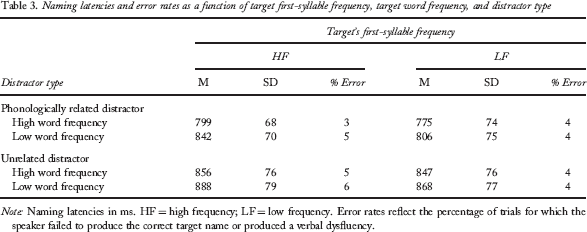
Note: Naming latencies in ms. HF = high frequency; LF = low frequency. Error rates reflect the percentage of trials for which the speaker failed to produce the correct target name or produced a verbal dysfluency.
Qualifying the main effects, all two-way interactions were significant (by participants only, although the means in the item analyses were consistent with the participant means), and follow-up analyses were conducted to unveil the nature of these interactions. First was the Syllable Frequency × Distractor Type interaction, F1(1, 43) = 11.36, MSE = 452.05, p1 = .002, F2(1, 76) = 2.4, MSE = 934.39, p2 = .12, which derived from a larger inhibitory syllable frequency effect in the phonologically related distractor condition, r = .77, syllable frequency effect = –30 ms, than in the unrelated distractor condition, r = .5, syllable frequency effect = –15 ms (ps < .001), as shown in Figure 1.
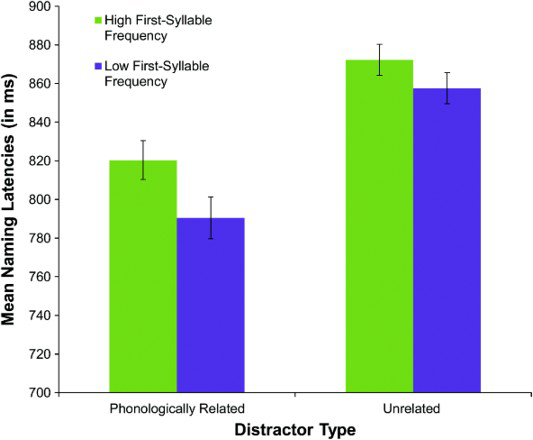
Mean picture naming latencies as a function of distractor type and target first-syllable frequency. To view a colour version of this figure, please see the online issue of the Journal.
There was also a significant interaction between syllable frequency and word frequency, F1(1, 43) = 4.87, MSE = 591.27, p1 = .033, F2 < 1, p2 = .56, shown in Figure 2. Follow-up analyses indicated an inhibitory syllable frequency effect for both HF and LF targets, ps < .001, although the effect was more pronounced for LF (r = .76, syllable frequency effect = –28 ms) than for HF (r = .51, syllable frequency effect = –17 ms) targets. Finally, the Word Frequency × Distractor Type interaction, F1(1, 43) = 4.19, MSE = 513.18, p1 = .047, F2 < 1, p2 = .36, reflects a larger word frequency effect in the phonologically related distractor condition, r = .82, word frequency effect = 36 ms, than in the unrelated distractor condition, r = .69, word frequency effect = 27 ms, ps < .001. The three-way interaction between word frequency, syllable frequency, and distractor type was not significant, F1 < 1, p1 = .784, F2 < 1, p2 = .97.
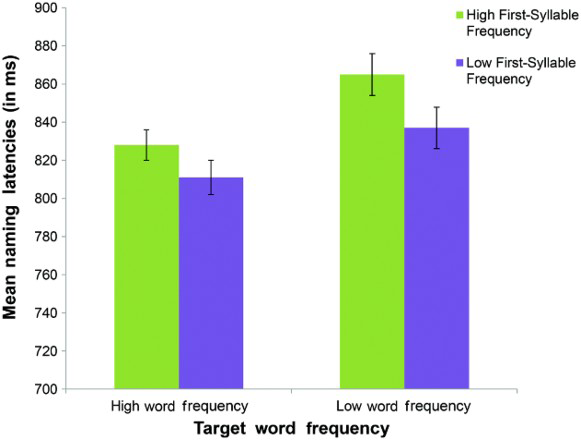
Mean picture naming latencies as a function of target word frequency and target first-syllable frequency. To view a colour version of this figure, please see the online issue of the Journal.
Discussion
Our findings replicate early research on the effects of word frequency and the influence of phonologically related distractors in PWI, while providing novel evidence for inhibitory syllable frequency effects under specific circumstances. Targets with high word frequency were named faster than LF words, replicating one of the most well-established effects in the speech production literature (e.g., Jescheniak & Levelt, 1994; Navarrete et al., 2006; Oldfield & Wingfield, 1965). Similarly, our observation of faster naming latencies in the phonologically related distractor condition than in the unrelated distractor condition is consistent with a long line of studies demonstrating a phonological facilitation effect in picture–word interference tasks (e.g., Cutting & Ferreira, 1999; Damian & Martin, 1999; Meyer & Schriefers, 1991; Schriefers et al., 1990; Taylor & Burke, 2002). Phonological facilitation occurred for both word and syllable frequency categories, suggesting that the boost in naming speed derived from phonologically related distractors is particularly robust. Phonological facilitation has been attributed to the level of phonological encoding such that reading the distractor “preactivates” the first syllable it shares with the target, therefore reducing the time spent on phonological encoding of the target. While our data do not conflict with this interpretation, the counterintuitive effect of syllable frequency observed here and the interaction between phonological facilitation and syllable frequency (by participants) suggest that phonological activation also has the ability to influence other stages of the speech production process.
Unlike previous research reporting an exclusively facilitative effect of syllable frequency on production (e.g., Cholin et al., 2011; Macizo & Van Petten, 2007), the current data suggest that a word's possession of an expansive first syllable cohort can be detrimental for production when it is named in the presence of a to-be-ignored distractor word. This explanation converges with other studies demonstrating phonological influences on lexical selection (e.g., Ferreira & Griffin, 2003; Humphreys et al., 2010; Navarrete & Costa, 2009; Starreveld & La Heij, 2004) and reveals circumstances wherein phonological activation can actually delay lexical selection. To our knowledge, this is the first report of an inhibitory syllable frequency effect on successful speech production (but see Farrell & Abrams, 2011, for inhibitory influences on TOT resolution). Further, results from the participant analyses suggest that inhibitory syllable frequency effects were more pronounced under circumstances where the target is especially vulnerable to interference from lexical competitors, specifically in the presence of a phonologically related distractor and for targets with low word frequency. Taken together, these results provide supporting evidence for lexical-selection-by-competition models and suggest that syllable frequency is one feature that influences the degree of lexical competition.
Only models that assume that lexical selection is achieved through competition and that allow for feedback activation from the phonological level to the lexical level can account for the present findings. According to these models, lexical selection would be sensitive to the number of simultaneously activated items as well as the strength of activation of competitors, both of which would be influenced by syllable frequency. Activation of a target's first syllable automatically spreads activation to other nearby words in the lexicon that also contain that first syllable. Because of the way that the syllable frequency measure is calculated (the summed word frequency of all words containing that syllable in the onset position), words with HF first syllables would possess more syllabic neighbours and a greater number of high-frequency neighbours. As a result, it takes more time to select a HF syllable target from the subset of activated lexical options. The potential for competition due to syllable frequency was heightened when targets were named in the presence of phonologically related distractors, as indicated by the Syllable Frequency × Distractor Type interaction. The lexical and phonological representations of the distractor would be activated more quickly than the target picture, causing feedback activation from its first syllable to a cohort of phonologically related lemmas prior to lexical selection of the target. This same effect would not apply for an unrelated distractor because its phonological components are not shared with the target and would not introduce new phonologically related competitors.
The inhibitory influence of target syllable frequency is inconsistent with noncompetitive models of distractor processing in PWI, which assume that target lexical selection is unrelated to the number of activated competitor words and/or the relative activation level of competitors. Instead, target naming is exclusively influenced by distractor features that affect the speed with which distractors enter the buffer and the speed with which they are removed. Therefore, in the phonologically related distractor condition, one would expect faster naming for target/distractor pairs with HF first syllables because phonological encoding of the distractor would occur more rapidly, which is the opposite pattern to that observed in the current data.
Importantly, because targets with HF first syllables were also named more slowly when accompanied by an unrelated distractor (albeit to a lesser degree), inhibitory syllable frequency effects cannot be accounted for by delays at visual perception/identification of the distractor. A number of studies have demonstrated inhibitory effects of high-frequency phonology (e.g., neighbourhood density, syllable frequency) during comprehension tasks, such as spoken and written word recognition (e.g., Luce & Pisoni, 1998; Perea & Carreiras, 1998; Taler, Aaron, Steinmetz, & Pisoni, 2010; Vitevitch, Stamer, & Sereno, 2008). As such, the slower response times for targets with HF first syllables in the phonologically related distractor condition could potentially be attributed to delayed comprehension of high syllable frequency distractors as opposed to production processes related to the target. However, there were no differences between the unrelated distractors paired with HF syllable targets and the unrelated distractors paired with the LF syllable targets. As such, it must be assumed that unrelated distractor comprehension did not differ as a function of target first-syllable frequency. Thus, the slower naming of HF syllable targets must have resulted from competition generated by the target itself, which is exacerbated when the distractor word shares the same first syllable and preactivates a cohort of phonologically related competitors.
Inhibitory syllable frequency effects were exacerbated for targets with low word frequency, granting further support in favour of a lexical competition model of syllable frequency effects. Although there is some disagreement about the locus of word frequency effects, previous research suggests that lexical selection is sensitive to word frequency (Navarrete et al., 2006). When starting at a low baseline activation level, having more syllabic neighbours (high first-syllable frequency) further delays the speaker's ability to select a LF target from among its cohort of activated competitors. In this study, participants were sometimes asked to name uncommon (LF) words whose lemmas are not often accessed. For example, the target peacock is rarely used during everyday speech for most people, so its lexical representation takes longer to select. However, because it begins with a HF first syllable /pi/, spreading activation from the phonological level may result in the activation of many other lemmas possessing that syllable, which also have a high likelihood of being higher frequency than peacock.
Overall, the inhibitory syllable frequency effect and its exacerbation in conditions that enhance competition among phonologically similar words (e.g., targets with low word frequency and phonologically related distractors) are supportive of lexical competition models. As a caveat, it should be noted that the interactions on which these interpretations are based were not significant by items, suggesting considerable variability among the items. Discrepancies between item and participant analyses might have been caused by insufficient power in item analyses, which treated syllable frequency and word frequency as between-subjects variables and reduced the number of observations per cell. The modulation of syllable frequency effects as a function of word frequency and distractor condition should therefore be confirmed in future research using a different set of stimuli to enhance the generalizability of these findings. Nevertheless, the patterns of results in the item analyses were similar to those in the participant analyses, as were the magnitude of syllable frequency effects across conditions.
While the present findings support the idea that English speakers access syllable-size structures during picture naming, it is important to acknowledge that the syllable plays a role during multiple stages of speech production, which can account for discrepancies in the direction of syllable frequency effects reported across studies. During the act of word preparation, nearby words (both at the level of semantics and at the level of phonology) become partially activated. Sometimes, activation of shared features can speed subsequent production of a target by preparing the necessary units that will be used for speech (i.e., the phonological facilitation effect). In other circumstances, if other words containing these shared features emerge as temporary candidates for production, target selection is slowed (i.e., the lexical competition effect). In the PWI task, two different processes determine the influence of the distractor on target naming: At one level, alternative words need to be excluded (therefore slowing naming); at another level, the distractor can activate the features it shares with the target (therefore hastening naming). Previous studies reporting facilitatory syllable frequency effect have used tasks that minimize the potential for lexical competition, such as word and pseudoword naming. Therefore, only the phonological facilitation effect emerges. However, in the PWI task when lexical selection is complicated by the activation of an alternative word (the distractor), having a large cohort of similar-sounding words is detrimental because it takes longer for the activation of alternative words to subside and allow the target to be selected for production. Overall, it seems that inhibitory syllable frequency effects will only emerge during tasks when the opportunity for lexical competition is high.
Another theoretically informative observation is that the magnitude of the inhibitory syllable frequency effects reported here (i.e., up to 30 ms) is substantially larger than the facilitatory syllable frequency effects reported in previous research (e.g., Cholin et al., 2011), which may suggest that competition effects observed at the lexical level outweigh the facilitation seen at the phonological/phonetic level. The size of these inhibitory syllable frequency effects (for LF words particularly) demands a reevaluation of phonological feedback activation on lexical selection, even by models that allow for bidirectional connectivity between the lexical and phonological levels. Phonological influences on lexical selection have been assumed to be minimal due to the number of steps required for a word to transmit activation to the lexical representation of a phonologically related word. Activation would need to spread from the lexical representation of the first word to its constituent phonological components, and then the phonological components would need to transmit the remainder of this activation to all connected lemmas. Accordingly, the shared activation would be sizeably reduced by the time it makes it to the lexical level. However, the current results suggest that there may be more interactivity and parallel processing between the lexical and phonological levels than previously assumed.
In conclusion, we have attempted to provide a theoretical foundation for understanding the loci of inhibitory syllable frequency effects and the processes that are evoked during lexical selection. These data provide confirmatory evidence that phonological spreading activation affects lexical selection, specifically by increasing the number of lexical competitors. Having a large cohort of phonologically related words may enable faster activation of the phonological units used for articulation, but conversely can complicate target lexical selection when there is the opportunity for lexical competition. Because age differences in the syllable frequency effect have been found at phonological encoding, the competitive effects of syllable frequency at the lexical level might also differ as a function of age. Future research should investigate developmental changes in the organization of the lexicon, including changes in the influences of phonological structure and frequency.
Footnotes
Acknowledgements
This research was supported by a William Orr Dingwall Neurolinguistics Dissertation Fellowship awarded to the first author. We are very grateful to Meredith Shafto for her assistance with the CELEX database and to Sean Hernandez, Anh-Thuy Le, Madelyn Hightower, and Adam Close for their assistance with data collection and response time coding. We also thank Katherine White for comments on an earlier version of this manuscript.
Appendix
Materials: Targets and distractors
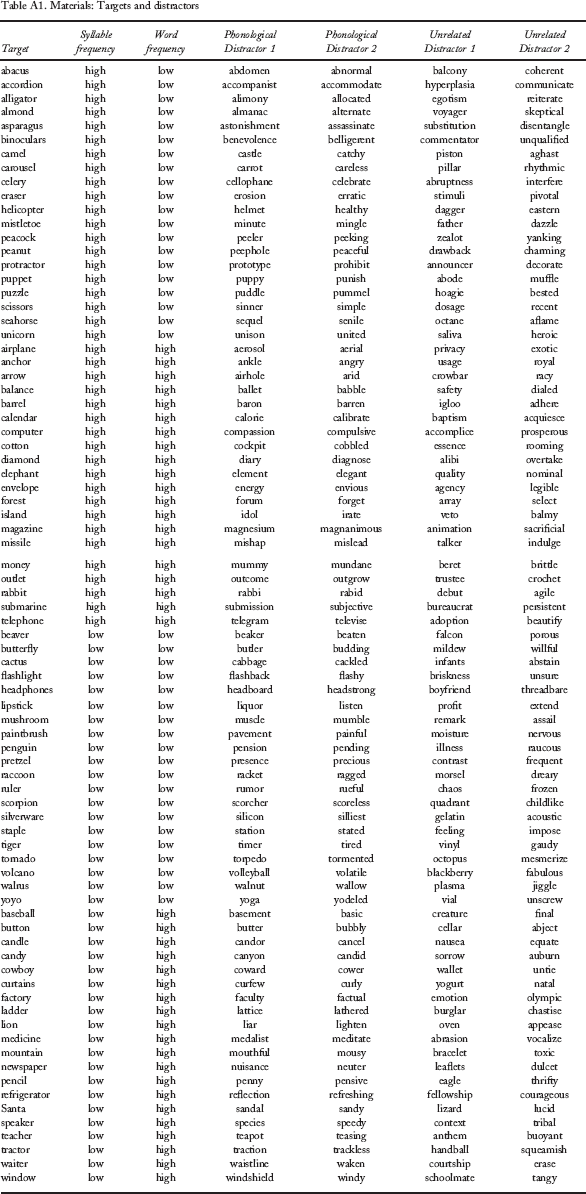
| Target | Syllable frequency | Word frequency | Phonological Distractor 1 | Phonological Distractor 2 | Unrelated Distractor 1 | Unrelated Distractor 2 |
|---|---|---|---|---|---|---|
| abacus | high | low | abdomen | abnormal | balcony | coherent |
| accordion | high | low | accompanist | accommodate | hyperplasia | communicate |
| alligator | high | low | alimony | allocated | egotism | reiterate |
| almond | high | low | almanac | alternate | voyager | skeptical |
| asparagus | high | low | astonishment | assassinate | substitution | disentangle |
| binoculars | high | low | benevolence | belligerent | commentator | unqualified |
| camel | high | low | castle | catchy | piston | aghast |
| carousel | high | low | carrot | careless | pillar | rhythmic |
| celery | high | low | cellophane | celebrate | abruptness | interfere |
| eraser | high | low | erosion | erratic | stimuli | pivotal |
| helicopter | high | low | helmet | healthy | dagger | eastern |
| mistletoe | high | low | minute | mingle | father | dazzle |
| peacock | high | low | peeler | peeking | zealot | yanking |
| peanut | high | low | peephole | peaceful | drawback | charming |
| protractor | high | low | prototype | prohibit | announcer | decorate |
| puppet | high | low | puppy | punish | abode | muffle |
| puzzle | high | low | puddle | pummel | hoagie | bested |
| scissors | high | low | sinner | simple | dosage | recent |
| seahorse | high | low | sequel | senile | octane | aflame |
| unicorn | high | low | unison | united | saliva | heroic |
| airplane | high | high | aerosol | aerial | privacy | exotic |
| anchor | high | high | ankle | angry | usage | royal |
| arrow | high | high | airhole | arid | crowbar | racy |
| balance | high | high | ballet | babble | safety | dialed |
| barrel | high | high | baron | barren | igloo | adhere |
| calendar | high | high | calorie | calibrate | baptism | acquiesce |
| computer | high | high | compassion | compulsive | accomplice | prosperous |
| cotton | high | high | cockpit | cobbled | essence | rooming |
| diamond | high | high | diary | diagnose | alibi | overtake |
| elephant | high | high | element | elegant | quality | nominal |
| envelope | high | high | energy | envious | agency | legible |
| forest | high | high | forum | forget | array | select |
| island | high | high | idol | irate | veto | balmy |
| magazine | high | high | magnesium | magnanimous | animation | sacrificial |
| missile | high | high | mishap | mislead | talker | indulge |
| money | high | high | mummy | mundane | beret | brittle |
| outlet | high | high | outcome | outgrow | trustee | crochet |
| rabbit | high | high | rabbi | rabid | debut | agile |
| submarine | high | high | submission | subjective | bureaucrat | persistent |
| telephone | high | high | telegram | televise | adoption | beautify |
| beaver | low | low | beaker | beaten | falcon | porous |
| butterfly | low | low | butler | budding | mildew | willful |
| cactus | low | low | cabbage | cackled | infants | abstain |
| flashlight | low | low | flashback | flashy | briskness | unsure |
| headphones | low | low | headboard | headstrong | boyfriend | threadbare |
| lipstick | low | low | liquor | listen | profit | extend |
| mushroom | low | low | muscle | mumble | remark | assail |
| paintbrush | low | low | pavement | painful | moisture | nervous |
| penguin | low | low | pension | pending | illness | raucous |
| pretzel | low | low | presence | precious | contrast | frequent |
| raccoon | low | low | racket | ragged | morsel | dreary |
| ruler | low | low | rumor | rueful | chaos | frozen |
| scorpion | low | low | scorcher | scoreless | quadrant | childlike |
| silverware | low | low | silicon | silliest | gelatin | acoustic |
| staple | low | low | station | stated | feeling | impose |
| tiger | low | low | timer | tired | vinyl | gaudy |
| tornado | low | low | torpedo | tormented | octopus | mesmerize |
| volcano | low | low | volleyball | volatile | blackberry | fabulous |
| walrus | low | low | walnut | wallow | plasma | jiggle |
| yoyo | low | low | yoga | yodeled | vial | unscrew |
| baseball | low | high | basement | basic | creature | final |
| button | low | high | butter | bubbly | cellar | abject |
| candle | low | high | candor | cancel | nausea | equate |
| candy | low | high | canyon | candid | sorrow | auburn |
| cowboy | low | high | coward | cower | wallet | untie |
| curtains | low | high | curfew | curly | yogurt | natal |
| factory | low | high | faculty | factual | emotion | olympic |
| ladder | low | high | lattice | lathered | burglar | chastise |
| lion | low | high | liar | lighten | oven | appease |
| medicine | low | high | medalist | meditate | abrasion | vocalize |
| mountain | low | high | mouthful | mousy | bracelet | toxic |
| newspaper | low | high | nuisance | neuter | leaflets | dulcet |
| pencil | low | high | penny | pensive | eagle | thrifty |
| refrigerator | low | high | reflection | refreshing | fellowship | courageous |
| Santa | low | high | sandal | sandy | lizard | lucid |
| speaker | low | high | species | speedy | context | tribal |
| teacher | low | high | teapot | teasing | anthem | buoyant |
| tractor | low | high | traction | trackless | handball | squeamish |
| waiter | low | high | waistline | waken | courtship | erase |
| window | low | high | windshield | windy | schoolmate | tangy |