







Abstract
By age 3, children track a speaker's record of past accuracy and use it as a cue to current reliability. Two experiments (N = 95 children) explored whether preschoolers’ judgements about, and trust in, the accuracy of a previously reliable informant extend to other members of the informant's group. In Experiment 1, both 3- and 4-year-olds consistently judged an animated character who was associated with a previously accurate speaker more likely to be correct than a character associated with a previously inaccurate speaker, despite possessing no information about these characters’ individual records of reliability. They continued to show this preference one week later. Experiment 2 presented 4- and 5-year-olds with a related task using videos of human actors. Both showed preferences for members of previously accurate speakers’ groups on a common measure of epistemic trust. This result suggests that by at least age 4, children's trust in speaker testimony spreads to members of a previously accurate speaker's group.
Even young preschoolers evaluate the quality of information provided by social partners. By the age of three, after listening to testimony from a consistently accurate and a consistently inaccurate speaker, children can identify the actor who was previously accurate (Koenig, Clément, & Harris, 2004). They prefer to learn new words from speakers who claim to be knowledgeable about the words’ referents (Sabbagh & Baldwin, 2001), and by the age of four (sometimes by three) they prefer to learn novel object labels and functions from previously correct informants, rejecting labels from previously incorrect informants (Birch, Vauthier, & Bloom, 2008; Jaswal & Neely, 2006; Koenig et al., 2004; Koenig & Harris, 2005a, 2008; Nurmsoo & Robinson, 2009). Children also continue to prefer a more accurate informant one week later by the age of three, suggesting that their assessments of speaker reliability are used as relatively long-term guides to behaviour (Corriveau & Harris, 2009b).
Trust decisions can be influenced by speakers’ patterns of accuracy in a number of ways. For example, 4-year-olds may flexibly update their assessments of reliability in the face of new information, reversing an initial pattern of trust after a previously reliable speaker becomes unreliable (Scofield & Behrend, 2008). Four-year-olds also track the relative frequency of speaker error, forgiving incorrect responses if the speaker is correct a majority of the time, while 3-year-olds mistrust informants who make even a single error (Pasquini, Corriveau, Koenig, & Harris, 2007).
Factors other than speaker accuracy can also influence children's trust decisions. For example, preschoolers use trait-based information when asked to trust in the testimony of speakers with positive traits versus those with negative traits, preferring to trust honest over dishonest speakers, nice over mean speakers, and smart over not-smart speakers (with some differences in the performance of older vs. younger children; Lane, Wellman, & Gelman, 2013). Children also prefer to trust members of some groups over others: They tend to agree with informants’ claims when they are reinforced by bystanders’ nonverbal cues of assent (Fusaro & Harris, 2008), and they prefer to learn from nondissenting informants over dissenters (Corriveau, Fusaro, & Harris, 2009). They also prefer to trust speakers with native accents over those with foreign accents (Kinzler, Corriveau, & Harris, 2011).
Furthermore, there is a demonstrated interaction between information about an individual's reliability and other information about that speaker. Although children initially prefer to trust familiar over unfamiliar teachers, evidence of unreliability from familiar teachers erodes this trust in 4- and 5-year-olds (Corriveau & Harris, 2009a). Relatedly, 3- and 4-year-old children trust adults over peers unless the adults have proven less reliable (Jaswal & Neely, 2006). Another study placed group-based preferences and individual's histories of accuracy in opposition through the use of a minimal-groups paradigm, which does not involve real-world groups that may have existing significance for participants. Children's ability to display trust in a previously accurate individual (vs. a previously inaccurate one) is disrupted when the inaccurate person is a member of the child's minimal ingroup while the accurate person is an outgroup member (MacDonald, Schug, Chase, & Barth, 2013).
Most recent research on children's trust in others’ testimony has emphasized the selective nature of this trust: the idea that children are tracking and retaining person-specific information in these paradigms (Birch et al., 2008; Koenig & Harris, 2005b). Children's epistemic trust in others is clearly selective in that it is sensitive to the relative accuracy of individual speakers (see Gelman, 2009; Heyman, 2008; Koenig & Harris, 2005b, for recent reviews). But how discriminating is preschoolers’ trust? Do children choose to trust only the individual who has already proven to be a reliable informant, or does an individual's history of accurate testimony lead children to generalize about the reliability of that individual's associates as well? Under some conditions, children exhibit evaluative contagion: the extension of evaluations of an actor to that actor's associates (e.g., Olson, Banaji, Dweck, & Spelke, 2006). For example, children consistently show a preference for members of lucky (or intentionally good) individuals’ groups over members of unlucky (or intentionally bad) individuals’ groups, even when they possess no information about the individual luckiness or unluckiness of those group members (Olson et al., 2006; Olson, Dweck, Dunham, Spelke, & Banaji, 2008). Do children also exhibit credibility contagion? Will they choose to extend their trust in one group member to others?
Here we explore these questions by asking whether young children's explicit judgements of accuracy and bestowals of trust will spread to other members of a previously reliable speaker's group, even if those others have never established themselves individually as reliable informants. As in previous studies investigating children's tracking of speaker reliability, we first used a simple object-labelling scenario to establish that one speaker was consistently accurate, and a second was consistently inaccurate. In a series of familiarization trials, children watched one speaker repeatedly give the correct label for a familiar object and a second repeatedly give an incorrect label. After such familiarization trials, even 3-year-olds can reliably identify the previously accurate speaker (Koenig et al., 2004), and by age four, children prefer to acquire new information (such as novel names for unfamiliar objects) from the previously accurate speaker (e.g., Koenig & Harris, 2005a).
In the present studies, we introduced novel, neutral speakers after the familiarization trials. These speakers were established as members of the same groups as the speakers who demonstrated reliability or unreliability, but they were neutral in the sense that they had not shown any individual evidence of either accuracy or inaccuracy. In the test phase of each of our experiments, these neutral speakers (rather than the original speakers) provided novel labels for unfamiliar objects. In Experiment 1 we used simple animated characters. The original accurate or inaccurate speakers remained visible as the neutral speakers provided their labels, and 3- and 4-year-old children were asked in each test trial to identify the speaker who had labelled the novel object correctly. In Experiment 2, 4- and 5-year-old children viewed videos of human actors in a conventional trust-in-testimony paradigm adapted to assess the extension of trust to group members. This study focused on typical measures of epistemic trust, as well as including explicit judgements of the accuracy of the original (accurate or inaccurate) speakers and of novel group members.
Experiment 1
By age three, children can identify the previously accurate speaker in typical speaker-reliability paradigms (Koenig et al., 2004). Here we asked whether 3- and 4-year-old children would extend explicit judgements of accuracy to members of a previously accurate character's group, even if those group members did not establish themselves individually as reliable informants. We also asked whether children's preferences would remain after a one-week delay.
Method
Forty-five children (N = 22 three-year-olds, mean 42 months, range 36–47 months; N = 23 four-year-olds, mean 53 months, range 48–57 months) were recruited from local preschools and childcare centres. The range of ethnicities and socioeconomic status (SES) was roughly representative of the local region, with approximately 15% of the participants nonwhite. Forty-one children (21 three-year-olds and 20 four-year-olds) also participated in a follow-up session five to seven days later.
Children first viewed four familiarization trials (presented on a laptop computer) to establish one animated character as consistently accurate and a second as consistently inaccurate. Most previous studies investigating children's use of testimony have used video segments involving pairs of human actors. Because we wished to include multiple group members onscreen at once, we used schematic characters on a computer screen as in some previous studies of evaluative contagion (e.g., Olson et al., 2006). Stimulus sequences were created with Keynote software. “Red” characters had elliptical heads and red clothing and appeared on the left; “yellow” characters had triangular heads and yellow clothing and appeared on the right (these categories were never mentioned to the participants). Group membership was therefore marked by clothing colour (Bigler, Brown, & Markell, 2001), screen location (left or right), and head shape. Individuals within groups were differentiated by spatiotemporal location, head aspect ratio, and facial features.
In previous studies of individual speaker reliability, different counterbalancing methods have been employed during this familiarization phase. In some cases, accurate and inaccurate informants’ locations alternate across trials (e.g., Nurmsoo & Robinson, 2009). In other studies, informants’ locations are held constant, and the informant who speaks first is either also held constant (e.g., Birch et al., 2008) or alternated (e.g., Corriveau & Harris, 2009b; Corriveau, Harris, et al., 2009; Fusaro & Harris, 2008; Pasquini et al., 2007). We reasoned that spatial location could be an effective cue for group membership in the present study and therefore chose to keep each group in the same spatial location throughout the study for each child (counterbalancing across, but not within, participants). Therefore, we counterbalanced who spoke first instead.
In each familiarization trial, a familiar object appeared in the centre of the screen. A red character moved onto the left side of the screen, and a yellow character moved onto the right side. Each character provided a familiar label for the familiar object; as each character spoke, its mouth moved visibly to identify it as the speaker. For each child, one character was consistently accurate, and the other was consistently inaccurate (with the accurate speaker's identity counterbalanced across participants). After both speakers had labelled the familiar object, the experimenter asked the child to identify the speaker who had said the correct thing. The original speakers remained on the screen in their original positions throughout, so that spatiotemporal cues would help the child retain the identities of the original speakers (see Figure 1).
Schematic depiction of Experiment 1 procedure. Red group members (with elliptical heads) wore red; yellow group members (with triangular heads) wore yellow. A. Children first observed four familiarization trials to establish one character as consistently accurate and a second character as consistently inaccurate. B. After the four familiarization trials, the two original speakers were joined by two new (nonspeaking) group members to enhance group salience and to emphasize that multiple individuals from each group were present in the scene. C. During five test trials, two additional neutral group members labelled novel objects; children were asked who they thought had said the right thing, with no information about the prior reliability of the two individuals who labelled the novel objects. Six characters total were present during test trials: two original speakers (one who had recently been accurate and one who had recently been inaccurate), two nonspeaking group members, and the two neutral group members who labelled the novel objects. To view this figure in colour, please visit the online version of this Journal.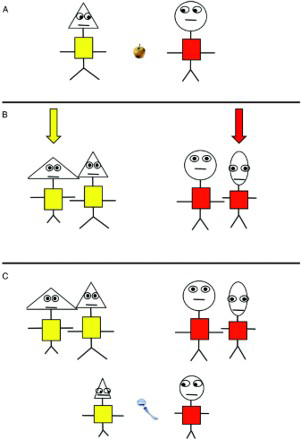
We reasoned that children would be more likely to understand that two distinct groups, not two individuals, were involved if multiple members of each group were presented before the critical test trials began. Therefore each original speaker was joined by another nonspeaking group member to enhance the salience of group membership: A nonspeaking red group member joined the original red speaker on the upper left, and a nonspeaking yellow group member joined the original yellow speaker on the upper right.
Finally, one new neutral speaker joined each group: A new red group member moved onto the lower left side of the screen, a new yellow group member moved onto the lower right, and the experimenter said, “Look—two new characters!”. Thus verbal cues provided additional evidence that the neutral speakers were individuals distinct from the original accurate or inaccurate speakers. These two neutral speakers (one per group) were present in the five test trials that followed, and the original accurate and inaccurate speakers and their corresponding nonspeaking group members remained present on the upper left and upper right throughout (see Figure 1).
For each test trial, an unfamiliar object appeared, and each neutral speaker provided the object with a novel label (e.g., “gling”). Children identified the “correct” speaker by pointing (“Who said the right thing?” 1
There was no objectively right or wrong answer to this question, as the neutral speakers had only labelled novel objects with novel labels.
The follow-up session consisted of five new test trials, with no preceding familiarization trials. Children saw the same six characters from the initial session, appearing in the same positions. New novel objects were given new novel labels by the same neutral characters who had labelled the previous week's novel objects, and children were again asked to identify the correct informant.
Results and discussion
Children correctly identified the accurate speakers during familiarization trials (when one speaker provided a correct familiar label for a familiar object, and the other provided an incorrect label). On test trials, children spontaneously directed responses to the two neutral speakers who provided novel labels (although the other characters also remained on the screen). We therefore used 2.5 responses (50% of the 5 test trial responses) as our chance level.
During the initial test session, both 3- and 4-year-olds chose the new speaker who was a member of the previously accurate speaker's group more frequently (out of five trials) than predicted by chance: 3-year-olds, M = 3.2, SD = 1.54, t(21) = 2.214, p < .05, d = 0.5; 4-year-olds, M = 3.4, SD = 1.78, t(22) = 2.52, p < .05, d = 0.5. The age groups did not differ from each other, t(43) = 0.42, p > .05.
An analysis of variance (ANOVA) with between-subjects factor age and within-subjects factor session was conducted on the responses of children who completed the initial session and the follow-up (N = 41), with number of times out of five that the child chose the new speaker who was a member of the previously accurate speaker's group as the dependent measure. There was no main effect of age, F(1, 39) = 0.05, p > .05, showing that 3- and 4-year-olds’ responses did not differ, and no main effect of session, F(1, 39) = 0.01, p > .05, showing that responses did not differ from the initial session to the follow-up. Overall, children chose the new speaker who was a member of the reliable character's group more often than predicted by chance: M = 6.7 (out of 10 total test trials), SD = 3.0, t(40) = 3.49, p < .005, d = 0.5.
These findings show that children judged a member of a previously accurate speaker's group more likely to be correct than a member of a previously inaccurate speaker's group, despite possessing no information about that individual group member's reliability. Both 3- and 4-year-olds did so, consistent with earlier findings when children were asked to choose between a previously accurate and a previously inaccurate informant with no additional group members present (Koenig et al., 2004). Preferences remained one week later: These evaluations of group members’ reliability are apparently used as long-term guides to behaviour (consistent with the findings of Corriveau & Harris, 2009b).
In Experiment 1, children were explicitly asked on every test trial about the neutral characters’ accuracy. They were more likely to identify members of the previously accurate group as correct in this type of explicit judgement task. Experiment 1, however, did not address common questions about children's epistemic trust: Would children demonstrate a preference to ask novel members of accurate speakers’ groups for information, or preferentially accept the labels they provide for novel objects? Experiment 2 therefore used a test of children's extension of trust to neutral group members. In Experiment 1, furthermore, the speakers were all animated characters, and group membership was determined only by relatively surface-level characteristics, so their results may not be informative about children's tendency to extend trust in the context of more meaningful groups, or to extend trust to humans. It is also possible that children considered the characters to be different kinds of creatures rather than different groups of individuals. Thus Experiment 2 used videos of human actors.
Experiment 2
Experiment 2 presented 4- and 5-year-olds with an adapted version of a standard selective trust paradigm using video clips of human actors. Groups were defined in terms of both a surface characteristic (clothing colour) and a deeper property (a personal preference). Young children have been shown to use existing social categories to draw inferences about the psychological characteristics of novel individuals (e.g., Diesendruck & haLevi, 2006), so it is possible that this manner of defining groups would best support the extension of trust to novel speakers. An accurate and an inaccurate speaker, each belonging to a different group, were established during a familiarization phase. This initial pair was replaced by a novel pair of human speakers, belonging to the same groups, during the test phase (with no extra group members involved).
Method
Fifty children (25 four-year-olds, mean 55 months, range 49–59 months; 25 five-year-olds, mean 63 months, range 60–70 months) participated.
To establish the presence of two groups, children were initially introduced to two pictures. One picture depicted three female actors in blue t-shirts, and the other depicted three female actors in red t-shirts; the experimenter never explicitly mentioned t-shirt colours to participants. The experimenter showed children the first picture and said, “Here are some of my friends, and they really like to play a game called zigo”. Next, the experimenter showed the second picture and said, “Here are some of my friends and they really like to play a game called zaber” (Diesendruck & haLevi, 2006; Heyman & Gelman, 2000). The picture seen first was counterbalanced across participants.
The epistemic trust procedure (adapted from Pasquini et al., 2007) then began. As in Experiment 1, children saw a set of familiarization trials in which speakers named familiar objects with familiar words, followed by a set of test trials in which new actors named novel objects with novel labels. Children were also asked to explicitly judge the accuracy of the informants after both the familiarization and the test trials. Children's willingness to extend trust to group members was assessed during test trials in two ways: through “ask” trials in which children indicated the actor from whom they preferred to receive information, and “endorse” trials in which they endorsed one of the speaker's novel labels.
First, four familiarization trials established one speaker as more reliable. A stationary image of two women seated on either side of a wooden table, one in a red t-shirt and one in a blue t-shirt, appeared on the screen. Then, a stationary image of a familiar object (e.g., a cup) appeared. Each actor then provided a label for the object as it sat on the table between them. The experimenter repeated the labels provided in the order they were spoken—for example, “She called it a cup” (pointing to the first actor); “she called it a duck” (pointing to the second actor). The child was asked what they thought the object was called.
This procedure was repeated for all four familiarization trials (with different familiar objects). One actor always provided the correct label for the object, and one actor always provided the incorrect label, such that either the actor in the blue t-shirt or the actor in the red t-shirt was established as the reliable speaker. The reliable actor was counterbalanced across participants. The actor on the left was the same for all four familiarization trials within participants and was counterbalanced across participants. The actor who spoke first was alternated across the four familiarization trials.
After viewing the familiarization videos, children were asked a set of three explicit judgement (EJ) questions about the original actors:
Was she good at naming the things or not good at naming the things? (pointing to the left-side actor). Was she good at naming the things or not good at naming the things? (pointing to the right-side actor). Who was better at naming the things—her (pointing to left-side actor) or her? (pointing to right-side actor).
Children then viewed four test videos designed to assess whether knowledge of the relative reliability of the original speaker would generalize to new members of their groups. In the test videos, two different women (new actors), one in a blue t-shirt and one in a red t-shirt, were seated on either side of the table. The location of the actor in the blue shirt (left vs. right) matched the blue-shirted actor's location from the familiarization trials. In each of these trials, a novel object (e.g., a part from a sewing machine) was placed on the table.
A stationary image of the two new actors was shown, and the experimenter said, “Oh look! Here are some of my friends, and we're going to play a game with them, too!” The child then viewed a stationary image of the novel object. The experimenter asked whether the child knew what the novel object was called. If the child did not provide a label, the experimenter said, “That's okay. I bet one of these people knows what it is called”. If the child provided a label, the experimenter said, “Actually, I don't think that's what it's called. But I bet one of these people knows what it is called”. Children were then asked to indicate which actor they wanted to ask for information about the novel object (“ask” trial). Then the child watched each actor provide a novel label (e.g., wug) for the object. The experimenter repeated the labels in the order they were spoken and asked the child to endorse one label: “She called it a ___ (pointing to first actor). She called it a ___ (pointing to second actor). What do you think it is called?” (“endorse” trial). The actor who spoke first (blue vs. red) was counterbalanced across videos. Finally, the children were asked the same explicit judgement questions about the new actors in the test videos.
All videos were shown on a laptop. Actors were college students of European descent, matched for appearance such that both actors in a video were similar in age, gender, hair colour, and ethnicity. Actors maintained a neutral facial expression and tone of voice.
Results and discussion
The main finding from this study was that both 4- and 5-year-olds extended trust to novel members of the previously accurate speakers’ groups. We first combined each child's responses to the ask and endorse questions to obtain an overall trust score (out of 8 responses total). Both 4- and 5-year-olds extended trust to novel members of previously accurate speakers’ groups more often than would be predicted by chance: 4-year-olds, M = 4.92, SD = 1.96, t(24) = 2.35, p < .03; 5-year-olds, M = 5.04, SD = 1.79, t(24) = 2.90, p < .008. These scores did not differ across age groups, t(48) = 0.23, p > .05.
Four-year-olds selectively endorsed novel labels provided by the member of the previously accurate group [endorse trials, out of 4: M = 2.56, SD = 1.29, t(24) = 2.16, p < .05] and showed a trend toward preferring to direct questions to that speaker [ask trials, out of 4: M = 2.36, SD = 1.04, t(24) = 1.74, p < .10]. Five-year-olds showed the opposite pattern [ask trials: M = 2.6, SD = 0.87, t(24) = 3.46, p < .002; endorse trials: M = 2.44, SD = 1.19, t(24) = 1.84, p < .08]. Responses to ask and endorse trials were not significantly different across age groups, t(48) = 0.89, p > .05; t(48) = –0.35, p > .05, respectively.
All but three of the 4-year-olds and all but two of the 5-year-olds answered the first set of EJ questions correctly (these questions referred to the original accurate/inaccurate speakers who used familiar words as labels). The second set of EJ questions, administered after the test trials, referred instead to the new group members who provided novel nonword labels. For this second set of EJ questions, we assessed whether the child responded as though the member of the previously accurate speaker's group was good at naming the things. Two 4-year-olds did not complete these three questions (responding “I don't know”); the rest of the 4-year-olds taken together did not prefer the member of the previously accurate speaker's group more often than chance, M = 1.88, SD = 1.19, t(23) = 1.54, p = .136. The 5-year-olds showed a nonsignificant trend toward preferring the member of the previously accurate speaker's group, M = 2.04, SD = 1.37, t(23) = 1.94, p < .07.
Overall, Experiment 2 showed that children do extend trust to novel members of previously accurate human speakers’ social groups, at least under the tested conditions. We discuss these and the previous findings further below.
General Discussion
A large body of work has established that young children selectively extend trust in testimony to individual actors who have previously shown themselves to be reliable informants. Here, two experiments investigated the possibility that preschool children's trust in speaker testimony, and their judgements of speaker accuracy, might spread to members of a previously accurate speaker's group who have never established themselves individually as reliable informants. Taken together, our findings suggest that preschoolers’ trust in testimony and, under some conditions, their explicit assessments of accuracy can generalize to novel individuals associated with accurate informants.
Experiment 1 provided evidence that children generalize explicit assessments of the accuracy of an individual speaker to other members of the same group. In this case, all speakers were schematic animated characters. During test trials, novel neutral group members (who had been neither accurate nor inaccurate) joined the original accurate or inaccurate speakers on the computer screen and provided novel labels for unfamiliar objects. Three- and 4-year-old children preferentially identified the novel associates of the original accurate speakers as the accurate labellers of the novel objects, both immediately and one week later. Experiment 2 demonstrated that children extend trust to a reliable speaker's ingroup members in a different experimental paradigm. For this experiment, speakers were human actors in a video rather than schematic characters; 4- and 5-year-old children were asked to give explicit judgements of accuracy along with responses to two common measures of epistemic trust. Four-year-olds did not show evidence of extending their judgements of accuracy to the novel speakers, but 5-year-olds showed a trend toward doing so. Children in both age groups extended epistemic trust to novel, neutral members of previously accurate speakers’ groups. We use the term credibility contagion to refer to this extension of trust to novel group members.
What factors might have led the 4- and 5-year-olds in Experiment 2 to extend trust to novel speakers who had never established themselves individually as reliable informants? It may be that the design of Experiment 2 provided particularly strong support for findings of credibility contagion. Children were asked to explicitly compare the speakers who labelled familiar objects before watching the neutral speakers label novel objects, and it is possible that generalizing trust to neutral speakers was facilitated by prompting children to first compare the relative reliability of the original speakers. This idea is appealing given the finding that 4-year-olds demonstrate selective trust after just a single demonstration of reliability if they are first asked to explicitly judge the relative reliability of the informants (Fitneva & Dunfield, 2010). It is also likely that use of verbal labels and meaningful preferences to establish group membership provided support. When young children use verbal labels to make inferences about novel individuals, they are more likely to attend to social group membership when individuals are labelled as part of a social group than if they simply share similar physical traits. They are also more likely to extend individuals’ properties to group members in the presence of verbal cues (Diesendruck & haLevi, 2006; Dunham, Baron, & Carey, 2011; Waxman, 2010).
Why didn't the children of Experiment 2 prefer the members of the previously accurate speaker's group when asked for explicit judgements about “who was better” at answering the questions? In particular, what is the explanation for this finding given that the younger children of Experiment 1 did provide explicit judgements that identified the associates of the reliable speakers as “saying the right thing”? It is important to note some differences in what was asked of children across the two studies. In Experiment 1, the explicit question was the focus of the game, and it was asked on every trial directly after the events in question. But in Experiment 2, the relevant EJ questions came at the very end of the study, following a series of test trials asking different types of questions. In addition, in Experiment 2 the first set of EJ questions came directly after the familiarization trials, in which speakers labelled familiar objects with familiar labels either correctly or incorrectly. Children were successful at that first set of EJ questions, identifying the accurate speaker as being good at answering questions. Here we were primarily concerned with the second set of EJ questions, which referred to the novel speakers who gave novel labels to unfamiliar objects, and there was no significant pattern of favouring the novel speaker of the previously accurate speaker's group in this second set. It is possible that children were confused by the juxtaposition of these two very different types of presentations (a first set of EJ questions with relatively easy and clear answers; a second set of EJ questions that probably seemed much more difficult in comparison). This might explain why children in Experiment 2 favoured the previously accurate speaker's group member during the trust questions (which had no easier/simpler precursors) but not during the EJ questions.
The present findings of credibility contagion fit well with an emerging picture of children's epistemic trust in which children appear to assess, and act on, others’ reliability by reasoning about the mental states and/or traits that led them to produce accurate or inaccurate responses (Birch et al., 2008; Koenig & Harris, 2005a, 2008; Lane et al., 2013; but see Lucas & Lewis, 2010; Nurmsoo & Robinson, 2009). On this view, children may be creating “cognitive profiles” of the informants (Harris, 2007), not just responding to the outputs of individual speakers without making use of traits or knowledge states. Though prior accuracy is not itself a quality that should generalize to a speaker's associates, experience of a particular speaker's accuracy may lead them to create such a profile, which may in turn comprise various qualities that are then readily generalized to new, neutral group members.
What drove children's trust of novel individuals in Experiment 2? There are at least two kinds of answers to this question that remain unexplored by the present study. First, did children extend a positive or a negative attribute to novel individuals? Did they suppose that members of accurate speakers’ groups were more likely to be accurate, that members of inaccurate speakers’ groups were more likely to be inaccurate, or both? The current data cannot answer this question, but future work could do so by incorporating neutral individuals pitted against group members. Another question concerns the specificity of what children extended to the novel individuals: Did they suppose anything at all about the novel speakers’ accuracy, or did some more global, general positivity (or negativity) adhere to the group members? Although the present data cannot provide an answer for the study described here, previous work investigating quite different questions may be relevant. In one study, 5-year-olds, but not 4-year-olds, thought that a history of accurate labelling indicated broad knowledge and other positive characteristics (a “halo effect” resulting from past accuracy; Brosseau-Liard & Birch, 2010; cf. Fusaro, Corriveau, & Harris, 2011). Therefore perhaps novel members of the accurate speakers’ groups benefited from such a general positivity. Recent work on traits and trust, on the other hand, provides evidence of specificity in children's trait-based preferences: Though children preferred to trust informants with a variety of positive traits, children's affiliation choices showed that these preferences did not arise from a general positive characterization. For example, 3-year-olds wanted to learn from a smart informant, but to be friends with an informant who was not smart (Lane et al., 2013). Further work on children's extension of trust to novel group members will determine whether the associates of previously reliable speakers benefit from global positive attributions or whether they receive more specific attributions.
In previous work, one broad class of studies on children's evaluation of testimony has focused on the use of cues that rely on direct evidence about the specific speaker being evaluated (such as evidence of the individual speaker's prior reliability or familiarity, or the speaker's confidence). Another class of studies has focused on the use of cues that do not rely on direct evidence about the speaker being evaluated: cues that allow children to evaluate new speakers without direct experience with those speakers, such as possession of a native accent or adult status. Findings from this second class of studies clearly show that children can evaluate testimony without direct evidence about a particular speaker's reliability—an advantageous ability, as speaker-specific evidence may not always be available before a decision must be made to trust or distrust. These studies leave open the question of whether past experience with individual group members influences the extension of trust to novel speakers from real-world social groups. Do children come to prefer native-accented speakers because they have interacted with reliable speakers with native accents in the past? Or does children's behaviour in these selective trust paradigms reflect a general preference for speakers who sound like them? The present data show that experience with individual group members can matter in some contexts: Experience can influence evaluations of and trust in novel group members. This finding ties in well with recent evidence that although children may initially prefer familiar speakers, they may also update these preferences based on new evidence about the accuracy of the familiar/unfamiliar speakers (Corriveau & Harris, 2009a).
The nature of children's extensions of trust to novel individuals may have broad social implications. Children's trust is clearly influenced by informants’ status as members of real-world social groups (e.g., Corriveau & Harris, 2009a; Corriveau, Fusaru, et al., 2009; Jaswal & Neely, 2006; Kinzler et al., 2011). The present study extends these findings by showing that young children's assessments of accuracy and bestowals of trust can spread to members of a previously reliable speaker's group, even though these other group members have not individually demonstrated reliability. This is so even when the groups in question have no social significance; children apparently may use rather minimal and value-neutral group information when deciding whether to trust novel individuals. In real-world circumstances, of course, many overlapping memberships in social groups complicate the picture of how children may use group status when deciding how to treat new testimony from others. The present work shows, however, that even in the absence of group associations with strong social significance, the perceived trustworthiness of individuals with no personal history of accuracy may benefit (or potentially suffer) from associations with others who have been right or wrong in the past.
Footnotes
Acknowledgements
The authors thank the participating parents, children, and preschools who made this work possible; Anima Acheampong, Jessica Sullivan, and Adam Tinkle for assistance with stimulus preparation and data collection; and Jessica Taggart for editorial assistance. Experiment 1 was conducted by Keera Bhandari in partial completion of the requirements for the MA degree in psychology, with support from the Wesleyan University McNair Program.