







Abstract
In opaque orthographies, the activation of orthographic and phonological codes follows distinct time courses during visual word recognition. However, it is unclear how orthography and phonology are accessed in more transparent orthographies. Therefore, we conducted time course analyses of masked priming effects in the transparent Dutch orthography. The first study used targets with small phonological differences between phonological and orthographic primes, which are typical in transparent orthographies. Results showed consistent orthographic priming effects, yet phonological priming effects were absent. The second study explicitly manipulated the strength of the phonological difference and revealed that both orthographic and phonological priming effects became identifiable when phonological differences were strong enough. This suggests that, similar to opaque orthographies, strong phonological differences are a prerequisite to separate orthographic and phonological priming effects in transparent orthographies. Orthographic and phonological priming appeared to follow distinct time courses, with orthographic codes being quickly translated into phonological codes and phonology dominating the remainder of the lexical access phase.
Keywords
Although it is now well established that both orthography and phonology play a crucial role in visual word recognition, the interrelationship and time course of orthographic and phonological processes are still subject to debate. Key questions are whether they operate independently from each other, whether they are performed sequentially or in parallel, and whether they are automatic or strategic (Braun, Hutzler, Ziegler, Dambacher, & Jacobs, 2009; Rastle, 2007). In order to answer these questions, research has focused on the earliest stages of the reading process in which orthography and phonology are accessed (Ziegler, Grainger, & Brysbaert, 2010). Since this access stage evolves highly rapidly and seemingly effortlessly in skilled readers, a paradigm is required that allows for the assessment of very fast processes. The masked priming technique (Kinoshita & Lupker, 2003) meets this requirement. In particular, time course analysis of masked priming effects has proven to be highly informative. With this technique, Ferrand and Grainger (1992, 1993, 1994) showed that, in French proficient readers, orthographic and phonological code activation follow distinct time courses, where activation of orthographic codes precedes activation of phonological codes.
Orthographies around the world show remarkable differences with respect to the consistency between the speech sounds in oral language and the written forms that represent these speech sounds in print (Protopapas & Vlahou, 2009). Therefore, the question arises whether theories and models on word recognition that apply in one language can explain phenomena in another language as well (e.g., Bick, Goelman, & Frost, 2011; Durgunoğlu & Öney, 1999; Goswami, Gombert, & Fraca de Barrera, 1998; Ziegler, Perry, & Coltheart, 2000; Ziegler, Perry, Jacobs, & Braun, 2001). For example, time course analyses of masked priming effects have repeatedly been conducted in French (Ferrand & Grainger, 1992, 1993). However, French has a semiopaque orthography, with inconsistent relations between orthography and phonology. It is unclear whether the activation of orthographic and phonological codes follow similar time courses in more transparent orthographies, with consistent letter–speech sound relations. Therefore, the aim of the current study is to examine the time courses of orthographic and phonological code activation in a transparent orthography such as Dutch.
Orthographic consistency effects on lexical access
In relatively transparent orthographies, such as Italian, Finnish, German, and Dutch, orthographic consistency is large, which entails that across words, a certain letter is generally pronounced identically. Conversely, in more opaque orthographies such as English, Danish, and French, a similar letter can be pronounced differently (e.g., the o in rock, no, down, love, lose, cough). It is now well known that this (in)consistency influences the rate of reading development (Seymour, Aro, & Erskine, 2003). However, less is known about the effects of orthographic (in)consistency on the processes that underlie visual word recognition. The orthographic depth hypothesis (Frost, 2005; Katz & Feldman, 1983; Katz & Frost, 1992) proposes that orthographic consistency influences the processing style adopted in reading. It suggests that in transparent orthographies the consistent letter–sound relations encourage a phonological encoding style, where letters and small letter clusters are translated to their corresponding phonological units, and the word's meaning is derived from the assembled whole word phonological representation. In opaque orthographies on the other hand, the unreliable letter–sound relations render phonological encoding susceptible to errors. Consequently, lexical access relies more strongly on orthographic structure, with access to the whole word's phonology and corresponding meaning directly addressed on the basis of larger orthographical units.
Interestingly, the orthographic depth hypothesis postulates that orthographic consistency already exerts an effect during the earliest stage of the word recognition process. During this lexical access stage, the encoded visual word stimulus makes the first contact with the lexical information stored in the lexicon. In order to allow a rapid initial search through the lexicon, lexical access is based on an access representation that constitutes a simplification of the comprehensive representation in the lexicon, yet addresses the relevant lexical information of this representation as unequivocally as possible. In opaque orthographies, the inconsistent relations between graphemes and phonemes preclude quick phonological computation and result in an access representation that is underspecified or “impoverished” with respect to phonology. More detailed phonological recoding occurs later in the word recognition process in opaque orthographies. However, in more transparent orthographies, phonology can be assembled quickly and thus allows lexical access to be based on a relatively detailed phonological representation (Frost, 1998, 2005). Therefore, on the basis of the orthographic depth hypothesis, phonological influences are expected to affect the word recognition process earlier in transparent than in opaque orthographies. In the current study we investigate this premise of the orthographic depth hypothesis.
Time course analyses of masked priming effects
Masked priming is a technique that is highly suitable to study early stages of the word recognition process (Forster & Davis, 1984). During the last decades, masked priming has offered valuable insights with respect to lexical access codes (Perea & Lupker, 2003) and the contributions of different component processes, most prominently phonology, orthography, and morphology (Frost, Forster, & Deutsch, 1997; Johnston & Castles, 2003). The technique has also been used successfully to study the development of word recognition (Castles, Davis, Cavalot, & Forster, 2007) and the acquisition of a second language or script (Brysbaert, 2003; Dimitropoulou, Duñabeitia, & Carreiras, 2011a). Masked priming involves the presentation of a target word, which is preceded by a briefly presented and masked prime word. Numerous studies established that recognition of the target word can be facilitated if the prime shares characteristics with the target (see Kinoshita & Lupker, 2003). It is generally assumed that the overlapping features between prime and target allow the word recognition process to start at perception of the prime, thus resulting in a time advantage at the moment the target is perceived (Forster, Mohan, & Hector, 2003). Through manipulation of the type and degree of overlap between prime and target, it is possible to examine which component processes are involved in the word recognition process. The masked priming paradigm offers two particular advantages. First, since primes can be presented very briefly, their effects provide insight in the earliest stages of word processing. Second, the brief presentation duration prevents fully conscious processing of the prime and thereby limits strategic effects (Forster et al., 2003).
In time course analyses of masked priming effects, the exposure duration of primes is manipulated in order to examine when orthographic and phonological information becomes available during visual word recognition. Time course analyses of masked priming effects were first conducted in a series of lexical decision tasks (Ferrand & Grainger, 1992, 1993; for a slightly different paradigm, Ferrand & Grainger, 1994), in which target words were preceded by three nonword primes: (a) a phonological prime, which was pronounced identically, yet spelled slightly differently from the target (a so-called pseudohomophone, e.g., lont–LONG), (b) an orthographic prime, which shared the same degree of orthographic overlap with the target as the phonological prime, but was not a pseudohomophone (e.g., lonc–LONG), and (c) a control prime, which shared neither orthography nor phonology with the target (e.g., tabe–LONG). Faster recognition of a target that was preceded by an orthographic prime in comparison to a control prime was referred to as orthographic priming and indicated that the orthographic overlap between prime and target had facilitated target recognition. Phonological priming was defined as the difference in recognition rate in the phonological as compared to the orthographic prime condition. Since both orthographic and phonological primes share the same degree of orthographic overlap with the target, any additional facilitation by the phonological prime should result from shared phonology.
Ferrand and Grainger (1992, 1993) showed that, in French, both orthographic and phonological priming effects resembled a reversed-U-shaped time course pattern, yet emerged at different stages of the word recognition process. The facilitative effect of orthographic primes appeared between 17 and 50 ms and declined rapidly after 67 ms, whereas phonological priming started to emerge between 50 and 67 ms and continued to exert a facilitative effect at priming durations as long as 100 ms. This indicates that, in French, orthographic processing and phonological processing follow distinct time courses, with orthographic activation preceding phonological activation.
At this point it should be noted that orthographic primes share not only orthographic but also some degree of phonological overlap with the target (e.g., “lonc” shares three phonemes with “LONG”). Consequently, phonological influences may affect priming effects that are assumed to be purely orthographic in nature (Ferrand & Grainger, 1994). However, researchers have employed the opaqueness of the French orthography to orthogonally manipulate orthographic and phonological overlap (Ferrand & Grainger, 1994). This approach showed time courses largely similar to those found in the original design. The above mentioned studies were all conducted in French, a semiopaque orthography. Studies in the highly opaque English (Grainger, Kiyonaga, & Holcomb, 2006) and logographic Chinese (Perfetti & Tan, 1998) orthographies report similarly patterned time courses. However, time courses in transparent orthographies have been less well delineated.
Masked priming effects in transparent orthographies
The few studies that did involve transparent orthographies suggest that although orthographic priming effects are quite robust, phonological priming effects can only be observed if specific requirements are met. Two studies in the transparent Dutch orthography found orthographic priming, but no phonological priming, in a backward masked priming paradigm and in a forward masked priming paradigm with a prime exposure duration of 29 ms (Brysbaert, 2001, Experiment 1; Brysbaert & Praet, 1992). In contrast, both orthographic and phonological priming effects could be established in a forward masked priming paradigm with a prime exposure duration of 43 ms (Brysbaert, 2001, Experiments 2 and 3). Orthographic and phonological time courses mimicked those in a more opaque orthography, with the activation of phonological codes lagging behind the activation of orthographic codes. However, both studies adopted a perceptual identification task, which has been argued to be sensitive to strategic control (Perry & Ziegler, 2002), and therefore it is difficult to compare these results to the lexical decision results of Ferrand and Grainger (1992, 1993, 1994). In addition, since only two prime exposure durations were used, time course analyses could not be done, which impeded insight in the build-up of phonological and orthographical codes over time.
To our knowledge, the only study that adopted time course analyses of masked priming effects in a transparent orthography was conducted by Carreiras, Perea, Vergara, and Pollatsek (2009). These authors compared their event-related potential (ERP) measures in Spanish with an ERP-study in English (Grainger et al., 2006), and they concluded that in both orthographies, orthographic and phonological code activation show distinct time courses, with orthography being activated slightly before phonology. However, in contrast to expectations based on the orthographic depth hypothesis, phonological priming effects emerged later in the transparent Spanish orthography than in the opaque English orthography. However, interpretation of these findings is complicated by the fact that ERP findings were not corroborated by behavioural results, either because the task at hand did not involve behavioural responses (Grainger et al., 2006), or because the behavioural results did not reveal priming effects (Carreiras et al., 2009). In addition, important differences in task design impede straightforward comparisons between the two studies. Most notably, Grainger et al. (2006) used a semantic categorization task with both a forward and backward mask, and their stimuli contained large variations in the degree and place of overlap between prime and target words. Carreiras et al. (2009), on the other hand, used a lexical decision task with a forward mask only, and their manipulation always involved the same letter (always the “c”) at the initial position in a word. Possibly, the restricted range of manipulations rendered the behavioural results insignificant (see Frost, Ahissar, Gotesman, & Tayeb, 2003, p. 350, for a similar argument).
In sum, current evidence about the time courses of orthographic and phonological priming effects in transparent orthographies is still inconclusive. Therefore, in Experiment 1 we aimed to obtain more decisive data regarding time courses of orthographic and phonological code activation in transparent orthographies. To this end, we used a lexical decision paradigm similar to that of Ferrand and Grainger (1992, 1993), we carefully selected stimuli to assure variety in degree and place of overlap between prime and target words, and we systematically varied prime duration.
Experiment 1
Method
Participants
Of the 114 participants, 105 undergraduate and graduate students (63.8% female, mean age 20.62 years; SD = 2.80) met the inclusion criteria of being a native Dutch speaker with normal or corrected-to-normal vision, absence of any form of neurological disability, and an average or above-average (≥Z − 1) level of word recognition ability as measured with the one minute test of reading (Brus & Voeten, 1979) and the Klepel pseudoword reading test (Van den Bos, Lutje Spelberg, Scheepstra, & De Vries, 1994). One participant only took part in two conditions (33 ms and 50 ms) due to technical defects. Participants received either course credit or monetary reward for participation.
Materials and design
The target stimuli were 90 words with lengths of 4, 5, or 6 letters. The targets were selected so as to allow for the generation of three types of pronounceable nonword primes: (a) a phonological prime, which was a pseudohomophone of the target [e.g., the prime vrient, pronounced as /vrint/, for the target VRIEND (friend), also pronounced as /vrint/]; (b) an orthographic prime with the same number of shared letters with the target as the phonological prime, but not homophonic [e.g., vrienk (/vrink/)–VRIEND (/vrint/)]; and (c) a control prime that had no letters in common with the target [e.g., claumf (/klɔumf/)–VRIEND (/vrint/)]. The three primes related to a particular target were matched in number of letters, phonemes, and syllables. In addition, the three primes did not differ in number of orthographic neighbours. For the purpose of the lexical decision task, 90 additional nonwords were generated to serve as foil targets. Each foil target was created by changing one or two letters of a word target. Consonants were replaced by consonants and vowels by vowels [e.g., SPIEND (/spint/)–spient (/spint/)–spienk (/spink/)–draalm (/draləm/)]. Due to this procedure, target words and foil nonwords were matched in number of letters, phonemes, syllables, and consonant–vowel structure. The foil nonwords did not differ significantly from the words in mean bigram frequency, number of neighbours, and frequency of the highest frequent neighbour. In a similar way as that described for the target words, for each target foil three different nonword primes were generated: a phonological prime, an orthographic prime, and a control prime. All stimuli were selected with use of the WordGen application (Duyck, Desmet, Verbeke, & Brysbaert, 2004) for the CELEX database (Baayen, Piepenbrock, & Van Rijn, 1993). An overview of the stimulus set is provided in Supplemental Table A1, and an overview of the lexical characteristics of the stimulus set can be found in Supplemental Table B1 (appendices available as supplementary materials to the online version of this manuscript). Three different experimental lists were created using these stimuli. Each of the 90 target words (and similarly each of the 90 target foils) was presented in all three lists, but was associated with a different prime type in every list. This ensured that each target word was presented once in each list, and that across lists, each target appeared in each priming condition. For example, the target VRIEND was primed with the phonological prime vrient in List 1, with the orthographic prime vrienk in List 2 and with the control prime claumf in List 3. The three lists did not differ with respect to mean bigram frequency, number of neighbours, and frequency of the highest frequent neighbour, neither for the primes of the word targets nor for the primes of the foil targets. Priming conditions were rotated semirandomly across lists, ensuring that each list contained an equal number of phonological, orthographic, and control primes (30 items from each priming category). For each list, the 90 words and 90 nonwords were randomly divided into six subsets of 15 words and 15 nonwords. The content and ordering of subsets were held constant across lists. Each nonword was presented in a different subset from the word it was derived from so that no subset contained both a word and its derivate nonword. Within every subset, words and nonwords had equal numbers of items from each word-length category, and items were presented in randomized order.
Four different prime exposure durations were used: 33, 50, 67, and 83 ms. We selected identical exposure durations to those of Ferrand and Grainger (1993) to enhance comparison of phonological priming effects in the transparent Dutch and the opaque French orthography. Each participant was presented with all four exposure duration conditions in randomized order and received the same experimental list with 180 target stimuli in all four exposure durations, yielding a total of 720 items.
Procedure
The primed lexical decision task was programmed in Presentation and was presented using one of six identical 15-inch Acer Travelmate 4150 laptops. Stimuli appeared on the screen in a 16-point Courier font, in black letters against a white background. Letters were 4 mm in length and were presented in upper case. Participants were seated at a viewing distance of 40–60 cm. The task started with 10 practice trials, divided into two blocks. During these practice blocks a well-trained test assistant could check understanding and repeat instructions if necessary. The practice trials included both 10 word targets and 10 nonword targets that were not included in the experiment.
Every trial consisted of the following sequence of stimuli: (a) a forward mask consisting of a row of six hash marks (800 ms), (b) the prime, presented in lower-case letters for one of the four prime exposure durations (33, 50, 67, or 83 ms), and (c) the target, presented in upper-case letters. All stimuli were presented in the same location of the computer screen. The target remained on the screen until the participant responded, with a maximum response duration of 10 seconds. Participants were instructed to respond as quickly and accurately as possible. They responded by pressing one of two preallocated green and red coloured buttons on the keyboard. The colours were counterbalanced in order to compensate for possible handedness effects or colour associations. Participants received no feedback on the accuracy of their responses.
The primed lexical decision task was preceded by a short word recognition task, which aimed to familiarize the participants with the target stimuli in order to reduce learning effects in response to the repeated presentation of the target stimuli during the lexical decision task. In this recognition task, all 180 target stimuli of the lexical decision task (both words and nonwords) were presented in 20 blocks of nine items. All target stimuli were presented in black letters on a white background, with 800-ms presentation duration and a font, size, and placement similar to those in the primed lexical decision task. Stimuli were divided across blocks in semirandomized order, with each block including either four words and five nonwords, or five words and four nonwords. The order of stimulus presentation in the recognition task was unrelated to the presentation order in the primed lexical decision task. After each block, one (pseudo)word was presented in red letters, and the task of the participants was to decide whether this (pseudo)word had been presented amongst the nine preceding stimuli or not. Participants were encouraged to respond as accurately as possible and did not receive feedback on their response accuracy.
Results
Data cleaning
We included only targets that were familiar to all participants. Targets with a mean accuracy below .8 were excluded from further analyses. This led to the exclusion of three targets. 1
These targets were the word target “lijn” meaning “line”, and nonword targets “zwacht” en “belijk”.
Median target word recognition latencies and error percentages as a function of prime type and prime exposure duration in Experiment 1
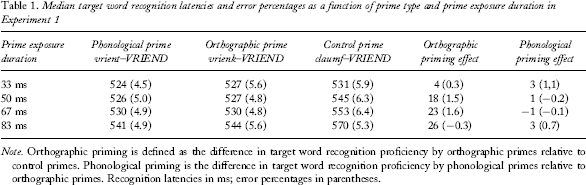
Note. Orthographic priming is defined as the difference in target word recognition proficiency by orthographic primes relative to control primes. Phonological priming is the difference in target word recognition proficiency by phonological primes relative to orthographic primes. Recognition latencies in ms; error percentages in parentheses.
Orthographic and phonological priming effects
Median target word recognition latencies for the different prime type and exposure duration conditions are presented in Table 1. The data were analysed with subject- and item-level repeated measures analyses of variance (ANOVAs) on median response latencies in which prime type and prime exposure duration were the main within factors, and list (Lists 1, 2, and 3) was the between factor. List was included as a dummy variable to extract variance due to the counterbalancing lists of the analyses (Pollatsek & Well, 1995). Results are reported for the subject-level (F1) and item-level (F2) analyses separately. Analyses showed a main effect of prime type [F1(1.92, 192.20) = 89.73, p < .001; F2(2, 166) = 57.76, p < .001], a main effect of exposure duration [F1(2.89, 289.40) = 11.35, p < .001; F2(2.88, 239.16) = 46.70, p < .001], and an interaction effect [F1(5.78, 578.21) = 7.90, p < .001; F2(6, 498) = 9.37, p < .001]. Consecutively, repeated measures ANOVAs were performed for each of the four prime exposure durations separately, to identify the time courses of orthographic and phonological priming effects. In each of these analyses, prime type was the main within factor, and list was included as dummy variable. At 33 ms, the main effect of prime type approached significance in the subject-level analyses, yet was nonsignificant at the item level [F1(2, 200) = 2.64, p = .074; F2(2, 166) = 0.92, p = .400]. At the longer prime exposure durations, the main effect of prime type was significant [50 ms: F1(2, 200) = 27.44, p < .001; F2(2.00, 166.00) = 28.46, p < .001; 67 ms: F1(2, 202) = 42.13, p < .001; F2(2, 166) = 40.41, p < .001; 83 ms: F1(2, 202) = 48.91, p < .001; F2(2, 166) = 36.57, p < .001].
At each presentation duration, the orthographic priming effect was operationalized as the difference in median RT between the orthographic and control primed conditions. Phonological priming was defined as the difference in median RT between the phonological and orthographic primed conditions. These planned comparisons indicated that at 33 ms, the orthographic priming effect showed a trend towards significance at the subject level, but was nonsignificant at the item level [F1(1, 100) = 1.73, p = .096; F2(1, 83) = 0.38, p = .270]. From 50 ms onwards, the orthographic priming effect was clearly significant [50 ms: F1(1, 100) = 36.43, p < .001; F2(1, 83) = 44.21, p < .001; 67 ms: F1(1, 101) = 63.53, p < .001; F2(1, 83) = 68.73, p < .001; 83 ms: F1(1, 101) = 66.42, p < .001; F2(1, 83) = 59.40, p < .001]. The phonological priming effect, on the other hand, was not significant at any of the four prime exposure durations [33 ms: F1(1, 100) = 1.02, p = .158; F2(1, 83) = 0.53, p = .235; 50 ms: F1(1, 100) = 0.00, p = .496; F2(1, 83) = 0.19, p = .332; 67 ms: F1(1, 101) = 0.08, p = .389; F2(1, 83) = 1.52, p = .111; 83 ms: F1(1, 101) = 0.34, p = .282; F2(1, 83) = 0.01, p = .453].
Discussion
With respect to our question on the time course of orthographic and phonological code activation in the transparent Dutch orthography, the results of Experiment 1 show that although orthographic priming consistently affects word recognition latencies from 50 ms onwards, phonological primes provide no additional facilitation on top of this orthographic priming. The absence of phonological priming effects at short prime exposure durations is inconsistent with the orthographic depth hypothesis of early phonological influences in the transparent Dutch language. This finding thus suggests that phonological codes are not yet activated during the early lexical access stage in readers of a transparent orthography. However, an alternative explanation for the absence of phonological priming effects is also suggested by the orthographic depth hypothesis. It postulates that the phonological impoverishment of access representations renders these representations insensitive to small phonological differences. Therefore, strong phonological manipulations are required to identify phonological priming effects. Since phonological priming is defined as facilitation brought about by a phonological prime in comparison to an orthographic control prime that shares the same degree of orthographic overlap with the target, this implies that phonological and orthographic primes need to be phonologically sufficiently different to identify phonological priming effects. Thus, whereas a small phonological difference (e.g., LONG—lont—lonc) may be too subtle to be detected by the underspecified phonological codes in the access representations, a large phonological difference (e.g., USE—yuice—douke, example taken from Rastle & Brysbaert, 2006) could be detected. Studies that explicitly tested and supported the relation between the strength of the phonological manipulation and the presence of phonological priming effects have thus far only been conducted in the opaque Hebrew orthography (Frost et al., 2003; Gronau & Frost, 1997). The orthographic depth hypothesis assumes that the requirement for a strong phonological manipulation holds particularly in opaque orthographies, where access representations are least phonologically specified. However, it has been suggested that the absence of phonological priming effects in more transparent orthographies may also result from too subtle phonological manipulations (see Brysbaert, 2001). In fact, the straightforward connections between letters and speech sounds in the transparent Dutch orthography impede the construction of phonological and orthographic primes that are phonologically very different yet share the same degree of orthographic overlap with the target. Consequently, the phonological manipulations in the stimulus set of Experiment 1 were indeed generally subtle, mostly involving just one phoneme (e.g., the phonological prime “
To tentatively test whether the presence of phonological priming effects depends on the strength of the phonological manipulations, 2
We refer to the phonological manipulation as contrasting targets with either a small or a large phonological difference between the phonological and orthographic prime. However, this same phonological manipulation has also been described as contrasting phonological primes with either large or small orthographic overlap with the target.
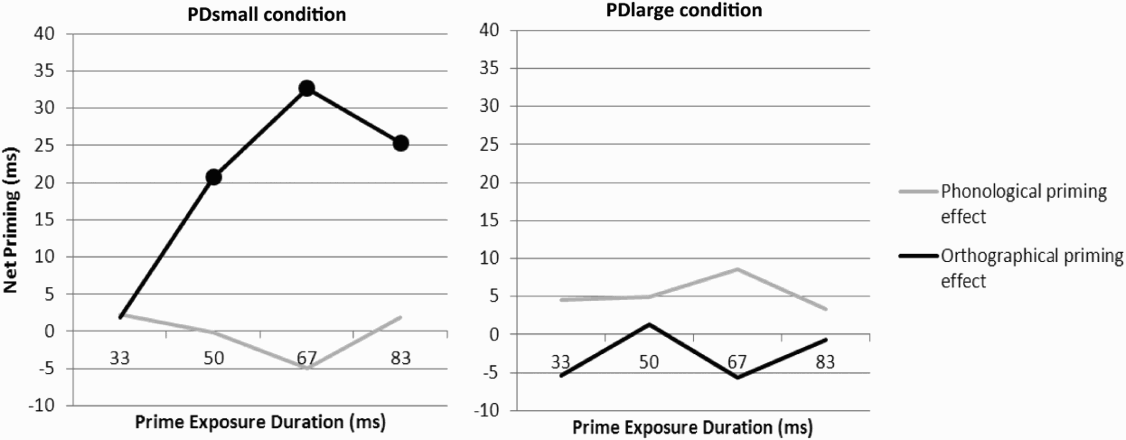
Net effects of phonological priming and net effects of orthographic priming as a function of prime exposure duration for targets with a small change in phonology between the phonological and orthographic primes (PDsmall condition, left panel) and for targets with a large change in phonology between the phonological and orthographic primes (PDlarge condition, right panel) in Experiment 1. Note: Markers indicate a significant priming effect for p < .05.
Therefore, we ran a second study to explicitly test whether phonological priming would become apparent if the phonological difference between phonological and orthographic primes were large enough. We replicated the time course analyses of Experiment 1 with two sets of stimuli: targets with small or large phonological differences between the phonological and orthographic prime. We aimed to answer two questions. First, is the presence of phonological priming effects dependent on the strength of the phonological manipulation in the transparent Dutch orthography, as in the opaque Hebrew orthography? And second, what is the time course of orthographic and phonological code activation in this transparent orthography?
Experiment 2
Method
Participants
A total of 96 undergraduate and graduate students (77.1% female, mean age 21.02 years, SD = 2.96) participated in Experiment 2. Inclusion criteria were similar to those in Experiment 1. Subjects participated for either course credit or monetary reward. None of the participants had participated in Experiment 1.
Materials and design
Target stimuli were 120 words with a length of 4 to 6 letters. The same procedure as that in Experiment 1 was used to generate three nonword primes for each target word: a phonological prime, an orthographic prime, and a control prime. For 60 target words, the phonological difference between the phonological and orthographic prime was small (PDsmall), whereas for the other 60 target words this phonological difference was large (PDlarge). A small phonological difference was defined as a change of one phoneme between the phonological and orthographic prime (e.g., vrien
An additional 120 nonwords were generated to serve as foil targets in the lexical decision task, each accompanied by the same three types of nonword primes as the word targets; a phonological, orthographic, and control prime. As in Experiment 1, foil targets were created by changing one or two letters of a word target. However, twelve PDlarge word targets required a change in three or four letters to create a pseudohomophone phonological prime. All foil targets were created such as to maintain the consonant–vowel structure of their derivate target word. The foil targets did not differ significantly from the word targets in mean bigram frequency, number of neighbours, mean frequency of neighbours, and frequency of the highest frequent neighbour. The manipulation on phonological difference that was applied to the word targets was maintained for the foil targets, resulting in 60 PDsmall foil targets and 60 PDlarge foil targets. For both types of foil targets, the three prime types were matched on bigram frequency, mean frequency of neighbours, and frequency of the highest frequent neighbour. The stimulus sets are depicted in Supplemental Table A2; lexical characteristics of the stimulus sets are described in Supplemental Table B2.
Similar to Experiment 1, three different experimental lists were created, each including all 120 word targets and 120 foil targets divided into six blocks of 40 targets. PDlarge and PDsmall stimuli were intermixed in the experiment to reduce strategic effects. Each block contained 10 PDlarge targets, 10 PDsmall targets, 10 PDlarge foils, and 10 PDsmall foils. The primes in the three lists did not differ with respect to mean bigram frequency, number of neighbours, mean frequency of neighbours, and frequency of the highest frequent neighbour. The same four prime exposure durations as those used in Experiment 1 were adopted: 33, 50, 67, and 83 ms. This resulted in a total number of 960 items for each participant.
Procedure
The procedure was identical to that in Experiment 1 except that Dell Optiplex 760 desktops with ASUS VW222U LCD monitors were used, since these monitors allowed a more precise control of stimulus presentation durations.
Results
Data cleaning
Targets with a mean accuracy below .8 were excluded from further analyses. This led to the exclusion of 16 targets 3
These included the PDsmall word targets “klucht” meaning “comedy”, “fjord” meaning “fjord”, “smaad” meaning “aspersion”, “locus” meaning “locus”, the PDlarge word targets “foyer” meaning “foyer”, “schub” meaning “scale”, “bidon” meaning “water bottle”, “pipet” meaning “pipette”, “geisha” meaning “geisha”, “quote” meaning “quote”, “twijg” meaning “twig”, and the nonword targets “geleg”, “wraad”, “smicht”, and “schijl”.
One participant had a normal RT pattern, but severely deviating RTs to control primed targets at 67 ms. Therefore, only these targets were removed from the analyses.
Median target word recognition latencies and error percentages as a function of prime type and prime exposure duration in the PDsmall condition of Experiment 2
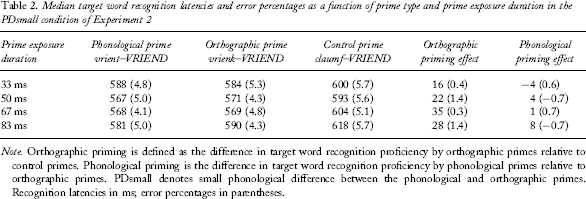
Note. Orthographic priming is defined as the difference in target word recognition proficiency by orthographic primes relative to control primes. Phonological priming is the difference in target word recognition proficiency by phonological primes relative to orthographic primes. PDsmall denotes small phonological difference between the phonological and orthographic primes. Recognition latencies in ms; error percentages in parentheses.
Data were analysed with subject- and item-level repeated measures ANOVAs on median response latencies in which contrast, prime type, and prime exposure duration were the main within factors, and list (Lists 1, 2, and 3) was included as a dummy between-subjects factor. Analyses showed a main effect of prime type [F1(2, 91) = 65.92, p < .001; F2(2, 105) = 43.44, p < .001], a main effect of exposure duration [F1(3, 90) = 6.96, p = .001; F2(3, 104) = 28.15, p < .001], an interaction effect between contrast and prime type [F1(2, 91) = 17.53, p < .001; F2(2, 105) = 9.76, p < .001], an interaction effect between contrast and exposure duration [F1(3, 90) = 8.91, p < .001; F2(3, 104) = 4.36, p = .006], an interaction effect between prime type and exposure duration [F1(6, 87) = 6.84, p < .001; F2(6, 101) = 4.62, p < .001], and a three-way interaction between contrast, prime type, and exposure duration [F1(6, 87) = 2.87, p = .013; F2(6, 101) = 3.55, p = .003]. Follow-up analyses were conducted for the orthographic and phonological priming effects separately. In the analyses on the orthographic priming effect, the factor prime type encompassed the two levels “orthographic prime” and “control prime”, and in the analyses on the phonological priming effect, the factor prime type encompassed the two levels “phonological prime” and “orthographic prime”. The analyses indicated that the three-way interaction between contrast, prime type, and exposure duration was significant for the orthographic priming effect [F1(3, 90) = 4.48, p = .006; F2(3, 94) = 5.37, p = .002], but not for the phonological priming effect [F1(3, 91) = 1.31, p = .276; F2(3, 94) = 2.07, p = .110]. The three-way interactions indicate differences between the time courses of priming effects in the PDsmall and PDlarge conditions. Therefore, results were subsequently analysed for PDsmall and PDlarge targets separately.
Orthographic and phonological priming effects in PDsmall targets
Data in the PDsmall condition were analysed with subject- and item-level repeated measures ANOVAs on median response latencies, in which prime type and prime exposure duration were the main within factors, and list (List 1, 2, and 3) was included as a dummy between-subjects factor. Analyses showed a main effect of prime type [F1(2, 186) = 65.63, p < .001; F2(2, 96) = 63.60, p < .001], a main effect of exposure duration [F1(3, 279) = 5.70, p = .001; F2(3, 144) = 10.06, p < .001], and an interaction effect [F1(6, 558) = 4.34, p < .001; F2(6, 288) = 6.91, p < .001].
Repeated measures ANOVAs for the four prime exposure durations separately showed a significant main effect of prime type at all exposure durations [33 ms: F1(1.86, 173.33) = 6.56, p = .002; F2(2, 96) = 9.29, p < .001; 50 ms: F1(2, 186) = 24.49, p < .001; F2(2,96) = 15.62, p < .001; 67 ms: F1(2, 186) = 55.02, p < .001; F2(2, 96) = 46.86, p < .001; 83 ms: F1(2, 186) = 26.59, p < .001; F2(2, 96) = 53.73, p < .001].
As in Experiment 1, the orthographic priming effect was operationalized as the difference in median RT between the orthographic and control primed conditions. Phonological priming was defined as the difference in median RT between the phonological and orthographic primed conditions. These planned comparisons indicated that the orthographic priming effect was significant at each prime exposure duration [33 ms: F1(1, 93) = 10.68, p = .001; F2(1, 48) = 11.93, p < .001; 50 ms: F1(1, 93) = 32.04, p < .001; F2(1, 48) = 21.03, p < .001; 67 ms: F1(1, 93) = 82.95, p < .001; F2(1, 48) = 68.42, p < .001; 83 ms: F1(1, 93) = 26.82, p < .001; F2(1, 48) = 50.44, p < .001]. The phonological priming effect was significant only at 83 ms [33 ms: F1(1, 93) = 0.73, p = .198; F2(1, 48) = 0.02, p = .451; 50 ms: F1(1, 93) = 1.09, p = .149; F2(1, 48) = 0.22, p = .320; 67 ms: F1(1, 93) = 0.05, p = .825; F2(1, 48) = 0.09, p = .382; 83 ms: F1(1, 93) = 3.26, p = .037; F2(1, 48) = 11.07, p = .001]. Time courses are depicted in Figure 2.
Net effects of phonological priming and net effects of orthographic priming as a function of prime exposure duration for targets with a small change in phonology between the phonological and orthographic primes (PDsmall condition, left panel) and for targets with a large change in phonology between the phonological and orthographic primes (PDlarge condition, right panel) in Experiment 2. Note: Markers indicate a significant priming effect for p < .05.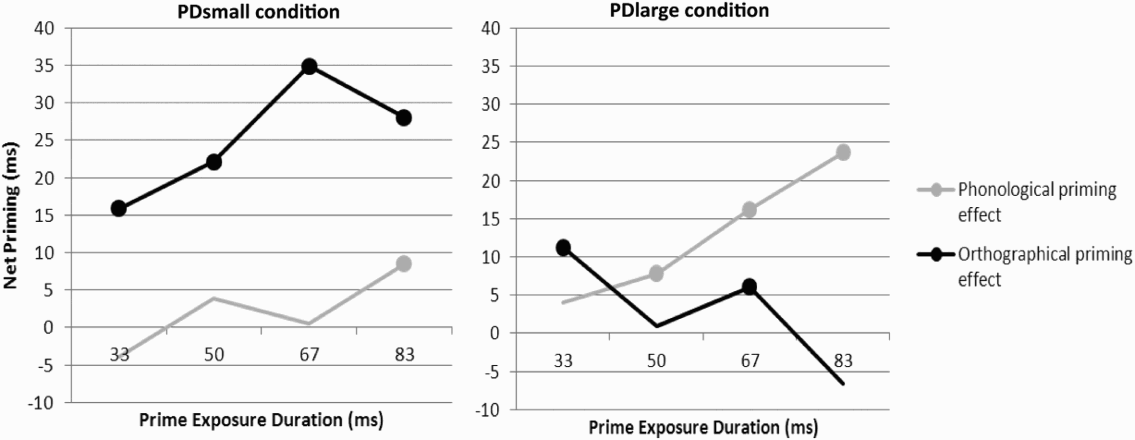
Orthographic and phonological priming effects in PDlarge targets
Median target word recognition latencies and error percentages as a function of prime type and prime exposure duration in the PDlarge condition of Experiment 2
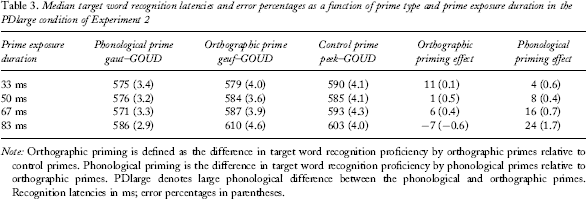
Note: Orthographic priming is defined as the difference in target word recognition proficiency by orthographic primes relative to control primes. Phonological priming is the difference in target word recognition proficiency by phonological primes relative to orthographic primes. PDlarge denotes large phonological difference between the phonological and orthographic primes. Recognition latencies in ms; error percentages in parentheses.
The repeated measures ANOVAs at each of the four prime exposure durations separately showed a main effect of prime type at every exposure duration [33 ms: F1(2, 186) = 6.57, p = .002; F2(2, 96) = 4.83, p = .005; 50 ms: F1(2, 186) = 3.27, p = .020; F2(2, 96) = 4.14, p = .010; 67 ms: F1(1.90, 174.68) = 15.57, p < .001; F2(2, 96) = 35.85, p < .001; 83 ms: F1(2, 186) = 16.38, p < .001; F2(2, 96) = 5.66, p = .005].
Planned comparisons indicated that the orthographic priming effect was significant at the shortest prime exposure duration of 33 ms [F1(1, 93) = 6.55, p = .006; F2(1, 48) = 8.26, p = .003]. At the longer priming durations, results were somewhat mixed. At 50 ms the orthographic priming effect was not significant, although there was a trend towards significance at the item level [F1(1, 93) = 0.11, p = .372; F2(1, 48) = 2.30, p = .068]. At 67 ms there was a significant priming effect, which was not significant at the item level [F1(1, 92) = 3.20, p = .039; F2(1, 48) = 0.52, p = .238]. At the longest prime exposure duration of 83 ms, there was a trend towards significant priming, but this was not significant at the item level [F1(1, 93) = 1.83, p = .090; F2(1, 48) = 0.08, p = .390]. The phonological priming effect was not significant at 33 ms [F1(1, 93) = 0.86, p = .178; F2(1, 48) = 0.11, p = .374], yet became significant from 50 ms onwards [50 ms: F1(1, 93) = 4.92, p = .015; F2(1, 48) = 2.20, p = .073; 67 ms: F1(1, 92) = 16.84, p < .001; F2(1, 48) = 13.28, p < .001; 83 ms: F1(1, 93) = 28.70, p < .001; F2(1, 48) = 8.65, p = .003]. Time courses of orthographic and phonological priming effects are depicted in Figure 2.
Discussion
The results of the PDsmall condition largely replicate the findings of Experiment 1: Orthographic primes facilitated visual word recognition from 33 ms onwards, whereas phonological primes did not provide additional facilitation during the earliest stages of visual word recognition. Phonological priming became apparent only at 83 ms. Together, these results indicate that phonological and orthographic priming effects do not show distinct time courses, but are intertwined, when stimuli contain the straightforward correspondences between orthography and phonology that are typical in a transparent orthography. In contrast, results from the PDlarge condition showed that when the correspondence between a word's spelling and pronunciation was not straightforward, orthographic and phonological primes did show distinct time courses. Orthographic primes facilitated visual word recognition only at the shortest prime exposure duration of 33 ms, and phonological priming effects became apparent from 50 ms onwards. The finding that phonological priming effects are consistently present from 50 ms onwards in words with a large phonological difference, yet appear only at 83 ms in words with a small phonological difference, supports the hypothesis that the presence of phonological priming effects depends on the strength of the phonological manipulation.
With respect to our key question concerning the time course of orthographic and phonological code activation in transparent orthographies, the PDlarge results indicate distinct time courses for orthographic and phonological priming effects, with phonological priming effects appearing shortly after orthographic priming effects. Interestingly, whereas orthographic priming effects were prominent at 33 ms, they diminished shortly afterwards, and from 50 ms onwards, phonological priming effects were most dominant. This suggests that once orthographic codes are translated into phonological codes, phonological influences predominate the visual word recognition process in skilled readers of the transparent Dutch orthography.
What should be noted is that despite the similar findings in Experiment 1 and the PDsmall condition of Experiment 2, small differences exist. Most notably, orthographic priming effects became apparent from 50 ms onwards in Experiment 1, yet were already present at 33 ms in the PDsmall condition of Experiment 2. In addition, whereas phonological priming effects were completely absent in Experiment 1, they appeared at 83 ms in the PDsmall condition of Experiment 2. These differences suggest that the design of Experiment 2 was more sensitive, which may result from the enhanced matching of the lexical characteristics of stimuli in combination with a tighter control of stimulus presentation durations due to the use of desktops.
One finding requires further clarification. That is, both item- and subject-level analyses show clear orthographic priming at 33 ms, which diminishes afterwards. However, at the subject level, orthographic priming becomes significant again at 67 ms (see Figure 1). One possible explanation for this peak is that around 67 ms an orthographical check on the assembled phonological code occurs, which is in line with interactive activation models that propose reciprocal interactions between sublexical orthographic and phonological processes (e.g., Grainger & Holcomb, 2009). However, this leaves unexplained why the orthographic priming effect at 67 ms appears solely at the subject level and not at the item level. Alternatively, it could be argued that the orthographic priming effect at 67 ms is an artefact. Future time course analyses in transparent orthographies are necessary to identify the nature of prelexical orthographic processes after phonological codes have been accessed.
General Discussion
The primary aim of this study was to assess the time courses of orthographic and phonological code activation during visual word recognition in a transparent orthography. To this end, we investigated orthographic and phonological priming effects in skilled Dutch readers. The first study showed early and consistent orthographic priming effects, yet no additional phonological priming. Post hoc analyses suggested that the absence of phonological priming effects might have been due to the subtlety of the phonological manipulations, since phonological priming effects became more easily observable in the few stimuli that did allow a strong phonological manipulation. This seemed to indicate that in typical stimuli of a transparent orthography, the high interconnectivity of phonology and orthography results in intertwined orthographic and phonological priming effects and as a consequence prevents the investigation of individual time courses for orthographic and phonological code activation. Therefore, we decided to conduct a second study in which we explicitly contrasted stimuli with subtle and large phonological manipulations. The aim of this study was to establish whether the presence of phonological priming effects depends on the strength of the phonological manipulation and, if so, to investigate the time courses of orthographic and phonological priming. This second study confirmed that in the transparent Dutch orthography, similar to the opaque Hebrew orthography, strong phonological differences are a prerequisite to separate phonological from orthographic priming effects. When phonological differences are strong enough, it becomes clear that orthographic and phonological priming follow distinct time courses. Orthographic codes are activated initially, yet orthographic influences diminish quickly after this initial activation. Phonological codes are activated shortly after orthographic codes and remain influential throughout the lexical access process.
Although the relation between the presence of phonological priming effects and the strength of the phonological manipulation is often noted (e.g., Carreiras, Ferrand, Grainger, & Perea, 2005; Van Orden & Kloos, 2005), it had thus far only been established in Hebrew (Frost et al., 2003; Gronau & Frost, 1997). However, the Hebrew orthography allows inducing of a large phonological difference between phonological and orthographic primes with only a small change in orthography, whereas in most orthographies, large phonological differences between the phonological and orthographic primes are accompanied by large orthographic differences (pointed out by Rastle & Brysbaert, 2006). The current study shows that the prerequisite of a strong phonological manipulation to identify phonological priming effects also holds in orthographies where phonology and orthography can be separated less easily. This finding corroborates near-significant results from post hoc analyses in a masked priming perceptual identification task in Dutch (Brysbaert, 2001). The finding is also in line with bilingual studies showing that phonological priming can be identified only in situations with low orthographic overlap (Comesaña et al., 2012; Dimitropoulou, Duñabeitia, & Carreiras, 2011b). Together, these findings suggest that the requirement for strong phonological manipulations to identify phonological priming effects is universal rather than characteristic of opaque orthographies. In terms of the orthographic depth hypothesis, this could be interpreted to indicate that the access representations of readers of transparent orthographies are as underspecified as those of readers of opaque orthographies, rendering them insensitive to small phonological differences. Alternatively, the requirement for a strong phonological manipulation may have other causes and may not be indicative of the impoverishment of access representations. Future studies are clearly needed to specify the nature of access representations across orthographies. In any case, the finding that phonological priming effects are only observable with strong phonological differences is in line with a meta-analysis on phonological priming effects in English (Rastle & Brysbaert, 2006) that concluded that effect sizes of phonological priming are generally small. Although we do not aim to distinguish between models of visual word recognition, our findings are in line with strong phonological theories that consider phonology an essential part of the word recognition process, yet they are difficult to incorporate in weak phonological theories that consider phonological influences secondary (see Rastle & Brysbaert, 2006, pp. 113–114).
The finding that orthographic and phonological code activation follow distinct time courses in a transparent orthography, with phonology being activated shortly after orthography, is in line with the results of Carreiras et al. (2009) in Spanish. However, Carreiras and his colleagues found orthographic and phonological priming effects on ERP waves but not on behavioural measures and attributed this to a lack of sensitivity of the behavioural measures. The current study shows that when the phonological manipulation is strong enough, distinct phonological and orthographic priming effects can be identified at the behavioural level as well in transparent orthographies. Our findings also extend the results of Brysbaert (2001), who, in a perceptual identification paradigm in Dutch, showed orthographic priming at both 29 and 43 ms, but phonological priming only at 43 ms. Despite the differences in experimental design, Brysbaert's results fit neatly in the time courses of phonological and orthographic code activation that are shown in the current study. Together, the findings suggest three stages during lexical access in the transparent Dutch orthography: During the first 30 ms, orthographic codes become activated. Between 30 and 50 ms these orthographic codes are translated into phonological codes, resulting in increasing phonological influences and diminishing influences of orthography. From around 50 ms onwards, phonology dominates the word recognition process. Interestingly, the time courses in the current study show remarkable similarities to the time courses in the opaque French orthography reported by Ferrand and Grainger (1993). The main difference resides in the timing of phonological codes becoming dominant. In French, phonological influences outperform orthographic influences from 67 ms onwards and thus slightly later than in Dutch readers. Although comparisons between results from different studies are always speculative due to differences in experimental design, the finding of earlier activation of phonological codes in readers of transparent than in readers of opaque orthographies is in line with the orthographic depth hypothesis. This provides preliminary support for the hypothesis that the straightforward correspondences between orthographic and phonological codes in transparent orthographies allow for accelerated phonological code activation. However, the difference between the timing of phonological dominance in the two orthographies is rather small. It should be noted that the time courses in the current study are based on stimuli that were specifically selected to allow for the separation of orthography and phonology. As a consequence, these stimuli contained less straightforward phoneme–grapheme correspondences than are typical in the transparent Dutch orthography. Thus, although the stimulus material might have hampered the formation of orthography–phonology associations, Dutch readers seemed to be able to activate phonology more quickly than French readers. This raises the question of how time courses of orthographic and phonological code activation manifest in stimuli with the straightforward grapheme–phoneme correspondences that are typical in transparent orthographies. However, the intertwined orthographic and phonological priming effects in these stimuli, as shown in Experiment 1 and the PDsmall condition of Experiment 2, suggest that the masked priming paradigm is not sufficiently sensitive to answer this question. Since the ERP technique allows identification of time course effects that remain hidden in behavioural measures, the addition of ERP measures to the current time course analyses of priming effects could provide useful additional information. ERP analyses might shed light on the time courses of orthographic and phonological code activation in targets with straightforward grapheme–phoneme correspondences that are typical of transparent orthographies. Moreover, the addition of ERP measures would allow more direct and more fine-grained analyses of time courses, since ERPs can be measured with high temporal resolution (Luck, 2005).
In conclusion, the current study contributes to our understanding of the activation and interrelation of orthographic and phonological codes during visual word recognition across orthographies. Time course analyses of priming effects in the transparent Dutch orthography provided two main conclusions. First, the straightforward grapheme–phoneme correspondences in typical words of transparent orthographies result in intertwined orthographic and phonological priming effects. As a consequence, similar to opaque orthographies, strong phonological differences are a prerequisite to separate orthographic and phonological priming effects. Second, when phonological differences are strong enough, orthographic and phonological priming can be shown to follow distinct time courses in transparent orthographies. Orthography is accessed initially, yet orthographic codes are quickly translated into phonological codes with phonological influences dominating the remainder of the lexical access stage. In line with the orthographic depth hypothesis, time courses seem to be indicative of earlier phonological code activation in transparent than in opaque orthographies.
Footnotes
Acknowledgements
We would like to thank Jasper Wijnen for programming the lexical decision task, Bert Molenkamp for technical assistance, and Anoek Appelboom, Sam Beekhuizen, Yke de Boer, Judou Breukers, Nienke Dekker, Jesse van den Doren, Laura Gerritsen, Alexander Mappes, Ileen Smits, and Michiel de Weger for assistance with data collection.