







Abstract
Rather than reflecting the long-term memory construct of a mental number line, it has been proposed that the relation between numbers and space is of a more temporary nature and constructed in working memory during task execution. In three experiments we further explored the viability of this working memory account. Participants performed a speeded dot detection task with dots appearing left or right, while maintaining digits or letters in working memory. Just before presentation of the dot, these digits or letters were used as central cues. These experiments show that the “attentional SNARC-effect” (where SNARC is the spatial–numerical association of response codes) is not observed when only the lastly perceived number cue—and no serially ordered sequence of cues—is maintained in working memory (Experiment 1). It is only when multiple items (numbers in Experiment 2; letters in Experiment 3) are stored in working memory in a serially organized way that the attentional cueing effect is observed as a function of serial working memory position. These observations suggest that the “attentional SNARC-effect” is strongly working memory based. Implications for theories on the mental representation of numbers are discussed.
Keywords
In a seminal study, Fischer, Castel, Dodd, and Pratt (2003) showed that the perception of Arabic digits elicits reflexive shifts of visuospatial attention. Specifically, they used a Posner cueing paradigm with numbers replacing the typical (unpredictable) attention cues (e.g., arrows, peripheral onset cues) and showed that the speed of lateral dot detection was modulated by the numerical magnitude of the cue: Small numbers facilitate left dot detection, while large numbers facilitate right dot detection. This so-called “attentional” spatial–numerical association of response codes (SNARC) effect is traditionally taken to derive from—and thus to provide support for—the mental representation of numbers taking the shape of a mental number line (MNL). On the MNL, at least in Western cultures, small numbers are located on the left and large numbers on the right (Dehaene, Bossini, & Giraux, 1993). Within this account, it is believed that processing of a number automatically activates its corresponding position on the MNL, resulting in an automatically triggered covert shift of spatial attention (e.g., Fischer et al., 2003; Hubbard, Piazza, Pinel, & Dehaene, 2005). The attentional SNARC effect is of theoretical importance because—with spatial attention as the underlying mechanism—the MNL provides a unitary explanation for a wide variety of other instances of number–space interactions—for example, the SNARC-effect (i.e., the observation that small numbers are associated with left-sided and large numbers with right-sided responses; e.g., Dehaene et al., 1993), the interval bisection bias in neglect patients (the observation that patients suffering from left-sided neglect overestimate the midpint of a numerical interval, as if they neglect the left part of the MNL; e.g., Zorzi, Priftis, & Umilta, 2002), and the observations and computational models that link spatial attentional processes to mental arithmetic (e.g., Chen & Verguts, 2012; Knops, Thirion, Hubbard, Michel, & Dehaene, 2009).
In the current study, we first briefly review the attentional SNARC literature. Next we propose an alternative to the MNL account of the attentional SNARC effect. We argue that the attentional SNARC effect is determined by serial position in working memory (WM) and not by the organization of long-term semantic memory for number magnitude. From there we present a set of experiments that explore both accounts, and—as we mainly outline in the General Discussion section—we conclude that our WM account is viable and should be considered in future explorations of the attentional SNARC effect.
A decade of the attentional SNARC effect
Following the seminal paper by Fischer et al. (2003), various studies on the attentional SNARC effect have been published over the last decade. For example, a study by Dodd, Van der Stigchel, Leghari, Fung, and Kingstone (2008) indicates that spatial attention shifts are triggered by number processing, but not by spontaneous processing of non-numerical ordinal series like days of the week, months of the year, or letters of the alphabet. Additionally, Dodd (2011) showed that negative numbers eliminate rather than reverse the attentional SNARC effect, which was interpreted as an indication that the MNL does not extend to negative numbers.
The attentional SNARC effect has also been explored at the neural level. Ranzini, Dehaene, Piazza, and Hubbard (2009) performed an event-related potential (ERP) study and showed that the processing of (task-irrelevant) number magnitude elicits a similar pattern of ERP components to that observed for task-irrelevant cues that have an explicit association with one side of space (i.e., arrows). This was taken to suggest similar orienting mechanisms for spatial and numerical cueing. Moreover, Goffaux, Martin, Dormal, Goebel, and Schiltz (2012) explored task-irrelevant number processing in a functional magnetic resonance imaging study. They showed that the congruency between number magnitude and dot location modulated the blood-oxygen-level-dependent (BOLD) response in occipital cortex, in line with the generally accepted notion that visuospatial attention orienting enhances neural processing in that region.
Additionally, a number of studies suggest that the attentional SNARC effect is not as automatic and obligatory as was originally assumed; rather, it is susceptible to top-down changes in the mental set that is adopted by the participant. For example, when participants are asked to imagine numbers on a clock-face, the perception of numbers induces attentional shifts in accordance with the position of the number on the clock (Ristic, Wright, & Kingstone, 2006). Similarly, when they are directly asked to shift attention towards the left after seeing a large number and towards the right after a small number, the attentional SNARC effect reverses (Galfano, Rusconi, & Umilta, 2006). This implies that besides properties of the task design and task context, the effect may also heavily rely on higher cognitive strategies that participants bring into play. Such a top-down perspective actually fits well with the time course of the attentional SNARC effect: Whereas typical central exogenous cues (e.g., eyes or arrows) generate rapid and reflexive shifts of attention that can reach the cued location in around 100 ms (e.g., Friesen & Kingstone, 1998; Tipples, 2002), the attentional SNARC is observed most prominently after more than 700 ms after number presentation (e.g., Fischer et al., 2003).
Importantly, a closer inspection on the studies in this domain seems to suggest that the effect is sometimes reported as relatively weak or even nonsignificant. In the studies of Galfano et al. (2006) and Ranzini et al. (2009), the attentional SNARC effect (at the behavioural level) was only significant when tested one-sided. Additionally, Ristic et al. (2006; Experiment 1) report on a significant interaction between number magnitude and dot location, but do not report further testing on the slope of the effect—which seems numerically very small (less than 5 ms). More importantly, Jarick, Dixon, Maxwell, Nicolls, and Smilek (2009; Experiment 2) even report a failure to replicate Fischer et al. (2003), despite the fact that these authors employed more trials per stimulus onset asynchrony (SOA) condition than the Fischer et al. study. This type of finding led Rossetti et al. (2011) to conclude that the attentional SNARC effect is overall weak and more difficult to replicate than the regular SNARC effect.
Testing a working memory account of the attentional SNARC effect
The attentional SNARC seems flexible and susceptible to contextual manipulations (e.g., Galfano et al., 2006; Ristic et al., 2006). This might indicate that the spatial coding is not inherent to number processing per se (cf. MNL account) but rather is constructed during task execution (see also van Dijck & Fias, 2011; Fischer, Mills, & Shaki, 2010; but see Treccani & Umilta, 2010). This suggests a crucial role for working memory (WM). Here we propose a WM account of the attentional SNARC effect as an alternative to the MNL account.
Recently, it has been observed that serial order WM and spatial attention are closely linked. Van Dijck, Abrahamse, Majerus, and Fias (2013) showed that retrieval of an item from a serially ordered sequence in WM induces a spatial attention shift on the basis of the item's serial position: The later an item was positioned within the WM sequence, the stronger attention was shifted towards the right when retrieving this item. Even though, as we see below, the van Dijck et al. study did not allow any firm conclusions about the attentional SNARC effect, their observations inspired the WM account of the attentional SNARC effect proposed here.
The WM account postulates that, when performing a typical attentional SNARC task, participants may soon form a mental representation in WM that includes the items (e.g., numbers) that occur during the experiment (cf. van Dijck & Fias, 2011; Monsell, 2003). These items are maintained in WM on the basis of a particular ordinal coding—which is probably not the order in which they are presented during the experiment (as this is not consistent throughout the experiment), but rather follows by default the canonical order implied by number magnitude. Moreover, this coding in WM can deviate from the default on the basis of alternatives that are imposed by specific task instructions and/or contextual manipulations (e.g., Galfano et al., 2006; Ristic et al., 2006). Once a fixed order—of whatever kind—has been established in WM, it is the trial-by-trial matching of the current number to the WM content that drives the spatial attention shifts. Importantly, the spatial coding is assumed to be conditional upon referential coding between multiple items (i.e., holding a single item in WM does not allow for referential coding and thus does not induce spatial coding). Within the WM account, the standard (unmanipulated) attentional SNARC can be explained, then, by retrieval from a canonically ordered WM representation. Overall, this WM account for the attentional SNARC is strongly reminiscent of the WM account proposed for the regular SNARC effect (van Dijck & Fias, 2011).
In the current paper we empirically test and confirm this WM account for the attentional SNARC effect as a viable alternative to the MNL account. We do so in three experiments in which we employed specific variations on the Fischer et al. (2003) and van Dijck et al. (2013) paradigms. In Experiment 1 we created the ideal conditions for a MNL-based attentional SNARC effect (a) by testing an appropriate amount of subjects who (b) showed spatial coding of numbers in a parity judgement task and who (c) were required to memorize on each trial the number cue in order to enhance explicit processing of numerical magnitude. Importantly, the latter manipulation would predict an absence of the attentional SNARC effect from the perspective of the WM account as it prevents referential coding (i.e., a single item is stored in WM).
Subsequently in Experiment 2, we further pitted the WM account and the MNL account against each other by asking participants to perform the Fischer et al. (2003) paradigm with a sequence of numbers serially stored in working memory—thus diverging from default canonical coding. Finally, in Experiment 3 we investigated whether the spatial shifts induced by the retrieval from WM is number specific or not. Here, participants performed the task while memorizing series of letters instead of numbers.
Experiment 1: Active Number Processing and Attentional Snarc
In Experiment 1, we explored whether number processing is sufficient to obtain an attentional SNARC effect. In an attempt to confront the above-mentioned observation that the attentional SNARC is often weak or even absent, we here created ideal conditions for it to emerge. First, we calculated the estimated number of participants needed to obtain a power of .90 based on the effect sizes of the Fischer et al. (2003) and Dodd et al. (2008) studies. Second, we made sure that participants demonstrate default spatial coding in a manual parity judgement task that was performed after the attentional SNARC task. Third, and most crucially, as it has been shown that explicit processing of the cue increases the chance to observe attentional cueing (e.g., Dodd et al., 2008), we added to the Fischer et al. (2003) paradigm the simple request to name, at random moments in the experiment, the digit cue of the trial that they had just finished. This additional task makes processing of the digit cue obligatory, so that number magnitude can be expected to be activated, given the strong automaticity of semantic processing of number magnitude (e.g., Dehaene et al., 1998). We hypothesize that the MNL account would therefore strongly predict the occurrence of a normal attentional SNARC effect, because the naming of Arabic digits is known to result in the automatic activation of their semantic representation (Reynvoet, Brysbaert, & Fias, 2002), and this semantic representation is assumed to underlie the attentional SNARC effect (e.g., Hubbard et al., 2005). Importantly, according to the WM account, this very same manipulation would result in the absence of spatial coding so that no attentional SNARC effect is to be expected: (a) The request to occasionally name the last encountered digit can be considered as a WM load such that default canonical coding is hampered (van Dijck, Gevers & Fias, 2009), and (b) the WM load concerns a single item that does not require ordinal (referential) coding, a condition that is according to the WM account crucial for spatial coding.
Method
Participants
Before starting the experiment, we determined, based on the average of the effect sizes obtained from Fischer et al. (2003, Experiment 2) and Dodd et al. (2008, Experiment 1), the number of subjects needed to obtain a power of .90 with alpha set to .05 (two-sided). A total sample size of 31 would be needed (average Cohen's d = 0.61). After signing an informed consent, 43 students successfully completed the entire experiment (age between 17 and 28 years; 34 females, 6 left-handed) and were paid 10 euros for their participation.
Stimuli and procedure
Attentional SNARC
The digits 1, 2, 8, and 9 (size 0.75°) and a white dot (diameter 0.70°) were used as stimuli and were presented in white on a black background. The speeded dot-detection task started with a fixation cross (ca. 0.25°) centred between two rectangles (1° × 0.67°; ca. 4° to the left and right of the fixation point). After 500 ms, the fixation cross was overwritten by a digit (unpredictive to dot location), which appeared for 300 ms. Based on the result of Fischer et al. (2003), the cue–target interval (CTI) was set to 250, 500, 750, and 1000 ms. During the CTI and target presentation, the fixation point appeared again. Next, the target dot appeared in one of the rectangles for 1000 ms, and the instructions were to press, with the right hand, the letter “n” on the keyboard as fast and accurately as possible from the moment this dot was perceived. The intertrial interval (ITI) was set to 1000 ms. To avoid anticipatory responding, 96 (20%) trials were catch trials, in which no target was presented. Finally, in 120 (25%) trials (catch trials included) the question “which number?” appeared after the response to request the participant to write down the digit cue on a piece of paper that was positioned next to the computer. Responses were written down column-wise, and the letter “n” had to be pressed to continue with the following trial. The experimental session contained 480 in total, and the factors magnitude of the digit cues, CTI, and dot location were fully crossed within participants, leading to 24 measurements per condition. After every 100 experimental trials, a short break was included. Before the experimental session, a practice block of 20 trials (randomly taken from the pool of trials) was run. Participants were additionally instructed to fixate the fixation cross throughout the entire trial.
Parity judgement
During parity judgement, the Arabic numbers 1, 2, 8, and 9 were presented. Participants completed two blocks. In the first, they were instructed to press the left button for odd and the right button for even numbers (or vice versa). The response mapping was reversed in the second block, and the order of blocks was counterbalanced across subjects. Each trial started with a fixation mark (500 ms), immediately followed by the target number (ca. 0.45°), which remained visible until response. After responding, the fixation point reappeared (500 ms). Eight practice trials were delivered prior to each block. Finally, each target number was presented 24 times per response mapping block.
Statistical analyses
Analyses were conducted on average reaction times calculated on correct trials with reaction times exceeding 150 ms. To evaluate the presence of an attentional SNARC effect, a repeated measures analysis of variance (ANOVA) was conducted with cue–target interval (CTI; 4 levels: 250, 500, 750, and 1000), magnitude (2 levels: small, 1 and 2; and large, 8 and 9) and dot location (2 levels: left and right) as within-subject factors. The presence of the SNARC effect in parity judgement was evaluated with a repeated measures ANOVA with magnitude (2 levels: small, 1 and 2; and large, 8 and 9) and response location (2 levels: left and right) as within-subject factors.
In these analyses, the potential interaction between magnitude on the one hand and dot location (attentional SNARC) or response location (parity judgement) on the other hand is indicative for the presence of the attentional/regular SNARC effect (possibly with further interactions with CTI). Finally, the correlation between the attentional SNARC and the parity judgement SNARC was calculated both across and separately for the different cue–target intervals.
Results
Attentional SNARC
Overall accuracy (hits and correct rejections) of the dot-detection task was 98% (SD = 4%), and participants correctly named the requested digit in 98% (SD = 3%) of the trials. Data trimming resulted in an exclusion of 0.27% of the trials. Overall average reaction time was 411 ms (SD = 47).
The repeated measures ANOVA revealed main effects of CTI, F(3, 126) = 34.74, p < .001, magnitude, F(1, 42) = 8.10, p < .01, and dot location, F(1, 42) = 4.20, p = .047. The average reaction times for the different cue–target intervals were, respectively, 429, 402, 399, and 413 ms. The average reaction times for small and large numbers were, respectively, 409 and 413 ms, and the average reaction times for left and right dots were, respectively, 414 and 408 ms. Importantly, the interaction between magnitude and dot location and the three-way interaction between CTI, magnitude, and dot location failed to reach significance (both Fs < 1.05; both ps > .37, indicating that no attentional SNARC effect was observed (see Figure 1a).
A: Differences in reaction times between right- and left-sided dots per digit (i.e., the attentional spatial–numerical association of response codes, SNARC, effect) for Experiments 1 and 2. B: Differences in reaction times between right- and left-sided dots per position in working memory for Experiments 2 and 3. RT = reaction time; CTI = cue–target interval.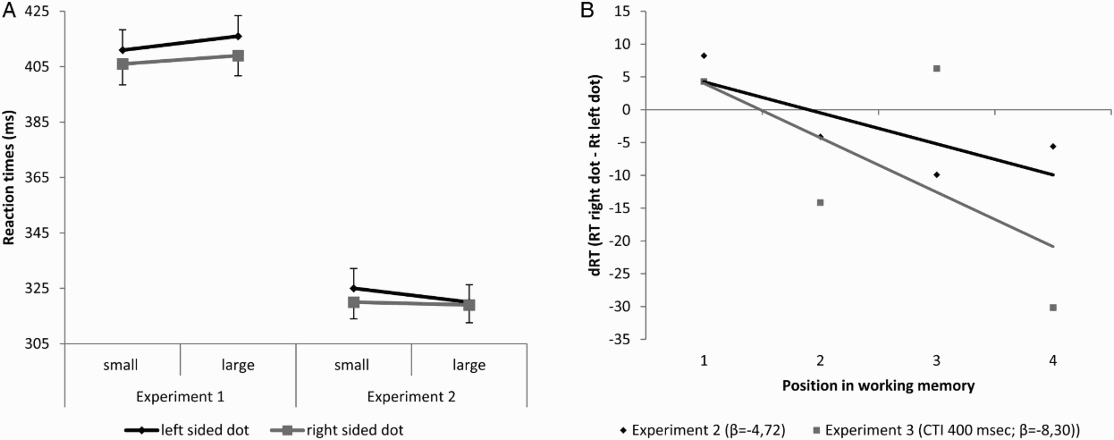
Parity judgement
Overall accuracy was 94% (SD = 5%). Data trimming resulted in an exclusion of 0.05% of the trials. Overall average reaction time was 580 ms (SD = 80).
The repeated measures ANOVA revealed a main effect of magnitude, F(1, 42) = 4.37, p < .043, and response location, F(1, 42) = 12.23, p < .001. The average reaction times to small and large numbers were, respectively, 575 and 586 ms, and the reaction times to left and right responses were, respectively, 592 and 570 ms. Importantly, the interaction between magnitude and response location reached significance, F(1, 42) = 4.30, p = .044, as the right response advantage was larger for large than for small numbers (small numbers: 579 ms, left, versus 572 ms, right; large numbers: 605 ms, left, vs 567 ms, right).
Additional analyses
To further substantiate the claim that the absence of the attentional SNARC effect is not due to the fact that the recruited subjects do not code numbers spatially, the correlation between the SNARC effect in parity judgement and the attentional SNARC effect was calculated for the different cue–target intervals. No correlations were found as the r-values ranged between −.17 and .08, and the corresponding p-values between .27 and .63. Finally, the correlation between the parity judgement SNARC effect and the attentional SNARC effect averaged across CTIs also failed to reach significance, r(43) = −.05, p = .74.
Discussion
As predicted, the instruction to memorize each digit (for possible reproduction after the dot detection task) resulted in a significant main effect of magnitude, confirming that digit magnitude was processed. Nevertheless, despite the activation of number magnitude (main effect of magnitude), no attentional cueing effect was observed. This absence of an attentional SNARC effect cannot be attributed to a lack of power as the number of subjects that participated in our study largely exceeded the amount needed to obtain a power of .90. Moreover, our participants demonstrated spatial coding of numbers as measured with an additional classical parity judgement task, ruling out the possibility that the null effect was due to that fact that our sample does not spontaneously code numbers in a spatial way. Further strengthening this claim, there was no correlation between the size of the parity judgement and the attentional SNARC effects for any of the cue–target intervals or overall. The absence of an attentional SNARC effect in a condition where numerical magnitude is processed cannot easily be explained by the MNL account, especially in the presence of a regular SNARC effect, as both effects are believed to originate from the same underlying mental representation (Hubbard et al., 2005).
From the serial position in WM account, however, the present pattern of result was actually to be expected, because not numerical magnitude but serial position in WM produces attentional shifts. Because the task instructions caused WM to be loaded with one single element (memorizing the cue till the end of the trial for the naming request), neither ordinal coding nor attentional orienting occurred. Whereas in the typical situation the multiple numbers that occur during the experiment may be spontaneously stored and ordered in WM, the current instruction to focus on the single number of the current trial probably has prevented such spontaneous storage of multiple items as well as referential coding between them. It must be noted, however, that Casarotti, Michielin, Zorzi, and Umiltà (2007) employed a similar WM manipulation and still observed temporal onset judgement modulation on the basis of number processing (and the assumed subsequent spatial shift). This discrepancy should be further explored in future research.
In the next experiments we further elaborate on this idea and provide more direct support for the claim that serial position in WM, and not numerical magnitude, drives the attentional SNARC effect.
Experiment 2: Pitting the Mnl Account and the Wm Account against Each Other
In Experiment 2 we further pitted the MNL and WM accounts against each other by asking participants to memorize a series of numbers (instead of just one, like in Experiment 1) in WM before starting with the dot-detection task. If the spatial coding of numbers has its origin in the MNL, a regular attentional SNARC effect is expected, with small numbers shifting attention towards the left and large numbers towards the right. From the perspective of the WM account, this manipulation should prevent the default canonical coding like in Experiment 1, but this is now replace by a new, experimentally imposed serial order. As such, spatial coding is now predicted to occur on the basis of positional coding in WM: Numbers should elicit shifts of spatial attention according to their position in the WM sequence irrespective of their numerical magnitude, with a leftward shift for beginning elements and a rightward shift for late elements.
We employed the van Dijck et al. (2013) paradigm in which we asked participants to maintain a series of digits in WM and to perform the Fischer et al. (2003) paradigm during the retention interval on only those numbers that belonged to the WM sequence (i.e., go/no-go). The design of the van Dijck et al. (2013) study had one crucial downside for current purposes: CTIs within the range of 100 and 400 ms were used, which arguably was too short for obtaining the magnitude-based attentional SNARC effect (Fischer et al., 2003). Therefore we replicated their first experiment with a broad(er) range of CTIs to reasonably cover the settings for obtaining effects of numerical magnitude on spatial attention in the first place. Specifically, CTIs of 100, 400, and 700 ms were employed. The 400-ms CTI is typical, and the other two are either 300 ms faster or 300 ms slower than the typical interval to anticipate scenarios in which the attention shifting occurs either 300 ms earlier or 300 ms later relative to responding. The estimate of 300 ms was derived from the study of van Dijck and Fias (2011) who inferred that the go/no-go procedure results in a reaction time (RT) cost of about 300 ms (by comparing the RTs for tasks with and without the go/no-go instructions).
Overall, Experiment 2 created similar ideal situations to those in Experiment 1 for the regular attentional SNARC effect to emerge; however, instead of predicting an absence of effects, the WM account now predicted an effect on the basis of serial position in WM.
Method
Participants
Thirty-one (age between 17 and 27 years; 29 female; 4 left-handed) native Dutch-speaking subjects from Ghent University participated. After signing an informed consent, they participated to receive course credits. The data of two participants were discarded because of randomization problems, which in combination with low overall performance led to empty cells in the data matrix.
Stimuli and procedure
The experimental session contained 36 blocks. Each block started with the central and self-paced serial presentation of 4 digits (0.45°). Those digits were pseudorandomly sampled from 1 to 8. In 32 of the 36 blocks, every digit was presented on every position an equal amount of times, whereas for the remaining four blocks the digits were randomly chosen for the generation of the sequences. After a 2500-ms rehearsal period, the speeded dot-detection task started with a central fixation cross (0.25°) centred between two rectangles (1° × 0.67°; 3.20° eccentricity). After 250 ms, a digit (uninformative about the location of the dot) replaced the fixation cross for 300 ms. Participants were instructed to fixate this central location during the entire trial. To optimize the time-window for observing attentional modulation, the interval between the cue offset and target onset (cue–target interval; CTI) was set to 100, 400, and 700 ms. Next, the target (white dot; 0.5 × 0.5°) appeared in one of the rectangles for 150 ms. To ensure WM access, participants had to respond only to dots that were followed by digits from the WM sequence (go trials), with a right-hand key-press on a response device aligned to body-midline. The response deadline and intertrial interval (ITI) were 700 ms and 250 ms, respectively. In cases where the digit cue was not part of the memorized sequence, no response had to be given to the dot-detection task (no-go trials), and the next trial was initiated after the response deadline and ITI had elapsed. To discourage anticipatory responding, trials with a response during dot presentation (<150 ms) further developed according to the procedure of no-go trials. Eye movements were not monitored as it is shown that these do not account for the attentional SNARC effect (e.g., van Dijck et al., 2013; Fischer et al., 2003).
Statistical analyses
Data selection, trimming, and analyses were analogous to those in Experiment 1 with the exception that the factor CTI now contained three levels (100, 400, and 700 ms) and that the factor WM-position (4 levels, 1 to 4) was added to the statistical model.
If the attentional SNARC has its origin in the long-term spatial coding of numbers, an interaction between magnitude and dot location, or a triple interaction between magnitude and dot location and CTI is to be expected. If the attentional SNARC effect has its origin in the ordinal coding in WM, an interaction between WM-position and dot location, or a triple interaction between WM-position and dot location and CTI is predicted.
Results
Trials from WM sequences with accurate serial order verification (on average 33.90 of 36 sequences; SD = 1.95) and correct go trials [accuracy on the dot-detection task was 92% (SD = 5%), 99% (SD = 1%), and 97% (SD = 3%) for the go, no-go, and catch trials, respectively] were considered. Data trimming resulted in an additional exclusion of 1.16% of the trials. The overall average reaction time was 321 ms (SD = 33).
The repeated measures ANOVA revealed main effects of CTI, F(2, 56) = 68.82, p < .001, and magnitude, F(1, 28) = 6.17, p = .019. The average reaction times per CTI were 343, 294, and 327 ms for the 100-, 400-, and 700-ms intervals, and slower responses were given to small (324 ms) than to large numbers (319 ms). There was an interaction between CTI and WM-position, F(6, 168) = 6.10, p < .001. Polynomial contrasts calculated for each cue–target interval separately confirmed a linear increase in reaction time in the 100-ms interval, F(1, 28) = 27.63, p < .001, 334, 334, 348, and 358 ms; no linear effect in the 400-ms interval, F(1, 28) = 0.94, p = .34, 293, 295, 290, and 300 ms; and a linear decrease in reaction times in the 700-ms condition, F(1, 28) = 5.08, p < .032; 332, 332, 327, and 318 ms. In line with the WM account, a clear interaction between WM-position and dot location was observed, F(3, 84) = 3.52, p = .019, indicating associations between WM position and spatial attention. The polynomial contrast of this interaction revealed a linear relationship, F(1, 28) = 3.38, p = .017; the advantage in reaction time to detect right-sided over left-sided dots increased on average with 4.73 ms per WM-position (see Figure 1b). Finally, a triple interaction was found between CTI, magnitude, and WM-position, F(6, 168) = 2.91, p = .010. Polynomial contrasts of this interaction revealed that in the 400-ms interval, reaction times were faster when small numbers were in the beginning of the sequence and large numbers at the end, F(1, 28) = 12.72, p = .001.
Importantly, the interaction between magnitude and dot location, F(1, 28) = 2.94, p = .097, and the triple interaction between CTI, magnitude, and dot location, F(2, 56) = 0.07, p = .929, failed to reach significance, and the former even tended to be reversed from what could be expected (see Figure 1a for a depiction of the magnitude by dot location interaction). To ensure that lack of a significant effect of magnitude was not due to the grouping of the factor magnitude in two levels (small/versus large), the above repeated measure ANOVA was repeated but now with all eight levels of magnitude and without the factor WM-position (to avoid empty cells in the design). Again both the interaction between magnitude and dot location, F(7, 175) = 0.82, p = .568, and the triple interaction between CTI, magnitude, and dot location failed to reach significance, F(14, 350) = 1.04, p = .410.
Discussion
When pitting the MNL and WM coding accounts against each other, numerical magnitude, though clearly activated and interacting with WM position in the 400-ms CTI, did not exert shifts of spatial attention. In contrast, a clear attentional modulation was found based on the positional coding of the digits in WM. This is fully in line with a WM-based account for the attentional SNARC effect.
Experiment 3: Is Ordinal Coding Sufficient?
In Experiment 2 we provided support for the notion that the attentional SNARC effect is related to retrieving serially stored digits from WM, and that numerical magnitude of the digits per se do not exert any influence. Here we further theorized that, if serial item position in WM indeed drives the attentional SNARC effect, then the effect should not be limited to numbers; rather, the same effect should occur with stimuli for which it is known that they do not spontaneously trigger attention shifts (Dodd et al., 2008). For this purpose, we tested the WM account for the attentional SNARC effect with letters of the alphabet.
Method
Participants, stimuli, and procedure
After signing an informed consent, 20 Dutch-speaking subjects from Ghent University (17 female; 2 left-handed; age between 19 and 26 years) participated to receive course credits. The experimental set-up was identical to that in Experiment 2, with the exception that the numbers were replaced by letters (a, b, c, d, w, x, y, z) and that the cue–target intervals were changed to 100, 250, and 400 ms (in correspondence to the parameters used in Experiment 1 of van Dijck et al., 2013). Responses were given with the right hand.
Data selection, trimming, and analyses were similar to those in Experiment 2, with the difference that the factor magnitude was left out of the statistical model. Trials from WM sequences with accurate serial order verification (on average 32.6 of 36 sequences; SD = 2.17) and correct go trials [accuracy on the dot-detection task was 88% (SD = 7%), 98% (SD = 2%), and 95% (SD = 6%) for the go, no-go, and catch trials, respectively] were considered. Data trimming resulted in an additional exclusion of 1.50% of the trials.
Results
There was a main effect of CTI, F(2, 38) = 17.99, p < .001, and WM-position, F(3, 57) = 4.76, p = .005. The average reaction times per CTI were 347, 317, and 327 ms for the 100-, 250-, and 400-ms intervals, respectively; and 324, 327, 333, and 336 for WM- positions 1 to 4. A polynomial contrast confirmed a linear increase in reaction time, suggesting serial scanning, F(1, 19) = 8.70, p = .008. The triple interaction between CTI, WM-position, and dot location was also significant, F(6, 114) = 2.89, p = .012. Further evaluation of this interaction confirmed the presence of a linear relationship in the CTI of 400 ms, F(1, 19) = 4.53, p = .046, but not in the others (both Fs < 0.58; both ps > .45): The further the position of the letters in the WM sequence, the stronger it shifts attention towards the right (see Figure 1b).
Discussion
In Experiment 3 we demonstrated that the attentional modulation triggered by the retrieval of information serially stored in WM is not limited to numbers, but is also observed when memorizing series of letters—a stimulus class for which previously no spontaneous attentional orienting was observed (e.g., Dodd et al., 2008). This clearly demonstrates the general principle that retrieval of information from WM is associated with shifts of spatial attention.
An interesting observation is that with letters, the attentional orientation only emerges clearly at CTI of 400 ms, while with digits the attentional modulation is independent from the CTI. It is well documented that there are variations in WM capacity for digits compared to letters, whereby WM spans are typically greater for Arabic numerals than for letters (e.g., Crannell & Parrish, 1957), although a clear account is lacking. A potential explanation for our observation is that WM is more efficient in maintaining and retrieving digits than letters, and that more time is needed to consult WM when letters are verified.
General Discussion
Across three experiments we provide empirical support for the WM account of the attentional SNARC effect. Attentional shifting induced by the number cues was not mediated by numerical magnitude, but by serial position within WM: The further an item occurs within a WM sequence, the stronger it will shift attention towards the right side of space. This happens irrespective of the nature of the stimuli, be it numbers or letters.
In Experiment 1 we began by showing that explicit processing of the number cues is not sufficient to obtain the attentional SNARC effect. By asking participants to (sporadically) name the digit at the end of the trial, we were able to induce number processing up to the level of its semantic numerical magnitude but were unable to observe an attentional SNARC effect. As a potential explanation, we speculated that the request to name the number cue at the end of the trial hampered the spontaneous ordinal coding of the stimulus set in WM as well as subsequent referential coding, which according to the WM account are necessary conditions for the attentional SNARC effect to occur.
This idea was further investigated in Experiment 2. Here we further pitted the influence of ordinal WM position against that of numerical magnitude by asking participants to maintain sequences of digits in a specific serial order in WM and to perform the speeded dot detection task when those digits were presented as cues. These experiments revealed clear attentional modulation by ordinal WM position but not by numerical magnitude (although again, numerical magnitude was processed). Experiment 3, finally, showed that ordinal coding in WM is sufficient for attentional SNARC (-like) effects to arise. Specifically, attentional modulation on the basis of WM position was still observed when employing letters as WM items. Taken together, we conclude that it is this access to serial order WM that drives the attentional SNARC effect, rather than the numerical magnitude to which the effect is traditionally ascribed.
More specifically, we propose that, when performing a Posner task with number cues that are passively perceived (e.g., Dodd, 2011; Dodd et al., 2008; Fischer, 2003), (some) participants spontaneously encode and maintain the numbers that are used in the experiment (see van Dijck & Fias, 2011, for a similar reasoning in the context of the SNARC effect). This quickly provides a mental set of these numbers in WM (see also Galfano et al., 2006), and, on the basis of the inherent ordinal structure of the number system, these numbers are systematically ordered as a function of their magnitude. From the notion that the processing of information serially stored in WM is systematically associated with spatial attention, as we demonstrated in our experiments (see also van Dijck et al., 2013), the attentional SNARC effect naturally emerges.
Besides providing an explanation for the current findings, the WM account has the potential of offering a coherent framework for the attentional SNARC literature, including earlier observations that the attentional SNARC can be modulated through top-down mental sets (Galfano et al., 2006; Ristic et al., 2006). For example, although mapping small numbers to the beginning and large numbers to the end of the memorized task-set sequence is the default mapping, this mapping can be easily changed by the instructions given to the participants (e.g., the request to imagine the numbers as hours on a clock-face, e.g., Ristic et al., 2006, or to associate small numbers with a right location and large numbers with a left one, e.g., Galfano et al, 2006). Whereas the MNL account has difficulties in explaining these findings, the WM account can easily account for this flexibility.
It is important to emphasize that—ultimately—the current study does not refute the core premises of the MNL account, as it cannot be ruled out that the long-term semantic association between numerical magnitude and space was somehow overruled by ordinal codes in WM. Nevertheless, if numbers would bring with them spatial codes into WM (as would be a consequence of the MNL), one would expect these spatial codes to interfere with the spatial codes associated to working memory position. The lack of interactions between numerical magnitude and space (even though numerical magnitude was processed) and the lack of a triple interaction between WM position, magnitude, and space in the current study thus suggest that MNL-based interference did not occur.
The idea that serial order WM is of crucial importance for the attentional SNARC effect fits well with other recent observations relating to number and space. Indeed, also for the SNARC effect (the observation that when performing a categorization task on numbers, e.g., parity judgement, small numbers are associated with a left- and large numbers with a right-hand response), recent studies point to crucial involvement of serial order WM resources. The importance of available WM resources for the SNARC effect was demonstrated in a series of dual-task studies where the SNARC effect was measured during the retention interval of a WM task. When WM resources were taxed, the SNARC effect disappeared (e.g., van Dijck, Gevers, & Fias, 2009; Herrera, Macizo, & Semenza, 2008). In a follow-up study, van Dijck and Fias (2011) demonstrated that, like in the present study, it is the ordinal coding of WM and not a spatial code inherently associated with numerical magnitude that drives the SNARC effect. In their study, participants were asked to memorize a sequence of numbers. Subsequently, using a go-no go procedure, participants had to make a parity judgement, but only if the presented number belonged to the memorized sequence. Regardless of their magnitude (i.e., no SNARC-effect was observed), numbers presented at the beginning of the memorized sequence were responded to faster with left responses whereas items presented at the end of the sequence were responded to faster with right responses. An identical observation was made when words (e.g., fruits and vegetables) instead of numbers were used, again strongly suggesting that it is the ordinal position in the sequence and not the cardinal meaning of the stimuli that interacts with the response side. Interestingly, in this latter experiment the size of the WM–space interactions positively correlated with the regular SNARC effect, which was administered in the same participants. All together, the findings of the present study thus nicely add to the growing body of evidence that number–space interactions in general critically depend on serial order WM mechanisms.
It has often been asked whether numbers are “special” compared to other ordinal representations such as size, letters, days of the week, et cetera. The answer to this question is not unequivocal. Whereas various behavioural effects found with numbers (e.g., distance effect, size effect, and SNARC effect) can also be obtained with other types of ordinal information (e.g., Gevers, Reynvoet, & Fias, 2003; Marshuetz, Smith, Jonides, DeGutis, & Chenevert, 2000; Previtali, de Hevia, & Girelli, 2010; Van Opstal, Fias, Peigneux, & Verguts, 2009), several studies indicate that those effects differ qualitatively from each other (e.g., Di Bono & Zorzi, 2013; Dodd et al., 2008; Zorzi, Priftis, Meneghello, Marenzi, & Umilta, 2006). With regard to the attentional SNARC effect, Dodd et al. (2008) observed that the attentional SNARC effect does not share the (regular) SNARC's feature of being domain-general. Specifically, the attentional SNARC effect was found to be restricted to numbers (and not observed with letters, days of the week, or months of the year), as if, in their interaction with space, number magnitude representations are indeed “special”, being distinct from other ordinal representations. In contrast to this, the WM account proposed here would provide a domain-general perspective on this domain as all ordinally coded item series should impact spatial processing—with no further special role for numbers specifically. This was supported already in the current study by observing WM-based effects on letters.
Finally, our WM account can help to explain why the attentional SNARC effect is much more difficult to replicate than the regular SNARC effect (for a review see Rossetti et al., 2011). In a regular SNARC task, numbers have to be processed and responded to explicitly. This renders it useful for participants to memorize the stimulus set to optimize task performance. In the attentional SNARC task, however, the numbers are usually task irrelevant, making memorization of the cue set not beneficial for task execution. If the attentional SNARC effect critically depends on the spontaneous (canonical) memorization of the overall cue set, one can speculate that large individual differences exist whether or not the cues are memorized and that it is highly sensitive to contextual factors—for example, the exact instructions, the mathematical background of the subjects, whether or not subjects participated in another (similar) experiments just before, et cetera. In other words, the WM account can easily explain the overall difficulty in finding the attentional SNARC effect by defining which top-down strategies are needed for effect, without questioning the validity of the previous observations.
Future research is definitively needed to validate this potential explanation and whether or not the WM account can be extended to other instances of number–space interactions. In the context of this special issue “Spatial Biases in Mental Arithmetic”, it may be worth discussing the operational momentum effect in mental arithmetic (McCrinck, Dehaene, & Dehaene-Lambertz, 2007). This effect entails the observation that a bias occurs towards larger numbers when evaluating summation outcomes, while a bias towards smaller numbers occurs when evaluating subtraction outcomes. One of the dominant explanations is that mental calculation is linked to a spatial shift along a MNL; for example, the attentional spotlight moves “rightward” when adding 18 and 5—that is, a shift from 18 to 23 (Knops et al., 2009). A potential extension of the WM account could be that mental calculation exerts spatial attention, but that it reflects the way in which information is searched for within serial order WM, rather than within a long-term representation. There is indeed abundant evidence that WM processes play an important role in mental arithmetic (for a review see Raghubar, Barnes, & Hecht, 2010), and a functional role could be that when solving arithmetic problems, the potential outcomes are serially ordered in WM, and attentional mechanisms are used to select the correct solution. Future studies are needed to validate this explanation, for example by testing whether the operational momentum effect in mental calculation can be modulated in a dual-task situation where WM resources are depleted by a concurrent task. Alternatively, one can also predict that the operational momentum effect reflects the way information is searched within WM in general, so that the effect should also been observed outside the context of mental arithmetic.
To conclude, the current study proposed and tested a WM-based account on how numbers are related to spatial attention. It shows that the WM account provides a valid alternative to the MNL account. Future studies should consider this WM account in framing their findings, and, ultimately, set out to provide a definite test between the WM and MNL accounts. In a broader context, future work should aim at exploring the consequences of current findings for number processing in general, such as in the case of (mental) arithmetic.
Footnotes
Acknowledgements
E.L.A. was supported by the Netherlands Organization for Scientific Research (NWO) [grant number 446–10–025]; and the Research Foundation–Flanders (FWO) [grant number 12C4712N]. This work was further supported by the Ghent University Multidisciplinary Research Partnership “The integrative neuroscience of behavioural control”; and by the Interuniversity Attraction Poles Program of the Belgian Federal Government [grant number P7/11].