







Abstract
Despite the growing interest in the ability of foreseeing (episodic future thinking), it is still unclear how healthy people construct possible future scenarios. We suggest that different future thoughts require different processes of scene construction. Thirty-five participants were asked to imagine desirable and less desirable future events. Imagining desirable events increased the ease of scene construction, the frequency of life scripts, the number of internal details, and the clarity of sensorial and spatial temporal information. The initial description of general personal knowledge lasted longer in undesirable than in desirable anticipations. Finally, participants were more prone to explicitly indicate autobiographical memory as the main source of their simulations of undesirable episodes, whereas they equally related the simulations of desirable events to autobiographical events or semantic knowledge. These findings show that desirable and undesirable scenarios call for different mechanisms of scene construction. The present study emphasizes that future thinking cannot be considered as a monolithic entity.
People project themselves into the future to preexperience potential scenarios (de Vito & Della Sala, 2011). This ability, labelled episodic future thinking (EFT), has recently gained some momentum (80 papers published in the last 5 years; Klein, 2013). However, how people construct future scenarios is not fully understood.
The two most influential theories on the cognitive underpinning of EFT (Hassabis & Maguire, 2007; Schacter & Addis, 2007) have not explicitly addressed the issue of whether different processes might be involved in the construction of different types of future scenes.
More specifically, the “constructive simulation hypothesis” (Schacter & Addis, 2007) maintains that for the purpose of engaging in mental excursion into the future, people extract and rearrange snippets from their autobiographical past. The “scene construction hypothesis” (Hassabis & Maguire, 2007) contends that past episodic memories and imagined future events are (re)constructed along analogous lines. Neuroimaging (Addis, Wong, & Schacter, 2007; Okuda et al., 2003), behavioural (Addis, Musicaro, Pan, & Schacter, 2010; D'Argembeau & Van der Linden, 2004; Gamboz, Brandimonte, & de Vito, 2010), and neuropsychological studies (Berryhill, Picasso, Arnold, Drowos, & Olson, 2010; de Vito et al., 2012; Klein, Loftus, & Kihlstrom, 2002) have reported marked differences or dissociations (Irish, Addis, Hodges, & Piguet, 2012) between episodic memory and future thinking, suggesting that future-oriented mental time travel is a multifaceted phenomenon and does not rely exclusively on a particular form of memory (for a review, see Irish & Piguet, 2013).
Atance and O'Neill (2001) had the interesting intuition that people may rely on different cognitive processes when generating best case or worst case scenarios.
This intuition has been corroborated only partially by extant literature, which has shown that the emotional valence of future thinking may affect crucial characteristics of simulations. D'Argembeau and Van der Linden (2004) reported that representations of positive events contained more sensorial details, clearer information related to time, and were associated with a greater feeling of preexperiencing than representations of negative events. Valence also influenced the speed that participants took to generate future simulations, with negative future thoughts coming to mind more slowly than positive thoughts (D'Argembeau & Van der Linden, 2004; Newby-Clark & Ross, 2003). Similarly, D'Argembeau, Renaud, and Van der Linden (2011) observed that when participants were experiencing future simulations, positive thoughts were more frequent, more specific, and associated with a greater amount of visual images than negative thoughts. In a diary study of involuntary and voluntary mental time travel, Berntsen and Jacobsen (2008) observed a marked prevalence of positive events, compared to negative ones, in particular in the future conditions. Likewise, future events were rated significantly more positive than past events (Newby-Clark & Ross, 2003). These positive-bias schemata contribute to guide the construction of future simulations (Taylor & Brown, 1988). Taylor and Brown (1988) suggested that uncorrected positive future scripts might be adaptive in motivating people to engage in novel situations, such as social relationships or productive jobs. Negative future thoughts may increase the chance of survival, by correcting positive illusions (see also Baumeister, Bratslavsky, Finkenauer, & Vohs, 2001; Janoff-Bulman, 1989; for a review see McGaugh, 2004; for a discussion see Berntsen & Bohn, 2010). Hence, important functional differences may underlie positive and negative future thoughts.
Given these differences in positive and negative simulations, we could hypothesize that these two types of EFT do not share the same mechanisms of scene construction. In the present article, we aimed at examining whether and to what extent the emotional valence associated with simulated future personal experiences influences the cognitive processes, by eliciting different types of future thinking. We manipulated the subjective and objective features of future mental time travel solely by changing the instructions. This provides us with a means to assess whether it is possible to fractionate EFT into types of prospection that may be differently constructed. We aimed at exploring this issue, by instructing healthy participants to construct two types of scenario, desirable and undesirable ones.
Experimental Study
Method
Participants
Thirty-five young adults (24 women) entered this experiment. Participants were right-handed students recruited at the “Suor Orsola Benincasa” University in Naples. Their average age was 20.61 years (SD = 4.03). None was under psychoactive pharmacological treatment or had a history of neurological or psychiatric disorder. Participants did not receive any honorarium. Before starting the testing session, participants signed an informed consent form. The study procedures were approved by the local ethical committee and were carried out in accordance with the Declaration of Helsinki.
Materials and procedure
Testing was carried out in a single session. All participants were tested individually and sat facing the same experimenter in a quiet testing environment. Participants were initially briefed that they would be required to mentally preexperience eight autobiographical episodes occurring in the future (four desirable and four undesirable). They were also told that after each description they would complete a 7-point scale rating about some characteristics of the episode, and finally they would answer an open question concerning each event.
In the “desirable episodes” condition, participants were instructed to imagine an event that they wished to happen to them in the next few years. In the “undesirable episodes” condition, participants were required to imagine an event that they did not wish to happen to them in the next few years. Half the participants performed the “desirable” task first, followed by the “undesirable” task; the other half received the opposite sequence. The experimenter further explained that all the events had to be imagined in as much detail as possible.
For each participant, eight cue-words were randomly selected from a larger pool including 20 words taken from the Burani, Barca, and Arduino (2001) Italian norms and matched for familiarity, frequency, imageability, and concreteness. Each word was written on a card that was presented, one at a time, and remained in view for all the duration of the description.
Participants were encouraged to produce temporally and contextually specific events and to vividly imagine novel and plausible future episodes. Following the paradigm of D'Argembeau and Mathy (2011), they were instructed to say everything that came into their mind from the time they heard the instructions to when they successfully imagined a precise event. Participants were allowed to keep on verbally illustrating the event until they thought that nothing else could be added. There was no time limit but time of response was taken. Furthermore, we maintained constant the prompting procedure for the participants in both the experimental conditions. When participants stopped talking, the experimenter asked only once whether there was any further detail that they would have liked to have added.
Simulations were digitally recorded to enable later transcriptions and subsequent scoring of the participants' responses. In the transcription phase, the time used for the initial description of general personal knowledge (which introduced the main future episode; D'Argembeau & Mathy, 2011) was separated by the time used to describe the main episode proper.
After the transcription, a trained rater, who was blind to the hypothesis of the study, used the standardized scoring procedure developed by Levine, Svoboda, Hay, Winocur, and Moscovitch (2002) to systematically parse the details generated in the past and future events. This allowed the rater first to segment the main event (i.e., the most talked about, with a brief timeframe) into details and then to distinguish between (a) internal details (i.e., information pertaining to the main event, specific to time and place) and (b) external details (general knowledge related to the event). A second rater, trained for this purpose, scored 20 random protocols.
Internal details were further categorized into: (a) event (happenings, individuals present, physical/emotional actions and reactions, weather); (b) place (information about the environment where the event occurred); (c) time (date, season, month, day of the week, time of day); (d) perceptual (sensory information, body position); and (e) emotion (emotional state, thoughts). External details were categorized into: (a) external event (specific details from other incidents, from all of the above categories, external to the main event); (b) semantic (general knowledge or facts, ongoing events, extended states of being); (c) repetition (unsolicited repetition of details); and (d) other (metacognitive statements, editorializing).
Moreover, participants rated each event, using a 7-point scale (Szpunar & McDermott, 2008), on measures referring to the sensorial clarity index (visual details, smells, sounds, and global clarity; 1 = vague, 7 = clear) and to the clarity of the spatial temporal context index of the event (clarity of location, clarity of temporal connotation of the event; 1 = vague, 7 = clear).
Soon after the main experiment, participants met with three further questions aimed at investigating the source of their representations. Participants indicated the source of each future event by rating (a) how often they had experienced in the past a similar event (1 = never; 7 = very often), and (b) how often they had imagined in the past a similar event (1 = never, 7 = very often). Similarly, at the end of the task, they were explicitly required to specify where they thought they drew their scenario (from past autobiographical experiences or from semantic knowledge).
A rater, who was blind to the hypothesis of the study, categorized the events that contained cultural life script (i.e., marriage, having children, retirement, begin job, lose job, fall in love, own death, other's death, parent's death, partner's death, divorce, long trip, serious disease, major achievement, settle on career; Berntsen & Bohn, 2010) and those that did not contain cultural life scripts.
A subgroup of 10 participants also completed the Italian version of the State–Trait Anxiety Inventory (STAI; Pedrabissi & Santinello, 1989; Spielberger, Gorsuch, Lushene, Vagg, & Jacobs, 1983), which measures, on a self-reported basis, trait anxiety (general level of anxiety experienced by the individual) and state anxiety (the contingent level of anxiety). Participants answered only once to the trait anxiety questions and after each episode to the state anxiety questions. This test was included to ensure that the state anxiety did not affect the quality of the future episodes, and in particular that of the undesirable ones.
Results
Amount of details
The interrater reliability (r) between the original rater and the second rater was r = .92, p < .001 for the internal details, and r = .82, p < .001 for external details. The outcome from the two future thinking conditions is summarized in Figure 1. A 2 (future thinking condition: desirable vs. undesirable) × 2 (details: internal vs. external) analysis of variance (ANOVA), with all variables as within-subjects factors, was carried out on the mean number of details.
Mean number of internal and external details produced in the future thinking task as a function of desirability (desirable and undesirable). Error bars show standard errors of the mean.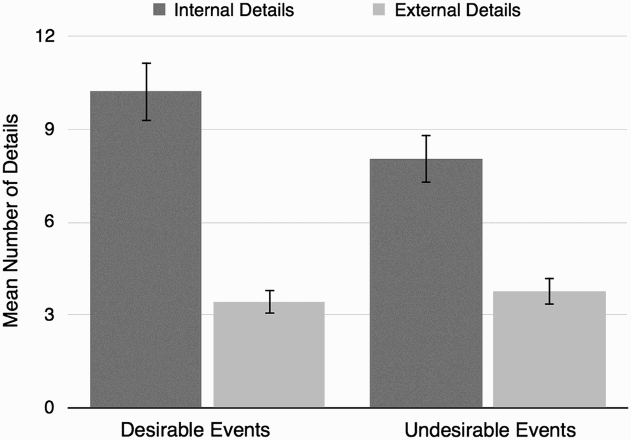
The results revealed main effects of future thinking condition, F(1, 34) = 29.94, p < .05,
A significant interaction between future thinking task and details, F(1, 34) = 7.31, MSE = 55.00, p < .05,
Subjective rating of characteristics
Mean ratings on sensorial clarity and clarity of spatial temporal context were analysed by means of t-tests. The Bonferroni adjustment was applied, α = .025, to correct for multiple comparisons. With respect to the sensorial clarity of the event, desirable future episodes were considered clearer (M = 4.68, SD = 1.04) than the undesirable ones (M = 4.32, SD = 1.09), t(34) = −2.35, p = .025. Similarly, the spatial temporal context was judged clearer in desirable (M = 5.08, SD = 0.95) than in undesirable future episodes (M = 4.56, SD = 1.04), t(34) = −2.9, p < .01.
Source of the event
The two ratings concerning the supposed source of the events were analysed by means of t-tests. Also in this case, the Bonferroni adjustment was applied, α = .025. Participants referred to having imagined more often in the past a similar event in the desirable (M = 6.02, SD = 0.81) than in the undesirable condition (M = 5.15, SD = 1.29), t(34) = −3.78, p < .005. Furthermore, participants were not equally likely to indicate autobiographical memory as the main source of their desirable and undesirable recollections, χ2(1) = 12.98, p < .001. Indeed, autobiographical memory was considered the main source of 92 out of the 140 undesirable simulations (65.71%), whereas it was indicated as main source of 62 out of the 140 desirable simulations (44.28%).
Life scripts
The categorization operated by the trained second rater indicated that participants were not equally likely to use cultural life scripts in desirable and undesirable simulations. Cultural life scripts were not contained in 100 out of the 140 undesirable simulations (71.42%) and in 77 out of the 140 desirable simulations (55%); this difference is significant, χ2(1) = 7.73, p < .01.
Time of response
We compared the time of response, the time used for the initial description of general personal knowledge, and the time used for describing the main event in the two conditions of desirable and undesirable future thinking tasks, by using t-tests. A Bonferroni adjustment was adopted, α = .016. The results showed that participants used overall the same amount of time to describe the event in desirable (M sec = 51.99, SD = 20.9) and in undesirable conditions (M sec = 51.91, SD = 20.28). However, undesirable future episodes required more time for their initial general description (M sec = 15.20, SD = 13.71), if compared to desirable events (M sec = 10.14, SD = 10.95), t(34) = 2.77, p = .01.
Anxiety inventory
A linear regression showed that the global scores obtained on the STAI explained part of the variability of the number of internal details, r2 = .22, F(1, 19) = 3.57, p = .05. This was true solely with respect to the trait anxiety scores, β = .65, t(19) = 2.67, p < .05.
Discussion
The implicit assumption on the cognitive underpinning of EFT is that all future thoughts share the same underlying cognitive processes (Hassabis & Maguire, 2007; Schacter & Addis, 2007). This might have led authors to overlook the possibility that different forms of future simulations call for a variety of memory and visual imagery processing (de Vito, 2012).
The purpose of this study was to investigate whether or not future thoughts are differently constructed depending on their emotional valence. Striking differences were observed on almost all the measures that we considered. A significantly greater percentage of desirable events than undesirable events contained life scripts. Berntsen and Bohn (2010) stated that life scripts are likely to influence the search descriptions that people follow when instructed to generate past and future scenarios. They observed that most of the “important” past and future events referred to events that are part of cultural life scripts (see also Berntsen & Rubin, 2004). Our findings allow us to refine this concept, by showing that desirable events activate life script to a greater extent than undesirable events.
We also observed that both desirable and undesirable future episodes required an initial general description. Therefore, we replicated previous findings, by showing that activating a general knowledge structure is the first step to future thinking and provides a context within which to retrieve and reshuffle specific details. Crucially, we also showed that general knowledge description lasted significantly longer during undesirable than during desirable episodes. Therefore, as Newby-Clark and Ross (2003) posited, people appear to take longer to generate future negative than positive episodes. These results are consistent with the fact that a life script, which is “a culturally shared part of our semantic knowledge” (Berntsen & Bohn, 2010, p. 267), may greatly help to structure individual self-narratives. Thus, future episodes that contain life scripts should generally be more accessible than episodes not revolving around a life script (Szpunar, 2010). Life scripts facilitate mental time travel (Berntsen & Bohn, 2010), even if at the end of the process the quality of the content (e.g., contextual details) of the two types of episodes (with or without life script) may be very similar (Klein, 2013).
Taylor and Brown (1988) suggested that the easier access to positive future thoughts might enable people to construct richer representations. Accordingly, we found that desirable events generated a greater amount of internal details. This finding could hardly be accounted for by the fact that thinking of undesirable events increased the level of contingent anxiety. In fact, we observed an overall increment of internal details generated by participants with higher anxiety scores, regardless of the experimental condition. Desirable events were considered more vivid than undesirable and were framed within a better defined spatial temporal context (see also D'Argembeau & Van der Linden, 2004). This may be due to the fact that undesirable episodes are less often imagined than desirable events—that is, they are more novel, as our participants acknowledged. People are more prone to imagine positive events (Berntsen & Jacobsen, 2008) and to focus on optimistic scenarios (Newby-Clark, Ross, Buehler, Koehler, & Griffin, 2000). The act of imagining future events (positive or negative) makes them seem more plausible and more likely to occur (Sherman, Cialdini, Schwartzman, & Reynolds, 1985; Szpunar & Schacter, 2013). Thus, people may be less willing to think of undesirable, unpleasant future scenarios and engage more often with thoughts of desirable future events. People tend to enrich in details the conceptual, general knowledge about their personal future each time they think of it. Szpunar and Schacter (2013) observed that, despite the fact the participants were explicitly instructed to avoid adding new details across repeated simulations, the number of details of the scenarios always increased when they were resimulated. This may be the reason why desirable episodes, which are more often thought about, are richer in details and more vivid than undesirable ones.
Finally, our participants were more likely to indicate autobiographical memories as the source of their undesirable events, whereas they equally related the simulations of desirable events to autobiographical events and semantic knowledge. This does not imply that the source of the two types of episodes diverges, but that the phenomenology related to desirable and undesirable events may be different.
Our participants stated that they had imagined more often desirable than undesirable episodes. It is of course difficult to draw inferences about the nature of a memory experience based on the analysis of verbally produced content, which is not inherently episodic or semantic memory based. However, the frequency with which one thinks of certain episodes may contribute to “semanticize” them. As the stories that are told and retold over the years may become anecdotal to some extent, also the scenarios that are imagined and reimagined may be perceived as less personal and more prototypical.
Changing the emotional valence of a future thought may affect the outcome that participants provide and the individual perception of a future thought, with desirable thoughts being perceived as more vivid and anecdotal. Tolstòj (2003, p. 21) must have experienced the same perception, when at the incipit of Anna Karenina wrote: “Happy families are all alike; every unhappy family is unhappy in its own way”.
Footnotes
Acknowledgements
We are very grateful to Gabriel Radvansky, Stanley Klein, and an anonymous reviewer for their comments on this manuscript. Moreover, we thank the three raters, Gianmarco Capasso, Brunella Altieri, and Chiara Pepino.