







Abstract
Psychometric schizotypy in the general population correlates negatively with face recognition accuracy, potentially due to deficits in inhibition, social withdrawal, or eye-movement abnormalities. We report an eye-tracking face recognition study in which participants were required to match one of two faces (target and distractor) to a cue face presented immediately before. All faces could be presented with or without paraphernalia (e.g., hats, glasses, facial hair). Results showed that paraphernalia distracted participants, and that the most distracting condition was when the cue and the distractor face had paraphernalia but the target face did not, while there was no correlation between distractibility and participants’ scores on the Schizotypal Personality Questionnaire (SPQ). Schizotypy was negatively correlated with proportion of time fixating on the eyes and positively correlated with not fixating on a feature. It was negatively correlated with scan path length and this variable correlated with face recognition accuracy. These results are interpreted as schizotypal traits being associated with a restricted scan path leading to face recognition deficits.
Schizotypy is characterized by nine traits reflecting cognitive/perceptual, interpersonal, and disorganized behaviours (Raine et al., 1994), representing unusual perceptions and thoughts, difficulties in social situations including anxiety and restricted affect, and odd or eccentric behaviours. These traits exist in a continuum (Platek & Gallup, 2002), where the extreme form is known as Schizotypal Personality Disorder and is thought to be genetically related to schizophrenia (Kraepelin, 1971). Psychometric schizotypy is associated with deficits in cognitive control (Kerns, 2006), visual processing (Dinn, Harris, Aycicegi, Greene, & Andover, 2002; Luh & Gooding, 1999), sustained attention (Bergida & Lenzenweger, 2006; Gooding, Matts, & Rollmann, 2006; Lenzenweger, 2001; Obiols, García-Domingo, de Trinchería, & Doménech, 1993), spatial working memory (Park, Holzman, & Lenzenweger, 1995; Park & McTigue, 1997), eye movements (O'Driscoll, Lenzenweger, & Holzman, 1998), and inhibiting irrelevant information (Braunstein-Bercovitz & Lubow, 1998; Braunstein-Bercovitz, Rammsayer, Gibbons, & Lubow, 2002; Lubow & De la Casa, 2002). Deficits in face recognition performance are also observed in participants from the general population with high schizotypy (Poreh, Whitman, Weber, & Ross, 1994) which parallel those observed in patients with Schizotypal Personality Disorder and schizophrenia (Feinberg, Rifkin, Schaffer, & Walker, 1986; Gruzelier, Wilson, Liddiard, Peters, & Pusavat, 1999; Hellewell, Connell, & Deakin, 1994) and often cause patients distress. Indeed, general deficits in face processing may lead to interpersonal problems and social isolation (Cramer, Bowen, & O'Niell, 1992). This highlights the importance in understanding the correlates between face perception and schizotypy.
Poreh et al. (1994) found that college students who scored higher in schizotypy made more errors in a face and an emotion recognition task than students with low schizotypy. Indeed, group differences in the emotion recognition task were not significant when general face recognition was controlled for, suggesting that schizotypy leads to a general impairment in face processing. Conklin, Calkins, Anderson, Dinzeo, and Iacono (2002) found similar results in a sample of first-degree relatives of patients with schizophrenia: participants who scored higher on the Schizotypal Personality Questionnaire (SPQ; Raine, 1991) performed worse on two face-recognition tasks than those who scored higher on the SPQ. Larøi, D'Argembeau, Bredart, and van der Linden (2007) largely replicated these effects, but found that self-face recognition was correlated with the cognitive/perceptual and disorganized dimensions of schizotypy but not the interpersonal dimension (see also Gruzelier, Burgess, Stygall, Irving, & Raine, 1995). There are four possible, though not mutually exclusive, reasons why schizotypy is related to face recognition: (1) deficits in cognitive control and disinhibition; (2) reduced use of configural processing; (3) social withdrawal; and (4) eye-movement deficits. We shall address each explanation in turn.
Deficits in cognitive control and disinhibition
A core deficiency in participants who score highly in schizotypy is in tasks that require sustained attention, such as the continuous performance task (Obiols et al., 1993). One reason for this deficit in sustained attention is that schizotypy is correlated with distractibility (Franke, Maier, Hardt, Hain, & Cornblatt, 1994). Tsakanikos (2004) has shown that schizotypy is associated with an attenuated latent inhibition effect (see also Baruch, Hemsley, & Gray, 1988; Lipp & Vaitl, 1992; Lubow, Ingberg-Sachs, Zalstein-Orda, & Gerwitz, 1992; Tsakanikos, Sverdrup-Thygenson, & Reed, 2003). Latent inhibition refers to the effect that after participants learn to ignore distractor stimuli in a visual search task and when these stimuli become targets, they are subsequently slower to identify them than stimuli they had not previously learnt to ignore (Lubow, 1989). A reduced latent inhibition effect in participants with high schizotypy is due to increased distractibility, whereby irrelevant stimuli are processed to the same degree as relevant stimuli (Braunstein-Bercovitz & Lubow, 1998; Tsakanikos & Reed, 2004). This has also been interpreted as a lack of inhibition in visual perception processes (Dinn et al., 2002; Waters, Badcock, Maybery, & Michie, 2003). This distractibility has been reported to be primarily associated with the cognitive/perceptual dimension of schizotypy rather than the interpersonal or disorganized dimensions (Steel, Hemsley, & Pickering, 2002). Conversely, Moritz, Andresen, Naber, Krausz, and Probsthein (1999) have indicated that disorganized schizotypy is more associated with cognitive control than the other dimensions.
Distractibility could be the cause of face recognition deficits if one assumes that attention to the most diagnostic features is required when processing faces (Hills, Cooper, & Pake, 2013). Therefore, if increased distractibility is the cause of deficits in face recognition, we would assume that participants with high schizotypy would attend to features that are not diagnostic to recognition. Paraphernalia is often considered irrelevant to face recognition as paraphernalia items are not stable features and are therefore not useful for face recognition. Fairly obvious changes to facial paraphernalia causes deficits in recognizing previously unfamiliar faces (Patterson & Baddeley, 1977), especially in children (Carey & Diamond, 1977; Flin, 1985; Freire & Lee, 2001) unless paraphernalia is included on both the target and distractor stimuli (Baenninger, 1994). We would assume that schizotypy would correlate with the recognition cost due to the presence of paraphernalia on all faces.
Reduced use of configural processing
Face recognition is an expert perceptual process thought to involve configural coding which differentiates it from the processing of other objects (Maurer, Le Grand, & Mondloch, 2002). Configural processing is a hallmark of expertise (typically employed for higher-order processing) and is typically unaffected by the presence of facial paraphernalia (Freire & Lee, 2001). Given the negative correlation between face recognition accuracy and schizotypy (Poreh et al., 1994), one might assume that schizotypy is related to the amount of configural coding engaged in. While no studies have directly tested this premise in the general population, Shin et al. (2008) have shown that patients with schizophrenia appear to show a reduced ability to employ configural coding during face recognition when compared with control participants. In this study, configural processing was operationalized as the ability to encode faces with configural and featural changes made to the images. Indeed, Dickey et al. (2010) have found that the fusiform gyrus (a part of the brain that is considered critical to configural coding in face recognition; Kanwisher, McDermott, & Chun, 1997) is abnormal in patients with schizophrenia (see also Fakra, Salgado-Pineda, Delaveau, Hariri, & Blin, 2008). Schwartz, Marvel, Drapalski, Rosso, and Deutsch (2002), however, have shown that patients with schizophrenia showed as large a face-inversion effect (an index of configural coding; Edmonds & Lewis, 2007) as non-patients, indicating that configural coding is unaffected in schizophrenia. If schizotypy is related to a reliance on featural coding (coding of information based on the constituent parts independently), we might expect to see changes in paraphernalia to cause deficits in face recognition.
Social anxiety
A third plausible reason why face recognition is affected by schizotypy is that social anxiety associated with schizotypy leads to social withdrawal. Schizotypy is associated with social anxiety, a lack of friends, and paranoia (Raine, 1991) which form the interpersonal dimension of schizotypy (Raine et al., 1994). Social, but not general, anxiety is known to affect face recognition negatively (Davis et al., 2011) potentially because anxiety causes people to avoid attending to faces and specifically the eyes. Indeed, in autism, social functioning correlates positively with fixations to the eyes and negatively with fixations to the mouth (Klin, Jones, Schultz, Volkmar, & Cohen, 2002; see also Joseph & Tanaka, 2003). Patients with schizophrenia also show reduced fixations to the eyes (see, e.g., Manor et al., 1999; Williams, Loughland, Gordon, & Davidson, 1999). Given that the eyes are the most important feature for accurate face recognition (Haig, 1986; Hills et al., 2013), avoiding the eyes may be the cause of poorer face recognition. In order to confirm this hypothesis, the amount of time fixating on the eyes should correlate negatively with schizotypy and positively with face recognition accuracy. We would also expect a negative correlation between the amount of time fixating on the mouth and face recognition, and potentially a positive correlation between mouth fixation and schizotypy.
Eye-movement deficits
Related to the preceding explanation, generalized eye-movement abnormalities associated with schizotypy may affect face recognition negatively. Eye-movement abnormalities have been reported as a consistent and diagnostic trait associated with schizotypy: smooth-pursuit deficits, saccadic intrusions, and anti-saccade deficits are observed in participants scoring highly in psychometric schizotypy but not in other personality measures (Gooding, 1999; Gooding, Miller, & Kwapil, 2000; Lenzenweger & O'Driscoll, 2006; O'Driscoll et al., 1998; Smyrnis et al., 2003). While these are very different types of eye-movement behaviour, these results suggest that there is a generalized deficit in an eye-movement control mechanism in schizotypy. While eye movements are controlled by a vast cortical network, regions in the frontal lobe (the frontal and medial eye-fields) have been identified as the main site for voluntary eye-movement control (Schall, 2004) and are implicated in the eye-movement tasks described above.
In face recognition, Leonards and Mohr (2009) have shown that positive schizotypy was associated with an enhanced leftward bias in initial face exploration, while other eye-movement measures (first fixation duration, number of saccades, mean saccadic amplitude, and scan path length) were unrelated to schizotypy. In schizophrenia, however, the number of saccades and the scan path length appear to be different to that of the control participants (Manor et al., 1999), leading Williams et al., (1999) to suggest that eye-movement deviations in patients with schizophrenia may cause a reduction in face recognition accuracy levels. If generalized eye-movement abnormalities are the cause of face recognition deficits in schizotypy, a negative correlation between these abnormal eye movements and face recognition accuracy should exist in the general population (Archer, Hay, & Young, 1992).
We mentioned that these four explanations may not be mutually exclusive. This assertion can be made because of the interrelation between cognitive control, attention, and eye movements (e.g., Ettinger et al., 2005). Cognitive control and attention are important in the operation of eye movements (Hutton, 2008). Distractibility is associated with the initiation of eye movements to irrelevant distractors in cueing tasks (Rizzolatti, Riggio, Dascola, & Umilta, 1987). There has also been a suggestion that the scan path when looking at faces is associated with expert configural processing, specifically that a central fixation enhances configural processing (cf., Blais, Jack, Scheepers, Fiset, & Caldara, 2008).
The current study
To test between these four theories explaining why face recognition correlates with psychometric schizotypy, we conducted a face recognition experiment where we recorded the eye movements of our participants during the task. Participants were presented with a cue face, followed by two faces (the target and a distractor). All faces could contain irrelevant paraphernalia. Firstly, we would predict that schizotypy would correlate with face recognition, though stronger correlations should be observed for the cognitive/perceptual and disorganized dimensions than the interpersonal dimension (Larøi et al., 2007). If distractibility is the cause of face recognition deficits in schizotypy, we would predict that psychometric schizotypy measured by the SPQ (Raine, 1991) would correlate with the recognition costs of the presence of paraphernalia compared to no paraphernalia, given that distractibility has been operationalized as focusing on non-facial information. If configural coding is disrupted in schizotypy, then the recognition accuracy cost due to a change in paraphernalia from study to test should correlate with the SPQ score, given that configural processing is unaffected by changes in paraphernalia. If the deficit in face recognition is due to social withdrawal, then we would predict that the interpersonal subscale of the SPQ should correlate with face recognition accuracy, as would the total time of eye fixation. Finally, if generalized eye-movement abnormalities are the cause of face recognition accuracy deficits in schizotypy, we would predict that the SPQ score would correlate with eye-movement abnormalities, and that these would correlate with face recognition accuracy.
Method
Participants
An opportunity sample of 30 (5 male) undergraduate psychology students (modal age = 19, range 18 to 40) from Anglia Ruskin University took part in this research as partial fulfilment of a course requirement. All participants self-reported that they had normal or corrected-to-normal vision and were ethnically white. No participant carried a diagnosis of schizophrenia or Schizotypal Personality Disorder. Scores on the SPQ ranged between 4 and 56 (mean = 25.20, SD = 13.23) and were normally distributed. For the cognitive/perceptual subscale the range was 2 to 24 (mean = 9.53, SD = 6.05) out of 33. For the interpersonal subscale, the range was 0 to 27 (mean = 10.30, SD = 7.80) out of 33. For the disorganized subscale, the range was 1 to 16 (mean = 7.67, SD = 4.25) out of 16.
Materials
In order to measure schizotypal personality, Raine's (1991) SPQ was employed. This questionnaire consists of 74 questions, with binary yes/no responses (8 questions are used in two subscales). The SPQ has a high internal (r = .90–.91) and test-retest reliability (r = .82), convergent (r = .59–.81), discrimination and criterion validity (r = .63–.68; Raine, 1992). Scores on this questionnaire range from 0 to 74, with a typical cut-off of 20 employed to indicate significant schizotypal traits (e.g., Platek & Gallup, 2002).
A total of 160 face stimuli were constructed using “Faces 4.0 EDU” (IQ Biometrix, 2003). This software is used by numerous law enforcement agencies to create lifelike greyscale images of faces, including accurate skin tone and shading. The faces constructed were all of white adults aged between 20 and 40. This was to keep the faces in the same age range and ethnicity as the participants, in order to avoid any own-group biases (see, e.g., Anastasi & Rhodes, 2006; Meissner & Brigham, 2001). These faces were constrained to the proportions 450 by 578 pixels at learning and 350 by 450 pixels at test, with a resolution of 72 dpi. Two images were constructed for each identity: one with no paraphernalia and one with paraphernalia added to the image. This paraphernalia could be a scar, glasses, a hat, facial hair, or a bruise (similar to Patterson & Baddeley, 1977). The type of paraphernalia on the face was randomized such that participants saw an approximately equal number of each type of paraphernalia. There is no published data suggesting that some types of paraphernalia are more distracting than others.
To record eye movements, a Tobii 1750 eye tracker was used. This emits near-infrared light that is reflected off the observer's corneas and is recorded by cameras mounted underneath the computer screen. Based on the default settings of the eye tracker, a fixation was defined as the eyes remaining within a 30-pixel radius for 100 ms or more (see, e.g., Goldinger, He, & Papesh, 2009). Data was recorded at 50 Hz. Participants’ heads were restrained 65 cm from the computer screen using a standard chin and forehead rest. Areas of interest (AOIs, invisible to participants) were mapped onto the face images individually, as shown in Figure 1. The areas of interest chosen were based on facial features typically used in the literature (see, e.g., Hills et al., 2013). Non-overlapping AOIs were mapped out onto stimuli that did not contain paraphernalia and transferred onto the stimuli with paraphernalia. In this way, paraphernalia items may have covered one or more AOI.
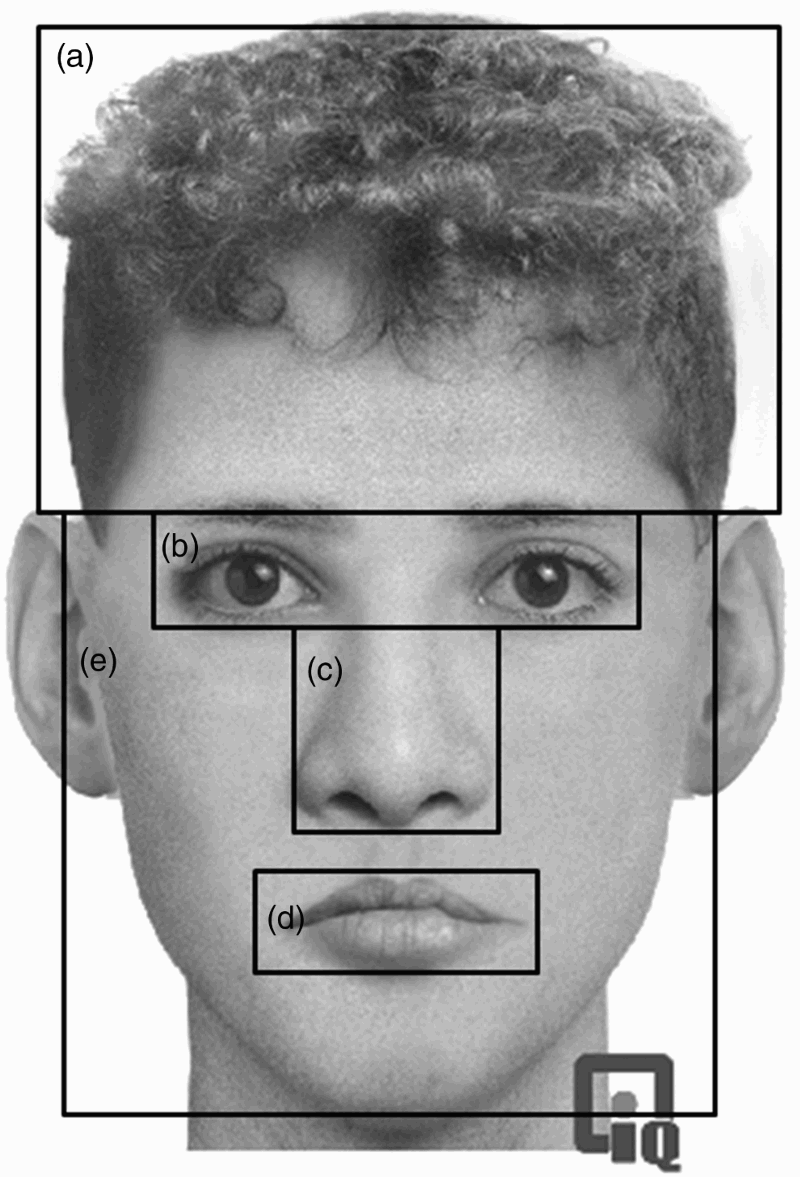
A face image used in this experiment with five AOIs mapped onto it: (a) forehead; (b) eyes; (c) nose; (d) mouth; (e) chin and cheeks. Note that the symbol in the bottom left corner is due to the software used to create the stimuli and was identical on all faces.
Stimuli were displayed on a high-resolution 15-inch LCD colour monitor from a Dell™ Inspiron™ computer running E-Prime Professional 2™. Keyboard button presses were recorded using E-Prime Professional 2™.
Design
A 2 × 2 × 2 within-subjects design was employed with the factors of the presence or absence of paraphernalia on the cue image, the target image, and the distractor image. Recognition accuracy was measured using the Signal Detection Theory (e.g., Swets, 1966) measure of stimulus discriminability, d’. Number and duration of fixations were recorded, as was saccade length. Accuracy, indices of distraction, and eye-movement measures were correlated with SPQ scores. The order of trials was fully randomized across participants.
Procedure
Testing took place individually in a sound-attenuated, air-conditioned laboratory. After providing informed consent, participants were given the paper-based SPQ to complete. This typically took approximately 5 minutes. Following this, each participant was positioned comfortably in front of the eye tracker, with his or her head resting in a chin rest. Each participant was then calibrated to the eye tracker using ClearView™ software, a process which involved the participant following a moving blue circle to nine pseudo-random locations on the screen. Calibration was successful for all participants at the first or second attempt. Immediately following this, the face recognition task commenced.
Participants were presented with 80 trials sequentially. Each trial consisted of the following structure: an inter-trial interval of 1 s, the cue face presented centrally, a 2 s inter-stimulus interval, and the test slide (see Figure 2 for a schematic of the procedure). In the test slide, two faces were presented side by side. Participants were asked to identify which of the two faces had the same identity as the cue face (the target) by pressing the “z” key for the left face and the “m” key for the right face. Participants were informed to ignore the paraphernalia. The test slide remained onscreen until participants responded. There was an equal number of trials across all conditions. The same paraphernalia item was used within each trial (e.g., the same hat was used on the cue, target, and distractor). The side of the screen on which the target face appeared was randomized by the E-Prime program. Eye movements were recorded for all face stimuli. Once all 80 trials were presented, participants were thanked and debriefed.
Schematic diagram of the trial structure used in this experiment. The trial shows the condition in which paraphernalia is on the cue face (a scar under the right eye) but not the target or distractor face.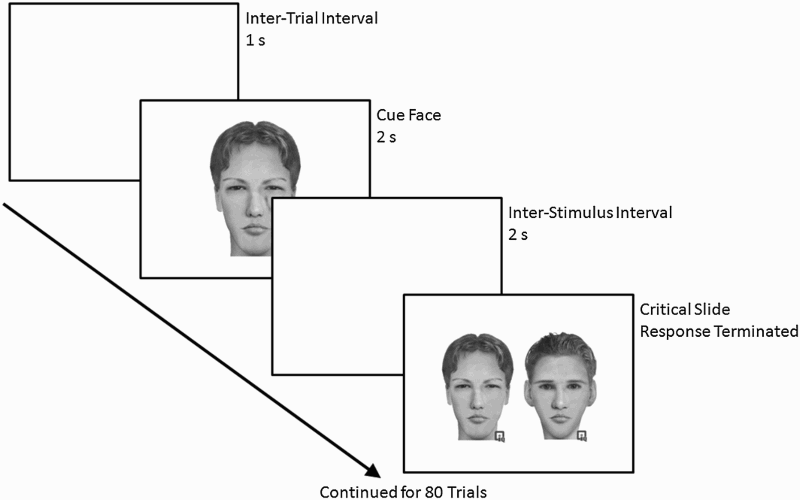
Results
A number of dependent measures were collected for this study. We shall present the behavioural data first, followed by the eye-tracking analyses. For clarity, we will only report significant and theoretically interesting findings. For a complete analysis, please contact the authors.
Behavioural data: recognition accuracy
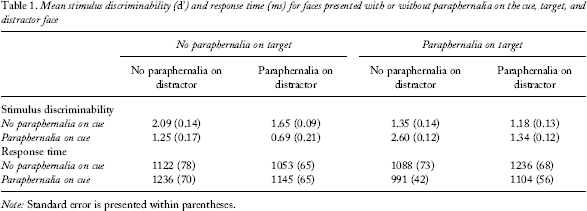
The raw data was converted into d’ using the Macmillan and Creelman (2005) method. In these types of experiments, d’ typically ranges between 0 and 4, where 0 is chance discriminability and 4 is near-perfect discriminability. These data are presented in Table 1 and were subjected to a 2 × 2 × 2 within-subjects ANOVA, with the factors of the presence or absence of paraphernalia on the cue face, the target face, and the distractor face. This analysis revealed a significant effect of paraphernalia when on the target face, F(1, 29) = 6.98, MSE = 0.33, p = .013,
Mean stimulus discriminability (d’) and response time (ms) for faces presented with or without paraphernalia on the cue, target, and distractor face
Note: Standard error is presented within parentheses.
The three-way interaction was significant, F(1, 29) = 7.36, MSE = 0.48, p = .011,
When there was no paraphernalia on the target face, there was a main effect of cue paraphernalia, F(1, 29) = 32.55, MSE = 0.74, p < .001,
The parallel analysis when there was paraphernalia on the target face revealed a significant main effect of paraphernalia on the cue, F(1, 29) = 30.29, MSE = 0.50, p < .001,
In summary, paraphernalia affected face recognition accuracy whereby accuracy was highest when the paraphernalia was matched from learning to test; any change in paraphernalia caused recognition deficits. Paraphernalia on the distractor faces caused detriments to recognition accuracy, especially when the cue and target faces were matched. The effect of paraphernalia on distractor faces was greater when the target and cue faces had paraphernalia than when only one face had paraphernalia. Indeed, when the cue and distractor faces had paraphernalia but the target face did not, recognition accuracy performance was at its lowest, indicating that in some instances the face was being recognized by paraphernalia rather than the features of the face itself.
Behavioural data: correlations with SPQ
Employing a series of Bonferroni-Šidák-corrected Pearson's correlations, we found that psychometric schizotypy correlated negatively with overall face recognition accuracy, r(28) = .60, p < .001. Specifically, the cognitive/perceptual and the disorganized behaviour subscales correlated negatively with face recognition accuracy, r(28) = .75, p < .001 and r(28) = .49, p = .018 respectively. Interpersonal interactions did not correlate with face recognition accuracy, r(28) = .35, p = .165. To address whether schizotypal personality is related to increased susceptibility to distraction due to paraphernalia on faces, we calculated an index of the cost of adding paraphernalia to each type of face (cue, target, distractor) by subtracting the recognition accuracy score when the face had paraphernalia from the recognition accuracy score when the face did not have paraphernalia. We correlated these costs of paraphernalia with SPQ scores. None of these correlations reached statistical significance. We also calculated other indices of distractibility by subtracting the conditions in which there was a change in paraphernalia from cue to target from when the paraphernalia matched cue and target. None of these indices of distractibility significantly correlated with SPQ scores.
Behavioural data: response time
We conducted a parallel analysis on response times, as presented in Table 1. This analysis revealed an interaction between paraphernalia on the cue and target face, F(1, 29) = 7.94, MSE = 89,582, p = .009,
Eye-tracking data
The eye-tracking data gave total time fixating in each region until the participant responded. Given that participants may take longer to respond in certain trials (see above), proportion of time spent fixating in each region was calculated by dividing the time in each region by the total time for that trial. Given the vastly different sizes of AOI (the chin and cheeks were 84 times larger than the nose), area-normalized scores were calculated by dividing the proportion of time spent fixating on each region by the proportion of the screen the AOI occupied. This calculation controls for the size of the AOIs and therefore provides a more valid method for assessing which areas are fixated on the most and is widely used in face recognition research (see, e.g., Bindemann, Scheepers, & Burton, 2009).
Given the complexity of the eye-tracking data, only significant and theoretically interesting results are presented. For all effects and interactions involving the factor “AOI”, the assumption of sphericity was violated (Mauchley's test was significant). Therefore, the Greenhouse-Geisser correction was applied to the degrees of freedom (e.g., Girden, 1992). Here we report the original degrees of freedom, but corrected MSE and alpha levels. Analyses were conducted on the eye-movement data for the learning (cue) trials separately to the test trials, given the fact that at learning there can be no effect of paraphernalia on target or distractor images, as these do not exist.
The learning data were subjected to a 2 × 5 within-subjects ANOVA, with the factors paraphernalia on cue face or not, and AOI. This revealed only an effect of AOI, F(4, 116) = 10.70, MSE = 1167, p < .001,
Eye tracking data: correlations with SPQ
Of critical importance to the aims of this study was identifying if schizotypal traits are associated to a scanning behaviour. To address this, we ran correlations between scores on the SPQ and the amount of time fixating on each region at learning and at test. This revealed that, both at learning and test, that SPQ score correlated negatively with fixation time on the eyes, r(28) = .35, p = .05 at learning and r(28) = .38, p = .039 at test, and positively with fixation time on the chin and cheeks, r(28) = .40, p = .028 at learning and r(28) = .41, p = .025 at test. To establish if this affected face recognition accuracy, we ran correlations between face recognition accuracy in each condition and time fixating on every region and found no significant correlations, largest r(28) = .15, p = .424.
We also ran correlations between SPQ scores and the eye-movement measures analysed by Manor et al. (1999) in their study on patients with schizophrenia. We found that SPQ score did not correlate with average fixation duration (r(28) = −.16, p = .392) or with total number of fixations (r(28) = −.07, p = .704), but did correlate negatively with scan path length (r(28) = −.40, p = .027). Consistent with Manor et al. (1999), scan path length is defined as the total distance travelled by the movement of the eyes over the face. The mean scan path length was 497 pixels. To establish if this affected face recognition accuracy, we correlated face recognition accuracy with scan path length, r(28) = .50, p = .005, and average duration of fixations, r(28) = .39, p = .032. This suggests that path length may mediate the relationship between schizotypy and face recognition. However, a mediational analysis (Baron & Kenny, 1986) revealed that this was only a partial mediation, given that the correlation between SPQ and face recognition remained significant even after controlling for scan path length (p = .002).
Discussion
We presented four hypotheses to explain why schizotypy correlates with face recognition: increased distractibility, deficient configural processing, social withdrawal and abnormal eye movements. Given that schizotypy has previously been shown to be associated with distractibility (Franke et al., 1994), we predicted that schizotypy would be associated with increased susceptibility to changes in paraphernalia on face images. We found no correlations between schizotypy and any measure of distractibility. One possible caveat with this interpretation is that encoding face images with paraphernalia is not necessarily a mistake when the face in unfamiliar. Given how difficult recognizing unfamiliar faces can be (Megreya & Burton, 2006), encoding paraphernalia with the face is likely to be a good strategy (since paraphernalia changes are not likely to occur within a single social interaction). Thus, paraphernalia might not be considered as a distraction when interacting with unfamiliar people but rather central to the task. Therefore, the effects of paraphernalia will not be enhanced in schizotypy.
We also hypothesized that schizotypy may be associated with a deficit in configural processing critical for face recognition (Shin et al., 2008). This should have been revealed through larger recognition deficits for conditions in which the paraphernalia changed from the cue to the target face in higher schizotypal participants. This too was not observed. These results indicate that schizotypy is unrelated to the amount of configural coding employed. However, there are two caveats with this explanation: the use of configural processing is not correlated with recognition accuracy (Konar, Bennett, & Sekuler, 2010); and the notion that paraphernalia effects are not observed when participants use configural coding (Freire & Lee, 2001) may not be entirely valid (this suggestion is based on data from the improvement in face recognition during childhood). A more valid measure of configural coding (such as inversion) could be more revealing in this case.
Our third hypothesis was that schizotypy would be associated with social withdrawal and this would affect face recognition through fewer fixations on the eyes (Manor et al., 1999). While we found that there was a negative correlation between schizotypy and the amount of time viewing the eyes and a positive correlation between schizotypy and the amount of fixations on the chin and cheeks, this did not predict face recognition accuracy. It has been observed that only a few central fixations (between the eyes) are required for accurate face encoding (Hsiao & Cottrell, 2008). This central fixation may lead to some form of holistic or configural coding. Thus, not looking at the eyes could mean that those with schizotypal traits do not fixate optimally and need to fixate other regions in order to accurately encode a face. Abnormal fixations, specifically avoiding looking at the eyes, may lead to social isolation (Loughland, Williams, & Gordon, 2002a, 2002b) given how important eye contact is for social interactions (Argyle & Dean, 1965), but not necessarily to deficits in face recognition. Similarly, the interpersonal dimension of schizotypy did not correlate with face recognition accuracy—rather it was the cognitive/perceptual and disorganized dimensions that correlated with face recognition accuracy. Therefore, our data does not support this hypothesis as an explanation for the reduced face recognition abilities in those with high schizotypy.
Finally, we predicted that schizotypy would be associated with abnormal eye movements and a restricted scan path, and that this would lead to poorer face recognition performance (Loughland et al., 2002a). We found that schizotypy was associated with the length of the scan path. This result is similar to that of Manor et al. (1999), who found that patients with schizophrenia showed a smaller scan path than control participants. We also found that the scan path negatively correlated with face recognition performance, suggesting that the correlation between schizotypy and face recognition is partially mediated by scan path restriction.
A restricted scan path is typically not solely observed when viewing faces in patients with schizophrenia (Williams et al., 1999), but this restriction may impair face recognition more than the perception of objects. This restricted scan path may be caused by reduced functioning of the dorsolateral prefrontal cortex, leading to a poorer working memory (Park & McTigue, 1997) and poorer integration of information (Schwartz-Place & Gilmore, 1980). Nevertheless, it indicates a deficit in allocating fixations to the most appropriate locations, leading to poorer encoding and thereby deficits in face recognition.
Of course, the results of this study suggest that the link between schizotypy and face recognition is only partially mediated by the scan path length. This implies that there are other variables that explain this link which we have not explored in the present study. Face processing is highly specialized, with dedicated and distributed neural processing (Haxby, Hoffman, & Gobbini, 2000) that is thought to be unrelated to general cognition (Wilhelm et al., 2010). Given this, the remaining part of the mediation between schizotypy and face recognition is not likely to be cognitive in nature, but rather due to motivational factors.
The observed correlation between schizotypy and scan path length conflicts with the results of Leonards and Mohr (2009), who did not find any association between schizotypy and scan path length. However, there are two reasons why this discrepancy may have been observed. Firstly, Leonards and Mohr used the magical ideation (Eckblad & Chapman, 1983) and the physical anhedonia (Chapman, Chapman, & Raulin, 1976) scales rather than the more widely used and standardized SPQ. The SPQ measures the full range of schizotypal traits rather than only the two subcomponents measured by Leonards and Mohr (2009). Secondly, participants in the Leonards and Mohr study were also required to scan the faces in order to answer unknown questions about them. This instruction may have encouraged more wide scanning by all participants than in the present study, whereby a speeded recognition decision was required. This, therefore, may have clouded any differences due to schizotypy.
Beyond the findings associated with schizotypy, this study is also one of the first to systematically describe the effects of paraphernalia on face perception. Paraphernalia changes did cause a detriment in face recognition performance for all participants, though the effects were not as large as those found by Patterson and Baddeley (1977). In the conditions where the target and the cue matched, accuracy was higher than when they did not. Face recognition in these cases could be based on pictorial codes (Bruce & Young, 1986) even though the cue and target images were of different sizes and in different retinotopic locations. Paraphernalia on the target face typically helped recognition due to the fact that when the cue and the target matched on paraphernalia, recognition accuracy was at its acme. Paraphernalia on the distractor face caused the biggest detriment to face recognition if there was paraphernalia on the cue face. In other words, there is evidence here that participants were making their recognition judgements based on the paraphernalia rather than on the face itself. This suggests that for the processing of unfamiliar faces, pictorial codes are more readily used, adding further evidence to the suggestion that unfamiliar faces are not necessarily processed as faces but as objects (Megreya & Burton, 2006).
In this study we attempted to explain why face recognition performance is associated with psychometric schizotypy in the general population. We have found that schizotypy negatively correlated with the amount of fixation on the eyes and positively with the fixation on the chin and cheeks. This may lead to impaired social interactions but does not appear to be correlated with face recognition performance. We have found that schizotypy is correlated with the scan path length and this is correlated with face recognition, similar to the effects observed in patients with schizophrenia (Manor et al., 1999). We have shown that a restricted scan path is associated with schizotypal traits and not restricted to schizophrenia and first-degree relatives. This suggests that the eye-movement dysfunction when viewing faces in schizophrenia is a core trait of schizotypy (Toh, Rossell, & Castle, 2011).