







Abstract
Three experiments examined the first-perspective alignment effect that is observed when retrieving spatial information from memory about described environments. Participants read narratives that described the viewpoint of a protagonist in fictitious environments and then pointed to the memorized locations of described objects from imagined perspectives. Results from Experiments 1 and 2 showed that performance was best when participants responded from the protagonist's first perspective even though object locations were described from a different perspective. In Experiment 3, in which participants were physically oriented with the perspective used to describe object locations, performance from that description perspective was better than that from the protagonist's first perspective, which was, in turn, better than performance from other perspectives. These findings suggest that when reading narratives, people default to using a reference frame that is aligned with their own facing direction, although physical movement may facilitate retrieval from other perspectives.
An inherent property of spatial memory is that it maintains information in a particular reference frame (Klatzky, 1998). For example, the memory of locations in one's immediate surroundings is generally believed to rely on an egocentric reference frame that maintains self-to-object relations. These egocentric representations are considered transient, updatable, and implicated in the moment-to-moment (or online) processing of spatial information (Kelly, Avraamides, & Loomis, 2007; Mou & McNamara, 2002; Waller & Hodgson, 2006). In contrast, the representations that refer to distal environments held in long-term memory are believed to be organized around allocentric reference frames. These enduring representations are thought to mediate decontextualized (or offline) spatial reasoning and to not be updated with the observer's movement (McNamara, 2003; see Avraamides & Kelly, 2008, for a discussion of online vs. offline spatial reasoning).
Research on enduring spatial representations encoded from sensory modalities suggests that people select an allocentric reference frame to organize information in memory based on a number of factors, including their learning viewpoint (e.g., Shelton & McNamara, 2001), the intrinsic structure of the layout (e.g., Mou & McNamara, 2002), the presence of environmental structure (e.g., Kelly, Avraamides, & Giudice, 2011), and experimental instructions (Greenauer & Waller, 2008). In fact, people weigh multiple cues that are available at the time of encoding, in order to select a reference frame (Galati & Avraamides, 2013).
Although everyday scenes provide an abundance of sensory information that can be used for reference frame selection, such cues are absent when learning about space indirectly from language: in linguistic descriptions reference frames are provided by the speaker or the text's author. When no reference frame is explicitly provided, people default to adopting a reference frame that is aligned with the first orientation described (Wilson, Wilson, Griffiths, & Fox, 2007). For example, in one experiment, Wilson, Tlauka, and Wildbur (1999) had participants either read or listen to descriptions of a U-shaped route and then carry out judgments of relative direction (JRDs), which involved pointing to a location on the route from an imagined perspective within it. Performance was faster and more accurate when the imagined perspective adopted during testing was aligned with the part of the route that was described first and the first direction of travel compared to other orientations. This finding was referred to as the first-perspective alignment effect.
In another experiment aimed to examine the first-perspective alignment effect further, Wildbur and Wilson (2008) manipulated whether the route description included the description of a salient landmark that was positioned as external to the route, thus providing an allocentric reference frame that could attenuate the advantage of the first perspective. When the landmark was included in route descriptions, it was aligned with the first perspective for some participants and counter-aligned with the first perspective for other participants. Performance on JRDs, after participants had read the route description, replicated that of Wilson et al. (1999): even when the landmark was included, performance was better for imagined perspectives aligned with the first perspective than for those counter-aligned with the first perspective. Thus, the provision of an allocentic reference frame (through the description of a salient external landmark) did not attenuate the first-perspective alignment effect.
A first-perspective alignment effect has also been reported by studies examining spatial reasoning in narratives (Avraamides, Galati, Pazzaglia, Meneghetti, & Denis, 2013; Franklin & Tversky, 1990). In the experiments of Avraamides et al. (2013), participants read short stories that described, in the second person, a fictitious environment with a number of objects placed in various positions around an implicit protagonist. Participants were instructed to adopt the perspective of the protagonist and, after memorizing the locations of all objects, to respond to JRD statements of the form “imagining facing X, point to Z”. In one experiment (Experiment 4), the participants’ physical orientation was manipulated so as to match or mismatch the protagonist's imagined rotation. Participants were also instructed to visualize the changes resulting from their physical rotation, since previous studies had suggested that explicit visualization instructions facilitate the updating of a remote environment, by linking its representation to the sensorimotor representation that maintains one's current surroundings (Avraamides & Kelly, 2010). Although participants at testing were physically misaligned with the protagonist's first perspective, they still performed best when responding from the imagined perspective that was aligned with that perspective, contributing to the proposal that the protagonist's first perspective in a narrative is important for constructing situation models.
Overall, a confluence of studies suggests that the first perspective has a special status in spatial memory representations that are constructed from information presented linguistically. One possible explanation for this is that when no reference frame is explicitly provided, readers establish a reference frame that is aligned with their own initial physical orientation, because this makes it easier for them to interpret spatial terms, such as “left” and “right”. Indeed, previous studies (e.g., Hintzman, O'Dell, & Arndt, 1981) have documented that people find it more difficult to differentiate between left and right from a perspective that is misaligned with their own.
In the present study we examine the limits of this first-perspective alignment effect by manipulating the salience of other perspectives relative to the protagonist's first perspective in order to determine whether readers, under some conditions, can organize their memories using perspectives other than the first. In the experiments of Avraamides et al. (2013), the first described perspective of the protagonist was also the one from which the locations were introduced in the text. It is therefore possible that the initial perspective was made salient by the fact that the object locations were described relative to it. To examine this possibility, in the present experiments we dissociated the protagonist's first perspective from the perspective from which most (Experiment 1) or all (Experiments 2 and 3) objects were described (hereafter, the description perspective). This was achieved by describing the protagonist as rotating to a different perspective before object locations were introduced in the narrative. If readers encode the described environment based on the protagonist's first perspective, as in previous studies, presumably by establishing a reference frame that is aligned with their own facing direction, then they should exhibit fast and accurate performance from that perspective. In contrast, if describing locations from a different perspective makes that perspective more salient, then readers should instead exhibit superior performance for imagined perspectives aligned with the description perspective. This latter possibility would suggest that the selection of reference frames when processing narratives is flexible and need not default to the protagonist's first perspective.
Experiment 1
In Experiment 1, participants read five narratives, each of which described a protagonist within a fictitious environment. Each environment contained eight objects located in different directions around the protagonist. Participants were instructed to imagine themselves in the position of the protagonist and memorize the locations of all objects in each described environment. Two of the objects were used to define the protagonist's first perspective, whereas the other six were described from a different perspective after the protagonist was described as rotating in the environment. Participants’ memory was then tested with pointing judgments towards the memorized locations of objects.
Method
Participants
Twenty students from the University of Cyprus participated in the experiment in exchange for a monetary compensation of 10€.
Materials
Materials included five narratives, one of which was used for practice. Each narrative was divided into six parts that participants read sequentially in a self-paced manner. The experimental narratives described an opera house, a hotel lobby, a construction site, and a museum; the practice narrative described a courtroom. These narratives were adapted from Franklin and Tverksy (1990) and were presented to participants in their native language (i.e., Greek). Descriptions in all stories were provided in the second person to encourage readers to imagine themselves as the protagonist. Four objects were initially described in each story and were located at canonical directions (i.e., front, back, left, and right) around the participant. These objects were later used to specify the imagined perspectives adopted in the pointing trials of the testing phase. Subsequently, another four objects were described as occupying the four corners of the room. These objects were used as the target stimuli in the pointing trials. Descriptions involved a mixture of allocentric and egocentric terms relative to the protagonist's orientation (i.e., “in the left back corner between the parking and the bench, you see a typewriter”) and included visual detail to encourage participants to create a vivid mental image of the described scene. An example of a narrative (translated from Greek to English) is included in the Appendix.
Design
The experiment followed a within-subjects design with perspective alignment as the independent variable. Perspective alignment indicates the relation of the imagined perspective of a given testing trial to the protagonist's described perspective at different stages of the narrative: the first perspective, which the protagonist first occupied when adopting a standpoint in the centre of the environment, the opposite-to-first perspective, which deviated 180° from the first perspective, the description perspective, which the protagonist occupied when the objects of the layout were described (i.e., 90° to the left or right from the first perspective), and the opposite-to-description perspective, which the protagonist was described as adopting following the description of the locations. While the protagonist was described as rotating to different perspectives, throughout the experiment participants remained in the same facing orientation.
Procedure
Participants first completed the practice block to familiarize themselves with the task and then proceeded with the four blocks of the main experiment. Each block consisted of a learning phase and a testing phase presented on a computer screen located at a comfortable distance in front of the participants. During the learning phase participants were first presented with an initial segment of a narrative that described the geometry of the environment and specified the protagonist's initial orientation in space. Specifically, the narrative described (in the second person) a protagonist entering a room through a door, walking towards the centre, and adopting an initial facing orientation (e.g., “you enter through the door and you are standing in the middle of the room facing the bench”). After this, participants read a second segment, which described the protagonist rotating 90° either to the left or to the right to inspect the locations of two other objects from another perspective (the description perspective). One of the objects was located in front of the protagonist and the other at the back of the protagonist. From this description perspective another four objects were described as occupying the four corners of the room. The protagonist was described as turning his or her head, without rotating the body, to inspect these objects (e.g., “ … you turn your head to the left, and at the back left corner you see a statue”). Finally, following the encoding of all object locations, participants read a segment of the narrative that described a sudden event (e.g., a loud noise, a telephone ringing, etc.) that caused the protagonist to turn around and face in the direction opposite to the description perspective. This opposite-to-description perspective was used to update the protagonist's facing orientation so that the final perspective would be aligned with neither the first perspective nor the description perspective. Then, a segment of text instructed participants to create a mental image of the described situation again and to think about where each object was relative to the protagonist from that final perspective. Participants had unlimited time to read the narratives, and they were allowed to go back and forth freely between the different narrative segments, which were presented as sequential displays on the computer screen.
Following the learning phase, participants carried out the testing phase, which involved a series of judgments of relative directions (JRDs). Participants listened through headphones to statements in the form of “you are facing the painting, point to the statue” and responded by deflecting a joystick to indicate the position of a target object from the imagined perspective described in the statement. The statements involved all the possible combinations between orienting objects (i.e., objects at canonical orientations) and target objects (i.e., objects at the diagonals, in the corners of the described rooms). While participants listened to a statement, the computer screen was blank, and the word “point” appeared to indicate when a response could be made. All audio clips presenting the JRD statements were 2 s long. Participants were instructed to respond as fast as possible without sacrificing accuracy. Response latency was logged by the computer and was measured from the end of a JRD audio clip until participants pressed the trigger on the joystick to enter their pointing response. Pointing responses were classified as correct vs. incorrect by rounding the exact angle pointed at to the nearest 45°-increment angle.
The four narratives were administered to participants in a randomized order. Also, JRDs were presented in a different random order to each participant. The direction of protagonist rotation (left or right) to the description orientation was counterbalanced across participants.
Results
Repeated-measures Analyses of Variance (ANOVAs) were carried out separately for accuracy and latency with perspective alignment as the within-subjects factor (levels: first, description, opposite-to-first, and opposite-to-description perspectives) and were followed by pairwise comparisons.
Accuracy performance differed across the imagined perspectives adopted at testing as documented by a significant main effect of perspective alignment, F(3, 57) = 13.89, p = .000, η2 = .42. As shown in Figure 1, participants were numerically more accurate when the imagined perspective at testing was aligned with the protagonist's first perspective (M = .94, SD = .05) than with the remaining perspectives. However, statistically, only the difference between the first and the opposite-to-first perspective was significant, p = .00. The pairwise comparisons of the first perspective to the description and to the opposite-to-description perspectives were not significant, p = .08 and p = .34, respectively. Accuracy did not differ when responding from the description perspective (M = .91, SD = .06) and the opposite-to-description perspective (M = .92, SD = .06), p = 1.
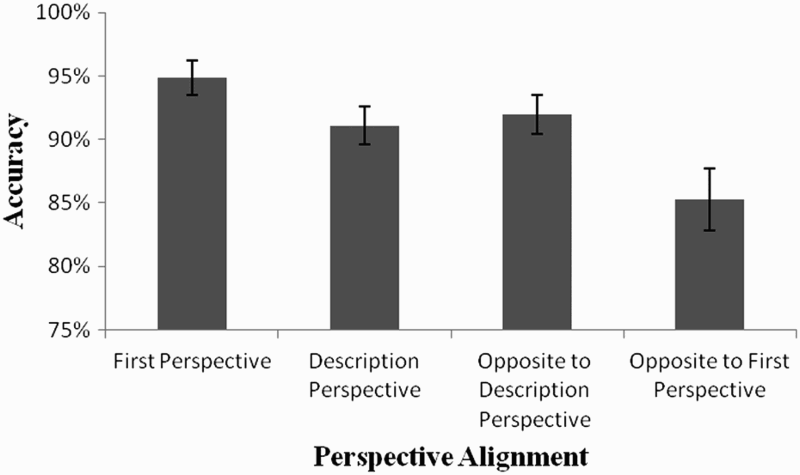
Proportions of correct responses across perspective alignment conditions for Experiment 1. Error bars represent standard errors from the ANOVA.
Response latency for correct responses showed the same pattern as accuracy (Figure 2). As with accuracy, there was a significant main effect of perspective alignment, F(3, 57) = 12.03, p = .000, η2 = .38. Participants were significantly faster to respond from the first perspective (M = 3584.63 ms, SD = 1684.63) than from any other perspective, all p < .05. Participants’ response latency did not differ when responding from the description perspective (M = 4412.82 ms, SD = 2369.90) and the opposite-to-description perspective (M = 4260.92 ms, SD = 2116.17), p = 1.
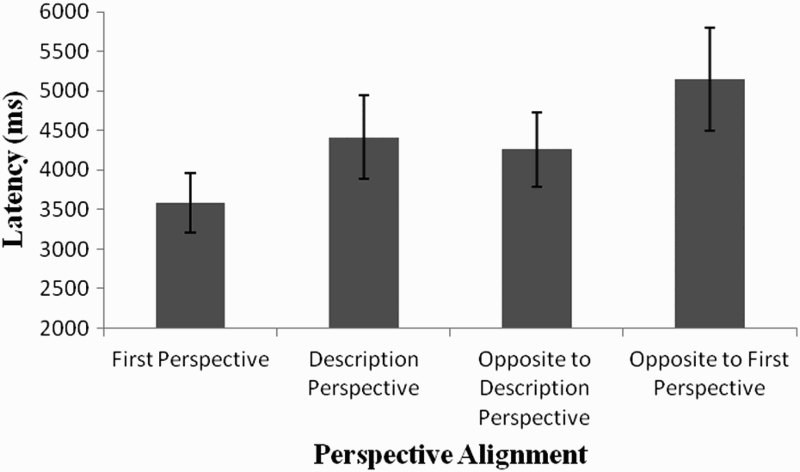
Response latency (in ms) across perspective alignment conditions for Experiment 1. Error bars represent standard errors from the ANOVA.
Discussion
Results from Experiment 1 showed that participants’ performance was best when responding from imagined perspectives aligned with the first perspective that the protagonist was described as occupying, replicating the first-perspective alignment effect reported in the literature (e.g., Wilson et al., 1999). Importantly, this advantage of the first perspective persisted despite the fact that the objects, other than the two used to specify the first perspective, were described from a novel perspective that the protagonist was described as adopting. Participants were significantly faster and numerically more accurate to respond from the first perspective relative to the description perspective. Thus, making a different perspective salient did not eliminate participants’ reliance on the protagonist's first orientation. This suggests that the first perspective introduced in a narrative has an important role for spatial memory, perhaps because it allows readers to set up the reference frame within which they can then encode incoming information.
However, a caveat to this conclusion is that, in order to establish this first perspective in Experiment 1, the locations of two objects were described. Although the majority of objects were described relative to a different perspective, the description of the first two objects could have encouraged participants to begin the encoding of information in spatial memory from the protagonist's first perspective. For this reason, in Experiment 2 we modified the narratives so that all objects were introduced from the description perspective, and no information was provided for the initial perspective of the protagonist in the scene. Therefore, if a first-perspective alignment effect is found in the absence of explicit information about the protagonist's first perspective, this will corroborate that participants default to their own physical orientation to establish a reference frame for encoding.
Another design limitation of Experiment 1 is that the protagonist's adoption of the final perspective may obfuscate any potential advantage of the perspective from which the object locations were described. Recall that, following the description of objects from the description perspective, the protagonist was described as rotating to the opposite-to-description perspective. If participants could update their mental representation during or following that described rotation, then any advantage of the description orientation might have been offset by an advantage associated with responding from an updated mental representation. Although previous studies suggest that automatic spatial updating does not take place during imagined movement (e.g., Presson & Montello, 1994), it is still possible that participants in this experiment deliberately updated spatial relations following the described rotation to the opposite-to-description perspective. To investigate whether describing locations from a particular perspective provides even a small performance benefit for that perspective, we have modified Experiment 2 so that the protagonist does not rotate to the opposite-to-description perspective following the description of locations. Instead, like other studies on spatial memory (e.g., Kelly et al., 2007), we use that perspective as a baseline to assess whether a benefit for the description perspective is present.
Experiment 2
In Experiment 2, all objects’ locations were introduced from the description perspective. In this version of the narratives, the new introductory text presented a protagonist standing in the centre of a room without mentioning any specific facing orientation, and then rotating 90° to the left or right to adopt the description perspective from which the locations of all objects were described. If the protagonist's first perspective is important for the organization of spatial information, then participants are expected to be faster and more accurate when responding from this than from any other perspective. Alternatively, if it was the description of the first objects in Experiment 1 that encouraged the encoding from the first orientation, leading to the first-perspective alignment effect, then participants in Experiment 2 are expected to exhibit best performance from the description perspective. However, even if a first-perspective alignment effect is observed in Experiment 2, the comparison between the description perspective and the opposite-to-description perspective will allow us to determine whether describing spatial information from a particular perspective yields a performance benefit for that perspective.
Method
Participants
Twenty-four student volunteers from the University of Cyprus participated in the experiment either voluntarily or for a monetary compensation (€10).
Materials, design, and procedure
Materials, design, and procedure were identical to Experiment 1, with two notable differences. First, the introductory text in Experiment 2 did not define a protagonist's initial orientation, as it did in Experiment 1. The protagonist was simply described as standing in the centre of the environment. Second, the sudden event that was described in Experiment 1 was moved prior to the protagonist assuming the description perspective. Whereas in Experiment 1 the sudden event caused the protagonist to rotate to adopt the final opposite-to-description perspective, in Experiment 2 the sudden event caused the protagonist to rotate 90° either to the left or the right of their implicit initial facing orientation (corresponding to the first perspective of Experiment 1) to assume the perspective from which object locations were subsequently introduced (i.e., “you hear a loud noise coming from the right side and you turn to see what happened”). This change allowed us to examine whether the description perspective has any performance advantage over a novel perspective that was never occupied by the protagonist, while also better motivating in the narrative the rotation of the protagonist to the description perspective.
Results
As in Experiment 1, repeated-measures ANOVAs, conducted separately for accuracy and latency, and pairwise comparisons were used to assess differences across levels of perspective alignment: the first, description, opposite-to-first, and opposite-to-description perspectives.
The pattern of results in Experiment 2 replicated that of Experiment 1. In terms of accuracy, a main effect of perspective alignment was observed, F(3, 69) = 7.37, p = .000, η2 = .24. As shown in Figure 3, participants responded most accurately when the imagined perspective corresponded to protagonist's first perspective (M = .94, SD = .07). The difference between the first and the opposite-to-first perspective (M = .86, SD = .15) was statistically significant, p = .01. Although accuracy from the first perspective was numerically higher than performance from the description (M = .90, SD = .13) and the opposite-to-description perspectives (M = .91, SD = .12), neither pairwise comparison reached significance, both p = .09. Accuracy performance did not differ when participants responded from the description perspective and the opposite-to-description perspective, p = 1.
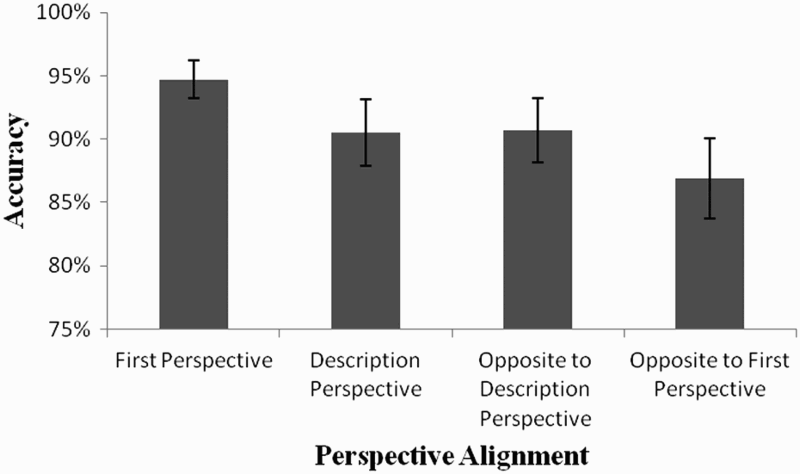
Proportions of correct responses across perspective alignment conditions for Experiment 2. Error bars represent standard errors from the ANOVA.
As with Experiment 1, the analysis of response latency paralleled the pattern observed for accuracy, with the main effect of perspective alignment being significant, F(3, 69) = 6.12, p = .001, η2 = .21. As shown in Figure 4, participants were faster to respond from the first perspective (M = 3798.47 ms, SD = 1893.13) than from any of the other perspectives, all p < .05. Latency did not differ when participants responded from the description perspective (M = 4790 ms, SD = 2776) and the opposite-to-description perspective (M = 4738 ms, SD = 2715), p = .1.
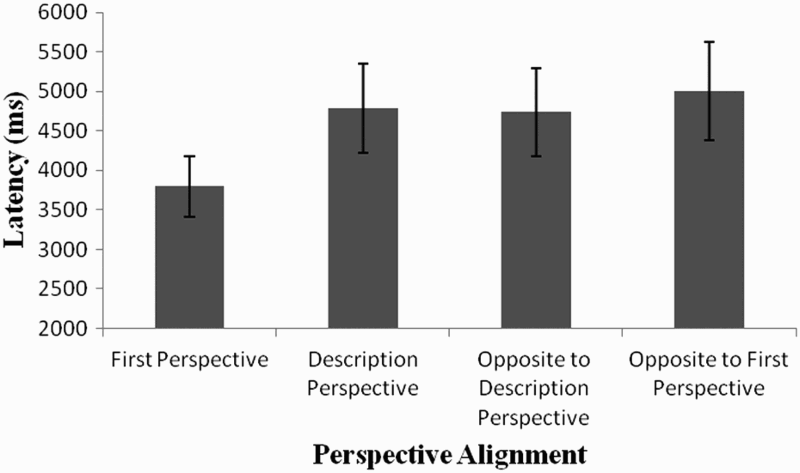
Response latency (in ms) across perspective alignment conditions for Experiment 2. Error bars represent standard errors from the ANOVA.
Discussion
Results from Experiment 2 revealed a significant first-perspective alignment effect despite the fact that this perspective was not explicitly defined by the narrative. The effect reported in Experiment 1 persisted, even though all objects were introduced in the narrative from a perspective other than the protagonist's implied first perspective.
Moreover, although the protagonist's orientation throughout the narrative differed across the two experiments, in both of them the opposite-to-description perspective showed similar performance. Performance for that perspective was worse than for the first perspective (numerically for accuracy and reliably for response latency) and comparable to the description perspective. That is, although at the end of the narrative, in Experiment 1, the protagonist was aligned with the opposite-to-description perspective, whereas in Experiment 2 the protagonist was not (they were aligned with the description perspective), that disparity did not influence performance from the opposite-to-description perspective. This isn't surprising because, in Experiment 1, that perspective was adopted late by the protagonist, and none of the object locations were described from it, thus affording little opportunity or motivation to organize spatial relations from that perspective.
Together, the findings of the two experiments suggest that the protagonist's first perspective, rather than the perspective from which locations are introduced, is used to organize spatial information in situation models. This finding is in line with the idea that if no reference frame is explicitly provided in language, readers and listeners default to a reference frame that is aligned with their own physical orientation.
To test the limits of this default behaviour, in Experiment 3 we increased the salience of the description perspective further, by having participants physically rotate along with the protagonist towards the description perspective. This modification could yield a greater benefit for the description orientation compared to Experiments 1 and 2 by promoting a stronger episodic memory trace of the environment from that physically adopted perspective. In addition, the compatible movement between participant and protagonist could also contribute to a greater advantage of the description orientation by promoting participant's use of a sensorimotor framework to encode object locations. If that is the case, the physical orientation of the participant during testing could influence performance by exerting sensorimotor facilitation or interference (May, 2004). To examine this, in Experiment 3 we had half participants carry out the pointing judgments while physically aligned with the description perspective and the other half after rotating back in alignment with the first perspective. We expected that participants’ rotation along with the protagonist towards the description perspective would strengthen the salience of this perspective. If so, performance should be best for the description perspective than the remaining perspectives. Alternatively, if the participants rotation’ does not exert sensorimotor facilitation/interference, then performance should be better for the first perspective than the description perspective. Although the findings from Avraamides et al. (2013) suggest the orientation of the participant during testing does not alter the perspective alignment effect, it is possible that it can influence performance if physical movement encourages encoding into a sensorimotor framework (see De Vega & Rodrigo, 2001, for a discussion on different levels of embodiment during narrative comprehension).
Experiment 3
In Experiment 3, prior to the introduction of object locations in the narratives, we instructed participants to turn along with the protagonist to face the description perspective. We also manipulated participants’ physical orientation at testing by having half of the participants carry out testing while physically aligned with the description perspective and the other half after rotating back to the first perspective. If participants linked the described objects to a sensorimotor framework, performance would be superior when the physical orientation of the participant matched the perspective from which information was maintained in memory. That is, if locations are retained from the first perspective, participants physically oriented with that perspective during testing would respond more efficiently than participants oriented along the description orientation. In contrast, if locations are maintained from the description orientation, then participants physically oriented with the description orientation would perform better than those oriented along the first perspective.
Method
Participants
Thirty-two student volunteers from the University of Cyprus participated in the experiment in exchange for a monetary compensation of 10€.
Materials, design, and procedure
Materials, design and, procedure were identical to Experiment 2, with two notable differences. First, after reading the introductory part of each narrative, when participants read about the protagonist's rotation, they swiveled in their chair 90o to the right or left of their initial physical orientation to face a second computer monitor. They continued reading the narrative on this monitor, which introduced object locations from this description perspective. Second, following the conclusion of the learning phase, an instruction appeared on the screen informing participants to either continue with the testing trials while facing the second monitor or to rotate back to their initial orientation and continue with testing on the first monitor. The physical orientation at the time of testing was manipulated across participants; half of the participants conducted testing from their initial orientation, while the other half proceeded to the testing phase without changing orientation.
Results
Mixed-model ANOVAs were conducted with perspective alignment as the within-subjects factor (levels: first, description, opposite-to-first, and opposite-to-description perspectives) and physical orientation during testing as the between-subjects factor (levels: first vs. description orientation).
As in Experiments 1 and 2, there was a main effect of perspective alignment on accuracy performance, F(3, 90) = 9.57, p = .000, η2 = .24. However, as Figure 5 reveals, participants were more accurate when responding from either the first (M = .83, SD = .16) or the description (M = .84, SD = .17) perspectives than the remaining two perspectives (M = .76, SD = .21 for both orientations), all p < .05. Performance did not differ between the first and the description perspectives, p = 1. Furthermore, although participants were numerically more accurate when they were physically aligned with the description orientation (M = .85, SD = .13) than with the first perspective (M = .74, SD = .20), the main effect of testing orientation did not reach significance, F(1, 30) = 3.437, p = .07, η2 = .10. Importantly, the interaction between testing orientation and perspective alignment was also not significant, p = .30.
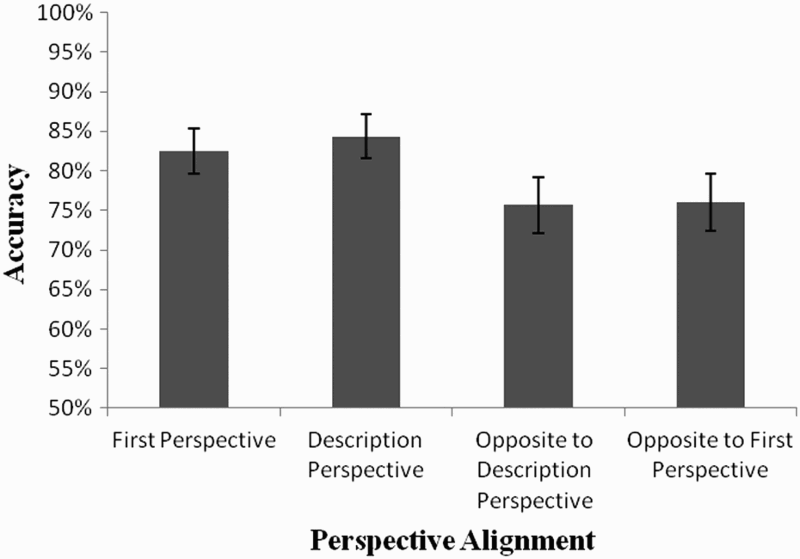
Proportions of correct responses across perspective alignment conditions for Experiment 3. Error bars represent standard errors from the ANOVA.
The effect of perspective alignment was also significant in the latency analysis, F(3, 90) = 16.79, p = .000, η2 = .35. As shown in Figure 6, participants responded significantly faster from the description perspective (M = 4340 ms, SD = 1867) than from any of the other perspectives, all p < .05. Moreover, participants also responded faster from the first perspective (M = 5054 ms, SD = 1826) than the opposite-to-first (M = 5801 ms, SD = 2332) and the opposite-to-description (M = 6133 ms, SD = 2599) perspectives, p = .047 and p = .002 respectively. In terms of participants’ physical orientation at test, that analysis showed similar performance for participants responding while physically aligned with the first perspective (M = 5378 ms, SD = 2148) and the description perspective (M = 5286 ms, SD = 1828), p = .89. Finally, the interaction between perspective and testing orientation was also not significant, p = .67.
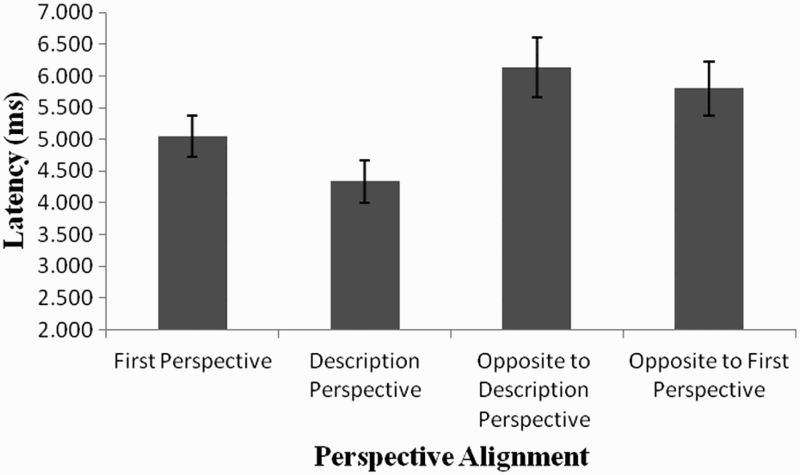
Response latency (in ms) across perspective alignment conditions for Experiment 3. Error bars represent standard errors from the ANOVA.
Discussion
Experiment 3 showed that participants’ performance was best when they responded from the description perspective compared to any of the other perspectives, including the first perspective in terms of response latency. Still, performance was superior from the first perspective compared to the opposite-to-first and the opposite-to-description perspectives.
The presence of a benefit for both the first perspective and the description perspective is compatible with two alternative explanations. First, it could be that some participants organized their memory based on the first perspective, while others relied on the description perspective. Averaging the data across participants who had used these two distinct encoding strategies could have yielded the obtained findings. Second, it could be the case that participants used the first perspective to structure their memory but then updated it when they physically rotated to the description perspective. If a trace of the initial representation is maintained in memory, as opposed to being overwritten during spatial updating, this could lead to an advantage for both perspectives.
To examine these possibilities we categorized participants according to whether their performance exhibited an advantage for the first, the described, or both perspectives, using the opposite-to-description perspective as a baseline. 1 Overall, 25 out of 32 participants exhibited an advantage for both orientations in either accuracy or latency. Of these 25 participants, 11 showed an advantage of both perspectives in both measures, whereas the remaining 14 showed an advantage for both perspectives but only for one of the measures (and no advantage of either perspective in the other measure). Only 3 participants showed an advantage for the first perspective (but not the description perspective) in at least one of the measures, and 4 an advantage for the description perspective (but not the first perspective) in at least one of the measures. This breakdown reveals that the majority of the participants showed an advantage for both perspectives, suggesting that both perspectives were used to organize spatial locations in memory. We return to this issue in the General Discussion.
For accuracy we subtracted each participant's mean score for the opposite-to-description perspective from the mean score for the first and the description perspectives. An advantage for a perspective was present if the result of the subtraction was positive. For latency, the terms in the subtraction were reversed, and the same procedure was used to identify advantages for the two perspectives of interest.
Finally, Experiment 3 showed that although participants were numerically more accurate (but not faster) to respond while physically aligned with the description than the first perspective, physical orientation at testing did not interact with perspective alignment. This suggests that even if participants encoded objects locations in a sensorimotor framework, they could rather easily ignore their own physical orientation at the time of testing.
General Discussion
The findings of the present study provide further insights about the first-perspective alignment effect documented in studies using described environments (Avraamides et al., 2013) or routes (Wildbur & Wilson, 2008; Wilson et al., 1999). In three experiments we examined whether readers would exhibit a first-perspective alignment effect even when a different perspective was made more salient by the description of locations and by the physical orientation of the readers. We assumed, based on the finding of previous studies (e.g., Wilson et al., 1999), that in the absence of explicit information about the protagonist's orientation in the scene, readers would project their own orientation onto the protagonist to establish a reference frame for the encoding of spatial information in memory. Here, we examined whether in the presence of cues that increase the salience of a different perspective, readers would override this initial reference frame and organize their memory along a different direction.
In Experiment 1, the protagonist was described as occupying a first perspective based on the description of two objects of the layout, which defined the protagonist's orientation in the scene. Even though the remaining objects of the scene were described from a novel perspective, participants’ performance in this experiment was best when locating objects from the protagonist's first perspective than from other perspectives. This finding replicates the first-perspective alignment effect reported elsewhere (Avraamides et al., 2013; Wildbur & Wilson, 2008; Wilson et al., 1999), but also extends those studies by demonstrating that this effect persists even when most of the objects to be memorized are described from a new orientation.
In Experiment 2, we completely dissociated the protagonist's first perspective from the description perspective: we did not provide any explicit information about the protagonist's initial orientation in the scene and introduced all objects from a different perspective. Despite this dissociation, participants still exhibited better performance when responding from the first perspective. Taken together, the results from Experiments 1 and 2 lend credence to our assumption that readers establish an initial reference frame that is oriented along with their own physical orientation. Furthermore, these experiments provided clear evidence that introducing object locations from a perspective other than the first does not eliminate the readers’ preference for the first perspective.
In Experiment 3 we increased the salience of the description perspective by having participants rotate along with the protagonist to the description orientation before locations were introduced. Furthermore, in this experiment participants carried out testing trials either remaining at the description perspective or after rotating back to the first perspective. In contrast to Experiment 1 and 2, results from Experiment 3 revealed that participants’ performance was best when responding to trials from the description perspective, although a first-perspective alignment effect (relative to the baseline opposite-to-description perspective) was still observed. Importantly, the performance advantage for the description and the first perspectives relative to the baseline was not caused by some participants preferring one perspective and others preferring the other: additional analyses corroborated that most participants exhibited a performance advantage for both the description and first perspectives.
Given the persisting first-perspective alignment effect in Experiment 3, what are the implications for how participants organized spatial information in memory? Our conjecture is that when reading narratives people establish, either automatically or purposefully, an initial reference frame that is oriented along their own facing direction. If a protagonist is described in a scene without an explicit facing direction, the protagonist is imagined to be oriented along with the reader's facing direction. This strategy supports comprehension by eliminating, at least initially, any costs associated with reference frame transformations (e.g., interpreting spatial terms such as front, back, left, and right from perspectives misaligned with one's own).
We believe that the protagonist's first perspective is superimposed on the reader's facing direction and is used as a reference frame for organizing information about described locations in spatial memory. Moreover, based on previous research with visual scenes (McNamara, 2003; see also Avraamides & Kelly, 2008 for a review), we propose that this reference frame is allocentric in nature—that is, it is centred on the described scene, it maintains object-to-object relations, and is not updated when the protagonist is described as moving. The reader, being an immersed experiencer who tracks the protagonist in space and time (Zwaan, 2004), can monitor the changes in the protagonist's orientation in the described scene relative to the fixed allocentric reference frame, but does not need to compute anew the changing protagonist-to-objects relations every time the protagonist is described as moving. This proposal is in line with findings from spatial updating studies with visual scenes documenting that egocentric (i.e., self-to-object) relations may be updated effortlessly with physical but not imagined movement (e.g., Rieser, 1989). Indeed, in Experiments 1 and 2, where readers had to imagine (but could not physically simulate) the protagonist's rotations in the environment, they did not show facilitation for any of the protagonist's subsequent perspectives; the first-perspective advantage of the protagonist persisted. By contrast, in Experiment 3, where participants physically rotated along with the protagonist to face the description perspective, that novel perspective did show facilitation, presumably because of the updating of spatial relations afforded by physical movement. In that case, readers might have still encoded locations within the allocentric reference frame that remained oriented with the first perspective, but also within an egocentric reference frame projected onto the protagonist that was aligned with them at the description orientation. This possibility can account for the presence of performance benefits for both the first and the description perspectives and is in line with recent theories of spatial memory, which posit the concurrent encoding of information in transient egocentric and enduring allocentric reference frames (e.g., Avraamides & Kelly, 2008; Mou, McNamara, Valiquette, & Rump, 2004; Waller & Hodgson, 2006).
Findings from all three experiments underscore the centrality of readers’ bodies to the process of encoding spatial information from narratives. First, readers seem to use their body's facing orientation as a reference frame for organizing spatial locations around the protagonist. The initial reference frame, aligned with the protagonist's first perspective, shows a persisting advantage when reasoning about the described environment across various task contexts. Second, the readers’ physical movement in conjunction with the protagonist's described movement enables them to use that updated perspective as an additional reference frame for encoding information. The compatible movement made along with the protagonist's described movement may help readers to create a link between the remote locations in a narrative environment and the sensorimotor framework that underlies spatial updating. The reported relevance of readers’ bodies to narrative processing is in line with studies demonstrating interactions between physical movement and the processing of described actions (e.g. Borregine & Kaschak, 2006; Glenberg & Kaschak, 2002; Kaschak & Borregine, 2008; Zwaan & Taylor, 2006) and more broadly with the view that representations of spatial information in situation models can have an embodied basis (Zwaan, 2004).
Beyond superimposing the protagonist's perspective on their own, readers in this study may, when selecting an initial reference frame, also have been influenced by their semantic knowledge about the typical structure of environments, in particular when the protagonist's first perspective is implicit. We acknowledge that typical spatial relations may indeed be part of the readers’ schema for particular environments (e.g., the orientation of the bench in a court or the reception in a hotel relative to the entrance), such that the preference of a first perspective congruent with that schema is particularly strong. In future studies, we plan to systematically examine whether the strength of the first perspective is attenuated when the described locations have spatial relationships incongruent with that environment's schema, or when the environment's schema does not include typical spatial relations.
In sum, our study reveals consistent preferences regarding the reference frames that readers select when encoding spatial information from narratives, while also demonstrating some flexibility in the selection of reference frames. We believe that this flexibility is not limited only to tasks relying on spatial memory representations but, rather, extends to other perspective-taking circumstances (e.g., the interpretation and production of spatial descriptions) in which people weigh various environmental and social cues to select a reference frame that may, in fact, override egocentric or other preferences (Duran, Dale, & Kreuz, 2011; Galati & Avraamides, 2013). Here, the protagonist's first perspective, which readers seem to align with their own facing direction, shows an overarching advantage even when all spatial information is subsequently described from another perspective. But when another perspective is reinforced by sensorimotor information, as when it is physically adopted by readers who simulate the protagonist's described movement, facilitation of additional reference frames is possible. The co-activation of these reference frames can be explained in terms of the concurrent recruitment of an enduring representation oriented with the first perspective and a transient representation that can be updated by the readers’ physical movement. In both cases, immersed readers construct an experiential simulation of the described situation, projecting the protagonist's orientation onto their own.