







Abstract
According to event cognition theory, people segment experience into separate event models. One consequence of this segmentation is that when people transport objects from one location to another, memory is worse than if people move across a large location. In two experiments participants navigated through a virtual environment, and recognition memory was tested in either the presence or the absence of a location shift for objects that were recently interacted with (i.e., just picked up or set down). Of particular concern here is whether this location updating effect is due to (a) differences in retention intervals as a result of the navigation process, (b) a temporary disruption in cognitive processing that may occur as a result of the updating processes, or (c) a need to manage multiple event models, as has been suggested in prior research. Experiment 1 explored whether retention interval is driving this effect by recording travel times from the acquisition of an object and the probe time. The results revealed that travel times were similar, thereby rejecting a retention interval explanation. Experiment 2 explored whether a temporary disruption in processing is producing the effect by introducing a 3-second delay prior to the presentation of a memory probe. The pattern of results was not affected by adding a delay, thereby rejecting a temporary disruption account. These results are interpreted in the context of the event horizon model, which suggests that when there are multiple event models that contain common elements there is interference at retrieval, which compromises performance.
The environment is a well-known source of influence on memory. Recent research has shown that the availability of information in memory can be impacted by the structure of the environment (e.g., Glenberg, Meyer, & Lindem, 1987; Radvansky & Copeland, 2006; Tamplin, Krawietz, Radvansky, & Copeland, 2013). That is, how well information is remembered is influenced by how it is distributed across different locations in experienced space. In one series of studies, people moved from one room to another, and memory for current information, such as the object being carried, was probed. The finding was that memory for this information is worse following a spatial shift than when simply moving across a large room (Radvansky & Copeland, 2006; Radvansky, Krawietz, & Tamplin, 2011; Radvansky, Pettijohn, & Kim, 2015; Radvansky, Tamplin, & Krawietz, 2010). This memory decline is called the location updating effect. The aim of the current study is to explore potential causes of this effect more deeply.
In the prior location updating effect studies, people navigated virtual environments while picking objects up and setting them down. The objects were various combinations of shapes and colours (e.g., blue disc). A person would pick one up and then walk either across the room or into another room, put the object down, pick the next one up, and so on. People were probed with the name of an object either halfway across a large room (no shift condition) or just after having entered a new room (shift condition). People responded “yes” if the probe was for either the object that was being carried or the one that was just set down and “no” otherwise.
The results of these experiments were that people made more errors after they had experienced a location shift. These results have been interpreted in the context of the event horizon model (Radvansky, 2012; Radvansky & Zacks, 2011, 2014). The explanation is that when a probe is presented there is retrieval interference because the probed-for object is represented in both the old and the current event models. This is similar to the fan effect (Anderson, 1974) in which the more locations an object is associated with, the harder it is to retrieve any one particular model (Radvansky, 1998, 2005; Radvansky, Spieler, & Zacks, 1993; Radvansky, Wyer, Curiel, & Lutz, 1997; Radvansky & Zacks, 1991), although in this case both of the models point to the same response. What makes this finding particularly surprising is that (a) people are expecting the memory test, (b) people are tested repeatedly (so they have familiarity with the task), and (c) only two objects need to be tracked (a relatively small memory load).
This basic finding has been observed when a person simply imagines travel from location to location (Lawrence & Peterson, in press), when probes consisted of pictures or word pairs (Radvansky et al., 2010), when the environment was displayed on smaller computer monitors and large screen monitors, and when a version of the task took place in actual, rather than virtual, reality (Radvansky et al., 2011). Because returning to the location in which the object was first encountered does not eliminate the effect, this is unlikely to be a version of the encoding specificity effect (Radvansky et al., 2011).
The aim of this study was to explore whether the location updating effect is due to causes other than those advanced previously. Specifically, Experiment 1 explored the possibility that the effect can be explained more simply as being due to differences in the retention interval that may be induced by travel time differences in the two conditions. This was assessed by tracking travel time in the virtual environment. Experiment 2 explored the possibility that the effect is due to a temporary disruption in processing that could occur as a person updates their event model from one room to the next by introducing a delay prior to the presentation of a memory probe.
Experiment 1
The aim of Experiment 1 was to assess whether the location updating effect could be due to a previously unassessed difference in retention interval. Specifically, in the prior work, the travel time from the point at which an object had been picked up to when a person encountered a memory probe was not recorded. It could be that in the location shift conditions, because a person needs to do the (slightly) more difficult task of navigating through a doorway, the time needed to do this may have been long enough to increase the duration of the retention interval. As such, the location updating effect may not be due to the movement from one event to another, but simply due to the greater passage of time, which results in greater forgetting. So, in Experiment 1 travel times from one location to another were recorded.
In addition to recording the travel times, Experiment 1 also included a change in how people interacted with the virtual environment and responded to the probes. In previous work, people navigated the virtual environment using arrow keys on a computer keyboard using their right hand, made their responses by pressing mouse buttons using their left hand, and picked up objects from a table was done by simply approaching the object in the virtual world. In contrast, in Experiment 1, people moved about using a joystick held in their dominant hand and made responses by pressing buttons on that joystick with the same hand. This provided an easier and more intuitive way to navigate the environment. Moreover, people picked up and set down the objects by touching the monitor with their nondominant hand, thereby increasing the interactivity of the experience. There is some recent work showing that interacting with things in the region of one's hands can influence performance (Davoli, Brockmole, & Goujon, 2011; Reed, Grubb, & Steele, 2006; Thomas, Davoli, & Brockmole, 2012).
Method
Participants
Forty-eight people (24 female) were recruited from the participant pool in the Department of Psychology at the University of Notre Dame and were compensated with partial course credit. Seven additional participants were replaced for motion sickness.
Materials, apparatus, and procedure
As in previous work, the virtual environments were created using the Valve Hammer editor. For this experiment, unlike previous studies, the displays were 46′′ diagonal touchscreen monitors (Samsung model #460TSN-2). The virtual environment was a 55-room series of locations. The rooms were two sizes. The large rooms were twice the length of the small rooms. This room size difference allowed for the distance travelled in the virtual world to be equated in the shift and no shift conditions. Within each room were either one or two rectangular tables, with each table placed along a wall. There was only a single table for the small rooms and a table in each half of each large room. On one table end was the object that was to be picked up, whereas the other half was empty. This empty spot was for the object taken from the previous table to be set down. There were two doorways per room, and they were never on the same wall. The objects that people interacted with were combinations of shapes and colours. The shapes were: cube, wedge, pole, disc, cross (X), and cone, and the colours used were: red, orange, yellow, green, blue, purple, white, grey, brown, and black. All combinations of shapes and colours were used once within the experiment. Note that although all shape–colour combinations were used, some were not probed.
In Experiment 1, after signing a consent form, people sat approximately 0.5 m from the display. Thus, the virtual world largely filled their field of view. Moreover, to make the experience more immersive, people wore headphones in which they could hear their own “footsteps” as they travelled, and the lights were turned off during the experiment.
The task was to pick up an object from the table, move to the next one either by moving across a large room (no shift) or by moving through a doorway to the next room (shift), place the object on the next table, pick up the next object, and so on. Picking objects up and setting them down was done by using the touchscreen. People were to use their nondominant hand to reach out and touch either the empty part of the table to set an object down or the object already on the table to pick it up. People moved through the virtual environment using a joystick held in their dominant hand. To ensure that people moved through the virtual world in the appropriate order, after a room was entered, the door behind them closed. The door to the next room did not open until the object being carried was set down on the table and the new object was picked up. In large rooms, an invisible wall prevented a person from crossing the room before setting the object down and picking the next object up.
To assess the availability of information there were 48 probe trials. Thus, people were not probed following every shift or in the middle of every room. On probe trials, immediately upon either moving halfway across a long room or moving into a new room, a probe appeared in the middle of the screen. The screen dimmed, and movement was disabled when the probe appeared, but the virtual environment could still be seen. People were instructed to respond “yes” if the probed object was either the one that was currently being carried or the one that had just been set down. They were also instructed to respond “no” to all other probes. These additional probes were created by recombining the shape and colour of the two potential “yes” probes. So, for example, if the carried object was a blue cone, and the set-down object was a green cross, a “no” probe might be “blue cross”. Participants responded by pushing one of two buttons on the joystick. The “trigger” button was used for “yes” responses, and a button at the top of the joystick marked “N” was used for “no” responses. There were 36 “yes” probes, 12 in the shift condition and 24 in the no shift condition. No shift probes were divided evenly between long and short rooms. Filler probes were presented to balance the number of “yes” and “no” responses. The experimental procedure typically lasted between 15 and 20 minutes.
Results and discussion
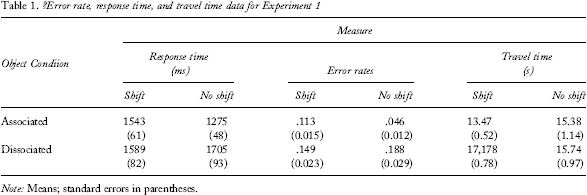
Error rate, response time, and travel time data for Experiment 1
Note: Means; standard errors in parentheses.
For the response time data, like the error rate data, the main effect of associated/dissociated was significant, F(1, 47) = 18.37, MSE = 148,161, p < .001,
Critically, for the travel time data, there were no significant differences, although the main effect of shift travel time was marginally significant, F(1, 47) = 3.04, MSE = 21,752,416, p = .088,
Experiment 2
The aim of Experiment 2 was to explore whether the location updating effect is due to a temporary disruption in processing as people update their event models. In all of the prior studies the probe was presented immediately upon either entering the second half of a large room or passing through a doorway. It may be that the memory disruption is due to a temporary disruption in processing. As a person enters a new event, some cognitive processes are needed to remove the prior event model from working memory and create a new event model to represent the current situation. The need to update one's event models has been the standard explanation for increases in reading time seen at event boundaries in the narrative comprehension literature (e.g., Zwaan, Magliano, & Graesser, 1995). Thus, cognitive resources that might be available to retrieval are otherwise occupied. It may be that this division of resources is what produces the shift effect that has been reported and as such is due to the immediacy of the person's experience.
To assess this, in Experiment 2, rather than having the memory probe appear as soon as a person was either halfway across a large room or just after they had walked through a doorway, there was a three-second delay. Three seconds was selected because this was thought to be a sufficient period of time for any updating to complete. The scenes presented in the experiment are also visually simple, consisting of the floor, walls, tables, and experimental objects. Many reading time studies find that reading time at event boundaries are often increased by less than one second. As such, three seconds should be sufficient for the updating process to complete. During the delay, the screen dimmed, and movement was halted, potentially freeing other resources to focus on model updating. At the end of the delay, the object probe appeared. If the spatial shift effect were due to retrieval interference, as has been suggested, then this delay time would have no influence on performance, and the location updating effect would emerge. In contrast, if this is a transitory effect of the updating process, then one would expect the location updating effect to be absent or attenuated in the presence of a delay.
Method
Participants
Fifty-seven people (33 female) were recruited from the participant pool in the Department of Psychology at the University of Notre Dame and were compensated with partial course credit. One additional participant was replaced for motion sickness during the task.
Materials, apparatus, and procedure
The same materials, apparatus, and procedure were used as those in Experiment 1. The only difference was that there was a three-second delay after ether crossing halfway across a large room or moving through a doorway before the probe was presented. During this delay, the screen was dimmed, and movement was disabled.
Results and discussion
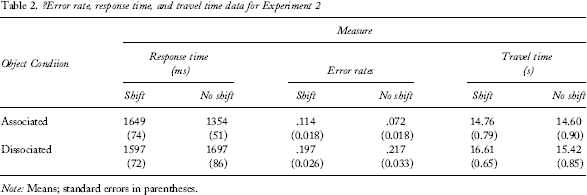
Error rate, response time, and travel time data for Experiment 2
Note: Means; standard errors in parentheses.
For the response time data, the main effects of shift/no shift, F(1, 56) = 4.10, MSE = 128,103, p = .047,
For the travel time data, the main effect of associated/dissociated was significant, F(1, 56) = 8.05, MSE = 13,896,415, p = .006,
Overall, the pattern of data for Experiment 2 largely replicates that seen in previous work. In this case, the experience of the shift was given more time to progress before the probe was presented, thereby allowing any cognitive processes that may have been initiated by the shift time to complete, or at least be further along. However, the additional time did not eliminate the increase in error rates associated with spatial shifts. This is more supportive of a view that suggests that this effect is due to retrieval interference experienced in response to the memory probe rather than a division of processing resources during the updating process.
The suggestion here is that the delay prior to the presentation of the memory probe did not affect the size of the location updating effect. To verify this more directly, we did a between-experiment analysis of the error rate, response time, and travel time data in Experiments 1 and 2. These data were submitted to separate 2 (experiment) × 2 (shift/no shift) × 2 (associated/dissociated) ANOVAs with experiment as a between-subjects factor and shift and association as within-subjects factors.
For the error rate data, the main effect of association was significant, F(1, 103) = 31.42, MSE = 1.10, p < .001,
For the response time data, there was a significant main effect of association, F(1, 103) = 19.88, MSE = 205,879, p < .001,
Finally, for the travel time data, the main effect of association was significant, F(1, 103) = 8.77, MSE = 163,000,000, p = .004,
Overall, the additional between-experiment analyses did not provide any suggestion that the location updating effect reflects a temporary disruption in processing due to a need for a person to update their current event models.
General Discussion
The two experiments reported here provide additional support for the idea that a change in location can disrupt memory for information encountered in those events. In Experiment 1, travel times were recorded to assess the possibility that the location updating effect is due to differences in the retention interval in the shift and no shift conditions. The results revealed that travel time was similar in these two conditions, thereby allowing a rejection of an account based on retention intervals. One concern that might arise is that travel time was not directly manipulated. However, this was done in an experiment reported elsewhere (Pettijohn & Radvansky, 2015) by varying the size of the rooms. Specifically, in the long condition, the travel distance of the room was three times the length in the short condition. If retention interval is responsible for the location updating effect, there should be a difference between the long and short conditions, with poorer memory performance in the long condition, but this was not the case. In that experiment, the location updating effect was observed with no difference between the long and short no shift conditions. Thus, it is the event structure that is disrupting memory, not the delay between encountering an object and the memory probe.
In Experiment 2 we assessed whether the location updating effect is due to a temporary disruption in processing as people were updating their understanding of the current event (e.g., Zwaan et al., 1995) because they have just changed spatial frameworks. To this end we added a three-second delay prior to the presentation of the probe. If the location updating effect reflects a temporary disruption in processing due to updating, then the delay should allow time for a person to recover, even if only partially. However, this was not the case.
The results of Experiments 1 and 2 are consistent with the event horizon model account that there is competition during retrieval because the associated object is part of two event models, one from the room in which it was picked up and another for the room a person has just entered. The effect is a result of the competition between these two event models during retrieval, even though they are both pointing to the same response.
An alternative account is that the location updating effect is due to reduced accessibility of the information because it is no longer in working memory. That is, this would be an effect of information from a previous event model being less available as it is removed from working memory (e.g., Glenberg et al., 1987; Radvansky, 2012; Radvansky & Copeland, 2001; Radvansky & Zacks, 2011, 2014; Zwaan, 1996). The idea that information from a prior event model is less available is consistent with the decline in availability of information in the dissociated condition as that object is not carried to the new event model. However, the result of central interest here is the effect of a shift in the associated condition, which lends itself to a competition-based account. Specifically, it is in this condition that the associated object is transferred from one event to another. Thus, there are two event models that contain the probed-for object. Radvansky et al. (2011) found that if a person travelled through two doorways, rather than one, the memory disruption increased. The explanation was that there were now three event models producing greater interference at retrieval. In another condition in which people travelled out of the original room into a second room (as in the shift conditions reported here) and then returned back to the original room, there was no difference in the pattern of data compared to the shift condition. Thus, this cannot simply be a case of the original event model being even further removed from working memory. One of two different things could have happened. First, returning to the original room could have reactivated the prior event model. If this were the case, performance in this condition should have been better than that in the shift condition. This did not happen. Alternatively, it could be that returning to the original room set up yet another event model. If this were the case, performance in this condition should have been worse than that in the shift condition (because the original event model would have been further removed from working memory) and perhaps should have been equivalent to that in the double shift condition. This also did not happen. The finding that performance in this return condition was equivalent to that in the shift condition led to the suggestion that retrieval interference underlies the memory disruption.
More generally, the current study is consistent with a broad range of work in cognitive science showing that characteristics of the environment and how one interacts with the environment can influence memory. Most directly, this work is relevant to research on environmental context-dependent memory (e.g., Smith & Glenberg, 1978; Smith & Vela, 2001) in that it shows that not only do people encode information about the context they are in during learning, but also that when information is distributed across regions, people relate it to those regions.
Less directly, this work has implications for research in fields such as narrative comprehension, autobiographical memory, memory retrieval, and working memory. In terms of narrative comprehension, this line of work developed from earlier lines of research on how people process spatial shifts when reading narratives (e.g., Glenberg et al., 1987; Radvansky & Copeland, 2001). The research reported here supports the idea that the processing and understanding of events is similar in reading and actual experience and is consistent with the finding that reading involves simulating the described experiences (Zwaan, 1999). Thus, one would expect that maintaining information across multiple events may sometimes impede later access, which has been found to be the case (Radvansky & Copeland, 2010).
Moreover, spatial location and a person's position within it are important for assessing the availability of information in memory during language comprehension (Morrow, Bower, & Greenspan, 1989; Morrow, Greenspan, & Bower, 1987 and interactive events, such as those reported here. This is consistent with the general finding that spatial framework information (where one was at the time) can be an effective memory cue (e.g., Radvansky & Zacks, 1991), and that common information stored across locations can produce retrieval disruptions (e.g., Radvansky, 1999), as was found here. This is also in line with research on autobiographical memory that spatial location can be an effective prime for experienced memories that occurred in those locations (e.g., Barsalou, 1988; Lancaster & Barsalou, 1997). In other words, the spatial structure of the experienced environment, in terms of the regions in which events unfold, has important consequences for the ease with which that information is later remembered. Thus, one would expect that autobiographical memory may sometimes be complicated by how elements of experience are distributed across events.
Finally, speculatively speaking, this work may have implications for the operation of working memory, broadly conceived. As noted earlier, the critical working memory load in this study is quite small. From one perspective, people needed to remember only two chunks of information, namely the associated and dissociated objects. Other work that we have done has found the location updating effect when people have a smaller working memory load and needed to remember only a single object (Pettijohn & Radvansky, 2015). Despite this, it is typically the case that memory error rates double or triple in this research paradigm when a person has moved from one event to another. What this finding implies is that working memory theories need to account for how working memory is processing information such that movement from one event to another disrupts processing. Is this a characteristic of working memory per se? If so, what is it about working memory processing that causes such a light memory load to be disrupted? There is unlikely to be some simple explanation, such as memory for the objects and the spatial movement involves a disruption of common processes that might be involved in working memory, such as processes of the visuospatial sketchpad, given that memory for verbal information is also disrupted (Radvansky et al., 2010). Alternatively, it may be that event structure influences on memory do not reflect the operation of working memory per se, but reflect the operation of other cognitive processes on working memory. However, the nature of such processes is unclear at this time.
Overall, the two experiments reported here support the idea that the structure of information across event models can affect memory. In our experiments people navigated through a virtual environment and responded to probes describing objects with which they had interacted. The basic finding was that memory was worse for objects the person was currently carrying following a spatial shift. According to the event horizon model, this is because the change in space triggers the creation of a new event model to accommodate the change. When an object is carried from one room to another, it is represented in both the old model and the newly created model. When a probe describing this object is presented, both models that contain a representation of the object must compete with one another, and the resolution of this competition is reflected in increased error rates and slower response times.
The current work further supports findings that suggest that changes in the unfolding events, and how information is structured in those events, can affect performance. This basic principle is not tied to experienced space, but also applies to more passive experiences, such as text comprehension (Curiel & Radvansky, 2002; Morrow et al., 1989; Radvansky & Copeland, 2010; Radvansky, Copeland, & Zwaan, 2003; Rinck & Bower, 2000) and watching film (Kurby & Zacks, 2008; Swallow, Zacks, & Abrams, 2009; Zacks, Speer, & Reynolds, 2009). The experiments reported here along with previous research demonstrate that the structure of events, unfolding as they occur, affects memory for information encountered in those events. In the present case, memory was made worse when people moved from one spatial framework to the next. Human cognition is strongly and meaningfully influenced by the structure of events (Radvansky & Zacks, 2014). By noting how people are experiencing a string of events, we can better understand how memory and cognition will be affected.