







Abstract
Metacognitive evaluations refer to the processes by which people assess their own cognitive operations with respect to their current goal. Little is known about whether this process is susceptible to social influence. Here we investigate whether nonverbal social signals spontaneously influence metacognitive evaluations. Participants performed a two-alternative forced-choice task, which was followed by a face randomly gazing towards or away from the response chosen by the participant. Participants then provided a metacognitive evaluation of their response by rating their confidence in their answer. In Experiment 1, the participants were told that the gaze direction was irrelevant to the task purpose and were advised to ignore it. The results revealed an effect of implicit social information on confidence ratings even though the gaze direction was random and therefore unreliable for task purposes. In addition, nonsocial cues (car) did not elicit this effect. In Experiment 2, the participants were led to believe that cue direction (face or car) reflected a previous participant's response to the same question—that is, the social information provided by the cue was made explicit, yet still objectively unreliable for the task. The results showed a similar social influence on confidence ratings, observed with both cues (car and face) but with an increased magnitude relative to Experiment 1. We additionally showed in Experiment 2 that social information impaired metacognitive accuracy. Together our results strongly suggest an involuntary susceptibility of metacognitive evaluations to nonverbal social information, even when it is implicit (Experiment 1) and unreliable (Experiments 1 and 2).
As social agents, we are highly sensitive to our conspecifics, effortlessly monitoring where they look and what they see, think or do. This sensitivity has adaptive value, as observing others’ interactions with the world provides us with potentially vital information about the environment. In particular, following another's gaze, often described as an automatic, reflexive behaviour (Langton, Watt, & Bruce, 2000), causes rapid attention shifts in the observer to the same location as that to which the observed agent is attending (Tipples, 2002). This informs the observer about the object of the gazing agent's attention, from which further information regarding their intentions or other mental states can be derived (Baron-Cohen, 1995; Materna, Dicke, & Their, 2008). Especially after establishing eye contact, gaze can serve as an ostensive cue, allowing the observer to predict that the direction of the observed agent's attention is going to be socially significant (Csibra & Gergely, 2009). Gaze following is thus a powerful mechanism through which we acquire information about the world (Becchio, Bertone, & Castiello, 2008; Csibra & Gergely, 2009; Feinman, Roberts, Hsieh, Sawyer, & Swanson, 1992).
Recent studies have demonstrated that reflexive tendency to process others’ gaze can affect our evaluations about objects in the environment (Bayliss, Frischen, Fenske, & Tipper, 2007; Bayliss et al., 2013; Bayliss, Paul, Cannon, & Tipper, 2006; Manera, Elene, Bayliss, & Becchio, 2014; Reid & Striano, 2005) in a similar manner to the opinions of others (Cample-Meiklejohn, Bach, Roepstorff, Dolan, & Frith, 2010). In three studies, Bayliss and colleagues presented participants with a face looking towards or away from a common object. Those objects that were looked at were later rated more likeable than those that were not (e.g., Bayliss et al., 2007; Bayliss et al., 2006; Manera et al., 2014; also see Treinen, Corneille, & Luypaert, 2012). Further, the objects gazed at with a happy face were rated as more favourable than those gazed at with a disgusted face (Bayliss et al., 2007). This liking effect seems to rely on the perceived intentional contingency between the gaze behaviour and the gazed at object (Manera et al., 2014). In addition, observing another gazing at one's chosen object can implicitly be perceived as confirmatory, influencing one's decisions in the following trials (Bayliss et al., 2013). These findings suggest that the salience, as well as the value we associate with an object, may change as a result of an observed interaction between another person and that object (Manera et al., 2014; for similar results, see Hayes, Paul, Beuger, & Tipper, 2008, also cf. Becchio et al., 2008). Observed social cues thus routinely influence our appraisal of the world. An interesting question is whether such social influence on our judgements, caused by reflexive processing of a nonverbal social cue (i.e., gaze), impacts our metacognitive evaluations of those judgements.
Metacognition refers to the processes by which one's cognitive operations are monitored and controlled (Proust, 2010). As we form a decision, we concurrently monitor our mental activity in order to assess the validity of that decision. In experimental work, metacognitive evaluations are often measured by a second-order decision, typically in the form of confidence judgements of the accuracy of one's response on the first-order task (Kepecs & Mainen, 2013). Studies on social influence on decision making have long shown that humans have a particular sensitivity to social cues, which is a heuristic with which individuals exploit information already acquired by others. They have a tendency to change their decisions or behaviour to match those of others (Asch, 1951). When a normative pressure to “fit in” is absent, this tendency is driven by an epistemic motivation, which is to achieve an accurate representation of the world (Deustch & Gerard, 1955; Festinger, 1954; Hogg, 2000; Laland, 2004).
Although sparse, there is some evidence to indicate that metacognition may also be susceptible to social influence. For instance, in one study, participants made predictive metacognitive judgements about the material they had previously learned as they received information about the recall performance of a reference group (De Carvalho Filho & Yuzawa, 2001). Participants’ confidence in future performance was modulated by how well the reference group recalled the material (for similar results see Karabenick, 1996). Studies on advice taking that provide feedback in form of explicit verbal information also report modulations in metacognitive evaluations of revised decisions, such that individuals tend to be more confident with their revised decisions than with their original ones (Kaliuzhna, Chambon, Franck, Testud, & Van der Henst, 2012; Yaniv & Milyavsky, 2007). These findings suggest that explicit information about others’ behaviour may not only cause us to alter our decisions and conform to the group, but also affect how confident we are in those decisions. One question that follows from this is whether or not social information available during interpersonal interactions would reveal similar effects. It is well known that social interactions rely, in great part, on the decoding of nonverbal signals (Mehrabian, 1971). Moreover, nonverbal signals are powerful enough to influence our evaluations of the world (Bayliss et al., 2007; Bayliss et al., 2006). Therefore, the first question we aim to investigate is whether nonverbal signals—that is, eye gaze—influence metacognitive evaluations of our decisions.
The second question we address concerns whether social feedback, besides affecting metacognitive evaluations, affects metacognitive accuracy as well. Metacognitive accuracy refers to the sensitivity with which subjective confidence evaluation discriminates correct from incorrect responses on the first-order task. Individuals who are overconfident or underconfident in their task performance are said to have low metacognitive accuracy. Metacognitive accuracy has a significant role in learning and decision regulation (Fleming, Dolan, & Frith, 2012). Low metacognitive accuracy (i.e., overconfidence or underconfidence) can trigger a misguided urge to either ignore potentially beneficial information or solicit information excessively. It has been shown that humans’ particular susceptibility to socially provided information may not always serve them well (Rendell et al., 2010). For example, collective decision-making studies have shown that deferring to undependable information leads to a decrease in future performance (Bahrami et al., 2010; Bang et al., 2014; Mahmoodi, Bang, Ahmadabadi, & Bahrami, 2013), yet to an increase in confidence (e.g., Kaliuzhna et al., 2012; Yaniv, 2004). These findings imply a potential risk of unreliable social feedback jeopardizing metacognitive accuracy, which may have important implications for future behaviour. In the present study, we ask whether our susceptibility to socially provided information has any direct bearing on the accuracy of our metacognitive evaluations by providing individuals with random and, in contrast to the above-mentioned studies, nonverbal and task-irrelevant feedback.
The aim of this study was to investigate whether metacognitive evaluations (i.e., retrospective judgements of confidence in one's decision) would spontaneously be influenced by the following social information when elicited by a nonverbal social cue such as gaze direction, even when the cue was entirely irrelevant for task purposes. We also tested whether such a potential influence may further impair metacognitive accuracy. To address these questions, we developed a paradigm that included a first-order perceptual decision task (two-alternative forced choice), which was followed by a subjective rating of decision confidence. After making their decision on the first-order task, and before providing a confidence rating, participants were presented with either a face or a nonsocial cue (i.e., car), orienting towards one of the two alternative response options. The cue randomly pointed either at the object consistent with the response option chosen by the participant (congruent condition) or at that consistent with the other response option (incongruent condition). Crucially, in the initial experiment, the participants were explicitly instructed to ignore these cues as they were not directly relevant to the task purposes.
We also manipulated the difficulty of the first-order task in order to test whether social influence on decision confidence would depend on this variable. It is known that decision confidence, just as performance accuracy on the first-order task, tends to scale inversely with task difficulty, with difficult trials leading to low levels of certainty (Oppenheimer, 2008). Moreover, as shown by the social psychology literature, low level of certainty makes people more susceptible to social influence and more likely to conform to others (Festinger, 1954; Kaliuzhna et al., 2012; Laland, 2004; Yaniv, 2004), suggesting that involuntary social influence on decision confidence depends on task difficulty. We made four predictions. First, if the perceived gaze renders the attended response option potentially significant for the observer, we would expect a modulation of confidence ratings as a function of gaze direction. Confidence in one's chosen response option would thus increase as compared to a baseline condition, in which no cue is provided, if the same response option is perceived to be selected by another, and decrease if the participant perceives the alternative response option to be selected. Second, this effect is not expected with a nonsocial cue, such as a car orienting towards response alternatives. Third, a spontaneous assessment of nonverbal social cues is expected to occur especially when an individual's level of confidence is low. The modulation of confidence as a result of social cueing is thus expected to scale with task difficulty: Difficult trials would trigger low levels of confidence, thus leading to a greater change in confidence levels for difficult trials than for easier trials (Festinger, 1954). Finally, given that the social feedback provided was completely random, and hence unreliable, the social influence should impair how well confidence ratings reflect the accuracy of decisions (i.e., metacognitive accuracy).
Experiment 1
Method
Participants
Seventy-nine volunteers were randomly assigned to one of the two cue type groups (face vs. car). Data from seven participants were excluded from analysis because their mean accuracy was more than two standard deviations above or below the group mean. Thus, analysis included data from 36 participants in the face group (13 males, mean age = 25.9 ± 0.9 years) and 36 in the car group (11 males, mean age = 26.8 ± 1.5 years). All participants were right-handed with normal or corrected-to-normal vision and were naive to the experimental aims. Participants gave their written informed consent and received €15 for participation.
Stimuli
The first-order perceptual task was a number estimation task where participants judged whether target displays contained more or fewer dots than a reference display. The displays consisted of arrays of white dots (10 pixels in diameter) randomly distributed on a black disc (320 pixels in diameter), with at least 10 pixels separating one dot from another. For target displays, the number of dots varied from 32 to 68 by increments of 4, while the number of dots was fixed at 50 for the reference display. Task difficulty was manipulated by varying the difference in dot numbers separating the target from the reference displays. This difference ranged from ±2 to ±18 dots in five increments yielding five levels of task difficulty. Forty different target displays were randomly generated for each level of difference, as well as 10 different reference displays.
The stimuli used for the directional cues consisted of 10 pictures of faces (5 males, 5 females) with neutral expression and 10 pictures of cars, both in full frontal and in three-quarter views, in both directions. The faces were selected from the Radboud Faces Database (Langner et al., 2010), and the car pictures were chosen from a web-based collection (http://www.cars.com). All stimuli were converted to a 256 grey-level format, rescaled proportionally to a size of 640 × 640 pixels, and matched in luminance.
Procedure
Participants were tested individually in a shielded room. They were seated approximately 90 cm away from a 17-inch LCD monitor. The stimuli were presented by E-Prime 2.0 software (Psychology Software Tools, Inc., Pittsburgh, PA).
The experiment consisted of 10 blocks of 40 trials each, with the reference display presented once every 20 trials, which remained on screen for a duration of 3000 ms. Each trial began with a fixation cross of 400-ms duration, followed by a brief target display of 100-ms duration. Following that, the words “fewer” and “greater” appeared, respectively, on the left and on the right half of the screen and remained until a response was registered. The task was to decide whether the target display contained greater or fewer dots than the reference display. After responding with a mouse-click, participants were asked to indicate their level of confidence in their response using a vertical scale ranging from 0 (not confident at all) to 100 (very confident; Figure 1). In each block, half of the trials constituted the baseline condition in which no cues were presented between the perceptual task and the confidence rating. On these no-cue trials, a fixation cross followed the response and remained on screen for 1500 ms. In the other half of the trials (congruent and incongruent), a fixation cross remained between the two response alternatives for 200 ms. This was followed by a picture of a face or car, in full-frontal view, for 900 ms. This picture was then replaced with the same stimuli but displayed in a three-quarter view (left or right) for 400 ms. The succession of the two pictures (frontal and then angled) created an apparent motion where the face or the car appeared to turn towards one of the two response alternatives. For the congruent trials (25%), the stimulus turned toward the response option just chosen by the participant, irrespective of its correctness. For the incongruent trials (25%), it turned away from the participant's response. Incongruent and congruent trials were presented in random order, but occurred equally for each level of difficulty. In both cue groups (face and car), participants were instructed that these directional stimuli were completely uninformative with respect to the correct response to the dot question and should therefore be ignored. The experiment began with a training session of 10 trials.
Schematic illustration of an example trial in which the participant responded as “GREATER”. The first row represents a no-cue trial (50%), the second and the third congruent or incongruent trials (25% each). Face in figure is taken from the Radboud Database, and reproduced with permission.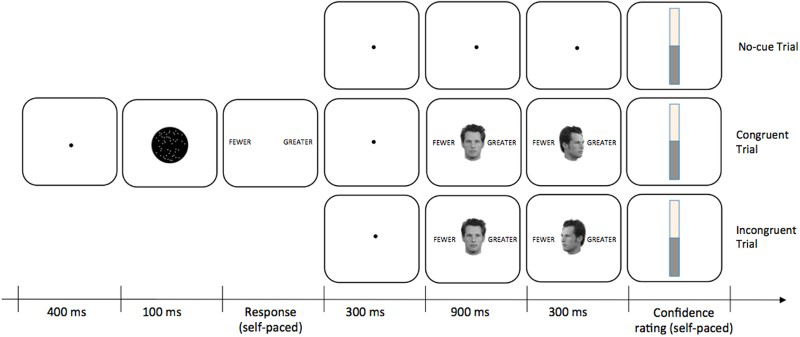
Analysis and results
Number estimation task
Means and standard errors for accuracy and reaction time data for Experiment 1
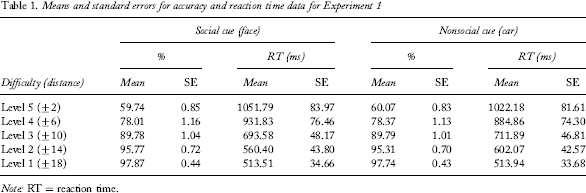
Note: RT = reaction time.
Confidence ratings
A 5 × 3 × 2 mixed-design ANOVA was carried out to analyse confidence data, with within-subjects factors difficulty and cue direction (congruent, incongruent, or no-cue) and with between-subjects factor cue type (face vs. car). The results yielded a significant main effect of difficulty, F(4, 272) = 251.090, ε = .36, p < .0001. Overall confidence ratings decreased with increasing levels of task difficulty (planned comparisons with Bonferroni correction, all ps < .05). Importantly, a significant two-way interaction between cue direction and cue type was found, F(2, 136) = 3.75, ε = .96, p < .05 (Figure 2). Confidence levels did not change with cue direction in the car group. In the face group, only the difference in confidence ratings between congruent and no-cue trials was significant, t(35) = 2.29, p < .05. The difference between incongruent and no-cue trials did not reach significance, t(35) = −0.08, p > .5.
Subjective confidence levels in Experiment 1 as a function of the cue direction and cue type (face vs. cars). The plotted data are confidence values on congruent and incongruent trials after confidence values on no-cue trials are subtracted.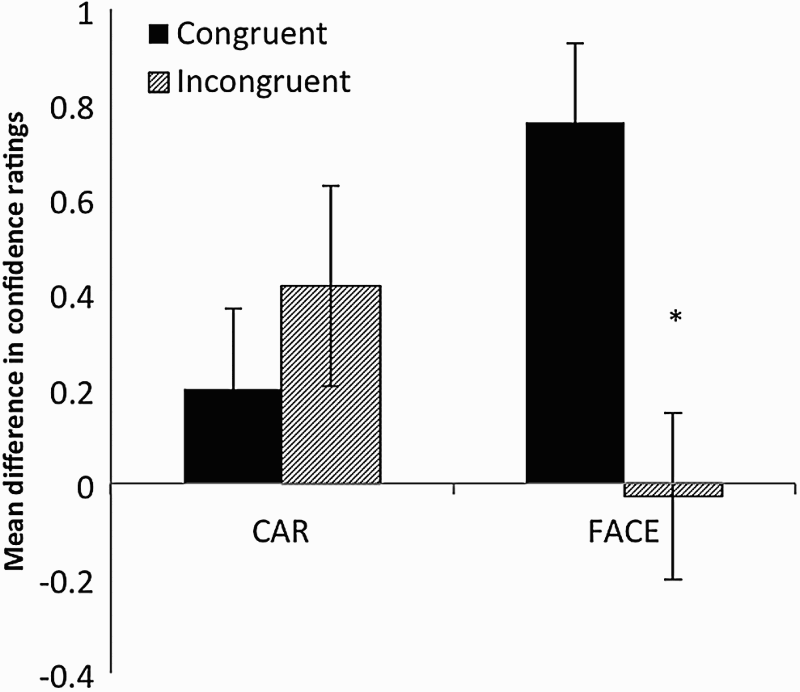
Metacognitive accuracy
We also computed participants’ metacognitive accuracy for each condition. Metacognitive accuracy, in this context, refers to how well one's decision confidence reflects objective task performance. It is commonly quantified as the relation between the accuracy performance in the first-order task and the confidence rating using the Type II receiver operating characteristic (ROC) curve (Fleming, Weil, Nagy, Dolan, & Rees, 2010). The Type II ROC curve reflects one's ability to discriminate between one's correct and incorrect decisions on the first-order event. It is a measure of the probability of being correct on the first-order task (i.e., number estimation) for a given level of confidence. The area under the ROC curve (Aroc) indexes a participant's metacognitive accuracy. In order to test whether social cues influence one's metacognitive accuracy, as it does one's subjective confidence, we calculated Aroc values per subject per each cue direction condition (congruent, incongruent, no-cue) (Galvin, Podd, Drga, & Whitmore, 2003). We performed a 3 × 2 ANOVA between the factors cue direction and cue type. The factor difficulty was not included for two reasons. First, the impact of social cues on confidence did not depend on task difficulty. Secondly, the number of observations per condition would not be sufficient for a reliable ROC analysis if broken down by difficulty level. The results revealed no significant main or interaction effects (Figure 3). The orientation of the cue did not modulate metacognitive accuracy in the face (p > .1) or in the car group (p > .1).
Mean area under the curve (Aroc) in Experiment 1 plotted as a function of the cue direction (incongruent vs. no-cue vs. congruent) and cue type (face vs. cars). The plotted data are values on congruent and incongruent trials after values on no-cue trials are subtracted.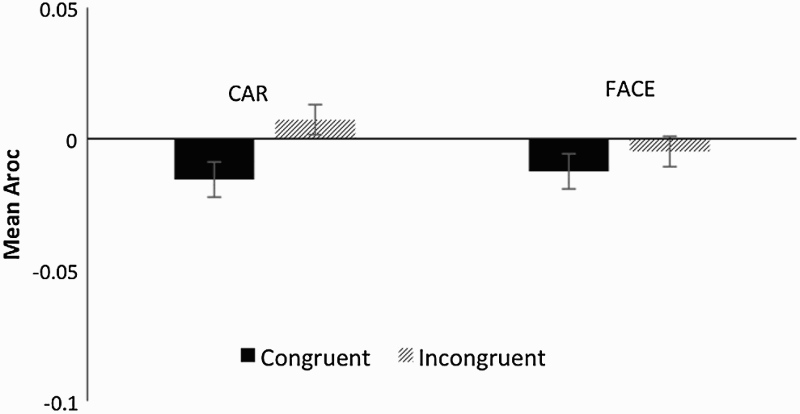
Discussion
In this experiment, we investigated whether simply observing another person gazing at one of the response alternatives in a first-order task would result in a spontaneous modulation of participants’ confidence judgements and metacognitive accuracy. The results provided partial support for our hypotheses.
Confirming our predictions, confidence was affected by the direction of the face, and not by that of the car. That is, effects on confidence were driven by the condition in which the cue was social by nature. Thus, participants spontaneously adjusted their confidence ratings as a function of the information provided by gaze direction, raising their confidence when the face oriented toward the response chosen by the participant as compared to when the face oriented toward the alternative response or when no social cue was present. In contrast, this effect was not elicited by the orientation of cars. We noted that the effect was mainly driven by congruent trials. This suggests that an implicit agreement by the observed gazer resulted in a larger change in confidence than an implicit disagreement. The observed asymmetry in confidence ratings between congruent and incongruent trials is probably due to a confirmation bias and is in line with the proposal that eye gaze can act more as a positive (rather than a negative) reinforcement (Bayliss et al., 2006), activating the brain's reward circuitry (Kampe, Frith, & Frith, 2003).
As expected, confidence also scaled with task difficulty. Confidence decreased, whereas RTs and errors increased, with increasing levels of task difficulty. This confirms that metacognitive evaluations, as indexed by retrospective confidence ratings, were sensitive to task fluency—that is, the ease with which the information was processed (e.g., Alter & Oppenheimer, 2009; Oppenheimer, 2008). People are indeed more confident in their performance when a task is experienced as fluent rather than disfluent (e.g., Kelley & Lindsay, 1993; Koriat, 1993; Simmons & Nelson, 2006). Surprisingly, however, we did not find a modulation of social influence as a function of task difficulty: The magnitude of the social influence on confidence levels did not change depending on the difficulty of the task. This indicates a lack of trade-off between two types of information (internal fluency and external social information). Instead, we find that both types of information contribute independently to the formation of confidence judgements.
Our results suggest a mechanism that grants a reflex-like sensitivity to social feedback during metacognitive evaluations. Note that the information provided by the cue in this experiment was entirely random and independent of the first-order task. The cue oriented towards each of the response alternatives 25% of the time, irrespective of the correct response to the question and of the response chosen by the participant. Further, the cue was presented as irrelevant to the task via explicit instructions. Therefore, our results confirm that gaze direction is spontaneously processed as a meaningful cue, altering the relative salience of the stimuli for the participants. The (mis)information then gets incorporated into their metacognitive evaluations, consequently modulating confidence ratings.
The results of Experiment 1 thus indicate that confidence ratings are susceptible to implicit social feedback signalled by nonverbal cues. However, this susceptibility does not seem to be powerful enough to alter one's metacognitive accuracy. Indeed, our findings further show that participants were adept at monitoring their response on the first-order task on no-cue trials as well as on trials where they received social feedback (Aroc ps < .001 for all conditions; Figure 3).
We conducted a second experiment in which the meaning of the cues was contextually enhanced. Here, the participants were instructed that the direction of the cues (face and car) reflected a previous participant's responses to the first-order task. In contrast to the previous experiment, the information provided by both cues was socially meaningful and provided explicit information. The cues, however, remained objectively unreliable for the task; the direction of the cue was randomly distributed independently of the participants’ response. In addition, and importantly, the participants were not instructed to consider the feedback while monitoring their confidence. We thus still explored an implicit effect of social cues on metacognitive evaluations. We expected both cues (face and car) to trigger a similar pattern of effects as revealed in the face group of Experiment 1. Secondly, if social influence on metacognitive evaluations (decision confidence) is indeed driven by an epistemic motivation—that is, an adaptive urge to achieve an accurate model of the world—then metacognitive accuracy should be altered by the explicit social feedback provided by both types of cues as they are both socially meaningful.
Experiment 2
Method
Participants
Sixty-six volunteers were randomly assigned to one of the two groups. Data from five participants were excluded from analysis because mean accuracy was more than two standard deviations above or below the group mean. Thus, data from 33 participants in the face group (10 males; mean age = 26.5 ± 1.0 years) and 28 in the car group (12 males; mean age = 25.7 ± 1.3 years) were analysed. Participants presented similar characteristics to those in Experiment 1, gave their written informed consent, and received payment for their participation.
Stimuli and procedure
The stimuli and the procedure in Experiment 2 were similar to those used in Experiment 1 except for instructions. Here, we informed participants that the orientation of the cues (face or car) reflected the response given by a previous participant to that particular trial. Moreover, in order to reinforce this belief manipulation, participants in the face group were photographed before the training session and were led to believe that their photographs would be used in subsequent experimental sessions to represent the responses they gave. Participants in the car group selected a car image they liked for the same purpose.
Results
Number estimation task
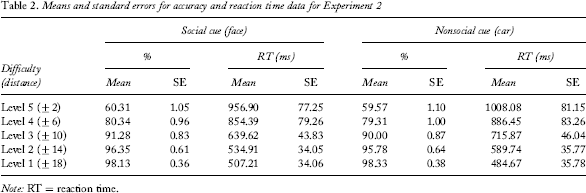
Means and standard errors for accuracy and reaction time data for Experiment 2
Note: RT = reaction time.
Confidence ratings
The 5 × 3 × 2 mixed-design ANOVA conducted on subjective confidence revealed, as in Experiment 1, a main effect of difficulty, F(4, 236) = 229.17, ε = .35, p < .001. Planned comparisons with Bonferroni correction showed that confidence decreased with task difficulty (all ps < .05). As in Experiment 1, confidence scaled with task difficulty. A significant main effect of cue direction was also found, F(2, 118) = 13.85, ε = .65, p < .0001. Confidence levels were higher on congruent than on incongruent, F(1, 59) = 15.38, p < .001, and no-cue trials, F(1, 59) = 23.14, p < .001 (Figure 4). In addition, confidence levels were marginally lower in incongruent than in no-cue trials, F(1, 59) = 3.73, p = .058 (Figure 4). There was no significant interaction between cue type and cue direction. We also directly compared the confidence increase following congruent trials and the reduction following incongruent trials and found the difference significant [all participants: F(1, 59) = 5.0, p < .05] revealing that congruent trials had a bigger influence on confidence than did incongruent trials. Finally, a significant two-way interaction between cue direction and difficulty was found, F(8, 472) = 3.07, ε = .62, p < .05. For both groups of cue type (car and face), confidence was greater in congruent than in no-cue trials only with high levels of task difficulty (Levels 4 and 5, p < .005). In contrast, confidence was lower for incongruent than for no-cue trials for easier trials only (Levels 1, 2, and 3, all p < .005; Figure 5). Yet, the difference in confidence ratings between congruent and incongruent trials remained significant for each level of difficulty (ps < .05 for all levels) with similar effect sizes (range = 4.42–6.15, mean = 5.08 ± .65). 1
Note that Experiment 1 and Experiment 2 were run in overlapping time periods, and that participants were randomly assigned to each experiment. Experiments differed only in terms of the instructions that participants received. To ascertain that the difference in effect of the nonsocial cue is due to instructions alone we performed additional statistical analyses to directly compare the participants of Experiment 1 to those of Experiment 2. We first compared the participant groups that received the nonsocial feedback cue (car) by running a 2 × 3 × 5 ANOVA on confidence ratings with the between-subject factor instruction (Experiments 1 and 2), the within-subject factors cue direction (congruent, incongruent, or no-cue) and difficulty (5 levels). There was a main effect of difficulty, F(4, 124) = 231.2, p < .001. Critically, the main effect of cue direction was found to be significant, F(2, 124) = 7.64, p < .01, as well as the interaction between the factors cue direction and instruction, F(2, 124) = 8.38, p < .001. Only in Experiment 2 were confidence ratings on congruent trials larger than those on no-cue trials (p < .005, congruent mean: 74.14; no-cue mean: 70.25).
We then compared the two participant groups that have been presented with social stimuli (face) as feedback cues. The 2 × 3 × 5 ANOVA on confidence ratings with the same factors as those above revealed a main effect of difficulty, F(4, 134) = 251.52, p < .001. Importantly, the main effect of cue direction, F(2, 134) = 10.24, p < .001, and the interaction between the factors cue direction and instruction were significant, F(2, 134) = 5.27, p < .01. A difference in confidence ratings between congruent and no-cue trials was observed for both experiments (Experiment 1, congruent mean: 70.61, no-cue mean: 69.85; Experiment 2, congruent mean: 77.43, no-cue mean: 73.94), but increased in Experiment 2 (Experiment 1: p < .05, Cohen's d = 0.373; Experiment 2: p < .001, Cohen's d = 0.685).
Together, these results indicate that the difference observed between the two experiments is related to the instructions—that is, the social meaning of the cues given to the participants. The instructions have thus provided a social meaning to the car cues while increasing the social relevance of the face cues.
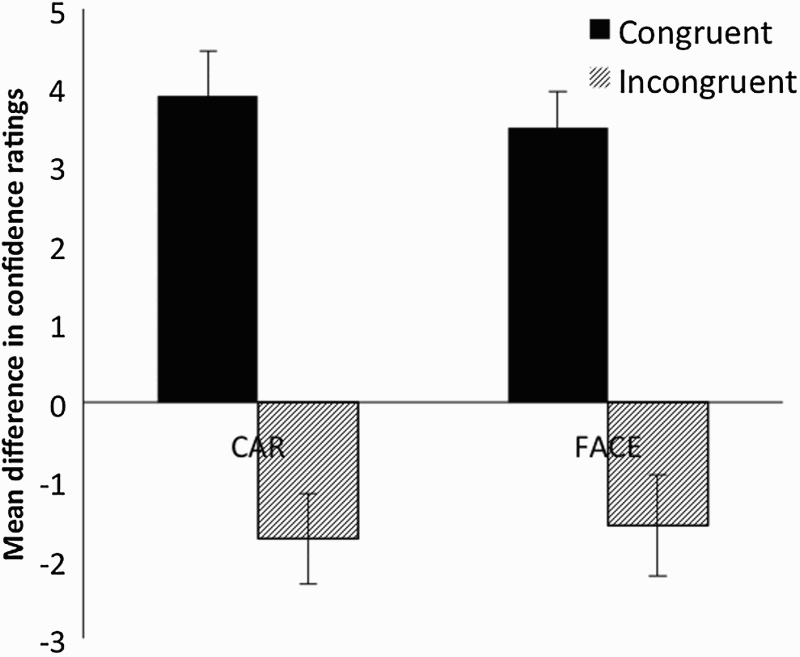
Subjective confidence levels in Experiment 2 plotted as a function of the cue direction (incongruent vs. no-cue vs. congruent) and cue type (face vs. cars). The plotted data are confidence values on congruent and incongruent trials after confidence values no-cue trials are subtracted.
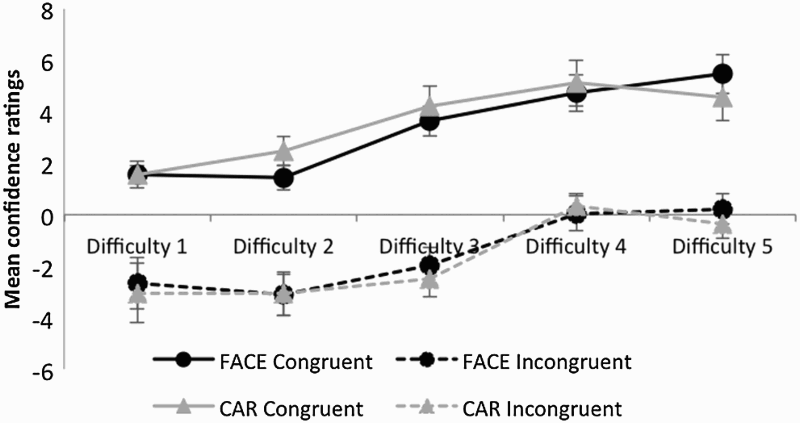
Difference in confidence levels (congruent/incongruent – no-cue) in Experiment 2 plotted as a function of cue direction, cue type, and difficulty.
Metacognitive accuracy
The ANOVA between factors cue type and cue direction on Aroc values revealed a main effect of cue direction, F(2, 122) = 5.89, p < .01 (Figure 6). In both groups, compared to congruent and incongruent trials, metacognitive accuracy was highest with no-cue trials. The main effect of cue type and the two-way interaction were not found to be significant (ps > 1).
Mean area under the curve (Aroc) in Experiment 2 plotted as a function of the cue direction (incongruent vs. no-cue vs. congruent) and cue type (face vs. cars). The plotted data are values on congruent and incongruent trials after values on no-cue trials are subtracted.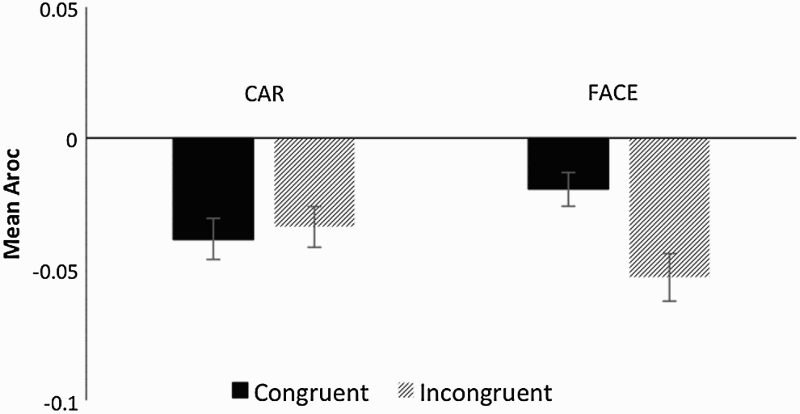
Discussion
In this second experiment, we investigated whether believing a cue orienting toward a response option represented a previous participant's response resulted in a spontaneous modulation of confidence ratings and of metacognitive accuracy. The results confirmed our hypotheses.
Regarding subjective confidence, our findings revealed a pattern similar to the one found in the face group of Experiment 1. Participants adjusted their confidence ratings as a function of the information provided by the cue direction: raising their confidence when the face or the car oriented toward the response chosen by the participant, and lowering it when it oriented toward the nonchosen response.
The only difference between the two experiments was the instructions given to the participants, which have obviously increased the relevance of the social (face) cues (see Footnote 1). Thus, the fact that both experiments yielded a similar pattern of results suggests that participants were unable to fully ignore the social cues (i.e., face) in Experiment 1 and were involuntarily influenced by the social information that the cues implicitly conveyed when forming their metacognitive evaluations. Participants are likely to have attributed attitudes to the gazer concerning the response toward which he or she gazed (Baron-Cohen, 1995). Hence, that response acquired new properties in the eye of the observer (Becchio et al., 2008). This converges with previous results suggesting that the value of the response alternatives is altered by the observation of gaze behaviour (Bayliss et al., 2006; cf. Becchio et al., 2008). However, in Experiment 2, both the nonsocial (i.e., car) and the social cue (i.e., face) orientation represented the decisions of previous participants. Car cues were as socially meaningful as face cues and therefore yielded the same effect on confidence as did face cues. This rules out the possibility that the modulation of confidence levels observed for faces in Experiments 1 and 2 were merely due to gaze cueing effects. This result instead demonstrates that, once a cue is attributed a social meaning, it becomes relevant for metacognitive evaluations. It should be remembered that in neither experiment were the participants instructed to take social feedback into account when monitoring their confidence.
Although the two experiments yielded a similar pattern of results, in Experiment 2, the effect of social feedback was larger than that in Experiment 1. We attribute this difference in effect size to task instructions. When instructed to ignore the cues (Experiment 1), we found that participants were able to ignore the nonsocial cue, yet they failed to fully inhibit ascribing a meaning to the social cue. In Experiment 2 the instructions made both cues explicitly relevant for the context, probably exacerbating the effect observed in Experiment 1. We also observed that, similar to Experiment 1, the results of Experiment 2 showed an asymmetry between the effect of congruent and incongruent feedback. We discuss this point in detail in the General Discussion.
In contrast to Experiment 1, the results of Experiment 2 revealed a significant interaction between task difficulty and the direction of the cue. Congruent cues increased confidence mainly for difficult trials, whereas incongruent cues decreased confidence as the task became easier (Figure 5). However, the magnitude of social influence on metacognitive evaluations was comparable for all levels of task difficulty. This pattern of results thus might reflect a mere ceiling/floor relation. The fact that we did not observe a decrease in confidence in the responses to incongruent cues in difficult trials suggests that participants were already at their most uncertain. They could not be any less confident than they already were after receiving the cue, hence the floor effect. In the same vein, participants were most confident in easier trials; therefore congruent cues could not increase participants’ confidence, resulting in a ceiling effect.
Finally, as predicted, social feedback also affected participants’ metacognitive accuracy (Figure 6). Participants were best at monitoring their performance when they received no feedback (no-cue trials); that is, reported levels of confidence were a better marker of the accuracy of their given responses. However, as soon as they received explicit social information about previous participants’ decisions, their metacognitive accuracy declined. Due to the particulars of our design, we cannot conclude that this finding would transfer to all situations. The reason we found social influence to impair metacognitive accuracy is that the feedback provided by the cue was purely random and unreliable. Therefore, any effect of social influence on metacognitive accuracy would have to be inevitably misleading. However, this finding has an important implication; it indicates that this spontaneous appraisal of social cues and our susceptibility to social influence can impact how well we evaluate our decisions, even at the expense of being wrong about our decisions.
General Discussion
Nonverbal social cues, such as gaze and emotional expressions, play a large role in our social interactions. We process them spontaneously, and they thus influence ongoing and subsequent processes. Here, we showed in two experiments that nonverbal social cues can involuntarily impact our metacognitive evaluations of the decisions we make (i.e., confidence), and when conveying explicit (mis)information, can sway the accuracy of those evaluations (i.e., metacognitive accuracy). Our results are in line with the view that metacognitive judgements (i.e., decision confidence) rely on a variety of online cues (Koriat & Levy-Sadot, 2000). One such cue is fluency, which refers to the subjective ease of information processing, and it is well known to underpin reliable judgements about performance accuracy (e.g., Alter & Oppenheimer, 2009; Oppenheimer, 2008). However, to our knowledge, this is the first study to demonstrate that metacognitive evaluations can involuntarily rely on nonverbal social cues irrespective of their relevance for the ongoing task, of task difficulty, and of their reliability, and importantly, in the absence of a normative pressure.
There could be several mechanisms underlying the effect that we observed in Experiment 1. One possibility is that gaze cues caused a stronger attention shift than the orientation of the cars in the first experiment and thus facilitated fluency in processing of the gazed response. Further processing of the cued response could have lent itself to the change in confidence ratings we noted. We are not able to rule out that possibility; however, we deem it unlikely. That is because, in Experiment 1, the effect on confidence ratings was driven by the congruent condition, when the cue oriented towards the response chosen by the participant. A pure attentional shift would have predicted the opposite effect on incongruent trials as well. Alternatively, the pattern of results in the two experiments suggests that the same mechanism underlay the effects in both experiments. Crucially, in Experiment 2, the effects triggered by faces and cars were strictly similar, rejecting the hypothesis that these effects relied on an attentional shift driven by gaze processing.
Another possible explanation for the effect revealed in Experiments 1 and 2 is related to the perceived (Experiment 1) or the explicitly attributed (Experiment 2) intentional contingency between the cue and the response alternative, which prompted the participant to rely on the information even when it was irrelevant for the task. Indeed, previous studies have shown that intentional contingency between gaze behaviour and an object can affect not only reflexive gaze following, but also subsequent inferential processes. Gaze cuing effects are influenced by the belief that the observed agent is able to see the object (Nuku & Bekkering, 2008; Teufel, Fletcher, & Davis, 2010). Further, as reported by the studies on gaze-induced liking, an object that is looked at by another agent acquires a positive valence (Bayliss et al., 2007; Bayliss et al., 2013; Bayliss et al., 2006; Corneille, Maudit, Holland, & Strick, 2009; Manera et al., 2014), whereas nonsocial directional stimuli do not (Bayliss et al., 2007). This effect on valence is modulated by emotional expressions displayed by the face (Bayliss et al., 2007) and its perceived trustworthiness (Treinen et al., 2012). These studies suggest that people form gaze–stimulus associations (Bry, Treinen, Corneille, & Yzerbyt, 2011) and make spontaneous inferences about the internal states of the gazing agent (Becchio et al., 2008).
Our results bear similarities with those reported by the research on gaze-induced liking. People understand that individuals look at the objects they prefer (Baron-Cohen, 1995). Here, in the absence of any other reason, participants spontaneously interpreted the gaze behaviour in the first experiment as a preference of one response over the other. The results from the second experiment further extend previous work and show that an ostensibly nonsocial stimulus (i.e., car), when attributed social meaning, can instigate a similar process. This attribution may have changed the informational value of an object, directly servicing the decision-making computations and the associated metacognitive evaluation (i.e., decision confidence; Experiments 1 and 2). With both ostensibly nonsocial and social stimuli, we found that participants aligned their metacognitive evaluations with the nonverbal social feedback, just as was reported by previous studies that manipulated verbal information (e.g., Kaliuzhna et al., 2012; Yaniv & Milyavsky, 2007).
Such a social influence on metacognitive evaluations, as we show, also compromises metacognitive accuracy. Although exploiting social cues are good diagnostic tools when assessing the quality of our beliefs and decisions, it does come with pitfalls. Relying on others when evaluating ourselves can influence how we assess those decisions, at the expense of being misled. This susceptibility has important implications for learning. Lowered metacognitive accuracy following feedback may prompt a misguided urge to subsequently ignore or defer to further information. Underconfidence, for example, can render the individual overly susceptible to additional input, while overconfidence would make the individual indifferent to it (De Carvalho Filho & Yuzawa, 2001). This is in line with findings reported by collective decision-making studies showing that, even though incorporating wrong information can lead group decisions astray, individuals can nonetheless become increasingly confident with those decisions (Bahrami et al., 2010; Koriat, 2012; Mahmoodi et al., 2013).
Finally, the asymmetry we observed between the respective effects of congruent and incongruent feedback suggests that affective motivations may also contribute to our effects. We found that congruent feedback was more influential in metacognitive evaluations than was incongruent feedback. This is in line with the proposal that positive and negative evaluative feedback may be underpinned by separable mechanisms and motivations (Cacioppo & Berntson, 1994; Winkielman & Cacioppo, 2001). Individuals tend to have a biased sensitivity towards positive feedback that is in line with what they tend to expect (Hepper, Gramzow, & Sedikides, 2010). This disposition might reflect an illusory tendency to see themselves in a positive light (Leary, 2007). Such self-serving bias is known to influence people's judgements (Fiske & Berdahl, 2007) and helps people maintain a positive self-concept (Taylor & Brown, 1988). Here we show that the heuristic strategy with which people readily incorporate other's opinions when elaborating metacognitive evaluations is modulated by such self-serving motivations. Such bias in metacognitive evaluations has considerable benefits in learning (Jones et al., 2011).
As highly social animals, humans are attuned to conspecifics with a strong attentional, perceptual, and motivational bias towards information transmitted by them (Heyes, 2012). This bias can serve social learning, which is an adaptive and cheap way of acquiring novel information (Rendell et al., 2011). However, there are situations where privileging information signalled by others can prove to be more costly than individual learning, misleading the behaviour of the learner and thus promoting the transmission of erroneous information (Enquist & Eriksson, 2007; Giraldeau, Valone, & Templeton, 2002; Rendell et al., 2010, 2011). Our data suggest that our bias towards social information, when signalled through nonverbal cues, can directly and spontaneously mislead metacognitive evaluations—that is, decrease metacognitive accuracy. We suspect that the misguided modulation in confidence levels that we found, and the consequential reduced metacognitive accuracy, reflects the revision of participant's initial decisions—that is, behavioural change. Even though our paradigm was not designed to test this hypothesis, such a potential coupling between social influence on decision confidence and behaviour change may have a critical role in (social) learning. In sum, our work emphasizes the importance of implicit nonverbal information in self-evaluations. The ways in which such a social influence on metacognition may impact the quality of learning remains an open question.