







Abstract
This study investigated within-person variability on basic psychomotor tasks in relation to errors on a higher order cognitive task. We were interested in whether more variable individuals were more prone to making errors, and whether this relationship varied with age. Variability was assessed using simple and choice reaction time, while errors of omission (misses) and commission (false alarms) were obtained from simple and complex visual search tasks. Data from 557 participants aged 18–90 years were included in the analysis. Greater variability was associated with more misses, and distribution analyses showed that slower responses were behind this effect. Variability was also associated with false alarms, but the pattern was inconsistent. Taking age into account revealed that the association between variability and misses in the simple visual search condition was stronger in older (aged 65–90 years) participants. The results suggest the relationship between greater variability and errors of omission (misses) may be related to inattention. Measures of variability may therefore provide valuable insights into individual differences in error rates and, more broadly, may also offer early warning of persons who are more prone to errors in visual search.
In safety-critical situations such as driving, visual processing errors can potentially have dangerous consequences. It is therefore important to identify factors that increase the likelihood of making such errors. Here, we focus on within-person reaction time (RT) variability, a measure that has received considerable interest in the cognitive ageing literature. Our main question was whether more variable individuals are more prone to making errors. Although there are a variety of taxonomies that have been used to classify errors (e.g., Miller & Swain, 1987; Norman, 1981; Reason, 1990), for present purposes we make the distinction between misses (omission errors) and false alarms (commission errors). Omission errors are the failure to carry out an intended action, whereas commission errors occur when an action is performed that should not have been.
Within-person RT variability refers to the trial-by-trial fluctuations in responses for a given cognitive task. Often, this has been thought of as methodological error variance and has been ignored by using measures of central tendency such as the mean or median RT collapsed across trials. However, there is evidence that within-person variability provides meaningful information about either individual differences or task engagement (e.g., Hultsch, Strauss, Hunter, & MacDonald, 2008). One proposal is that increased variability may reflect fluctuations in attentional or executive control (Bunce, MacDonald, & Hultsch, 2004; Bunce, Warr, & Cochrane, 1993; West, Murphy, Armilio, Craik, & Stuss, 2002). Here, the extent to which attentional or executive processes are focused is reflected in RTs of differing duration with more consistent responding indicating greater focus. Across individuals, variability typically increases with age (Bielak, Cherbuin, Bunce, & Anstey, 2014; West et al., 2002), even when controlling for age-related slowing (Dykiert, Der, Starr, & Deary, 2012). Also, it has been proposed that RT variability is a behavioural marker of neurobiological disturbance (Hultsch et al., 2008), and, consistent with this view, elevated variability has been shown to accompany neuropathology such as mild cognitive impairment or dementia (e.g., Dixon et al., 2007; Duchek et al., 2009), Parkinson's disease (de Frias, Dixon, Fisher, & Camicioli, 2007), and traumatic brain injury (Stuss, Murphy, Binns, & Alexander, 2003).
Our interest in the measure in the present study stems from previous research suggesting that within-person variability in laboratory tasks is linked to real-world functioning (Bunce, Young, Blane, & Khugputh, 2012; Burton, Strauss, Hultsch, & Hunter, 2009; Kennedy et al., 2013). Although few studies have investigated the association between variability and visual search performance, Biggs and colleagues showed that search time variability predicted search accuracy (Biggs, Cain, Clark, Darling, & Mitroff, 2013; Biggs & Mitroff, 2014). Other research has focused on the link between variability and errors in other contexts such as sustained attention (e.g., Gu, Gau, Tzang, & Hsu, 2013). Here, increased variability was linked with misses and false alarms, though, notably, misses were specifically associated with slower RTs whereas false alarms were associated with faster responses. However, as this study was limited to adolescents, it is unclear whether such relationships hold across adult age ranges.
There is also evidence that the relationship between within-person variability and errors may vary as a function of age. In older adults, increased variability has been associated with poorer memory performance (MacDonald, Nyberg, Sandblom, Fischer, & Backman, 2008) and forgetting rates over a one-week period (Papenberg et al., 2011). Across old and young, however, increased variability was moderately associated with poorer memory in older adults, but in younger adults the opposite was found (Vandermorris, Murphy, & Troyer, 2013). In addition, RT variability was not associated with prospective memory accuracy in younger adults although faster responses were related to more prospective memory misses (Loft, Bowden, Ball, & Brewer, 2014).
The present study investigated within-person variability on basic psychomotor tasks that use relatively straightforward information processing. Hultsch et al. (2008) suggest that such tasks capture fundamental central nervous system functioning. Our main research question was whether variability on these lower order tasks was predictive of errors (misses and false alarms) on higher order cognitive tasks. This issue was examined in a sample of 557 participants where visual search errors (referred to as “errors”) were recorded from simple and complex visual search tasks. Such laboratory tasks require processes that are important in everyday activities and may therefore provide valuable insights into everyday visual functioning. Given previous work, we expected to see an association between variability on the psychomotor tasks and errors on the visual search tasks. RT variability has been linked to fluctuating attentional or executive control mechanisms, and it is likely that errors such as misses are related to attentional lapses (see Reason, 1990). Due to this shared theoretical association with attention, an association with increased variability was particularly expected for misses.
We were also interested in the relationship between errors and faster and slower responding. As attentional fluctuations may lead to intermittently slower RTs, we anticipated that slower responses would be associated with misses. In contrast, we expected that faster responses would be associated with false alarms, as these errors may reflect more impulsive responding. Additionally, based on previous research (e.g., Vandermorris et al., 2013), and evidence that variability increases with age (Bielak et al., 2014; Dykiert et al., 2012), we expected associations between variability and errors to strengthen with age. Finally, we anticipated a stronger relationship between variability and errors for the complex visual search task, as this was more attentionally demanding than the simple version of the task.
Experimental study
Method
Participants
Data were drawn from two previously published studies (Bauermeister & Bunce, 2015; Bunce, Handley, & Gaines, 2008) to form the current dataset of 557 community-dwelling participants (327 women) aged 18–90 years (M = 56.45, SD = 17.20). There were 105 younger (18–39 years, 61% women), 249 middle-aged (40–64 years, 63% women), and 203 older adults (65–90 years, 77% women) in the combined sample. There were no significant differences in the gender distribution across the three age groups. The original studies excluded participants with major neurological disorders that could affect cognitive function. To minimize inclusion of persons with possible dementia, older participants were also excluded if they scored <25 on the Mini-Mental State Examination (Folstein, Folstein, & Mchugh, 1975). The National Adult Reading Test (NART: Nelson, 1982) was used to assess verbal intelligence, with error scores converted to full scale IQ scores using standard procedures (M = 119.12, SD = 7.38). Ethics approval was obtained from the School of Social Sciences Research Ethics Committee, Brunel University London.
Materials
The cognitive tasks were embedded within a broader battery, details of which have been previously reported (Bauermeister & Bunce, 2015; Bunce et al., 2008). Task and condition order were counterbalanced across participants.
Visual search tasks
Errors were taken from simple and complex visual search tasks in which 16 practice trials and 64 test trials were administered for each task. Simple visual search: On each trial, participants were presented with a 6 × 6 array of green letter “O”s (stimulus size 0.6 × 0.8 cm) presented in a 5 × 8-cm grid. On half of the trials a target (a green letter “Q”; 0.6 × 1.0 cm including tail) was embedded pseudorandomly within the array. Participants were instructed to respond with designated keyboard keys according to whether the target was present or absent. Complex visual search: Participants were presented with an array of “O”s and “Q”s of differing colours and had to respond according to whether a target was present or absent. Targets were defined by the conjunction of the colour and letter (e.g., a green letter “Q” in an array of red “Q”s and green “O”s). For both visual search tasks, each array remained on the screen until a response was made, or to a maximum of 10,000 ms (inter-trial interval 500 ms). Participants were instructed to respond as quickly and as accurately as possible and were allowed to move their eyes throughout the task. Prior to computing error measures, unusually fast (RTs < 150 ms) trials were removed (<0.1% of trials) as these are likely to represent accidental key presses. For both visual search tasks, the proportion of misses (where a target was present but a target absent response was made) and false alarms (where a target was absent but a target present response was made) were recorded. On the complex visual search task, mean false-alarm rates were 1.41%; however, six participants produced false-alarm rates greater than 25%. Removal of these participants did not substantially change any of the results reported below. However, to ensure that these outlying participants did not unduly influence analyses, this variable was log transformed.
Psychomotor tasks (within-person variability measures)
Three 48-trial psychomotor tasks were administered. Before each task, participants completed eight (simple reaction time, SRT, task) or 12 (choice reaction time, CRT, task) practice trials. SRT: In this task a stimulus (the letter “X”) was presented in the middle of the computer screen following a randomly determined inter-trial interval (300–1000 ms). Participants were instructed to press the spacebar as fast as possible when the stimulus appeared. Two-choice RT (2CRT): The stimulus (a black circle, 25 mm diameter) was randomly presented on either the left or the right side of the computer screen (inter-trial interval 500 ms). Participants were instructed to respond with designated keyboard keys (X and M) according to the side on which the stimulus appeared. Four-choice RT (4CRT): The stimulus (a black circle) was presented in one of the four corners of the screen (inter-trial interval 500 ms), and participants responded using four keyboard keys (S, X, M, and K) that mapped spatially onto the locations on the computer screen. For both choice RT tasks, instructions emphasized speed and accuracy.
Data processing
Prior to computing the within-person variability and distribution measures, we removed unusually fast (<150 ms) or slow (3 SDs beyond the intra-individual mean RT) responses and error trials on the CRT tasks. Eliminated trials were replaced with the intra-individual mean RT for that task. For all tasks, <5% of trials were replaced across the full sample. On the 4CRT task, data from two older participants were removed as the trimming procedure replaced more than 45% of trials, which would result in artificially low variability measures. Seven further participants (n = 5 aged 65–90 years, and n = 2 aged 40–64 years) were removed for having a high proportion of extreme RTs (>3000 ms) remaining after data trimming. These cases were treated as missing data.
The coefficient of variation (CV: raw individual SD/raw mean RT) was used as a within-person variability metric as this measure takes mean level of performance into account. Additionally, we used Vincentile analysis to assess the relationship between an individual's faster and slower responses and errors. To obtain six Vincentiles, intra-individual RTs were rank ordered from fastest to slowest. The first sixth of trials (in our case the fastest eight) were averaged to form Vincentile-1, then the next sixth were averaged to form Vincentile-2, and so on. We were interested in whether errors were associated with intermittently slower RTs (indexed by an individual's slower responses only, i.e., Vincentile-6) or response speed in general (indexed by both faster and slower responses, i.e., Vincentile-1 and Vincentile-6).
Results
At the aggregate sample level, a small amount of missing data (<0.7%) was imputed using the EM algorithm in IBM SPSS Version 21 taking all study variables into consideration (Schafer & Graham, 2002). This procedure uses an iterative process to impute missing data using estimates of the means, covariances, and correlations obtained from other observed data.
The mean values for the RT variability and error measures are displayed in Table 1 together with the bivariate correlations between variables. All variability measures were positively associated with age, which was also positively associated with misses on the complex visual search task, but not the simple visual search task. In contrast, age was negatively associated with false alarms on the simple visual search task, but the association with complex visual search task was nonsignificant. Regarding correlations between variability and errors, greater variability was associated with a higher percentage of misses on both visual search tasks. For false-alarm errors, there was a less consistent pattern. SRT variability correlated with errors on the simple visual search task, while CRT variability correlated with complex visual search errors. Associations, however, were small.
Bivariate correlations between age, reaction time, and error variables.
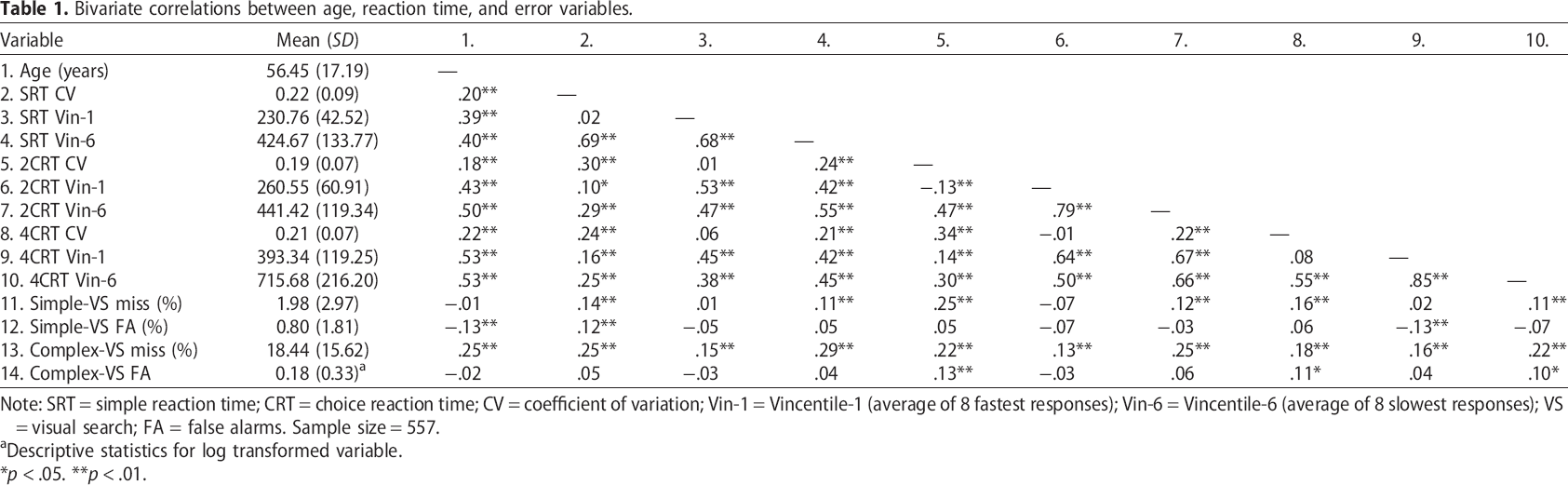
Note: SRT = simple reaction time; CRT = choice reaction time; CV = coefficient of variation; Vin-1 = Vincentile-1 (average of 8 fastest responses); Vin-6 = Vincentile-6 (average of 8 slowest responses); VS = visual search; FA = false alarms. Sample size = 557.
aDescriptive statistics for log transformed variable.
*p < .05. **p < .01.
Misses (errors of omission)
A series of hierarchical linear regression analyses were run with percentage of errors as the outcome variable. In Model 1, we adjusted for sex and NART scores at Step 1, and in Step 2 each RT measure was added in turn, to see whether this accounted for variance in each error type. To adjust for multiple analyses for each outcome, we adopted a conservative alpha of 1%. There were significant relationships between variability and misses for both visual search tasks (see Table 2). In Model 2, after additionally adjusting for age, variability remained a significant predictor of misses, though ΔR2 values were somewhat attenuated for complex visual search. For example, after controlling for IQ and sex, adding SRT CV explained 6.2% of the shared variance, but only 3.8% after additionally taking age into account. To explore the age effects further, associations between variability and misses were assessed separately in younger, middle-aged, and older participants. As similar results were obtained for the three RT tasks, and they were significantly intercorrelated (r ≥ .24, p < .001), a composite measure was computed for these analyses. Figures 1a and 1b show the relationship between the CV-composite and misses in the age subgroups. Here estimates were obtained from linear regression using a continuous CV variable, but have been plotted with high and low CV defined as ±1 standard deviation from the overall sample mean. On the simple visual search task, the strength of the relationship increased with age (younger, β = 0.10, p = .297; middle-aged, β = 0.20, p = .001; older, β = 0.34, p < .001). These regression coefficients were compared by rerunning the initial model with the addition of age group (older participants as the reference group) and a multiplicative Age Group × CV-Composite interaction term. The interaction was significant for the comparison between the older participants and the younger (β = −0.10, p = .035), and middle-aged (β = −0.12, p = .033) groups. For complex visual search, although older participants made more errors both at low variability and high variability, within all groups greater variability was associated with more errors (younger, β = 0.22, p = .024; middle-aged, β = 0.21, p = .001; older, β = 0.28, p < .001: Between-group differences were non-significant).
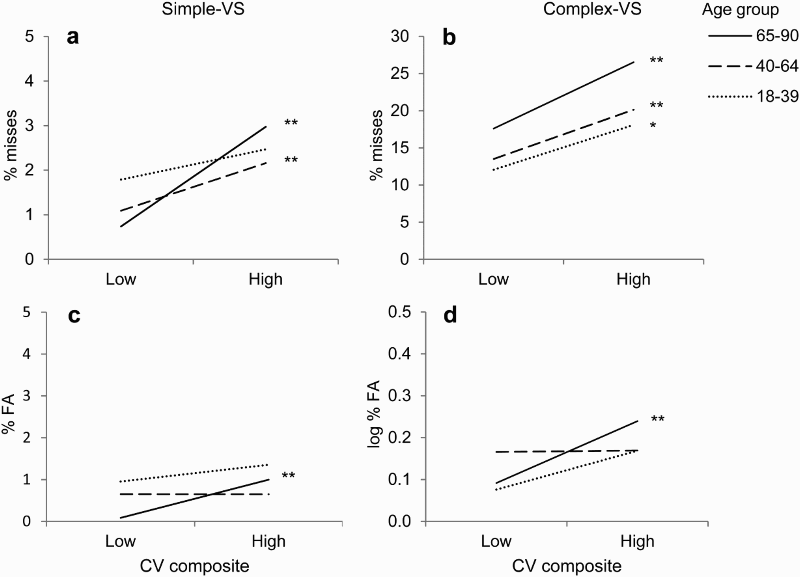
The relationship between coefficient of variation (CV)-composite score and errors in younger, middle-aged, and older adults. Note: VS = visual search; FA = false alarms.
Hierarchical regression: Errors regressed on variability metrics (CV).
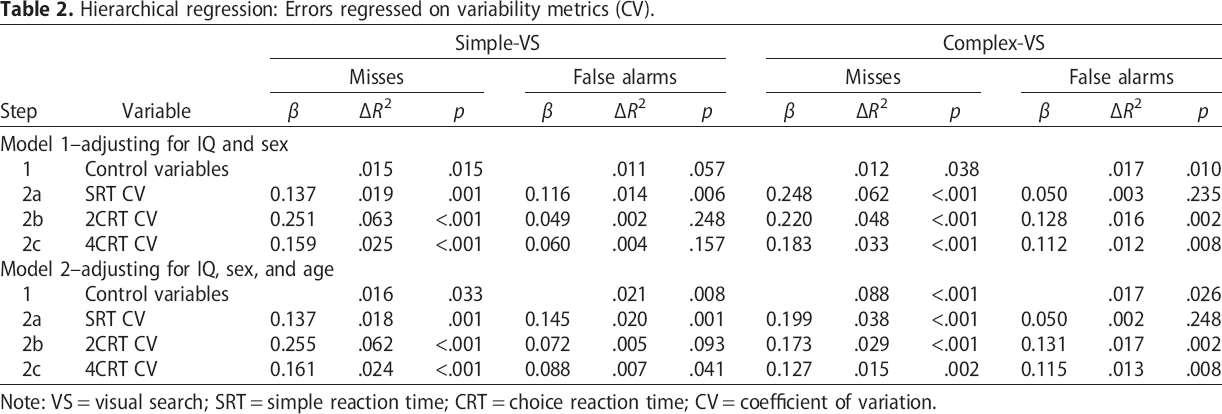
Note: VS = visual search; SRT = simple reaction time; CRT = choice reaction time; CV = coefficient of variation.
To further understand the relationship between variability and misses, models were also run regressing errors onto faster (Vincentile-1) and slower (Vincentile-6) responses. This assessed whether errors were associated with intermittently slower RTs or a general slowing of responses. The results for these hierarchical regression models are displayed in Table 3. After adjusting for IQ and sex (Model 1), faster responses were not related to misses on the simple visual search task, but did show a significant relationship with complex visual search misses (all ps ≤ .003). When age was controlled for (Model 2), this significant relationship was rendered nonsignificant (ps ≥ .170). Similarly, there were no significant associations between faster responses and misses within any of the three age subgroups (β ≤ 0.11, p ≥ .122). In contrast, slower responses were associated with misses for both tasks (all ps ≤ .006, see Table 3). Controlling for age (Model 2) did not affect the relationship between slower responses and simple visual search misses (all ps ≤ .005), but the association with complex visual search misses was attenuated, particularly for the 4CRT task. A final analysis investigated the association between slower responses and errors when also adjusting for faster responses. This controlled for a general slowing of responses, which would affect both the faster and the slower responses of an individual. This strengthened all relationships between slower responses and errors, suggesting that it was slower responses relative to faster responses that were associated with misses rather than a general slowing of responses. As can be seen in Table 3, β-values for the association between slower responses and misses ranged from 0.10 to 0.30. When also controlling for faster responses, β-values increased in both Model 1 (simple visual search, β ≥ 0.20, p < .001; complex visual search, β ≥ 0.32, p < .001) and Model 2 (simple visual search, β ≥ 0.21, p < .001; complex visual search, β ≥ 0.24, p < .001). Further investigation splitting the sample by age group revealed comparable results to those obtained using the CV-composite measure (figures not shown).
Hierarchical regression: Errors regressed on distribution parameters.
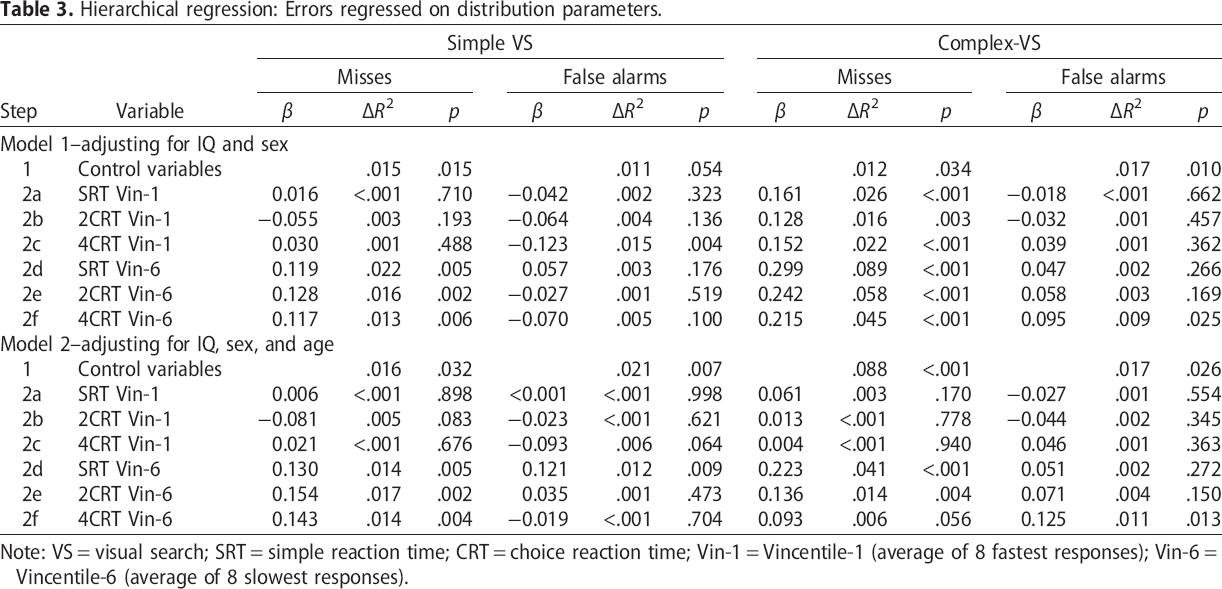
Note: VS = visual search; SRT = simple reaction time; CRT = choice reaction time; Vin-1 = Vincentile-1 (average of 8 fastest responses); Vin-6 = Vincentile-6 (average of 8 slowest responses).
It is possible that differences in episodic memory underlie the reported effects, as poorer memory in older adults could lead to occasional long RTs and misses in the visual search task. We therefore reran the models controlling for episodic memory performance (measured using a word recognition memory task used in the original studies: Bauermeister & Bunce, 2015; Bunce et al., 2008). This did not influence the reported results.
False alarms (errors of commission)
Consistent with the bivariate correlations described earlier, regression analyses showed that SRT variability was related to false alarms on the simple visual search task whereas CRT variability was related to false alarms on the complex visual search task (Table 2). Controlling for age (Model 2) did not influence these associations. However, as one of our hypotheses was that the relationship would vary with age, associations between the CV-composite measure and false alarms were assessed separately within the younger, middle-aged, and older participants (see Figures 1c and 1d). On both visual search tasks, the association between variability and errors was significant in the older participants (simple visual search, β = 0.27, p < .001; complex visual search, β = 0.21, p = .003) but nonsignificant in the middle-aged group. Contrary to expectations, in the younger group, variability was associated with errors on the complex search task (β = 0.22, p = .023). However, further inspection revealed that one younger participant was an outlying case, and excluding this participant removed this significant result (β = 0.12, p = .213). For both tasks the Age Group × CV-Composite was significant for the comparison between the older and middle-aged groups (simple visual search, β = −0.15, p = .008; complex visual search, β = −0.14, p = .019) but was non-significant for the comparison between the older and younger participants (p ≥ .324).
The relationship between false alarms and the distribution measures was also assessed, and results can be found in Table 3. In Model 1, faster responses (Vincentile-1) for the 4CRT task were negatively associated with simple visual search false alarms. All other associations were nonsignificant. In Model 2, controlling for age, the relationship between 4CRT faster responses and simple visual search errors was eliminated. When split by age group, the relationship between faster responses and simple visual search false alarms was nonsignificant in all three groups (β ranged from −0.02 to −0.10, p = .335). The results for slower responses were similar to those obtained using the CV; in the age group analysis, there was a significant association between slower responses and complex visual search errors in the older participants but not in the other groups.
General discussion
To our knowledge, this the first study to investigate the relationship between within-person variability on basic psychomotor tasks and errors on a higher order cognitive task across a wide age range. Greater variability was associated with an increased percentage of misses (omission errors), a finding that was independent of task complexity as relations were similar across both task conditions. Controlling for age attenuated the relationship between variability and misses for the complex visual search task, but did not eliminate it. Importantly, although the association strengthened with age, variability was significantly related to misses across all age groups. Greater variability was also associated with false alarms (commission errors), although somewhat inconsistently. When split by age group, this association was only significant in the older participants.
The findings support previous research showing a positive association between RT variability and misses (Gu et al., 2013), but extends this finding from adolescents to the broader adult age range. RT variability is thought to reflect fluctuations in attentional or executive control mechanisms (Bunce et al., 2004; Bunce et al., 1993; West et al., 2002), and failures of attention may lead to lapse errors (Reason, 1990) such as the failure to detect a target (i.e., a miss). The relationship between greater variability and misses may therefore be related to inattention. The results from the distribution analyses supported this view, as it was slower responses that were consistently associated with misses. If attentional variation leads to more intermittently slower RTs, these would be captured by the slower Vincentile. Controlling for faster responses (Vincentile-1) strengthened this relationship, suggesting that it was specifically the slower RTs that accounted for the misses and not response speed shifts across the entire distribution (as captured by Vincentile-1).
A further aim was to see whether the relationship between variability and errors was affected by age. Based on previous research in this area (e.g., Vandermorris et al., 2013) and predictions arising from the dedifferentiation hypothesis (Baltes, Cornelius, Spiro, Nesselroade, & Willis, 1980; Hulur, Ram, Willis, Schaie, & Gerstorf, 2015) where cognitive performance in different domains is commonly found to converge onto a single factor, we anticipated that the relationship between variability and errors would strengthen with age. This possibility was, therefore, assessed separately in the younger, middle-aged, and older participants. Consistent with earlier work and this hypothesis, the expectation was confirmed, as a stronger association between variability and misses on the simple visual search task was found for the older than for the younger participants. It may be that due to age-related reductions in attentional resources, more variable older individuals are particularly vulnerable to making errors of omission (i.e., misses). However, for the more attentionally demanding complex visual search task, greater variability was associated with increased misses in all three age groups. The findings for the younger group contrast with earlier work in which younger adults’ increased variability was associated with fewer errors (Vandermorris et al., 2013). However, this may be due to that earlier study using an outcome measure that combined misses and false alarms. It is possible, therefore, that collapsing the error type masked the effects for misses.
Consistent with previous research (e.g., Gu et al., 2013), false alarms showed a positive association with variability and a negative association with faster responses (Vincentile-1). Both findings, however, were inconsistent, and relationships were only evident for certain task conditions. For example, SRT variability was related to simple visual search false alarms, whilst CRT variability was associated with complex visual search errors. Moreover, when analyses were conducted by age group, the association between variability and false alarms was only significant for the older adults, supporting the notion that variability–error relations strengthen with age. In contrast, controlling for age eliminated the association for faster responses. This would suggest that the relationship in the full sample was related to older adults’ slowing of responses and concurrently making fewer false alarms.
The present findings have important broader implications for everyday behaviours as they suggest that individuals who are more variable may also be more prone to making errors, particularly those of omission (i.e., misses). Research in older adults suggests that greater variability is associated with motor problems such as gait difficulties and falls (for review, see Graveson, Bauermeister, McKeown, & Bunce, 2015) and is related to simulated driving (Bunce et al., 2012) or flight (Kennedy et al., 2013) performance. Given the association identified here, suggesting a relationship between greater variability and visual search errors, a key question for future research is whether increased variability in laboratory tasks translates into errors in other contexts or in real-world situations. Examples where greater within-person variability may be associated with errors include prospective memory failures (e.g., forgetting medications) and errors in safety-critical situations (e.g., driving, medical fields, or industrial processes). It is important that future research is extended to these contexts to provide information on the neurocognitive mechanisms supporting everyday performance and help identify potentially vulnerable older persons for possible intervention. For example, more variable older individuals may benefit from cognitive remediation interventions that enhance attentional focus or improve mobility (e.g., Verghese, Mahoney, Ambrose, Wang, & Holtzer, 2010). An interesting question is whether such approaches would also reduce errors in everyday tasks.
A strength of the present study was the large sample size that allowed us to investigate the association between variability and errors across age groups in some detail. There were, however, some limitations that we should acknowledge. First, error rates, particularly false alarms, were very low. This may have impacted on our ability to detect relationships and may explain the inconsistency in the false-alarm data. It may be that a more complex visual search task (e.g., medical or baggage screening) that produces higher false-alarm rates would better determine the relationship between RT variability and false alarms. Second, as there were relatively few practice trials for the RT tasks, some of the variability in RTs may have been due to practice effects, with those who take longer to learn (e.g., older adults) having larger CVs. Future work using tasks with a greater number of trials would allow greater understanding of whether relationships persist once RT performance has stabilized. Third, although the analyses controlled for extraneous variables that can influence RT performance such as IQ and sex, there are other factors that may have influenced the relationship between variability and errors. These include motivation, fatigue, and various personality traits. It is clearly important that future research take these into account too. Finally, as CV and Vincentile-6 were significantly associated, it is possible that the relationship between misses and Vincentile-6 was due to the latter variable serving as a proxy for CV. Indeed, in unreported supplementary analyses, when we adjusted for CV in the significant Vincentile-6–misses associations, we found that relations were weakened or became nonsignificant. This suggests that some of the variability that was related to misses stemmed from responses that fell into the tail of the RT distribution.
In conclusion, the present study identified a clear link between variability on lower order psychomotor tasks and errors on a higher order cognitive task. These basic psychomotor tasks are thought to capture fundamental central nervous system functioning (Hultsch et al., 2008), while the visual search tasks require higher order processes that are important for everyday functioning. In making a distinction between omission errors (misses) and commission errors (false alarms), greater variability was consistently associated with increased omission errors, a relationship that may stem from fluctuations in attentional control. The relationship with commission errors was less consistent, but false-alarm rates were low, and future research using tasks that elicit a greater number of errors is warranted to allow better understanding of the relationship with variability. Across both error types, the association with variability strengthened with age, suggesting that more variable older adults are particularly prone to making errors. Variability measures may therefore have some potential in helping to identify older persons who are more vulnerable to everyday errors of both commission and omission.
ORCiD
Becky I. Haynes http://orcid.org/0000-0003-0054-6591
Sarah Bauermeister http://orcid.org/0000-0001-9463-6971
Footnotes
Acknowledgements
We would like to thank Rowena Handley for her assistance in collecting data for the Bunce et al. (2008) study.