







Abstract
A current main issue on conditionals is whether the meaning of general conditionals (e.g., If a card is red, then it is round) is deterministic (exceptionless) or probabilistic (exception-tolerating). In order to resolve the issue, two experiments examined the influence of conditional contexts (with vs. without frequency information of truth table cases) on the reading of general conditionals. Experiment 1 examined the direct reading of general conditionals in the possibility judgment task. Experiment 2 examined the indirect reading of general conditionals in the truth judgment task. It was found that both the direct and indirect reading of general conditionals exhibited the duality: the predominant deterministic semantic reading of conditionals without frequency information, and the predominant probabilistic pragmatic reading of conditionals with frequency information. The context of general conditionals determined the predominant reading of general conditionals. There were obvious individual differences in reading general conditionals with frequency information. The meaning of general conditionals is relative, depending on conditional contexts. The reading of general conditionals is flexible and complex so that no simple deterministic and probabilistic accounts are able to explain it. The present findings are beyond the extant deterministic and probabilistic accounts of conditionals.
Conditionals (if p then q) are extensively used in everyday life and scientific context (Goodwin, 2014; Johnson-Laird & Byrne, 2002; Oberauer, 2006). A basic conditional is one “for which general knowledge, the meaning or reference of its clauses, or knowledge of its context, has no effect on the interpretation of the relation between its if-clause and its then-clause” (Johnson-Laird, 2011, p. 121). Goodwin (2014) classified basic conditionals into general and specific conditionals. A general conditional refers to a set of truth table cases (e.g., If a card is red, then it is round). A specific conditional refers to a single case or event (e.g., If the card is red, then it is round).
A current main issue about basic conditionals is whether the meaning of basic conditionals is deterministic (tolerating no exceptions) or probabilistic (the conditional conveys merely that the conditional probability of the consequent is high, but not necessarily certain, so that people tolerate some exceptions—p & not q cases—to a high conditional probability conditional (Goodwin, 2014). The extant theories of conditionals are sharply divided on this issue. The mental model theory and formal rules treat conditionals as having a deterministic meaning (Braine & O’Brien, 1991, 1998; Johnson-Laird, 2006; Johnson-Laird & Byrne, 2002; Rips, 1994, 2002). In contrast, a variety of probabilistic accounts treat conditionals as having a probabilistic meaning.
The probabilistic accounts of conditionals generally argue that basic conditionals are probabilistic (De Finetti, 1995; Douven & Verbrugge, 2010; Evans, Handley, & Over, 2003; Evans & Over, 2004; Fugard, Pfeifer, Mayerhofer, & Kleiter, 2011; Geiger & Oberauer, 2007; Goodwin, 2014; Oaksford & Chater, 2001, 2009; Oaksford, Chater, & Larkin, 2000; Oberauer, Geiger, Fischer, & Weidenfeld, 2007; Oberauer & Wilhelm, 2003; Over & Evans, 2003). An indicative conditional is acceptable to a person if and only if the person’s degree of belief P(q|p) is high (Adams, 1965, 1998). One main probabilistic account is the suppositional account of conditionals (Adams, 1998; Evans, Ellis, & Newstead, 1996; Evans & Over, 2004; Goodwin, 2014; Handley, Evans, & Thompson, 2006). This account claims that people interpret conditionals as probabilistic (that is, highly probable and tolerating some exceptions; Adams, 1998; Evans et al., 1996; Evans & Over, 2004). Some researchers proposed a probabilistic threshold account for truth judgments for conditionals (Oberauer & Wilhelm, 2003; Pfeifer & Kleiter, 2009, 2010). This account claims that the conditional conveys merely that the conditional probability P(q|p) of the consequent given the antecedent is high, but not necessarily certain, and people will accept a conditional with some exceptions that exceed their subjective thresholds of conditional probability.
Overall, the main accounts of conditionals give the conflicting predictions for the reading of conditionals. Thus, examining whether people treat conditionals as probabilistic or deterministic would help adjudicate between these competing accounts.
Previous research shows that there is the conflicting evidence for the meaning of basic conditionals. The main evidence from the possibility judgment task of conditionals seems to support the deterministic reading of conditionals (Goodwin, 2014). But, the main evidence from the truth judgment task of conditionals does not definitely support the deterministic reading of conditionals. Some other evidence from conditional reasoning and constructing truth table cases for conditionals seems to support the probabilistic reading (De Finetti, 1995; Douven & Verbrugge, 2010; Evans et al., 1996; Evans et al., 2003; Evans & Over, 2004; Fugard et al., 2011; Geiger & Oberauer, 2007; Goodwin, 2014; Liu & Chou, 2014; Liu, Lo, & Wu, 1996; Oaksford & Chater, 2001; Oaksford et al., 2000; Oberauer et al., 2007; Pfeifer & Kleiter, 2009, 2010; Politzer, 2007; Politzer, Over, & Baratgin, 2010).
The possibility judgment task asks participants to judge what is possible or impossible given that a basic conditional is true. It examines people’s direct reading of the meaning of conditionals. In such tasks, participants tend to produce the three possibilities that a material implication interpretation of the conditional gives rise to, and judge exception cases (p¬q) as impossible (Barrouillet, Gauffroy, & Lecas, 2008; Barrouillet, Grosset, & Lecas, 2000; Handley et al., 2006; Schroyens, 2010). This pattern is consistent with the deterministic account of the mental model theory. Goodwin (2014) found that given a true conditional “if p then q”, most participants judged that all ps are or must be q, and that no ps are not or can be not q. This is also consistent with the deterministic account.
However, in these tasks, the possibility judgment problems were abstract without frequency information of truth table cases. Thus, possibility judgment may depend on only the abstract semantic meaning (which is deterministic) of conditionals without considering frequency information. Participants’ deterministic responses reflect the abstract semantic interpretation of basic conditionals. However, an implicit precondition of the probabilistic threshold account for general conditionals is that the probabilistic threshold is based on frequency information. In the lack of frequency information, the probabilistic threshold cannot be formed so that people will make the deterministic reading on the basis of the abstract semantic of conditionals. Thus, these possibility judgment experiments are unable to rule out the possibility of the probabilistic threshold account.
To test the probabilistic threshold account, it is necessary to use the possibility judgment problem with frequency information that asks participants to judge whether a set with frequency information is possible or not given that a conditional is true. For instance, given that a conditional, “if a card is round, then it is red”, is true, then ask people to judge whether the set of cards (including 999 round red cards, 1 round blue card, 500 square red cards, and 500 square blue cards) is possible or not for the true conditional. This problem is concrete with frequency information. According to the probabilistic threshold account, people may judge the set as possible according to that the set has the high conditional probability of .999. Thus, they may accept the set including an exception, thereby showing the probabilistic reading. However, to my knowledge, no prior studies have examined such problems. Frequency information may yield the probabilistic reading of general conditionals for such problems. This is essentially a pragmatic effect that the specific circumstance (which here is frequency information) of conditionals’ utterance affects the interpretation of conditionals, according to the principle of pragmatic modulation in the mental model theory (Johnson-Laird, 2006; Johnson-Laird & Byrne, 2002). However, the original principle of pragmatic modulation does not include frequency information as contextual knowledge of conditionals’ utterance, and does not deal with basic conditionals.
Thus, we surmise that the reading of general conditionals may depend on whether the possibility judgment problem has frequency information or not. When it does not have frequency information, people will show the semantic deterministic reading, depending on the abstract semantic interpretation of general conditionals. When it has frequency information, people will show the pragmatic probabilistic reading, depending on the concrete threshold interpretation of general conditionals. Thus, the reading of general conditionals may exhibit a duality: the semantic deterministic reading and the pragmatic probabilistic reading, depending on whether conditional problems have frequency information.
If people can show the dual reading of general conditionals in the possibility judgment task, they may also show the similar duality in the truth judgment task that asks people to judge whether a conditional is true or not given a set of truth table cases under the conditional. This is because truth judgments reflect the indirect reading of conditionals that is on the basis of the direct reading of conditionals in the possibility judgment task.
Goodwin (2014) concluded that truth judgments for basic conditionals with frequency information are generally deterministic rather than probabilistic. However, the results of his Experiments 7, 8, and 9 did not definitely support his conclusion. In his experiments, for a set including two exceptions to a general or specific conditional with P(q|p) = .96, most individuals (67% and 65%, respectively) judged the conditionals as false. They did not tolerate two exceptions. This did not mean that they would not tolerate an exception. It might be that more individuals would tolerate an exception, and thereby accept the conditionals. Exception frequency may affect truth judgments. Moreover, Goodwin only examined truth judgments in the two particular conditional probabilities of .90 and .96. He did not examine truth judgments in the extreme conditional probabilities of .99 and .999 with only one exception. Thus, the results of his experiments do not definitely support the deterministic reading of basic conditionals.
Overall, there is no convincing resolution for the issue whether the meaning of general conditionals is probabilistic or deterministic. Is there a difference in how people think about the conditional due to the presence versus absence of frequencies? Will people tolerate small numbers of exceptions when provided with frequency information? Will the frequency of exceptions affect exception-tolerating in the high conditional probability? The present study aims to resolve these issues.
According to the above analyses, we surmise that in both the possibility and truth judgment tasks, people will exhibit the dual reading of general conditionals, depending on the context (abstract versus concrete) of general conditionals. The abstract context is without frequency information, whereas the concrete context is with frequency information. The context of general conditionals will determine the predominant reading. The abstract context should yield the predominant deterministic reading reflecting the abstract semantic interpretation of general conditionals. The concrete context should yield the predominant probabilistic reading reflecting the probabilistic threshold interpretation of general conditionals. The threshold interpretation is a pragmatic interpretation modulated by given frequency information. Here, we can distinguish the interpretation of general conditionals into the abstract semantic interpretation and the concrete pragmatic interpretation. The former will lead to the deterministic reading, whereas the latter will lead to the probabilistic reading. The predominant reading of general conditionals will switch between the two interpretations contingent on whether conditional contexts are abstract or concrete.
We conducted two experiments to test the above suppositions. Experiments 1 and 2 examined the influence of conditional contexts on the reading of general conditionals in the possibility and truth judgment tasks, respectively.
Experiment 1
Method
Experiment 1 was a paper-and-pencil experiment using a between-subjects design to examine the direct reading of general conditionals in the possibility judgment task.
Participants
A total of 160 college students (85 males, 75 females) from Xi’an Polytechnic Institute in China participated in the experiment. They had not studied any logic course.
Design
We used a between-subjects factor design with the context of general conditionals (the abstract vs. concrete context) as independent variable, and possibility judgments as dependent variable. The abstract context did not have frequency information of truth table cases, whereas the concrete context had frequency information of truth table cases.
The abstract context condition had one abstract problem without frequency information where participants were asked to judge whether each of the four types of truth table cases is possible or impossible given that a general conditional is true. Judging whether p¬q cases are possible or impossible can adjudicate whether the reading of the conditional would be deterministic or probabilistic. Possible judgments for p¬q cases would indicate tolerating exceptions to the conditional, showing the probabilistic reading, whereas impossible judgments for p¬q cases would indicate tolerating no exceptions to the conditional, showing the deterministic reading. An illustration of the abstract problems is as follows. Here is the English version translated from the original Chinese version.
Instruction
Please complete the following problem. Thank you for your cooperation. There is a pack of cards. The shape of these cards is either round or square. The colour of these cards is either red or blue. For the pack of cards, the assertion “if a card is round, then it is red”, is true. Please judge whether each kind of cards below is possible or impossible for the constituents of the box of cards. Please tick your answers. Round red cards (Possible, Impossible) Round blue cards (Possible, Impossible) Square red cards (Possible, Impossible) Square blue cards (Possible, Impossible)
The concrete context condition had 11 concrete problems with frequency information. Frequency information of these problems is shown in Table 1. An illustration of concrete problems is as follows. Here is the English version translated from the original Chinese version.
Frequency information of truth-table cases in the concrete problems of Experiments 1 and 2.
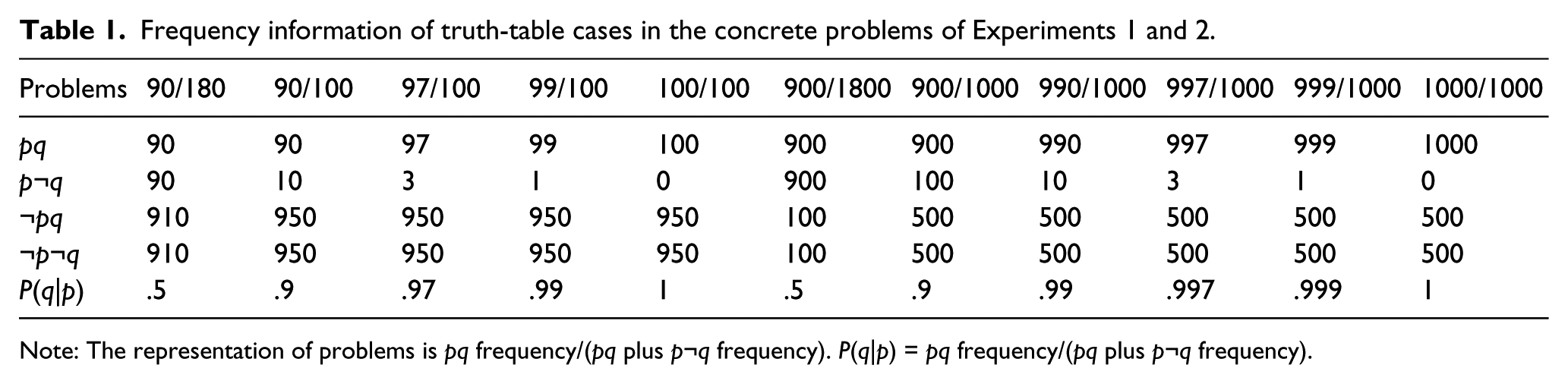
Note: The representation of problems is pq frequency/(pq plus p¬q frequency). P(q|p) = pq frequency/(pq plus p¬q frequency).
There is a pack of 2000 cards. The shape of these cards is either round or square. The colour of these cards is either red or blue. For the pack of cards, the assertion “if a card is round, then it is red”, is true. Given this true assertion, please judge whether the pack of cards is possibly the following pack of cards. (Possibly, Impossibly)
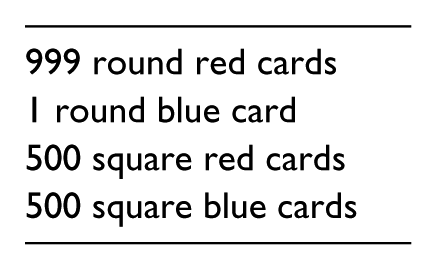
Among the 11 problems, there were two series of concrete problems that varied in terms of P(p)—that is, (pq + p¬q)/(pq + p¬q + ¬pq + ¬p¬q). Problems 90/100, 97/100, and 99/100 formed the series of problems with low P(p) (100/2000), whereas Problems 900/1000, 990/1000, 997/1000, and 999/1000 formed the series of problems with high P(p) (1000/2000). For each series, conditional probability P(q|p) was systematically manipulated to examine whether the rate of possible judgments would increase as P(q|p) increased. The two series would examine whether the response pattern was reliable across low and high P(p).
The problems with both the conditional probabilities higher than .9 and a few (less than 10) exceptions were the target problems with one or three exceptions to the conditionals, whereas the other problems were the non-target problems. The target problems aimed to examine whether participants would tolerate a few exceptions to a true conditional or not, thereby adjudicating whether the reading of the conditional would be deterministic or probabilistic. If they judged a set including a few exceptions as possible, this would indicate that they tolerated a few exceptions to the true conditional, thereby showing the probabilistic reading. If they judged the set as impossible, this would indicate that they did not tolerate a few exceptions to the true conditional, thereby showing the deterministic reading.
The abstract and concrete target problems would adjudicate whether the reading of general conditionals would be deterministic or probabilistic in the abstract and concrete context condition. Thus, they would be compared to examine the influence of conditional contexts.
Materials and procedure
For both the abstract and concrete contexts, we designed two kinds of problem contents (cards and balls): If a card is round, then it is red; or if a ball is white, then it is metal. The two kinds of problem contents were balanced across participants.
The possibility judgment tasks were performed by paper-and-pencil tests. The abstract problem was presented on a sheet. The 11 concrete problems constituted a booklet in which each problem was presented on a small piece of paper. The instruction on the first page was as follows: “Please complete the following problems by the presentation order of these problems. Please tick your answers.” One presentation order was as follows: Problems 90/180, 90/100, 97/100, 99/100, 100/100, 1000/1000, 999/1000, 997/1000, 990/1000, 900/1000, 900/1800. The other presentation order was the reverse versions of the former. The two presentation orders were balanced across participants. Thus, the 11 problems were counterbalanced.
The experiment was conducted in a quiet classroom. The two conditions were equal in the number of participants. They took about 5–10 minutes to complete the tasks. Each participant received a pen for participation.
Results and discussion
In the two conditions, participants’ responses showed no obvious differences between the two kinds of problem contents. Thus, they were collapsed. The overall results are shown in Tables 2 and 3.
Possibility judgments for the abstract problems in Experiment 1.

Note: Frequencies. Percentages in parentheses.
Possibility judgments for the concrete problems in Experiment 1.
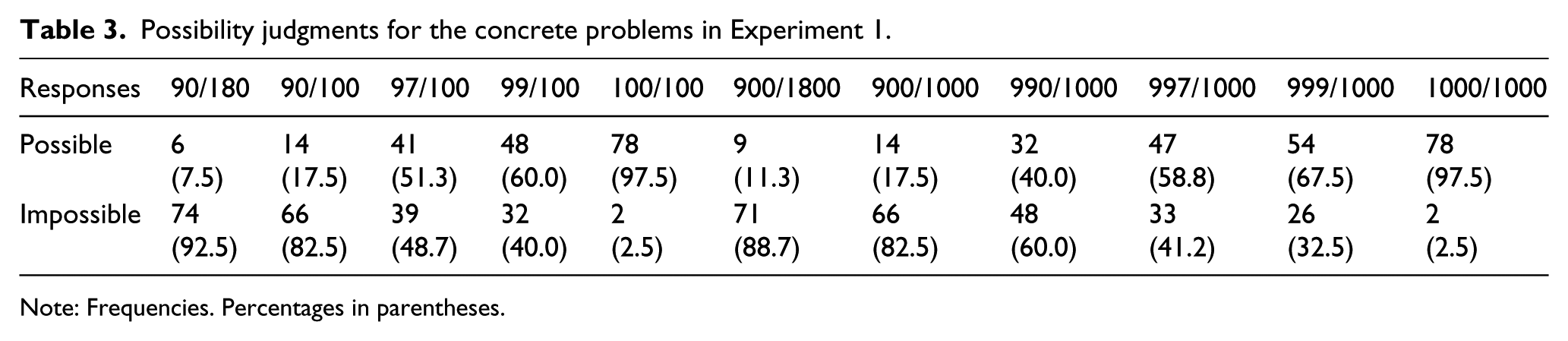
Note: Frequencies. Percentages in parentheses.
In the abstract context condition, most participants (≥77%) accepted pq, ¬pq, and ¬p¬q cases as possible, whereas 87.5% of participants rejected p¬q cases as impossible. The rejection response to p¬q cases was the deterministic reading. The acceptance response to p¬q cases was the probabilistic reading. Thus, most participants tolerated no exceptions to the conditionals, thereby showing the deterministic reading.
In the concrete context condition, for the target problems with a few exceptions, the rejection (“impossible”) response was the deterministic reading, and the acceptance (“possible”) response was the probabilistic reading. For the two target problems with one exception, the respective acceptance rates were larger than the respective rejection rates [χ2(1) = 3.2 for Problem 99/100, p > .05; χ2(1) = 9.8 for Problem 999/1000, p < .05], and most participants (60% and 67.5%) accepted the respective sets with one exception, thereby showing the probabilistic reading. More than 30% of participants rejected the respective sets, thereby showing the deterministic reading. For the two target problems with three exceptions, the respective acceptance rates were larger than the respective rejection rates (although the frequency distributions were not non-uniform), and the majority of participants (51.3% for Problem 97/100 and 58.8% for Problem 997/1000) accepted the respective sets with three exceptions, thereby showing the probabilistic reading. The minority of participants rejected the respective sets, thereby showing the deterministic reading. Overall, the majority of participants showed the probabilistic reading, whereas the minority of participants showed the deterministic reading. Thus, there were obvious individual differences.
For the two series of concrete problems, the acceptance rate increased with P(q|p) [for the series with low P(p), χ2(2) = 37.1, p < .001; for the series with high P(p), χ2(3) = 49.3, p < .001]. On the whole, the acceptance rate increased as P(q|p) increased. Moreover, the acceptance rate was higher for Problem 99/100 than for Problem 990/1000, χ2(1) = 6.4, p < .05. When P(q|p) remained .99, the acceptance rate increased as exception frequency decreased. These results mean that most participants made possible judgments on the basis of the conjunction of a high conditional probability and a few exceptions. This is beyond the prediction of the probabilistic threshold account that the rate of possible judgments should accord with conditional probability regardless of exception frequency.
Possibility judgments for p¬q cases showed obvious differences between the abstract problem condition and the two concrete target problems with a few exceptions [χ2(1) = 48.2 for Problem 99/100, p < .001; χ2(1) = 27.7 for Problem 97/100, p < .001; χ2(1) = 54.8 for Problem 999/1000, p < .001; χ2(1) = 37.3 for Problem 997/1000, p < .001]. Participants were more likely to tolerate exceptions in the concrete than in the abstract context condition. The predominant reading was deterministic in the abstract context condition, but was probabilistic in the concrete context condition. Thus, the context of conditionals yielded a significant effect on the reading of general conditionals.
Overall, in possibility judgment, the direct reading of general conditionals exhibited the duality. The predominant reading was the deterministic semantic interpretation in the abstract context condition, but was the probabilistic pragmatic interpretation in the concrete context condition. The reading of general conditionals showed obvious differences between the abstract and concrete context condition. In possibility judgment, the context of conditionals determined whether the predominant reading of general conditionals was deterministic or probabilistic, thereby leading to the dual reading of general conditionals.
Experiment 2
Method
Experiment 2 was a paper-and-pencil experiment using a between-subjects design to examine the indirect reading of general conditionals in the truth judgment task.
Participants
A total of 160 college students (80 males, 80 females) from Xi’an Polytechnic Institute in China participated in the experiment. They had not studied any logic course.
Design
We used a between-subjects factor design with the context of general conditionals (the abstract vs. concrete context) as independent variable, and truth judgments as dependent variable. The abstract context did not have frequency information of truth table cases, whereas the concrete context had frequency information of truth table cases.
The concrete context condition had 11 concrete problems with frequency information. Frequency information of the 11 problems was identical to that in Experiment 1 (see Table 1). The variable manipulation of the 11 problems was also identical to that in Experiment 1. Among these problems, the problems with both the conditional probabilities higher than .9 and a few (less than 10) exceptions being were the target problems with an exception, whereas the other problems were the non-target problems. The target problems aimed to examine whether participants would tolerate a few exceptions to a conditional in truth judgment. An illustration of concrete problems is as follows. Here is the English version translated from the original Chinese version.
There is a pack of 2000 cards. The shape of these cards is either round or square. The colour of these cards is either red or blue. It is known that the composition of the pack of cards is as follows:
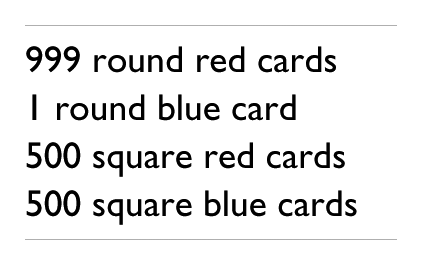
Given the above information, please judge whether the assertion “if a card is round, then it is red” is true or false for these cards. (True False)
The abstract context condition had four abstract problems without frequency information. The four problems had given sets (pq, ¬pq, ¬p¬q), (pq), (p¬q, ¬pq, ¬p¬q), (p¬q), respectively. Each problem included two questions. The first question was to judge whether the conditional is true or false for a given set without frequency information. The second question was to judge again whether the conditional is true or false after a pq or p¬q case is added to the given set. For the problems with given sets (pq, ¬pq, ¬p¬q) and (pq), a p¬q case is added to the given sets. For the problems with given sets (p¬q, ¬pq, ¬p¬q) and (p¬q), a pq case is added to the given sets. The problem with given set (pq, ¬pq, and ¬p¬q) was the target problem that aimed to examine whether participants would tolerate an additional counterexample to the conditional. The other problems were the non-target problems. The two problems with given sets (pq, ¬pq, ¬p¬q) and (pq) formed a paired comparison that would examine whether ¬pq and ¬p¬q cases affect truth judgments or not. The abstract target problem as an illustration of the four problems is as follows. Here is the English version translated from the original Chinese version.
There is a pack of cards with the following composition.
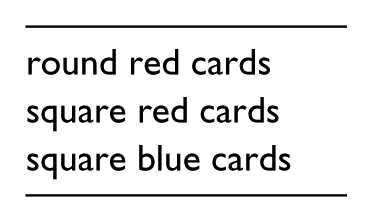
According to the above information, please judge whether the assertion “if a card is round, then it is red” is (true, false) for these cards. Now, a round blue card is added to the pack of cards. After this addition, please judge again whether the above assertion is (true, false).
Both the abstract and concrete problems had two response options (true and false). For the target problems with an exception, if participants tolerated an exception to the conditional, they would accept the conditional as true, thereby showing the probabilistic reading; if participants did not tolerate an exception to the conditional, they would reject the conditional as false, thereby showing the deterministic reading. Thus, the set of the two response options would distinguish whether participants tolerated the minimal (one) exception to the conditional or not. Thus, both the abstract and concrete target problems can adjudicate whether the reading of general conditionals would be probabilistic or deterministic. They had the similar qualitative combination of truth table cases. Thus, they would be compared to examine the influence of conditional contexts.
Materials and procedure
For both the abstract and concrete problems, we designed two kinds of problem contents (cards and balls): If a card is round, then it is red; or if a ball is white, then it is metal. The two kinds of problem contents were balanced across participants.
The four abstract problems were presented on a sheet. They were counterbalanced. One presentation order was the series of problems with given sets (pq, ¬pq, ¬p¬q), (p¬q, ¬pq, ¬p¬q), (pq), and (p¬q). The other was the reverse version of the former. The instruction on the top of the sheet was as follows: “Please complete the following problems by the presentation order of these problems. Please tick your answers.”
The 11 concrete problems constituted a booklet in which each problem was presented on a small piece of paper. The instruction on the first page was as above. The presentation order of the 11 problems was identical to that in Experiment 1.
The experimental procedure was identical to that in Experiment 1.
Results and discussion
In the two conditions, participants’ responses showed no obvious difference between the two kinds of problem contents. Thus, they were collapsed. The overall results are shown in Tables 4 and 5. In truth judgment, “true” responses were the acceptance of conditionals, whereas “false” responses were the rejection of conditionals.
Truth judgments for the abstract problems in Experiment 2.
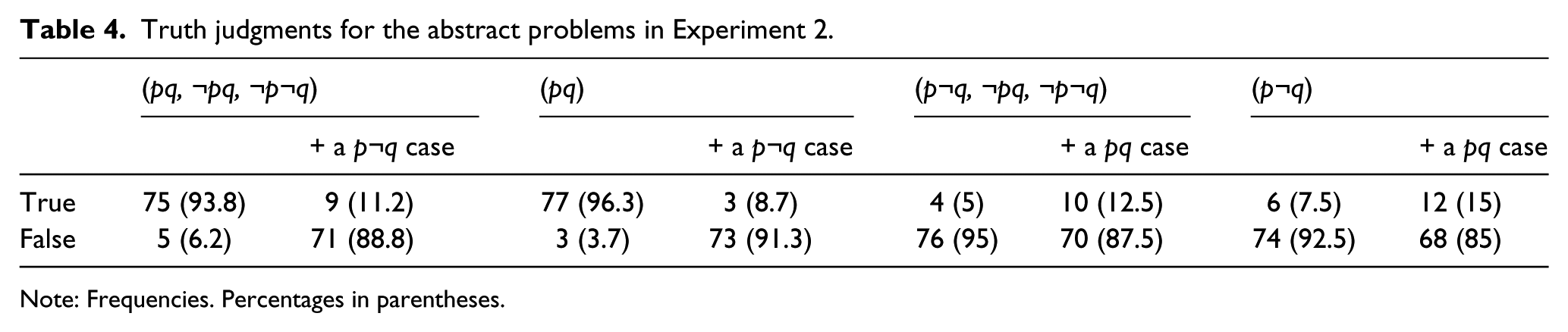
Note: Frequencies. Percentages in parentheses.
Truth judgments for the concrete problems in Experiment 2.
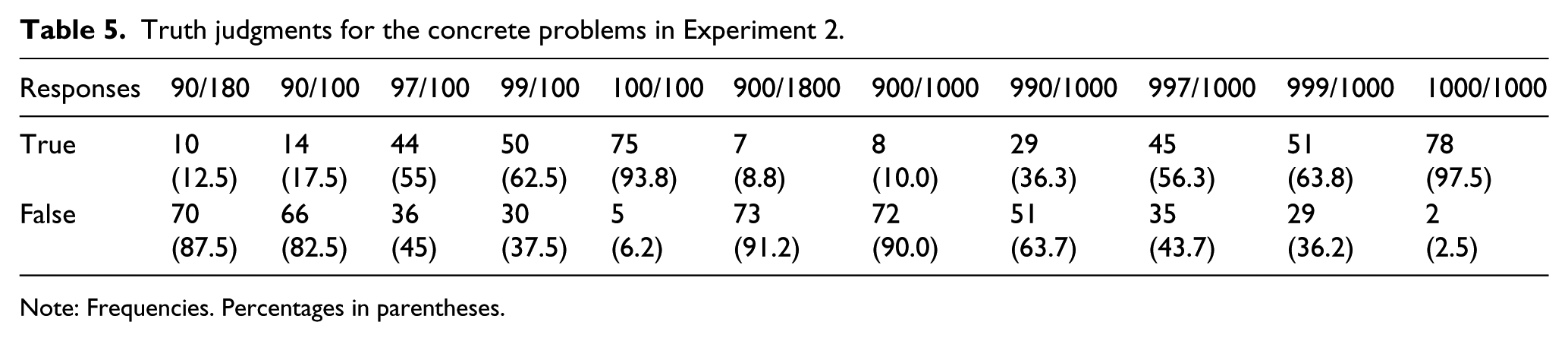
Note: Frequencies. Percentages in parentheses.
In the abstract context condition, the two problems with given sets (pq, ¬pq, ¬p¬q) and (pq) showed no obvious response differences. Thus, whether ¬pq and ¬p¬q cases were present in given sets or not made no difference to truth judgments. For the target problems, most participants (93.8%) accepted the conditionals under given set (pq, ¬pq, ¬p¬q). After a p¬q case is added to the given set, most participants (88.8%) rejected the conditionals. They did not tolerate an additional counterexample to the conditionals, thereby showing the deterministic reading.
In the concrete context condition, for the target problems with a few exceptions, the rejection (“false”) response was the deterministic reading, and the acceptance (“true”) response was the probabilistic reading. For the two target problems with one exception, the acceptance rates of the conditionals were larger than the respective rejection rates of the conditionals [χ2(1) = 5 for Problem 99/100; χ2(1) = 6.1 for Problem 999/1000, p < .05]. Most participants (62.5% and 63.8%) accepted the respective conditionals, thereby showing the probabilistic reading. More than 30% of participants rejected the conditionals, thereby showing the deterministic reading. For the two target problems with three exceptions, the respective acceptance rates were larger than the respective rejection rates (although the frequency distributions were not non-uniform), and the majority of participants (55% for Problem 97/100 and 56.3% for Problem 997/1000) accepted the respective conditionals with three exceptions, thereby showing the probabilistic reading. The minority of participants rejected the respective conditionals, thereby showing the deterministic reading. Overall, the majority of participants showed the probabilistic reading, whereas the minority of participants showed the deterministic reading. Thus, there were obvious individual differences.
For the two series of concrete problems, the acceptance rate increased with P(q|p) [for the series with low P(p), χ2(2) = 39.6, p < .001; for the series with high P(p), χ2(3) = 64.6, p < .001]. On the whole, the acceptance rate increased as P(q|p) increased. Moreover, the acceptance rate was higher for Problem 99/100 than for Problem 990/1000, χ2(1) = 11.0, p < .01. When P(q|p) remained .99, the acceptance rate increased as exception frequency decreased. These results mean that most participants made true judgments on the basis of the conjunction of a high conditional probability and a few exceptions. This is beyond the prediction of the probabilistic threshold account that the rate of true judgments should accord with conditional probability regardless of exception frequency.
Truth judgments showed obvious differences between the abstract target problems with an additional counterexample and the two concrete target problems with one exception [χ2(1) = 53.1 for Problem 99/100; χ2(1) = 54.1 for Problem 999/1000, p < .001]. Participants were more likely to tolerate exceptions in the concrete than in the abstract context condition. The predominant reading was deterministic in the abstract context condition, but was probabilistic in the concrete context condition. Thus, the context of conditionals yielded a significant effect on the reading of general conditionals.
Overall, in truth judgment, the indirect reading of general conditionals exhibited the duality. The predominant reading was the deterministic semantic interpretation in the abstract context condition, but was the probabilistic pragmatic interpretation in the concrete context condition. The reading of general conditionals showed obvious differences between the abstract and concrete context condition. In truth judgment, the context of conditionals determined whether the predominant reading of general conditionals was deterministic or probabilistic, thereby yielding the dual reading of general conditionals.
General discussion
Summary of the present findings
In possibility and truth judgment, the direct and indirect reading of general conditionals showed a similar response pattern. Both the direct and indirect reading exhibited the duality, as confirms our surmise in the introduction. The predominant reading was the deterministic semantic interpretation in the abstract context, but was the probabilistic pragmatic interpretation in the concrete context. The reading of general conditionals showed the obvious difference between abstract and concrete problems. The respective rates of the deterministic reading for the abstract target problems were significantly higher than those for the concrete target problems. The respective rates of the probabilistic reading for the concrete target problems were significantly higher than those for the abstract target problems. In both possibility and truth judgment, the context of conditionals determined the predominant reading. The abstract contexts yielded the predominant deterministic semantic reading, whereas the concrete contexts yielded the predominant probabilistic pragmatic reading. Thus, the context led to the dual reading of general conditionals, as is predicted in the introduction. This is a novel finding.
Moreover, in both possibility and truth judgment, for the two series of concrete problems, the acceptance rate increased as P(q|p) increased. P(q|p) affected the acceptance rate in a way of positive correlation. For the pair of problems 99/100 versus 990/1000 with the constant conditional probability of .99, the acceptance rate increased as exception frequency decreased from 10 to one. Exception frequency affected the acceptance rate in a way of negative correlation. These results mean that most participants made acceptance responses on the basis of the conjunction of a high conditional probability and a few exceptions. The effect of exception frequency is beyond the prediction of the probabilistic accounts that the acceptance rate should accord with only conditional probability regardless of exception frequency.
In both possibility and truth judgment, for the concrete context problems, there were obvious individual differences. The majority showed the probabilistic reading, whereas the minority showed the deterministic reading.
Theoretical implications
The semantic and pragmatic interpretation of general conditionals
The dual reading means that the reading of general conditionals is flexible, varying with the context of general conditionals. The present results confirm our surmise that there is a distinction between the abstract semantic interpretation and the concrete pragmatic interpretation of general conditionals. Abstract contexts yield the deterministic semantic interpretation that reflects the logical meaning of general conditionals. Concrete contexts yield the probabilistic pragmatic interpretation on the basis of the probabilistic threshold. This interpretation reflects the threshold meaning of general conditionals. Thus, the dual reading reflects the dual meaning of general conditionals. In everyday contexts, people can flexibly show the logical meaning and the threshold meaning, depending on the context of general conditionals. Thus, the meaning of general conditionals is relative. There is no absolute meaning of general conditionals.
The pragmatic effect that concrete contexts yield the probabilistic interpretation of general conditionals on the basis of frequency information is different from the principle of pragmatic modulation that the meaning of a conditional based on the construction of its mental models is notoriously influenced by its context: general knowledge in long-term memory and knowledge of the specific circumstance of its utterance (Johnson-Laird & Byrne, 2002). However, the essence of this principle is that contextual knowledge modulates the mental model analysis for non-basic conditionals. Such contextual knowledge does not include frequency information of truth table cases. The original principle of pragmatic modulation does not deal with basic conditionals (Johnson-Laird & Byrne, 2002).
The pragmatic effect means that frequency information is also a specific circumstance that affects the interpretation of general conditionals. This is a pragmatic effect. Thus, contextual knowledge should include frequency information, and thereby we can upgrade the principle of pragmatic modulation to deal with basic conditionals with frequency information. The pragmatic effect of frequency information conflicts with Johnson-Laird’s original definition of basic conditionals. He claims that contextual knowledge has no effect on the interpretation of basic conditionals (Johnson-Laird, 2011). Thus, strictly speaking, there are no basic conditionals the interpretation of which is not affected by contextual knowledge.
The limitation of the extant accounts for the meaning of conditionals
Both the dual reading of general conditionals and individual differences in reading general conditionals with frequency information are beyond the predictions of the extant main accounts for conditionals. The predominant deterministic reading in the abstract context accords with the prediction of the deterministic accounts such as the mental model and formal rule theories, rather than the probabilistic accounts. The predominant probabilistic reading in the concrete context accords with the prediction of the probabilistic accounts rather than the deterministic accounts. Thus, no extant accounts of conditionals can explain the above two findings.
Moreover, the present experiments show that in the concrete context, most participants made acceptance responses on the basis of the conjunction of a high conditional probability and a few exceptions, and the highly probable conditionals with 10 exceptions were not acceptable. This result means that conditional probability and exception frequency affect the acceptance rate in a joint way. The effect of exception frequency is beyond the prediction of the extant probabilistic accounts that the acceptance rate should accord with only conditional probability. Thus, the extant probabilistic accounts are unable to explain the effect of exception frequency.
Overall, no extant accounts can explain the two findings. These findings pose a challenge for the extant accounts for the meaning of basic conditionals.
Relation to existing research
In possibility judgment, participants showed the deterministic response pattern for the abstract problems. This is consistent with the previous finding (Barrouillet et al., 2008; Barrouillet et al., 2000; Goodwin, 2014; Handley et al., 2006; Schroyens, 2010). The new finding is that for the concrete problems, most participants accepted a set including a few exceptions, thereby showing the probabilistic reading.
In truth judgment, participants showed the deterministic reading for the abstract problems. For the concrete problems, most participants showed the probabilistic reading. This is different from the previous result that most individuals apparently showed the deterministic reading in truth judgment (Goodwin, 2014; Oberauer & Wilhelm, 2003). We consider the factors yielding this difference as follows. First, compared with Goodwin’s (2014) experiments using the conditionals with two exceptions and with the conditional probabilities of .9 and .96, and Oberauer and Wilhelm’s (2003) experiments using the conditionals with 10 exceptions and with the conditional probabilitiy of .9, we used the conditionals with one exception and with the conditional probabilities of .99 and .999. Our conditionals had higher conditional probabilities and fewer exceptions than their conditionals had. According to the probabilistic threshold account, participants should be more likely to accept our conditionals than their conditionals. Our conditionals can examine whether people tolerate the least exceptions and thereby can really adjudicate the issue of whether the reading of general conditionals is deterministic or probabilistic.
Second, compared with Goodwin’s (2014) experiments using the three response options (true, false, and neither) for conditionals, we used the two response options (true and false) used by the classical truth judgment task with frequency information in Oberauer and Wilhelm’s (2003) article. In Goodwin’s experiments, the rates of “neither” responses to the conditionals with conditional probabilities .9 and .96 were 31% and 19%, respectively. This suggests that the “neither” option may induce the uncertain response, and thereby may reduce the rate of “true” responses. The uncertain response means that participants neither accepted nor rejected a few exceptions to a conditional, thereby being meaningless. Logically, the “neither” option violated the law of excluded middle, thereby being meaningless, like an uncertain review decision that an editor neither accepts nor rejects a reviewed manuscript. Thus, the “neither” option is not conducive to adjudicating the issue of whether the reading of basic conditionals is deterministic or probabilistic. Overall, the present options are more valid for adjudicating the issue.
Boundary conditions
The scope of the present findings may be affected by the following three boundary conditions.
First, our explanation for the difference between the present and previous results of truth judgment for concrete problems suggests that conditional probability and exception frequency may jointly affect truth judgments. The conditional with both a high conditional probability and a few exceptions is more likely to elicit the probabilistic reading.
Second, present research focused on basic conditionals such as general conditionals, without addressing specific conditionals and non-basic conditionals. Goodwin (2014) has found that the response pattern of specific conditionals was similar to that of general conditionals. Thus, it is reasonable that the dual reading will also apply to specific conditionals. Thus, there will be the dual reading of basic conditionals. If basic conditionals exhibit the dual reading, non-basic conditionals will also exhibit the dual reading. The reading of non-basic conditionals will be affected by the pragmatic factors such as contextual knowledge and frequency information. It is necessary to examine how these factors affect the reading of non-basic conditionals in the future.
Third, education may affect the reading of basic conditionals. Education cultivates individuals’ rational thinking. As a result, the higher the education level that individuals have, the more rational they are in thinking and reasoning. This is suggested by Stanovich and West’s (2008) finding that both reasoning rules as logic rules and cognitive capacity such as decoupling capacity can change some thinking biases. Education shapes the mastering degree of logic rules and cognitive capacity. Thus, individuals with higher education levels are more likely to acquire the logic rules of conditionals such that they are more likely to conform to the normative logical meaning (deterministic) of basic conditionals regardless of frequency information. Generally, the results of experiments on thinking and reasoning may be affected by participants’ education level. In order to examine naive reasoners’ reading, the present experiments used the participants from a bottom-ranking institute in China. If participants are from a top-ranking university like Peking University, they may show the deterministic reading of basic conditionals with frequency information. Thus, the present findings may limit themselves to the population with lower education levels.
Conclusion
The present research makes the following findings and theoretical contributions.
Both the direct and indirect reading of general conditionals exhibit the duality: the predominant deterministic semantic reading in the abstract context, and the predominant probabilistic pragmatic reading in the concrete context. The context of general conditionals determines the predominant reading. There are obvious individual differences in reading general conditionals with frequency information. The meaning of general conditionals is relative, depending on conditional contexts. The reading of general conditionals is flexible and complex so that no simple deterministic and probabilistic accounts are able to explain such flexible and complex reading. The present findings are beyond the extant deterministic and probabilistic accounts of conditionals.
Footnotes
Disclosure statement
No potential conflict of interest was reported by the authors.
Funding
This work was supported by National Natural Science Foundation of China under General [grant number 30170901].