







Abstract
The preferred viewing location (PVL) is a robust finding in research on reading that when fixating on a word during normal sentence reading, readers tend to land slightly to the left of the center of the word. This is in contrast to the optimal viewing location in single word recognition, which falls at the center of the word. This study outlines the history of the PVL in eye tracking since Rayner’s 1979 original study, documenting the origins of the conflicting theoretical explanations. In addition, a new study is reported examining whether the PVL can be attributed solely to oculomotor error or a processing advantage by using an experimental manipulation that separates tracking direction (left-to-right reading) and landing position (left-to-right within a word). Sentences were presented to participants from the top to the bottom of a computer screen with one word per line while eye movements were recorded. In this presentation format, readers continued to land to the left of center, suggesting that the PVL in normal reading is not solely due to oculomotor error.
In 1979, Keith Rayner used eye-tracking methodology to systematically evaluate where readers land within words during sentence reading. One year earlier, Peter Dunn-Rankin (1978) conducted his own study of landing positions on words and phrases by exposing participants to a small pinprick of light and using the location of the afterimage from the light to have participants self-report where they were fixating within words. Dunn-Rankin found that participants tended to focus slightly to the left of the center of each word. Using eye tracking, Rayner (1979) documented surprisingly similar findings of typical landing position during progressive eye movements in sentence reading. He called this slightly left-of-center effect of landing position, the preferred viewing location (PVL). Shortly thereafter, O’Regan (1981) documented a similar effect that he called the convenient viewing position (CVP). Noting its similarity to Rayner’s PVL, O’Regan described the CVP as the location within a word, slightly left of center, where it is most advantageous for readers to fixate during sentence reading. When readers do not fixate in this most convenient location, they are more likely to make a short fixation and then refixate the same word on their next saccade (see also Rayner, Sereno, & Raney, 1996). This is in contrast to the effects seen in single word recognition where a word is processed most rapidly when it is fixated at its center, at the optimal viewing location (OVL; e.g., McConkie, Kerr, Reddix, Zola, & Jacobs, 1989; Rayner et al., 1996; Vitu, O’Regan, & Mittau, 1990, but see O’Regan & Jacobs, 1992 and van der Linden & Vitu, 2016 who report a leftward bias). 1
In the nearly 40 years since Rayner (1979), Dunn-Rankin (1978), and O’Regan (1981) published their findings, many researchers have replicated this preferred landing position effect during normal sentence reading 2 (e.g., McConkie et al., 1989; Nuthmann, Engbert, & Kliegl, 2005; Nuthmann & Kliegl, 2009; Rayner, Fischer, & Pollatsek, 1998; Rayner et al., 1996; van der Linden & Vitu, 2016; Vitu, McConkie, Kerr, & O’Regan, 2001; Vitu et al., 1990, see Vitu, 2011 for a review). Word length and launch site strongly influence the PVL (McConkie, Kerr, Reddix, & Zola, 1988; Nuthmann et al., 2005; Radach & McConkie, 1998; Rayner et al., 1996). Specifically, the PVL is more pronounced in longer words than shorter words (where the PVL is often shifted toward the center or even right of center) and readers land further into a target word (and with less variability) when launching from a closer location to the target. Research on the PVL has also been conducted in languages that read from right to left, such as Hebrew (Deutsch & Rayner, 1999) and Arabic (Farid & Grainger, 1996), where the PVL is found to be slightly right of the center of the word instead of slightly left of the center, preserving the proximity of the PVL to the beginning of words. Research into the PVL effect, and landing position generally, has indicated that it is mostly driven by low-level visuospatial factors such as word length, launch site, and spacing (Paterson & Jordan, 2010; Radach & McConkie, 1998; Rayner et al., 1998), and not the spatial area of the word (McDonald, 2006). However, arguments have also been made that, under certain conditions and in certain languages, morphological and orthographic information may influence the typical landing position (Farid & Grainger, 1996; Underwood, 2009).
Despite the substantial research documenting the existence and characteristics of the PVL in reading, there is little consensus in the field on why it occurs. Some researchers attribute the PVL effect to oculomotor error that occurs during sentence reading (e.g., McConkie et al., 1988; O’Regan, 1990, 1992; O’Regan & Lévy-Schoen, 1987). McConkie et al. suggested that in moving the eyes to the next word in the text, the reader selects the center of the word as the functional target location. However, there is error in the oculomotor control in directing the eyes to the center, which leads readers to land between the beginning and middle of the word. This oculomotor error has two components. The first is a systematic error component attributed to the saccadic range effect (Kapoula, 1985, but see Gillen, Weiler, & Heath, 2013 and Nuthmann, Vitu, Engbert, & Kliegl, 2016 for failures to replicate this effect). That is, in oculomotor tasks, when the eyes are close to a target (requiring a short saccade), they tend to overshoot the center of it. However, when the eyes fall further from a target, the eyes tend to undershoot the target (Becker, 1972; Henson, 1979). The second component is a random error component that accounts for the spread in landing positions; greater variance occurs in cases where the reader launches further from the target word. According to the oculomotor error hypothesis, landing positions would be centered if readers consistently launched from six to seven letters from the center of the target; however, they typically launch from further away than this and undershoot the target due to the saccadic range error, leading to an overall leftward shift in landing positions.
Certain results from reading studies may lend support to an oculomotor error theory of the PVL effect. For example, Rayner (1979) reported that during interword regressive saccades, the typical landing position was to the right of the center of the word, between the middle and the end, rather than between the beginning and the middle. An oculomotor error theory would predict this outcome, as it assumes readers are targeting the center but falling short, landing near the end. Furthermore, readers show a leftward bias in landing positions when reading meaningless strings of zs, resulting in PVL curves that greatly match those in normal reading (Nuthmann & Engbert, 2009; Nuthmann, Engbert, & Kliegl, 2007; Vitu, O’Regan, Inhoff, & Topolski, 1995). Finally, the undershooting bias has also been described as an economical strategy for saving energy (Becker, 1989) or minimizing the time spent during saccades (Harris, 1995).
Other researchers, however, have attributed the PVL effect to a possible processing advantage that is conferred when fixating in this landing position. That is, in reading, the PVL differs from the central OVL because it is beneficial to land toward the beginning of the word. There are many theories for why this off-center landing position may produce a processing advantage. Rayner (1979) suggested that this advantage may be due to how attention is directed to the right of fixation during sentence reading and the related finding that the perceptual span during reading is asymmetric, such that more information is available to the right than to the left of fixation. If attention is directed to the right and more information is gained from the right of fixation, a fixation shifted to the left would allow for the maximum amount of information to be processed from a word at a given fixation. This attentional/perceptual theory has been echoed by multiple other researchers (e.g., Deutsch & Rayner, 1999; Dunn-Rankin, 1978; Farid & Grainger, 1996).
Another plausible theory explaining the processing advantage of the PVL is that it is due to the importance of the beginnings of words and, in particular, the first letter of a word in lexical identification (Deutsch & Rayner, 1999; Farid & Grainger, 1996; O’Regan, 1981; Paterson & Jordan, 2010). Previous research shows that greater reading difficulty occurs when beginning letters are manipulated compared to letters at other positions (Johnson & Eisler, 2012; Jordan, Thomas, Patching, & Scott-Brown, 2003; Rayner & Kaiser, 1975; White, Johnson, Liversedge, & Rayner, 2008). Furthermore, in many languages, the letters at the beginnings of words provide more constraint on the number of possible lexical candidates than letters at other positions (Clark & O’Regan, 1999; Farid & Grainger, 1996; Grainger & Jacobs, 1993). This lexical constraint that beginning letters provide can affect fixation durations (Lima & Inhoff, 1985) and landing positions (Everatt & Underwood, 1992; Hyönä, Niemi, & Underwood, 1989; Underwood, Clews, & Everatt, 1990; but see Rayner & Morris, 1992, for a failure to replicate). There is also ample evidence to suggest that readers gain useful information from the beginning letters of words prior to fixation, during parafoveal processing (Briihl & Inhoff, 1995; Johnson, Perea, & Rayner, 2007; Lima & Inhoff, 1985; Plummer & Rayner, 2012; Rayner, McConkie, & Zola, 1980), and that this benefit is not solely driven by the proximity of these letters to the fovea (Johnson & Eisler, 2012). Landing between the beginning and middle of words, then, could offer a processing advantage because it shifts attention toward the most important part of the word in terms of lexical access. Indeed, studies have shown that the initial landing position is sensitive to the frequency of the word initial letters in longer words (Hyönä, 1995; Hyönä & Pollatsek, 1998; Radach, Inhoff, & Heller, 2004; White & Liversedge, 2004, 2006a, 2006b) and that the legality of word-initial letter strings presented in the parafovea can affect where readers land on the word once fixating on it (Plummer & Rayner, 2012).
In addition to these two theories, there are other possible explanations of a PVL advantage. For example, Brysbaert (2004) posits a theory of cerebral dominance that word recognition is easiest when the majority of the word falls within the right visual field due to the left hemisphere lateralization of language (but see Farid & Grainger, 1996). Relatedly, Nazir, Ben-Boutayab, Decoppet, Deutsch, and Frost (2004) argue that the leftward shift in initial landing positions is due to perceptual learning that results from left to right reading habits; as readers learn to recognize upcoming words in the right visual field, the visual system develops a bias in favor of letters to the right of fixation making a leftward fixation beneficial. Finally, Li, Liu, and Rayner (2011) argue that the leftward shift in PVL curves can also be attributed to the fact that the PVL is calculated from only forward progressing saccades initiated from previous words. Especially in languages like Chinese where saccade lengths are small, this calculation biases more leftward letters toward increased likelihoods of fixations.
Despite the lack of clear empirical evidence favoring any single theory, many publications in the reading literature claim that the PVL effect is due to an undershooting bias from oculomotor error. Even Rayner (2009) recently stated in a response to his seminal 1979 article that These [PVL] findings have generally been interpreted as indicating that readers aim for the middle of a word, but owing to oculomotor error the saccade often falls short (and hence lands between the middle and the nearest edge of the word). (pp. 896-897)
Additionally, many models of eye movement control during reading include as one of their assumptions that the typical landing position is due to oculomotor error, including the E-Z Reader model developed by Rayner and colleagues (Reichle, Pollatsek, Fisher, & Rayner, 1998; Reichle, Rayner, & Pollatsek, 1999), as well as SWIFT (Engbert, Nuthmann, Richter, & Kliegl, 2005), SERIF (McDonald, Carpenter, & Shillcock, 2005), and Glenmore (Reilly & Radach, 2006).
The purpose of the present study was to assess why the PVL effect is observed during normal sentence reading, and specifically, whether it can be solely explained by an undershooting bias. Previous research assessing the nature of the PVL was limited in their ability to address this question for a number of reasons. Primarily, in natural sentence reading, the location of the beginning of a word is confounded with the location where fixations would be made if oculomotor error causes the reader to land short of the OVL. Thus, when readers land in the PVL, it is unclear whether they are doing so because of a processing advantage at that location (to bring the beginning letters into better focus, to put the majority of letters in the right visual field, etc.), or because they are targeting the center of the word but falling short. Examining where readers fixate during interword regressions can provide some insight into the nature of landing positions because here the beginning letters fall furthest from the launch site instead of short of center. However, these findings have been mixed; Rayner (1979) originally found that interword regressions fell to the right of center, but others have found landing position distributions of interword regressions to be centered over the middle of the word with no relationship between launch site and landing position (Nuthmann & Kliegl, 2009; Radach & McConkie, 1998). Given this lack of a saccadic range effect, and that regressions likely occur when there is difficulty in processing (e.g., Frazier & Rayner, 1982), it seems that the strategies of eye movement control and fixation patterns seen during regressive eye movements may not reflect those of fluent reading. Finally, other attempts to identify the cause of the PVL have used text manipulations that were perhaps too unfamiliar and jarring for the reader, such as using a backward sentence presentation method (Inhoff, 1990; Johnson & Eisler, 2012) or manipulating text spacing, such as using unspaced text (Perea & Acha, 2009; Rayner et al., 1998) or dramatically increased spacing (Paterson & Jordan, 2010). Thus, none of these methods have been able to successfully parse out the possible effects of oculomotor error from the possibility of processing advantages conferred in this location.
The present study explored whether the PVL effect can be attributed solely to oculomotor error by using eye-tracking methodology and a novel text manipulation where sentences were presented with one word per line from the top to the bottom of the screen. This manipulation served to decouple left-to-right sentence tracking from left-to-right word tracking. Thus, the typical landing position predicted by the oculomotor error hypothesis was disentangled from the typical landing position predicted by the processing advantage hypotheses. However, unlike previous studies using complex text manipulations, the text presentation in this study is not likely to present too much of a challenge to readers, as top-to-bottom text is often seen in print such as road signs and logos. It was also hoped that this format would be immune to the effects of reading habits, as full sentences read for comprehension are very rarely, if ever, presented in this manner. By replacing the need for sentence-level left-to-right tracking with top-to-bottom tracking, and yet preserving the within-word left-to-right tracking, this sentence presentation format disentangled the possible effects of landing position due to oculomotor error from those due to a processing advantage. If the PVL occurs in normal left-to-right reading due to a processing benefit, it was expected that readers would continue to fixate slightly left of the center of words in top-to-bottom reading. If instead the PVL in normal reading is solely the result of oculomotor error, this experimental manipulation should eliminate this undershooting error and allow readers to freely fixate on the OVL, at the center of the word.
Method
Participants
Thirty participants were recruited from a subject pool of introductory psychology students at Skidmore College. Participants were native English speakers with normal or corrected to normal vision and received 1 hr of research credit for their participation.
Materials
Apparatus
An Eyelink 1000 eye tracker (SR Research, ON, Canada) was used to track participants’ eye movements during sentence reading. The eye tracker was interfaced with a Pentium 4 computer (Intel Corp., Santa Clara, CA, USA). Participants’ eye movements were captured and recorded by the eye tracker every millisecond as they read sentences displayed on the computer screen. While reading, participants’ heads were secured with a forehead and chin rest. A 21-in. NEC Accusync120 CRT computer screen was positioned 83 cm from the participant, on which sentences were displayed in 14-point Courier New font. Four characters constituted 1° of visual angle. The participants were able to read the sentences binocularly, but data were only recorded from the right eye.
Stimuli
The stimuli were 78 sentences presented with one word per line from top-to-bottom. The sentences were taken from Johnson and Eisler (2012) and were shortened as needed due to constraints in the number of lines of text that could be presented on the monitor. All sentences were between 7 and 12 words in length.
To assess the central question of this experiment, namely whether the PVL is solely due to oculomotor error, we explored the initial landing position on words during top-to-bottom reading when the words were centered on the screen (see Figure 1 for example stimuli). In this condition, the OVLs of each word length (i.e., the exact center of the word) are located directly above and below each other. The easiest and most direct eye movements from word to word would be from the exact center of one word (the OVL) to the exact center of the next (the OVL). If readers are indeed targeting the center of words but fall short during left-to-right reading, as the oculomotor error theory suggests, it would be predicted that in top-to-bottom reading readers would typically land on the OVL rather than direct their eyes away from center.

Sample stimuli sentence.
However, given that this was the first study to examine top-to-bottom reading in a left-to-right–based writing system, we wanted to explore whether landing position effects might be influenced by text justification. Thus, sentences were presented in three conditions: justified to the left, to the center, or to the right. The three text justifications were counterbalanced and randomly intermixed so that each participant read 26 sentences in each formatting condition, but across all participants, every sentence appeared in each of the three conditions. Here, we report the results from the centered condition, which was theoretically motivated. 3
Procedure
Before beginning the experiment, participants read and signed an informed consent form. The researcher then prepared the subject for the eye-tracking task and calibrated the camera. Calibration was only accepted if the average error was less than 0.50° of visual angle and if the maximum error was less than 1.0° of visual angle. Calibration was reassessed before every trial, and redone when necessary.
Once the machine was ready, participants were instructed to first fixate on a circle presented in the center of the screen, which served to check calibration. After calibration was accepted, participants saw a black box at the top center of the screen, which they looked at to trigger the display of the sentence. A sentence then appeared, presented from the top to the bottom of the screen with one word per line. Participants were instructed to read the sentences normally and silently to themselves. When the participants were done reading each sentence, they were asked to look off-screen and press a button on a handheld controller.
The experimental trials were presented in random order. After one-third of the trials (N = 26), participants were asked a comprehension question which they responded with the handheld controller. Comprehension was high across participants (M = 96.13%, range = 80%-100%). When the participants were done with the task, they were debriefed and given research credit. The duration of the study was no longer than 60 min.
Results
In cases where there were two fixations on adjacent letters and one of the fixations was extremely short (less than 80 ms), the two fixations were pooled. Isolated fixations shorter than 80 ms or longer than 1000 ms were removed from the data prior to analysis. Trials with substantial track loss, blinks, or other error were also removed. This resulted in an average data loss of 7.86%. The first two and last two words of each sentence were not included in the analyses. Across all the sentences, each participant read 141 three-letter words, 74 four-letter words, 42 five-letter words, 33 six-letter words, 51 seven-letter words, 32 eight-letter words, and 21 nine-letter words, providing sufficient data to determine landing positions as a function of word length.
Eye movements in top-to-bottom reading strongly resembled those typically seen during single line left-to-right sentence reading (e.g., Rayner, Pollatsek, Ashby, & Clifton, 2012; Schilling, Rayner, & Chumbley, 1998). First fixation durations on words were 257 ms, gaze durations were 272 ms, and total times were 286 ms. The average total number of fixations made on sentences (which ranged from 7 to 12 words in length) was 8.3.
Initial landing position during top-to-bottom reading was calculated as the first letter that the participant fixated on during first pass reading; the first letter of the word was encoded as Character 1. These landing positions were analyzed as a function of word length in comparison to the theoretical OVL, that is, the center of the word. To compare the landing positions to the OVL, 95% confidence intervals based on the t-distribution were calculated for each word length (see Table 1). Landing positions in all word lengths were found to be significantly to the left of center (all ts > 2.04; all ps < 0.042). In fact, landing positions in this condition were nearly identical to the landing positions of progressive eye movements recorded by Rayner in his initial assessment of the PVL in 1979. Figure 2 shows a graphical depiction of the similarity between Rayner’s (1979) left-to-right PVL and the current center-justified top-to-bottom PVL. Furthermore, the PVL curves for each word length indicated a leftward shift in the proportion of initial fixations made at each character position (see Figure 3).
Confidence intervals around mean landing position as a function of word length.
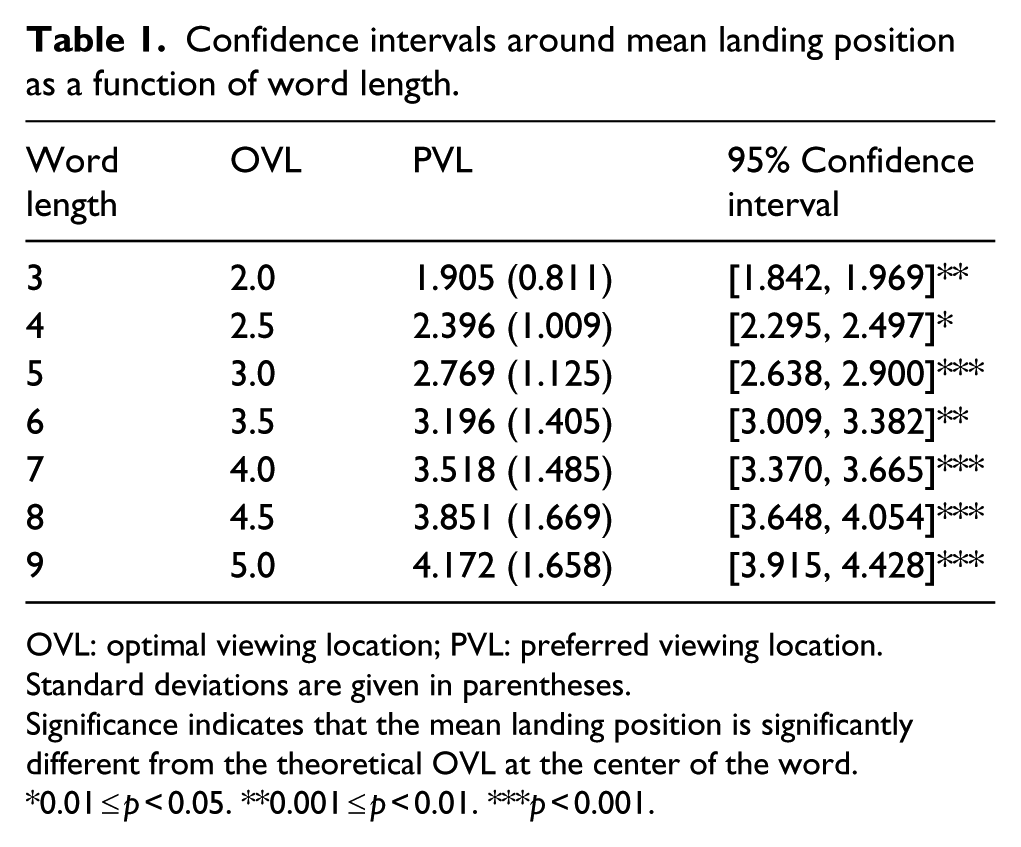
OVL: optimal viewing location; PVL: preferred viewing location.
Standard deviations are given in parentheses.
Significance indicates that the mean landing position is significantly different from the theoretical OVL at the center of the word. *0.01 ≤ p < 0.05. **0.001 ≤ p < 0.01. ***p < 0.001.
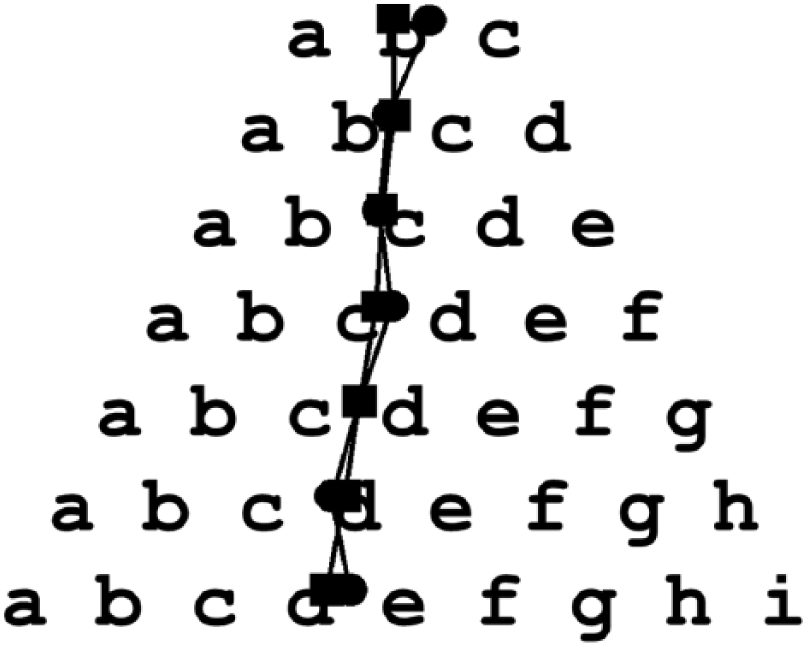
Mean landing position for words of three through nine letters.
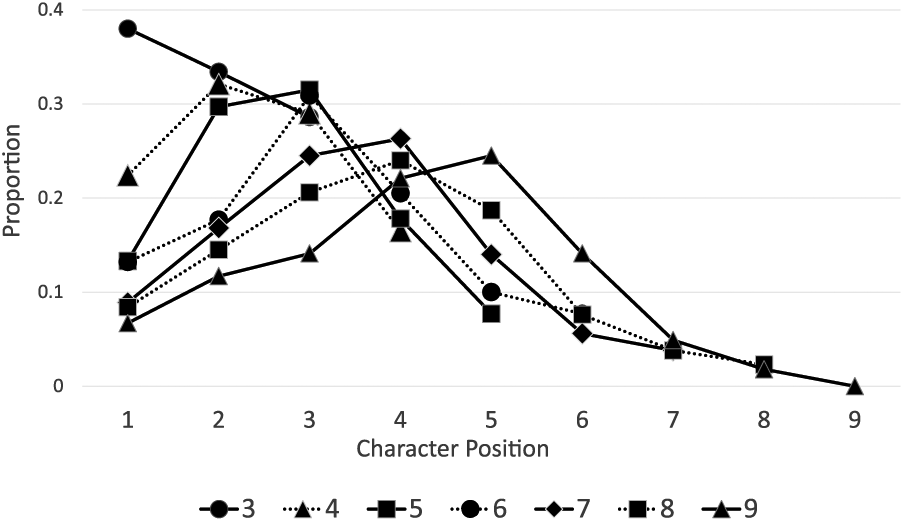
Proportion of initial fixations at different character positions as a function of word length.
Finally, it should be noted that even in those cases in which readers launched from the center of word n − 1 (at the OVL), they did not land at the OVL of word n. Indeed, they moved their eyes away from the center, and landed significantly left of center (t(294) = 2.174, p = 0.031, d = 0.13).
Discussion
This study was designed to understand whether the typical, slightly left-of-center landing position observed during sentence reading is due to oculomotor error from undershooting the center during left-to-right sentence tracking as is suggested by some researchers (McConkie et al., 1988; O’Regan, 1990, 1992; O’Regan, Lévy-Schoen, 1987; Rayner, 2009; Reichle et al., 1998), or whether it is due to a processing advantage provided to the reader when landing in this position. Sentences in the current experiment were presented with one word per line from the top to the bottom of a computer screen while landing positions were recorded with an eye tracker. This sentence presentation format disentangled landing position effects due to oculomotor error from undershooting the target from the effects due to a processing advantage, as sentence tracking was directed from top-to-bottom instead.
The fact that landing positions still fell in the typical left-of-center location indicates that readers were directing their eyes away from the OVL to initially fixate on a location left of center. Although these effects are small, they are strikingly similar to the PVL effects previously reported, including those originally reported by Rayner (1979). This leftward bias is also supported by the subset of trials in which readers launched from the OVL of word n − 1; in these cases, the initial fixation on word n was significantly to the left of center although again the effect size was small. This finding echoes that from van der Linden and Vitu (2016) who found a strong bias toward refixating the left side of an isolated word when the initial fixation was near the center. That is, when readers are fixated at the center of a word, they tend to move their eyes away from center toward the beginning of the word in the subsequent fixation. The explanation of Li et al. (2011) that the PVL is in part due to its calculation from only incoming rightward saccades also cannot explain the effects of the present study, given that forward saccades all came from above the target word rather than consistently near the beginning letters; yet, readers made longer saccades than necessary to target these leftward letters. Instead, the current results suggest that the left-of-center PVL effect in normal left-to-right reading occurs because this landing position confers a processing advantage and is not driven by oculomotor error in undershooting the center or specifics in calculating PVL curves.
As outlined in the introduction, multiple theories have been put forth to explain what could be driving this processing advantage, such as mechanisms underlying attentional focus during reading (Deutsch & Rayner, 1999; Dunn-Rankin, 1978; Farid & Grainger, 1996; Rayner, 1979), proximity to beginning letters which provide lexical information critical to word identification (Deutsch & Rayner, 1999; Farid & Grainger, 1996; O’Regan, 1981; Paterson & Jordan, 2010), hemispheric lateralization (Brysbaert, 2004), or a rightward visual bias due to perceptual learning (Nazir et al., 2004). In the current task, although words were presented from top to bottom, the letters within the words were still presented from left to right. Thus, a leftward fixation may have been preferable in this task as in normal left-to-right reading because it places the majority of text in the right visual field or because it puts the reader at the beginning of the word to begin processing the letters. Thus, the overall leftward shift of typical landing position in the current experiment could be driven by any one of these possibilities, and these explanations are also not mutually exclusive; it could be that multiple higher-order factors contribute to the processing advantage that drives readers to land left of center in sentence reading rather than at the OVL.
A number of future studies using this top-to-bottom reading format can help to pinpoint which of these alternative hypotheses underlie the PVL effect. For example, exploring landing position effects during top-to-bottom reading of meaningless z-strings could assess whether the current effects are language related or not. Implementing a scrambled word condition would address whether the PVL is restricted to sentences in this novel format. Studying a right-to-left writing system like Hebrew could tease apart the hemispheric lateralization explanation from the others. Finally, manipulating the orthographic information at the beginning of the word can help to identify whether the important role that the first letter serves is shifting readers’ fixations leftward.
In sum, this study sought to explore whether the left-of-center landing position in words during sentence reading is solely due to the effects of systematic oculomotor error when trying to target the center of words. In using a novel text presentation format, in which sentences were presented with one word per line from the top to the bottom of a screen, readers continued to fixate left-of-center, directing their fixations away from the center of each word (the OVL) to land at the PVL. The results from this study suggest that, contrary to the assumption held by many researchers since Rayner’s original 1979 eye-tracking study that the PVL in typical left-to-right sentence reading is solely due to oculomotor error, the PVL is instead due to a processing advantage.
Footnotes
Declaration of conflicting interests
The author(s) declared no potential conflicts of interest with respect to the research, authorship and/or publication of this article.
Funding
The author(s) received no financial support for the research, authorship and/or publication of this article.