







Abstract
The main purpose of the present study is to analyse the effect of sinusoidal magnetic field on a rough porous hyperbolic slider bearing system. The analysis is subjected to (i) Beavers and Joseph's slip model measuring the effect of slip velocity (ii) Christensen and Tonder's stochastic model representing the transverse surface roughness (iii) Sinusoidal magnetic field as suggested by Patel and Deheri. The novelty of the present study lies with the effect of sinusoidal magnetic field strength combined with the stochastic roughness of the bearing surface on pressure distribution and load-carrying capacity. The striking result reported in the present study is that the sinusoidal magnetic field enhances the load-bearing capacity by a factor
 which amounts to 38.3% of increase in the load-carrying capacity. The magnetisation of the ferrofluid lubricant and slip parameter augment the load-bearing capacity within certain range.
Introduction
Ferrofluids constitute a special category of nano materials exhibiting simultaneously liquid and super paramagnetic properties. Several theoretical investigations were conducted using a ferrofluid as lubricant due to its various advantages such as long life, silent operation and reduced wear. Shliomis 1 discussed briefly the methods of preparation and stability problems of magnetic colloids. This review paper summarises the results of theoretical and experimental investigations relating to the effect of a magnetic field on the equilibrium conditions and on the character of the motion of the suspensions. The nanofluids are extensively used due to its increasing thermal conductivity property. Usually fluids such as water, ethylene glycol and mineral salts in heat transfer process used as base fluid exhibiting low thermal conductivity in the absence of nanofluid. Nanofluid considered first by Choi 2 is an advanced kind of fluid containing nanometre-sized particles (diameter less than 100 nm approximately) or fibres hanged in the ordinary fluid. They undergo constant oscillation and are most stable with suitable viscosity having better spreading, wetting and dispersing property on a solid surface and having potential to enhance the heat transfer rates. Choi et al. 3 pointed out that the effect of a small amount of nanoparticles added to any standard base fluid (less than one per cent by volume) enhances approximately twice the thermal conductivity of the base fluid. The use of magnetic fluid as a lubricant for the bearing system in the domain of nanoscale science has attended a great height. Magnetic fluid consists of colloidal magnetic nanoparticles dispersed in a carrier fluid. The average diameter of the dispersed particles ranges from 5 to 10 nm. The ferrofluid contains enormous magnetic nanoparticles and hence, amenable to external magnetic field with a body force to which each and every particle experiences. Therefore, retention of magnetic fluid in any specific orientation or oscillations can be affected by the external magnetic fluid. The magnetic fluids are used in many energy devices, computer disk drives and high precision speakers. Bhat and Patel 4 studied a ferrofluid lubricant in an exponential slider bearing and established that the load-carrying capacity increases with an increase in magnetic field intensity. Bhat and Deheri 5 studied the performance of a porous composite slider bearing in the presence of a magnetic fluid lubricant and found that the magnetisation of the fluid increases the load-carrying capacity of the bearing. Andharia et al. 6 studied the effect of transverse surface roughness on the hydrodynamic lubrication of slider bearings with various film shapes and concluded that the inclusion of positively skewed roughness and standard deviation causes severe load reduction. Rao and Agarwal 7 studied the effect of roughness of the surface on hydrodynamic lubrication of porous inclined slider bearing considering slip velocity and squeeze velocity in couple stress fluids.
Ferrofluid-squeeze film between curved annular plates including rotation of magnetic particles was studied by Shah and Bhat. 8 It was shown that an increase in the slip parameter failed to alter the load-carrying capacity as well as the centre of pressure. Further, they claimed that the friction was reduced as the material parameter increased. Oladeinde and Akpobi 9 studied the load capacity of finite slider bearings with slip surfaces and Stokesian couple stress fluids. It was established that in order to augment the bearing performance the slip velocity should be reduced, at the same time they remarked that the couple stress parameter enhanced the performance. Shimpi and Deheri 10 studied the ferrofluid lubrication of a squeeze film in rotating curved rough porous circular plates and evaluated the deformation effect. They observed that the adverse effect was encountered by the deformation of the plates on the performance of the bearing system. Ahmad and Singh 11 analysed the effect of slip velocity on the load-carrying capacity of a magnetic fluid-based porous inclined slider bearing. It was shown that the slip coefficient is to be kept at a minimum to arrive at an overall improved performance of the bearing system. Patel 12 investigated the effect of velocity slip on the behaviour of a squeeze film between two circular discs under the application of a uniform magnetic field and found that for a better performance of the bearing system the slip parameter had to be minimised. Zakaria et al. 13 explored the study of static and dynamic characteristics of eccentric cylinders lubricated with ferrofluid.
Singh and Gupta 14 studied the effect of ferrofluid lubrication on the dynamic characteristic of curved slider bearing based on Shliomis model and found that the stiffness and damping capacities were improved due to the rotation of magnetic particles. Agarwal 15 analysed a ferrofluid lubrication of an inclined plane slider bearing and concluded that performance of the bearing with ferrofluid as lubricant, was relatively better than that of the bearing with a conventional lubricant. Shah and Bhat 16 studied the ferrofluid lubrication of a parallel plate squeeze film between circular plates using Jenkins’ model and concluded that the load-carrying capacity increased with increasing values of the axial permeability or material constant of Jenkins’ model and attained the maximum when values of the material constant approached to unity. Patel and Deheri 17 studied the Shliomis model based on ferrofluid lubrication of a plane inclined rough slider bearing with slip velocity and concluded that although, the transverse surface roughness adversely affected the bearing system, the magnetisation increased the load-carrying capacity. Further, they remarked that the slip parameter not only decreased the load but also decreased the friction on the slider. An analysis was carried out by Patel et al. 18 on squeeze film with magnetic fluid as lubricant between rotating porous rough circular plates. Shimpi and Deheri 19 analysed the performance of a magnetic fluid-based squeeze film in curved porous rotating rough annular plates and studied the effect of bearing deformation. Naduvinamani et al. 20 investigated the combined effects of unidirectional surface roughness and magnetic field effect on the performance characteristics of a porous squeeze film lubrication between two rectangular plates. It was observed that the roughness of bearing surfaces enhanced pressure and squeeze film time. Siddangouda et al. 21 studied the combined effects of micro-polarity and surface roughness on the hydrodynamic lubrication of slider bearings with different film shapes including hyperbolic type. Here, interesting observation was that the negative skewed roughness increased the load-carrying capacity and temperature also. Sparrow et al. 22 studied the effect of velocity slip on porous-walled squeeze films and found that substantially faster response could be attained by the use of porous materials which accentuated the velocity slip.
The aim of the present study is to discuss the effects of slip velocity as well as surface roughness on a hyperbolic slider bearing system subjected to sinusoidal magnetic field with ferrofluid as lubricant. The striking features of the present work are laid down as follows:
Stochastic modelling of Christensen and Tonder has been employed to estimate the effect of transverse surface roughness. The bearing which supports a load is subjected to sinusoidal magnetic field and slip velocity.
The load-bearing factor is not only affected by slip velocity, surface roughness but also shape of the slider and porosity of stator. The crux of the present investigation is the shape of the slider i.e. hyperbolic one with imposed sinusoidal varying magnetic field. The present results are also compared with the earlier published work of Patel et al. 23 as a particular case.
Figure 1 shows the geometry of the hyperbolic slider bearing moving with a uniform velocity U in x direction and a stator with a porous matrix of thickness H*.
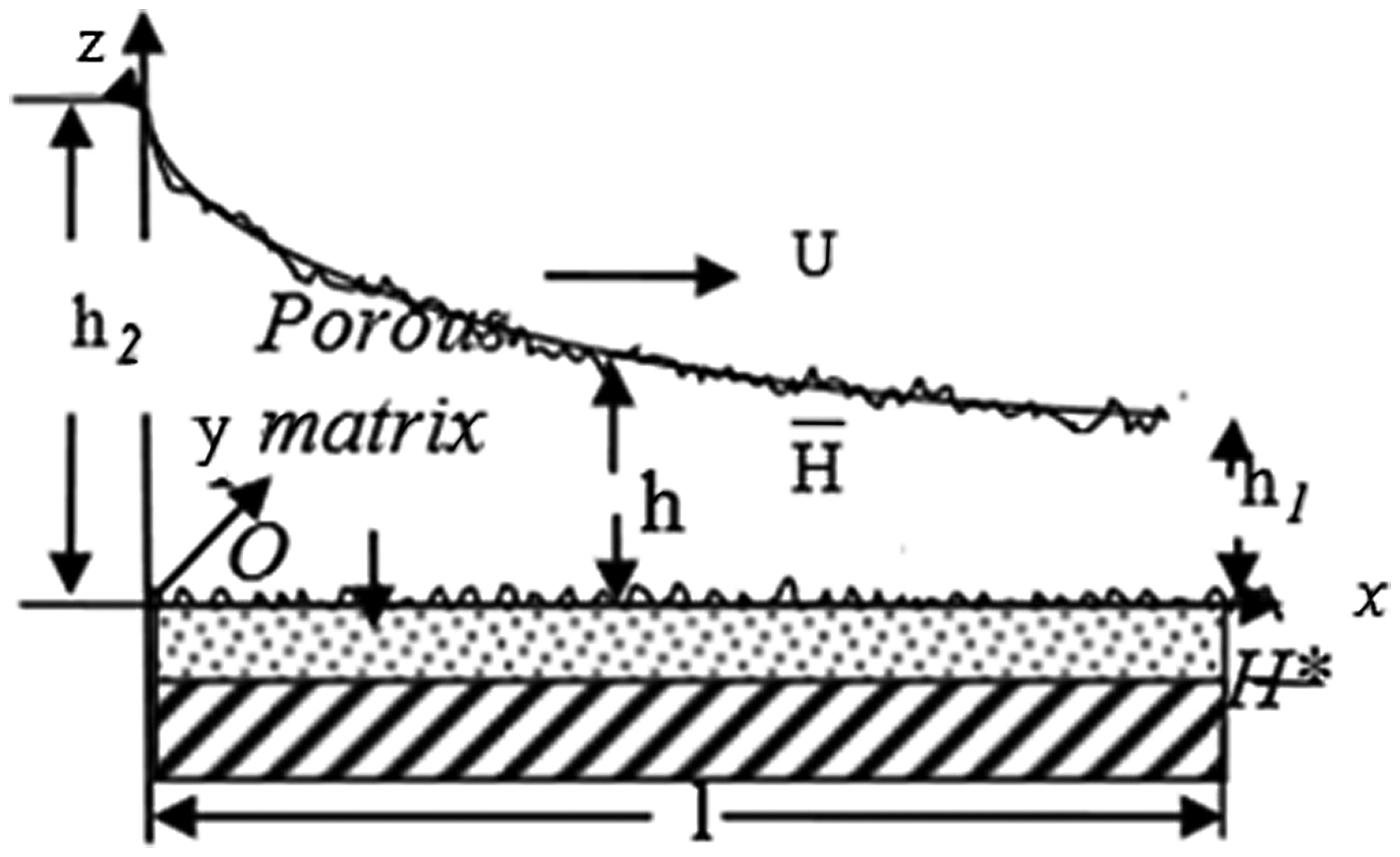
Hyperbolic slider bearing 23
Here, the length of the bearing is l and the breadth is b where, l < < b.
The thickness of the film h, in view of Cameron, 24 is given by
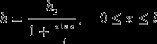
where
 ,
,
 and the minimum and maximum values of h are h1 and h2, respectively.
Following Patel and Deheri
25
the magnetic field
 of magnitude H is:

K being a dimensionless constant. Following Verma 26 the fluid flow in the film region is governed by
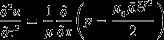
where u, x-component fluid velocity, μ, the fluid viscosity, μ0, the permeability of free space,
 , the magnetic susceptibility and p, the film pressure. Sparrow et al.
22
prescribed the following boundary conditions:
, the magnetic susceptibility and p, the film pressure. Sparrow et al.
22
prescribed the following boundary conditions:


where s is the slip parameter.
Solving equation (3) with boundary conditions (4) and then substituting the value of u in the integral form of the continuity equation for the film region, using continuity of velocity components of the fluid in the film region and porous matrix across the surface z = 0 one gets the Reynolds equation governing the film pressure is obtained as
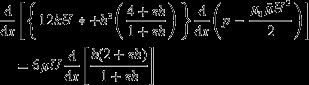
where k, the permeability of the porous material.
Bearing surfaces experience transverse and longitudinal roughness but transverse roughness finds frequent occurrence and affect bearing system significantly. Following Christensen and Tonder27–29 the lubricant film thickness
 is taken as

where
 is the mean film thickness, h
s
is assumed to have the probability density function f(h
s
) which is given by
is the mean film thickness, h
s
is assumed to have the probability density function f(h
s
) which is given by

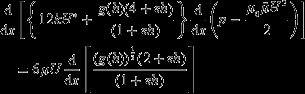
c, the maximum deviation from the mean film thickness. Now, resorting to the stochastic averaging of Christensen and Tonder,27–29 the equation (5) becomes
where

α, the mean, σ, the standard deviation and ɛ, the measure of symmetry of the random variable h s .
With the help of equations (1) and (2) and the following dimensionless variable and parameters
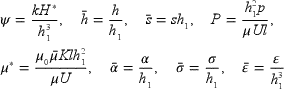
Equation (6) becomes

where
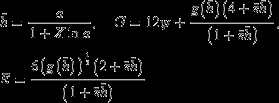
and

The corresponding boundary conditions are

Solving equation (7) with boundary conditions (9), the non-dimensional pressure distribution is obtained as

The non-dimensional form of the load-carrying capacity W and friction
 are given by
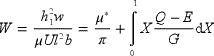

The expression for
 (non-dimensional X-coordinate) of centre of pressure
 is given by
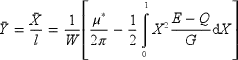
The location of centre of pressure indicates the position on which the resulting force is acting. Finally, we have dropped the bar from each of the non-dimensional parameters in figures.
The effects of the pertinent parameters on load-bearing capacity, friction and centre of pressure are to be discussed in the following lines. It is evident from equation (11) that the load-bearing capacity of the bearing system has been increased by
 in the present study by applying sinusoidal magnetic field of strength H2 = Kl2 sin (πX). As pointed out by Patel et al.
23
the load-bearing capacity has been enhanced by
in the present study by applying sinusoidal magnetic field of strength H2 = Kl2 sin (πX). As pointed out by Patel et al.
23
the load-bearing capacity has been enhanced by
 by using
 as the magnetic field. Hence,
 is the net increase in load-bearing capacity by using the sinusoidal magnetic field.
Further, it is also evident from equation (11) that the load-bearing capacity (W) is linear with respect to the magnetisation parameter (μ*). Therefore, the load-bearing capacity is directly proportional to the magnetisation. From the physical point of view magnetisation increases the viscosity of the lubricant which results in enhanced pressure and consequently the load-bearing capacity. The dimensionless friction and the position of centre of pressure are calculated from equations (12) and (13), respectively.
Figures 2–4 depict the effect of load-bearing capacity with respect to magnetisation parameter (μ*) for different values of slip parameter (s), mean (α) and attitude (
 ), respectively. It is to note that the load-bearing capacity increases sharply as magnetic intensity increases because magnetisation increases the viscosity of the lubricant and consequently pressure in the bearing.
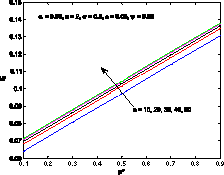
Variation of load-carrying capacity w.r.t μ* and s
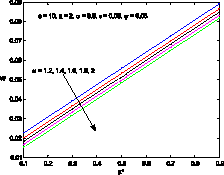
Variation of load-carrying capacity w.r.t μ* and α
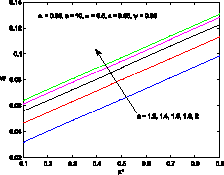
Variation of load-carrying capacity w.r.t μ*and a
Figures 5–8 illustrate the variation of load-carrying capacity with respect to the slip parameter for various values of standard deviation (σ), skewness (ɛ), porosity (ψ) and attitude (
 ), respectively. Analysing Figs. 5–8, it is observed that the load-carrying capacity decreases with an increase in standard deviation, skewness and porosity whereas, the load-carrying capacity increases when attitude increases. On careful study it reveals that the load-carrying capacity increases sharply with slip parameter s when s < 30 and afterwards it increases slowly.
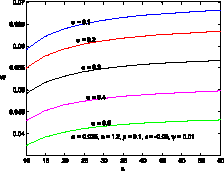
Variation of load-carrying capacity w.r.t s and σ
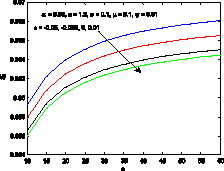
Variation of load-carrying capacity w.r.t s and ε
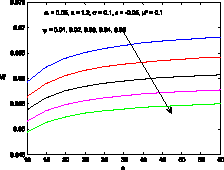
Variation of load-carrying capacity w.r.t s and ψ
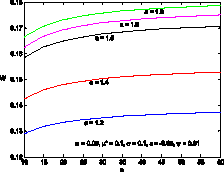
Variation of load-carrying capacity w.r.t s and a
Figures 9 and 10 exhibit the variation of load-bearing capacity versus standard deviation for different values of skewness and porosity. It is noticed that load- bearing capacity decreases for higher values of standard deviation as well as positive skewness.
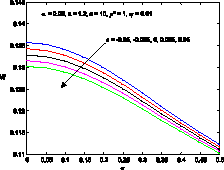
Variation of load-carrying capacity w.r.t σ and ε
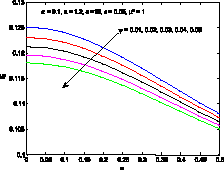
Variation of load-carrying capacity w.r.t σ and ψ
The variation of friction with respect to the magnetisation parameter for various values of slip parameter, mean and attitude are shown in Figs. 11–13. It is observed that an increase in magnetisation parameter leads to decrease in the friction. Moreover, an increase in slip parameter and attitude decrease the friction where as the reverse effect is observed in case of mean.
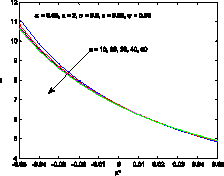
Variation of friction w.r.t μ* and s
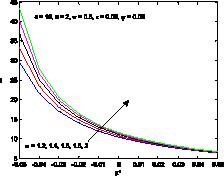
Variation of friction w.r.t μ* and α
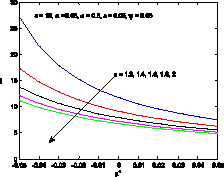
Variation of friction w.r.t μ* and a
Figures 14–16 illustrate the variation of friction with respect to slip parameter for different values of standard deviation, skewness and porosity. It is seen that an increase in standard deviation, skewness and porosity generates higher friction. However, for slip parameter s < 15, friction increases with standard deviation but decreases with skewness and porosity. This serves as the guide line while designing the slider bearing in the present context.
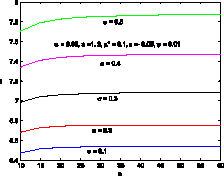
Variation of friction w.r.t s and σ
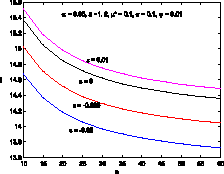
Variation of friction w.r.t s and ε
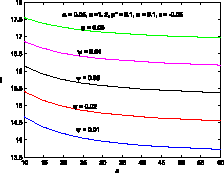
Variation of friction w.r.t s and ψ
Figures 17 and 18 represent the variation of friction versus standard deviation. The striking feature of the profiles is that the friction increases with higher value of standard deviation but it increases sharply when standard deviation exceeds 0.025.
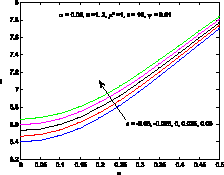
Variation of friction w.r.t σ and ε
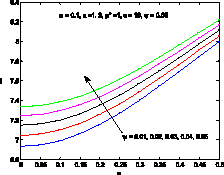
Variation of friction w.r.t σ and ψ
Figures 19 and 20 present the location of centre of pressure with respect to magnetisation parameter and standard deviation. It is seen that as magnetisation parameter increases centre of pressure shifts towards the outlet edge, but as standard deviation increases centre of pressure shifts towards the inlet edge.
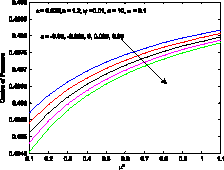
Variation of centre of pressure w.r.t μ* and ψ
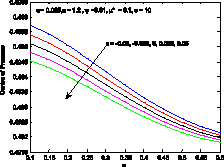
Variation of centre of pressure w.r.t σ and ε
From the above discussion, the following conclusions are drawn:
The sinusoidal magnetic field enhances the load-bearing capacity by a factor
Magnetisation of the ferrofluid used as lubricant leads to supplement the load-carrying capacity. The slip parameter increases the load-carrying capacity significantly for s < 30 whereas standard deviation, positive skewness and porosity decreases it. The attitude contributes to load-carrying capacity by reducing the friction. The anomalous property of slip parameter s(s < 15) is to be taken care of in order to augment the effect of standard deviation, skewness and porosity. Shifting of centre of pressure is affected by magnetisation and standard deviation.
 in the present study whereas in case of Patel et al.
23
it is
in the present study whereas in case of Patel et al.
23
it is
 . This amounts to an increase of 38.3% in load-carrying capacity.
Disclosure statement
No potential conflict of interest was reported by the authors.
Footnotes
Acknowledgement
Authors express their deepest sense of gratitude to the learned editors and reviewers for constructive suggestions and authorities of the Siksha ‘O’ Anusandhan University and U.N (Auto.) College of Science and Technology.