







Abstract
This study is focused on the fire and shock resistance of wooden structures. Fire resistance was investigated through testing the fire resistance duration and charring rate at different positions of the wooden structure. Shock resistance was studied based on the peak load changes and shear capacity of the wooden structure. Finally, optimization strategies were proposed for improving the performance of the wooden structure of buildings.
Introduction
With the continuous development of society, people have put forward higher requirements on various properties of buildings as their expectations of buildings have not been limited to living. Barotto et al. (2018) studied wood in detail from an architectural perspective and analysed the relationship between species and wood density. Researchers have studied the improvement of material selection for earthquake resistance. For example, Giuriani and Marini (2008) has proposed a wood roof strengthening technique which could convert roof asphalt into seismic shear-resistant partitions. This technique weakens the integrity of the building minimally and could be applied to the construction of aseismic wood roofs in new buildings. Ichikawa et al. (2010) proposed a connection structure for seismic strengthening which included at least one structural member with a longitudinal axis and at least one seismic strengthening member. Most researchers, such as Barber and Gerard (2015), believe that new technologies which apply cross-laminated timber are the key to improving the fire resistance of timber buildings. In fact, there is no direct relationship between fire and wood burning in timber buildings. For example, Östman (2017) studied the fire classification system of building products, fire resistance of building components and the European code of structure in the perspective of European requirements for fire safety of buildings and concluded that wood structures had higher heat and fire resistance. Chang and Jeon (2014) pointed out that Daejojeon was the sole royal building with fire prevention design introduced into the traditional wood structure in the palace. When studying the Deajojeon complex reconstruction in Changdeokgung during the period from 1917 to 1921, it was found that the architectural norm of using a traditional roof frame for the buildings of the inner palace was valid even during the Japanese colonial period. Dârmon and Suciu (2018) studied the mechanical smoke control system in timber architecture, with the intention of preventing fire disasters. Wooden-structured building is a characteristic of Chinese culture and the main form of Chinese ancient buildings, which has outstanding performance in all aspects. From the primitive society to the feudal society, ancient Chinese wooden architecture suffered from germination, development, prosperity and gradual decline. The feudal society is a period of prosperity and development of wooden architecture, and the classical mortise-tenon connection and bucket arch are similar to the current shock isolation and energy dissipation technologies, with far-reaching research values. However, at present, people generally lack understanding of fire resistance and seismic performance of wooden structures and pay little attention to wooden-structured building. In this study, the fire and shock resistance performance of wooden-structured buildings was examined. The fire and shock resistance performance of wooden-structured buildings was analysed in depth by two groups of simulation experiments. Some suggestions for the optimization of wooden-structured buildings were put forward, hoping to provide some theoretical bases for the application of wooden structure in buildings.
Overview of wood-frame buildings
Research background
Chinese ancient architecture (Qin and Yang 2018) which is mainly made of timber is world famous for its unique structure and imposing manner. With a special style, Chinese ancient wood-frame buildings feature long history, large numbers, complex structure and favourable seismic resistance, and some of them are still functioning even after suffering multiple earthquakes over thousands of years; those buildings have extremely high cultural, artistic and scientific values (Wang and Yang 2014). In the traditional sense, wood-frame buildings have poor fire resistance, and can even be an important cause of fire disasters. However, there is evidence to suggest that wood-frame buildings have less damage in fire events among various ancient buildings.
Generally speaking, fires in wood-frame buildings are man-made. Of course, natural factors can also lead to the occurrence of fires, such as lightning. Improper use of fire can lead to the burning of decorations in the house; if there are casualties, the spread of toxic gases after the burning of decorations is the main reason. Fires in more than 50% of the wood-frame buildings are not directly related to the combustion of building materials themselves. In terms of seismic performance, each member of the internal structure is connected in the form of mortise-tenon joints which are divided into beam-lifting type, crossing bracket type and comprehensive type (Figure 1).
Beam-lifting wooden building and crossing bracket wood building.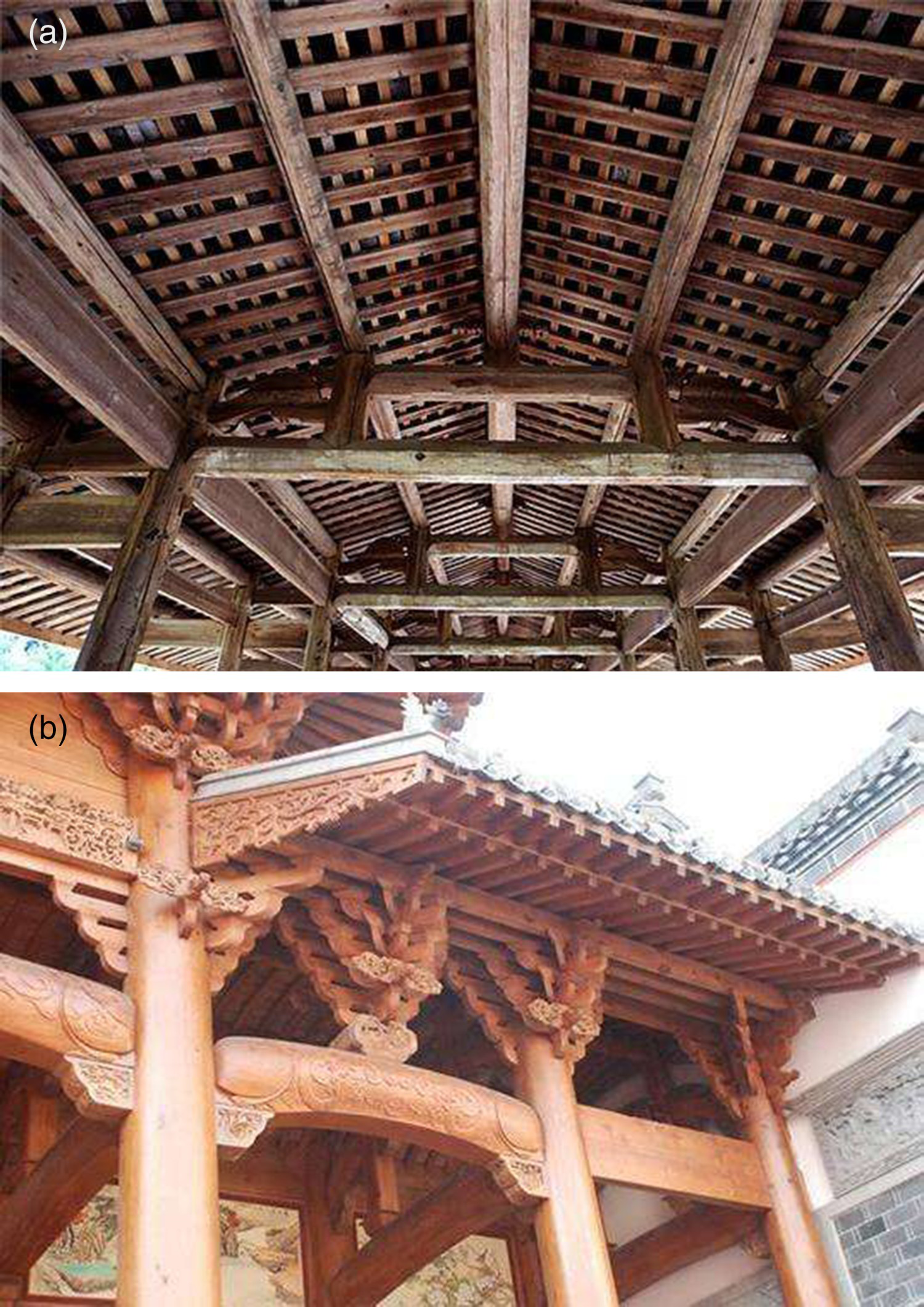
Improving the seismic performance of buildings is an important reflection of a nation's ability to deal with sudden natural disasters, and many places in China are located in the earthquake zone. For example, the three light-weight wooden public buildings built after the 2008 Wenchuan earthquake, Dujiangyan Xiang'e Primary School, Mianyang Disabled School and Beichuan Hongfeng Home for the Aged, showed excellent seismic performance when suffering multiple strong aftershocks. Wood structure which is firm, light in weight, and small in volume will absorb little seismic force, and under seismic action, many components and joints of the wood structure can form a variety of load transmission paths (Kamiya et al. 2018) to cushion and disperse seismic action. Its favourable elasticity and resilience can effectively reduce earthquake damage.
Wood-structured building is an architectural characteristic of China. The development of thousands of years has suggested that wood-structured buildings have good fire and earthquake resistance, such as Guanyin Pavilion in Dule Temple in Ji County and Fengguo Temple Hall in Yi County. They have experienced many large earthquakes, but are still safe. Wood-structured buildings have good properties, and wood is a good green building material, which can be recycled, degraded and reused. Therefore, under the current advocacy of the sustainable development policy in China, it is of great value to study wood-structured buildings.
Chinese wooden structure architecture is an important part of Chinese traditional culture. It has rich value in history, art and science. However, there are great difficulties in the study of wood-structured architecture, so there are few related studies. At present, many scholars have done some research on wood structure, but there are few studies concerning properties of wood-structured buildings.
Purpose of the research
Wood-frame buildings have the following advantages.
First, the firm structure has a favourable shock resistance. Second, it is easy to repair and has good energy saving and heat conservation properties. Thirdly, it has a short production cycle and is environmentally friendly (Bailis et al. 2015).
The authors expected to make more people understand the advantages of wood-frame buildings and promote timber materials through studying the fire and shock resistance of wood-frame buildings (Wang 2011).
Experiment on the fire and shock resistance
Experimental process
Experiment of fire resistance
The fire resistance of building components including the load-bearing floorslab, bearing wall, non-bearing suspended ceiling, non-bearing wall, glued load-bearing wooden beams and glued load-bearing wooden columns were tested in a vertical test furnace whose cross section was 3 m * 3 m (Figure 2). Picea asperata Mast. which is a special species of tree and has even texture and subtle structure was taken as the material of laminate, and plywood and gypsum board were taken as facing materials. Several thermocouples with high sensitivity and favourable oxidation resistance were installed at the specified locations of the components. Hydraulic jacks and a high-temperature camera were also installed.
The vertical test furnace used in the experiment.
The temperature of different sections was measured before the experiment. Thermocouples were installed in the test furnace. The three quarters of the horizontal furnace was separated using a heat-resisting steel sheet and plate which was filled with silica wool. The reaction frame on the horizontal furnace was moved to the position of wood testing, and load was applied at the trigonal point at the top through the hydraulic jack. The frames were put into the furnace. The combustion process was observed through a high-temperature camera. The temperature in the furnace was measured and controlled. Oxygen supply was stopped when it reached the fire resistance value. After the temperature decreased, they were taken out and cooled with water.
Experiment of shock resistance
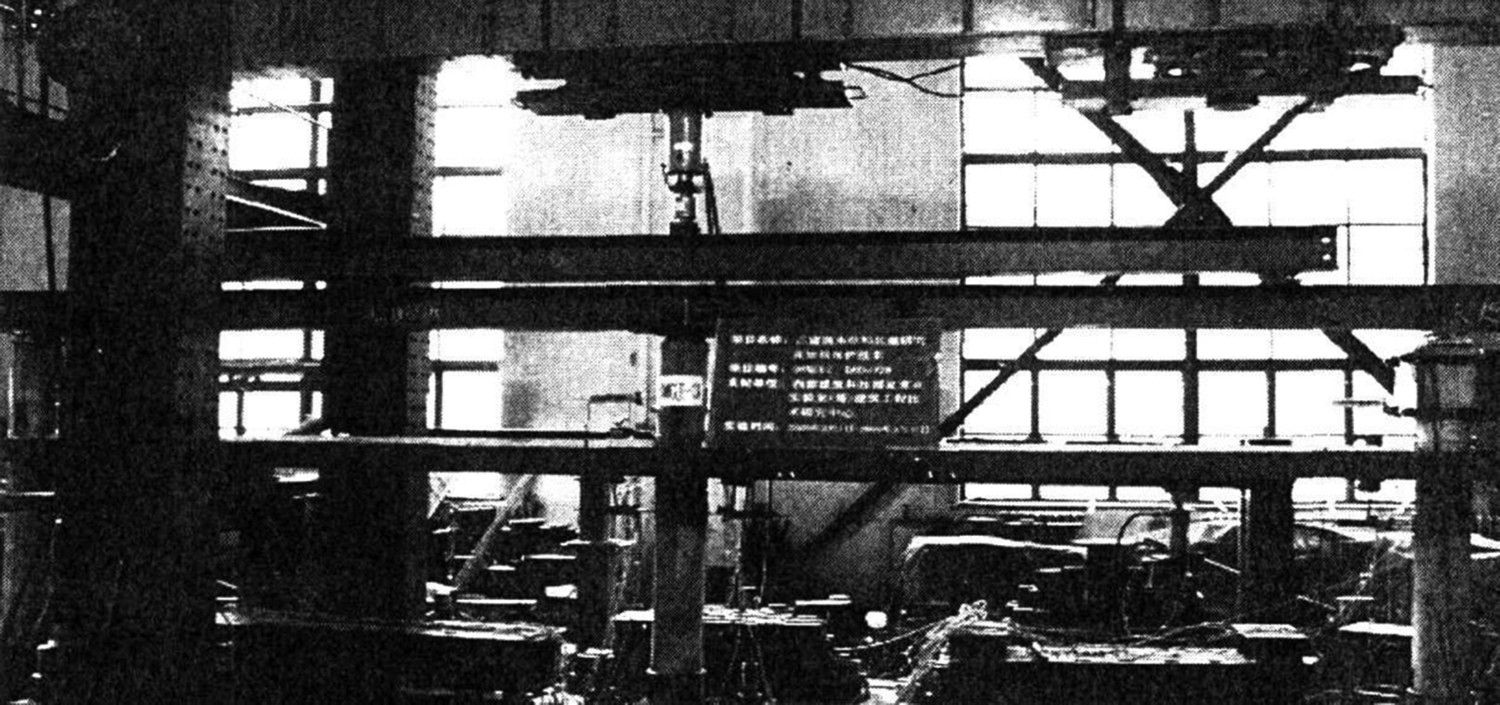
The loads imposed on the wood components included compression, tension, bending and shearing. The following content is about the compressive load that is similar to the pressure in an earthquake. Cryptomeria fortunei wood whose upper and lower diameter was both 200 mm was taken as the experimental column, and a column of the same size which was made of steel was taken for comparison. To make the observation of cracks easier, the surface of the experimental wood column was marked with ink lines every 50 mm. To avoid rigid body displacement of the wood frame under the effect of horizontal forces, a round mount tenon which is commonly used for column base connection in ancient wood structures was used at the bottom of the column (Ido et al. 2017), and it was placed at the foundation beam groove. The diameter of the circular opening of the foundation beam was 100 mm. A sliding support, spherical hinge, jack, actuator and wood beam which were made of the same material. The model loading frame was set as shown in Figure 3. The picture of the equipment is shown in Figure 4.
The schematic diagram of loading. The loading equipment.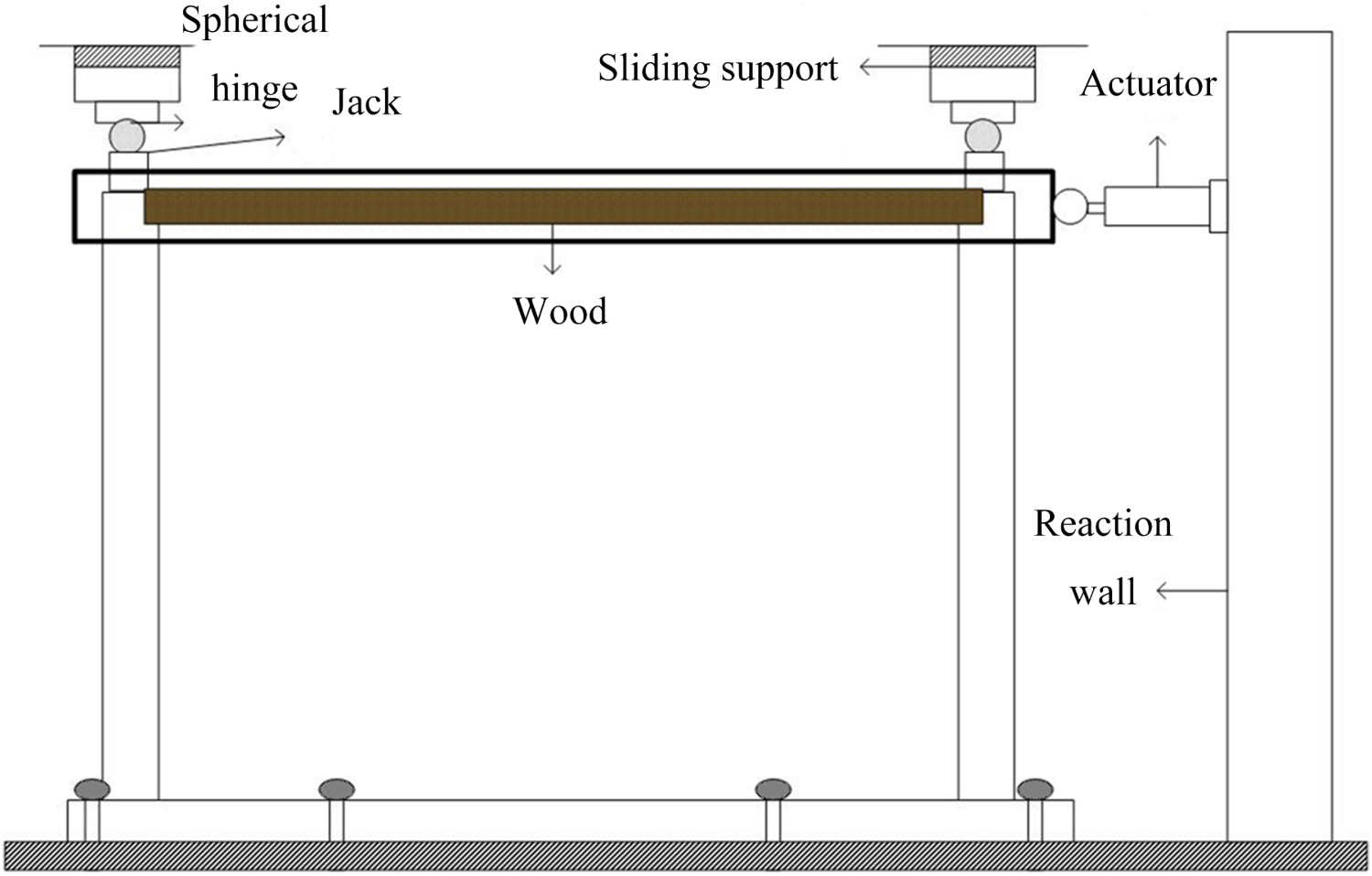
First, half of the vertical preload was loaded and unloaded from the load-sharing beam, once through the vertical jack, spherical hinge and sliding support. Then the vertical preload was loaded and lasted for two or three minutes. The loading diagram is shown in Figure 3. Next, the horizontal low cyclic repeated load was applied slowly using the actuator at a loading rate of 0.3 mm s−1. The yield point was determined according to whether unloading stiffness degenerated or not. Load increment must be reduced at the segment of small load before the yield point was reached. The above procedures were repeated to obtain the loading value P of the horizontal low cyclic peak point.
Analysis of experimental results
Results of experiment of fire resistance
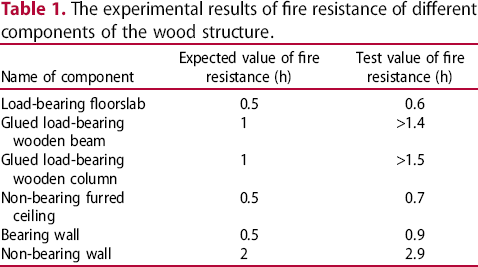
Fire resistance reaches the limit when bearing capability, integrity and thermal insulation are lost.
The experimental results of fire resistance of different components of the wood structure.
The charring rate of the different parts of the wood frame.

As can be seen from Table 2, the charring rate of wood with different widths was basically the same; the charring rate of the column bottom and top was the same, keeping at 0.034 mm/min; the charring rate in the plane was slower than that outside the plane; the velocity in the plane of the column bottom was even 0, i.e. there was almost no charring in the plane of the column bottom. The above experimental data indicated that the wood had strong fire resistance because of the charring effect.
Results of experiment of shock resistance
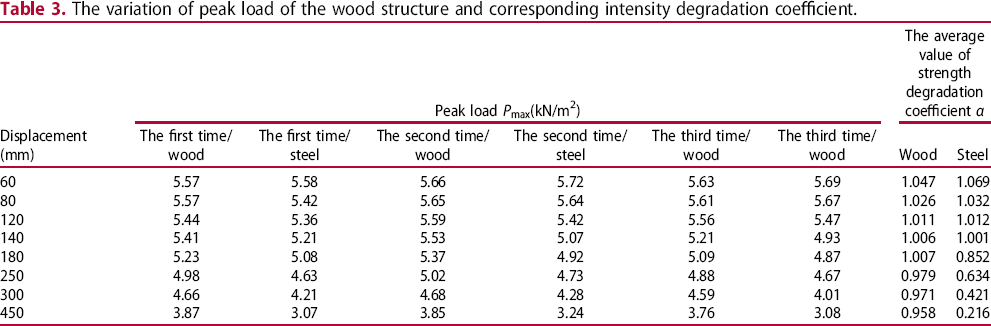
The experiment was repeated three times.

 stands for the peak load at the nth loading, and
 stands for the peak load at the first loading.
The variation of peak load of the wood structure and corresponding intensity degradation coefficient.
 (kN/m2)
The intensity degradation coefficient of the wood structure decreased with increasing pressure, but the variation was slow, i.e. the compressive capacity of the wood structure was strong, and it could still control the strength very well even if the displacement was about 450 mm. It suggested that the wood structure had superior resistance to pressure in earthquake conditions. The peak load decreased with the decrease of displacement, i.e. the force that the wood structure could bear was decreasing, the peak load decreased to about 3.8, and it still could bear force larger than 3.5 even if the displacement was 450 mm. During the experiment, the original cracks changed slightly with the change of pressure, and no new cracks appeared. The stiffness of the wood structure changed little, and there was no obvious yield load in the whole process. Compared to the wood material, the strength coefficient of the steel material decreased faster with the increase f pressure. When the displacement was 450 mm, the steel material could only bear 3 kN/m2 of load. It indicated that the pressure resistance performance of the steel material was poorer than that of the wood material.
The shear capacity at the ultimate load.
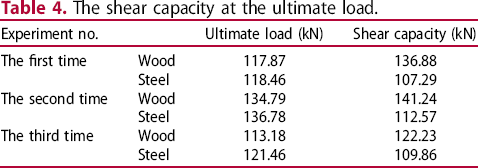
It could be seen from Table 4 that the greater the ultimate load, the greater the shear capacity; the shear capacity was generally greater than the ultimate load, and even exceeded 10 kN; the shear capacity of the steel material was smaller than the ultimate load. When the steel structure was damaged, its shear capacity was unable to support pressure higher than the ultimate load, but the wood structure could still support a part of the pressure when the load exceeded the ultimate load, indicating an excellent compressive capacity.
Optimization method
The fire and shock resistance of a wood structure can be optimized using modern technologies. In terms of fire resistance, fire-retardant treatment can be used, including surface coating treatments (Li et al. 2010) and impregnation treatment (Han et al. 2017). Because of the good seismic resistance of wood itself, the only way to improve the seismic resistance is to reinforce and repair wooden beams. New materials such as carbon fibre reinforced plastics (CFRP) (Rababeh et al. 2014) can be used to enhance the bending resistance, interface stress and shear resistance of wooden beams. For existing wooden structures, tensile joints between components and reinforcement of walls can be considered according to actual conditions. If the damage of wooden structures is serious, it is necessary to reinforce the main body of a building. If a building has no reserves of strength, it should be considered for retirement. A wood structure with large cracks can be reinforced by iron hoops to ensure good shock resistance. Rotten wood can be reinforced by replacing the rotten part with new wood of the same size and then reinforcing by an iron hoop. If the wood structure of a building is intact but the infill wall is damaged, the wall should be renewed or strengthened. Attention should be paid to the connection between the wood structure and the wall during the reinforcement process, such as the use of wood compression bars and fastenings in the wood structure.
Discussion and conclusion
Wood structures have been widely used in China, especially in ancient buildings. In the modern age, the wood structure construction industry has also been well developed. The application fields of wood structure have extended from residential buildings and hotels to tea houses, garden landscape and so on. Wood-structured residential buildings are increasing in a speed of more than 600 buildings per year, occupying an important position in post-disaster reconstruction and tourism resources development. The current development directions include new countryside residential construction in the Yangtze River Delta and Pearl River Delta area, resistance residential construction in earthquake-prone areas, ecological and environmental protection residential construction in tourist attractions and renovation and reconstruction of ancient buildings. One of the reasons why wood structures are widely used is their excellent fire resistance and shockproof performance. In order to have a better understanding of the fire and shock resistance performance of wood structures, the fire resistance performance of wood structures was analysed through experiments in this study. Fire resistance tests of different components showed that the fire resistance of each component was obviously beyond expectation. The fire resistance of the non-load-bearing wall was the highest, approaching 3 h. The charring rate of wood was generally slow, and there was even no charring phenomenon in the bottom plane of the column, indicating that wood has a strong resistance to charring. The results of the experiments indicated that wood had good fire resistance. It is generally acknowledged that wood is a combustible material. Many people think that fire resistance of wooden structures is inferior to that of concrete or steel structures, but in fact, the fire resistance of wooden structures is superior. The strength of the steel structure decreased when the temperature reached 240°C. If the temperature reached 750°C, the strength decreased to a level which was 10% of the original strength. The concrete structure had similar performance. The strength and modulus of elasticity of the concrete structure decreased significantly with the increase in temperature. During burning, the charring layer on the surface supported the flame to burn into wood to protect the overall structure, and so it will not collapse in a short time. In the event of fire, it increases the possibility of escape for people in the building.
In this study, the shock resistance experiment found that the strength coefficient of the wood structure showed a downward trend with the increase in pressure, but the downward speed was very slow, even if there was a 450 mm displacement. Moreover, with the increase in pressure, there were no new cracks, and the original cracks did not change much, indicating that the wood structure had good compressive capacity and shock resistance performance. The comparison test also suggested that the compressive strength of wood was significantly better than that of steel. In the history of earthquakes, wood-structured buildings have shown the best shock resistance performance and are less likely affected by earthquakes. For example, the Buddha tower in Yingxian, Shanxi, China, has experienced seven major earthquakes but still stands. Many wood-structured buildings can still be used safely after the Wenchuan earthquake.
On the premise of continuously improving the design method and construction technology of wood-structure buildings and considering the traditional wood structure construction technology of China and the new technology in the West, the prospect of modern wood-structure buildings is bright. Its excellent fire-proof and earthquake-resistant performance can play a more effective role after a number of improvements. It is necessary to accept wooden frame buildings with new ideas and develop new paths continuously.