






Abstract
This study aims to investigate whether it is possible to predict the modulus of elasticity (MOE) and modulus of rupture (MOR) of lumber produced from different heights using the stress-wave velocity of standing trees or the dynamic Young's modulus of logs in Siberian larch (Larix sibirica). A total of 190 pieces of lumber (38 by 89 mm in cross section) were cut from 111 logs obtained from 25 standing trees. Significant positive correlation coefficients were found between the stress-wave velocity of standing trees and MOE (r = 0.776) and MOR (r = 0.702) of this lumber. The dynamic Young's modulus of the logs also correlated significantly with MOE (r = 0.745) and MOR (r = 0.584) values. The results obtained in the present study suggest that stress-wave velocity and dynamic Young's modulus are useful for selecting superior trees in tree breeding and sorting logs for producing structural lumber.
Keywords
Introduction
It is well known that the mechanical properties of wood and wood based-materials can be estimated by many types of non-destructive testing methods (Niemz and Mannes 2012). Of these various testing methods, acoustic methods are considered the most effective at measuring Young's modulus of wood in different forms, such as standing trees, logs, lumber, and small-clear specimens (Sobue 1986; Nanami et al. 1992a, 1992b; Ikeda and Arima 2000; Wang et al. 2007; Wang 2013).
The stress-wave velocity of standing trees has been used to assess the wood quality of logs or lumber produced from softwood tree species (Nanami et al. 1992a, 1992b, 1993; Ikeda and Arima 2000; Ikeda et al. 2000; Chauhan and Walker 2006; Ishiguri et al. 2006, 2008; Wang et al. 2007, Auty and Achim 2008; Wessels et al. 2011; Paradis et al. 2013; Hiraiwa et al. 2014; Merlo et al. 2014; Fischer et al. 2015). Positive correlations were found between the stress-wave velocity of standing trees and modulus of elasticity (MOE) in lumber from Picea mariana (Paradis et al. 2013), Pinus pinaster (Merlo et al. 2014), Larix kaempferi (Ishiguri et al. 2008), and others (Wang et al. 2007). These results indicate that the bending properties of lumber can be predicted by the stress-wave velocity of standing trees in softwood species. However, more available information is needed for predicting bending properties of lumber produced from different height positions in a stem by stress-wave velocity of standing trees.
Log and structural lumber qualities have been also evaluated by acoustic methods (Sobue 1986; Aratake et al. 1992; Aratake and Arima 1994; Ross et al. 1997; Wang et al. 2002; Brunetti et al. 2016; Butler et al. 2017; Simic et al. 2019). The dynamic Young's modulus of logs determined using resonance frequency correlated significantly with MOE or modulus of rupture (MOR) for lumber from L. kaempferi (Nagao et al. 2003), balsam fir (Abies balsamea), eastern spruce (Picea rubens) (Ross et al. 1997), Sitka spruce (Picea sitchensis) (Simic et al. 2019), and Japanese cedar (Cryptomeria japonica) trees (Matsumura et al. 2012). Fujita et al. (1995) reported that, in C. japonica, the dynamic Young's modulus of logs correlated significantly with the MOE (r = 0.85) and MOR (r = 0.56) of kiln-dried square lumber (12 by 12 cm, 10.5 by 10.5 cm, and 9 by 9 cm in cross section). In P. sitchensis, the dynamic Young's modulus of logs also correlated significantly with the MOE of lumber (44 by 100 mm or 35 by 75 mm in cross section) (Simic et al. 2019). The dynamic Young's modulus of lumber also correlated strongly with MOE and MOR of lumber in softwood species (Arima et al. 1990, 1993; Sobue and Mizukami 1993; Fujita et al. 1995; Halabe et al. 1997; Yang et al. 2017; França et al. 2019). These results also indicate that the MOE and MOR of structural lumber can be predicted using a dynamic Young's modulus of logs and lumber from those tree species. However, the relationships between dynamic Young's modulus of logs or lumbers and MOE or MOR of structural lumber should be clarified for each tree species.
The Siberian larch (Larix sibirica Ledeb.) is a major tree species in Mongolia that is primarily used for construction lumber (Tumenjargal et al. 2018, 2019). In our previous report, we determined the MOE and MOR of dimension lumber (in 2 by 4 lumber measuring 38 by 89 mm in cross section) produced from logs collected from five natural stands of L. sibirica in Mongolia (Tumenjargal et al. 2019). We found significant geographic variations of bending properties of lumber among five natural stands, suggesting that improvement of mechanical properties might be possible through tree breeding programmes for wood quality (Tumenjargal et al. 2019). To establish tree breeding programmes for wood quality in this species, evaluation of non-destructive tests is needed for selecting the superior trees.
The aim of this study is to evaluate whether it is possible to predicting the bending properties of L. sibirica lumber using the stress-wave velocity of standing trees and the dynamic Young's modulus of logs taken from L. sibirica.
Materials and methods
Materials and data collection
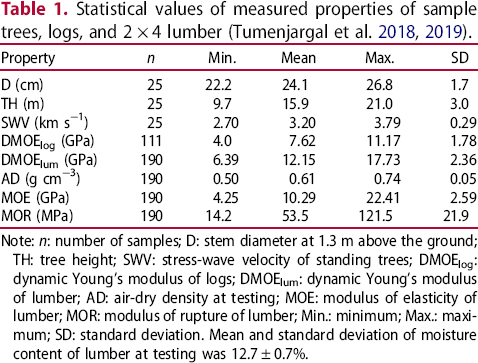
Five trees with good stem shape without any severe damages were selected in each provenance (Khentii, Arkhangai, Zavkhan, Khuvsgul, and Selenge) in Mongolia (Tumenjargal et al. 2018, 2019). These provenances are famous for L. sibirica forestry in Mongolia. Before cutting trees, stress-wave velocity of standing trees was measured for these 25 selected trees (Tumenjargal et al. 2018, 2019). When measuring stress-wave velocity, the start and stop sensors were set at 1.5 and 0.5 m above the ground, respectively (Figure 1, Tumenjargal et al. 2018, 2019). The start sensor was struck with a small hammer in order to create a stress wave. A stress-wave timer (Fakopp Microsecond Timer, Fakopp Enterprise) was then used to record the stress-wave propagation time between the start and stop sensors. Six stress-wave propagation time measurements were made at the same positions on each standing tree (Ishiguri et al. 2006). The stress-wave velocity was calculated by dividing the distance between two sensors by the average value of stress-wave propagation time (Ishiguri et al. 2008). Table 1 shows statistical values in the properties of standing trees, logs, and lumber (Tumenjargal et al. 2018, 2019).
Illustration of experimental procedures. Note: n: number of samples; D: stem diameter at 1.3 m above the ground; TH: tree height; SWV: stress-wave velocity of standing trees; DMOElog: dynamic Young's modulus of logs; DMOElum: dynamic Young's modulus of lumber; AD: air-dry density at testing; MOE: modulus of elasticity of lumber; MOR: modulus of rupture of lumber; Min.: minimum; Max.: maximum; SD: standard deviation. Mean and standard deviation of moisture content of lumber at testing was 12.7 ± 0.7%.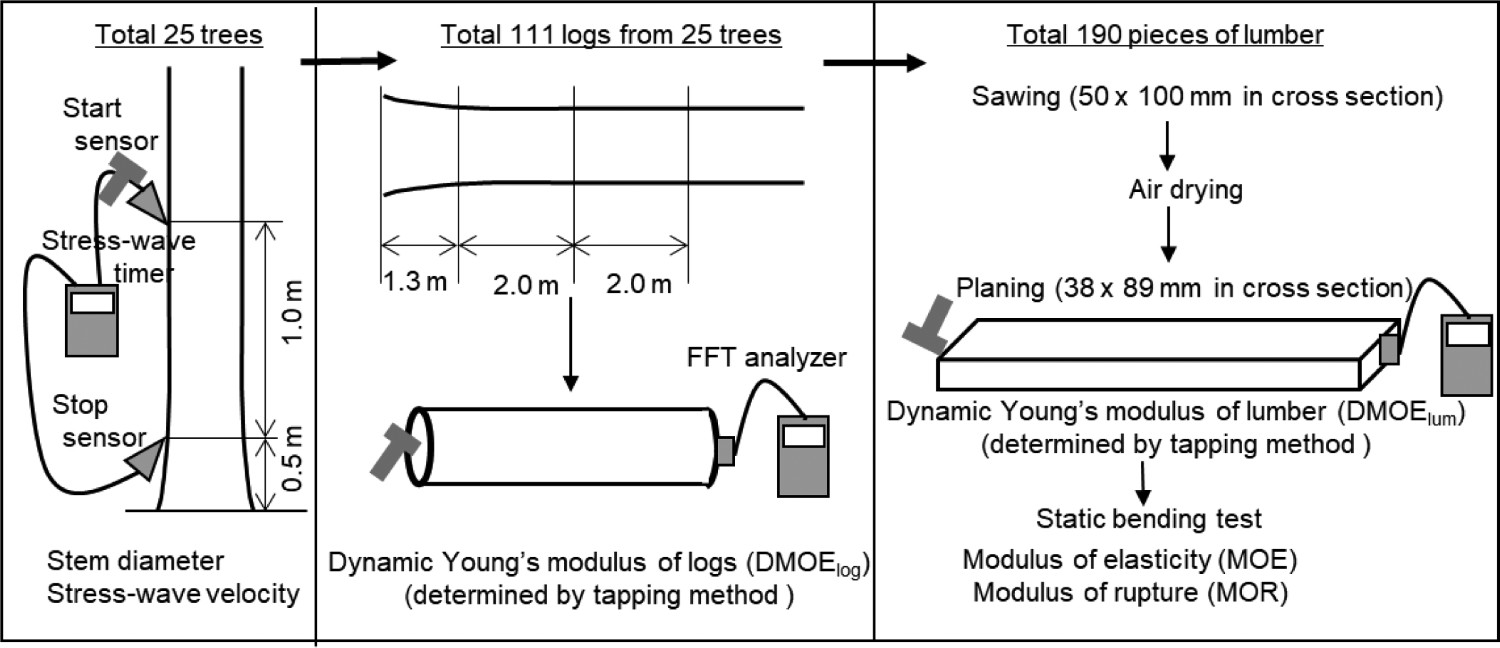
After measuring the stress-wave velocity, the sample trees were harvested. A total of 111 logs of 2 m each were collected from the harvested trees, beginning 1.3 m above the ground and ending when the top diameter of each log became less than 14 cm (Figure 1, Tumenjargal et al. 2018, 2019). The dynamic Young's modulus of the logs was determined using the tapping method (Sobue 1986). Before measuring the first resonance frequency, green weight, diameter of both ends with bark, and length of logs were measured by electric balance, tape measure, and laser distance metre, respectively. After that, green density was calculated by dividing green weight by green volume calculated from mean diameter of both ends and length. One cross end of each log was tapped with a small hammer in order to obtain the first resonance frequency, and the sounds were analysed by a fast Fourier transform analyzer (AD3527, A&D) equipped with an accelerometer (PV85, Rion).
The logs were sawn into as many pieces of 50 by 100 mm cross section lumber as possible, with a total of 190 pieces (Figure 1, Tumenjargal et al. 2019). All pieces of lumber obtained from the logs were used in the present study. After air-drying, the lumber was planed into pieces that measured 38 by 89 mm in cross section. The dynamic Young's modulus of the lumber was also determined using the tapping method (Sobue 1986). Then, a four-point static bending test was conducted using a universal testing machine (WDW-20E, Jinan Kason Testing Equipment) and according to the following conditions: load speed, support span, and the distance between load points, which measured 14 mm min−1, 1,602, and 534 mm, respectively. The load was applied in an edgewise direction. After conducting the bending test, the MOE and MOR were calculated (Tumenjargal et al. 2019). After static bending tests, small specimens (2.5 cm in longitudinal direction) without defects were collected from each lumber to measure moisture content and air-dry density at testing. Moisture content was determined by oven-dry method. Air-dry density was determined by weight measured by electric balance and dimensions determined by digital calipers. Mean and standard deviation of moisture content of all pieces of lumber was 12.7 ± 0.7%.
Data analysis
Data analysis was conducted digitally (Excel 2016, Microsoft). The mean values of growth characteristics and stress-wave velocities were calculated by averaging the values of individual trees. The mean values of the dynamic Young's modulus of the logs and the static bending properties of the lumber were calculated by averaging the values of all the logs obtained from the 25 harvested trees and all the lumber sawn from the 111 logs, respectively. The relationships between the measured properties were determined using Pearson's correlation analysis.
Results and discussion
Predictions based on stress-wave velocity of standing trees
Figure 2 shows the relationships between the stress-wave velocity of standing trees and the mean lumber properties. Significant positive correlation coefficients were found between the stress-wave velocity of standing trees and: the mean dynamic Young's modulus (r = 0.738); the MOE (r = 0.776); and the MOR (r = 0.702) of lumber. The obtained results suggest that the stress-wave velocity of standing trees is useful in evaluating the elastic properties of lumber produced from those trees. On the other hand, Ishiguri et al. (2006) reported that, in 27-year-old Japanese cypress (Chamaecyparis obtusa) trees, it was very difficult to evaluate the MOR of lumber (55 by 55 mm in cross section) using the stress-wave velocity of standing trees, because the lumber included defects, for example, knots. Similar results were obtained in L. kaempferi (Ishiguri et al. 2008), however, as shown in Figure 2, a significant positive correlation coefficient was found between the stress-wave velocity of standing trees and the MOR (r = 0.702) of lumber. Although further research is needed to examine how lumber defects like knots affect this relationship, it seems that it might be possible to predict the MOR of lumber using stress-wave velocity of standing trees in L. sibirica.
Relationships between stress-wave velocity of standing trees and bending properties of lumber.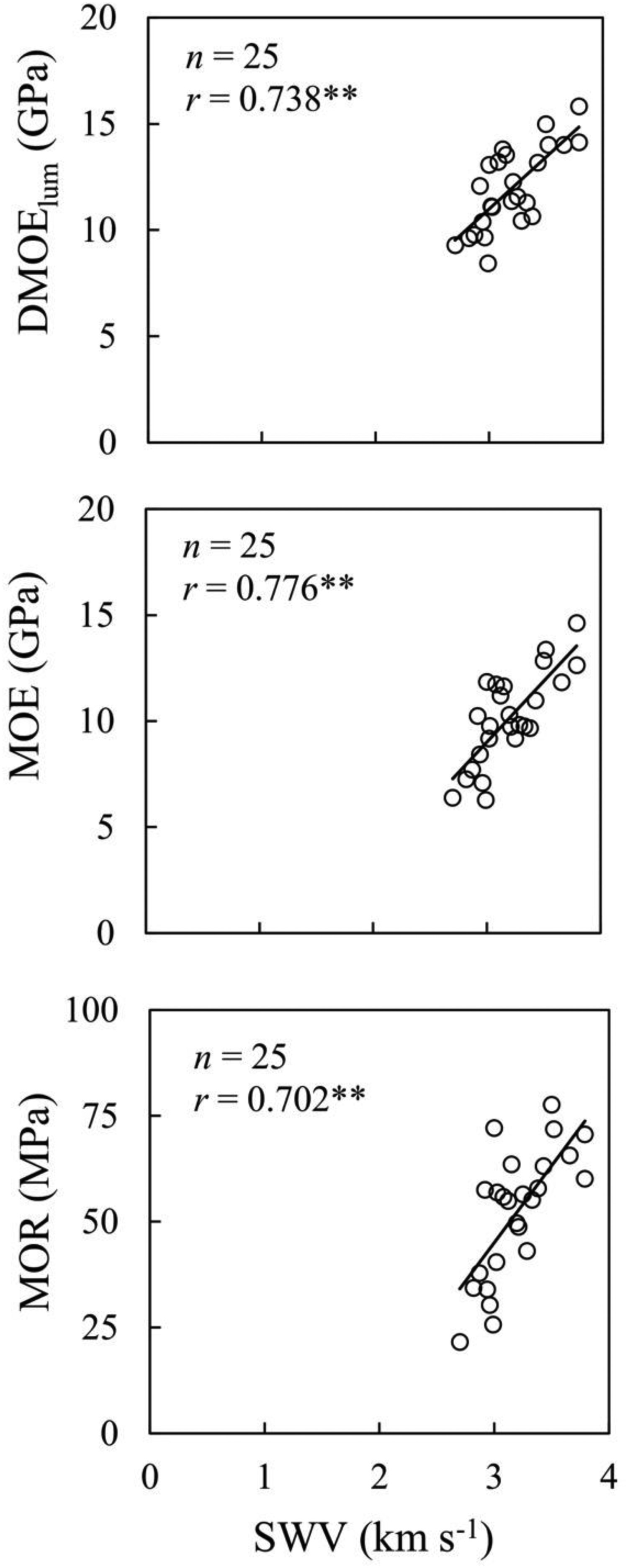
Correlation coefficients between stress-wave velocity of standing trees or dynamic Young's modulus of logs and bending properties of lumber at various sample height positions.
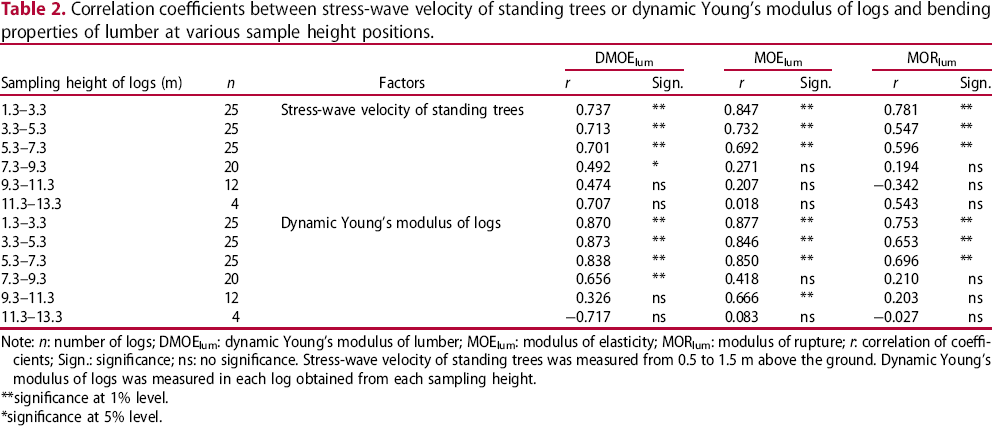
Note: n: number of logs; DMOElum: dynamic Young's modulus of lumber; MOElum: modulus of elasticity; MORlum: modulus of rupture; r: correlation of coefficients; Sign.: significance; ns: no significance. Stress-wave velocity of standing trees was measured from 0.5 to 1.5 m above the ground. Dynamic Young's modulus of logs was measured in each log obtained from each sampling height.
**significance at 1% level.
*significance at 5% level.
Predictions based on the dynamic Young's modulus of logs
Figure 3 shows the relationships between the dynamic Young's modulus of logs and the mean lumber properties of lumber taken from those logs. The dynamic Young's modulus of logs showed a significant correlation to the dynamic Young's modulus (r = 0.786); the MOE (r = 0.745); and the MOR (r = 0.584) of lumber from those logs. These results indicate that the dynamic Young's modulus of logs is a good predictor for evaluating the static bending properties for MOE and MOR in L. sibirica tree lumber. In addition, it is considered that pre-sorting logs for various purposes including structural use might be possible by measuring dynamic Young's modulus of logs.
Relationships between the dynamic Young's modulus of logs and bending properties of lumber.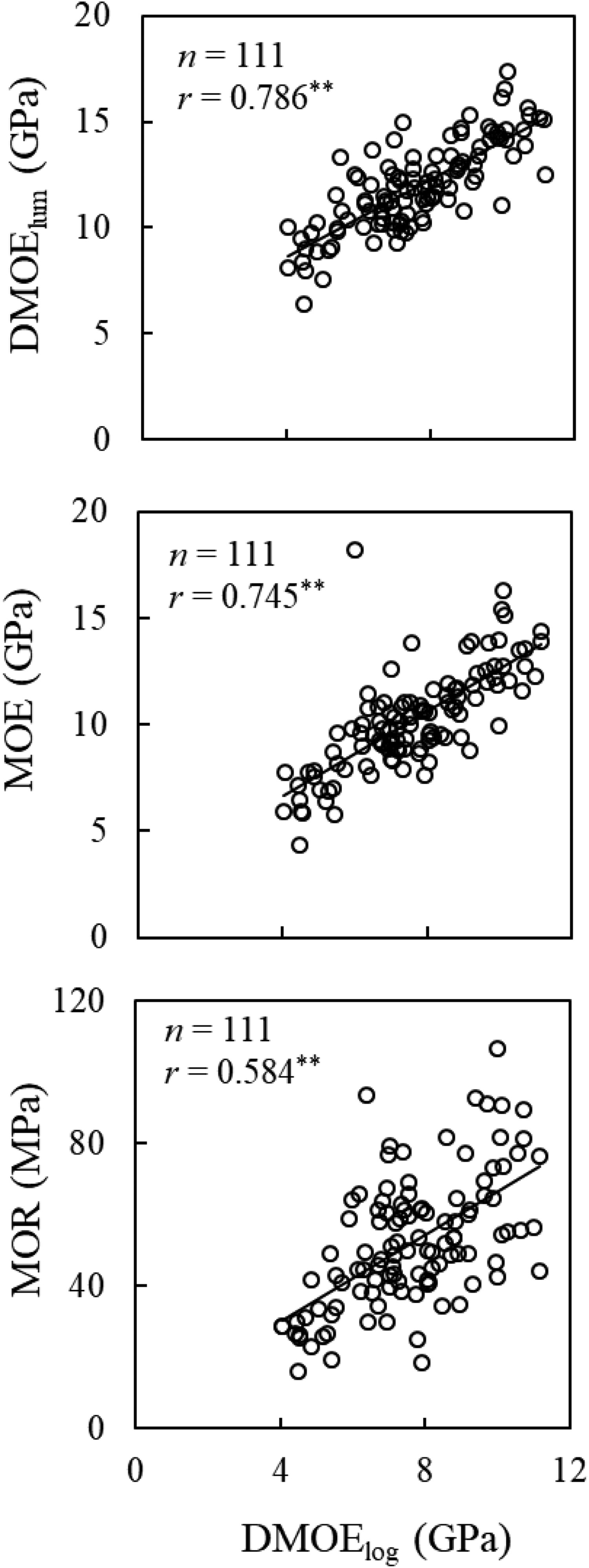
Previous studies (Tumenjargal et al. 2018, 2019) have shown that, in longitudinal variations in the dynamic Young's modulus of logs and the MOE and MOR of L. sibirica lumber, the values decreased from the bottom to the top of tree. In this study, the correlation coefficients between the dynamic Young's modulus of logs and the bending properties of lumber were determined for samples taken from different tree heights (Table 2). The significant correlation coefficients were found with both MOE and MOR of lumber up to 7.3 m above ground, suggesting that even in the same height position, prediction of bending properties of lumber in L. sibirica is difficult by dynamic Young's modulus of logs obtained above 7.3 m from ground. Similar trends were observed between the dynamic Young's modulus of logs and the MOE of lumber in P. sitchensis (Simic et al. 2019). Our previous study also found that the juvenile wood percentage gradually increased from the bottom to the top of L. sibirica trees (Tumenjargal et al. 2019). In addition, knot was one of the major downgrading factors in visual grading of L. sibirica lumber (Tumenjargal et al. 2019). No significant correlation coefficients between dynamic Young's modulus of logs and MOE or MOR of lumber in the present study might be related to juvenile wood percentage of logs and number of knots in lumber as trees increase in height.
Predictions based on the dynamic Young's modulus of lumber
Previous reports confirmed that the dynamic Young's modulus of lumber, as determined using the natural frequency of longitudinal vibrations, correlated strongly with MOE in softwood species (Arima et al. 1990; Sobue and Mizukami 1993; Fujita et al. 1995; Halabe et al. 1997; Yang et al. 2017; França et al. 2019). Similar significant correlation coefficients were also found between the dynamic Young's modulus of lumber and MOE (r = 0.842) in the present study (Figure 4). On the other hand, however, the relationship between the dynamic Young's modulus of lumber and MOR is less significant (Halabe et al. 1997; Yang et al. 2017; França et al. 2019). For example, Halabe et al. (1997) reported that the correlation coefficients were r = 0.640 in MOE and r = 0.529 in MOR, respectively, for Southern pine lumber (38 by 89 mm in cross section). Yang et al. (2017) determined the relationships between these properties in Southern pine lumber using various cross sections (38 by 140 mm, 38 by 186 mm, 38 by 236 mm, and 38 by 287 mm). Across the different lumber cross sections, they found the weakest correlation in larger sized lumber (38 by 287 mm in cross section), suggesting that these correlations might be affected by the cross-sectional size of lumber, perhaps because larger lumber may contain more defects such as knots. In the present study, the correlation between the dynamic Young's modulus of lumber and the MOR was higher (r = 0.739) relative to findings by Yang et al. (2017) related to larger lumber (Figure 4). In addition, correlation coefficients were determined between air-dry density and MOE or MOR of lumber. As the results, significant, but lower correlation coefficients were found (Figure 4). These results suggest that the dynamic Young's modulus of lumber is the most reliable parameter for predicting MOE and MOR in L. sibirica species.
Relationships between the dynamic Young's modulus of lumber or air-dry density at testing and static bending properties of lumber.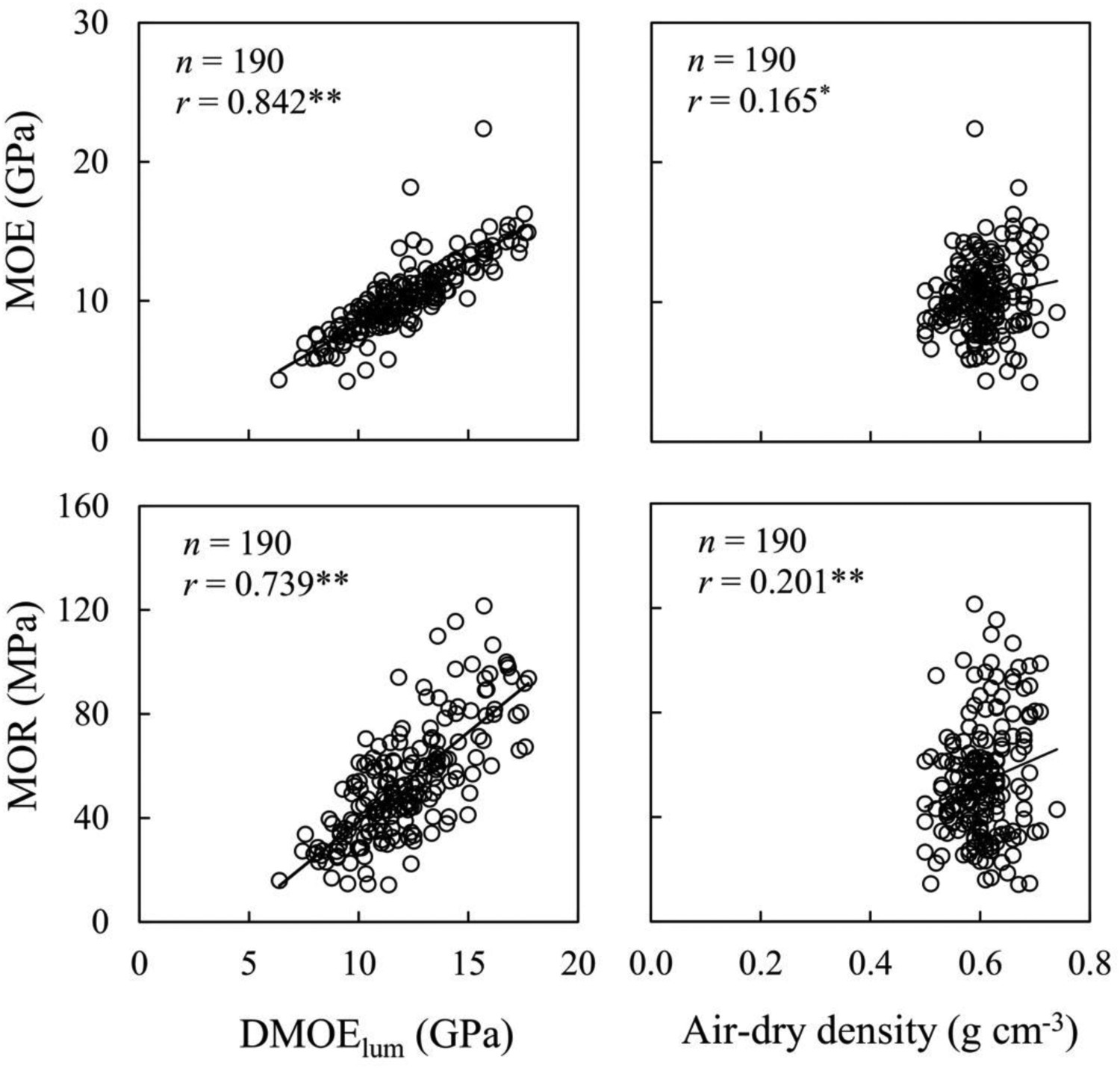
Conclusion
The possibility of predicting the bending properties of lumber using the stress-wave velocity of standing trees and the dynamic Young's modulus of logs was investigated in L. sibirica trees grown in Mongolia. Significant positive relationships were found between the stress-wave velocity of standing trees or dynamic Young's modulus of logs and the bending properties (MOE and MOR) of lumber taken from those logs. However, the methods are limited to predict bending properties of lumber produced from logs or pieces of lumber obtained from higher height positions, such as above 7.3 m positions from the ground in a stem of the species. The results obtained in the present study suggest that acoustic methods, such as stress-wave velocity and dynamic Young's modulus determined by resonance frequency, are useful for selecting superior trees in tree breeding for wood quality and sorting logs for producing structural lumber.
Footnotes
Acknowledgements
The authors wish to thank Ms Yui Kobayashi and Mr Tappei Takashima, students at Utsunomiya University, and Mr Sarkhad Murzabek and Ms Togtokhbayar Erdene-Ochir at the Mongolian University of Science and Technology for their assistance in the measuring lumber properties.
Disclosure statement
No potential conflict of interest was reported by the author(s).