







Abstract
ABSTRACT
Russia is China's main log supplier and has implemented a series of log export control policies. The implementation of Russia's export control policy has inevitably had an impact on China's timber processing industry. This paper uses breakpoint regression to analyse the impact of the increase in the import price of logs under the Russian log export control policy on the market price of timber products in China. The results show that under the control policy, the increase in log import prices had a significant positive impact on the timber product market when April 2008, January 2010 and January 2019 were the breakpoints. Due to the lag effects in price transmission, the impact on China's timber product market was not reflected when July 2007 and January 2018 were the breakpoints. Based on the research conclusions, this paper puts forward some suggestions from the perspective of China's log supply security.
China is a big country in wood production and consumption, but the total amount of forest resources in China is insufficient, and the domestic wood supply capacity is limited (Tang and Song, 2013). Importing wood has become an important way to fill the gap between China's wood supply and demand. China and Russia are each other's largest neighbours and have superior geographical cooperation advantages. Russia's rich forest resources play an indispensable role in making up for the gap in China's timber demand, and Russia is the world's largest timber supply and demand country, and has a vast domestic market, which can effectively alleviate the overcapacity of China's wood processing products (Li and Zhou 2020). China is the largest log importer in the world, and Russia is China's main log trading partner (Feng 2010; Han 2021). According to unicomtrade statistics, from 2001 to 2020, China's log imports from Russia accounted for an average of 30% of China's total log imports, and the highest year accounted for more than 50%.
Various scholars have carried out research on Sino-Russian forest product trade from the aspects of factors affecting forest product trade, intra-industry trade, competitiveness and complementarity, import and export structure and scale. For instance, Tian and Ge (2021) used the constant market share model to explore the influencing factors of the fluctuation of China's import of Russian wood forest products from 1998 to 2018. Their conclusions show that this fluctuation is affected by various factors such as product structure, market size and competitiveness, among which China's import structure and domestic market demand are the main factors for trade fluctuations. Wu and Tian (2019) found that the economic size, population, forest resource endowment differences and per capita resource endowment differences are important factors affecting the bilateral trade of wood and forest products between China and Russia based on the gravity model. Tian et al. (2017) and Lan (2013) used the GL index to analyse the intra-industry trade of Sino-Russian wood forest products, and their conclusions show strong complementarity between China and Russia, but the overall level of intra-industry trade in Sino-Russian forest products was low. Tian and Wu (2017) used the trade complementarity index and export stability index to study the complementarity and stability of Sino-Russian in wood forest products trade from 2006 to 2015. Their conclusions show that there are huge differences in the comparative advantages of China and Russia. Zhang (2017) analysed the comparative advantage and trade complementarity of wood forest products between the two countries. The results show that the resource-intensive products exported by Russia, such as logs, sawn timber and wood pulp, are highly complementary to those imported by China, while the labour-intensive products such as wood-based panels, wooden furniture and wood products exported from China are also highly complementary to those of Russia. Narins (2015) suggested that Sino-Russian forest product trade is highly dynamic, temporally variable and intimately intertwined with national political and economic considerations through Sino-Russian bilateral trade data. Simeone (2013) implied that China imports unprocessed timber from Russia, which is then processed into various value-added products for export to Russia. Tian and Li (2013) and Su (2011) pointed out that the reduction of export tariff rates after Russia's accession to the WTO is beneficial to China's imports of Russian logs.
Since Russia implemented the log export control policy, various scholars have studied the role of the Russian log export control policy. For example, Kooten and Johnston (2014) analysed the results of liberalization of Russian log export taxes and removal of the export restrictions on Canadian lumber exports to the United States, and they found that Russian welfare has increased, while Canada has not changed much. Wang (2011) believed that the increase in Russian long tariff rates has had an important impact on Russia's timber trade structure, capital agglomeration, industrial upgrading and income distribution. Solberg et al. (2010) used a global forest sector model to conclude that the high tariff rates improve the speed of development in the Russian sawnwood and pulp industry. Wen et al. (2009) believed that the motivation for Russia to adjust its log export tariff policy was the drive of interests. Lin (2008) suggested that the increase in export tariff rates is of great help to the development of wood processing industry in Siberia. Some scholars have analysed the impact of Russia's increase in log export tariff rates on China's imports. For instance, Song and Li (2008), Su and Li (2009), Li (2009) and Wang et al. (2011) analysed the impact of Russia's increase in log export tariff rates on China's timber trade and proposed some measures. Jiang (2012) used the GTAP model to simulate the role of measures taken in collective forest reform in responding to changes in the trading environment of the international log market. The simulation results show that collective forest measures can offset the impact of Russia's increase in log export tariff rates.
In summary, there are some studies on Sino-Russian trade in forest product and the impact of Russian log export control policies. Russia is the main supplier of logs in the world. Russia's implementation of log export control policy will have an impact on the global log supply and will promote the rise of world log export prices (Cao and Gu 2009; Kooten and Johnston 2014). China is the world's largest importer of logs and the main importer of Russian logs (Feng 2010; Han 2021). The increase in log import prices will impact the market price of timber products in China. However, to our knowledge, there are no studies which combine the log export control policies and the log import price to analyse the impact of the increase in log import prices on timber market prices in China. In reality, studying the impact of the increase in log import prices on the market price of timber products under Russia's control of log exports and putting forward some countermeasures are of great practical significance for stabilizing the Chinese timber product market. Therefore, based on the impact mechanism of the increase in import prices on the market price of timber products under the export control, this paper uses a breakpoint regression model to empirically test the market effect of log import price increases, and suggest some policies. Next, this paper analyses the impact mechanism of increases in log import price on the timber market price under Russia's control of log exports. Section 3 presents methods and data. Section 4 provides results and discussion. Section 5 analyses the limitations of the study. Finally, we summarize the results and propose policy suggestions.
Influence of increases in log import prices on timber market prices under Russia's control of log exports
The volume of timber harvesting and trade in Russia is constantly increasing, but the advantages of Russia's forest resources have failed to bring huge economic benefits to the country. The Russian government has noticed the pressure on its domestic environmental protection caused by heavy deforestation and the loss of economic profits from exporting logs (Chen et al. 2014). Also, the Russian government and President Vladimir Putin have realized that if Russia can shift its reliance on log exports to more value-added wood products, Russia will increase more employment in timber processing and promote more efficient use of raw resources. Therefore, the Russian government provided a series of preferential treatment for the export of wood products after further secondary processing such as flooring, furniture or handicrafts in terms of taxation and import duties, and controlled log exports to encourage the development of the wood processing industry in the country (Li et al. 2007).
The policies of controlling log exports in Russia can be divided into two periods. The first period was from 2006 to 2010, which was mainly reflected in the tariff rate increase. On 5 February 2007, the Government issued the Government Decree No. 75 to gradually increase the export tariff rate of logs, stipulating to adjust the export tariff rate of unprocessed timber, and to implement a new tax rate for unprocessed timber, which will be increased in three stages: on 1 July 2007, it will be increased to 20%, but not less than 10 euros per cubic metre; in April 2008, it will be increased to 25%, but not less than 15 euros per cubic metre; from January 2009, to 80%, but not less than 50 euros per cubic metre (Song and Li, 2008). However, affected by the world financial crisis, Russia considered delaying the increase of log export tariffs by 9–12 months, and postponed the implementation of log export tariffs originally scheduled to be implemented in 2009 to January 2010 (Su and Li 2009). The second period is from 2018 to 2020, which mainly controls the export of specific logs through quotas and tariffs. On 12 December 2017, the Russian government promulgated Decree No. 1520 ‘On the Implementation of Tariff Quotas on the Export of Some Species of Softwood Timber’, which clearly stipulates that from 1 January 2018, the quota management will be implemented for the export of yeso spruc, khingan fir and larix gmelinii from Russia, and the total annual quota is 4 million cubic metres. The issuing authority of the quota license is the Russian Federation Industry Ministry of Trade. In addition, according to Decree No. 1521 issued by the Russian government on the same day, the export tariff rates of the above three commodities in 2018 are adjusted. The export tariff rate in-quota is 6.5% (and the unit price is not less than 4 euros per cubic metre). The out-of-quota export tariff rate is 25% (and the unit price is not less than 15 euros per cubic metre) (Ministry of Commerce of the People's Republic of China 2017). The out-of-quota tax rate will gradually increase to 40% in 2019, 60% in 2020 and 80% in 2021 (Ministry of Commerce of the People's Republic of China 2019). The Russian Ministry of Industry and Trade issued a statement stressing that the purpose of the tariffs is to combat illegal logging and timber smuggling, and hopes to further stimulate the development of Russia's timber processing industry. In the face of Russia's export control policy, the China Wood Protection Industry Association pointed out that the policy will lead to a rise in log market prices, promoting China to import logs from other regions (China Wood Protection Industry Association 2022).
China fully implemented the commercial logging ban on natural forests in 2017 (Ke et al. 2018; Zhang and Chen 2021), and domestic timber processing companies have expanded log imports to meet the needs of the domestic timber market. Russia is not only a major supplier of logs to China, but also a major supplier of logs to the world. Its log export control policy has reduced the supply of logs, which has had an impact on the world log market and increased the import price of the world log market (Cao and Gu 2009; Kooten and Johnston 2014). China is a major importer of logs, and the increase in the import price of logs has pushed up the overall price of domestic timber market price. The market price of timber leads to changes in the cost of wood processing enterprises, which is reflected in the changes in the producer price in the production link and the retail price in the consumption link. The specific impact mechanism of control policies on the market price of timber products is shown in Figure 1.
The impact mechanism of log import price increases on the timber market price under Russia's control of log exports.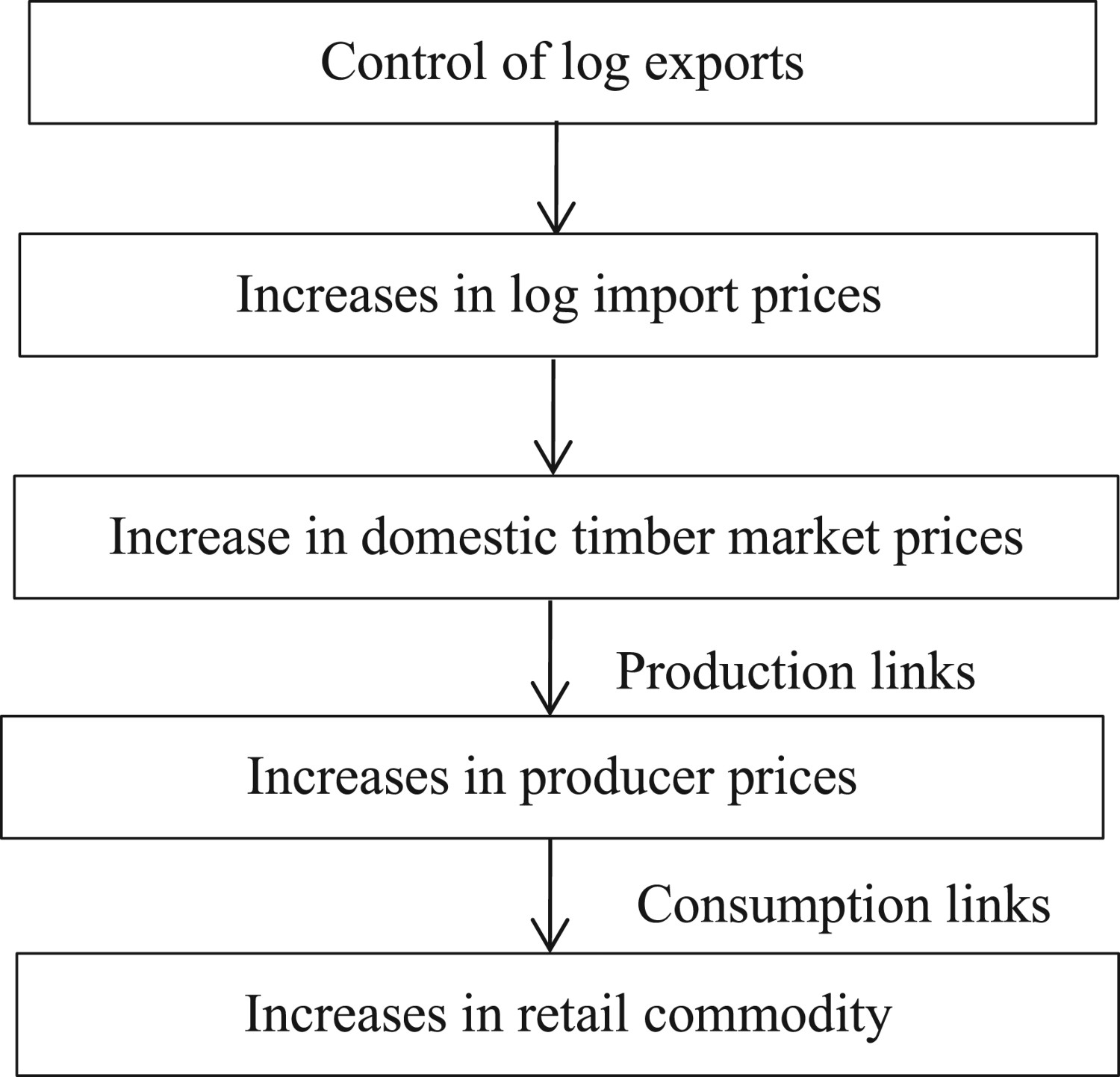
Methods and data
Breakpoint regression is an empirical method that effectively utilizes realistic constraints to analyse causal relationships between variables. This method requires the assumption that there is a variable with different probability of policy intervention on both sides of a certain critical point, and that the variable is continuous on both sides of the critical point and is not affected by human manipulation (Zhu et al., 2019). Causal effects are estimated by observing and estimating individual differences to the left and right of the breakpoint. The breakpoint regression method is an important method in policy evaluation. In actual estimation, the conditional variable of policy implementation is generally used as a grouping variable to test the effect of policy intervention when the reference variable reaches a critical point (Xie and Zhang, 2020).
Breakpoint regression is divided into precise breakpoint regression and fuzzy breakpoint regression. The main difference between the two is that the individual at the breakpoint has a different probability of being processed (Feng et al. 2013). In breakpoint regression analysis, it is first checked whether the model meets all the conditions of breakpoint regression, that is, individuals do not jump at breakpoints; covariates are independent of grouping variables; explanatory variables jump at breakpoints (Chen et al., 2019). Then, a breakpoint regression model for non-parametric estimation is established (Wang et al., 2015). Finally, in order to exclude the influence of other factors, the robustness of the conclusions is assessed by adding covariates and selecting different bandwidths (Zhang and Guan, 2021).
At present, most scholars determine breakpoints from policy regulations or theoretical analysis, and use precise breakpoint regression analysis to discuss their impact on national macroeconomic policies (Jin et al., 2021; Wang et al., 2021; Zhu et al., 2019; Ruan, 2019). Referring to Alarcon and Nuel (2019) and Lee and Lemieux's (2010) studies, the specific model can be expressed as follows:

 represents the explanatory variable, which includes domestic timber market prices, forest industry producers’ ex-factory prices and the retail price index of furniture product, D is a dummy variable, indicating whether Russia controls log export (before the control,
 ; after the control,
 ).
).
 is a control variable that represents the increase in log import prices at different time breakpoints.
 represents the covariates and
 is a random error term. All variables are subset by year (year = i), except for the dummy variable for the control.
The total sample and its descriptive statistics.

 (USD/m3)
Results and discussion
Non-parametric estimates.
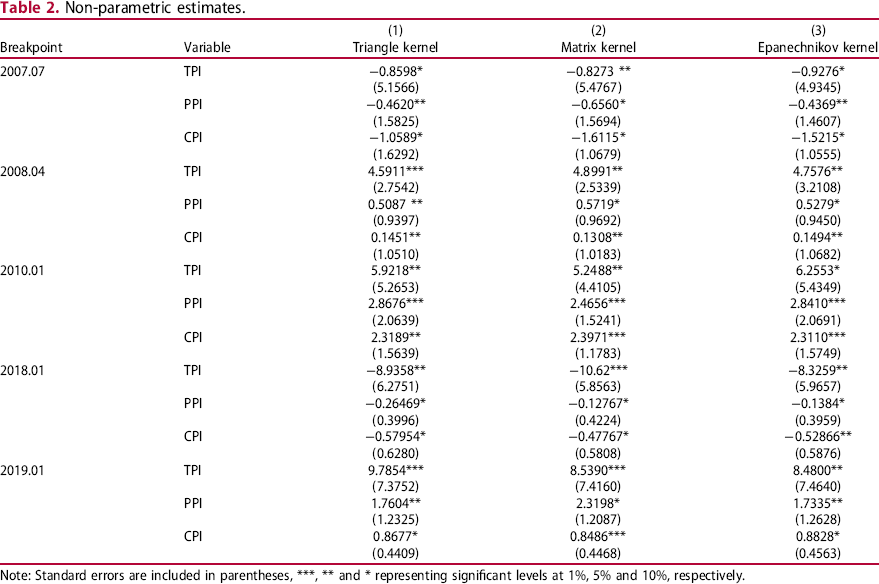
Note: Standard errors are included in parentheses, ***, ** and * representing significant levels at 1%, 5% and 10%, respectively.
Based on Table 2, we find that market prices show an increase under the breakpoint in April 2008, January 2010 and January 2019, while a decrease in July 2007 and January 2018. Russia is China's main log supplier. In the first period, Russia's main measures to control log exports are to increase log export tariff rates. The increase in log export tariff rates results in an increase in China's log import prices, which will inevitably have an impact on the market price of China's timber products. However, there are lag effects in price transmission (Yang and Bessler, 2004), that is, there is a time lag in the impact of price increase on TPI, PPI and CPI in the timber products market. From January to September 2007, the overall timber market price in China was in a declining stage. The lagging effect of price transmission makes the impact of import price increase on the price of timber market products insignificant. Therefore, it appears at this time that TPI, PPI and CPI are still declining. After September, the effect of the increase in the price of imported logs has begun to appear, the wood market price increased, and the ex-factory price and retail price of forest products also increased. At the same time, we can see that compared with April 2008, the breakpoint coefficient value in January 2010 has increased a lot, indicating that the increase in the import price of logs under the Russian log export control policy has an increasing impact on the market price of timber products. Russia joined the WTO in 2012 and pledged to gradually reduce its log export tariff rates to single-digit final bound rates over the next few years (Ruta and Venables, 2012). A system of quotas was established for specific logs species such as spruce, fir and pine, that is whereby a given quantity, or quota, is allocated for export at a certain lower tax rate and any quantity exported above that level will receive a higher tax rate (Simeone, 2013). From Russia's WTO accession, pine exports have an in-quota tariff tax rate at 15%, and the reduction rate is close to 40%; spruce and fir exports have an in-quota tariff rate of 13%, and the reduction rate is close to 50%, the quota of these log species enjoys a reduced tariff, after which the higher rate applies to encourage China to reduce log imports from Russia (Tian and Li, 2013; Simeone and Eastin, 2012). On the whole, the export tariff rates have dropped significantly, which is helpful for China to import Russian logs (Chen, 2012). In the second period, Russia announced the gradual implementation of a higher out-of-quota tariff rate on certain types of log exports from 2018. It had an impact on the global market price of logs, and gradually increased the global log market price. This impact is gradually reflected in China's log import prices, and also has an impact on PPI, TPI and CPI of China's wood products market. At the breakpoint in January 2018, the impact was not reflected due to the lag effects in price transmission, but in January 2019, the effect was reflected.
Limitations of study
This paper uses a breakpoint model to explore the impact of increases in log import price on the market price of timber products in China at five-time points when Russia implemented log export controls. A few potential limitations to our analysis exist. First, we used breakpoint regression to test the impact of various factors on product prices in the timber market, yet other potentially important factors such as China's timber demand, changes in forest stocks, commercial logging ban have not been considered. Furthermore, we have not considered the impact of log export restrictions in other countries on the price of China's log imports during the same period. Although these countries export logs account for a small share of China's imports, they are not the world's major suppliers. We expect additional work to be done in elucidating the effects of these factors in future research.
Conclusion and recommendations
This paper uses breakpoint regression to analyse the impact of the increase in the import price of logs under the Russian log export control policy on the market price of timber products in China. The results show that under the Russian log export control policy, the increase in log import prices had a significant positive impact on the timber product market when April 2008, January 2010 and January 2019 were the breakpoints. Due to the lag effects in price transmission, the impact on China's wood product market was not reflected when July 2007 and January 2018 were the breakpoints.
Although China's log imports from Russia are declining, Russia is still China's main log supplier. The Russian government has introduced a series of measures to reduce log exports in recent years, and the policy is unstable. In the long term, Russian log exports will decrease or even stop. From the perspective of log supply security, the Chinese government should further expand its sources of timber imports, reduce its dependence on timber from a single country, and import from countries with sufficient forest resources and developed economies such as Sweden, Germany and Finland. The Chinese government should strengthen cooperation with the Russian government to help wood processing companies to overcome the problems of excessive investment risk in the context of changing Russian economic policies. The Chinese government should also encourage the companies to build factories in Russia, establish product processing parks, and carry out forest resource development and deep wood processing, so as to solve the problem of wood shortage, and at the same time, it can also drive employment in Russia and meet the market demand of Russia. In addition, it is necessary to improve technology innovation, speed up the cultivation of domestic collective forests, fast-growing forests and high-yield forests, and guarantee the safety of domestic timber.
Footnotes
Acknowledgements
Author's contributions: This paper is a joint work of the two authors.
Disclosure statement
No potential conflict of interest was reported by the author(s).