







Abstract
This study aims to examine the role that gender plays in sustainable consumption (SC) initiatives and environmental communication that encourages sustainable consumption and pro-environmental behaviour in Madrid. To do so, this project uses a qualitative methodology to perform a text analysis of 10 sustainable consumption guides and to hold personal interviews (eight experts in environmental communication and training on SC in Spain or/and Madrid) and four group interviews (different people involved in SC initiatives and projects in Madrid). The results describe the consumption-gender relationship in the practice and discourse of the initiatives studied and the people interviewed. We observe that the interviewees encounter several difficulties when applying a gender perspective on sustainable consumption initiatives. This perspective is not very visible in the discourse. The interviewees agree that applying the gender perspective is a chance to transform consumption discourses and practices in order to contribute to greater social justice as part of sustainability. Among the findings, we can highlight the presence of reflections on gender in the discourses, but they are a minority in regular communication on SC and still insufficient in SC practices.
We are currently facing a global change, a phenomenon understood as the set of environmental changes prompted by human activity, particularly changes in the processes that determine the functioning of the planet Earth (Alonso et al., 2006). The outcome of this phenomenon is the advent of an environmental, socioeconomic and ethical crisis which affects all of humanity, particularly the more disadvantaged peoples (Ozcáriz, Novo, Prats, Seoane, & Torrego, 2008). In this context, ecological deterioration contributes to widening social inequalities which are expressed via a rise in poverty and the gap between genders, social classes, states and regions in the world. This, in turn, increases latent conflicts (Bifani et al., 2010).
Consumption plays an important role in the unsustainability of the model that has led us to the current global crisis by ignoring the planet’s biophysical limits (Porro, 2012). This is not only important from an ecological perspective but also crucial when understanding and dealing with social inequalities in the quest for social justice. However, the problem of inequality lies not solely in consumption but instead in the entire production chain. Labour exploitation in the global market is growing and increasingly affects women (Novo, 2009). Multinationals are seeking favourable conditions for production on a global scale and seek to occupy land that is easily alienable, along with tax perks and cheap, submissive labour, and these conditions are particularly unfavourable to women and children (Lucena, 2002).
In view of this situation, alternatives are emerging, such as the ones that encompass sustainable consumption (SC), 1 whose multiple defining criteria include a consideration of the gender perspective. SC is conceptualized as the choice of products and services based not only on their quality and price but also on their environmental and social impact and on the behaviour of the companies that manufacture them (Ecology and Development Foundation, 2007). It consists of taking these economic, social, political and ecological considerations into account when choosing between the different options available on the market, as well as considering other core factors in the foundation and praxis of SC, such as developing active awareness, joint consciousness, critical thinking and social action (Fernández, 2007).
In the international setting, the most common definition of the term sustainable consumption (SC) is the one proposed by the Oslo Symposium in 1994, which focuses more on the ecological aspects: ‘The use of goods and services that meet basic needs and bring better quality of life while minimizing the use of natural resources, toxic materials and emissions of waste and pollutants over the life cycle so as not to jeopardize the needs of future generations’.
In this study, we use the broad concept of ‘sustainable consumption’ (SC) which Alonso, Fernández, Ibáñez and Piñeiro (2011) mean as alternative forms of consumption and self-responsibility. It encompasses a range of practices, discourses and nuances which are related to criteria and reflections on alternative ways of consuming. In this sense, the criteria of REAS’s Solidarity Charter (Red de Economía Alternativa y Solidaria) is a referent in the social and solidarity economy in the field of SC. It includes equity-equality criteria that bring the gender perspective into this concept. It is defined as: ‘satisfying the respective interests of all the people involved in the company’s or organization’s activities in a balanced way’. Even though SC is included in the criteria of REAS’s Solidarity Charter, it is one of the aspects examined the least in other conceptualizations, such as the aforementioned international definition devised in Oslo (Grover, Hemmati, & Fenley, 1999).
Given that the use and distribution of goods and services has gender implications, the purpose of this study is to examine how the gender perspective 2 is integrated into SC discourses and praxis as pro-environmental behaviours in a specific geographic setting: Madrid, Spain.
To accomplish this, we set the following specific objectives: To analyse how the gender perspective is addressed in the SC discourses and praxis constructed by the different organizations present on the SC map in Madrid. To identify criteria to improve communication on sustainable consumption considering the gender perspective.
Method
Design and procedure
Summary of research and sampling techniques applied to each research objective.
Note: Initial participation was 8–9 people per group, but because of difficulties attending this number was regarded as a limitation to interpreting the results. Groups of 3 and 4 people were moderated as triangular groups.
The research process entailed several stages. First, we started by analysing the guides. Later, in-depth interviews were conducted, and finally group interviews were held. The application of the techniques provided feedback on the way each technique was analysed, so the analysis of the guides, which took place over the course of several months, was influenced by the course of the interviews, and vice-versa. Thus, the analysis of the guides and the first interviews generated information we used to choose the subsequent interviewees.
Data-gathering instruments, sampling, participants and analysis
Document analysis of sustainable consumption guides
This analysis enabled us to describe how the gender perspective appears in the discourses found in the SC guides published by social and citizen movements, NGOs, public institutions and companies between 2006 and 2009. We found the guides after checking with experts and conducting a systematic Internet search, and through benchmark organizations on the SC map in Madrid. This non-probabilistic sample of intentional documents (Ander-Egg, 1996; Cohen & Manion, 1986; Valles, 1999) was performed using the following criteria: Main target: The citizenry. Purpose: To raise awareness (not necessarily exclusively on SC) and with the mission of being a ‘guide or manual’ aimed at reflection and action. Origin/authorship: Collective or organizational, excluding books with individual authorship. Geographic scope: Madrid (exclusively, or nationwide with a large impact in Madrid). Focus of interest: Addressing sustainable consumption as a whole (not in a specific area or sector of consumption, for instance food or clothes). Accessibility and diversity of sources: Publicly available on the Internet under copyleft license, authorized for reproduction citing the author, or registered under ISBN or ISSN, some of them under copyright. Size: Heterogeneous (from 11 to 286 pages) with a total corpus of 939 pages. If the same organization published several guides, we chose only the most specific one for our study. We also excluded periodical publications like magazines or newsletters. Analysis breakdown of the sustainable consumption guides.
The texts were processed using an interpretative document analysis following the guidelines recommended by Tójar (2006), and we strove to interpret it within the context of the (material and social) conditions in which it was produced and is read (Valles 1999). To do so, we devised a template with the items observed in each document, which served as the analysis guide (Table 2).
We gathered the breadth and diversity of discourses in SC and classified them according to their degree of institutionalization (meant in this case as their relationship with institutions) and their degree of protest (meant as an explicit expression of opposition to the status quo), as shown in Figure 1 (Piñeiro, 2011). We thus used the concept of field (present in Alonso, Fernández, Ibáñez, & Piñeiro, 2011, and other qualitative studies) to describe the entire set of documents analysed according to these two criteria (degree of institutionalization and degree of protest). This approach led us to deem the document sample adequate.
Summary of the main lines of discourse constructed by organizations linked to SC in the sample of guides analysed. All the guides are referred in the text by the number of the list in this figure. They are included in the final references. Authors are quoted in those cases whose quotes are also included in the text.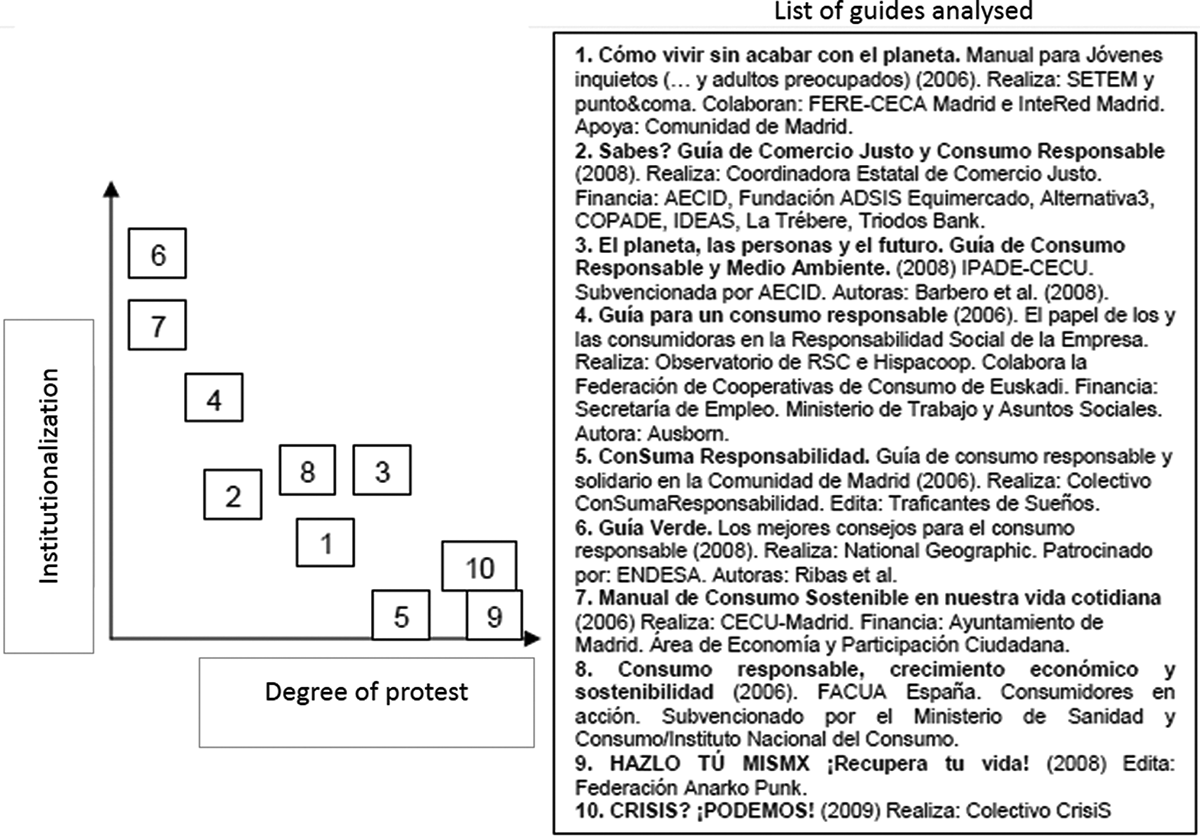
In-depth and group interviews
To complement the criteria used to communicate sustainable consumption considering the gender perspective which were extracted from the document analysis, we also held in-depth and group interviews in Madrid.
In all cases, we made strictly literal transcriptions of the oral language 3 . The analysis performed is interpretative and socio-hermeneutical, which postulates an interpretation of the text based on a study of the lines of argumentation or discourse of the data recorded in the interviews. This form of analysis is similar to the form used by Alonso et al. (2011).
Two interview processes were held in which participants were chosen. First, for the expert interviews, we determined that they had to have prominent communication careers in the field of consumption nationwide. Secondly, to choose the other interviewees (for both the in-depth and group interviews) we mainly considered their experience in organizations that have direct ties with SC.
In the group interviews, we invited people who participate in these groups, but we explained that they were not there in their capacity as representatives as a way of seeking a discourse grounded upon their personal experiences. To identify these people, we took into account the results of the analysis of the expert interviews, the analysis of the guides and the classification of entities in the Guía ConSuma Responsabilidad (Responsible Consumption Guide, 2006). This guide serves as the basis for a map of SC in Madrid.
Results
Analysis of the gender perspective in the discourses on responsible consumption constructed by organizations in Madrid
After analysing the sample of guides, we noted the general absence of both a critical, in-depth reflection on the consumption-gender relationship and a view of consumption specifically from a feminist perspective.
However, there were general mentions of the relationship between sustainability and gender in the texts studied. One of the main avenues of reflection present in the guides’ discourse (Figure 2) was the link between the role of women and global sustainability. One of the documents analysed referred to the appearance of the specific principle contained in the Rio Declaration: Summary of the main lines of discourse constructed by organizations linked to SC in the sample of guides analysed. Women have a vital role in environmental management and development. Their full participation is therefore essential to achieve sustainable development (in the Appendix to guide 8, FACUA Consumidores en Acción, 2006).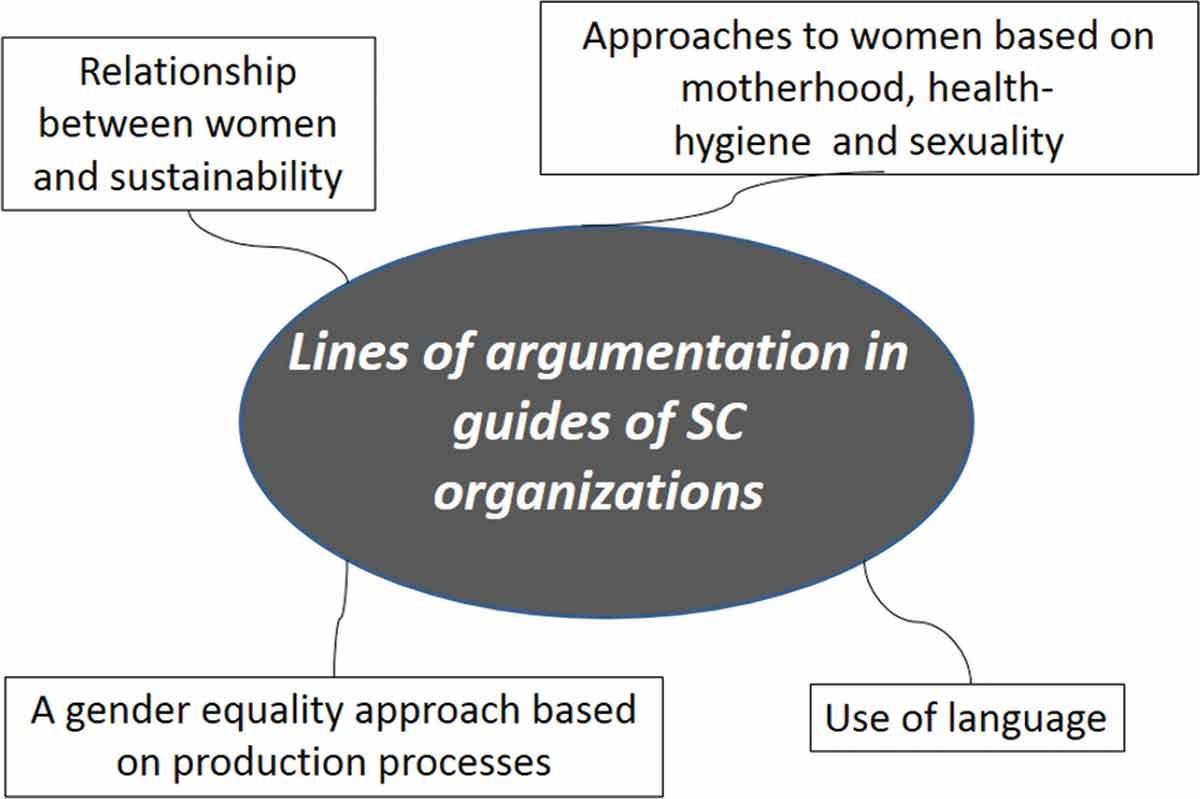
Worth noting is that multiple approaches are taken regarding women, including motherhood, health, hygiene and sexuality. This appears in two guides through their consideration of pregnant women as the people who are the most sensitive to toxins (guides 6 and 10). Two of them mention the possibilities of mutual support in childrearing and the existence of nursing support groups (guides 9 and 10). This guide also explains how the heteropatriarchy and consumption affect our bodies and minds, along with sexuality, relationships and motherhood, and this is the document where this avenue of reflection appears with the greatest depth. For example: Power is reproduced in our most intimate gestures, we cannot destroy power without building ourselves in the same process as free beings who expand over each other. Here we come upon ideas that underpin our relationships: love, sex, freedom, the couple... More than ideas, they are idealizations which the advertising system of power works hard to manipulate, universally promote and transfer to the brains of consumers (guide 9, Federación Anarko Punk, 2008).
Several guides show a gender equality approach that is based on production processes. This phenomenon is particularly focused on the ‘economic South’, an expression we use to talk about ‘developing countries’, and the ‘South of the North’ (such as when referring to people at risk of exclusion). This discourse is signalled by the presence of Fair Trade criteria (guides 1, 2, 4, 5, 6, 8) or by referring to the conditions of production and consumption in the South (guide 3). In impoverished countries, be sure not to buy souvenirs which might have been crafted in precarious labour situations or through child exploitation. You can avoid this by purchasing from cooperatives of handcrafters or women (guide 4, Ausborn, 2006). Women and children travel long distances to get fuel, so they have less time for other activities (education, etc.) (guide 3, Barbero et al., 2008).
Another interesting aspect contained in the sample of guides studied is the inclusion of consumption criteria associated with values like gender equality and non-violence (guide 4). Choose toys that convey positive values and avoid those than convey sexist values or encourage violence (guide 4, Ausborn, 2006).
On the other hand, some guides mention the need to consider the relationship between production processes and possible situations of discrimination when choosing a product: As responsible consumers, we do not want our money to be used to support companies that pollute, fail to respect human rights or discriminate against women, the handicapped and ethnic minorities (guide 4, Ausborn, 2006).
Only one of these guides (guide 5) mentions the equity-equality principle, primarily applied to the choice of the organizations that appear throughout the whole guide, such that it is associated with production in the South and the North. This includes information provided by the organizations on women’s and men’s participation in the organizations and the division of power.
Finally, we noted that only some guides use non-sexist language in their different versions, which is also a topic of discussion. The formulas used most often in Spanish include the suffixes os/as and todas y todos (the Spanish equivalent of he/she, or not using the masculine to refer to mixed-gender groups), as well as other plural expressions in the masculine, making for a mixture of situations of sexist and non-sexist language use. Three of the 10 guides use @ or × (newer ways to neutralize the gender of nouns and adjectives in Spanish) (guides 3, 5, 9). Another guide clarifies in the prologue that it will use the masculine term consumidor (consumer) to refer to both males and females (guide 4). Thus, this formal element is quite highly integrated into the communication on sustainable consumption.
Analysis of discourses on sustainable consumption considering the gender perspective present in the context studied and emerging communication criteria
After studying the discourses on SC in the guides, we have also analysed the different contributions to the individual and group interviews. They encompass reflections on how the gender perspective is present in SC and the way it is communicated as diagnostic and/or proposal. Below is a list of the main criteria that emerged in the guise of proposals and aspects that were absent in discourses and praxis:
Care and economy: a paradigm that is present, but not enough
With regard to care, two groups spoke about ‘the care crisis that is being triggered’ (gr1)
4
and the contributions from feminist economics. Based on this perspective, one of the members of the groups spoke about the experience of the collectives in which she participates. She considers them extremely important because ‘it is an important point of consumption and […] in fact this should be worked on much more’ (gr1). She then proposes a shift in the model: The second conceptual revolution in the collectives in which I’m involved [in addition to the ecological economy, which] is being worked on explicitly, is the feminist economy, or the economy of care […]. It places on the table what the market has cast aside, namely the concept of need, what are the jobs first to live and then to live well, […] which have primarily been performed by women and later rendered invisible by the ‘science economy’, etc. […] There is total receptiveness to this message (gr2).
With regard to this situation, it is recognized that ‘this has not been discussed much’ (r2) in this kind of project. In two groups this was put down to the fact that ‘it is already internalized […]. The gender issue has not been discussed in any meeting of the consumer group […] Internally, to me this barrier has been overcome. I’m not saying it doesn’t exist, but we’ve pretty much overcome it’ (gr1).
This kind of reflection includes a comparison between the ‘economic South and North’, thus dovetailing with the results of the analysis of the guides: ‘It is true that this argument […] fails here in the North […]. Perhaps you could promote it a lot in the South, but then you come here […and] we’re failing’ (gr4).
We could say that there was agreement that the gender perspective is missing or that it requires much more work in SC (r2, r5, r6, r7, gr1, gr4, gr3). In one of the groups, there was silence after the initial reaction to the question that led to this reflection. Person 6: Clearly people forget about it. Because of all the issues that we talk about a lot sometimes, and we’ve gone to many talks, we just babble on. And this itself is like silence, slowing down, thinking… (gr1).
Differences in experiences, concepts and types of SC groups
In two of the groups, several people’s statements about the lack of focusing on and communicating SC from the gender perspective is striking, and this sparked discrepancies in the group: Person 1: We don’t have a gender discourse at all; we could have some better practices […] Person 3: More and more care is being taken with this, I mean, we are learning to incorporate rhythms that include other ways of seeing life, or other ways of living life, but there is still a lot to learn (gr3).
In some groups, we detected how the forms of organization sometimes reveal that ‘we don’t have this approach in consumer groups and it doesn’t exist. Starting with the fact that the meetings begin at 9 at night, for example, [it is difficult] to make them compatible [with home life], so people who have babies really have to juggle it all’ (gr4).
We primarily found the use of non-sexist language in the interviews analysed. If we interlink gender with other perspectives, there was self-criticism in just one of the groups, spotlighting the fact that ‘there are many gaps before our discourse becomes our social position. White men, middle class […] There are dark points in our discourse. How does this affect immigrants? We don’t work on gender because half of us aren’t interested in it’ (gr3). This comment gives rise to a reflection on other equity-equality issues in the discourse in addition to gender which should be integrated into the communication on sustainable consumption. This aspect is dealt with in more depth in Piñeiro (2011).
Participation of women and men in organizations and collectives, and receptivity to the message
When we asked about the gender perspective in SC and how it is communicated, one of the first elements in the discourse revolved around men’s and women’s participation in terms of both number and proportion and the kinds of roles they play, as well as visibility and the division of power. There is no agreement on whether participation is balanced or whether there are more women than men, but in no interview did the participants argue that there are generally more men in SC than women. We identified many experiences argued primarily by the differences in receptiveness to the messages according to sectors or areas of consumption. For some issues, like ethical banking, the participants mentioned that ‘the receptiveness […] is more or less the same’ (gr1), while others believe that food is primarily considered female-dominated ‘because women sustain feeding around the world’ (r2). In this sense, the idea of production being women’s responsibility was recurrent, along with the need to ‘support and allocate their own resources to a production model that is never discriminatory. And if it is discriminatory, and there are many cases of this, especially in fair trade, [let it be] positive discrimination’ (r3). Thus, this proposal to include the ideal of gender equality and equity in consumption appears preferentially linked to a productive model (r6, r4, r3). However, this criterion was not used when assessing local production in the benchmark consumer groups or in the groups in which the interviewees participate (gr4).
With regard to greater participation by women in some of these initiatives, in some interviews and groups explanations for this situation were sought. They generally fell along two different lines of argumentation: (i) explanations related to ‘Marxism, the productive-reproductive model, thinking […] that women work less […] in the job market’ (r6); or (ii) views of this situation as a consequence of the ‘patriarchal system’ (r4), stating that in this system ‘women spend their lives buying food [and] managing the household budget […]’. This latter argument was repeated in two groups.
In the discourse, this ‘sensitivity’ towards consumption with sustainability, justice, ethics and similar criteria, which is more often attributed to women, is linked to an unequal division of labour in these practices: ‘If you live as a couple it is difficult to keep it up, right? If you’re always the one who goes shopping, if you’re always the one who has to defend it and plus you have to justify why you’re spending more money, well, it’s difficult. And some people have started backsliding because it didn’t seem important to their male partners’ (gr3) (r1).
The prime motivations for embarking on this pathway of SC were motherhood and health, which matches what we had analysed in the guides: ‘The issue of health is a gateway […] [With] mothers with children […]it is much simpler; [it is] a very clear gateway’ (r1, r8).
With regard to the presence of women in collectives, several groups mentioned that a stronger female presence changes how these collectives work and how they do things, but not in a ‘natural’ way (gr3). That is, it is not an essentialist issue but one of how one works towards ‘changing the systems of participation’ in ‘grid-like shapes’ (gr2): My experience in collectives and such, although it’s always difficult to generalize, is that practices change with the more horizontal presence of women, when the presence of women is greater in these collectives or the quest for different ways of doing things and consuming, or of raising awareness or transforming. But it’s not natural. What’s needed is… (gr3).
The values of responsible consumption and equality as part of these values
The so-called traditional female values nicely match everything we’re saying. Slowing down, relationships caring for people, relationships with people. Well, but in the end, perhaps underneath it all or at the root of sustainable consumption these values may be traditionally associated with a female role (gr2).
This discourse was found in the projects internally, but to a lesser extent in external communication: ‘Perhaps within sustainable consumption [the gender perspective] should be worked on more as an inherent part of sustainable consumption itself. Perhaps this discourse is in fact glaringly absent’ (gr1).
However, even though gender equality is not quite as evident in the discourse, it is indeed present in the projects’ values, criteria and objectives (r3, r6, r5). As one of them explains, ‘we joined forces over the same cause, which was what we called sustainable and socially conscious consumption, which includes consumption […] that is respectful of the environment, […] socially conscious consumption, especially with the respect for human rights, […] and equality between men and women’ (r3).
Even though some of the people interviewed believe that it is still premature to worry about gender, class and other similar issues since the SC movement is quite incipient (r7), others believe it is necessary to apply this perspective ‘first in production and later in communication’ (r6) in order to ‘always include a gender perspective in conscientious consumption messages’ (r5).
The gender perspective as a tool for reflection on consumption habits and practices
Some people believe that the gender perspective is a tool for SC, since in ‘the society that has raised us to do certain things […] the perspective is also to disentangle ourselves from this culture that pushes us and binds us to behaviours and try to choose more freely’ (r5).
In this sense, gender is a strong guide of consumption since it is among ‘the mechanisms […] that we have drawn from when consuming’ (r5, r6). Gender ‘is closely attached to identity and to meeting needs’ (gr3).
The consumption pattern is fed by the use of women’s images as the motivation for consumption in advertising communication. This is another way in which the application of the gender perspective in sustainable consumption takes shape, through the route ‘of consumerism […], breaking away from the paradigm […] or the idea of the woman as object, as the motivator for the consumption of bubbly drinks, which has nothing to do with it, or a car’. In the opinions of the interviewees, part of the process of applying this perspective entails reflecting on how ‘within advertising discourse women have been, are and will remain totally mistreated, used, instrumentalized as a selling point’ (r6, gr3).
Discussion and conclusions
Reflections on gender in the analyses exist, but they are in the minority in the usual communication on SC and still lacking in SC practices, as reflected in the analysis of the guides and in the discourses of the individual and group interviewees.
The results show a greater reflection on women’s conditions in production and by extension on working conditions, which is particularly noteworthy in relation to the economic South through the principles of fair trade. However, the reflection on production in the North is in the minority, even though it is not equitable. According to the CERES figures contained in Oceransky (2006), in Spain one out of every three people working in agriculture is female, and they earn an average of 30% less; half of them are wives-partners and only 9% are the owners of the lands they farm. These factors do not appear or are barely mentioned in the discourse identified in the guides and in the group and individual interviews.
With regard to participation, the presence of women in the collectives has served as an engine of change for the ways decisions are made and the ways these groups are organized. Some interviews revealed a difference in the everyday practice of participation, which was fleshed out in examples of how not only are women necessary but should they play a more important role in that collective and/or everyone in the group should work on this equity, so the stress is on the fact that this does not happen ‘naturally’. This situation is shared in other spheres of ecologism, as noted in the origin of the formation of the Women’s Environmental Network (Grover et al., 1999) back when ecologism and environmentalism began to emerge and many women in the movement were concerned about the fact that the men in the movement were overtaking the positions of influence. This may be an issue to study in the future, since it is indeed a factor that may prove to be a major contribution to SC discourse and practices. In short, the division of power and its visibility are questionable, which is criticized in certain local SC projects according to the interviews. These results are confirmed in numerous studies on gender and the third sector (García et al., 2004; Third Sector Observatory of Bizkaia, 2010). They explain the power differentials inside organizations and show that managerial posts, regardless of whether most of the volunteer base is male or female, tend to be occupied by men. Other gender and SC studies on consumer groups (Suriñac, 2012) also confirm that an examination of the greater presence of women is incomplete if it is not accompanied by an analysis of the group interactions and operations. This is also a perspective which should bear in mind the diversity of approaches and experiences in terms of sex, gender and oppressions, in addition to including an analysis in terms of men and women.
With regard to the reflection on the gender perspective in groups or organizations linked to SC, there is talk about an absence or at least insufficient attention in both the individual interviews and some of the group interviews. There were many expressions of surprise and silence and comments that there has been no reflection on this issue. Further examining the same vein of results, the study by Cruz, López, Ortiz, Rodríguez, and Del Valle (2006), working from the gender perspective within the ecological farming movement, confirms that only a minority of the collectives contacted in their study had explicitly addressed this issue. In this study, the idea emerged that it is not explicitly dealt with because it is a moot issue in activist settings, as gender issues have already been resolved. However, Cruz et al. (2006) also reveal that there is probably no equity if it has not been dealt with explicitly. That is, it is impossible to take for granted that the division has been done equitably when the inequitable situation has deep historical roots. In this sense, MacGregor (2006) stresses that as long as household and caregiving jobs are considered when achieving a social/environmental change (as in SC), we must analyse the gender division of labour/responsibility and costs/benefits.
On the other hand, in some discourses, SC is linked to traditionally feminine values, and some of these propositions are considered feminized or maternal. However, feminine is not the same as feminist. A proposition that is more closely aligned to the values that are culturally assigned to women (within the patriarchy) does not mean that it is more equitable or that it entails gender equity in its practices and discourses. This association is harshly criticized by feminists, as it should be noted that women’s link to life sustenance is a consequence of culturally assigned roles, such as the one that states that women have closer ties to nature, which is grounded upon a social construct (Herrero, 2013; Luna, 2008; Novo, 2009).
What stands out among the important results is that in the communication on SC there is a minority reflection on gender (in our case, especially in the part of the chain called consumption). This concurs with the results of similar studies performed in other European settings (Grover et al., 1999), just as this perspective is also in the minority in public policies on SC (Stieß & Schutlz, 2009, for the EUPOPP project). However, as the interviewees themselves stated, it is necessary to reflect on this perspective and incorporate it into discourses and practices, including public communication.
The criteria to communicate SC with the gender perspective that emerged in the interviews (which are largely contained in the analyses) are similar to the criteria for including the gender perspective in the field of SC according to Stieß and Schutlz (2009), although their focus is on public policy and entails questioning: (i) the sexual division of labour; (ii) the gender construction around the body, health and the social organization of intimacy; and (iii) power relations and men’s and women’s access to decision-making. That is, these are the crucial factors in constructing messages when the gender perspective is taken into account in SC communication.
In recent years, after this study was concluded proposals have emerged to better incorporate the gender perspective into SC, which we regard as a confirmation of the presence — albeit minority — of this reflection. The concern with the low incidence of the gender perspective has led organizations like SETEM to publish a specific guide (Piñeiro & Ballesteros, 2013) that serves to shift to practice by applying new paradigms to ‘put life into the centre’ (Weingärtner & Monasterio, 2010). It has also led organizations like the Xarxa de Consum Solidari (Socially Conscious Consumer Network) to focus their annual workshops on this consumption-gender relationship, and other organizations (Sodepaz, IPADE, etc.) to hold specific workshops. For this reason, we believe that there are recent signals pointing to possible changes in this scene involving the presence of the gender perspective in SC.
Consumo responsable con perspectiva de género. Discursos y prácticas de consumo en torno a la equidad de género y sostenibilidad en Madrid
Nos enfrentamos al cambio global, fenómeno entendido como el conjunto de cambios ambientales afectados por la actividad humana, con especial referencia a los cambios en los procesos que determinan el funcionamiento del sistema Tierra (Alonso et al., 2006). Dicho fenómeno tiene como consecuencia la aparición de una crisis ambiental, socioeconómica y ética, que atañe a toda la Humanidad y que afecta, especialmente, a las poblaciones menos favorecidas (Ozcáriz, Novo, Prats, Seoane, y Torrego, 2008). En este contexto, la degradación ecológica contribuye a ensanchar las desigualdades sociales entendidas como un aumento de la pobreza y la distancia entre géneros, clases sociales, estados y regiones del mundo. Esto incrementa los conflictos latentes (Bifani et al., 2010).
El consumo tiene un importante peso en la insostenibilidad de un modelo que nos ha conducido a la actual crisis global al ignorar los límites biofísicos del planeta (Porro, 2012). Su importancia no es solo desde una perspectiva ecológica, sino que también es crucial a la hora de entender y atender a las desigualdades sociales en la búsqueda de la justicia social. Sin embargo, el problema de desigualdad no está sólo en el consumo, sino en toda la cadena de producción. La explotación laboral en el mercado global es creciente y cada vez más feminizada (Novo, 2009). Las empresas multinacionales buscan a escala internacional condiciones favorables para su producción y priman la ocupación de suelo fácilmente enajenable, facilidades fiscales y mano de obra barata y sumisa, siendo estas condiciones especialmente desfavorables para las mujeres y la infancia (Lucena, 2002).
Ante esta situación surgen alternativas como las que engloba el consumo responsable (CR) 1 , que incluye entre sus múltiples criterios de definición la consideración de la perspectiva de género. El CR se conceptualiza como la elección de los productos y servicios, no sólo en base a su calidad y precio, sino también por su impacto ambiental y social, y por la conducta de las empresas que los elaboran (Fundación Ecología y Desarrollo, 2007). Consiste en tener en cuenta estas repercusiones económicas, sociales, políticas, ecológicas, etc. en el momento de elegir entre las distintas opciones que ofrece el mercado, pero también considera otros elementos centrales en los fundamentos y la praxis del CR como el desarrollar conciencia activa, conciencia de conjunto, pensamiento crítico, y acción social (Fernández, 2007).
En el marco internacional, la definición habitual para el término consumo sostenible (CS) es aquella propuesta en el Simposio de Oslo en 1994 y está más centrada en los aspectos ecológicos: ‘El uso de bienes y servicios que responden a necesidades básicas y proporcionan una mejor calidad de vida, al mismo tiempo que minimizan el uso de recursos naturales, materiales tóxicos y emisiones de desperdicios y contaminantes sobre el ciclo de vida, de tal manera que no se ponen en riesgo las necesidades de futuras generaciones’.
En este trabajo se utiliza el concepto amplio de ‘consumo responsable’ (CR) que Alonso, Fernández, Ibáñez y Piñeiro (2011) denominan como formas de consumo alternativas y de autorresponsabilidad. Engloba prácticas, discursos y matices diferentes que se relacionan con criterios y reflexiones acerca de otras maneras de consumir. En esta sentido, los criterios de la Carta Solidaria de REAS (Red de Economía Alternativa y Solidaria) constituyen un referente en la economía social y solidaria en el campo del CR. Entre ellos, destaca el criterio de equidad-igualdad que incorpora la perspectiva de género a dicho concepto. Lo define como: ‘satisfacer de manera equilibrada los intereses respectivos de todas las personas implicadas en las actividades de la empresa o de la organización’. A pesar de incluirse en los criterios de la mencionada Carta solidaria REAS, es uno de los aspectos menos abordados en otras conceptualizaciones como la ya mencionada definición internacional de Oslo (Grover, Hemmati, y Fenley, 1999).
Puesto que el uso y distribución de bienes y servicios tienen implicaciones de género, el objetivo de este trabajo es profundizar en cómo se integra la perspectiva de género 2 en las prácticas y en los discursos de CR o CS como comportamientos proambientales, en un contexto geográfico concreto: Madrid (España).
Para ello, surge la necesidad de abordar los siguientes objetivos específicos: Analizar cómo es abordada la perspectiva de género en los discursos y prácticas del CR que construyen las diferentes organizaciones presentes en el mapeo del CR en Madrid. Identificar criterios para mejorar la comunicación sobre CR, considerando la perspectiva de género en dicho contexto.
Método
Diseño y procedimiento
Síntesis de técnicas de investigación y muestra aplicadas a cada objetivo de investigación.
Note: Convocatoria inicial de 8–9 personas por grupo para llegar a un óptimo de entre 5 y 7 personas, pero por dificultades de asistencia se asume esta condición como un limitante a considerar en la interpretación de los resultados. Los grupos de 3 y 4 personas fueron moderados como grupos triangulares.
El proceso de investigación comprende varias etapas. En primer lugar, se inició el análisis de las guías, posteriormente se realizaron entrevistas en profundidad y por último entrevistas grupales. La aplicación de las técnicas fue retroalimentando la forma de análisis de los resultados de una a otra. De esta manera, el análisis de las guías desarrollado a lo largo de meses fue influido por el trascurso de las entrevistas y viceversa. Así, el análisis de las guías y las primeras entrevistas generó información para seleccionar las personas entrevistadas posteriormente.
Instrumentos de recogida de datos, muestra, participantes y análisis
Análisis documental de las guías de Consumo Responsable
Este análisis permite caracterizar cómo aparece la perspectiva de género en los discursos de las guías sobre CR de movimientos sociales y ciudadanos, ONG, instituciones públicas y empresas, publicadas entre 2006 y 2009.Las guías fueron buscadas a partir de consulta a personas expertas, búsqueda sistemática por Internet, y a través de las organizaciones de referencia del mapeo de CR en Madrid. Este muestreo de documentos intencional no probabilístico (Ander-Egg, 1996; Cohen y Manion, 1986; Valles 1999) se realizó según los siguientes criterios: Destinatario principal: la ciudadanía. Objetivo: sensibilizar (aunque no necesariamente con exclusividad en CR) y vocación de ‘guía o manual’, orientadas hacia la reflexión y la acción. Origen/autoría: Colectivo u organización, excluyendo libros de autoría individual. Ámbito geográfico: Madrid (exclusivas o de carácter estatal con gran impacto para este contexto). Foco de interés: abordar el consumo responsable de manera conjunta (no en un ámbito o sector específico del consumo, como la alimentación o la ropa). Accesibilidad y diversidad de fuentes: disponibilidad pública en Internet, bajo licencia copyleft, autorizan su reproducción citando autoría, o están registradas bajo un ISBN o ISSN, algunas de ellas bajo copyright. Extensión: heterogénea (de 11 a 286 páginas) alcanzando el corpus un total de 939 páginas. En caso de que una misma organización haya publicado varias, se selecciona solo la más específica para el contexto. También se han excluido publicaciones periódicas como revistas o boletines.
Pauta de análisis de las guías de consumo responsable.
El estudio recoge la amplitud y diversidad de discursos en las guías del CR, clasificadas según el grado de institucionalización (entendido especialmente como relación con las instituciones) y el grado de protesta (entendido como manifestación explícita de oposición al status quo) tal como muestra la Figura 1(Piñeiro, 2011). Se utiliza así el concepto de campo (presente en Alonso et al., 2011 y otros estudios cualitativos) para describir el conjunto de documentos analizados en función de estos dos criterios (grado de institucionalización y grado de protesta). Esta disposición nos hace considerar suficiente la muestra de documentos.
Síntesis de las principales líneas discursivas construidas por organizaciones ligadas al CR en la muestra de guías analizadas. Todas las guías estãn mencionadas en el texto por el número de la lista en esta figura. Están incluidas en la lista de referencias final. Aquellas de las que se incluye una cita están citadas también por autor. Todas las guías están mencionadas en el texto por el número de la lista en esta figura. Están incluidas en la lista de referencias final. Aquellas de las que se incluye una cita están citadas también por autor.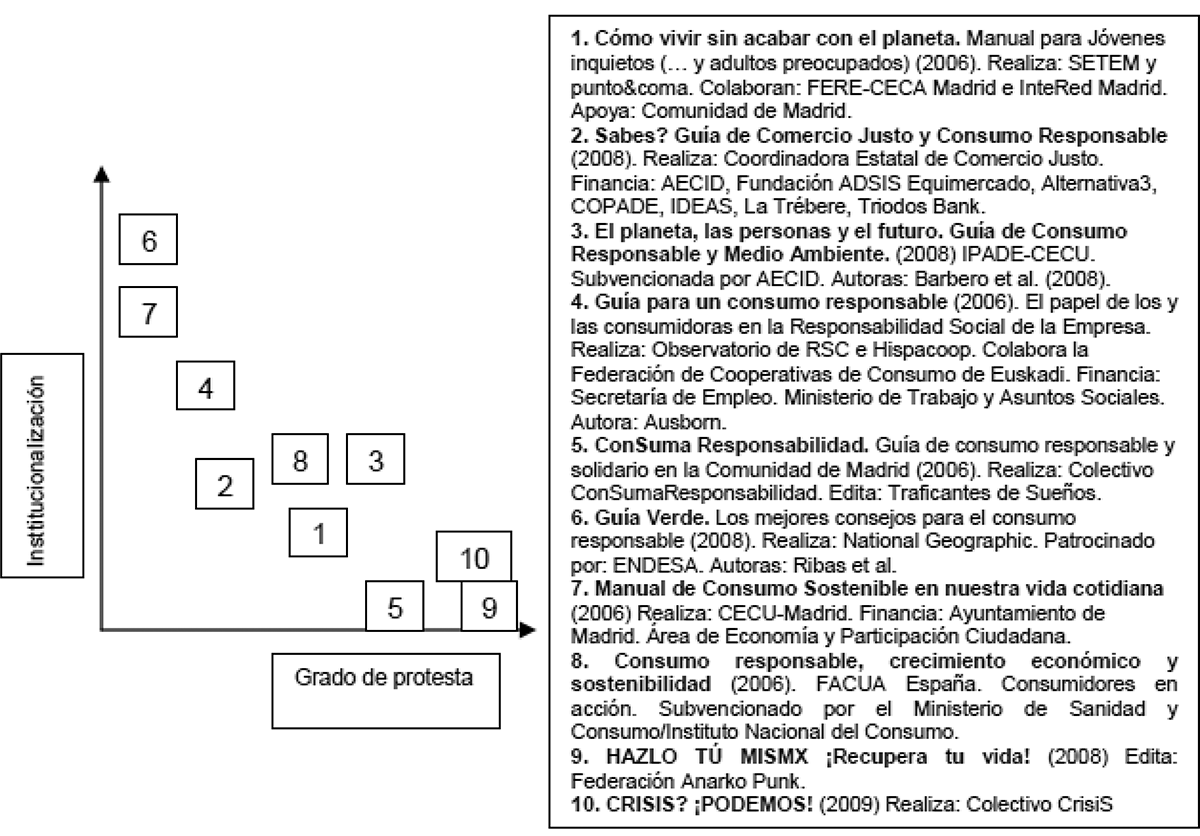
Entrevistas en profundidad y entrevistas en grupo
Para complementar los criterios para comunicar el consumo responsable conside- rando la perspectiva género que han sido extraídos del análisis documental, se han realizado entrevistas en profundidad y en grupo en el contexto madrileño.
En todos los casos la transcripción es estrictamente literal de un lenguaje oral 3 . El análisis realizado es de tipo interpretativo y sociohermenéutico que postula una interpretación del texto en contexto basada en el estudio de las líneas argumentales o discursivas de los datos registrados en las entrevistas. Esta forma de análisis es similar a la realizada por Alonso et al. (2011).
Se han realizado dos procesos de entrevistas en los que seleccionar participantes. En primer lugar, para las entrevistas a personas expertas, se ha considerado que fuera relevante su trayectoria en comunicación sobre consumo en el ámbito estatal. En segundo lugar, para la selección de las demás personas entrevistadas (tanto en profundidad como en grupo), se ha considerado principalmente su experiencia en entidades que están relacionadas directamente con el CR.
En las entrevistas en grupo se ha convocado a las personas que participan en esos colectivos, pero explicitando que no era a modo de representantes, con el fin de buscar el discurso construido a partir de la experiencia personal. Para identificar a estas personas, se han tenido en cuenta los resultados del análisis de las entrevistas a personas expertas, el análisis de las guías, especialmente la clasificación de entidades de la Guía ConSuma Responsabilidad (2006), una de las guías analizadas. Esta guía sirve como base del mapeo del CR en el contexto madrileño.
Resultados
Análisis de la perspectiva de género en los discursos del consumo responsable construidos por organizaciones en Madrid
Tras el análisis de la muestra de guías se observa una ausencia general de reflexión crítica y profunda sobre la relación consumo-género o una mirada al consumo específicamente desde una perspectiva feminista.
Sin embargo, en los textos estudiados sí aparecen menciones generales a la relación entre sostenibilidad y género. Entre las principales líneas de reflexión presentes en el discurso de las guías (Figura 2), es destacable la vinculación que se hace del papel de las mujeres y la sostenibilidad global. Uno de los documentos analizados hace alusión a la aparición del principio específico recogido en la Declaración de Río:
Síntesis de las principales líneas discursivas construidas por organizaciones ligadas al CR en la muestra de guías analizadas. Las mujeres desempeñan un papel fundamental en la ordenación del medio ambiente y en el desarrollo. Es por tanto imprescindible contar con su plena participación para lograr el desarrollo sostenible (en anexo de la guía 8, FACUA Consumidores en Acción, 2006).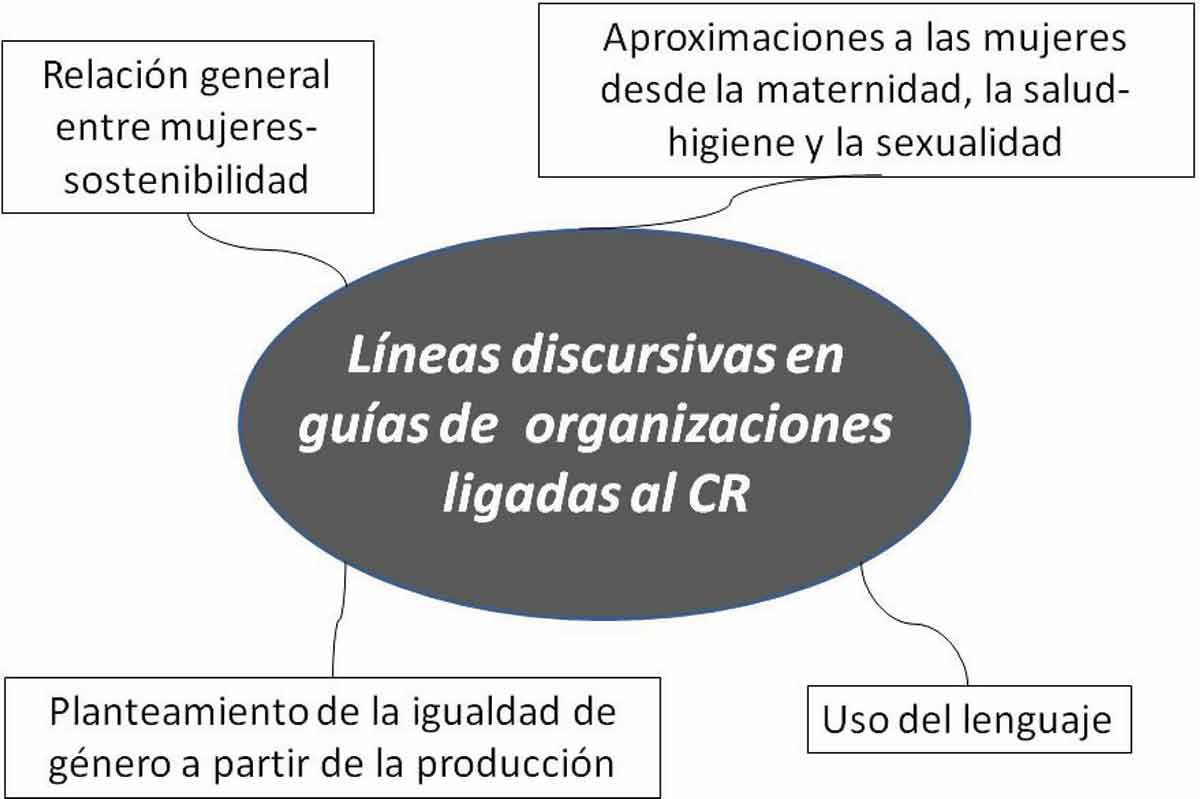
Es de interés destacar cómo se hacen múltiples aproximaciones a las mujeres desde la maternidad, la salud e higiene y la sexualidad. Esto aparece en dos guías, a través de la consideración de las mujeres embarazadas como personas más sensibles a los tóxicos (guías 6 y 10). En dos de ellas se reflejan las posibilidades de apoyo mutuo en la crianza (guía 10) y la existencia de colectivos de apoyo a la lactancia materna (guía 9). En dicha guía también se recoge cómo incide el heteropatriarcado y el consumo sobre nuestros cuerpos y mentes, la sexualidad, las relaciones y la maternidad, siendo el documento donde aparece esta línea de reflexión con más profundidad. Por ejemplo: El poder se reproduce en nuestros gestos más íntimos, no podemos destruir el poder sin construirnos en el mismo proceso como seres libres que se expanden unos sobre otros. Aquí topamos de frente con las ideas que vertebran nuestras relaciones; el amor, el sexo, la libertad, la pareja… Más que ideas, idealizaciones sobre las que el sistema publicitario del poder pone todo su empeño en manipular, promover y transferir universalmente a los cerebros de los consumidores. (guía 9, Federación Anarko Punk, 2008).
Existe en diversos textos un planteamiento de la igualdad de género a partir de los procesos de producción. Este fenómeno aparece enfocado especialmente en el ‘Sur económico’, expresión que utilizamos para hablar de los llamados ‘países en vías de desarrollo’ y del llamado ‘Sur dentro del Norte’ (p.e. cuando se refieren a personas en riesgo de exclusión). Este discurso está señalado por la presencia de los criterios de Comercio Justo (guías 1, 2, 4, 5, 6, 8) o por aludir a las condiciones de producción y consumo en el Sur (guía 3). En los países empobrecidos, asegúrate de no comprar recuerdos en cuya fabricación puede haber habido situaciones laborales precarias o explotación infantil. Lo puedes evitar comprando a cooperativas de mujeres o artesanos (guía 4, Ausborn, 2006). Las mujeres y los/as niños/as se desplazan largas distancias para obtener combustible, por lo que disponen de menos tiempo para otras actividades (educación, etc.) (guía 3, Barbero et al., 2008).
Otro aspecto de interés recogido en la muestra de guías estudiadas es la introducción de criterios de consumo respecto a valores como la igualdad de género y la no violencia (guía 4). Opta por juguetes que transmiten valores positivos y evita aquellos que transmiten valores sexistas o que incitan a la violencia (guía 4, Ausborn, 2006).
Por otro lado, en algunas guías se hace mención a la necesidad de considerar en la elección de un producto la relación de su proceso de producción con posibles situaciones de discriminación: Como consumidores responsables, no estamos de acuerdo con que nuestro dinero se utilice para apoyar a empresas que contaminan, no respetan los derechos humanos o discriminan a mujeres, discapacitados y minorías étnicas (guía 4, Ausborn, 2006).
Sólo una de las guías (guía 5) habla del principio de equidad-igualdad en toda la guía aplicado fundamentalmente a la selección de las organizaciones que aparecen en la guía, de manera que queda asociado a la producción en el Sur y en el Norte. En ella, se incluye la información facilitada por las organizaciones respecto a la participación de mujeres y hombres en ellas, y la distribución del poder.
Finalmente, se observa que solo algunas guías realizan un manejo del lenguaje no sexista, en sus diferentes versiones, ya que es también un tema de discusión. Entre las fórmulas más utilizadas destacan tanto el uso de personas, ‘os/as’ y ‘todas y todos’, como otras expresiones en masculino del plural, habiendo así situaciones mixtas de uso de lenguaje no sexista y lenguaje sexista. Tres de las 10 guías, utilizan @ o × (guías 3, 5 y 9). Otra de ellas aclara en el prólogo el uso de ‘consumidor’ para referirse a consumidor y consumidora (guía 4). Por ello, este elemento formal es uno de los aspectos más incorporados en la comunicación del consumo responsable o sostenible.
Análisis de discursos sobre el consumo responsable considerando la perspectiva de género presente en el contexto estudiado y criterios emergentes para comunicar
Tras estudiar los discursos sobre el CR en las guías, también se han analizado intervenciones recogidas en las entrevistas individuales y grupales. Éstas engloban reflexiones sobre cómo está presente la perspectiva de género en el CR y su comunicación a modo de diagnóstico y/o de propuesta. A continuación, se enumeran los principales criterios para mejorar la comunicación en CR, que emergen como propuestas o son identificados como elementos ausentes en discursos y prácticas y consideran que deberían estar presentes:
Cuidados y economía: un paradigma presente, aunque aún no lo suficiente
En relación al cuidado, en dos grupos se habla de ‘la crisis de cuidados que [se] está generando’ (gr1)
4
y de las aportaciones de la economía feminista. Desde la cual, una de las personas presentes en los grupos habla de la experiencia en los colectivos donde participa. Le da gran relevancia porque ‘es un punto importante del consumo y [...] de hecho se debería trabajar muchísimo más’ (gr1) y propone un cambio de modelo: La segunda revolución conceptual en los colectivos donde yo estoy [además de la economía ecológica, que] sí que se trabaja explícitamente es la economía feminista, o economía de los cuidados […].Pone encima de la mesa lo que el mercado ha dejado fuera, que es el concepto de necesidad, que son cuáles son los trabajos primero para vivir y luego para vivir bien, […] que han sido fundamentalmente desarrollados por mujeres e invisibilizados posteriormente por la ‘ciencia económica’, etc. […] Hay una receptividad absoluta a ese mensaje (gr2).
Respecto a esta situación se reconoce que ‘tampoco se ha hablado mucho de esto’ (r2) en este tipo de proyectos. En dos grupos se atribuye a ‘que ya está inte- riorizado […]. En ninguna reunión de grupo de consumo he hablado nunca del tema de género [...] A nivel interno para mí es una barrera superada. No digo que no exista, pero bastante superada’ (gr1).
En este tipo de reflexión, se incluye una comparación entre el ‘Sur y el Norte económicos’, coincidiendo así con los resultados del análisis de las guías: ‘Sí que es verdad que falla aquí en el Norte [...] ese argumento. […] A lo mejor lo puedes potenciar mucho desde lo del Sur, pero luego vienes aquí [...y] estamos fa- llando’ (gr4).
Se podría decir que hay acuerdo al expresar que falta o se debe trabajar mucho más esta perspectiva en el CR (r2, r5, r6, r7, gr1, gr4, gr3). En uno de los grupos, se forma un silencio tras la reacción inicial a la pregunta que lleva esta reflexión: Persona 6: Está claro que hay un olvido. Porque de todos los temas que son de los que hemos hablado muchas veces, y hemos ido a muchas charlas, se nos va la lengua. Y ya éste es como silencio, ralentizar, pensar… (gr1).
Diferencias en experiencias, conceptos y tipos de grupos de CR
En dos de los grupos, la afirmación de algunas personas respecto a la carencia de enfocar el CR y su comunicación desde la perspectiva de género es rotunda y origina discrepancias en el grupo: Persona 1: No tenemos un discurso de género, para nada, podemos tener alguna práctica mejor […] Persona 3: Cada vez se cuidan más, o sea, que estamos aprendiendo a incorporar ritmos que incluyan otras formas de ver la vida, o de vivir la vida, pero queda mucho que aprender (gr3).
Se reconocen diferencias entre experiencias y proyectos, así como en el manejo de conceptos: qué se entiende por la relación consumo-género, en qué aspectos se aplica, cuál es el mensaje, etc. Por ejemplo, en este grupo, se muestran estas diferencias. Para una persona sí hay discurso de género en el proyecto que participa, porque éste cuenta con el liderazgo de mujeres, pero para otra hay diferencias entre este proyecto de agroecología y otros de finanzas éticas, en el cual ‘hay más hombres liderando los procesos, y menos mujeres’ (gr3). Además, considera que no está trabajado el tema, aunque haya más mujeres empoderadas. En definitiva, en varios grupos, se apunta a marcar estas diferencias según sectores o ámbitos del consumo (finanzas, alimentación, etc.) y según experiencias concretas.
En algunos grupos, se detecta cómo las formas de organizarse a veces ponen de manifiesto que ‘no tenemos y no hay ese planteamiento en los grupos de consumo. Desde el momento en que por ejemplo las reuniones se convocan a las 9 de la noche, [es difícil la] compatibilización, o sea gente que ha tenido bebés tiene que hacer malabares’ (gr4).
En las entrevistas analizadas, se ha encontrado el uso del lenguaje no sexista de manera mayoritaria. Enlazando el género con otras perspectivas, en solo uno de los grupos, emerge una autocrítica, visibilizando que ‘hay muchas lagunas porque nuestro discurso es de nuestra posición social. Hombres blancos, clase media. […] Hay puntos oscuros en nuestro discurso. ¿Cómo afecta a inmigrantes? El género no lo trabajamos porque a una mitad no nos interesa’ (gr3). Este comentario da paso a la reflexión sobre otras cuestiones de equidad-igualdad en el discurso, además del género, que deben ser integradas en la comunicación sobre el consumo responsable. Este aspecto se trata en mayor profundidad en Piñeiro (2011).
Participación de mujeres y hombres en organizaciones y colectivos, y receptividad al mensaje
Al preguntar por la perspectiva de género en CR y su comunicación, uno de los primeros elementos en el discurso gira en torno a la participación de hombres y mujeres, tanto en el número o proporción como en los tipos de roles que asumen unos y otras, así como en la visibilidad y el reparto del poder. No hay un acuerdo respecto a si la participación es equilibrada o hay más mujeres que hombres, pero no hay ninguna entrevista en la que se argumente que en el CR en general hay más hombres que mujeres. Se identifican diversas experiencias argumentadas principalmente por las diferencias en receptividad a los mensajes según sectores o ámbitos de consumo. Para algunos temas como la banca ética, se habla de que ‘la receptividad […] más menos es la misma’ (gr1) y para otros como la alimentación se considera de manera mayoritaria que hay más mujeres, ‘porque las mujeres sostienen la alimentación en el mundo’ (r2). En ese sentido, es recurrente la idea de la producción a cargo de las mujeres, y la necesidad de ‘apoyar y asignar recursos propios a un modelo de producción que no sea en ningún caso discriminatorio. Y si es discriminatorio, que hay muchos casos sobre todo en el comercio justo, [que sea de] discriminación positiva’ (r3). Así, esta propuesta de incorporar la idea de la igualdad y la equidad de género en el momento de consumir, aparece preferentemente unida al modelo productivo (r6, r4, r3). Pero no es un criterio utilizado a la hora de valorar la producción local en aquellos grupos de consumo que son de referencia o participan las personas entrevistadas (gr4).
Respecto a la mayor participación de mujeres en algunos de los tipos de iniciativas, en algunas entrevistas y grupos se buscan explicaciones a esta situación en dos líneas argumentales distintas: (i) explicaciones cercanas ‘al marxismo, al modelo productivo-reproductivo, pensando [...] que la mujer trabaja menos [...] en el mercado de trabajo’ (r6); (ii) visiones de esta situación como una consecuencia del ‘sistema patriarcal’ (r4), esgrimiendo que en éste ‘la mujer se dedica a la compra de alimentación [y] gestionar el presupuesto del hogar [...]’. Este último argumento se repite en dos grupos.
En el discurso, esa ‘sensibilidad’ para este consumo con criterios de sostenibilidad, justicia, ética, etcétera, más atribuida a las mujeres, va vinculada al reparto desigual de tareas en estas prácticas: ‘Si vives en pareja es difícil sostener eso, ¿no? Si siempre eres tú la que va a hacer la compra, si siempre eres tú la que tiene que defender eso y además tienes que justificar que te vas a gastar más dinero, pues es complicado. Y algunas se han vuelto atrás porque [a] sus compañeros varones no les parecía importante’ (gr3)(r1).
Como primeras motivaciones para empezar en este camino del CR, se refleja la maternidad y la salud, lo cual coincide con lo analizado en las guías:‘el tema de salud es una vía de entrada [...] [Con] las mamis que tienen críos [...] lo tienes pero mucho más sencillo, [es] una vía de entrada muy clara’ (r1 y r8).
En relación a la presencia de mujeres en los colectivos, hay aportaciones en varios grupos sobre cómo la mayor presencia de mujeres cambia el funcionamiento de los mismos, en el modo de hacer, pero no de manera ‘natural’(gr3). Es decir, no se trata de una cuestión esencialista, sino de cómo se hace un trabajo hacia ‘cambiar los sistemas de participación’ en ‘formas reticulares’ (gr2): Mi experiencia dentro de los colectivos y tal, aunque generalizar siempre es complicado, es que cuanto mayor es la presencia de mujeres en esas vías o búsqueda de vías diferentes de hacer las cosas y de consumir, o de sensibilizar o de transformar, las prácticas cambian, con la presencia más horizontal de mujeres. Pero no es natural. Hace falta… (gr3).
Los valores del consumo responsable y la igualdad como parte de ellos
Los llamados tradicionales valores femeninos casan muy bien con esto que estamos diciendo. El ir más despacio, las relaciones en el cuidado de las personas, las relaciones con las personas. Bueno, pues al final, quizás en el trasfondo o en las raíces del consumo responsable, pudieran estar esos valores asociados tradicionalmente a un rol femenino (gr2).
Este discurso se recoge en los proyectos a nivel interno, pero en menor medida en la comunicación externa: ‘Quizá en el consumo responsable [la perspectiva de género] se debería trabajar más como parte del propio consumo responsable. Quizá ese discurso sí que brille por su ausencia’ (gr1).
Sin embargo, aunque no esté tan presente en el discurso, la igualdad de género sí que está en los valores, criterios y objetivos de los proyectos (r3, r6, r5).Como explica una de ellas, ‘nos unimos por una misma causa, que fue lo que nosotros llamamos consumo responsable y solidario, que incluye pues el consumo […] respetuoso con el medio ambiente,[…], el consumo solidario, sobre todo con el respeto de los derechos humanos, […], y la igualdad entre hombres y mujeres’ (r3).
Aunque desde algunas personas entrevistadas se considera que es pronto, ya que el movimiento del CR es un movimiento muy incipiente para preocuparse por temas de género, clase, etc. (r7), desde otras se considera necesario aplicar esta perspectiva ‘primero en la producción y después en la comunicación’ (r6), para poder, ‘en los mensajes de consumo consciente […], siempre incluir una perspectiva de género’ (r5).
La perspectiva de género como herramienta para la reflexión sobre los hábitos o prácticas de consumo
Algunas personas consideran que la perspectiva de género es una herramienta para el CR, ya que en ‘la sociedad que nos ha educado para hacer unas cosas u otras […] la perspectiva es también desentrañar esa cultura que nos empuja y nos ata a unas conductas e intentar elegir con más libertad’ (r5).
En este sentido, el género es una pauta fuerte de consumo, ya que está entre ‘los mecanismos […] que hemos ido bebiendo para consumir’ (r5, r6). El género ‘está muy entroncado con la identidad y con la satisfacción de necesidades’ (gr3).
Esta pauta está alimentada por el uso en la comunicación publicitaria de imágenes de mujeres como motivación para el consumo. Éste es otro de los aspectos en los que se concreta la aplicación de la perspectiva de género al consumo responsable, por la vía ‘del consumismo […], romper un poco con el paradigma […] o la idea de la mujer objeto, como elemento motivador para el consumo de una bebida gaseosa, que no tiene nada que ver, o un coche’. Parte de este proceso de aplicar esta perspectiva, para las personas entrevistadas, pasa por reflexionar sobre cómo ‘dentro del discurso publicitario la mujer ha sido, es y seguirá siendo absolutamente maltratada, utilizada, instrumentalizada como un argumento de ventas’ (r6, gr3).
Discusión y conclusiones
Las reflexiones en torno al género en los análisis existen, pero son minoritarias en la comunicación habitual sobre el CR y aún insuficientes en las prácticas de CR tal como queda reflejado en el análisis de las guías y en el discurso de las entrevistas individuales y grupales.
En los resultados aparece una mayor reflexión en torno a las condiciones de las mujeres en la producción y por extensión de las condiciones laborales, especialmente presente en relación al Sur económico, de la mano de los principios del Comercio Justo. Sin embargo, es minoritaria la reflexión sobre la producción en el Norte, a pesar de ser una situación no equitativa. Según los datos del CERES recogidos en Oceransky (2006), en España, una de cada tres personas que trabaja en la agricultura es mujer, cobrando de media un 30% menos, la mitad de ellas con estatuto de cónyuge-colaborador y sólo 9% son propietarias de las tierras que trabajan. Estos aspectos no aparecen o lo hacen de forma minoritaria en el discurso identificado en las guías y en las entrevistas grupales o individuales.
Respecto a la participación, la presencia de mujeres en los colectivos ha servido de motor de cambio para las formas de tomar decisiones, organizarse, etc. Se revela en algunas entrevistas una diferencia en la práctica cotidiana de la participación, explicitando en algunos ejemplos que no sólo es necesaria la presencia de mujeres sino que tengan un papel más relevante en ese colectivo y/o que se trabaje esa equidad entre todas las personas del grupo, por lo que se hace énfasis en que no se produce ‘de forma natural’. Esta situación se comparte con otros ámbitos del ecologismo tal como se observa en el origen de la formación de Womens Environmental Network (Grover et al., 1999) cuando comenzó a emerger el ecologismo o ambientalismo y muchas mujeres del movimiento se preocuparon por las posiciones de influencia que estaban ganando los hombres de estos movimientos. Puede ser un tema estudiado en el futuro, ya que efectivamente es un factor que puede ser un aporte importante de cara al discurso y las prácticas en CR. En definitiva, es cuestionable el reparto del poder y su visibilidad, al que se hace una crítica en algunos proyectos de CR del contexto según las entrevistas. Estos resultados se confirman en diversos estudios sobre género y tercer sector (García et al., 2004; Observatorio del Tercer Sector de Bizkaia, 2010). En ellos, explican la dife- rencia en términos de poder dentro de las organizaciones y muestran que sus puestos directivos, independientemente de que su base voluntaria sea mayorita- riamente femenina o masculina, suelen estar ocupados por hombres. También en otros estudios de género y CR en grupos de consumo (Suriñac, 2012), se afirma que la mirada sobre la mayor presencia de mujeres es incompleta si no se acompaña de un análisis de las relaciones y el funcionamiento del grupo. También esta mirada ha de tener en cuenta la diversidad de enfoques y vivencias en cuestión de sexo, género y opresiones, además de incluir un análisis en términos de hombres y mujeres.
En relación a la reflexión sobre la perspectiva de género en los grupos u organizaciones vinculadas con el CR, se habla de una ausencia o al menos de una atención insuficiente tanto en las entrevistas individuales como en algunas de las grupales. Son numerosas las expresiones de sorpresa, de silencio o de explicitar que no se ha reflexionado sobre ello. Ahondando en esta misma línea de resultados, el estudio de Cruz, López, Ortiz, Rodríguez y Del Valle (2006), realizado dentro del movimiento de la agroecología para trabajar desde la perspectiva de género, confirma que de los colectivos contactados en su investigación sólo minoritariamente lo habían abordado explícitamente. En la presente investigación aparece la idea de que no se explicita porque en los entornos activistas ya está superado. Sin embargo, Cruz et al. (2006) también ponen de manifiesto que si no se trabaja explícitamente, es muy probable que no haya equidad. Es decir, no es posible dar por hecho que la división se va a hacer de forma equitativa, cuando la situación de inequidad tiene profundas raíces históricas. En este sentido, MacGregor (2006) insiste en que siempre que se considere la esfera doméstica y las tareas del cuidado para lograr un cambio social/ambiental (como en el CR), se ha de analizar la división de género de trabajo/responsabilidad y costes/beneficios.
Por otro lado, en algunos discursos, el CR está vinculado a valores tradicionalmente femeninos o se consideran feminizadas o maternales algunas de estas propuestas, pero no es lo mismo femenino que feminista. Una propuesta más cercana a los valores culturalmente asignados a las mujeres (dentro del patriarcado) no implica que sea equitativa o que conlleve un trabajo de equidad de género en sus prácticas y discursos. Esta asociación es muy criticada desde posiciones feministas, ya que cabe remarcar que la vinculación de las mujeres al sostenimiento de la vida es consecuencia de la asignación cultural de roles, como el que las mujeres tengan una estrecha relación con la naturaleza se sustenta en una construcción social (Herrero, 2013; Luna, 2008; Novo, 2009).
Entre los resultados, destaca que en la comunicación sobre CR hay una reflexión minoritaria sobre el género (en nuestro caso, especialmente en la parte de la cadena que se denomina consumo). Esto concuerda con los resultados de estudios similares realizados en otros contextos europeos (Grover et al., 1999), como también es minoritaria esta perspectiva en las políticas públicas sobre CS (Stieß y Schutlz, 2009 para el proyecto EUPOPP). Pero, como las propias personas entrevistadas afirman, es necesario el trabajo de reflexión y de incorporación de esta perspectiva a discursos y prácticas, incluyendo la comunicación pública.
Los criterios que emergen para comunicar el CR con perspectiva de género en las entrevistas (que a grandes rasgos son los apartados del análisis) son similares a los criterios para incluir la perspectiva de género en el campo del CS según Stieß y Schutlz (2009), aunque su enfoque se dirija a las políticas públicas, e implican cuestionar: (i) la división sexual del trabajo; (ii)la construcción de género en torno al cuerpo, la salud y la organización social de la intimidad; y (iii) las relaciones de poder y acceso a la toma de decisiones de mujeres y hombres. Es decir, a la hora de tener en cuenta la comunicación del CR con perspectiva de género, estos aspectos son claves para construir los mensajes.
En los últimos tiempos, una vez concluido el estudio, se han dado propuestas para la mejora de la incorporación de la perspectiva de género en el CR que consideramos como una confirmación de la presencia aún minoritaria de esta reflexión. La preocupación por la baja presencia de esta perspectiva ha llevado a organizaciones como Setem a publicar una guía específica (Piñeiro y Ballesteros, 2013) que sirva para pasar a la práctica aplicando nuevos paradigmas para ‘poner la vida en el centro’ (Weingärtner y Monasterio, 2010) y a organizaciones como la Xarxa de Consum Solidari centrar sus jornadas anuales en esta relación consumo-género, así como a otras entidades (Sodepaz, IPADE, etc.) a realizar talleres específicos. Por ello, interpretamos que hay señales recientes que indican posibles cambios en este panorama de la presencia de la perspectiva de género en el CR.
Footnotes
This project was made possible thanks to the individuals participating in the interviews and groups, who made an effort to communicate how to change consumption to make it more sustainable (especially in the guides analysed), as well as those whose practices seek to transform relationships day by day to achieve a better life within the planet’s biophysical limitations, not just for themselves but for everyone. / Este trabajo es posible gracias a las personas que han participado en entrevistas y grupos en particular, a las que se esfuerzan por comunicar cómo cambiar el consumo hacia la sostenibilidad (en especial a las de las guías analizadas), así como a aquéllas que con sus prácticas buscan transformar día a día las relaciones para lograr un buen vivir dentro de los límites biofísicos del planeta, no sólo para ellas, sino para todas.
1.
In Spain, consumo responsable (responsible consumption) is used as an umbrella term or one that gathers together these practices, unlike internationally where the most commonly used term is ‘sustainable consumption’. In this paper we have used the term ‘sustainable consumption’.
2.
Our intention is to explore the consumption-gender relationship in a broad sense. The sex-gender theory is a theory on which we have based our analysis, as a critical analysis category as defined by Celia Amorós (cited by Puleo,  ), assuming the limitations it entails, as noted by other theories. We are also open to other contributions emerging from future studies that go beyond the man-woman construct. To accomplish this we speak about people, since we want to include not only people who identify themselves as men and women but also people who do not identify with either of these categories. The selection of individuals has sought this diversity.
3.
In the verbatim excerpts from the interviews, we have added words in brackets to make the text more legible given that owing to space limitations omitting the entire paragraph could make them more difficult to understand. The brackets that contain ellipses mean that part of the paragraph has been omitted for the sake of brevity.
4.
The groups are numbered from 1 to 4 and are identified with ‘gr’. The interviews are also numbered and identified with an ‘r’. The speakers’ literal expressions are transcribed.
1.
En el contexto español se utiliza ‘consumo responsable’ (CR) como término paraguas o aglutinador de estas prácticas, a diferencia del ámbito internacional en el que el término más empleado es ‘consumo sostenible’.
2.
Nuestra intención es explorar la relación consumo-género en un sentido amplio. La teoría sexo-género es una teoría en las que nos apoyamos para el análisis y como categoría crítica de análisis, según define Celia Amorós (citada por Puleo, ), asumiendo las limitaciones que conlleva, indicadas por otras teorías, con apertura a que en futuras investigaciones puedan surgir otras contribuciones que vayan más allá de la construcción mujeres-hombres. Por ello, en el artículo, hablamos de personas, ya que queremos incluir no sólo a aquellas personas que se identifican a sí mismas como mujeres y hombres, sino también a las personas que no se identifican con estas categorías. La selección de personas entrevistadas ha buscado esta diversidad.
3.
En los verbatim o extractos de las entrevistas, entre corchetes se han añadido algunas palabras que hacen más legible el texto, puesto que por limitaciones de extensión, no contar con los párrafos completos puede disminuir su comprensión. Los corchetes que contienen puntos suspensivos reflejan que se ha cortado una parte del párrafo para lograr mayor brevedad.
4.
Los grupos están numerados del 1 al 4 y se identifican con gr. Las entrevistas también están numeradas y se identifican con una r. Se recogen las expresiones literales.