







Abstract
This research analyses pro-environmental behaviour (considering four categories: transport and mobility, waste management, ecological consumption and activism) according to environmental attitudes and certain contextual factors regarding the neighbourhood of residence. In addition, based on the assumptions of ABC theory, we evaluate the moderating effects of context on the relationship between attitudes and pro-environmental behaviours. The study sample consists of 218 people living in China who completed a questionnaire distributed to an online panel. The data obtained are analysed by means of iterative regressions, t tests for independent samples and regressions using the PROCESS macro for moderating effects. The results show that the four categories of pro-environmental behaviours are explained by different attitudinal dimensions. It is also noted that contextual factors directly impact the four behavioural categories considered and further moderate the relationship between the attitudinal dimensions and two types of behaviours (waste management and ecological consumption). Implications for the design of strategies to promote pro-environmental behaviour among the Chinese population are discussed.
The growth of the Chinese economy has helped to improve the standard of living of households by changing the overall consumption structure of the population. However, rising living standards are not always accompanied by a positive social impact, as rapid income growth, combined with an unsustainable form of consumption, can cause tremendous pressure on the environment and natural resources. Thus, in 2019, the concentration of PM2.5 (suspended particles of less than 2.5 microns) in the air of 337 cities at prefecture level and other higher levels (in total, 370 cities) was 36 μg/m3 (Chinese Department of Ecology and Environment, 2020). This figure basically met the air quality standards of the Chinese Government, but it is still a long way from the 10 μg/m3 standards proposed by the World Health Organization [WHO] (2005).
China has gradually reinforced its emphasis on environmental behaviour. In 2017, the Plan to Implement a Domestic Waste Classification System proposed the following target by the end of 2020: of the key cities that implement mandatory waste classification, the coverage rate for classification should exceed 90% and the recycling rate for domestic waste should be 35% (Chinese State Council, 2017). This means, among other things, that the classification of waste in China will be incorporated into the country’s legislative framework and that non-compliance will incur penalties. However, with regard to sustainable consumption, this is still a relatively new concept in China. In addition, there is little comprehensive and specific research on the environmental behaviour of the Chinese population. Most of the research reviewed applied to this country focuses on one specific type of environmental behaviour (Awuni & Du, 2016; Liao et al., 2020; Yu, 2014; Zhao et al., 2014), with the exception of the work of Hong and Park (2018), which, although it considers five types of environmental behaviour, performs a grouped analysis, without exploring in depth how the different determinants can influence each specific type of behaviour.
Environmental attitudes and personal characteristics are the most recurrent factors analysed in the empirical literature concerning China, considering attitudes from a one-dimensional perspective, which measures favourability towards environmental issues using, for example, the NEP scale (New Ecological Paradigm; e.g., Yu, 2014) or a two-dimensional perspective (anthropocentric/ecocentric; e.g., Hong & Park, 2018). However, contextual factors have received comparatively less attention in previous research, with the exception of Hong and Park (2018). These authors analyse the impact that contextual factors, measured at the local level, have on individual pro-environmental behaviour and also the interaction between local contextual factors and various individual variables such as environmental attitudes. In light of the above, there is a need to conduct research in the Chinese context that: (1) analyses the attitudinal and contextual factors that determine various types of environmental behaviour; (2) uses a multidimensional perspective on environmentalism, as previous literature has emphasized the need to take into account the multidimensional nature of environmental attitudes because such an approach is better suited to analysing, transculturally, complex relationships between people and the environment (Ajdukovic et al., 2019; Amérigo et al., 2020; Domingues et al., 2019); and (3) further explores the moderating effect of contextual factors.
Since the 1990s, or thereabouts, special attention has been paid to analysing the determinants of pro-environmental behaviour (Fraj & Martínez, 2006). Thus, Balderjahn (1988) assesses how five types of environmentally responsible behaviours (home insulation, energy saving, purchase and use of organic products, environmental activism and responsible environmental automobile use) are explained by different influential factors, such as environmental attitudes, personality, socio-economic and demographic variables or cultural variables. This author concludes that each of these specific behaviours has its own influential factors. Subsequently, a large number of papers have attempted to study the different factors that influence pro-environmental behaviour. Stern (2000) proposes four types of determinants for pro-environmental behaviour: (1) environmental attitudes, including norms, beliefs and values; (2) personal skills, related to knowledge, skills, abilities and resources, along with socio-demographic variables that could be considered indicators of personal capacities (Barr, 2003); (3) contextual factors, referring to interpersonal influences (social norms, persuasion and expectations), legal and institutional factors and public policies; and (4) habits or routines.
One very interesting theoretical proposal to analyse the factors that influence environmental behaviour is ABC theory, put forward by Guagnano et al. (1995). This theory considers that environmental behaviour (B) is basically the product of attitudes (A) and contextual factors of the environment (C). Thus, ABC theory holds that individuals’ environmental behaviour is best explained by taking into account environmental attitudes and contextual factors at the same time. Thus, when contextual factors tend to be zero, the relationship between environmental attitudes and behaviours is stronger. In contrast, where contextual factors are extremely favourable or unfavourable towards engaging in a particular environmental behaviour, these factors alone can greatly promote or prevent engagement in that behaviour and, in this case, environmental attitudes are unimportant. This implies that contextual factors determine the strength of the relationship between environmental attitudes and behaviours (Stern, 2000). Thus, if contextual factors are not favourable to a particular environmental behaviour (for example, they require an individual to spend more money, spend more time or make more effort), environmental attitudes will not be of great help in determining or changing people’s behaviours (Stern, 2000).
Contextual factors therefore play a relevant role in favouring or hindering pro-environmental behaviour, since when such behaviours are difficult to perform (because of their high cost and time required, technology not available, etc.), dependence on environmental attitudes will weaken and the influence of contextual factors will increase. Most studies on contextual variables include the need to design material incentives, reduce economic costs, create laws, etc. (Borgetede & Biel, 2002). According to the concept of perceived behavioural control, included in Ajzen’s (1991) planned behaviour theory, people will perceive the level of difficulty of a given behaviour based on their previous experience or psychological expectations, i.e., whether they have the confidence to perform the behaviour or not. This degree of difficulty usually depends on contextual factors such as convenience, time constraints or economic conditions. A large body of research shows that the degree of perceived control will affect the performance of environmental behaviour. For example, if recycling is very easy and not very time-consuming, this will have a positive impact on recycling behaviour (Vining & Ebreo, 1990). Along the same lines, McCarty and Shrum (1994) show that the external contextual factors that can stimulate sustainable consumption are, in particular, conditions of convenience. So, for example, if a person wants to buy an eco-product but it is not available in their regular supermarket, they might rule out buying it. Therefore, in order to encourage pro-environmental behaviour, it is essential to act on contextual factors, providing adequate infrastructure, increasing convenience or creating laws or regulations, among other aspects.
Taking into account all of the above, and based on the assumptions of ABC theory, the general objective of this paper is to analyse how environmental attitudes and contextual factors in the neighbourhood of residence impact on pro-environmental behaviour among the population residing in China, considering four categories: transport and mobility (MOB), waste management (WAS), ecological consumption (ECO) and activism (ACT). On the one hand, we hypothesize that environmental attitudes, measured using the Multidimensional Environmental Concern Scale (MECS) proposed by Amérigo et al. (2012), relate to the four categories of pro-environmental behaviour. In particular, we expect apathy (APA) to be inversely related to pro-environmental behaviours. In the case of anthropocentrism (ANT), the sign of the relationship cannot be specified a priori, and for connectivity (CON) and emotional affinity (EMO), we would expect a positive relationship. On the other hand, we hypothesize that four objective indicators related to contextual factors in the neighbourhood will directly impact on each of the categories of pro-environmental behaviour considered (facilitating engagement in each type of behaviour) and that, in addition, these factors will moderate the relationship between environmental attitudes and pro-environmental behaviours (weakening this relationship). Figure 1 provides a summarized version of the proposed model.
Proposed analytical model.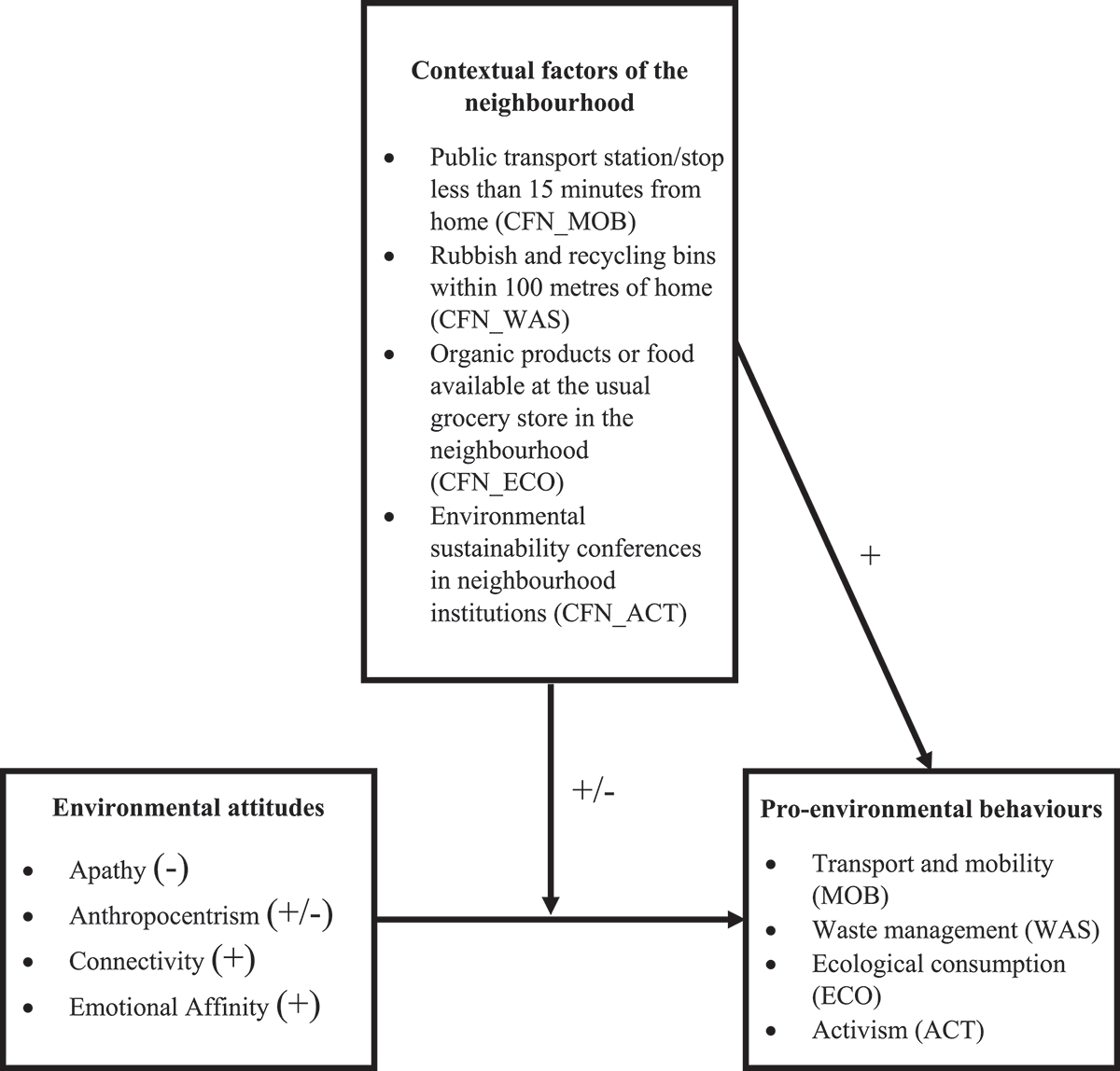
Method
Procedure and participants
The study sample consisted of 218 people living in China who completed a self-administered online questionnaire using the Wenjuan online panel (Wenjuan.com, 2020). This company offers a professional online data collection service, has more than 10 years of experience in the quantitative research sector and has an online panel of more than eight million users in China. The fieldwork was conducted between the months of April and May 2020. When analysing distribution by gender, the proportion of women was slightly higher, at 52.8%. The age of the respondents (M = 36.99, SD = 13.76) included different age brackets, although most were aged 25 to 30 (22.9%), 18 to 24, and 41 to 50 years old (18.8% in both cases). In terms of education, the majority (59.6%) had a university-level education and 20.2% had a high school or vocational education. In the case of occupation, 49.5% worked as an employee in a company or organization, 26.2% were retired, students or homemakers, 7.3% were self-employed. 5.5% were unemployed and 11.5% had a different working situation. With regard to monthly household income, 22.9% reported an income of between ¥10,001–16,000, 20.6% between ¥6,001–10,000 and 19.3% between ¥4,001–6,000. The average number of household members was 3.19 (SD = 1.11). As for place of residence, the persons surveyed lived in 61 different localities in China. This ensured a relatively heterogeneous sample of the general population.
Instruments
A questionnaire was designed with nine questions divided into two sections: the first to measure pro-environmental behaviour and environmental attitudes; and the second to measure socio-demographic characteristics. Pro-environmental behaviour was measured using 10 items taken from the study by Amérigo and García (2014) grouped into four categories of behaviour: transport and mobility (MOB, two items), waste management (WAS, three items), ecological consumption (ECO, four items) and environmental activism (ACT, one item); with three response options from ‘never’ to ‘usually’. In addition, the MECS scale proposed by Amérigo et al. (2012) was included, which consists of 20 items to measure environmental attitudes across its four dimensions (five items per dimension): apathy (APA), anthropocentrism (ANT), connectivity (CON) and emotional affinity (EMO); using a five-point Likert scale. All of these items were originally written in Spanish and were therefore translated into Chinese. In order to guarantee the adequacy of this translation, a process of back translation into Spanish was used, ensuring the accuracy of concepts and ideas with respect to the original scales. The second part included different variables on socio-demographic characteristics used for the description of the sample, such as gender, age, level of education, monthly household income, employment status, household size and place of residence.
Four dichotomous indicators (0 = no; 1 = yes) were used to measure contextual factors of the neighbourhood (CFN) according to the four categories of pro-environmental behaviours considered. The data were collected from the information provided by users to the Webjuan online panel and measured: (1) the availability or non-availability of a public transport station or stop within 15 minutes of the home (CFN_MOV); (2) the existence or non-existence of rubbish and recycling bins within 100 metres of the home (CFN_WAS); (3) the availability of organic products or foods at the usual grocery store in the neighbourhood (CFN_ECO); and (4) knowledge about the delivery or non-delivery of environmental sustainability conferences in neighbourhood institutions (CFN_ACT).
The instrument developed in Chinese, with the behavioural, attitudinal and context measures used in the research, is given in Appendix 1.
Data analysis
The data were analysed using IBM® SPSS® Statistics 24.0 and R 4.1.0. Specifically, the following R-packets were used: GPArotation (Bernaards & Jennrich, 2005), psych (Revelle, 2021) and Rcmdr (Fox & Bouchet-Valat, 2020). In addition, the PROCESS 3.5.3 macro for SPPS (Hayes, 2018) was used to analyse the moderating effects of the context. We decided to use the regression approach with the PROCESS macro to analyse the moderating effect instead of modelling with structural equations, since: (1) the sample size was not large enough to estimate multigroup models with structural equations for the two categories of each contextual factor; and (2) as a relatively small sample, standard errors associated with parameter estimates would be skewed downwards if modelling with structural equations had been used (Hayes et al., 2017).
Results
Reliability ratios, descriptive statistics and non-parametric correlations for pro-environmental behaviour indices and environmental attitudes dimensions (N = 218)
Note: n.a.: not applicable, ***p < .001, **p < .01, *p < .05
The descriptive analysis and correlations between the pro-environmental behaviour indices and the dimensions of environmental attitudes are also shown in Table 1. As we can see, the category of pro-environmental behaviour most frequently performed by the sample was related to waste management, with the least frequent related to environmental activism. Correlations between the four categories of pro-environmental behaviour tended to be moderate or weak, ranging from .41, recorded between the categories of mobility and transport and ecological consumption, and .12 (p > .05), between waste management and activism. Regarding environmental attitudes: (1) negative and significant correlations were obtained between apathy and the dimensions of connectivity and emotional affinity (−.44 and −.35, respectively); (2) anthropocentrism correlated positively and significantly with the other three attitudinal dimensions; and (3) the dimensions of connectivity and emotional affinity correlated positively and significantly with each other (.75).
Standardized coefficients of iterative regressions (forward method) for pro-environmental behaviours based on the dimensions of environmental attitudes
Note: ***p < .001, **p < .01, *p < .05
Differences in pro-environmental behaviours according to contextual factors of the neighbourhood
Note: aEqual variances are not assumed.
Explanatory models of pro-environmental behaviours: analysis of the moderating effect of contextual factors of the neighbourhood (non-standardized coefficients)
Note: 1The variables were previously centred on their mean before entering them in the moderation analysis; 2based on 5,000 bootstrap samples of size 218.
Discussion
Based on the ABC theory of Guagnano et al. (1995), the research presented has analysed the impact of contextual and attitudinal factors on four categories of pro-environmental behaviour in a sample of 218 people from the general population in China. The results obtained allow us to conclude that: (1) the four types of pro-environmental behaviours are explained by different attitudinal dimensions; (2) contextual factors in the neighbourhood of residence facilitate engagement in the four types of behaviours; and (3) two of these contextual factors, related to waste management and ecological consumption, weaken the relationship between the attitudinal dimensions and these pro-environmental behaviours.
Beginning with the results obtained in relation to the association between environmental attitudes and the four categories of pro-environmental behaviour, the findings of the paper provide empirical support for the relevance of studying environmental attitudes following multidimensional approaches, especially taking into account transcultural differences in the configuration of attitudinal dimensions (Amérigo et al., 2020). Other previous work in China had addressed this issue from a one-dimensional (Yu, 2014) or two-dimensional (anthropocentric/ecocentric) perspective (Hong & Park, 2018). However, the results of the present research suggest that one- or two-dimensional measurements of environmental attitudes are insufficient, with multidimensional approaches providing nuances about which specific dimension(s) (apathy, anthropocentrism, connectivity or emotional affinity) impact on engagement in each type of pro-environmental behaviour. In addition, the multidimensional approach to attitudes helps us better understand the complex relationships between people and the environment (Amérigo et al., 2020). Thus, for example, it has been found that, in the sample of the Chinese population, the dimension of anthropocentrism correlates positively with those of connectivity and emotional affinity. These results would provide empirical evidence for the new paradigm of human interdependence (Corral-Verdugo et al., 2008) that proposes the existence of environmental concern in which the ecocentric orientation (close to the dimensions of connectivity and emotional affinity) to preserve nature for its intrinsic value is fundamental, without questioning the importance of preserving it also for the well-being and quality of human life (anthropocentrism). Findings of this type have been previously reported with samples from other countries, such as Brazil (Amérigo et al., 2017) or India (Amérigo et al., 2020), and further work with wider samples is needed to explore in greater depth the factorial structure of the MECS in China.
Regarding the relationship between contextual factors of the neighbourhood and pro-environmental behaviours, we conclude that the four factors considered, which provide comfort or convenience to individuals when engaging in each category of behaviour, encourage the realization of pro-environmental behaviours. In addition, we also found that, in the case of waste management and ecological consumption, contextual factors that facilitate this type of behaviour weaken the association between behavioural and attitudinal dimensions. This provides partial empirical support for ABC theory in the case of China. It should be noted that the explanatory power of pro-environmental behaviours for models that include the direct and moderating effects of the context was substantially greater than for those that included attitudinal dimensions only. Hong and Park (2018) found results along the same lines in China, although these authors measured contextual factors at the local level (considering provincial-level indicators related to environmental conditions, environmental policy and civil society) and addressed the study of pro-environmental behaviour following a one-dimensional measurement. However, the results of the research presented here highlight the relevance of the multidimensional structure of pro-environmental behaviour (García, 2021; Olivos et al., 2014; Schultz, 2014), based on the existence of different explanatory factors and barriers to its realization according to the type of pro-environmental behaviour considered and low or moderate correlations between different behaviours in the sample of the Chinese population.
As proposed by Schultz (2014), strategies to promote pro-environmental behaviours (e.g., based on social norms, incentives, convenience or education) may be more or less effective depending on the context, individual and the specific type of pro-environmental behaviour desired. Thus, in cases where the context is very critical and the benefits an individual gains from engaging in such behaviour are low, it would be interesting to use tools or interventions based, for example, on incentives or competitions; whereas, if there are important contextual barriers and the benefits available to the individual are high, interventions that seek, for example, to provide people with convenience and commitment may be more effective. By applying this intervention framework to the sample of the Chinese population considered, it is possible to identify which types of interventions would be most appropriate to promote each type of pro-environmental behaviour.
Despite the interest of this study, it is important to note the existence of a number of limitations. Firstly, taking into account sample size, it has only been possible to evaluate the reliability of the scales, and the moderator effect has been analysed using an approach based on manifest variables (by means of the PROCESS macro). In this sense, working with a larger and more representative sample of the Chinese population would have made it possible to use structural equation modelling both to analyse the factorial structure of the MECS and to evaluate the moderating effect. Secondly, contextual factors have been limited to four neighbourhood-related indicators that provide comfort or convenience to individuals. However, according to Stern (2000), there are many other types of contextual factors that have not been considered in this study. Consequently, one promising line for future work would be to address the analysis of contextual factors including aspects related to different levels (neighbourhood of residence, city, region, etc.), using, for example, multilevel models.
Comportamiento proambiental en China: analizando el impacto de los factores actitudinales y contextuales
El crecimiento de la economía china ha favorecido la mejora del nivel de vida de los hogares cambiando la estructura general de consumo de su población. Sin embargo, el aumento del nivel de vida no siempre va acompañado de un impacto social positivo, ya que un rápido crecimiento de los ingresos, combinado con una forma de consumo insostenible, puede causar una tremenda presión sobre el medio ambiente y los recursos naturales. Así, en 2019, la concentración de PM2,5 (partículas en suspensión de menos de 2,5 micras) en el aire de 337 ciudades a nivel de prefectura y otras de nivel superior (en total 370 ciudades) fue de 36 μg/m3 (Ministerio de Ecología y Medio Ambiente de China, 2020). Esta cifra básicamente cumplió con los estándares de calidad del aire del Gobierno de China, pero todavía hay una gran brecha respecto a los estándares de 10 μg/m3 propuestos por la Organización Mundial de la Salud [WHO] (2005).
China ha fortalecido gradualmente su énfasis en el comportamiento ambiental. En 2017, el Plan de Implementación del Sistema de Clasificación de Residuos Domésticos propuso como objetivo para final de 2020 que la tasa de cobertura de la clasificación de basura en las ciudades clave que implementan la clasificación obligatoria supere el 90% y que la tasa de reciclaje de los residuos domésticos el 35% (Consejo de Estado de China, 2017). Esto significa, entre otras cosas, que la clasificación de basura en China se incorporará al marco del derecho y su incumplimiento llevará asociadas sanciones. Sin embargo, por lo que respecta al consumo sostenible, este sigue siendo un concepto relativamente nuevo en China. Además, existen pocas investigaciones exhaustivas y específicas sobre el comportamiento ambiental de la población china. La mayor parte de los trabajos revisados aplicados a este país se centran en un tipo específico de conducta ambiental (Awuni & Du, 2016; Liao et al., 2020; Yu, 2014; Zhao et al., 2014), a excepción del trabajo de Hong y Park (2018) que, aunque sí considera cinco tipologías de comportamientos ambientales, realiza el análisis de forma agrupada sin profundizar en cómo los distintos factores determinantes pueden influir en cada tipo de comportamiento específico.
Las actitudes ambientales y las características personales son los factores más recurrentes analizados en la literatura empírica relativa al caso de China, considerando las actitudes desde una perspectiva unidimensional, que mide la favorabilidad o no hacia las cuestiones ambientales utilizando, por ejemplo, la escala NEP (New Ecological Paradigm; e.g., Yu, 2014) o bidimensional (antropocéntrica/ecocéntrica; e.g., Hong & Park, 2018). Sin embargo, los factores contextuales han recibido comparativamente menor atención en estos trabajos previos, con la excepción del trabajo de Hong y Park (2018). Estos autores analizan el impacto que los factores contextuales, medidos a nivel local, tienen sobre el comportamiento proambiental individual y también la interacción entre los factores contextuales locales y diversas variables individuales como las actitudes ambientales. Teniendo en cuenta esta circunstancia, surge la necesidad de llevar a cabo una investigación en el contexto chino que: (1) analice los factores actitudinales y contextuales determinantes de varias tipologías de conductas ambientales; (2) utilice una perspectiva multidimensional del ambientalismo, ya que la literatura previa ha incidido en la necesidad de tener en cuenta el carácter multidimensional de las actitudes ambientales por su mejor adecuación para analizar transculturalmente las relaciones complejas entre las personas y el medio ambiente (Ajdukovic et al., 2019; Amérigo et al., 2020; Domingues et al., 2019); y (3) profundice en el estudio del efecto moderador de los factores contextuales.
Desde aproximadamente la década de los noventa se ha prestado especial atención al análisis de los factores determinantes del comportamiento proambiental (Fraj & Martínez, 2006). Así, Balderjahn (1988) evalúa cómo cinco tipos de comportamientos ambientalmente responsables (aislamiento del hogar, ahorro de energía, compra y uso de productos ecológicos, activismo ambiental, y uso responsable ambiental del automóvil) se explican por distintos factores de influencia, tales como actitudes ambientales, personalidad, variables socioeconómicas y demográficas, o variables culturales. Este autor concluye que cada una de estas conductas específicas tiene sus propios factores de influencia. Posteriormente, un gran número de trabajos han intentado estudiar los diferentes factores que influyen en el comportamiento proambiental. Así, Stern (2000) propone cuatro tipos de factores determinantes del comportamiento proambiental: (1) las actitudes ambientales, incluyendo normas, creencias y valores; (2) las capacidades personales, relativas a conocimientos, habilidades, capacidades y recursos. También las variables sociodemográficas que podrían considerarse como indicadores de las capacidades personales (Barr, 2003); (3) los factores contextuales, referidos a influencias interpersonales (normas sociales, persuasión y expectativas), factores legales e institucionales, y políticas públicas; y (4) los hábitos o las rutinas.
Una propuesta teórica muy interesante para analizar los factores que influyen en los comportamientos ambientales es la teoría ABC, de Guagnano et al. (1995). Esta teoría considera que el comportamiento (behaviour, B) ambiental es, básicamente, el resultado del producto de las actitudes (attitudes, A) y de los factores contextuales del entorno (contextual factors, C). Por tanto, la teoría ABC sostiene que el comportamiento ambiental de los individuos se explica mejor si se consideran, al mismo tiempo, las actitudes ambientales y los factores contextuales. De esta forma, cuando los factores contextuales tienden a ser nulos, la relación entre las actitudes y comportamientos ambientales es más fuerte. Por el contrario, cuando los factores contextuales son extremadamente favorables o desfavorables para realizar una determinada conducta ambiental, estos factores por sí solos pueden promover o evitar en gran medida la realización de esa conducta y, en este caso, las actitudes ambientales son poco importantes. Esto implica que los factores contextuales determinan la fortaleza de la relación entre actitudes y conductas ambientales (Stern, 2000). Así, si los factores contextuales no son favorables para realizar un determinado comportamiento ambiental (por ejemplo, requieren gastar más dinero, emplear más tiempo o realizar un mayor esfuerzo), las actitudes ambientales no serán de gran ayuda a la hora de determinar o cambiar las conductas de las personas (Stern, 2000).
Por tanto, los factores contextuales juegan un papel relevante a la hora de favorecer u obstaculizar el comportamiento proambiental, ya que cuando esos comportamientos son difíciles de realizar (por su alto coste y tiempo requerido, tecnología poco disponible, etc.) la dependencia de las actitudes ambientales se debilitará y la influencia de los factores contextuales aumentará. La mayoría de los estudios sobre las variables contextuales incluyen la necesidad de diseñar incentivos materiales, reducir costes económicos, crear leyes, etc. (Borgetede & Biel, 2002). Según el concepto de control conductual percibido, incluido en la teoría del comportamiento planeado de Ajzen (1991), las personas percibirán el nivel de dificultad del comportamiento en función de su experiencia previa o expectativas psicológicas, es decir, si tienen la confianza para realizar el comportamiento o no. Este grado de dificultad, generalmente, depende de factores contextuales, como la conveniencia, las limitaciones de tiempo o las condiciones económicas. Una gran cantidad de investigaciones muestran que el grado de control percibido afectará a la realización del comportamiento ambiental. Por ejemplo, si reciclar es muy fácil y no supone mucho tiempo, esto tendrá un impacto positivo en el comportamiento de reciclaje (Vining & Ebreo, 1990). En esta misma línea, McCarty y Shrum (1994) muestran que los factores contextuales externos que pueden estimular el consumo sostenible son, especialmente, las condiciones de conveniencia. Así, por ejemplo, si una persona desea comprar un producto ecológico, pero no está disponible en su supermercado habitual puede descartar comprarlo. Por lo tanto, para incentivar los comportamientos proambientales es fundamental actuar sobre los factores contextuales, proporcionando las infraestructuras adecuadas, aumentando la conveniencia o creando leyes o reglamentos, entre otros aspectos.
Teniendo en consideración lo comentado hasta aquí y partiendo de los postulados de la teoría ABC, el objetivo general del presente trabajo consiste en analizar cómo las actitudes ambientales y los factores contextuales del barrio de residencia impactan sobre el comportamiento proambiental entre la población residente en China, considerando cuatro categorías: transporte y movilidad (MOV), gestión de residuos (RES), consumo ecológico (ECO) y activismo (ACT). Por un lado, se hipotetiza que las actitudes ambientales, medidas utilizando la Escala Multidimensional del Ambientalismo (EMA) propuesta por Amérigo et al. (2012), se relacionan con las cuatro categorías de comportamiento proambiental. En concreto, se espera que la apatía (APA) se relacione inversamente con las conductas proambientales, en el caso del antropocentrismo (ANT) no se puede especificar a priori el signo de la relación, y para la conectividad (CON) y la afinidad emocional (EMO) se espera una relación positiva. Por otro lado, se hipotetiza que cuatro indicadores objetivos relacionados con los factores contextuales del barrio impactarán directamente sobre cada una de las categorías de comportamiento proambiental consideradas (facilitando la realización de cada tipo de conducta) y que, además, moderarán la relación entre actitudes ambientales y conductas proambientales (haciendo que esta relación sea más débil). De forma sintética, en la Figura 1 aparece el modelo propuesto.
Modelo analítico propuesto.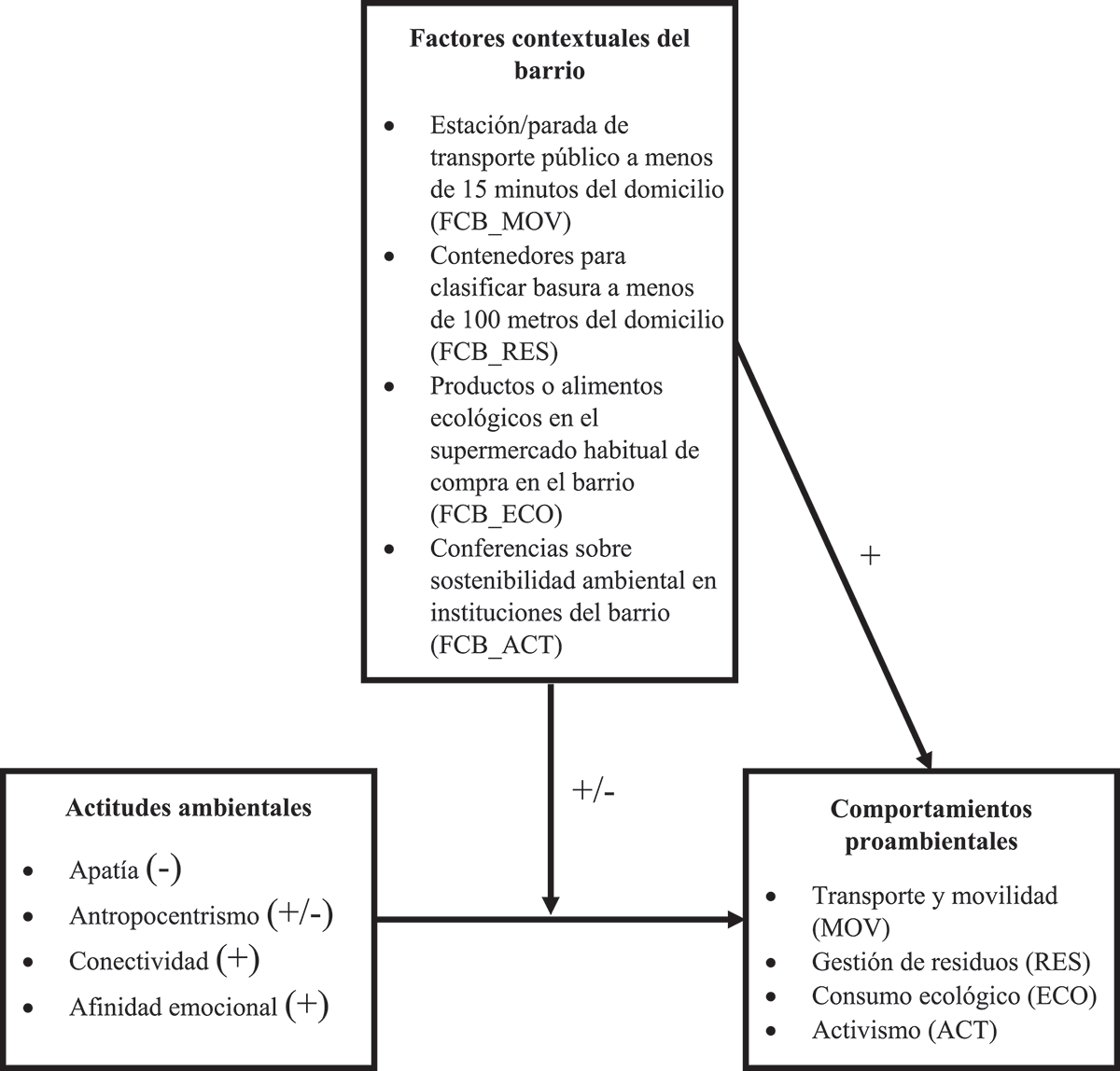
Método
Procedimiento y participantes
La muestra del estudio estaba formada por 218 personas residentes en China que completaron un cuestionario autoadministrado a través de Internet utilizando el panel online de Wenjuan (2020). Esta empresa ofrece un servicio profesional de recopilación de datos online, cuenta con más de 10 años de experiencia en el sector de la investigación cuantitativa y posee un panel online de más de ocho millones de usuarios de China. El trabajo de campo se realizó entre los meses de abril y mayo de 2020. Al analizar la distribución por género, la proporción de mujeres se situaba en el 52.8%. La edad de las personas encuestadas (M = 36.99, DT = 13.76) incluía distintos tramos, aunque predominaban los grupos de 25 a 30 años (22.9%), de 18 a 24 años y de 41 a 50 años (estos dos últimos con un 18.8%). En cuanto a la formación, la mayoría (59.6%) contaba con estudios universitarios, aunque un 20.2% tenía estudios de bachi-llerato o formación profesional. En el caso de la ocupación, el 49.5% trabajaban por cuenta ajena como empleado en una empresa u organización, el 26.2% eran jubilados, estudiantes o se dedicaban a las tareas doméstica de su hogar, el 7.3% trabajaban por cuenta propia, el 5.5% estaban desempleados y el 11.5% tenían otra situación laboral diferente. Por lo que respecta a los ingresos mensuales del hogar, el 22.9% afirmó tener unos ingresos entre ¥10,001–16,000, el 20.6% entre ¥6,001–10.000 y el 19.3% entre ¥4,001–6.000. El número medio de miembros en el hogar era de 3.19 (DT = 1.11). En cuanto a la localidad de residencia, las personas encuestadas vivían en 61 localidades diferentes de China. Esto permitió asegurar que se trataba de una muestra de población general relativamente heterogénea.
Instrumentos
Se diseñó un cuestionario con nueve cuestiones divididas en dos secciones. La primera para medir el comportamiento proambiental y las actitudes ambientales; y la segunda sobre las características sociodemográficas. El comportamiento proambiental se midió con 10 ítems tomados del estudio de Amérigo y García (2014) agrupados en cuatro categorías de conducta: transporte y movilidad (MOV, dos ítems), gestión de residuos (RES, tres ítems), consumo ecológico (ECO, cuatro ítems) y activismo medioambiental (ACT, un ítem); con tres opciones de respuesta desde ‘nunca’ hasta ‘habitualmente’. Además, se incluyó la EMA, propuesta por Amérigo et al. (2012), que está formada por 20 ítems para medir las actitudes ambientales a través de sus cuatro dimensiones (cinco ítems por dimensión): apatía (APA), antropocentrismo (ANT), conectividad (CON) y afinidad emocional (EMO); siguiendo una escala Likert de cinco puntos. Todos estos ítems estaban redactados originalmente en español y, por tanto, fueron traducidos al chino. Para garantizar la adecuación de esta traducción, se recurrió a un proceso de traducción inversa (back-translation) al español asegurando la precisión de los conceptos e ideas respecto a las escalas originales. En la segunda parte se incluyeron distintas variables sobre características sociodemográficas utilizadas para la descripción de la muestra, tales como género, edad, nivel de estudios, ingresos mensuales del hogar, situación laboral, tamaño del hogar o localidad de residencia.
Para medir los factores contextuales del barrio (FCB) se utilizaron cuatro indicadores dicotómicos (0 = no; 1 = sí) según las cuatro categorías de comportamientos proambientales consideradas. Estos datos fueron recopilados a partir de la información proporcionada por los usuarios al panel online de Webjuan y medían: (1) la disponibilidad o no de una estación o parada de transporte público a menos de 15 minutos del domicilio (FCB_MOV); (2) la existencia o no de contenedores para clasificar basura a menos de 100 metros del domicilio (FCB_RES); (3) la comercialización o no de productos o alimentos ecológicos en el supermercado habitual de compra en el barrio (FCB_ECO); y (4) el conocimiento sobre la impartición o no de conferencias sobre sostenibilidad ambiental en instituciones del barrio (FCB_ACT).
El instrumento en chino con las medidas conductuales, actitudinales y de contexto utilizadas en la investigación se recoge en el Apéndice 1.
Análisis de los datos
Los datos fueron analizados con los programas IBM® SPSS® Statistics 24.0 y R 4.1.0. En concreto, se utilizaron los siguientes paquetes de R: GPArotation (Bernaards & Jennrich, 2005), psych (Revelle, 2021) y Rcmdr (Fox & Bouchet-Valat, 2020). Además, se empleó la macro PROCESS 3.5.3 para SPPS (Hayes, 2018) con el fin de analizar los efectos moderadores del contexto. Se decidió utilizar el enfoque de regresión con PROCESS para el análisis del efecto moderador en lugar de recurrir a la modelización con ecuaciones estructurales, ya que: (1) el tamaño muestral no era lo suficientemente amplio para estimar modelos multigrupo con ecuaciones estructurales para las dos categorías de cada factor contextual; y (2) al tratarse de una muestra relativamente pequeña, los errores estándar asociados a las estimaciones de los parámetros estarían sesgados a la baja si se hubiera recurrido a la modelización con ecuaciones estructurales (Hayes et al., 2017).
Resultados
Coeficientes de fiabilidad, estadísticos descriptivos y correlaciones no paramétricas para los índices de comportamiento proambiental y las dimensiones de las actitudes ambientales (N = 218)
Nota: n.a.: no aplicable, ***p < .001, **p < .01, *p < .05
El análisis descriptivo y las correlaciones entre los índices de comportamiento proambiental y las dimensiones de las actitudes ambientales se muestran también en la Tabla 1. Como se observa, la categoría de conducta proambiental realizada con mayor frecuencia por la muestra era la relacionada con la gestión de residuos, siendo la menos frecuente la relativa al activismo medioambiental. Las correlaciones entre las cuatro categorías de conducta proambiental tendían a ser moderadas o débiles, oscilando entre el .41, registrado entre las categorías relativas a movilidad y trasporte y el consumo ecológico; y el .12 (p > .05), entre gestión de residuos y activismo. Por su parte, respecto a las actitudes ambientales: (1) se obtuvieron correlaciones negativas y significativas entre la apatía y las dimensiones de conectividad y afinidad emocional (−.44 y −.35, respectivamente); (2) el antropocentrismo correlacionó de manera positiva y significativa con las otras tres dimensiones actitudinales; y (3) las dimensiones de conectividad y afinidad emocional correlacionaron entre sí de manera positiva y significativa (.75).
Coeficientes estandarizados de las regresiones iterativas (método forward) para los comportamientos proambientales en función de las dimensiones de las actitudes ambientales
Nota: ***p < .001, **p < .01, *p < .05
Diferencias en los comportamientos proambientales según los factores contextuales del barrio
Nota: aNo se asumen varianzas iguales.
Modelos explicativos de los comportamientos proambientales: análisis del efecto moderador de los factores contextuales del barrio (coeficientes no estandarizados)
Nota: 1Las variables fueron previamente centradas respecto a su media antes de introducirlas en el análisis de moderación; 2basado en 5,000 muestras bootstrap de tamaño 218.
Discusión
Partiendo de la teoría ABC de Guagnano et al. (1995), la investigación presentada ha permitido analizar el impacto que los factores contextuales y actitudinales tienen sobre cuatro categorías de comportamiento proambiental en una muestra de 218 personas de población general china. Los resultados obtenidos permiten concluir que: (1) los cuatro tipos de comportamientos proambientales se explican por dimensiones actitudinales diferentes; (2) los factores contextuales del barrio de residencia facilitan la realización de los cuatro tipos de conductas; y (3) dos de estos factores contextuales, relacionados con la generación de residuos y el consumo ecológico, debilitan la relación entre las dimensiones actitudinales y estos comportamientos proambientales.
Comenzando por los resultados obtenidos en relación con la asociación entre actitudes ambientales y las cuatro categorías de comportamiento proambiental, los hallazgos del trabajo proporcionan soporte empírico sobre la pertinencia de abordar el estudio de las actitudes ambientales siguiendo planteamientos multidimensionales, sobre todo teniendo en cuenta las diferencias transculturales en la configuración de las dimensiones actitudinales (Amérigo et al., 2020). Otros trabajos previos realizados en China habían abordado su estudio siguiendo una perspectiva unidimensional (Yu, 2014) o bidimensional (antropocéntrica/ecocéntrica; Hong & Park, 2018). Sin embargo, los resultados de la presente investigación apuntan a que las mediciones unidimensionales o bidimensionales de las actitudes ambientales resultan insuficientes, siendo más apropiados planteamientos multidimensionales que aporten matices sobre qué dimensión/es concreta/s (apatía, antropocentrismo, conectividad o afinidad emocional) impacta/n en la realización de cada tipo de comportamiento proambiental. Adicionalmente, el enfoque multidimensional de las actitudes ayuda a comprender mejor las complejas relaciones entre personas y medio ambiente (Amérigo et al., 2020). Así, por ejemplo, se ha comprobado que, en la muestra de población china, la dimensión de antropocentrismo correlaciona de manera positiva con las de conectividad y afinidad emocional. Estos resultados proporcionarían evidencia empírica para el nuevo paradigma de interdependencia humana (Corral-Verdugo et al., 2008) que propone la existencia de una preocupación ambiental en la que la orientación ecocéntrica (cercana a las dimensiones de conectividad y afinidad emocional) para conservar la naturaleza por su valor intrínseco resulta fundamental, pero sin que ello suponga cuestionar la relevancia de preservar la misma también por el bienestar y la calidad de vida humana (antropocentrismo). Hallazgos de este tipo se han reportado previamente con muestras de otros países como Brasil (Amérigo et al., 2017) o India (Amérigo et al., 2020), siendo necesario que futuros trabajos con muestras más amplias profundicen en el estudio de la estructura factorial de la EMA en China.
En cuanto a la relación entre los factores contextuales del barrio y los comportamientos proambientales, se concluye que los cuatro factores considerados, que proporcionan comodidad o conveniencia a los individuos a la hora de realizar cada categoría de conducta, incentivan la realización de las conductas proambientales. Además, se ha comprobado que, en el caso de la gestión de residuos y el consumo ecológico, la existencia de factores contextuales que faciliten este tipo de conductas debilita la asociación entre las dimensiones actitudinales y conductuales, lo que proporciona soporte empírico parcial para la teoría ABC en el caso de China. Cabe destacar que el poder explicativo de los comportamientos proambientales para los modelos que incluyen los efectos directos y moderadores del contexto era sustancialmente mayor que para los que únicamente incluían las dimensiones actitudinales. Hong y Park (2018) encontraron resultados en esta misma línea en China, aunque estos autores midieron los factores contextuales a nivel local (considerando indicadores a nivel provincial relacionados con las condiciones ambientales, la política ambiental y la sociedad civil) y abordaron el estudio del comportamiento proambiental siguiendo una medición unidimensional. Sin embargo, los resultados de la presente investigación inciden en la pertinencia de la estructura multidimensional del comportamiento proambiental (García, 2021; Olivos et al., 2014; Schultz, 2014), fundamentada en la existencia de distintos factores explicativos y barreras para su realización según el tipo de comportamiento proambiental considerado y en unas correlaciones bajas o moderadas entre distintos comportamientos en la muestra de población china.
Tal y como propone Schultz (2014), las estrategias para promover los comportamientos proambientales (e.g., basadas en las normas sociales, los incentivos, la conveniencia o la educación) pueden resultar más o menos eficaces dependiendo del contexto, del individuo y del tipo de comportamiento proambiental específico que se desee promover. Así, en aquellos casos en los que el contexto resulta muy determinante y los beneficios que obtiene el individuo al realizar esa conducta son bajos, resultaría interesante recurrir a herramientas o intervenciones basadas, por ejemplo, en los incentivos o los concursos; mientras que si existen importantes barreras del contexto y los beneficios que obtiene el individuo son altos pueden resultar más efectivas las intervenciones que busquen, por ejemplo, proporcionar conveniencia y compromiso a los individuos. Aplicando este marco de intervención a la muestra de población china considerada es posible identificar qué tipo de intervenciones resultarían más apropiadas para fomentar cada tipo de comportamiento proambiental.
A pesar del interés del estudio, es importante señalar la existencia de una serie de limitaciones. En primer lugar, teniendo en cuenta el tamaño muestral, únicamente ha sido posible evaluar la fiabilidad de las escalas y el análisis del efecto moderador se ha efectuado siguiendo un enfoque basado en variables manifiestas (utilizando la macro PROCESS). En este sentido, trabajar con una muestra más amplia y representativa de la población china habría permitido recurrir a la modelización con ecuaciones estructu-rales tanto para analizar la estructura factorial de la EMA como para evaluar el efecto moderador. En segundo lugar, los factores del contexto se han limitado a cuatro indicadores relacionados con el barrio de residencia que proporcionan comodidad o conveniencia a los individuos. Sin embargo, siguiendo a Stern (2000) hay muchos otros tipos de factores contextuales que no se han considerado en este estudio. En consecuencia, una línea prometedora para futuros trabajos consistiría en abordar el análisis de los factores contextuales incluyendo aspectos relacionados con distintos niveles (barrio de residencia, ciudad, región, etc.) recurriendo, por ejemplo, al uso de modelos multinivel.
Footnotes
No potential conflict of interest was reported by the authors. / Los autores no han referido ningún potencial conflicto de interés en relación con este artículo.

Behavioural,attitudinal and context measures contained in the instrument
Pro-environmental behaviour
1. Transport and mobility
MOB1 在城里徒步或者使用自行车出行,但更多的是为了环境保护, 而不是出于经济或实用的理由
MOB2 使用公共交通出行, 但更多的是为了减少环境污染, 而不是出于经济或实用的理由 2. Waste management
WAS1 使用公共废纸篓丢弃纸屑
WAS2. 如果有的话, 使用公共废物箱丢弃废物 (玻璃, 纸板盒, 废纸, 废电池)
WAS3. 在家里将电池与其他废物分开丢弃 3. Ecological consumption
ECO1. 购买生态产品及生产过程不污染环境的产品
ECO2. 寻找包装简单的产品, 但更多的是为了环境保护而不是出于实用的原因
ECO3. 自己携带购物袋或者购物车去购物以避免产生对环境有害的废物
ECO4. 避免购买不需要的东西。即使有钱通常也只购买必需的东西 4. Environmental activism
ACT1. 参与保护环境行动 (清洁海滩和公园, 植树)
Environmental attitudes
5. Apathy
APA1. 球污染问题对我没有太大影响因为我对这个问题无所谓
APA 2. 环境问题对我来说不重要
APA3. 我个人的舒适安逸不受自然世界的安宁影响
APA4. 我不准备为生态问题投入更多, 因为这是政府的工作
APA5. 污染不会直接影响我的生活 6. Anthropocentrism
ANT1. 保持湖泊及河流清洁的一个最重要的原因是为了人类能够从事水上运动
ANT2. 保护环境最重要的理由是人类的生存
ANT3. 对于森林的消失, 我最担心的是子孙后代没有木材可以使用
ANT4. 保护及储备自然资源的最重要理由是为了人类能够保持高质量的生活水平
ANT5. 破坏热带雨林最坏的结果是停止了新型药用作物的生长 7. Connectivity
CON1 我像在乎我所处的社会环境一样在乎自然环境
CON2. 我之于广阔的然世界, 就像树木之于森林
CON3. 我时常觉得自己是生命网中的一部分
CON4. 我认为自己是大自然的一部分, 而不是与其分离
CON5. 我经常觉得我与动植物是有联系的 8. Emotional affinity
EMO1 我需要在大自然的怀抱下消磨时光来感受幸福安逸
EMO2. 有时当我感到悲伤的时候我能在大自然中找到慰藉
EMO3. 如果不能时常外出享受大自然, 我就会觉得生活中失去了一个重要的部分
EMO4. 我能够仅仅因为亲近了大自然而享受在自然环境中所度过的时间
EMO5. 身处于大自然中能有效地为我减轻压力
Contextual factors of the neighbourhood
CFN_MOB. 从我家出发走15分钟, 就有公交车站, 地铁站或者其他的公共交通
CFN_WAS. 在我的房子周围100米以内的地方, 有可以分类或者回收垃圾的容器
CFN_ECO. 我在所在小区, 我经常购买的超市内有可持续产品或者绿色食品
CFN_ACT. 我所在的小区或者学校有举办关于环境保护重要性以及消费者如何为环境作出贡献的会议
Medidas conductuales,actitudinales y de contexto recogidas en el instrumento
Comportamiento proambiental
1. Transporte y movilidad
MOV1. 在城里徒步或者使用自行车出行, 但更多的是为了环境保护, 而不是出于经济或实用的理由
MOV2. 使用公共交通出行, 但更多的是为了减少环境污染, 而不是出于经济或实用的理由 2. Gestión de residuos
RES1. 使用公共废纸篓丢弃纸屑
RES2. 如果有的话, 使用公共废物箱丢弃废物 (玻璃, 纸板盒, 废纸, 废电池)
RES3. 在家里将电池与其他废物分开丢弃 3. Consumo ecológico
ECO1. 购买生态产品及生产过程不污染环境的产品
ECO2. 寻找包装简单的产品, 但更多的是为了环境保护而不是出于实用的原因
ECO3. 自己携带购物袋或者购物车去购物以避免产生对环境有害的废物
ECO4. 避免购买不需要的东西。即使有钱通常也只购买必需的东西 4. Activismo medioambiental
ACT1. 参与保护环境行动 (清洁海滩和公园, 植树)
Actitudes ambientales
5. Apatía
APA1. 全球污染问题对我没有太大影响因为我对这个问题无所谓
APA 2. 环境问题对我来说不重要
APA3. 我个人的舒适安逸不受自然世界的安宁影响
APA4. 我不准备为生态问题投入更多, 因为这是政府的工作
APA5. 污染不会直接影响我的生活 6. Antropocentrismo
ANT1. 保持湖泊及河流清洁的一个最重要的原因是为了人类能够从事水上运动
ANT2. 保护环境最重要的理由是人类的生存
ANT3. 对于森林的消失, 我最担心的是子孙后代没有木材可以使用
ANT4. 保护及储备自然资源的最重要理由是为了人类能够保持高质量的生活水平
ANT5. 破坏热带雨林最坏的结果是停止了新型药用作物的生长 7. Conectividad
CON1. 我像在乎我所处的社会环境一样在乎自然环境
CON2. 我之于广阔的然世界, 就像树木之于森林
CON3. 我时常觉得自己是生命网中的一部分
CON4. 我认为自己是大自然的一部分, 而不是与其分离
CON5. 我经常觉得我与动植物是有联系的 8. Afinidad emocional
EMO1. 我需要在大自然的怀抱下消磨时光来感受幸福安逸
EMO2. 有时当我感到悲伤的时候我能在大自然中找到慰藉
EMO3. 如果不能时常外出享受大自然, 我就会觉得生活中失去了一个重要的部分
EMO4. 我能够仅仅因为亲近了大自然而享受在自然环境中所度过的时间
EMO5. 身处于大自然中能有效地为我减轻压力
Factores contextuales del barrio
FCB_MOV. 从我家出发走15分钟, 就有公交车站, 地铁站或者其他的公共交通
FCB_RES. 在我的房子周围100米以内的地方, 有可以分类或者回收垃圾的容器
FCB_ECO. 我在所在小区, 我经常购买的超市内有可持续产品或者绿色食品
FCB_ACT. 我所在的小区或者学校有举办关于环境保护重要性以及消费者如何为环境作出贡献的会议