







Abstract
By October 2018, there are 35 copper smelters under operation in China, with an annual output of 9860 kt refined copper. In copper matte converting, P-S converters are still used in 20 copper smelters in China, and the annual capacity of refined copper in these smelters is 5530 kt, accounting for 54.06% of the total. In the last two decades in China, many improvements in the P-S converting have been made, including the automatic monitoring and intelligent controlling. Besides the P-S converting, other converting technologies developed later, such as, the Kennecott-Outotec flash converting, the bottom blowing converting, the Ausmelt converting, the continuous converting using a Vaniukov furnace (for slagging) plus a furnace with multiple non-submerged lances (for copper making) and the continuous converting using a furnace with multiple non-submerged lances, have also been used successively in China.
Keywords
Introduction
Great progress has been made in China's copper metallurgical industry during the past two decades. Figure 1 shows China's output and growth rate of refined copper annually from 2001 to 2017 (National Bureau of Statistics). During this period, China's average annual growth rate of the refined copper output is close to 11.0%. As listed in Table 1, by October 2018, there are 35 copper smelters, which utilise copper concentrate as main raw material, under operation in China, with a total annual capacity of refined copper of 9860 kt.
China's output and growth rate of refined copper annually from 2001 to 2017. China's copper smelters under operation by the end of 2018. a The smelter will be reconstructed using the bottom blowing smelting-bottom blowing converting process, the capacity of refined copper in the new smelter reaches 300 kt annually. b Relocated and rebuilt project, and the capacity listed here is that after rebuilding. c New project, which is expected to be put into operation in 2018.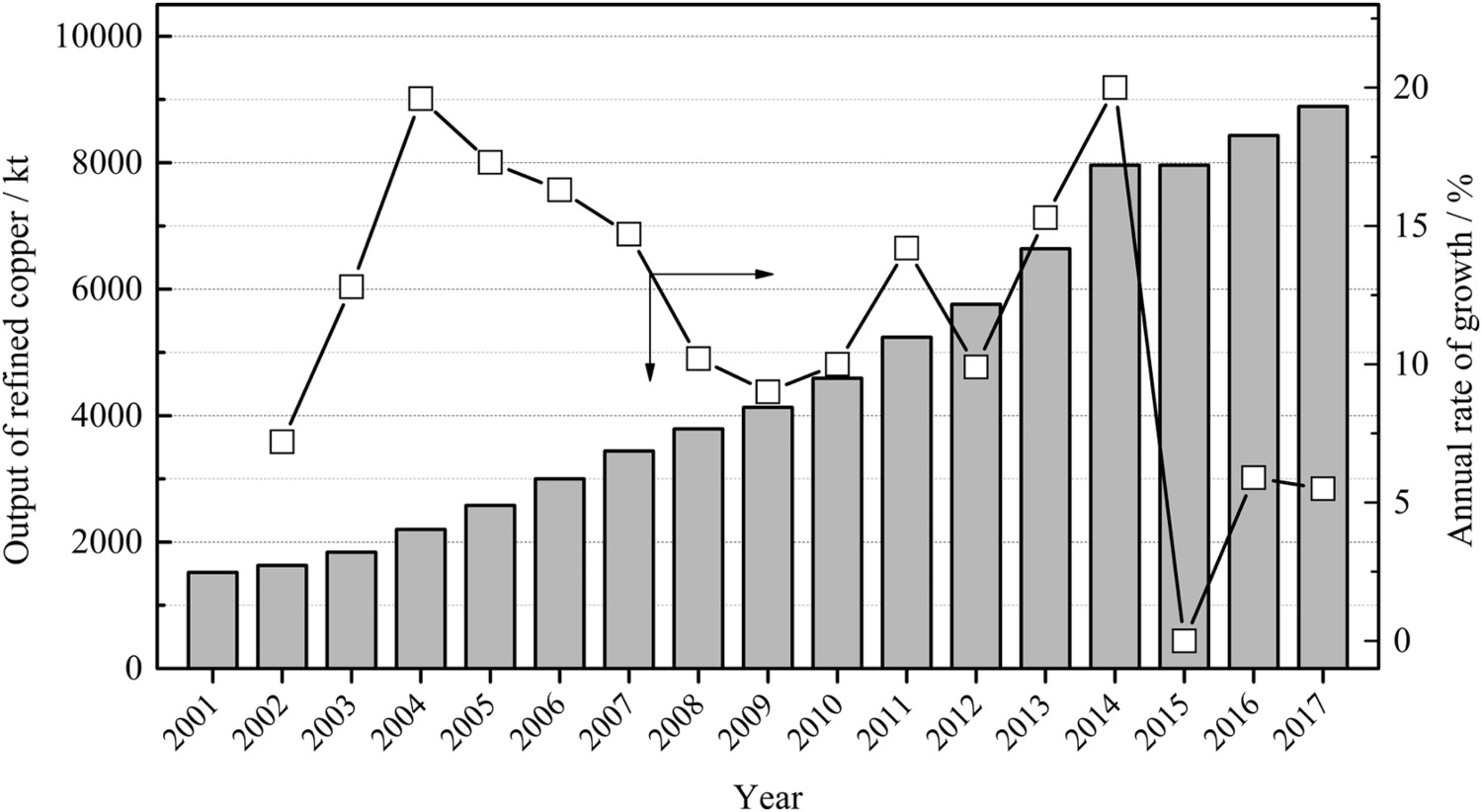
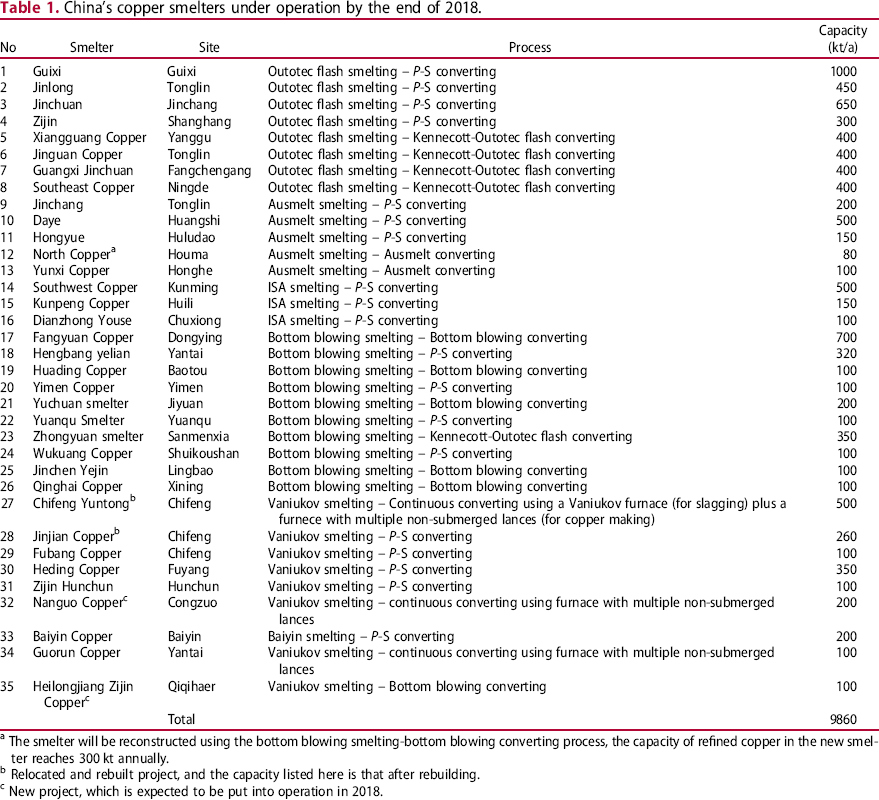
From Table 1, it can be seen that in the last decades, while China's copper metallurgical industry has been expanding rapidly, its technology has also been improving dramatically. At present, four technologies are mainly used in the smelting stage, including the Outotec flash smelting, the top submerged lance smelting (Ausmelt and ISA), the bottom blowing smelting and the Vaniukov smelting. In the converting stage, up to now, the Peirce-Smith (P-S) converters are still used in 20 copper smelters in China. Besides the P-S converting, another five copper matte converting processes, including the Kennecott-Outotec flash converting, the bottom blowing converting, the Ausmelt converting, the continuous converting using a Vaniukov furnace (for slagging) plus a furnace with multiple non-submerged lances (for copper making), and the continuous converting using a furnace with multiple non-submerged lances, have been put into commercial use successively in China. All of these five belong to continuous converting technologies.
P-S converting
As shown in Table 1, in China, there are still 20 copper smelters which use the P-S converters for copper matte converting. The annual capacity of refined copper in these smelters is 5530 kt, accounting for 54.06% of the total.
Dimensions and production details of two typical P-S converter operations in China.a
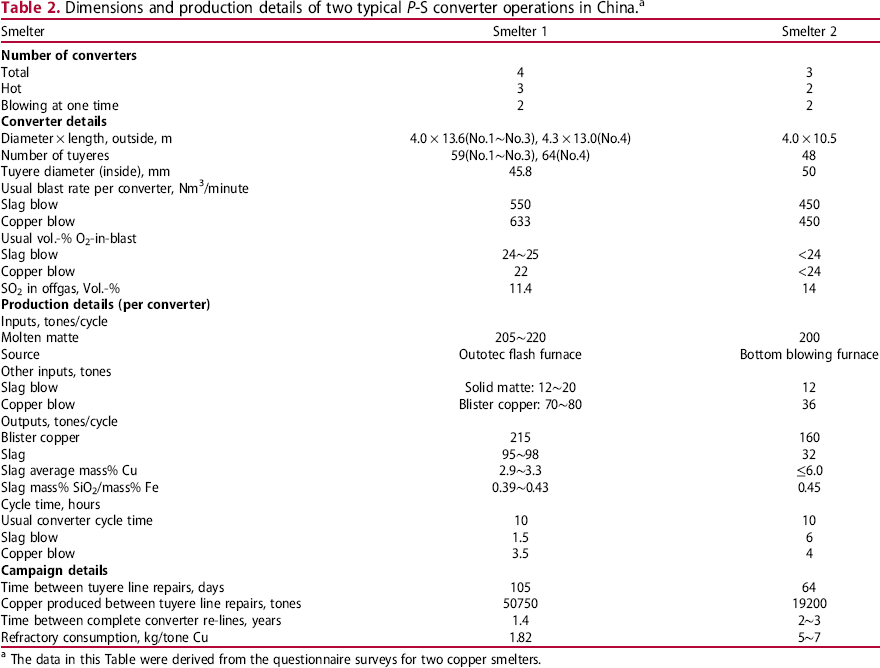
a The data in this Table were derived from the questionnaire surveys for two copper smelters.
On the basis of achieving the on-line measurement for the melt temperature, as well as the automatic judgement for the end points of the slagging and the copper making periods, the smelter developed a mathematic model to realise the automatic monitoring and intelligent controlling for its P-S converters. Since then, the accuracy of judging the end points increased to 99.9%; the copper content in the converting slag was reduced by 1.5 wt%; the mass ratio of the cold charges raised from 32 wt% to 43 wt%; the splashing accident did not happen again. In order to prolong the life span of the converters and reduce the consumption of the refractory, some measures have also been taken in this smelter. The temperatures on the converter body surface were monitored via infrared thermometers. According to the variation trend of the temperatures, combined with the measurement value for the thickness of the lining around the tuyere area, as well as the practice experience, the lining consumption and the converter body conditions can be evaluated well and truly, as a result, the right decisions can be made for the adjustment of the operation parameters, the hot spray fill time and the maintenance cycle for the converter lining. The P-S converting technology in this smelter represents a relatively advanced level in China.
Smelter 2, a newly built one, uses the bottom blowing smelting and P-S converting process, with an annual capacity of refined copper of 100 kt. As shown in Table 2, Smelter 2 is somewhat worse than Smelter 1 in some technical indicators, such as, the copper content in the converting slag, the refractory consumption and so on.
In the last ten years or so, the bottom blowing smelting has been used widely in China. As shown in Table 1, at present, there are 10 copper smelters in China using this smelting technology. One great advantage of the bottom blowing smelting is that the copper content in the smelting slag can be kept as low as about 3 wt%, even if the matte grade attains as high as 70%∼75%. In addition, the beneficiation of the smelting slag, by which, the copper content in the disposal slag can be reduced to about 0.3 wt%, a level much lower than that obtained by other slag cleaning technologies, has been adopted almost wholly in China's copper smelters in order to improve the recovery of copper. Therefore, the production of a high grade matte by the bottom blowing smelting will not deteriorate the total recovery of copper in the smelting process. As a result, a new development of the P-S converting has been made in a copper smelter of China (Zhang et al. 2016). This is that copper matte with a grade of 73%∼75%, which is produced by the bottom blowing smelting and contains only about 3 wt% of iron, is converted by P-S converters into blister copper in one single period. The converting uses silica as flux, and makes an iron silicate slag with an iron to silica mass ratio at about 2.2. The converting slag contains copper of less than 20 wt%, which is returned to the bottom blowing smelting furnace.
Although the P-S converting has many inherent shortcomings, such as batchwise operation, multiple converters covering a large area, difficulty in control of the fugitive emission of SO2, instability in the volume and the SO2 concentration of the flue gas, many experts in China's copper metallurgical industry still agree that compared with those converting technologies developed and applied later, the P-S converting still has some vitality due to its mature technology, simplicity of the operation, capability of handling a lot of cold charges and reverts, and so on. Nevertheless, in China, the speed at which the P-S converting is replaced by the continuous converting technologies developed later has been much faster than we expected.
Kennecott-Outotec flash converting
As shown in Table 1, at present, in China, there are five copper smelters which use the Kennecott-Outotec flash converting technology under operation, with an annual capacity of refined copper of 1950 kt as a whole, accounting for about 20% of the total.
Dimension and production details of three flash converting operations in China.a
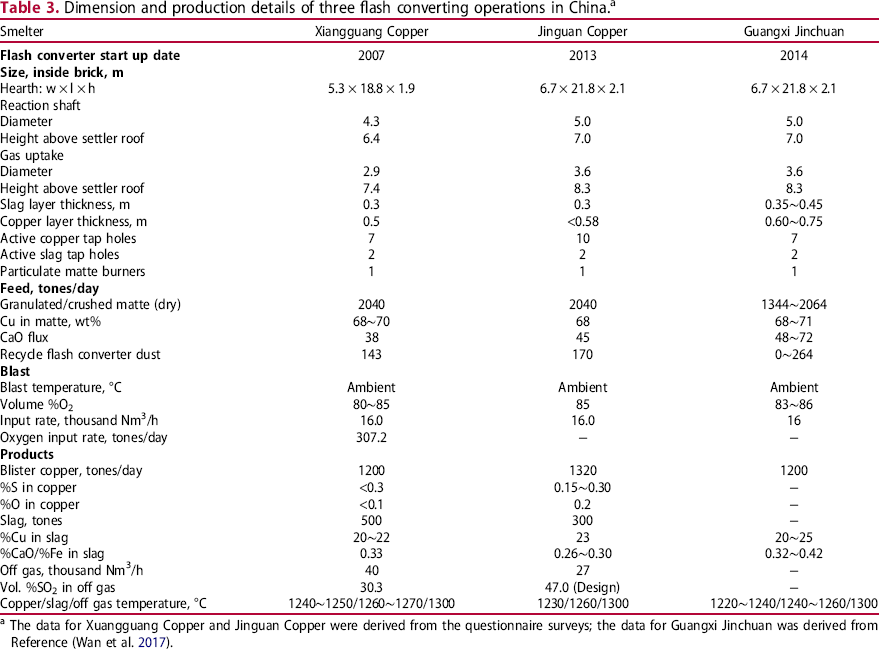
a The data for Xuangguang Copper and Jinguan Copper were derived from the questionnaire surveys; the data for Guangxi Jinchuan was derived from Reference (Wan et al. 2017).
For the Kennecott-Outotec flash converting, the following four main advantages can be concluded. First, the process is highly enhanced and efficient, therefore, adapting for mass production; second, the connection between the smelting and the converting is flexible and does not interfere with each other, thus, resulting in a high operation rate of over 95%; third, the investment in the flue gas treatment and the acid-making is low due to a high SO2 concentration in the flue gas; fourth, the sulphur fixation rate is high enough to satisfy the most stringent environment standards. The main drawbacks of this process are in following two aspects: first, the process itself cannot handle cold feeds; second, the calcium ferrite slag used in this process is too corrosive to the refractory bricks, resulting in an unstable life span of the furnace. How to prolong the life span of the furnace has been the main direction for improvement of the Kennecott-Outotec flash converting technology. Now, the situation has been improved much in China's Smelters which use this technology, and generally the life span of the furnaces in these smelters attains 5–6 years (Zhou 2017).
The bottom blowing converting
Since 2000, dozens of bottom blowing furnaces have been used widely for copper smelting and lead making in China. On the basis of this, China ENFI Engineering and Technology Co., Ltd (ENFI), combined with Fangyuan Copper and Yuguang Gold&Lead, developed a copper matte continuous converting process using the bottom blowing furnace. The process was industrialised firstly in 2014 in Yuchuan smelter, a subsidiary of Yuguang Gold&Lead, and at present, has been put into commercial uses in Yuchuan smelter (Zhao and Wu 2015), Fangyuan Copper (Cui et al. 2018), Huading copper (Yuan and Wang 2017), Qinghai Copper and Jinchen Yejin, successively. In addition, Houma North Copper, a smelter using currently the Ausmelt smelting and Ausmelt converting process with an annual blister copper capacity of 50 kt, has begun the reconstruction and extension in 2018. After the reconstruction, the Ausmelt smelting and Ausmelt converting process used currently will be replaced by the bottom blowing smelting and bottom blowing converting process, with an annual capacity of refined copper expansion from current 80 to 300 kt. Since 2014, using the bottom blowing converting instead of the P-S converting has becoming an obvious trend in new or reconstructed projects of the medium-size copper smelters in China.
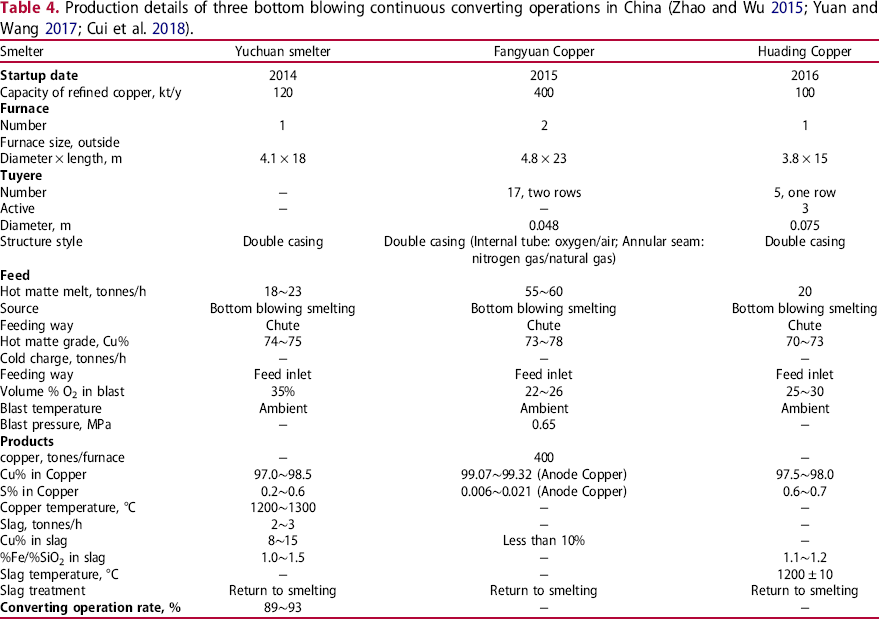
The bottom blowing technology has been a ‘black horse’ in copper smelting (Coursol et al. 2015). With the application of this technology in copper matte converting, its many advantages are further revealed. The bottom blowing converting process is far away from the thermodynamic equilibrium due to the unique configuration of the blowing lances, therefore, the magnetite content in the fayalite slag is very low, resulting in the copper content in the slag far below the other continuous converting processes. In addition, the grade of copper matte treated by the bottom blowing converting is as high as 75%, and as a result, the amount of the converting slag is small. The low copper content in the slag and the less slag make the direct recovery of copper in the bottom blowing converting approximately equal to that of the P-S converting.
Compared with the P-S converting, the bottom blowing converting not only inherites its merits, such as, simplicity in the furnace structure, capability of treating cold feeds in large amounts, but also overcomes its inherent shortcomings. The bottom blowing converter is almost identical to the P-S converter in the furnace structure as a whole. According to the metallurgical calculations, the cold furnace charges in the bottom blowing converting can account for 50 wt% of the total, on the premise of increasing oxygen concentration in the blowing. In the bottom blowing converting, the flue gas is continuous in the flow, and high in the SO2 concentration enough for the sulfuric acid making economically; all of the molten charge or discharges are transported through chutes instead of steel ladles, therefore, reducing to a great extent the fugitive emission of the low-concentration SO2 flue gas. The bottom blowing converting technology has been developing. Currently, the optimation for the specification, number and configuration of the blowing lances is the key in the technological improvement for the bottom blowing converting (Kapusta 2017).
It is worth mentioning that in Fangyuan Copper, there are three bottom blowing furnaces, one for smelting (referred to as S furnace) and another two for matte converting and pyro-refining (referred to as CR furnace). The molten matte is discharged at a certain intervals through a chute from S furnace into one of the two CR furnaces. The processes of converting and pyro refining are conducted in one CR furnace step wisely. When one CR furnace is under blowing, another CR furnace is under Charging or discharging. This mode is a new development for copper matte converting and blister copper pyro refining in copper metallurgy (Cui et al. 2018).
The Ausmelt converting
In 1998, a copper smelter (North Copper), which used the Ausmelt smelting and Ausmelt converting process with a blister copper capacity of 35 kt, was constructed and put into commissioning in Houma, Shanxi province, China. In fact, the Ausmelt converting technology was not very mature at that time, and till 2004, the smelter had reached its designed capacity. After nearly 20 years of continuous improvements, the technology has been proved to be capable of dealing with copper matte of a high grade for continuous converting. In 2018, North Copper has initiated the relocated reconstruction, and in the new smelter, the bottom blowing technologies, instead of the Ausmelt technologies, will be used for both of the smelting and the converting (Li 2017).
In 2012, another copper smelter (Yunxi Coppper), which used the Ausmelt smelting and Ausmelt converting process with a blister copper capacity of 100 kt, was constructed and put into commissioning in Yunnan province, China. The smelting furnace produces copper matte of a grade of about 60%. After water quenching and drying naturally, the solid matte is charged into another Ausmelt furnace for converting. The converting, which lasts for 8 h, is operated in a slagging, copper making and slag reduction circle. The slagging period lasts for 5 h, and during this period, about 270 tons of the water quenched matte is added into the furnace, and here converted into white matte under the conditions of temperature of 1300°C, iron to silica mass ratio of the slag of 1.7 ± 0.2. The slag formed in this period is discharged from the furnace for three times. After the slagging, the white matte is converted further to blister copper with a sulphur content of about 0.5 wt% at 1270°C. The copper making and discharging takes 2 h and 1hour respectively. After discharging the copper and part of the slag, the furnace, in the hearth of which there remains about 0.4 meters of molten slag, is switched into the next furnace period. The converting slag contains copper of about 14 wt%. This is attributed to two effective measures: first, a certain amount of FeS is remained in the matte by controlling the end point of the slagging; second, after the period of copper making, the slag is reduced a while before discharging (Gu et al. 2016).
The continuous converting using a Vaniukov furnace (for slagging) plus a furnace with multiple non-submerged lances (for copper making)
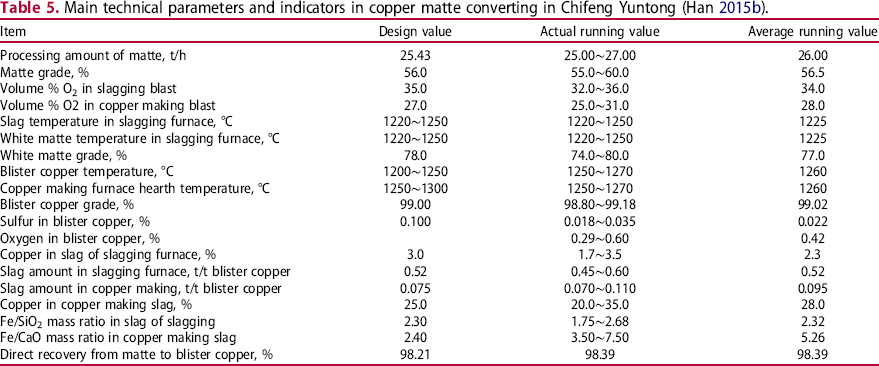
At the end of 2014, a new continuous converting technology was put into industrial application successfully in Chifeng Yuntong, Inner Mongolia, China (Han 2015a). The copper matte converting is divided into two periods, and fulfilled respectively in two furnaces, a Vaniukov furnace for slagging and another furnace with multiple non-submerged lances for copper making.
Main technical parameters and indicators in copper matte converting in Chifeng Yuntong (Han 2015b).
The continuous converting using a furnace with multiple non-submerged lances
This technology has been used industrially in Guorun Copper (Liu 2017). This smelter designed by Enfi uses a Vaniukov furnace for the smelting of copper matte with a grade as high as about 75%. Then the copper matte flows continuously into a furnace with multiple non-submerged lances for copper making. Chifeng Yuntong will also use this converting technology in its relocated reconstruction project. Another copper smelter under construction, Nanguo Copper in Congzuo county, Guangxi, China, will also use this technology for the copper matte converting.
The furnace with multiple non-submerged lances is a fixed type horizontal furnace. The furnace can be designed and built in the form of rectangle, circle or ellipsoid, and adopts a full water jackets structure. In the converting, oxygen enriched air is blown into the molten bath through multiple non-submerged lances, which was configured vertically on the top of the furnace. The converting uses calcium ferrite slag with an Fe/CaO mass ratio of about 2.5. The copper content in the converting slag is 10∼15 wt% and the temperature of the converting slag is kept between 1250 and 1300°C. The flux of CaO, together with other cold feeds, are added via a feed opening on the top of the furnace into the molten bath. The thickness of the slag layer is 0.10 m. The blister copper is discharged continuously through a siphon opening set at the end of the furnace, and the converting slag is overflowed continuously via a slag outlet set at the side of the furnace.
Epilogue
By the end of 2018, there are 35 copper smelters under operation with a total annual capacity of refined copper of 9860 kt in China. In these smelters, there are six kinds of copper matte converting technologies being applied, such as, the P-S converting, the Kennecott-Outotec flash converting, the bottom blowing converting, the Ausmelt converting, the continuous converting using a Vaniukov furnace (for slagging) plus a furnace with multiple non-submerged lances (for copper making), and the continuous converting using a furnace with multiple non-submerged lances. Besides the P-S converting, the other technologies for copper matte converting are all used industrially in recent two decades in China. At present, the P-S converting is still used in 20 copper smelters in China, the annual output of refined copper in these smelters is 5530 kt, accounting for 54.06% of the total. The P-S converting is still competitive in economy, its fatal weakness lies in difficulty of controlling the fugitive emission of SO2 flue gas. Therefore, in China, the speed at which the P-S converting is replaced by the continuous converting technologies developed later has been much faster than we expected The Kennecott-Outotec flash converting is widely recognised in China. Many improvements have been done in China's copper smelters using this converting technology. Its greatest advantage is that it adapts to a large scale production with an annual output of blister copper over 400 kt efficiently and economically. It is believed that in the near future, the annual output of blister copper may reach over 600 kt in a Kennecott-Outotec flash converting furnace. In China, many technologies for copper matte continuous converting have been developing. Among them, the bottom blowing converting and the continuous converting using a furnace with multiple non-submerged lances show good prospects. Copper matte with a grade of about 75% is produced in the smelting, and then converted into blister copper continuously in another furnace. This has become an unanimously approved copper smelting model. The competition of various technologies for copper matte converting focuses mainly on following aspects, the environmental protection, the economical efficiency, the impurity removal ability and the quality of blister copper.
Footnotes
Acknowledgment
Authors would like to acknowledge Dr. Jun Zhou& Mr. Keke Zang from Tonglin Nonferrous Metal Group Co., Ltd., Mr Yinwu Chen from Xiangguang Copper Co., Ltd., Mr. Xiaodong Zeng from China Minmetals Corporation, Mr. Feng He from Nerin, and Miss Hongfei Li from Enfi in providing data and information for this paper.
Disclosure statement
No potential conflict of interest was reported by the authors.