







Abstract

Converters have a very important function in Metals Processing by enabling effective removal of some dissolved elements, as for example, carbon in the case of steel and sulphur in the case of copper. The impurities are oxidised to form gaseous oxides of carbon or sulphur taking the metal bath towards the final steps of refining. Aiming at increasing the productivity, the converter operation is trimmed to have high chemical reaction rates and efficient heat and mass transfers. Gas phase-liquid metal reactions are optimised. Thus, converters form an essential, integral part of metals production.
While some authors attribute the concept of converters to ancient asiatic scriptures, dating back to eleventh century C. E., the present form of converters was probably evolved with the famous patent of Henry Bessemer in the year 1856 (American inventor William Kelley has earlier been experimenting with blowing air to decarburise iron melts). The invention of the vertical reactor for decarburisation by air blowing has, in fact, revolutionised steelmaking and geared up the production rate.
In the case of non-ferrous metals processing, Manhès–David process (ca1880) was a predecessor to the Peirce-Smith converter which is largely used in the case of copper, probably inspired by the idea of Bessemer. The conversion in this case is to oxidise the sulphides in two stages; in the first stage, iron sulphide is oxidised to iron oxide which forms the iron silicate slag combining with added silica and in the second stage, copper sulphide to blister copper. Copper converter is a horizontal vessel with air blowing from the side, in contrast to the vertical steel converter of Bessemer (where air is blown from the bottom or lanced from the top or both in later modifications). Peirce-Smith converters account for about 80% of world copper production and 60% of nickel production. The converter technology has been extended to even platinum group metals. The design of the reactors is defined by a number of factors such as the optimisation of the chemical reactions, heat generation and transfer, refractory erosion issues and process control.
While these two ‘cousins’ in the reactor family might have the same source of inspiration, the technologies had deviated from each other over the past century. The developments of ferrous and non-ferrous converters took different directions addressing different issues in the production of the metals. With the division of metallurgy into ferrous and non-ferrous, barriers have come up sealing the lines of communications between the two areas. Steel converters have been the subjects of many research studies, both with respect to fundamental- as well as the industrial aspects. The reactor has been modelled at micro- as well as macro scales and optimised. This perhaps is due to the volume of steel produced in comparison to other metals and its extensive use in modern society. Figure 1 illustrates the world production of some of the common metallic materials. It can be seen that steel production dominates! This accounts for the development of the technology.
World production of various metallic materials-2010.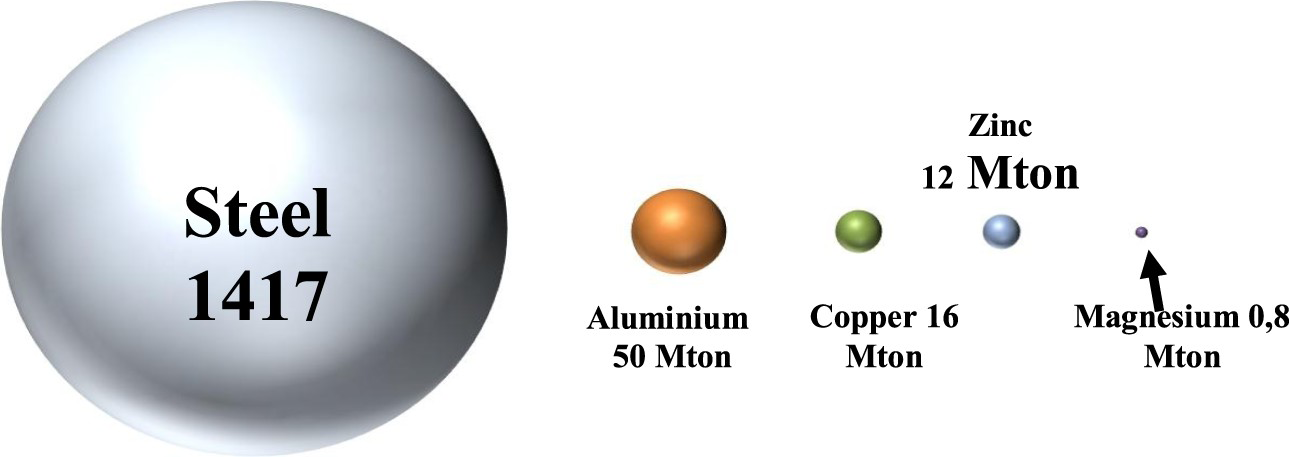
In the case of steel converters, basic linings have been advantageously used considering the impurities like S. Oxygen blowing has become common. The implications of bottom blowing, top blowing and combined blowing have all been well-investigated. The lance design has undergone tremendous improvements. The steel converter concept has evolved into Argon Oxygen Decarburization (AOD) for the decarburisation of high alloy steels like stainless steel. In the case of Peirce-Smith converters for copper, improved design in the form of Teniente converter has come up. Refractory design to withstand the erosion by sulphide melts and molten fayalite slags have been developed. The technology evolution has been progressing steadily.
Over the past decades there has been very little cross-pollination between the ferrous and non-ferrous converter practices. With environmental problems getting serious attention, emissions from the reactors need to be taken care of. This problem is common to both ferrous and non-ferrous areas. In the case of copper converters, adequate care is necessary to capture the SO2 gas emitted. The solution to dust treatment can be evolved jointly, as also slag disposal. Waste slags from steelmaking contain heavy metal like Cr and V. Economic recovery of these metal values from waste would not only save the environment, but also offer a potential source of strategic metals. There is a strong need to bring the scientists and technologists from both sides to a common platform to meet and discuss various issues.
The intention of this themed issue is to initiate a think-tank comprising of leading scientists from all over the world, from both ferrous as well as non-ferrous areas in order to make future developments in converter practice and address the common problems in metals processing.
I take this opportunity to thank the contributors, who have spent their valuable time to bring out this themed issue. My deep gratitude to the Institution of Mining and Metallurgy London and the editorial group of the journal for their support in publishing this themed issue. I express my special thanks to Ms Rose Worrell, for the wonderful cooperation, without which it would have been impossible to get this issue ready. I also thank Mr. Narasimhan of the peer-review board who patiently helped me at every stage of this effort.
Stockholm, November 2, 2018