







Abstract
Reprocessing of iron ore tailings (IOTs) and extracting recoverable valuable iron oxides will become increasingly financially attractive for mining companies and also may reduce environmental problems. Using databases built based on long term monitoring of units installed on plants to control the operational conditions to generate artificial intelligence models can decrease the cost of reprocessing operations Although some investigations have been focused on the reprocessing of IOTs, several challenges still remain which need to be addressed, especially for fine particles. SLon®, has developed a pulsating high gradient magnetic separator for the processing of fine iron oxides. However, there has been no systematic optimisation and variable assessments for SLon® operating variables to examine their effects on metallurgical responses (separation efficiency) on the industrial scale. This study addressed these drawbacks by linear (Pearson correlation) and non-linear (random forest) variable importance measurements (VIM) through an industrial SLon® installation.
Introduction
Due to mining of lower grade iron ores, the volume of the gangue minerals associated with iron oxides has markedly increased. To achieve the required liberation degree for processing these type of ores, the rate of fine particle production has significantly increased (Xiong et al. 1998; Hearn and Dobbins 2000; Svoboda 2001; Dobbins et al. 2007, 2009; Liu et al. 2013; Ren et al. 2015; Makhula et al. 2016; Tohry et al. 2017; Li et al. 2018). Processing these large volumes of low-grade iron ores has led to the production of huge amounts of waste materials. Iron ore tailings (IOTs) the most common solid waste in the world (Tang et al. 2019). These IOTs contain a massive amount of fine iron oxide particles; therefore, there is a considerable value in their reprocessing. For successfully reprocessing IOTs by conventional methods, several treatment steps need to be implemented. Although some studies have been undertaken to examine different methods for reprocessing of fine iron oxide particles from IOTs, several gaps in the understanding of process mechanisms still remain (Yi et al. 2009; Yakubailik et al. 2017; Panda et al. 2018).
Magnetic separation has been historically used for processing coarse iron ore particles. Over the last decade, magnetic separation has significantly improved in operability and performance. The relative magnetic field strength (MFS) for separation classifies magnetic equipment into three types: low-intensity magnetic separators (LIMS), medium intensity magnetic separators (MIMS), and wet high-intensity magnetic separators (WHIMS). Several factors need to be considered in selecting the appropriate magnetic equipment, such as particle size, degree of association of minerals in an ore (liberation degree), magnetic susceptibility of the targeted mineral and its gangue phases, as well as the capabilities of the magnetic equipment (Xiong et al. 1998; Hearn and Dobbins 2000; Svoboda 2001; Dobbins et al. 2007, 2009; Liu et al. 2013; Ren et al. 2015; Makhula et al. 2016; Li et al. 2018). LIMS is generally used for the scalping of simple ferromagnetic minerals such as magnetite. MIMS traditionally has been employed for separation of fine weak ferromagnetic minerals, and WHIMS mostly has been considered for separation of paramagnetic minerals such as hematite. Although WHIMS has several advantages, it is not suitable for the processing of fine and ultrafine particles. Moreover, another drawback through using WHIMS is that non-magnetic minerals may become entrapped among the magnetic minerals (Hearn and Dobbins 2000; Dahe 2002, 2003; Zeng and Dahe 2003; Chen et al. 2012).
Applications of SLon technology for mineral beneficiation.
Applications of SLon technology for mineral beneficiation.

*All assays are % by weight.
This investigation employed the Pearson correlation and random forest (RF) as a machine learning tool. In industrial-scale investigations, ranking operating variables based on variable importance measurement (VIM) can be considered as an essential key for efficient operation. The VIM methods that can determine the most effective variables on processing responses have been receiving significant attention. RF can eliminate the imprecision and uncertainty of complex linear and non-linear relationships for VIM. Although RF for VIM has been used in several mining area investigations (Matin et al. 2016; Matin and Chelgani 2016; Chelgani et al. 2016a, 2016b; Shahbazi et al. 2017; Chelgani and Matin 2018; Matin et al. 2018; Nazari et al. 2019; Tohry et al. 2019; Jafari et al. 2019a, 2019b), it is not yet widely used in mineral processing. Therefore, this worked used RF for ranking variables of a SLon® unit (rougher and cleaner stage) based on their effec on the separation efficiency (SE) for reprocessing IOTs in an industrial plant.
Process
The circuit for tailing reprocessing from the Chadormalu plant, Yazd, Iran, was used in this study. The SLon® circuit for hematite reprocessing includes four rougher units in parallel and two cleaner units, also in parallel (Figure 1). The LGS 2000 SLon® model was installed in roughing and cleaning circuits. The machines were manufactured by the LONGI Company. Their nominal capacity is 150–180 t/h slurry. The feed of the SLon unit was provided by the final tail of the medium magnetic separation (3500 G) unit in. The d80 of the input feed for the SLon flowsheet was below 30 µm and the FeO content was below 3%.
Schematic of the SLon circuit of the Chadormalu tailing recovery plant.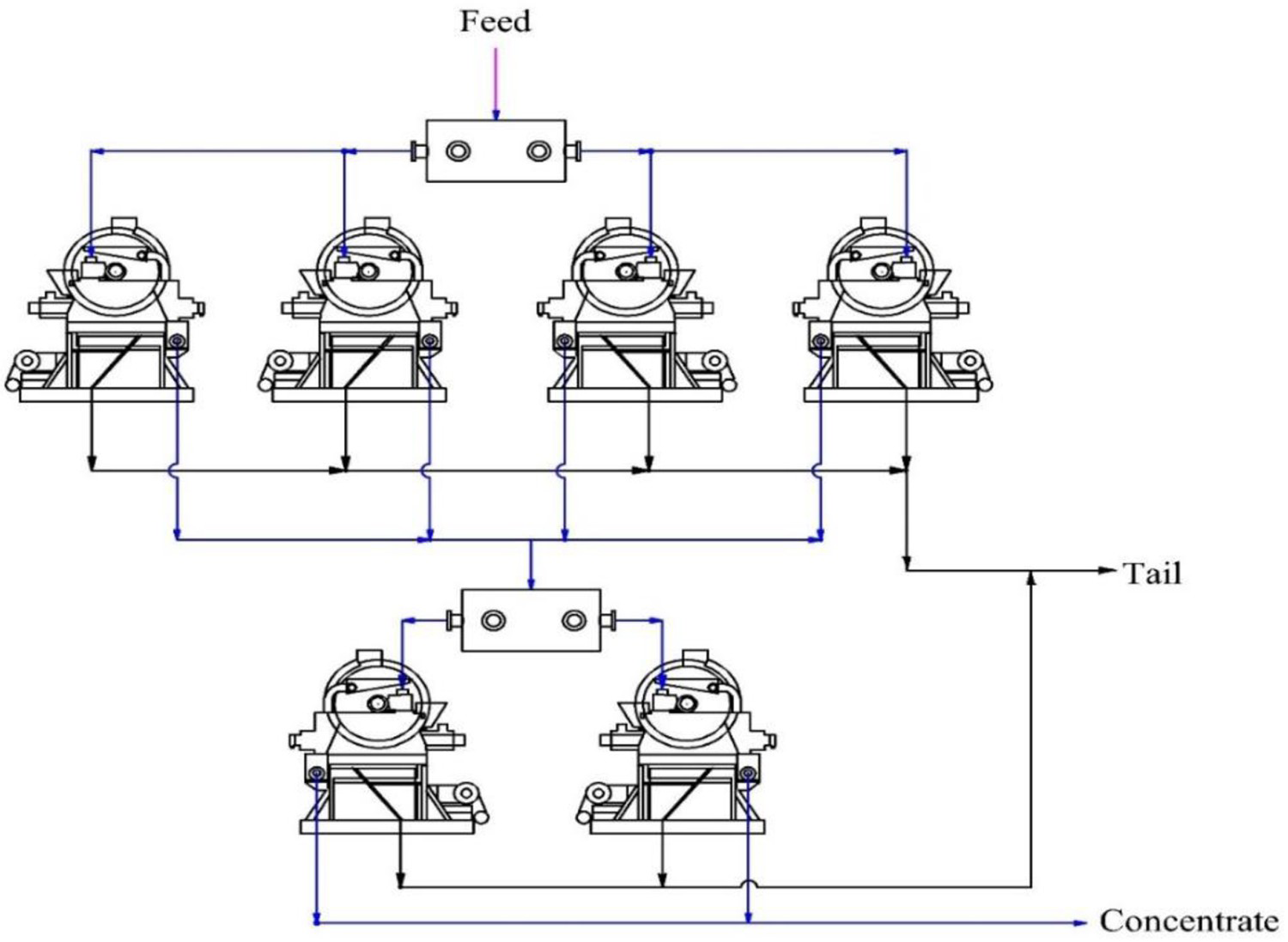
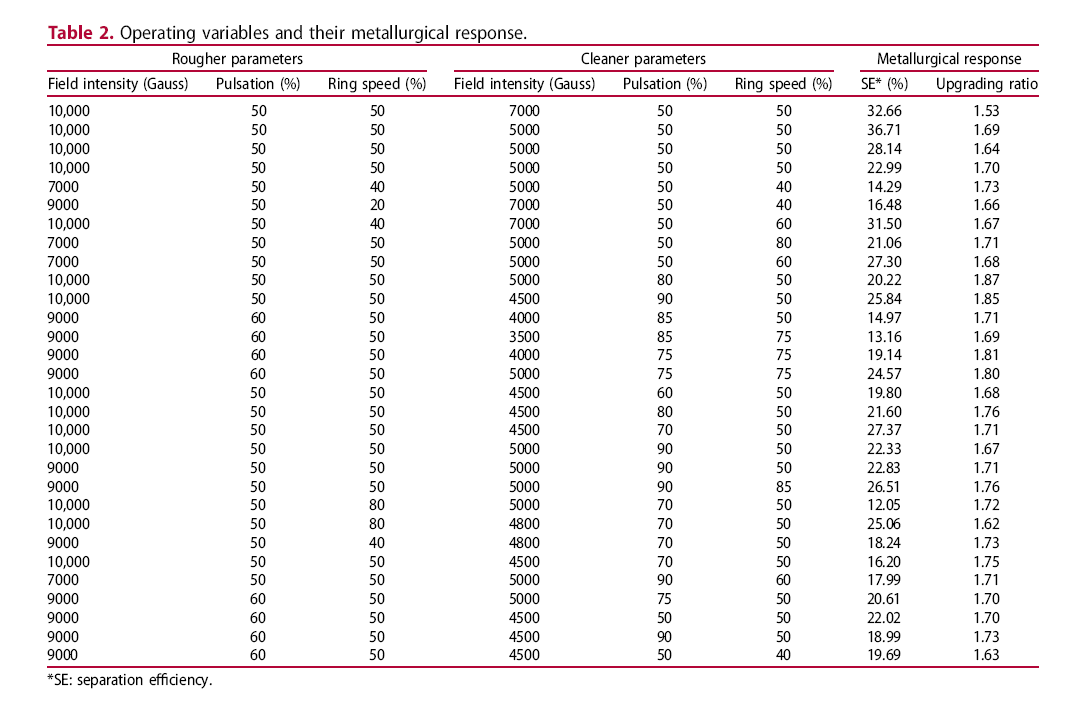
Operating variables and their metallurgical response.
*SE: separation efficiency.
Pearson correlation
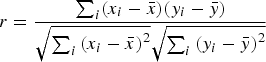
Pearson correlation r is a statistical index for assessing linear correlations between dependent and independent variables. r ranks the inter-correlations of variables between −1 and +1. The absolute value of r shows the strength of correlation between two variables (a larger absolute value indicating stronger interdependence), while its sign indicates their relationship magnitude. In general, |r| > 0.5 shows that there is a significant linear correlation between two variables, which is calculated based on the following equation (Chelgani et al. 2016b; Matin et al. 2018; Jafari et al. 2019b).
For ranking operating variables by RF, the permutation accuracy importance measurement (PAIM), which is an advanced non-linear tool for VIM, is used. The PAIM for VIM compares the differences between the prediction accuracy of a tree before and after random permutation of the target variable (Matin et al. 2016; Matin and Chelgani 2016; Chelgani et al. 2016a, 2016b; Shahbazi et al. 2017; Chelgani and Matin 2018; Matin et al. 2018; Nazari et al. 2019; Tohry et al. 2019; Jafari et al. 2019a, 2019b). The final ranking of variables is based on the computed average of differences over all trees. The empirical PAIM (mp) of the variable Xj is defined as follows

 represents a replicate of learning set ℒ (the training set (ℒ) of size N) by model
 in the values of Xj which have been randomly permuted, and
 , … ,
, … ,
 . denote the indices of the trees (M) that have been built from bootstrap replicates that do not include (xi, yi) (for i = 1, … , N) (Matin et al. 2016; Matin and Chelgani 2016; Chelgani et al. 2016a, 2016b; Shahbazi et al. 2017; Chelgani and Matin 2018; Matin et al. 2018; Nazari et al. 2019; Tohry et al. 2019; Jafari et al. 2019a, 2019b). High values of the PAIM show a strong non-linear relationship between the predictor and the output. Values around zero (or even negative values) indicate insignificant non-linear relationships between variables. The PAIM can evaluate the impact of each variable individually as well as in multivariate interactions with other variables on the interested target, and guarantee unbiased VIMs (Matin et al. 2016; Matin and Chelgani 2016; Chelgani et al. 2016a; Chelgani et al. 2016b; Shahbazi et al. 2017; Chelgani and Matin 2018; Matin et al. 2018; Nazari et al. 2019; Tohry et al. 2019; Jafari et al. 2019a, 2019b).
Results and Discussion
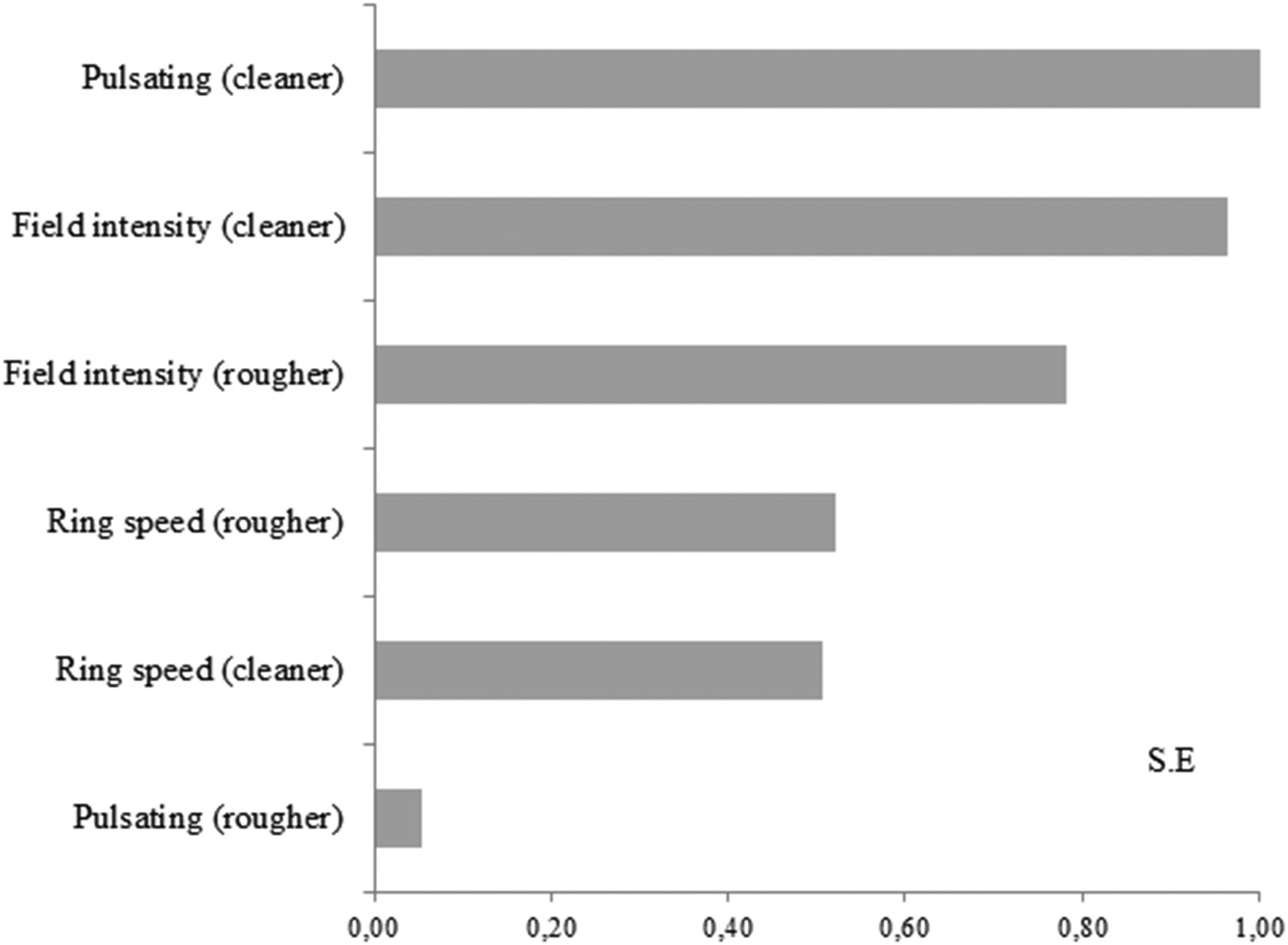
The results show (Table 2) that the designed flowsheet can recover and upgrade IOTs of the plant (Figure 2). For improving the metallurgical responses within the examined operating conditions, VIM assessments are conducted. Assessing linear relationships r between operating conditions and their representative SEs demonstrates that the field intensity in the cleaner stages has the highest correlation (r = 0.45) with SE (Table 3). Pearson correlation assessments show that by increasing the field intensity (both in rougher and cleaner stages), the SE is increased. In both rougher and cleaner stages, increasing the pulsation percentage has a negative effect on the SE (Table 3). Linear assessments show that the ring speed in both rougher and cleaner stage, within the considered conditions, has an insignificant effect on S.E (Table 3). Based on the linear correlations, the absolute impact (importance) of operating variables on SE for both rougher and cleaner stages has the following order: field intensity > pulsating > ring speed. However, non-linear VIM by RF (Figure 3) illustrates that the pulsation in the cleaner stage has the highest effectiveness on SE. This could be because pulsation in the cleaner stage has the highest impact on the final grade of products (Table 3). These results could be iused by the plant operators to maintain the process in its steady-state efficiently.
Metallurgical responses of the SLon unit. Non-linear ranking of operating variables by variable importance measurement (VIM) and the random forest method (RF). Pearson correlation between operating variables and metallurgical responses.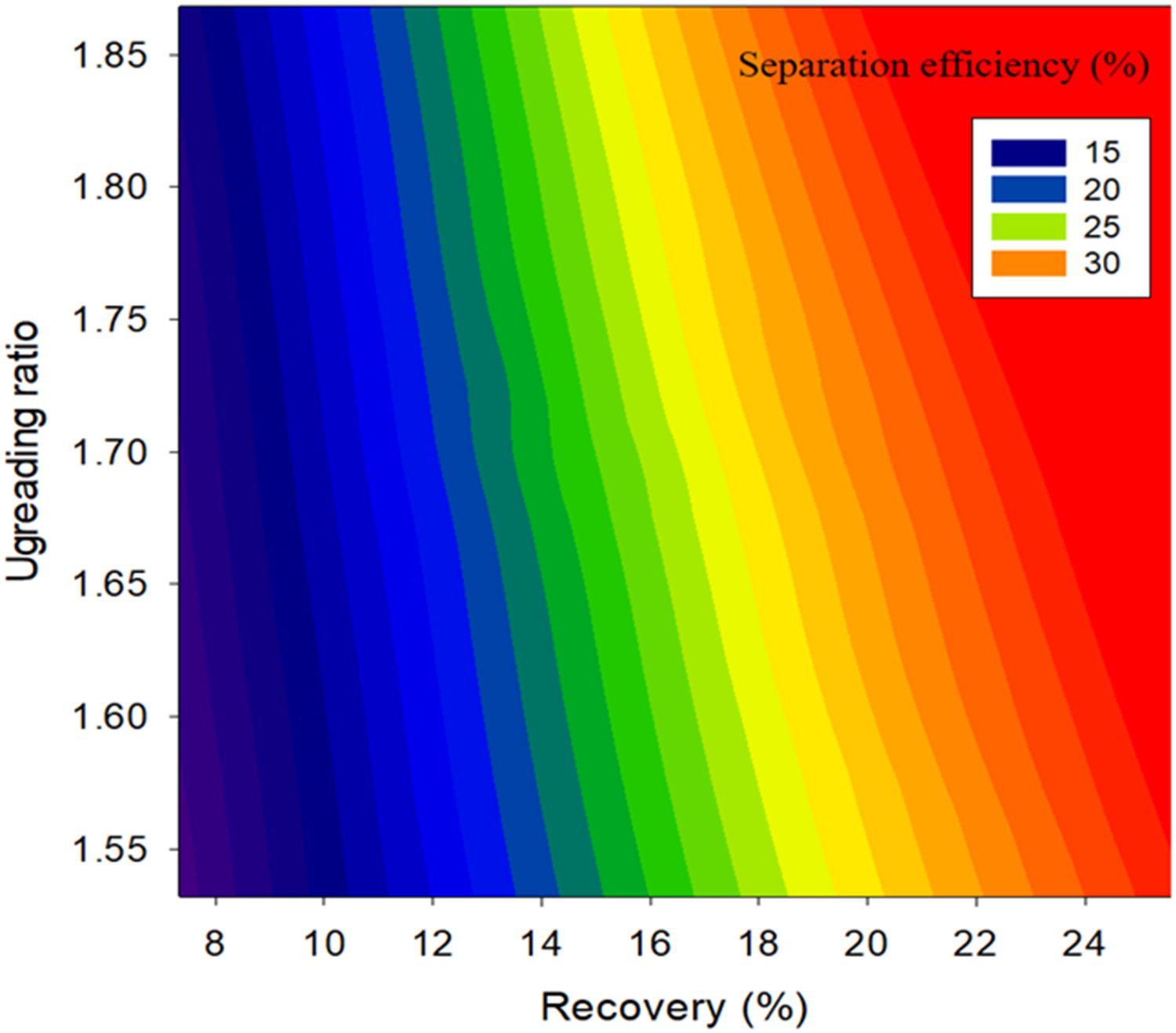

According to the metallurgical results, the highest SE for each operating variable potentially can be obtained when in the rougher stage; field intensity, pulsation and ring speed were 10, 000 Gauss, 50 and 50%, and in the cleaner step they were 5000 Gauss, 50 and 50%, respectively (Figure 4). Using these optimum points (rougher: field intensity 10, 000 Gauss, pulsation 50% and ring speed 50%, and cleaner: field intensity 5000 Gauss, pulsation 50%, and ring speed 50%) could achieve 36.7% SE and 1.7 upgrading ratio from IOTs.
Relationship between various SLon operating variables and their representative separation efficiency (SE).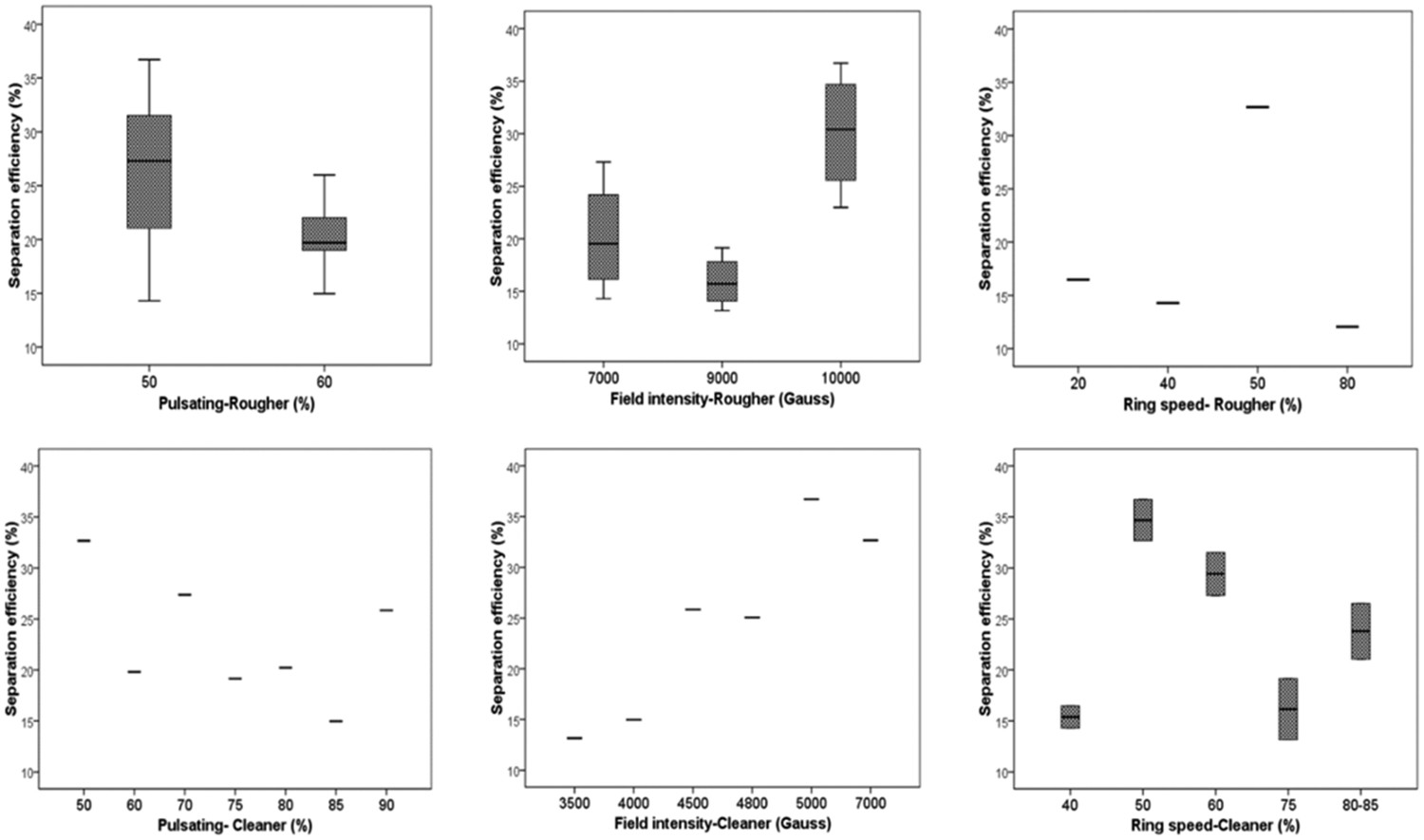
Angadi et al. (2012) explored the relationship between various parameters of magnetic separation and their representative recoveries and concluded that the significance of variables has the following order: particle particle size > magnetic field > wash water rate. They reported that increasing the magnetic field leads to a higher probability of capturing magnetic particles. Makhula et al. (2016) suggested the following order of variable importance: field intensity > pulsation frequency > pulp density. Increasing the magnetic field strength generates a high force on the magnetic particles, improves their loading on the matrix, and promotes their recovery. However, this improvement leads to the entrapment of finely sized non-magnetic particles which dilutes the product grade (Makhula et al. 2016). Thus, continuously increasing the field intensity cannot improve the SE, and interactions of different factors have to be considered for an optimum separation (Dobbins et al. 2007, 2009). It was indicated that, by increasing the magnetic field intensity, the recovery was also increased while this increase has a negative effect on the product quality (Makhula et al. 2016).
Pulsation action reverses the slurry direction and decreases the entrapping and clogging of the matrix by non-magnetic particles. Thus, the capacity of the matrix can be improved, and it can be covered with an increased quantity of magnetic minerals from a certain volume of a slurry through a shorter time (Xiong et al. 1998; Hearn and Dobbins 2000; Dobbins et al. 2009). Moreover, it was documented that increasing the pulsation velocity has a positive effect on the quality of SLon products (Makhula et al. 2016); however, it can reduce the recovery (a negative relationship between pulsation and recovery after a certain level) (Xiong et al. 1998). The ring speed directly affects the retention time of the magnetic matrix, which can have a critical impact on SLon performance. Increasing the ring speed would decrease the residence time; thus, a huge volume of the slurry may be unprocessed. Moreover, a significant decrease in the speed of the ring would affect the feed rate and overall processing (Dobbins et al. 2009; Chen et al. 2012). Therefore, ranking variables and providing a balance between these variables (optimisation) can improve SLon efficiency (Makhula et al. 2016). These reported conclusions from various studies confirmed the reliability of the provided results (Table 3 and Figure 3) of this investigation.
A study of relationships between operational variables (field intensity, ring speed, and pulsation) of an industrial SLon unit (rougher and cleaner stages) and their representative separation efficiencies for reprocessing of iron ore tailings was investigated. Pearson correlation and the random forest methods, being powerful statistical tools, were used for assessing the intercorrelations and for ranking the parameters. In general, statistical assessments indicated that field intensity had a positive correlation with the process recovery while it had a negative correlation with the upgrading ratio whereas pulsation had a positive relationship with the upgrading ratio but a negative correlation with the recovery. Variable importance measurement by random forest indicated that pulsation in the cleaner stage has the highest effect on the unit efficiency. The highest separation efficiency (36.7%) was achieved when in the rougher stage (field intensity, pulsation, and ring speed were 10000 Gauss, 50% and 50%, respectively) and in the cleaner stage (field intensity 5000 Gauss, pulsation 50% and ring speed 50%).
Footnotes
Acknowledgment
The first author would like to thank the Rahbar Farayand Arya Co (RFACo) for technically supporting this work.
Disclosure statement
No potential conflict of interest was reported by the authors.