






Abstract


The poor recovery of cobalt was ascribed to the mineralogical complexity making the routine processing strategy poorly effective. More attention must hence be placed during the processing stages of Co-ores, in order to avoid inappropriate leaching conditions, inappropriate pulp density and liberation issues caused by the occurrence of Co-bearing phases refractory to leaching treatments.
The small Cristal Zn deposit is located in the northernmost part of a wide mining district, the ‘Charlotte Bongará Zinc Project’, which covers an area of approximately 110 km2 in the Amazonas district (Northern Peru). The mineralised area consists of many Zn occurrences with mixed sulphide and nonsulphide ores. The nonsulphide ores are the product of weathering of primary sulphide bodies, genetically representing a MVT mineralisation. The Zn concentrations of Bongará-Cristal are hosted in the platform carbonates of the Condorsinga Formation (Early Jurassic) in the Pucará Group. The nonsulphide mineralisation consists mainly of semi-amorphous orange to brown zinc ‘oxides’ that include hemimorphite, smithsonite and Fe-(hydr)oxides. The most significant mineralised areas are present at Esperanza and Yolanda occurrences, which were also most densely explored. In these occurrences, the supergene Zn-carbonates and silicates infill solution cavities, or replace the carbonate host rocks and/or the primary sulphides. The analyzed drillcores are mainly from Esperanza, where the zinc content associated with hemimorphite-rich layers can reach ∼53 wt.% Zn (average Zn grade is around 20 wt.%). Germanium concentrations are significant at Cristal, with values around 200 ppm measured on bulk rock.
The Bongará area experienced a prolonged phase of weathering from Miocene to Recent under tropical climatic conditions. Under such a climate setting, weathering processes involved many pre-existing sulphide orebodies (e.g. Cristal, Florida Canyon, Mina Grande mines), where supergene profiles were developed under locally different conditions, mainly outlined on the basis of mineralogical and geochemical data. The mineralogy and geochemistry of the Bongará mineralised zones were mainly determined at a local scale by two factors: (1) uplift rates, and (2) host rock composition. The latter may favor the development of more (e.g. Mina Grande) or less (e.g. Cristal) alkaline supergene environments. Uplift was controlled by the activity of local faults, which allowed the exposure of sulphide protores at variable altitudes in different periods of time and hydrological settings. Such different factors and settings may result in the precipitation of isotopically different supergene carbonates (e.g. smithsonite and calcite). Contrary to the Mina Grande deposit nearby, the development of a karst network at Cristal was quenched by a limited uplift rate, and supergene alteration did not completely obliterate the roots of the original sulphide orebody.
The Lismore block is located in southern Ireland (Co. Waterford), approximately 200 km SW of Dublin. It holds five contiguous prospecting licences, encompassing the east-west trending Lismore-Dungarvan syncline, which mostly consists of Lower Carboniferous carbonate units, bounded by a thick sequence of clastic Devonian sediments. Extensive geochemical and geophysical exploration programmes allowed identifying strong Zn geochemical anomalies both on the northern and southern limbs of the syncline. However, subsequent drilling operations revealed that much of the surface anomalies did not always reflect sulphide ores at depth. In this work, we present the preliminary results of a new geochemical exploration campaign conducted in the Lismore area by Adventus Zinc Corporation, aiming to identify any relationships between Zn and other elements in the above mentioned anomalies, potentially revealing concealed deep sulphide bodies. The data have been cross-checked with textural and geochemical characteristics of drill cores carried out in the south-central part of the syncline by Navan Resources.
More than 150 specimens of shallow soils were sampled along the syncline. Log-transformed data revealed a bimodal distribution for the elements Zn-Ag-Cd-Pb-Ge-As-Al-Mn-Ni, thus confirming the presence of anomalous samples population. Pearson correlation coefficient (PCC) reflected strong correlations between Zn and Ag-Cd-Ni-Pb-Mn-Sb-Co-Cu, and low correlations with Al and Ge. The first two principal components of the Principal Component Analysis (PCA), PCA1 and PCA2 (which explain 70% of the total variance of the data), allowed to identify two distinct groups of variables: Zn-Pb-Ag-Cd-Co-Cu-Mn-Sb-Ni and Al-K-Ge-Ga-Ba, confirming the PCC. In the cores drilled across the surficial E-W southern anomaly, at around 40–50 meters above the base of the Tournasian Waulsortian Limestone Fm., we identified a sphalerite-pyrite mineralisation, disseminated into a clast- to matrix supported, poorly sorted breccia body, cemented by fine-grained dark grey dolomite. Sphalerite is almost totally oxidised in the first 10–12 meters from the surface, wheareas patchy oxidation occurs at greater depth. However, part of the southern anomaly was also related to the occurrence of a mixture of Zn-bearing clays and Fe-Mn-hydroxides, in solution-karst cavities. In conclusion, this study suggests that in the Lismore area the surface anomalies are controlled by both the effective presence of concealed sulphide bodies and the occurrence of supergene Zn-bearing minerals in karst cavities. The common association of Zn and other metals in the soils (evidenced with PCC and PCA) suggests that the chemical and/or mechanical Zn dispersion which produced the anomalies was probably limited to areas very close to hidden sulphide-bodies, because a more extensive dispersion would have produced a major fractionation of metals (Reichert and Borg 2008), and a consequent separation of the more mobile Zn from the less mobile elements Pb, Cd and Mn.
The vein-type Pb-Zn deposit at Leadhills-Wanlockhead, SW Scotland, has been one of the largest base metal resources in the UK. The 68 documented veins are hosted in Lower Palaeozoic strata and are dominantly concentrated along normal faults. The 16 km2 mining district has yielded over 400, 000 tons of Pb, 100, 000 tons of Zn, and 25 tons of Ag from the 16th century until 1958. However, since the seminal work of Temple (Temple 1956) published research has been scarce (Gillanders 1981; Anderson et al. 1989). By shedding new light on the ore paragenesis, and developing a new geochemical and geochronological framework, we aim to devise a genetic model for the mineralisation.
Vein cross-cutting relationships and mineral textures show that a major Fe-oxide phase pre-dates the main Pb-Zn mineralisation. This paragenesis suggests ore precipitation due to mixing of oxidised and reduced fluids at the basin/basement interface in combination with decreasing fluid to rock ratio due to boiling. New in-situ and bulk δ34S data (galena: −11.6 to −6.7‰ (n = 48); chalcopyrite: −8.4 to −4.6‰ (n = 14); sphalerite: −7 to −5‰ (n = 17); pyrite: −4.5 to -2.1‰ (n = 3)) overlap the range of δ34S values measured in diagenetic pyrite from regional Lower Palaeozoic shales and greywacke (Anderson et al. 1989). Congruent δ34S values implies that sulphide metals were sourced from underlying shales and greywacke. Sulphide δ34S are distinct from δ34S values of Caledonian granites (0 to 3.3‰ [Lowry et al. 2005]), ruling out magmatic fluids as a source of the ore S. Despite obvious variations in vein orientation, host lithology, and the density of veins across the ore district, δ34S values are remarkably homogeneous. This suggests that S source and ore fluid temperature remained unchanged during the mineralisation process and that sulphides precipitated at or near equilibrium. (U+Th)/Ne ages of two hematite samples from the Glengonnar mine imply a late Triassic age for the early oxide phase. This contrasts with the mid-Carboniferous K-Ar age of fault gouge illite (Ineson and Mitchell 1974) and, if substantiated, requires a radical re-interpretation of the origin of the deposit.
The dominant occurrence of ore veins on normal faults and (U+Th)/Ne ages implies emplacement during a period of extension in the late Triassic. Ore paragenesis suggests fluid mixing at the basin/basement interface in combination with decreasing fluid to rock ratio due to boiling as the means of ore precipitation. δ34S data and a fluid temperature of ∼150°C at 30°C/km geothermal gradient implies Pb-Zn is sourced from hydrothermal convection of sulphide bearing connate fluids at depths of ∼5 km within Lower Palaeozoic strata.
Karst bauxite deposits occurring in southern France (Provence and Languedoc), lie between Jurassic platform carbonates in the footwall and Cretaceous–Eocene marine to continental sediments in the hangingwall, and formed between Albian to Cenomanian (Combes 1990). Textural and geochemical features suggest that a combination of different processes contributed to the bauxite formation (Combes 1990): the deposits consisting of reworked bauxite fragments accumulated in karst depressions, have been considered of detrital origin or allochthonous (Nicolas 1968), whereas the deposits with distinct mineralogical and geochemical zonation have been interpreted as derived from in-situ (autochthonous) alteration of the original protore (Guendon and Parron 1985). Similarly to other karst bauxites worldwide (Boni et al. 2012), the nature of the protores for the French bauxites could not be immediately identified because the deposits do not directly lie above the weathered parent rock (Combes 1990). Here, we present new data on bulk rock geochemistry of Provence (Les Baux, Mazaugues, and Brignoles) and Languedoc bauxites (Bédarieux, San Chinian and Villeveyrac), and new U-Pb data of detrital zircons of the Provence deposits, aiming at: 1) identifying elements re-mobilised during the in-situ alteration of the deposits; 2) identifying the bauxite protores.
Relevant information was obtained from trace elements geochemistry, particularly from REEs, which have a total average amount of 700 ppm in most of the analysed occurrences, but are characterised by variable concentrations along the bauxite profiles (min. 200 ppm, max 1500 ppm). Maximum REE concentrations occur at different levels along the sampled profiles, and are commonly associated with positive Ce anomalies in PAAS- or chondrite- normalised patterns, and/or with the presence of supergene REE-minerals (e.g. cerianite and parisite).
U-Pb zircon dating was carried out on bauxite samples from the Les Baux and Mazaugues deposits and revealed important differences in the age spectra of the two localities. In particular:
in both deposits, zircons record the early Ordovician (480 Ma) extension along the north Gondwana margin; the zircons of Les Baux subsequently record an unknown event at 420 Ma, while the Mazaugues ones record the continuation of the extension until 440 Ma; in the samples from Les Baux we detected abundant 545 Ma-old zircons, probably originated from the Velay Orthogneiss Fm., that are instead less abundant at Mazaugues.
In conclusion, trace elements geochemistry allowed evidencing REE patterns typically associated with in-situ alteration, indicating that also bauxites, which preserve textural characteristics originally related to an allochthonous character were reworked in-situ after their deposition. U-Pb zircon ages confirm that the protores of Provence bauxites are Variscan basement rocks, with some differences: at Les Baux there was a major contribution of material derived from the East French Massif Central, whereas the Mazaugues area was mostly supplied by material originated from the proto-Alpine domain.
The Wingellina property (Metals X Ltd) is a classic ‘oxide-type’ Ni-Co laterite (168 Mt of ore at 0.98% Ni and 0.08% Co), which is derived from the weathering of the olivine-rich mafic to ultramafic layered-intrusion of the Giles Complex (Mesoproterozoic). The lateritic profile consists of a well-developed ‘limonitic’ unit and a less voluminous saprolite horizon.
The ‘limonitic’ ore consist of Fe- and Mn-(hydr)oxides, which are the carrier of both Ni and Co. The Fe-(hydr)oxides are common also in the lower saprolite horizon. At Wingellina, the Mn-(hydr)oxides display a high mineralogical variability. The lithiophorite-asbolane intermediate compound is the most widespread Mn-(hydr)oxide. This mineral is the main Co-host in the ‘limonite’ zone, and has also a significant Ni content (Co and Ni average values: 7.92 and 8.49 wt% respectively). Less abundant compared to lithiophorite-asbolane, but still ore-bearing Mn-(hydr)oxides consist of romanèchite (average Ni and Co values: 1.63 and 0.89 wt%), ernienickelite (7.75 and 1.66 wt%), manganite (1.12 and 0.48 wt%), and birnessite (1.57 and 0.49 wt%). The Ni enrichment in the Fe-(hydr)oxides can be triggered either by sorption on the (hydr)oxides surface, or by substitution of Fe3+, whereas the Co sequestration is mainly related to sorption process under pH values ranging between 8 and 10. In general, also the Mn-(hydr)oxides show a high degree of chemical affinity both for Ni and Co, which is due to the sorption of these metals onto the Mn-(hydr)oxides surface. In the case of the lithiophorite-asbolane intermediate, the main trigger for Co and Ni enrichment is the replacement of Al by Ni- and Co-rich asbolane-type layers in the gibbsite-like octahedral sites of lithiophorite.
The ‘saprolitic’ horizon occurs as a massive and poorly developed unit. The ore mineralogical association consists of hydrous Mg(Ni)-silicates and of subordinate Mg(Ni)-bearing clays. These species do not contain Co, and display a lower Ni enrichment (max 5 wt%) compared to that of the Mn-(hydr)oxides. The limited development of the saprolite unit can be due to the tectonic stability of the Australian shield during the lateritisation process, which likely prevented the efficient migration of fluids towards the lower zone of the weathering profile and caused a limited Ni-enrichment of the Mg-bearing phyllosilicates (e.g. Freyssinet et al. 2005; Golightly 2010; Butt and Cluzel 2013).
Karst bauxite deposits occurring in southern France (Provence and Languedoc), lie between Jurassic platform carbonates in the footwall and Cretaceous–Eocene marine to continental sediments in the hangingwall, and formed between Albian to Cenomanian (Combes 1990). Textural and geochemical features suggest that a combination of different processes contributed to the bauxite formation (Combes 1990): the deposits consisting of reworked bauxite fragments accumulated in karst depressions, have been considered of detrital origin or allochthonous (Nicolas 1968), whereas the deposits with distinct mineralogical and geochemical zonation have been interpreted as derived from in-situ (autochthonous) alteration of the original protore (Guendon and Parron 1985). Similarly to other karst bauxites worldwide (Boni et al. 2012), the nature of the protores for the French bauxites could not be immediately identified because the deposits do not directly lie above the weathered parent rock (Combes 1990). Here, we present new data on bulk rock geochemistry of Provence (Les Baux, Mazaugues, and Brignoles) and Languedoc bauxites (Bédarieux, San Chinian and Villeveyrac), and new U-Pb data of detrital zircons of the Provence deposits, aiming at: 1) identifying elements re-mobilised during the in-situ alteration of the deposits; 2) identifying the bauxite protores.
Relevant information was obtained from trace elements geochemistry, particularly from REEs, which have a total average amount of 700 ppm in most of the analysed occurrences, but are characterised by variable concentrations along the bauxite profiles (min. 200 ppm, max 1500 ppm). Maximum REE concentrations occur at different levels along the sampled profiles, and are commonly associated with positive Ce anomalies in PAAS- or chondrite- normalised patterns, and/or with the presence of supergene REE-minerals (e.g. cerianite and parisite).
U-Pb zircon dating was carried out on bauxite samples from the Les Baux and Mazaugues deposits and revealed important differences in the age spectra of the two localities. In particular:
in both deposits, zircons record the early Ordovician (480 Ma) extension along the north Gondwana margin; the zircons of Les Baux subsequently record an unknown event at 420 Ma, while the Mazaugues ones record the continuation of the extension until 440 Ma; in the samples from Les Baux we detected abundant 545 Ma-old zircons, probably originated from the Velay Orthogneiss Fm., that are instead less abundant at Mazaugues.
In conclusion, trace elements geochemistry allowed evidencing REE patterns typically associated with in-situ alteration, indicating that also bauxites, which preserve textural characteristics originally related to an allochthonous character were reworked in-situ after their deposition. U-Pb zircon ages confirm that the protores of Provence bauxites are Variscan basement rocks, with some differences: at Les Baux there was a major contribution of material derived from the East French Massif Central, whereas the Mazaugues area was mostly supplied by material originated from the proto-Alpine domain.
Gold ore deposits in carbonaceous volcanogenic-carbonate-terrigenous formations make up a considerable share of the world gold reserves. Large objects are known in the USA, Australia, Russia, China, Kazakhstan and other regions of the world (Mizerny et al. 2017; Dolgopolova et al. 2015).
Analysis of geologic conditions for forming the Bakyrchik gold deposit proves a complicated history of gold accumulation and concentration in ores of gold-arsenic-carbon-bearing type. Ore bodies of the deposit are represented by mineralised zones of banded, phacoidal and tabular shapes of considerable thickness (up to 10–20 m) and more than 1.0–1.2 km lateral extension. Basic ore-controlling elements are fault zones of north-west and sublatitudinal direction (overthrusting, strike-slip faults), lithological composition of reservoirs and magmatic formations (granitoid mass hidden at depth of 3.0–3.5 km and dikes identified within the ore zones).
Carbon-bearing, sericitic, kaolinite-hydromica, quartz-sericitic, sericite-phlogopite-carbonate, chlorite-albite and other metasomatic associations are developed in the deposit.
Metasomatic zoning of the Bakyrchik deposit is as follows: Carboniferous kaolinite-hydromicacous metasomatites are developed in the upper horizons, carboniferous-sericitolitic changes have ‘through’ expansion (they are most developed in central part of ore reserves), sericite-phlogopite-carbonate with apatite and tourmaline association occupies lower levels.
Ore minerals of the Bakyrchik deposit form five paragenetic assemblages: early melnikovite- pyrite-pyrrhotite-marcasite (with nickeline and pentlandite); ore stage gold-pyrite-arsenic pyrite (with cubanite and gersdorffite), gold-quartz- polymetallic (fahlore, chalcopyrite, galenite, and sphalerite), and gold-quartz-carbonate-scheelite-chalcopyrite (with breunnerite, dolomite, aikinite, free gold); late quartz-carbonate-antimonite-tetrahedrite (with marcasite, refractory gold). Gold-pyrite-arsenic pyrite assemblage occurs widely, whereas melnikovite-pyrite-pyrrhotite-marcasite, melnikovite-pyrite-pyrrhotite-marcasite and gold-quartz-carbonate-scheelite-chalcopyrite assemblages are developed at deeper levels, gold-quartz- polymetallic and quartz-carbonate-antimonite-tetrahedrite assemblages are confined to upper and medium horizons of the deposit. Impregnated and vein-impregnated gold-pyrite-arsenic pyrite assemblages are the most significant (90%) in total mass of sulphides and total gold balance (Halls et al. 2004).
Based on the obtained new data about magmatism and ore formation of Bakyrchik deposit and on materials of previous years, a geological-structural model of the Bakyrchik ore field is proposed, with defining perspective areas for prospecting of new gold-ore objects of this type concerning dipping of ore columns of the known deposits and occurrence of Kyzyl zone. Perspective zones are controlled by the Kalba intrusion belt and different fault zones extending to depth of 1 to 3.5 km.
A magmatic input into the VMS hydrothermal system has been hypothesised to explain the enrichment in certain elements such as Se, Te, Co, Cu, Au and Bi [1, 2,3]. Analysis of late euhedral pyrite from the South Apliki Breccia Zone of the Apliki VMS [4] reveals significant enrichment in Se of up to 5950 ppm with corresponding Se/S ratios of up to 9240. Se/S ratios >500 may indicate an increased magmatic component in the VMS hydrothermal system [5]. Sulphides from the South Apliki Breccia Zone indicate a paragenesis consistent with multiple overprinting fluid pulses, sulphide dissolution and a late magmatic component into the VMS hydrothermal system (vapour or liquid phase). This complex paragenesis is responsible for the enrichment of Se in late stage euhedral pyrite at Apliki [4].
The Troodos ophiolite, Cyprus hosts the type locality for mafic or Cyprus-type VMS. Regional soil geochemistry of southern Cyprus [7] has highlighted the heterogeneous distribution of trace elements in VMS deposits; some are enriched in Te and Se. Laser ablation ICP-MS (LA-ICP-MS) of sulphides from VMS of the Troodos ophiolite highlights distinct trace element profiles which are interpreted to represent ‘end member’ magmatic and hydrothermal VMS systems; the Apliki and Kokkinoyia VMS deposits.
When viewed on graben scale clear trends in Se/S ratios and trace metal enrichment in VMS sulphides have been distinguished. Three structural grabens dominate the Troodos ophiolite, from E-W they are; Larnaca, Mitsero and Solea [6]. Solea represents a ‘full’ spreading axis with underlying magma conduit whilst Mitsero is purely an extensional feature. Both grabens are associated with VMS formation. Based on trace element enrichment and Se/S ratios of VMS we have identified magmatic and hydrothermal end member deposits. Apliki and deposits of the Solea graben are enriched in Cu, Co, Bi, Te and Se and have high Se/S ratios whilst Kokkinoyia, and deposits of the Mitsero graben are depleted with Se/S ratios <640.
We hypothesise that the distribution of Se (and associated elements) is a function of increased magmatic influx; centres where spreading is accommodated through extension and graben formation are likely depleted in elements of magmatic affinity. At magmatic dominated spreading ridges end member VMS may exhibit significant enrichment in Se with the highest known Se concentrations of any mafic hosted VMS recorded at Apliki. Geochemically all VMS are expected to have compositions between the two end members; this reflects variable degrees of magmatic influx and is intrinsically linked to the structure of the spreading centre.
The Main Zone (MZ) of the Bushveld Complex of South Africa is composed of gabbronorite and generally lacks both olivine and platinum-group element (PGE) mineralisation. Olivine reappears in the MZ of the northern limb of the Bushveld Complex as a >200 m thick PGE-enriched zone of olivine-norite cumulates known as the Troctolite Unit (TU). The TU appears to be absent from the eastern and western Bushveld Complex but olivine-rich rocks with PGE also characterise the lower (F Zone) part of the Waterberg PGE deposit, located further north. Any relationship (or not) between the TU and the F Zone remains to be established. This study is the first to tackle the petrology, mineralogy, geochemistry and PGE distribution in the TU and surrounding MZ to determine the genesis of the TU and its role within the stratigraphy of the northern limb. Samples were taken from Bushveld Minerals’ VSF2 borehole, the Council for Geoscience BV1 stratigraphic borehole and outcrop samples.
Models suggesting that the TU represents a raft of Platreef or Critical Zone rocks, a new input of mafic magma into the MZ, or a post-Bushveld sill can all be dismissed on mineralogical and/or geochemical grounds. Detailed logging of the TU reveals: an absence of typical ‘cyclic units’ of harzburgite-troctolite-anorthosite; no evidence for mixing or reaction between TU and MZ; no thermal contacts with the surrounding MZ or within the TU; and limited evidence for either chromite or base metal sulphide (BMS)-rich PGE mineralisation. The TU shows unexpected textures and phases for a conventional ‘dry’ magmatic system including interstitial olivine (with melt and fluid inclusions), hydrous minerals, rounded and zoned plagioclase, mottles of olivine and pyroxene and noritic autoliths. The TU has constant An# and Mg# ratios throughout which do not change significantly between TU and MZ. Cr- and PGE enrichment are decoupled with the highest PGE grades found at and below changes between lithological subzones and high grade zones confined to less mafic lithologies (troctolite>anorthosite> harzburgite>pyroxenite). The TU is enriched in PPGE and depleted in IPGE and Au compared with the Platreef or Critical Zone. Fractionation of Pt and Pd also differs between PGE- enriched and depleted samples; enriched samples generally have Pt/Pd <1 whereas depleted samples have Pt/Pd >1. Platinum-group minerals (PGM) are fine grained with the majority of measured PGM < 1 µm in diameter (range between 50 µm - <100 nm). Distinctive PGM associations (either enclosed in silicate, enclosed in BMS or BMS-silicate alteration zone) characterise particular high grade zones with PGM types increasing in the order Sb>Bi>Te> alloy>As>Pb. There is strong textural evidence of fluid(s) reworking and redistributing PGM and leaching of PGE from BMS on a local scale. The majority of measured PGM are found in BMS-silicate alteration zones.
Based on the above observations, we propose that the TU formed during development of the MZ by fluid-driven flux melting reactions that transformed gabbronorite proto-cumulates into the olivine-rich lithologies. Current PGE enrichment and mineralisation might have been localised by the redissolution of BMS or primary PGM in the fluid that caused the flux melting. This is evident in the size (< 2 mm) and distribution (highly disseminated) of BMS. Visible BMS are only found in areas of high fluid activity; at and below the change between lithological subzones, pegmatitic lithologies and in the reaction zone with a granite dyke.
Eudialyte group minerals (EGM) are the focus of commercial interest because they host significant amounts of Zr, Nb and the high value middle- and heavy REE. They are structurally and chemically complex alkali-zirconosilicates that crystallise in unusually volatile-rich peralkaline magmas. On average EGM contain c. 12 wt. % ZrO2, 1–2 wt. % Nb2O5 and c. 1–10 wt. % total rare earth oxides with high proportions of the valuable middle- and heavy REE (c.35% of TREO). The EGM crystal structure can accommodate REE in various sites. Light and middle REE are generally inferred to occupy the 6-fold Ca-dominated M1-site and/or the low symmetry 8–9–10-fold coordinated Na-site, while HREE may occupy the smaller octahedral Zr-site. How the REE are distributed at the nano/microscale, and how REE substitution mechanisms affect the crystal structure, are poorly understood. XRD refinement is insensitive to REE site allocation, and LREE and HREE may occupy different sites due to the range of ionic radii.
Here we use synchrotron X-ray absorption spectroscopy to determine how light and heavy REE are accommodated in the EGM crystal structure. We collect Y K-edge and Nd LIII-edge absorption data, including the µ-XANES and μ-EXAFS regions, using Y and Nd as proxies for HREE and LREE, respectively. Natural and synthetic REE phases with REE in known coordination states were measured for comparison of µ-XANES patterns. Crystalline (XRD-confirmed) EGM from Ilímaussaq, Narssârssuk, Norra Kärr, Kipawa and Lovozero yielded indistinguishable µ-XANES for Nd and Y, indicating similar LREE/HREE site occupancy in EGM of varying compositions. The Y K-edge µ-EXAFS were processed to quantify Y coordination and bond distances, and yield optimal fits for Y in 6-fold coordination with average Y-O bond distances between 2.24–2.32 Å. This is consistent with Y substitution on the octahedral M1-site as the dominant REE substitution mechanism in all analysed EGM varieties, associated with a 3–5% radial decrease in size of the M1-site as inferred from XRD refinement. We exclude preferential substitution of HREE onto the smaller Zr-site (typical Zr-O distances of 2.08 Å). As such, the relatively flat REE profiles that make eudialyte an attractive target for exploration for high value REE are not the result of distribution of REE between different sites.
This work was carried out as part of the NERC-SoSRARE consortium. Beamtime and support at the I18 beamline (grants SP14793 and SP15903) at Diamond Light Source (UK), and the SUL-X beamline (in-house grant) at ANKA, KIT Karlsruhe (Germany) are gratefully acknowledged.
Hyperspectral reflectance spectroscopy has been widely available for more than 25 years and is now undertaken as a standard procedure by many exploration and mining companies. The data collected is used to characterise the mineralogy of alteration zones but is rarely used in conjunction with geochemical datasets. In this study, we integrate hyperspectral and whole rock geochemical datasets acquired at the Northwest Zone of the Lemarchant volcanogenic massive sulphide (VMS) deposit in order to determine the dominant formation processes and to establish new exploration parameters. The mineralisation at the Northwest Zone is hosted in andesitic and dacitic rocks and exhibits intense hydrothermal alteration (e.g. high CCPI, AI and Ba/Sr lithogeochemical signatures) extending at least 300 m along strike of the andesitic and dacitic units. The alteration corridor has hyperspectral signatures that correlate with phengitic white micas with 2200W longer than 2215nm, and Mg-rich chlorites with 2250W shorter than 2252nm. The integration of hyperspectral reflectance, geochemical alteration proxies (i.e. AI, CCPI, Ba/Sr, Na2O) and mass volume changes has documented specific alteration processes responsible for the alteration (i.e. seawater alteration versus silicification), which is not possible using hyperspectral reflectance or geochemistry alone.
Orogenic gold deposits offer compelling insights into Earths geodynamic past, in effect highlighting how crustal scale hydrothermal processes can alter penurious geological terranes into fertile ore systems. However, gaining insight to these processes in terms of geochemical characterisation of the source(s) and mineralised systems, and in particular dating these, is fraught with difficulty. Uranium-bearing accessory minerals that can be dated and where their trace element budget can help to trace fluid(s) and fluid-rock interaction are ideal, particularly as they can be physically and chemically robust and have high affinities for certain groups of elements. Rutile (TiO2), in particular, is enriched in high field strength elements, which can be a useful source for protolith composition in metamorphic rocks. Moreover, it readily accepts ppm levels of siderophile elements such as tungsten and molybdenum. Together with ppm levels of uranium, a moderately high closure temperature for Pb (c.500oC), and being a robust accessory mineral common in orogenic gold deposits, rutile could be a useful lode tracer. Furthermore, mineral inclusions inside rutile have been largely overlooked previously and could also offer new insight. We explore this concept here and new trace element and U-Pb geochronological data, from shear-hosted, gold-bearing veins from the Ouro Preto gold district (SE Brazil).
We collected samples from two mines: the Passagem de Mariana and Chico Rei Mines. Rutiles were separated and/or studied in polished thick/thin sections. Paragenetic relationships were established by optical microscopy and SEM-EDS imaging and analysis. LA-ICPMS was used to measure trace element concentrates and U-Pb ages on selected grains.
Interstitial gold inclusions within rutile attests to a cogenetic crystallisation, therefore the age of gold mineralisation can be constrained by rutile geochronology. Hence, gold mineralisation ages were determined by the U-Pb rutile ages of 502 ± 5 & 485 ± 14 Ma from two mines. Regionally, this implicates the Brasiliano orogenic collapse as the tectonic driving force behind the gold mineralisation of this area. Rutile trace elemental chemistry revealed vast heterogeneity within the contemporaneous lodes, delineating the targeted mines through Cu, Cr, Sb, Sc, Sn, Nb, Nb/Ta, Zr/Hf, and W concentrations. These results show the Brasiliano orogenic collapse, generated a locally heterogeneous fluid, producing temporally analogous but geochemically contrasting rutiles in the lode, likely influenced by local geology during fluid migration.
Lanthanoids or ‘Rare Earths’ are critical to a range of advanced technologies; however, the formation processes that result in concentrated economic deposits of lanthanoids remain enigmatic. This research has focused on the evolution of the Norra Kärr syenite which has measured ore grades up to 0.61% TREO (of which 52.6% are HREO) and an indicated resource of 31.1 Mt at 0.4% TREO cut-off grade (Saxon et al. 2015) making it mainland Europe's largest lanthanoid resource. Recent exploration work by Tasman Metals Ltd. has provided an opportunity investigate the 3D nature of the intrusion in parallel with the petrology and geochemistry. This contribution focuses on the petrology of the constituent syenite bodies at Norra Kärr and the major and trace element patterns associated with them.
Based upon field and borehole relations, bulk rock geochemistry and mineral analyses two phases of intrusion can be recognised. The first intrusive phase contains the ore domains in the form of pegmatite bodies and fine-grained eudialyte bearing syenite; while later phase feldspathic magmas are non-ore bearing. The mineralogy is similar across all lithologies with petrographic relationships suggesting that aegirine formed first followed by zirconosilicate phases and finally feldspars.
Each phase of magmatism appears to display its own separate petrological trend in zirconosilicate species and abundance with electronprobe analyses (EPMA) showing that each zirconosilicate species has a different affinity for the lanthanoids. Andersen et al. (2013) have shown that the species of zirconosilicate mineral formed in an alkaline magma is dependent on the relative activity of a given volatile (F−, Cl−, OH−) in the magma. This suggests that variations in magmatic volatile activity could result in differing zirconosilicate trends thereby influencing the removal of lanthanoids. Future work will involve further testing of this hypothesis and synthesising the data into a holistic ore-deposit model for exploration purposes.
The Argyle diamond deposit is the only mined diamond-bearing lamproite in the world and at its peak dominated 40% of the global diamond market. Since production started in 1983 over 800 million carats of rough diamonds have been won and the mine has grown famous for its spectacular violet, red and pink diamonds (Shigley et al. 2001). But while much has been written on the gem-quality material produced by the Argyle mine there is little information available on the more abundant non-gem-quality rough material despite this material being important for fully understanding the deposit.
This study describes the surface and internal features of a fancy-red octahedral-rough-diamond from the Argyle mine, which is held in the collection of National Museums Scotland. The diamond was imaged using high resolution photography equipment and the SEM facility available at the National Museums Collection Centre in Edinburgh.
High-resolution photography has shown a range of growth and resorption features on the surface of the diamond. Due to the surface etching several major deformation planes are visible on the surface of the stone. The rest of the resorption has resulted in triangular etch pits (trigons) and rounded edges that indicate that 5–10% of the original diamond has been resorbed into the lamproite magma. The orientation of the trigons indicate that H2O was likely to have been locally abundant during this etching stage. Hexagonal etch pits are reported to be common on gem-quality Argyle material, however this non-gem diamond only displays negative trigons and a single positive trigon indicating localised resorption processes in the lamproite during eruption.
SEM imaging has shown that notches along the edges of the octahedron display resorbed crystal features rather than brittle-fractures and further work is required to determine if these notches originate from resorption of fractures or deformation planes within the stone.
The Kerry Road volcanogenic massive sulphide (VMS) deposit (∼500, 000 tonnes grading at 1.2% Cu, 3.5% Zn) is a metamorphosed Besshi-type (mafic-siliciclastic) VMS deposit hosted within the Lower Proterozoic Loch Maree Group (c. 2.0 Ga) (LMG) in the northwest of Scotland. The LMG is an intensely deformed, low-amphibolite facies supracrustal sequence of metavolcanics and metasediments.
Sulphide mineralisation typically consists of pyrite and pyrrhotite with subordinate chalcopyrite and sphalerite. Three types of sulphide disposition are present: (1) disseminated, (2) vein and (3) semi-massive to massive. Prolonged low-amphibolite facies metamorphism associated with Laxfordian deformation caused a remobilisation of sphalerite first, followed by pyrrhotite, and finally chalcopyrite. Maximum temperature and pressure was not high enough for pyrite to cross the brittle-ductile boundary and thus pyrite displays brittle deformation. Pyrite underwent mechanical reworking and was rounded, fractured and transported as it was carried by the remobilised sulphide varieties during ductile remobilisation. This sulphide remobilisation sequence, alongside the country rock associations of garnet, biotite, and amphibole, defines the low-amphibolite metamorphism experienced by the deposit.
The metamorphism overprints any primary VMS alteration in the surrounding host rock. However, microprobe analysis of amphibole geochemistry outlines a systematic variation in mineral chemistry ranging from ferrotschermakite (Ca1.6(Mg0.03,Fe2.44)Al2.6Si5.93O22(OH)2) distal to the deposit, to actinolite composition (Ca1.7(Mg3.9,Fe1.1Si7.94O22(OH)2) proximal to the Kerry Road deposit, highlighting an Mg- and Si- enrichment associated with the VMS system. Thus, variation in amphibole geochemistry could be used as a useful vector in the Loch Maree Group, or perhaps in similarly metamorphosed VMS regions, as an indicator for proximity to VMS mineralisation.
The origin of the LMG is disputed, with the most widely accepted model being an island arc tholeiitic (IAT) subduction-accretion model suggested by Park et al. (2001). Our data add weight to this hypothesis, as immobile element systematics of the metavolcanic amphibolite reflect an IAT signature. Furthermore, we argue that the Besshi-type classification and its tectonic associations, the P-T path highlighted through the sulphide remobilisation sequence, and the age and rare preservation of the Kerry Road deposit, are all consistent with this IAT subduction-accretion model for the genesis of the LMG.
Tara Deep is the latest major discovery (announced in 2017) by the Boliden Tara Mines Exploration Department, which has led to a significant addition to the Navan-cluster of Zn+Pb deposits. The Navan deposit is currently Europe's largest Zn resource, having been mined for over 40 years. Tara Deep was discovered following the acquisition and interpretation of seismic data in the area in 2011, with drill-based exploration beginning in 2012. Since then, almost continuous drilling has resulted in >96 km of drill-core, from depths regularly in excess of 1, 500 m. First drill holes in the region yielded a significant ore intersection of 32 m, grading 11.0% Zn and 3.0% Pb.
The study will apply the following techniques to deliver the required outcomes;
Petrographic, mineralogical analyses of base-metal sulphide textures using standard transmitted, reflected light microscopy and SEM imaging, to inform genetic modelling. This work will also include extensive, detailed logging of pertinent drill-core and the use of pXRF technology. Carbonate textural analyses using transmitted light, cathodoluminescence and SEM petrography to establish whether paragenetic relationships to metallogenesis exist. In-depth S isotope analyses of base-metal sulphides from Tara Deep using conventional and in situ laser S isotope systems to inform ore genesis and provide comparisons to the extensive S isotopic database developed for the Navan deposit. Interrogation of drill-core intersections and current geochemical data bases, using Leapfrog and ioGas software to explore timing of metallogenesis relative to rifting and investigate stratigraphic differences and similarities between the development of Tara Deep and Navan deposit pre-, syn- and post-rift, sequences. Digital structural analyses as drilling proceeds.
This study aims to understand, in detail, the depositional and tectonic processes that led to the formation of Tara Deep to elucidate the genesis of the deposit, particularly ascertaining its tectonic, geological and genetic relationship to the adjacent giant Navan ore-body. Whilst exploring these relationships, the project will inform the prospectivity of further ore discovery in the Dublin Basin, around and beyond this deposit.
Heavy rare earth elements (HREE: Gd-Lu) are critical metals, particularly Dy which is widely used in magnets. However, their known resources are restricted to deposits associated with peralkaline igneous rocks and regolith-hosted ‘ion adsorption type’ REE occurrences located in temperate to tropical climates (Goodenough et al. 2017). Challenges in the processing of peralkaline rock deposits have resulted in the dominance of regolith-hosted REE deposits as the main source of HREE and yttrium to the global market. Although these deposits supply much of the HREE only a few occurrences in south-eastern China are strongly enriched in HREE and Y (i.e. ∑HREE + Y > 50% of the total REE oxide (TREO); [Li et al. 2017]). In these rare cases the parental rocks are HREE-enriched granites, in which the HREE are proposed to have been concentrated during the last stages of granite crystallisation and autometasomatism (Li et al. 2017). This late stage alteration has also led to the development of degradable REE-bearing minerals, which easily release REE into the regolith. Although late magmatic alteration is a consistent feature for the development of HREE-enriched granites in southern China, there has been little investigation into the characteristics of the fluid phases associated with this alteration.
The Tantalus Rare Earths AG prospect, in northwest Madagascar, is currently unique as it encompasses both of these deposit types, with regolith profiles containing REE developed upon alkaline to peralkaline igneous and volcanic parent rocks of the Ambohimirahavavy Complex (Gilbertson 2013). Major intrusive rocks of the complex include alkali feldspar and nepheline syenites, which form the main ring dyke and a marginal dyke swarm comprised of quartz microsyenite and peralkaline granite sheets (Estrade et al. 2014).
Results from our ongoing-research project investigating the pre-conditions for the formation of this regolith-hosted REE mineralisation will be presented. Focussing on the late- to post-magmatic alteration of the ring dyke syenites, we will provide examples of key mineral assemblages and reaction textures, and present preliminary characterisation of the alteration fluids. Petrographic observations in the syenites indicate that alteration of REE minerals and REE mobilisation occurs at late stages in the magmatic evolution of some of the syenites at Ambohimirahavavy. In some cases, such as within the alkali feldspar syenites, this results in the development of REE-fluorcarbonates, which are amenable to breakdown during weathering; however, within the nepheline syenites typical late-stage REE-minerals include zirconosilicates and REE-phosphates that are relatively resistant to dissolution at low temperatures (Li et al. 2017; Cetiner et al. 2005). Thus, the late- to post magmatic mineral assemblages have important implications for the release of REE into the regolith, and hence for the grade of the deposit.
Pyrite from ancient hydrothermal ore deposits commonly shows coupled geochemical behaviour of Au and As, and spatial decoupling between Au-As rich areas and Cu contents (Reich, et al. 2005; Deditius et al. 2009; Tardani et al. 2017). Both speciation (solid solution Au1+ vs. native Au0 nanoinclusions) and concentration of Au are thought to be strongly dependent on the incorporation of As into the pyrite structure and As contents (Reich, et al. 2005; Deditius et al. 2014). Conversely, Cu is geochemically decoupled from As in pyrite with zoned crystals exhibiting for example As, Ag, Sb, Te, Pb rich zones that are Cu poor, and distinct Cu-rich zones substantially poorer in these elements (Deditius et al. 2009; Deditius et al. 2014; Reich et al. 2013). The pathways and processes through which this decoupling behaviour occur are key to the economic recovery of these commodities in ancient VMS deposits and require investigation of modern day SMS that have not undergone significant zone refining. Here we report primary colloform pyrite (Py1) and recrystallised subhedral to-euhedral pyrite (Py2) from the only known SMS deposit associated with thinned continental margin volcanism, Kolumbo arc-volcano, Hellenic arc (Kilias et al. 2013). The 2 generations of pyrite are enriched in Au, Cu and As {Py1 – up to: 58 ppm Au, 2wt% Cu, 9071 ppm As; Py2 up to 24 ppm Au, 1.3wt% Cu, 4297 ppm As} with positive correlations between the concentrations of these elements. We found that Au and Cu were possibly incorporated in Py1 mainly in solid solution, possibly at distortions in the lattice or vacancies caused by As substituting for Fe, and to a lesser extent in native Au0 species, and/or composite Au0, Cu-sulphide, or native Cu0, inclusions. Recrystallisation of Py1 to Py2 led to partial expulsion of As, Au and Cu from pyrite. There is an increase in the abundance of Au- and Cu-enriched inclusions in Py2, and Au, and Cu are also enriched in secondary sulphide phases (galena: ≤60 ppm Au; Pb-Sb-sulphosalt: ≤87 ppm Au; As-sulphide: ≤171 ppm Au) and late chalcopyrite, respectively. Our results suggest that Cu may be more readily accumulated in the pyrite lattice when As and Au are present and substituted into the Fe site in pyrite. With increasing recrystallisation, Cu is preferentially expelled from the pyrite lattice into Cu rich inclusions and external secondary Cu-sulphide grains, as it has been previously documented for Au and As (Wohlgemuth-Ueberwasser et al. 2015; Keith et al. 2016). It is likely that this coupled Au, Cu and As behaviour is due to these elements being delivered together via magmatic volatile contribution to the Kolumbo shallow-submarine hydrothermal system.
The Gardar Province of Greenland refers to alkaline magmatism from intraplate rifting in the Mesoproterozoic. It is a period of geological history associated with several substantial rare element deposits, including the Nb-Ta deposit at Motzfeldt, the Ti-V deposit at Isortôq, the REE-Zr-Nb-Ta deposit at Ilímaussaq. To understand further the sources of heavy REE and HFSE in the Gardar, we analysed the Lu-Hf isotopes of several Gardar centres, representing early and late Gardar magmatism and the geographical extent of the Province from Ivigtut in the West to Paatusoq in the East.
Age-corrected Hf isotopes show low Hf values inconsistent with sourcing from depleted mantle in Gardar times. Early Gardar zircons have significantly lower age-corrected Hf than those of the Late Gardar. Hf signatures in Early Gardar zircons project back to Ketilidian or older mantle extraction ages (> 1.8 Ma). One might interpret such data to indicate that Hf in the Early Gardar zircons was scavenged from Ketilidian basement. However, primary Gardar melts are unlikely to have contained negligible Hf and an unrealistic proportion of assimilated Ketilidian Hf is required.
The data are consistent with a model whereby subduction of Archaean crust (i.e. very low 176Hf/177Hf) during the Ketilidian enriched the subcontinental lithospheric mantle with Archaean Hf. In Gardar times, mantle melting preferentially accessed this subducted (Archaean) mantle component, providing magmas with anomalously low Hf isotopic ratios. As rifting continued, proportionately more contemporary Hf was present in the melts. The model suggests recycling of Archaean crust via the mantle in Gardar times and helps explain the significant numbers of rare element deposits formed in Gardar times. Such processes may be important in providing the conditions for rare element deposit formation throughout geological time.
Aynak is the largest and best known copper discovery in Afghanistan, located about 30 km SSE of Kabul in Logar province. It has been exploited for over 2400 years and the site contains remnants of an ancient settlement with old copper smelting furnaces visible at the surface and slag covers much of the deposit area. Following re-discovery of the deposit in the 1970s and extensive drilling, Soviet-Afghan geologists estimated an indicated resource of 240 million tons at a grade of 2.3% copper in the Central and Western parts of Aynak copper deposit.
The host rocks for the copper mineralisation are a metamorphosed cyclic succession of dolomite, marls, siltstones and carbonaceous pelites of the Ediacaran to Cambrian age Loy Khawar Formation. Late Alpine folding formed an asymmetrical anticline approximately 4 km long by 2.5 km wide. The core of the anticline consists of amphibolites and gneisses of the Welayati Formation which are flanked on the limbs by the Loy Khwar Formation.
The aims of this project are to determine the origin of Aynak copper resources (Central, Western, North Aynak-Taghar), located in the Kabul Basin (District), and to describe the geochemistry, mineralogy and distribution of the copper ore in these deposits. To achieve this, a total of 92 rock specimens were collected, mainly comprising drill cores. The samples have been analyzed using XRF; optical and scanning electron microscopy; sulphide geochemistry from partial acid dissolution followed by ICP-MS; fluid inclusion microscopy for vein samples; stable isotope analyses of sulphur in sulphides and geochronological analysis using the pyrite Re-Os method. Results from these analyses have enabled consideration of the sources of sulphur and metal components in the mineralising fluids and the processes of ore formation.
The primary ore minerals are dominantly chalcopyrite and bornite with less abundant pyrite and sphalerite, and rare cobaltite, pyrrhotite and molybdenite. Sulphides occur as bedded laminae, disseminations, cross-cutting veins, and in metamorphic segregations together with coarsely crystalline quartz, dolomite and calcite. Sulphide δ34S ratios range from -14.5 to +17.3‰ in bedded and disseminated sulphides (n = 35) and from -6 to +12.2‰ in vein and segregation sulphides (n = 25). ICP-MS analysis of sulphide separates shows high cobalt concentrations in chalcopyrite, pyrite and pyrrhotite with nickel enrichment in some pyrites supporting petrographical interpretations that pyrite replaced pyrrhotite post-metamorphism.
The origin of the Aynak copper deposit is still under debate. According to previous researchers, the ore formed syngenetically in sediments deposited in a near-shore environment, as copper mineralisation is typically bedding-parallel and largely constrained to the Loy Khwar Formation. However it is possible that the Aynak ore is instead of epigenetic (hydrothermal-metamorphic) origin, in which case the copper and associated metals could have been extracted by hydrothermal fluids from Proterozoic basic meta-igneous rocks in the crystalline basement of the Kabul tectonic block. Interpretation of sulphur isotope analyses suggests that bacterial reduction of seawater sulphate is the likely source of sulphur in the ore deposit, with some redistribution during metamorphism. This favours a SEDEX genetic model for the formation of the ore deposit, which is also constrained by geochronological analysis.
Clumped C-O isotope analysis of carbonate phases offers a powerful new technique to deliver accurate fluid temperatures and fluid O isotope compositions, refining current models and developing new tools for exploration. The technique relies on the degree of ordering of rare 13C and 18O isotopes in the carbonate mineral lattice, with an increasingly random distribution at higher temperatures. Of particular importance is the ability to obtain accurate temperatures for phases that contain fluid inclusions often too small (<3 µm) for conventional analysis. These include black matrix breccias (BMBs) intimately associated with Zn-Pb mineralisation throughout the Irish orefield, and hanging-wall white matrix breccias (WMBs). In addition, 18O and 13C of fluids in equilibrium with carbonates can be determined as part of the same isotopic analyses.
We present the first clumped C-O isotope results for paragenetically constrained carbonate phases from several Irish-type deposits. Preliminary analysis of dolomite from hanging-wall WMBs from Lisheen shows no systematic temperature variations (100–170°C) towards mineralisation, although calculated fluid δ18O increases with temperature. Post-ore pink dolomite at Lisheen and crosscutting calcite veins formed at significantly lower temperatures (67 to 42°C). Clumped C-O isotope temperatures of 61 to 110°C were obtained for sphalerite-bearing calcite veins from the hanging-wall of the Randalstown Fault near Navan. This temperature range is similar to the spread of fluid inclusion temperatures within individual samples for carbonate veins from above the Randalstown Fault (e.g. 68–92, 73–102, 85–102, 69–133°C). A comparison between clumped and standard fluid inclusion temperatures reveals a close match between datasets (e.g. Clumped T / Thomog = 89 / 81°C, 107 / 93°C, 110 / 109°C) using the UEA calibration equation (Δ47 = ([0.0389×10⁶]/T2) + 0.2139). Extrapolation of this calibration line passes through a sample of Carrara marble experimentally re-crystallised at 600°C and 1000 MPa before quenching.
In the last 50 years, five orebodies have been mined and over 20 sub-economic prospects discovered in the Irish Zn-Pb orefield. Conditions required for the formation of Irish-type Zn-Pb deposits include normal faults that allowed ascending, warm, metal-bearing fluids equilibrated with Lower Palaeozoic basement to mix with sinking, cooler, hypersaline brines that carried bacteriogenically reduced dissolved sulfide. A key, understudied aspect of this metallogenic environment is the role that inherited Caledonian terranes and structures have on the regional distribution of metals and the focussing of hydrothermal fluids from depth.
Our research aims to use Sm-Nd and Pb isotopic methods to identify and map Lower Palaeozoic Caledonian terranes across Ireland. Areas of juvenile and evolved crust will be identified through variations in Nd2DM (two-stage Nd isotope evolution model age) and εNdt of granites and felsic volcanic rocks. Through a similar method using Pb isotope constraints from galena occurrences, a more direct link to mineralisation will be established. This research follows several cutting-edge studies across Australia which have highlighted the effectiveness of the combined Pb and Sm-Nd isotope systems to detail regional-scale crustal evolution and mineral prospectivity (Huston, et al. 2014).
Preliminary Pb isotope maps of Ireland have been produced with data compiled from 11 peer-reviewed sources (n = 504), complemented by new data (n = 63) from galena occurrences across Ireland not previously analysed (e.g. Kilbricken, Rapla, Curraghinalt, Navan - Tara Deep, Lisheen – Island Pod, Whitespots). In this preliminary dataset, variations in 206Pb/204Pb, 207Pb/204Pb, 208Pb/204Pb and µ (source rock 238U/204Pb) correspond well with known terrane boundaries in most areas, with significant differences across the Iapetus Suture. Apparent 207Pb/204Pb vs 206Pb/204Pb mixing trends are deposit specific and reflect the derivation of Pb from two sources – probably Laurentia (µ 9.2) and Ganderia (µ 9.9). High µ for galena from the Down – Longford Terrane is interpreted to reflect the presence of Ganderian basement underlying the outcropping Silurian accretionary prism. Relative to other parts of the Leinster – Lakesman Terrane, anomalously low µ values are mapped for the Rathdowney Trend (host to mineralisation at Lisheen, Galmoy and Rapla). Lead isotope data from galena occurrences in Newfoundland has also been compiled (n = 294) and will be discussed with respect to regional terrane correlations across the Caledonian-Appalachian orogen.
Hazel M. Prichard was an outstanding mineralogist and a remarkable woman. Her fundamental contributions to the fields of PGE and Cr research have made it what it is today, and exceeded the more traditional confines of layered intrusions. Through numerous published reports she lobbied government to highlight that our way of living is underpinned by an economy requiring secure supply of minerals. This ultimately led to the current research initiative ‘SoS MinErals’, a NERC programme for Security of Supply of Mineral Resources which has fed into applied and economic research groups worldwide – indeed this supports much of the science presented at MDSG. The aim of this contribution is to summarise some of the developments and research in the field so close to Hazel's heart. No researcher works alone and Hazel was the epitome of a collaborative scientist, thus the overview presented in this talk serves to highlight the achievements of numerous groups in this discipline.
Oceanic crust makes up approximately 70% if the Earth's crust and fundamental to its formation are mafic and ultramafic magmatic processes – it was from this standpoint that Hazel began her research career. She and her colleagues discovered that an array of platinum-group minerals (PGM) may be found within podiform chromitites in ophiolites (e.g. [Prichard 1986]). Alongside collaborators and the PGE community, this led to advances in our understanding of mantle melting, oceanic crust formation and of course, PGE and Cr mineralisation. Together with observations of PGM in stratabound chromitites in layered intrusions, recent analytical developments, such as X-ray computed microtomography (µCT) and laser ablation inductively coupled plasma mass spectrometry (LA-ICP-MS) have allowed researchers to investigate the physical as well as chemical controls on PGE mineralisation (e.g. [Prichard et al. 2017; Barnes et al. 2008]). Such advances range from observations of PGM as exsolved minerals within chromite, sulphides or silicates; through to the discovery that arsenic (and other semi-metals) can act as ‘collectors’ for PGE in some geologic systems (e.g. [Prichard et al. 2013]). Changes in the mineralogy of PGM are detected across large-scale magmatic systems, including the Bushveld Complex of South Africa (e.g. [Maier et al. 1999]) and such observations may be valuable clues towards unpicking the magmatic plumbing system and intrusive mechanisms of these enigmatic layered intrusions. Indeed, by furthering our understanding of magma fertility and intrusion processes, we may hone exploration models in the pursuit of orthomagmatic mineralisation. Part and parcel of Hazel's focus on exploration geology, security of mineral supply and sustainable development was her recognition of novel sources of metals. This included unique studies into the abundance and possible utilisation of precious metals (especially Pt and Pd) in road dust, sewage and urban waste (e.g. [Prichard et al. 2016]).
Throughout her distinguished career Hazel was a stalwart of the UK mineral deposits community and the discipline of exploration geology, an understated role model for collaborative international science, and a champion for student opportunities. She was, not least, a role model for female geologists and equality. It is a privilege to convey even a fraction of her enthusiasm for the community and her achievements to the MDSG.
Pyroxenite xenoliths are characterised by cumulus textures and may be of upper mantle and/or lower crustal origin. On the basis of trace element geochemistry for Scottish pyroxenite xenoliths (and other global examples), these rocks have been interpreted as fragments of crystalised basaltic (alkaline and tholeiitic) magma underplating the continental crust (Downes et al., 2007). Therefore pyroxenite xenoliths may be directly analogous to material from the melting, assimilation, storage and homogenisation (‘MASH’) zone overlying subduction environments (Hildreth & Moorbath, 1988; Richards, 2003 and references therein), and hence provide a unique insight into the magma and metallogenic processes operating at depth below porphyry mineralising systems.
We will use Scottish and Swedish pyroxenite xenoliths to assess the palaeo-tectonomagmatic environment of the Grampian event (active oceanic subduction) of the Caledonian orogeny (e.g. Atherton & Ghani, 2002). Through in situ mineralogical and geochemical analysis of base metal sulphides in these pyroxenites, we can gain an insight into the metal budget and its mobility (including precious and critical metals) in the suprasubduction mantle wedge and overlying MASH zone. This study will ascertain: (1) what were the parental melts (and/or metasomatic characteristics) of these cumulates? And (2) what was the metal budget for the pyroxenitic lithology, in the context of the mineralisation potential of the region? Direct analysis of pyroxenite metal budgets via in situ analysis of Cu, Co, Mo, Au and precious metal-bearing mineral phases (sulphides) has thus far been largely overlooked.
Scotland has experienced multiple tectono-magmatic events and provides an ideal framework in which to assess the metallogenic record of the lithospheric mantle and lowermost crust through time. In situ sulphide analysis of Scottish peridotite xenoliths has shown that there are regional trends in metal content. Caledonian basement forms the southern terranes of Scotland (south of the Great Glen Fault, GGF) providing a direct comparison between on- and off-craton lithospheric mantle and lower crust geochemistry. Cobalt is consistently elevated in sulphides from peridotite xenoliths south of the GGF (> 2.9 wt.% Co) but only present in trace levels in sulphides from peridotite xenoliths north of the GGF (< 0.36 wt.% Co). The cause for Co enrichment south of the GGF remains unclear, but it is suggested that the subduction of the Iapetus during the Caledonian Orogeny was critical to this process (Hughes et al. 2016). In this way, the lithospheric mantle and the lowermost crust (including the MASH zone) may act as a record for slab-derived partial melts, metasomatism and volatiles – they are our direct insights into metal mobility at this depth and may be fundamental to testing previous model-based predictions centred on lava and/or intrusive rock composition from palaeo or active arcs.
Through this study, we aim to ascertain the underlying controls on subduction-related metallogeny. Thus we seek to understand how these rocks might melt and how much metal they may contribute to a magma in doing so. This project is funded by the Polish National Science Centre grant no. UMO-2016/23/B/ST10/01905.
The Rogerley fluorite mine (‘Rogerley’) is the United Kingdoms’ only mineral specimen focused mine, located in the Weardale mining district in County Durham. SRK was commissioned by UK Mining Ventures Ltd to undertake geological mapping (surface and underground), a 3D scan, and geological modelling of the fluorite mine workings and surrounding area.
Rogerley is located within the Northern Pennine Orefield, a 1, 400 km2 block of Carboniferous aged (∼325 million years old) sedimentary rocks (limestones, sandstones, and shales). Mineralised veins were intruded into the Pennine Orefield during a single phase, sourced from the Weardale granite.
The majority of lead, zinc, barite and fluorite mineralisation within the Weardale region, and at Rogerley, occurs within the upper 10 m of the Carboniferous aged ‘The Great Limestone’ unit. At Rogerley, two main types of fluorite mineralisation occur:
purple fluorite crystals associated with near vertical fissure veining (feeder structures), and, green fluorite crystals associated with near horizontal mineralisation, locally termed ‘flats’, which formed via the metasomatic and cavity replacement processes.
A surface geological sketch map of the Rogerley area has been produced by SRK. The fissure vein structures occur within all of the units mapped by SRK. But, other than the Great Limestone unit, the other units do not appear to be as prospective for mineral specimen quality fluorite mineralisation due to the competency contrast and lack of ‘flats’ (dissolution cavities).
SRK identified an additional fluorite bearing vein during the surface geological mapping, located approximately 35 m to the north of, and with the same orientation as, the Sutcliffe vein, and named it the ‘River Catcher’ vein. During the underground mapping SRK also identified sub parallel mineralised fissure veins trending in the same orientation as the Greenbank vein. The intersection points for the River Catcher and Sutcliffe veins, with the Greenback vein set, is considered by UK Mining Ventures to be a target zone for the long term development of the mine, as the intersection between these structures may have resulted in an increased amount of jointing and fracturing of the rocks and therefore potential for mineralisation.
The underground mine extents were scanned by SRK using a handheld Zeb Revo device, an automated 3D laser scanner. This scan resulted in an extremely detailed 3D point cloud dataset, from which a wireframe mesh was built. Small mine development drives, voids and even individual timbers within the mine were captured during the scan.
A 3D geological model of the mine was built combining the Zeb Revo scan data, SRK geological mapping data (surface and underground) and Lidar (topographical) data. The model allowed an accurate distance between the current mine development and the postulated vein intersection points to be calculated, as well as identifying near mine exploration targets associated with the Greenbank vein.
Over the last 50 years the largely unexposed Molopo Farms Complex (MFC) in southern Botswana has been explored for PGE mineralisation. Exploration mostly focused on finding laterally continuous PGE mineralisation similar to that found in the contemporaneous Bushveld Igneous Complex, several hundred kilometres to the east in South Africa. However, PGE mineralisation found in individual drillholes was always laterally discontinuous. Our exploration is focusing on classic-feeder zone Ni-PGE mineralisation in a geophysically defined ENE-WSW shear/feeder zone through the centre of the MFC, which has been interpreted to represent an extension of the Thabazimbi-Murchison Lineament. Re-processing of available Landsat DTM and high-resolution airborne magnetic data produced gross 3D models of target areas but resolution is limited by the 200–250m line spacing used in the airborne magnetic survey. Follow-up ground magnetic and gravity measurements will be used to refine the 3D shapes. Existing regional gravity data over the MFC completed by the BGS in the 1980s is at a nominal 2km spatial station separation. This separation is larger than the target horizons and target areas we are seeking to identify. It does, however, provide a general view of the regional lithological and structural regime. Soil sampling over the targets is also planned to support the ground geophysics.
Drill core from previous exploration as well as thin sections from the BGS/Botswana Geological Survey study of the entire MFC in Botswana in the 1980s (Gould et al. 19897) have been examined. This work confirmed that the lower ultramafic part of the Complex away from the central shear/feeder zone is intensely deformed to explain, at least in part, the laterally discontinuous PGE mineralisation found previously. It is proposed that the MFC is a syn-tectonic intrusion with emplacement linked to major lateral crustal movement along sub-continental shear zones defining the northern margin of the Kaapvaal Craton during the Palaeoproterozoic.
Aurora is a Cu-Ni-PGE prospect hosted in the Northern Limb of the Bushveld Complex, South Africa. The host cumulates are interpreted to represent the Upper Main Zone and intrude the dolomites of the lower Transvaal Supergroup (McDonald et al. 2017). Stratigraphically the prospect consists of peridotites and melagabbronorites (Unit 1) below gabbronorites and leucogabbronorites (Unit 2), and pigeonite gabbronorites (Unit 3) (McDonald et al. 2017). Unit 1 is intruded by coarse grained gabbronorite veins with up to 50% interstitial pyrrhotite-pentlandite-chalcopyrite+/-pyrite. Base metal sulphides (BMS) are also present in Unit 2, which contains 1–5% chalcopyrite-pyrite hosted in hydrothermal alteration, and rare pentlandite-pyrrhotite-chalcopyrite assemblages. The deposit contains pervasive, predominately talc-carbonate, hydrothermal alteration. The highest whole rock Pd + Pt concentrations (up to 6.8 ppm) are in Unit 2, and in the gabbronorite veins (McDonald et al. 2017).
LA-ICP-MS of sulphides shows the BMS in Aurora have lower platinum-group element (PGE) concentrations than other Bushveld magmatic sulphides. Pentlandites from unit 2 have an average Pd concentration of 28 ppm, compared to >100 ppm in the Platreef and Merensky Reef (Holwell and McDonald 2007; Osbahr et al. 2013). Other PGEs (Ru, Rh, Os, Ir, Pt), Au and Bi are all <0.5 ppm. Unit 2 pentlandites also contain an average of 1.3 ppm Ag and 1.6 ppm Te. Pentlandites in the gabbronorite veins contain an average of 10.4 ppm Pd, 1.3 ppm Ag, 3.3 ppm Te, and <0.5 ppm of other PGEs, Bi and Au. Chalcopyrites from both units have an average of 1.6 ppm Pd, 23.4 ppm Ag, 2.2 ppm Te, and <0.5 ppm other PGEs, Au and Bi. Pyrrhotites from both units have PGE, Au, Ag, Te and Bi concentrations <0.5 ppm. Pyrites from Unit 2 contain an average of 21.6 ppm As, 0.9 ppm Pd, 4.1 ppm Ag, 1.6 ppm Te, 0.9 ppm Bi, and <0.5 ppm other PGEs and Au. This contrasts with pyrites from the veins where all PGEs, Au, Ag and semi-metals are below detection limits.
SEM-EDS analysis of 26 slides characterised 849 platinum-group minerals (PGMs), with a total area of 25630 µm2. 28% of PGMs studied are present in Unit 2 and 72% are in the gabbronorite veins which intrude Unit 1. 85% of the PGMs are Pd-Bi-Te minerals, with 13% Pd-Te minerals, 1% Pt-As minerals and rare Pd-As and Pt-Te minerals. The deposit contains significant amounts of Au-rich electrum (average 83 wt.% Au), hessite, altaite and galena-clausthalite. 90% of PGMs are hosted within quartz, chlorite and talc-carbonate alteration products, with only 9% hosted within or on the edge of sulphides and 1% within silicates.
The PGE grade in Aurora is predominately in hydrothermal alteration hosted PGMs, rather than in magmatic sulphides. Assimilation of dolomite would have released water, creating a volatile phase with the potential to dissolve and/or remobilise PGEs from any early BMS liquid (Holwell and McDonald 2007). This is supported by the presence of fluid inclusions with halite daughter minerals in both hydrothermal quartz and magmatic plagioclase, showing a Cl-rich fluid was present during crystallisation.
Most magmatic-hydrothermal Cu deposits are genetically linked to arc magmas. However, most arc magmas are barren, and hence new methods have to be developed to distinguish between barren and mineralised arc systems. Source composition, melting conditions, the timing of S saturation and an initial chalcophile element enrichment represent important parameters, which control the potential of an arc setting to host an economically valuable deposit (Richard 2011).
Brothers volcano is one of the best studied examples of arc-related submarine magmatic-hydrothermal activity. This study, for the first time, compares the chemical and mineralogical composition of the Brothers seafloor massive sulphides and the associated dacitic to rhyolitic lavas that host the hydrothermal system. The results presented here suggest that the circulating hydrothermal fluids were modified by a magmatic volatile component, which also affected the composition of the seafloor massive sulphide ores at Brothers volcano. Melt inclusion data and the occurrence of sulphides along vesicle margins suggest that a S-rich, Cl-poor and potentially Cu-bearing volatile phase exsolved from the Brothers melts. However, thermodynamic modelling calculations revealed that the melts reached volatile saturation subsequent to the onset of sulphide segregation. Copper is a chalcophile element, and hence it is highly compatible in immiscible sulphide liquids. Some of the Brothers magmatic sulphides have Cu contents similar to those of mid-ocean ridges (Keith et al. 2017), where Cu is commonly leached from the magmatic rocks that host the hydrothermal system. Consequently, we conclude that a combined process of Cu leaching and degassing may explain the formation of the Cu-rich seafloor massive sulphides at Brothers volcano (up to 35.6 wt. % Cu, de Ronde et al. 2011).
Similarities, between the Brothers magmatic-hydrothermal system and epithermal-porphyry deposits on land suggest that Brothers and probably other shallow marine island arc (and back-arc) hydrothermal systems may represent a new hybrid-type between those subaerial systems and classic Cyprus-type volcanic-hosted massive sulphide deposits.
The Tlamino gold project is situated in southeast Serbia, hosted within the Serbo-Macedonian Massif (SMM), a north-south belt of metamorphic rocks within the East Alpine orogen (Antić et al. 2015). The project comprises two historical prospects, Liska and Barje, both previously explored by Yugoslav-era state companies for base metals. Liska is located 1.5 km south-southwest of and 150 m lower than Barje, the prospects are both thought to be associated with the Eocene Crnook detachment, a regional scale low angle detachment fault, striking east-west and dipping south. The area between the prospects is overlain by conglomerate, deposited in half grabens formed by listric faulting in the hanging wall of the Crnook detachment (Antić et al. 2015).
Liska is located at the base of the conglomerate cover and parallel to the surface of the detachment fault, the body of mineralised rocks are shallow dipping and lensiod shaped. Mineralised rocks at Barje are strata bound and dip gently to the south, an adit driven into the prospect perpendicular to the dip suggests mineralisation may continue up dip slope. Mineralisation at both prospects is hosted in a tectonic breccia, thought to have formed along the Crnook detachment. The prospects are characterised by different base metal to precious metal ratios, Liska is barren of precious metals but relatively enriched in base metals, whereas Barje is enriched in precious metals and base metal poor.
It is hypothesised that Liska and Barje prospects are genetically and temporally linked and the different styles of mineralisation observed at each prospect represent the product of a single evolving fluid, with Barje prospect representing a more evolved hydrothermal fluid than Liska. It is suggested that if the two prospects are related in this way then mineralisation may occur between the two prospects below the conglomerate cover, with Au content increasing towards Barje. This hypothesis will be addressed through geological mapping, petrographic studies, scanning electronic microscope analysis, and geochemical analysis.
Initial results show that Ag/Au ratios at Liska and Barje fall into very different fields, with average Ag/Au ratios of 126 and 23 respectively, suggesting either the evolution of a single fluid or two independent fluids forming each prospect. Au is not correlated with any elements at Liska, whilst Ag, Pb, Sb and Bi show strong correlations suggesting Ag may be concentrated in galena and possibly sulfosalts. Au and Ag show a good correlation at Barje and are also associated with Sb and Hg. Early Petrographic work suggests native electrum is present as a later phase in Py-Gln-Spl veining at Barje.
There is currently a focus on research into the trace element chemistry of alteration minerals within the far-reaching and subtle geochemical footprints of known hydrothermal ore deposits, as researchers aim to develop new techniques for mineral exploration that could be used as vectors to new discoveries that may occur undercover or at depth. The propylitic halo of porphyry deposits is one area where systematic variations in the concentrations of key pathfinder elements within certain minerals have been identified as useful guides towards the centre of these systems [Wilkinson et al. 2015; Cooke et al. 2014]. Porphyry systems, however, are complex and it is common for porphyry alteration to be overprinted by later alteration events or by regional metamorphism, especially in ‘older’, long lived porphyry camps such as the Central Asian Orogenic Belt, which hosts Paleozoic porphyries including the world class Oyu Tolgoi (OT) porphyry Cu-Au deposits of Southern Mongolia. In complex systems such as OT, in order to elucidate any truly useful patterns in trace element mineral chemistry, we need to be able to distinguish porphyry related propylitic assemblages from later overprinting events.
Titanite CaTi[SiO4](O, OH,F) is an accessory phase common to propylitic assemblages, and can incorporate trace amounts of uranium and thorium into its structure making it a useful geochronometer. In-situ LA-ICP-MS U-Pb analysis of hydrothermal titanite within propylitically altered rock samples from across the OT district identified distinct multiple episodes of titanite growth at approximately 370 Ma, 340 Ma, 320 Ma and 290 Ma. These dates are consistent with known major intrusive events in the district including porphyry emplacement and mineralisation in the late Devonian, the intrusion of granodiorite plutons, andesite dykes, and rhyolite dykes and sills in the early Carboniferous, a second pulse of granodiorite and granite plutonism later in the Carboniferous, and finally emplacement of the Khanbogd Granite in the Permian. Propylitic titanite records episodic growth in the OT district. Propylitic assemblages at OT may therefore be associated with porphyry mineralisation, or could be associated with later non-mineralising magmatic activity. Through titanite petrochronology it is now possible to definitively classify porphyry and non-porphyry alteration in a rock sample. The ability to classify alteration in this way is critical in the development of geochemical vectoring tools, as we can be confident that alteration observed in the rock is the same age as known mineralisation in a porphyry camp.
Gold and copper concentrates often contain high enrichments of scarce or critical elements such as Te, Bi and Sb, but there are few financial incentives for recovery of these elements as by-products. Deep eutectic solvents (DES) may provide novel processing opportunities – these are a form of ionic liquid that are mixtures of salts such as choline chloride with hydrogen-bond donors such as urea. DESs are environmentally benign, yet chemically stable and, furthermore, the components are already produced in large quantities at low cost.
We have demonstrated that gold is rapidly dissolved in DES by iodine oxidation (Abbott et al. 2015; Jenkin et al. 2016), whereas many base metal sulfides are unreactive or react only slowly. However, most trace minerals that host the majority of Te, Bi and Sb in a concentrate, such as native Te and Bi, tellurides, or Bi- or Sb-bearing sulfosalts, are rapidly dissolved at similar rates to gold, suggesting routes to recovering gold and critical elements.
Systematic patterns are observed in the leaching rate in homologous mineral series, for example Ag2Te leaches more rapidly than Ag2S and in turn that leaches more rapidly than Ag2Se. Similarly the leach rates for HgTe > HgS > HgSe. Sometimes sulfides leach most rapidly, e.g. Bi2S3 > Bi2Te3 > Bi2Se3. In all cases investigated so far the selenide leaches the slowest suggesting lower solvation energy. These observations are enabling us to predict and quantitatively model the bulk leaching behavior of various ore concentrates and design bulk leaching tests.
There is systematic behaviour of trace and ultratrace metals in seafloor hydrothermal systems that can be directly linked to primary ore-forming and subsequent secondary modification processes, dissolved metal-complexing in hydrothermal fluids, and mechanisms of metal incorporation in sulphide minerals. We investigated the behaviour of trace metals in the active basalt-hosted TAG seafloor hydrothermal system on the Mid-Atlantic Ridge, one of the largest known currently-forming seafloor massive sulphide deposits, by analysing multiple generations of pyrite formed under well-constrained conditions in the subseafloor. In particular, the trace element geochemistry of pyrite, which is the dominant mineral in the TAG deposit, records a number of different processes related to the evolution of the deposit. Mineral mass balances and element budgets show that pyrite is the principal host for many of the trace and ultratrace elements, in contrast to other deposits that have experienced less zone-refining.
Laser ablation inductively-coupled mass spectrometry (LA-ICP-MS) has been used to investigate the concentration and distribution of trace metals in pyrite and to distinguish between multiple episodes of mineralisation on a millimeter to micrometer-scale. Trace metal signatures show systematic partitioning into seven distinct pyrite textures. Lattice-bound elements such as Co, Se, Ni, Mo, and Tl discriminate primary high-temperature trace-metal-depleted pyrite and primary lower-temperature trace-metal- and inclusion-rich pyrite from recrystallised secondary lower-temperature trace-metal-depleted pyrite. The incorporation of different trace metals into pyrite occurs by (i) lattice substitution, (ii) sulphide micro-inclusions, (iii) surface adsorption, or (iv) the inclusion of metalliferous nanoparticles. Known thermodynamic properties of minerals and dissolved species, and a detailed paragenetic history allows constraints on the physico-chemical conditions of primary and secondary pyrite formation at TAG, and fingerprinting of hydrothermal fluid fluctuations at both a deposit- and mineral-scale.
Comparisons to other mid-ocean ridge deposits indicate that the mature TAG deposit is depleted in many trace and ultratrace elements due to over-refinement, but is notably enriched in Co, Ni, and Se, indicating the retention of these elements in the pyrite structure, and possibly either an ultramafic footwall contribution to the element budget or a primary Co, Ni, and Se-enriched end-member hydrothermal fluid.
Porphyry- and porphyry-skarn-type deposits constitute a major source of the world's Cu, Mo, Pb, Zn, Ag and Au. They share many characteristics such as their common association with calc-alkaline porphyritic plutons (Sillitoe 2010; Meinert 1992). How porphyry-type and exoskarn deposits form is relatively well understood but two questions remain: (1) why do some calc-alkaline systems produce endoskarn- rather than porphyry-style mineralisation; and (2) why are some plutons poorly mineralised or ‘barren’. The aim of this study is to address these questions and develop mineralogical and geochemical exploration criteria for porphyry- and porphyry-endoskarn-type deposits. This will be based on a case study in the Daye district of China, the second largest mineral district in the Late Mesozoic Metallogenic Belt, both in terms of historical production and reserves. More than 90% of its Cu-Fe-Au-Mo ores are hosted in adakite-like intrusive rocks or along their contacts with Early Triassic marine carbonate rocks (Zhai et al. 1996). Many porphyry and porphyry-related skarn deposits have been documented such as the Tongshankou porphyry skarn Cu-Mo deposit, Fengshandong porphyry Cu deposit and Tieshan Fe-Cu skarn deposit (Zhai et al. 1996).
This study will focus on the mineralogical and geochemical differences between magmatic-hydrothermal systems producing porphyry or endoskarn deposits, and between poorly mineralised/‘barren’ and ‘fertile’ systems. Particular emphasis will be given to assess the level of carbonate assimilation by feeder magmas at depth. A recent study has shown that mafic magmas assimilating carbonate may degas a significant amount of CO2 in the deep crust before evolving to more silicic compositions (Carte et al. 2016). These higher levels of CO2 may affect the exsolution of metal-bearing fluids, fluid pressures and even sulphide precipitation. Data from the study will be compared with that from the literature for worldwide porphyry- and skarn-type systems to better constrain the formation of porphyry- and endoskarn-type deposits.
Seafloor massive sulphide (SMS) deposits are typically rich in base metals, such as Fe, Cu, Zn and Pb, and there formation is genetically linked to active hydrothermal vent systems (Hannington et al. 2010). These deposits are thought to be analogous to ancient volcanogenic massive sulphide (VMS) deposits. This study aims to identify if ancient VMS deposits can be used as analogues for SMS deposits. For this study, two genetically distinct, previously mined VMS systems were chosen. The Troodos VMS deposits are hosted within the 90 Ma Troodos ophiolite, which formed in a sediment-starved, supra-subduction environment (Robertson 2002). The 436 Ma Parys Mountain mineralisation formed within a back-arc during subduction of the Iapetus ocean as part of a sediment-covered hydrothermal system (MacLean et al. 2001). These ancient systems will be compared to data from modern SMS systems, including the deposits in the Escanaba Trough on the Gorda Ridge, and the TAG mound on the Mid-Atlantic Ridge.
Fieldwork and examination of hand specimens has shown that the Troodos VMS deposits are hosted in extrusive lava unit of the Troodos ophiolite. The Parys Mountain mineralisation occurs at the contact between shales and rhyolites. Bulk ore XRF data showed that the Troodos VMS ores are rich in Cu, Zn and Au whereas the Parys Mountain ores are Pb-, Zn- and Ag-rich. Scanning electron microscopy revealed that galena is the main host for Pb in both systems and contains zones rich in Ag and Sb. Pyrite grains in the Parys Mountain ores show both oscillatory and sector zoning of As, possibly reflecting changes in fluid composition. Chalcopyrite and sphalerite usually occur together and in association with disseminated and massive pyrite or as individual disseminated phases in the wall rock and quartz veins. Rutile bearing Nb- and REE-rich monazite has been found in the Parys Mountain ores, likely responsible for their REE enrichment compared to the Troodos samples. Electron microprobe and LA-ICP-MS will be carried out to investigate the zoning patterns in pyrite and galena from the Parys Mountain and the Troodos VMS samples. This will help us to better understand the trace element distribution (e.g. Te and Au) between different sulphide phases and their main incorporation mechanisms, which can provide information on the ore-forming processes. The ultimate aim of this study on ancient onshore VMS deposits is to predict the geometallurgy, potential by-products and to identify toxic trace elements that may be released during potential future submarine mining operations of modern SMS deposits.
Accessory minerals provide valuable archives of the petrogenetic evolution of magmatic systems. Due to its ability to partition a broad suite of elements, apatite (Ca5(PO4)3(OH, F, Cl) has a versatile chemical composition that can act as a proxy for melt chemistry. As a result, apatite has attracted interest as both a petrogenetic indicator (Miles et al. 2013) and as an exploration tool (Mao et al. 2016). Apatites from a spatially and temporally diverse sample set from Central Chile, studied by (Hollings et al. 2005), were analysed by laser ablation inductively coupled plasma mass spectrometry and electron microprobe. These samples are unmineralised volcanic rocks that span the major porphyry copper mineralisation window in Central Chile. The aim of the study is to use apatite to track the evolution of the parental magmas of porphyry copper deposits.
One common fingerprint of ‘fertile’ magmatic arcs, is their association with high Sr/Y magmas (Loucks 2014), believed to be a product of wet magmas promoting amphibole crystallisation and suppressing plagioclase fractionation (Richards 2011). In this study, the evolution of Sr/Y ratios and europium anomalies (Eu/Eu*) show strong correlation both within samples and across the sample set. We attempt to resolve the origins of such trends using textural observations and modelling of melt evolution with crystallisation. Apatite trace element chemistry is found to be amenable to the syn/post crystallisation of other mineral phases.
The results of this project further demonstrate that apatite chemistry is a valuable tool for mineral exploration and as a tracer of the petrogenesis of magmatic systems.
The Munali deposit is a highly complex, chaotic magmatic nickel sulphide megabreccia deposit hosted by a multi-stage mafic-ultramafic intrusion, with an unusual apatite-carbonate-magnetite-sulphide ore assemblage. Located 75 km south of Lusaka in southern Zambia, within the Zambezi belt, Munali was emplaced into carbonaceous rift sediments during the Neoproterozoic (Holwell et al. 2017) in a period of extensional rifting related to the break-up of the Congo and Kalahari cratons. Munali is comprised of four deposits/prospects: Enterprise (site of the Munali Ni mine), Voyager, Intrepid and Defiant which form part of the Munali intrusive complex. The igneous complex is steeply dipping and exhibits typical characteristics of a magmatic-conduit system located along a translithospheric fault zone.
Mineralisation is hosted by a mafic-ultramafic breccia unit (MUBU), which is extensively brecciated with a sulphide infill matrix. These mafic-ultramafic rocks are intruded around the margins of an unmineralised, elongated central gabbro unit emplaced within marble. The sulphide-mineralised MUBU comprise poikilitic gabbros and a range of atypical ultramafic rocks (olivinite, phoscorite (olivine-magnetite-apatite rock) and pegmatic wehrlite), with characteristically no chromite.
Seven styles of magmatic sulphide mineralisation have been identified texturally and mineralogical by field-mapping, petrological and geochemical analysis. Mineralogy across all styles comprise pyrrhotite >> pentlandite > chalcopyrite > pyrite +/- magnetite, however, mineral abundance, geochemistry and textural association differ between the styles. The earliest styles are disseminated, interstitial sulphides hosted within the mafic and ultramafic clasts of the MUBU, and represent sulphide crystallisation prior to brecciation and associated massive sulphide infill. This is followed by main stage sulphide fill, forming as the matrix to MUBU clasts, and include; massive pyrrhotite-pentlandite sulphide; semi-massive sulphide associated with phosphate and carbonate; pyritic sulphide; carbonate hosted sulphide; and altered talc-carbonate sulphide mineralisation. The different styles within the sulphide breccia fill likely represents separate phases and timing of sulphide liquid injections. Some of the sulphide styles show distinct textures of immiscible carbonate and apatite, and include interstitial calcite and droplets of apatite within sulphide. These textures and mineralogical associations suggest the interaction of immiscible carbonate melts, potentially sourced from a carbonatite.
As such, Munali represents a magmatic sulphide deposit emplaced during intraplate rifting but with the presence of phoscorites and unusual carbonate-phosphate textures within the ore-body that may provide evidence of carbonatitic as well as mafic magmas utilising the same pathways.
The Cornubian Batholith represents a type-locality for granite-associated mineralisation, yet our understanding of the relationship between regional magmatism and mineralisation is limited by an incomplete modern dataset. The opening of the Drakeland's Mine, Hemerdon (2015), has renewed interest in unravelling felsic magmatism and associated fertile, hydrothermal systems. Directly adjacent to the Sn-W muscovite granite at Hemerdon lies the Crownhill Intrusion, comprising biotite and tourmaline-muscovite granite. No modern analytical work has been applied to this intrusions and this study provides the first whole-rock and accessory phase geochemical dataset together with U-Pb LA-ICP-MS geochronological record of Crownhill. All granite samples analyzed are peraluminous (A/CNK>1) and reveal fractionation trends between biotite and tourmaline-muscovite granites due to decreasing Ti and HFSEs and increasing Al and LOI, owing to the metasomatic replacement of biotite by tourmaline and the effect of secondary muscovitisation.
Polyphase zircons from Crownhill granites yield 288.9 ± 1.7 Ma for resorbed cores (e.g. Hemerdon, Bodmin and Carnmenellis), whereas oscillatory-zoned rims produce 275.9 ± 2.3 Ma (Dartmoor, St Austell and Land's End). Trace element analysis of zircons reveal rims with greater incompatible elements concentrations, including REEs, over their core-counterparts.
A decoupling is observed between wolframite and cassiterite, where cassiterite occurs in association with interstitial metasomatic tourmaline within tourmaline-muscovite granites and wolframite occurs as isolated crystals within the groundmass of muscovite granite. Cassiterite crystallised within boron-rich fluids exsolved from a second phase of magmatism, where nucleation of ore minerals was perhaps induced by the liberation of sequestered Sn from biotite during tourmalinisation. As the granites underwent the magmatic-hydrothermal transition, exsolved borosilicate fluids promoted the remobilisation of ore minerals, causing them to appear spatially, and temporally associated.
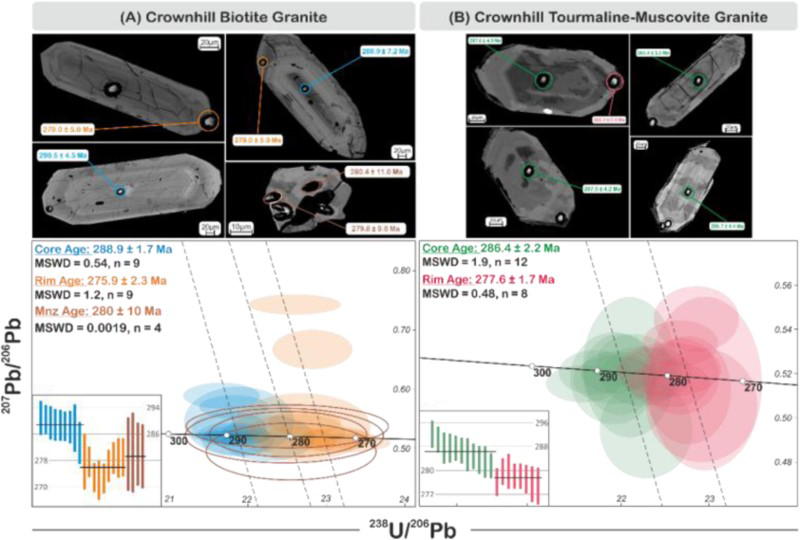
Irish Zn-Pb orebodies are a type of carbonate-hosted deposit, with mineralisation strongly associated with normal faults. Ore deposition typically occurs due to the replacement of Lower Carboniferous limestones, triggered primarily by fluid mixing, between a hot (up to 240°C), metal-bearing, hydrothermal fluid, which ascended normal faults, and a cooler (<50°C), hypersaline brine, carrying bacteriogenically reduced dissolved sulphide, of ultimate seawater origin.
The Lisheen deposit (23 Mt @ 13.3% Zn & 2.3% Pb), consists of several stratabound orebodies, which are strongly controlled by an extensional, left-stepping, ramp-relay fault array. The Island Pod (0.4 Mt @ 20% Zn & 1.6% Pb), discovered late in the mine's life, is a small, satellite body of high-grade mineralisation located ∼ 900 m north of main orebody. Despite being distal to the main orebody, the Island Pod is still very high grade, and hosts best quality ore at Lisheen. The Island Pod also displays rapid lateral variation on a small scale (<10 m), where adjacent boreholes can have zinc concentration differences of ∼ 40%. The Island Pod also displays a weaker structural control than elsewhere in the southern Irish orefield.
We present the first detailed petrographic and S-Pb isotopic study of the Island Pod orebody. The basic sulphide mineralogy for the Island Pod is pyrite, sphalerite and galena, with multiple generations of each observed, along with several carbonate phases. Dendritic pyrite/galena, colloform sphalerite and sphalerite/dolomite intergrowth textures suggest an early, rapid mineralisation event, from a supersaturated fluid, in a nonequilibrium depositional environment, marking the onset of fluid mixing. As the mineralising system came closer to equilibrium, sulphide textures changed, reflecting a slower precipitation environment.
Galena sampled from across the Island Pod orebody and its surrounding halo has a homogeneous Pb isotopic signature, regardless of paragenetic stage, and plots on the same mixing trend as historic analyses from Lisheen. This suggests that all Lisheen ore lenses have a common Pb source. Additionally, 34δS data suggest a dominantly bacteriogenic source for S in the Island Pod, with minor +34δS values recorded. This is consistent with the distal position of the orebody, away from the feeder ramp-relay fault system at Lisheen, which is thought to have introduced metal-bearing hydrothermal fluids with 34δS>0. In addition, the orebody and its halo have very similar 34δS values, signifying that a lack of hydrothermal sulphur is not what led to the halo being sub-economic. This may suggest that other factors are responsible for ore grade, such as the availability of bacteriogenic sulphur or stratigraphic controls like the nature of host rock permeability.
Most rare earth element (REE) mines and many currently-active exploration projects exploit carbonatites or carbonatite-related deposits. These are typically very large, high grade, and are rich in light (L)REE, such as Nd, but have particularly low heavy (H)REE contents. However, recent work indicates that some carbonatites exhibit localised HREE-enrichment, as well as elevated Zr, Nb, Ti, Th, and Mo concentrations, typically on the periphery of a carbonatite complex (Broom-Fendley et al. 2017a, 2017b, 2016; Andersen et al. 2016). At least one of these localities has formerly been mined (for Ti), and several of the others have been prospected for Mo, Ti, Nb and Th, signifying their potential economic importance. In this contribution, we review some localities which exhibit such mineralisation, focussing on the Songwe Hill carbonatite, Malawi.
Preliminary work at Songwe Hill has identified three roughly circular breccia units, interpreted as vents, which host HREE, Zr, Nb and Ti mineralisation. These are located approximately 1 km from the main LREE deposit, and were first identified by ASTER anomalies, followed by gamma-ray spectrometry and geological mapping. The vents are composed of altered trachyte or phonolite, and contain clasts of nepheline syenite, phonolite, carbonatite and country-rock, indicative of late emplacement in the timeline of the complex, after the carbonatite. The host rocks are extensively altered to K-feldspar, akin to fenitisation, and are locally altered to clay, although it is unclear if this is caused by weathering. The HREE are hosted in xenotime-(Y), associated with Nb-rutile and zircon. Locally, pre-existing zircons helped nucleate further xenotime growth. Here, it is clear that extensive zircon dissolution has occurred, prior to xenotime formation, supporting the notion that mineralisation was a relatively late-stage process in the geological history of the complex.
Other localities with Zr, Nb, Ti, Th, and HREE mineralisation include Bear Lodge, Amethyst, Wet Mountains, Iron Hill, Magnet Cove (USA), Goudini, Salpeterkop (South Africa), and Gross Brukkaros (Namibia) (Andersen et al. 2016; Staatz 1983; Verwoerd et al. 1995; Armbrustmacher 1980; Flohr 1994; Werner and Cook 2001), although the degree of exploration at each locality is highly variable. Commonalities include features of shallow emplacement, such as emplacement through extrusive rocks or breccia pipes, as well as extensive host rock alteration and silicification, similar to the process of fenitisation. In combination, these features are circumstantial evidence for formation from a late hydrothermal fluid in a shallow, subvolcanic system, and may be analogous with epithermal mineralisation.
Mining has been practiced on Earth since the dawn of civilisation, bringing wealth, jobs, goods and scientific knowledge. However, these activities produce enormous quantities of liquid and solid wastes, because the valuable commodities extracted only form a small percentage of the mined materials. The amounts of mine wastes are increasing globally because of growing demand for metals and the exploitation of lower grade ores with higher waste to ore ratios (Mason et al. 2010). Historic mine wastes have equal or greater environmental impacts due to the lack of legislation, less efficient processing and the use of toxic components (e.g. mercury) to recover ores (Cooke et al. 2011). Solid mine wastes can be dispersed by wind as dust, or by rivers either chronically through regular discharge, or episodically during tailings dam failures (Kossoff et al. 2014), causing erosion and/or alluviation, and contamination. Liquid mine wastes can contaminate surface and ground waters with a large number of potentially toxic elements (e.g. antimony, lead, mercury), posing health hazards. Mine wastes also contain elements such as iron and sulfur which are involved in many natural geological processes (acidification, mineral precipitation). A number of mine waste elements (copper, selenium) are micro-nutrients in the oceans, rivers and soils, but are toxic if their concentrations exceed critical thresholds (Rauch & Pacyna 2009). Millenia of discharge of mine wastes to the Earth's surface environment has therefore impacted on global biogeochemical cycles, fluvial and marine morphodynamics, water and soil supply and quality, and ecosystem and human health. This presentation will give an overview of these global mine wastes impacts, and discuss trends for the future.
Stratiform carbonate replacement Zn-Pb mineralisation in the Irish Midlands is relatively devoid of non-economic sulphide minerals. The notable exception is pyrite, which occurs temporally and spatially throughout deposits, overlying the sphalerite-galena ore body and forms a distal halo in the hanging-wall of fluid-controlling structures.
Samples were taken from 10 vertical diamond drill holes along a section perpendicular to a major normal fault (feeder conduit) transecting the Derryville ore body at the Lisheen mine. Bulk lithogeochemistry of parent samples was undertaken at ALS Loughrea by ICP-MS using a 4-acid digestion. Polished thin sections of samples from the lowermost reef-bearing sulphides were examined by optical and SEM-BSE/EDS microscopy before undergoing LA-ICP-MS for a suite of elements (32S, 55Mn, 58Fe, 59Co, 60Ni, 63Cu, 70Zn, 75As, 107Ag, 114Cd, 118Sn, 121Sb, 202Hg, 205Tl, and 208Pb).
Petrographic observations support multiple stages of dissolution and crystallisation involving pyrite±marcasite-sphalerite-galena. Early pyrite (Py1) is spongy in appearance and defined as disseminated aggregated framboids. Py1 was subsequently recrystallised into disseminated botryoidal pyrite (Py2). These phases are further recrystallised by latter hydrothermal phases. Distal to feeder structures, LA-ICP-MS data shows these pyrite phases are deficient in elements associated with ore stage mineralisation (Zn-Cd-Cu-As-Tl) within the core. Both have elevated Co, Ni, Mn, Pb and Sb and a further central zone (in preserved framboids) identified by increased Sn. Distal, early-stage pyrite shows evidence of a later rim (Py4) with distinctively higher As-Tl concentrations associated with minor crystals of sphalerite.
Within the ore zone, preserved early pyrite occurs as radiating agglomerated botryoidal forms, subsequently recrystallised into euhedral crystals (Py3) with additional, fine, massive pyrite (Py4) replacing the accompanying carbonate phases. As and Co are concentrated in the rims of, early, hydrothermally altered diagenetic pyrite similar to the distal sample; large euhedral recrystallised pyrite concentrates Mn-Cu preferentially.
Massive finely-crystalline Py4 in the proximal sample is As-rich, yet poor in many other trace elements analysed. Bladed marcasite overgrows pyrite and sphalerite phases. Trace-element variations are less certain, Ni is preferably concentrated in pyrite over marcasite; Co and Mn contents are variable with no discernible features.
This characterisation can, with appropriate treatment of data, be applied to bulk lithogeochemical data utilising principle component analysis to map dominant pyrite stages at Lisheen mine, thus a new target discriminator in regional exploration.
As mining of seafloor massive sulphide (SMS) deposits edges closer to reality, with Nautilus Minerals Inc. poised to commence production offshore of Papua New Guinea by 2019, it is imperative that we have a full understanding of the deposit characteristics, the natural processes affecting their economic worth and the environmental impact associated with the mining process. Acid rock drainage is a natural oxidation process that is often exacerbated by mining activities, and this type of pollution is common in terrestrial sulphide mines. A related weathering process also occurs on SMS deposits, and the prospect of seafloor mining in the future raises similar environmental concerns. Unlike terrestrial deposits, it is assumed the seafloor sulphides are converted to oxides with negligible metal release and minimal net acid generation due to the buffering capacity of seawater and low solubility of iron at near neutral pH. Whilst a few dissolution studies of specific sulphide minerals in seawater exist, the majority are within the context of acid mine drainage related to terrestrial mines.
By investigating the oxidative dissolution of SMS deposits in both a natural and anthropogenically-enhanced context, we highlight some important parameters that should be considered for future mining activity. In this study, the fate of metals throughout the natural oxidation process has been investigated using SMS samples at various stages of evolution covering a range of bulk chemistry, mineralogy and trace element chemistry. Potential toxicity was assessed for samples from a wide range of tectonic settings (high temperature vent, ultra-mafic hosted, back-arc rift, hot spot) considering the specific mineralogy, trace element chemistry and other factors such as sample surface area. Following the mining process outlined by Nautilus Minerals Inc., an experimental approach was designed to simulate shipboard dewatering and subsequent return of water to the seabed, providing an understanding of accelerated oxidation and assessment of heavy metal release. Toxicity potential of mining different deposits was evaluated by comparing concentrations observed in experiments to tolerance levels of species observed at active vents.
Results indicate that oxidised deposits have lost a significant amount of target metals, but deposits associated with inactive vents that contain secondary sulphides in the presence of abundant limonite may be of economic interest based on retention of some metals combined with the reduced toxicity associated with mining them. Experiments indicate that bulk chemistry alone cannot predict the toxicity observed during mining, and instead full characterisation of deposits and leaching tests with the full range of ore mineralogy from prospective sites is required. Arc-related deposits are shown to pose the highest toxic potential, whilst Cu rich ultra-mafic deposits can be considered a ‘lower risk’ prospect. Zn and Cd are of most concern based on observations of both natural and accelerated oxidation. Leaching experiments indicate that localised acid generation and toxicity is a real danger and requires a refinement of the mining process to protect the fragile and complex ecosystems associated with these deposits. Results provide insight into how mining parameters can be adapted to minimise toxicity including processed grain size, fluid-rock ratio and dilution requirements. Ultimately, this study highlights a need to better understand the response of ecosystems that call these deposits home.