







Abstract

Porphyry magmatic systems emplaced within carbonate host rocks are a major source of Cu, Mo, Au, Pb and Zn (Sillitoe 2010). Mineralisation is generally either porphyry- or endoskarn-style within intrusions, and exoskarn- or manto-style in the proximal and distal parts of the systems, respectively (Meinert et al. 2005). Genetic models for porphyry and skarn mineralisation are well established (Meinert et al. 2005; Sillitoe 2010), however questions remain as to why endoskarn- rather than porphyry-style mineralisation predominates in certain systems and regions. Clues from recent studies are that magmas can assimilate large volumes of crustal carbonates, so providing a significant amount of CO2 to late and post-magmatic-hydrothermal fluids (Carter and Dasgupta 2016), and that high levels of CO2 in magmatic-hydrothermal systems may affect sulphide solubility (van Hinsberg et al. 2016), the partitioning of metals during volatile exsolution (Tattitch et al. 2015), and the location and timing of sulphide precipitation (Barton and Chou 1993).
To address this question, the Daye ore district, east-central China was selected for study as it hosts porphyry-, exoskarn- and endoskarn-styles of mineralisation. The porphyry and skarn deposits lie within late Mesozoic intrusions or along their contacts with Cambrian to Late Triassic carbonates (Zhai et al. 1996). From among the many porphyry-related systems, the Tongshankou porphyry and skarn Cu–Mo complex was selected for C, O and Sr isotope study as the nature of the porphyry stock and ores is well-understood (Li et al. 2008).
This study presents new C and O isotope data for different calcite generations and for the marble host rock. Preliminary results show that mineralised veins dominantly have mantle signatures but with a crustal component, likely due to magmatic assimilation of marble, but post-ore veins are restricted to a marble signature (Figure 1). Further work will focus on the Sr isotope compositions of the same calcite materials, in combination with δ13C and δ18O data, to constrain the sources of magmas and hydrothermal fluids and to determine whether the hydrothermal fluids forming the mineralised and barren veins contained a component of meteoric fluid. It is hoped that this study will eventually help address why some arc segments contain no porphyry deposits (e.g. Japan) and enhance exploration models for porphyry-skarn-type Cu deposits.
Carbon and oxygen isotope compositions (in % relative to V-PDB and V-SMOW) of the Tongshankou porphyry and skarn deposits. Isotope reservoirs and arrows for mechanisms are modified from Rollinson (2014) and references therein.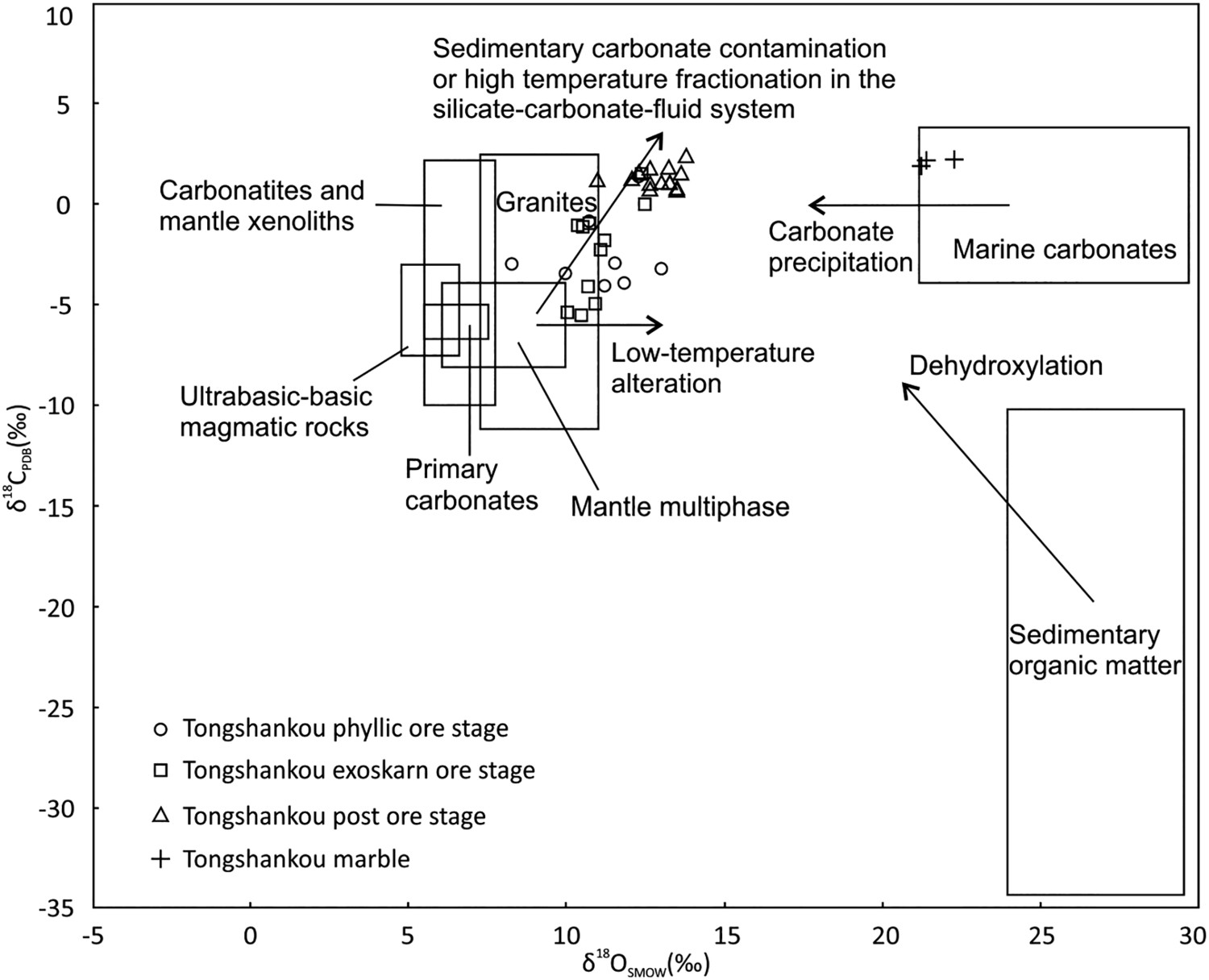
Footnotes
Disclosure statement
No potential conflict of interest was reported by the authors.