






Abstract
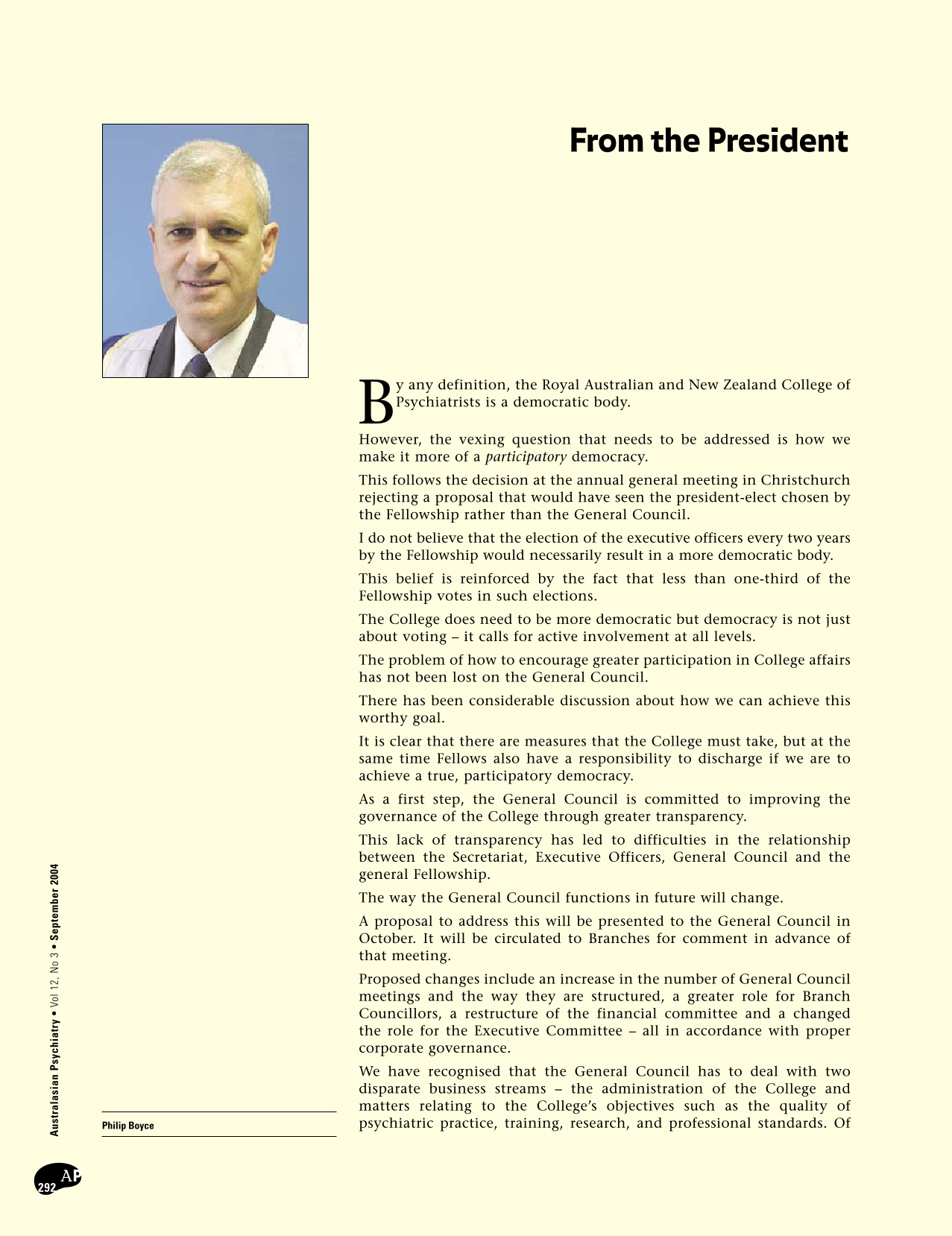

By any definition, the Royal Australian and New Zealand College of Psychiatrists is a democratic body.
However, the vexing question that needs to be addressed is how we make it more of a participatory democracy.
This follows the decision at the annual general meeting in Christchurch rejecting a proposal that would have seen the president-elect chosen by the Fellowship rather than the General Council.
I do not believe that the election of the executive officers every two years by the Fellowship would necessarily result in a more democratic body.
This belief is reinforced by the fact that less than one-third of the Fellowship votes in such elections.
The College does need to be more democratic but democracy is not just about voting-it calls for active involvement at all levels.
The problem of how to encourage greater participation in College affairs has not been lost on the General Council.
There has been considerable discussion about how we can achieve this worthy goal.
It is clear that there are measures that the College must take, but at the same time Fellows also have a responsibility to discharge if we are to achieve a true, participatory democracy.
As a first step, the General Council is committed to improving the governance of the College through greater transparency.
This lack of transparency has led to difficulties in the relationship between the Secretariat, Executive Officers, General Council and the general Fellowship.
The way the General Council functions in future will change.
A proposal to address this will be presented to the General Council in October. It will be circulated to Branches for comment in advance of that meeting.
Proposed changes include an increase in the number of General Council meetings and the way they are structured, a greater role for Branch Councillors, a restructure of the financial committee and a changed the role for the Executive Committee-all in accordance with proper corporate governance.
We have recognised that the General Council has to deal with two disparate business streams-the administration of the College and matters relating to the College's objectives such as the quality of psychiatric practice, training, research, and professional standards. Of course, these two strands are interconnected-we must have a good administrative support to be able to deal with the professional activities of the College.
Reporting mechanisms to the General Council are being modified to ensure we meet our statutory obligations and provide councillors with sufficient information to achieve good corporate governance.
We are also looking at ways to improve communications between the General Council and the Fellowship.
As I mentioned earlier, this is a two-way street. The Fellowship also has a responsibility to make the College grow and prosper.
There are many opportunities to become involved with the College including the General Council, boards, committees, special interest groups and faculties. If you want the College to become more democratic, then I urge you to become involved by putting your name forward for election to College committees or the General Council.
Contributions in these forums are highly valued.
Obviously, in some of these areas there are limitations on the number of Fellows who can participate.
However, there is a very important area where all Fellows have a role: the development of mental health policy.
The establishment of a policy committee and a policy unit within the College will lead to a more proactive College voice in policy development.
The policy committee is working with our new Director of Policy, Mr Harry Lovelock, in preparing a document detailing the mechanism for Fellows to put forward policy ideas to the College. These ideas will be debated at the policy forum at the annual Congress to identify key policy issues for the College to develop.
So, if you have a burning issue, don't keep it to yourself. Raise it with the Executive Officers or through our policy forums.
If we can develop a healthy policy debate among the Fellowship, we will have taken a big step towards embedding participatory democracy in the College.
College awards certificates of advanced training
The General Council awarded the following candidates advanced training certificates on 8 May 2004.
Certificate of Advanced Training in Child and Adolescent Psychiatry
Victoria
Dr Teresa Flower
Dr Samuel Jolayemi
Dr Allister Cairns Bush
Dr Karen Gaunson
Dr Konya Roy
Queensland
Dr Wendy Jackson
New South Wales
Dr Alison Saunders
Western Australia
Dr Elizabeth Rhys-Maitland
New Zealand
Dr Jik Loy
Certificate of Advanced Training in Psychiatry of Old Age
Queensland
Dr Pamela Hudson-Jessop
Dr David Storor
New South Wales
Dr Larissa Grund
Western Australia
Dr Fiona Krantz
New Zealand
Dr Matthew Croucher
Dr Suzanne Duff
Certificate for Advanced Training in Consultation-Liaison Psychiatry
Queensland
Dr Paul Cadzow
New South Wales
Dr Ivan Safranko
Certificate for Advanced Training in Psychotherapy
New South Wales
Dr Bruce Lachter
Dr Tatiana Grosman