







Abstract
Keywords
I would never have started training if it meant moving to the city.
Rural psychiatry registrar
The NSW Rural Psychiatry Project was initiated in 2002. It is a joint project of the NSW Branch of the College and the Centre for Mental Health, NSW Health. The project was designed to look at a broad range of issues relating to recruitment of the psychiatric workforce in rural NSW. 1
Training in Australia is almost entirely centred in metropolitan centres. Metropolitan trainees are required to spend a minimum of 3 months in a rural location or can alternatively satisfy the by-laws with a 15 day flyin fly-out service to a rural setting. Prior to implementing the compulsory rural rotation of 3 months, most rural terms in NSW were relatively unpopular and often unfilled.
A key component of the Rural Psychiatry Project was to identify the local rural doctors who wanted to train in psychiatry. Instead of limiting rural psychiatry training to those registrars who only rotate to the country, country hospitals would look for someone suitable within their midst. These doctors could start training in a rural centre and complete the bulk of their training in that rural centre. These doctors saw their futures not in Sydney but in the country. A rural coordinator of training, Dr Marina Vamos, was appointed to help coordinate these trainees. 2 By the end of 2004, 13 rural-based registrars had started training. This study examines their experiences.
CONDUCT OF THE REVIEW
The investigators developed question sets for each of the main groups involved in the review – psychiatry trainees, supervising psychiatrists, service administrators and the rural coordinator of training. The following sites were visited – Port Macquarie, Tamworth, Kempsey, Coffs Harbour and Lismore. Trainees and supervisors at Tweed Heads and Wagga were interviewed by videoconferencing or by questionnaire. In addition, two of the authors had experience with trainees in Goulburn and Orange, which helped shape the questions. Finally, Newcastle was visited to assess the video teaching programme and resources available to Dr Vamos, the Rural Training Coordinator (RTC). Figure 1 shows the sites covered by the study.
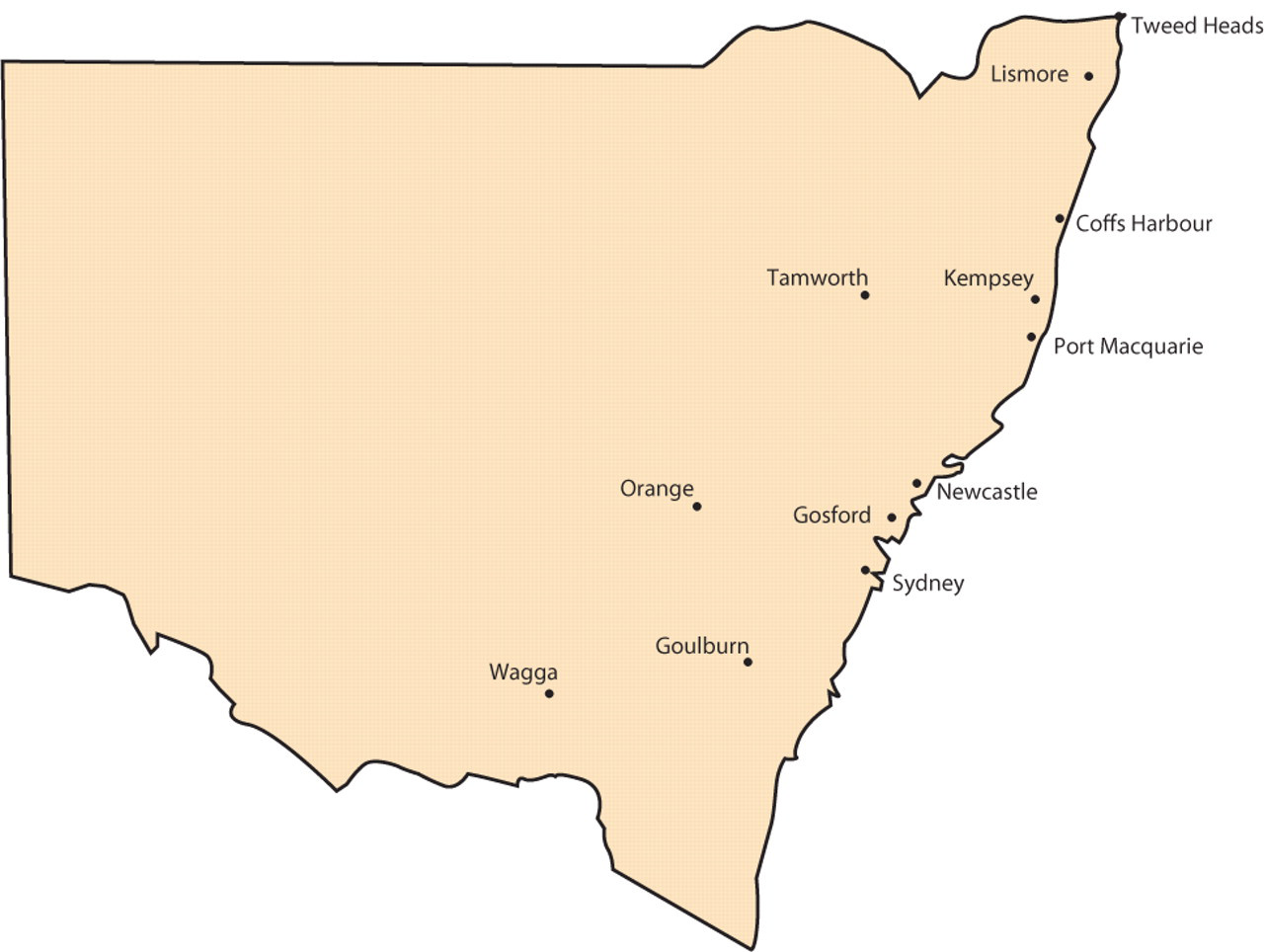
Map of New South Wales (training sites in this study).
THE TRAINEES
Of the 13 trainees who had commenced rural-based training, we interviewed nine. Of the four trainees not interviewed, two had moved interstate and were still training. Of the two who had left training, one was interviewed prior to departure as part of a recent site visit by one of the authors; the other trainee could not be located.
Five of the nine trainees had lived and worked in the local area prior to starting psychiatry training. All these trainees had been local general practitioners (GPs). The remaining four registrars came from different backgrounds, but typically had undertaken a country psychiatry term. After a positive experience of psychiatry and with the guidance of a local consultant psychiatrist, they made the decision to train in psychiatry in a rural setting.
It was clear from the outset that this group of registrars was exceptional. To a person, they showed initiative and perseverance. Trainees were unanimous that they entered training only because the opportunity to do so was available in a rural setting. Even when they knew about such rural training positions, they were hesitant about joining the programme. This hesitancy was due to a limited understanding of what training entailed, uncertainty of whether they were up to the task and the wrench of giving up a settled life. Once the switch was made, they enjoyed the freedom and educational aspects of being a registrar. Several GPs commented that despite taking a pay cut, the nature of registrar work was not as demanding as that of a country GP. It was vital that prospective trainees had contact with a local psychiatrist, versed in the requirements of training. This psychiatrist acted as a guide and instilled confidence that training was an achievable goal. Without this direct support from an interested psychiatrist, the authors believe that most of these trainees would not have undertaken training.
REGISTRAR EXPERIENCES
Registrars were able to identify positive aspects as well as difficulties associated with their rural training.
Positive aspects
The opportunity to experience a close, supportive working relationship with their consultant psychiatrists. Generally speaking, NSW towns have an extensive system of consultants who fly in each day from Sydney. We were satisfied that this was well coordinated and the registrars were not lost in this system.
A sense of appreciation and respect from all the mental health staff they worked with.
Autonomy in their working experience.
Lifestyle benefits, including more favourable overtime commitments.
Difficulties
Isolation from a peer group for professional, educational and social support remains a big issue. This was more obvious to trainees once they had experienced a city rotation.
The need to have a high level of initiative to sustain oneself in training.
Working and living within the same community(e.g. concerns about assessing people known totrainees outside of work).
Coordinating rotations to the city.
All trainees believed that it was important to their professional development that some time in training was spent out of the rural setting. However, they all had experienced considerable difficulties when relocating to metropolitan training zones. These difficulties included trying to organize spouses and their employment, as well as children and their schooling, coping with the financial burden of renting their own house while renting a place in the city and trying to find city accommodation. Sometimes trainees had arranged to live apart from their spouses to accommodate this training requirement. Rural trainees, their consultants and administrators had very little idea of any entitlements such trainees may be able to access when rotating to the city. These difficulties had brought some registrars to the brink of pulling out of training. They felt angry that on the one hand the College makes ‘such a fuss’ about rural training and then appeared to do nothing to help make it more flexible.
A couple of trainees highlighted what they saw as a city-centric view of training adopted by the College. ‘If the College could sanction a paltry 15 fly-in flyout visits to a country town to get rural experience, why can't we have 15 fly-in fly-out visits to Sydney to get consultation-liaison experience?’ The suggestions were not acrimoniously put but rather were meant to highlight that in the face of a shortage of rural psychiatrists, the rules were skewed to facilitate city trainees but not rural trainees. Despite this frustration, trainees accepted that a longer stint in the city to get specialist terms was of value if the local service could not provide this experience. If possible, most trainees would like to undertake all their training in the country, or at least minimize the time spent in the city.
WHERE DO PEOPLE WISH TO PRACTICE AFTER TRAINING??
As a group, these trainees want to practice in rural locations on completion of their training. They identified a number of factors that will impact on their ability to do this, including: (i) the schooling and social needs of their children; (ii) the employment needs or opportunities for their partners; and (iii) the availability of positions in an area of psychiatry in which they are interested.
THE IMPORTANCE AND ROLE OF THE RURAL TRAINING COORDINATOR
The lack of face-to-face contact with the coordinator did not seem to be an issue of concern for the trainees and it did not appear to inhibit their use of the coordinator. Some trainees had attended the workshops and teaching sessions held in Newcastle and Sydney. These had been designed to promote opportunities for the rural trainees to meet the coordinator and other trainees, in addition to providing an opportunity for learning.
The trainees had made use of the RTC for a variety of roles, including assistance with setting up their position within their service of origin, assistance with by-law requirements and tutoring via the videoconferencing teaching sessions. The trainees perceived the role of the RTC to be most useful for helping them to set up their rural training and to deal with by-law related issues.
The current RTC felt that the position had increased the profile of rural psychiatry and helped some trainees to develop accredited placements. The RTC identified great potential for more senior registrar rural postings and Aboriginal Mental Health training and experiences.
TEACHING
Aspects of teaching included:
Rural training activities: weekly informal phonein tutorials, regular lectures, videoconferencing of Grand Rounds (through Newcastle), regular visits by the RTC to training sites and regular meetings of supervisors of rural trainees.
Training workshops for rural trainees, held at the NSW Branch Office. The attendance costs were met by the project.
Financial support of rural trainees to attend College Congress.
The experience of video technology was variable. Most trainees did not participate in the videoconferencing tutorials or opportunities beyond the mandatory by-law requirements. The reasons for this included frustration with the technology, boredom and feeling ‘singled out’ by the technology.
It did not appear that a strong network had formed between the rural trainees, despite attempts to promote this. All trainees had enjoyed opportunities for meeting that had been provided. They indicated that it had been helpful in breaking down their sense of isolation and had given them an opportunity to share experiences. However, this did not generally translate into contact beyond the meetings. Some trainees in different rural locations had formed personal support connections, but this seems to have been a function of the individuals themselves rather than the network.
SUPERVISORS' AND ADMINISTRATORS' PERSPECTIVE
Overwhelmingly, administrators' eyes were on filling vacant psychiatry positions. Most psychiatrists felt that they could provide quality training though were aware of the possible exploitation of registrars by an understaffed service. Most sites could not offer advanced training in anything but Adult General Psychiatry. Universally, consultants and administrators were derisive of the concept of the 15 day fly-in flyout model. At best, it was seen as tokenism to satisfy city trainees and at worst created more work for the local staff.
The new College by-laws which mandate a 3 month rotation by city trainees to rural settings may impact upon the concept of locally grown rural trainees. The new by-laws provide rural centres with access to a much larger pool of trainees to assist in the provision of mental health services. One possible result is that, with the large number of rotating registrars, some of the gains of the home-grown trainees may be lost and the focus may be taken off trying to develop local trainees. If this was to happen, there is the
risk of not addressing the longer-term venture of preparing rural doctors to take on a rural psychiatry training and remain within their community as consultant psychiatrists.
Footnotes
Acknowledgements
We wish to thank the following people for their contributions and hospitality during our travels throughout NSW: all the registrars, supervisors and administrators; Dr Marina Vamos, Rural Training Coordinator in NSW; Dr Catherine Hickie, Psychiatrist, NSW Centre for Mental Health; Members of the Steering Committee of the Rural Psychiatry Project, NSW (chaired by Grant Sara); MTEC for the opportunity of discussing our findings with them; Dr Susan Blinkhorn, Child Psychiatrist, Orange, for her notes on her interview questions for rural child and adolescent psychiatrists; Dr Brian Kelly, Director, Centre for Rural and Remote Mental Health, Orange.