







Abstract
Objectives:
The purpose of this pilot study was to evaluate the efficacy of acupuncture in relieving perineal pain after mediolateral episiotomy during childbirth.
Design and subjects:
Women with mediolateral episiotomy during delivery were enrolled in this study and were assigned to be treated or not with acupuncture.
Outcomes measures:
Perineal pain relieving effect of acupuncture was evaluated considering oral analgesics request during post-partum period and was the main outcome of this trial.
Results:
A total of 42 women were enrolled in this trial. Twenty-one (21) women were treated with “wrist–ankle” acupuncture, inserting one needle in their right ankle. A second group of 21 women was not treated with acupuncture. Women in the acupuncture group were significantly less likely to experience pain; only 8 of them (38.1%) asked for analgesics. All women in the second group assumed oral analgesics because of perineal pain (p < 0.01).
Conclusions:
Wrist–ankle acupuncture during the postpartum period is effective for perineal pain relief after mediolateral episiotomy.
Introduction
These data reflect Italian obstetrics habits, which do not yet agree with evidence-based medicine recommendations.
The most common complication of episiotomy is postpartum perineal pain. 1,2 However, the degree of perineal pain and discomfort associated with episiotomy are underestimated, 3 as they often interfere with daily activities and impact on motherhood experiences. 4 It is estimated that 20%–25% of women experience distress and discomfort for up to 2 weeks after birth, 2,5 and 10% of women experience pain 3 months after childbirth. 4,5 A recent Australian study reports that 94% of women experienced one or more health problems up to 6 months after birth, including perineal pain. 6
Strategies to reduce perineal pain include oral and rectal analgesics and nonpharmacologic applications such as marigold and ice packs. 7
Oral medications, however, may have side-effects, such as stomach pain, nausea, and vomiting, 8 while the efficacy and safety of rectal analgesia is still largely unknown. 9
Moreover, the prescription of analgesics during lactation is controversial, as there might be possible adverse drug reactions in neonates and infants, even if knowledge about the practical impact of drugs concentrations found in maternal milk is still limited. 10 –14
To date, there are many reports showing the efficacy of acupuncture in relieving musculoskeletal pain of various origins. 15 –17
In particular, in wrist–ankle acupuncture the body is divided into six longitudinal regions. These regions are represented by six points located in each wrist and ankle, and needles are placed based on the location of the disease: in the wrist if the pain is located over the diaphragm, and in the ankle if it is in the lower part of the body. One of the advantages of this method is that subcutaneous needling does not induce soreness, numbness, distension, heaviness, or pain, and it is completely safe, as there are no vital organs, large vessels, or nerves in the wrist and ankle anatomic regions. 18,19 Moreover, wrist–ankle acupuncture can treat pain of various origins. 20
This pilot study was designed to evaluate the efficacy of acupuncture in relieving maternal pain after perineal episiotomy, and whether it could reduce the use of conventional analgesics.
Materials and Methods
Women were recruited from the delivery ward of the San Gerardo Hospital, Monza, Italy, between March and September 2008. This institution is a tertiary care center with approximately 3000 annual deliveries.
Inclusion criteria were age >18 years and mediolateral episiotomy at the delivery. Forty-two (42) patients were enrolled in the study.
Twenty-one (21) patients were treated with acupuncture as perineal pain relief, while 21 patients were monitored during their hospitalization and the request for oral analgesic was recorded.
The needles were inserted within 2 hours after childbirth by a physician certified as acupuncturist from the Italian Federation of Acupuncture Societies after a 4-year course and with experience in a Chinese hospital in Nanjing. The acupuncture treatment consisted of one needle placed in the Lower 1 point according to wrist–ankle acupuncture, in the right ankle. The Lower 1 point is on the interior border of the Achilles tendon, three transverse fingers above the medial malleolus. The puncturing technique consists of inserting the needle obliquely (with a 45° angle) to the depth of the hypodermis and then parallel to epidermis. The tip of the needle is cranially directed. No manipulation and needling sensation is required to get good results. When the entire needle is inserted, the handle is bent and attached to the skin with an adhesive bandage.
Sterile 0.25 × 25 mm needles were used, according to the Nanjing University method.
The needle was left in place since the discharge of the woman on the second or third day after delivery, and it was removed by a midwife. Additional oral pain relief could be supplied at any time upon patient request during hospitalization. Oral ibuprofen was given as the first choice, while ketoprofen was given as the second choice.
Acupuncture was considered ineffective when women treated with needles asked for one or more oral analgesics during their hospital stay (data were extracted from chart review by the acupuncturist).
Side-effects such as pain in the area of acupuncture, allergic reactions to the needle, or abnormal uterine bleeding and uterine contraction were recorded.
At discharge, women treated with acupuncture were invited to take part in a short survey, to determine whether the needle interfered with their activities, such as walking, washing, and breastfeeding. They were also asked to specify an overall degree of acceptability (defined as low, medium, or high) of the acupuncture treatment.
Statistical analysis was performed using a χ2 test with Yates' correction. P < 0.01 was considered significant.
Results
Requests for oral analgesics were significantly more frequent in the control group (p < 0.01). In detail, 8/21 women treated with acupuncture (38%) and 21/21 patients not treated (100%) experienced perineal pain, which required oral drugs (Fig. 1). No adverse side effects were required in the acupuncture group.
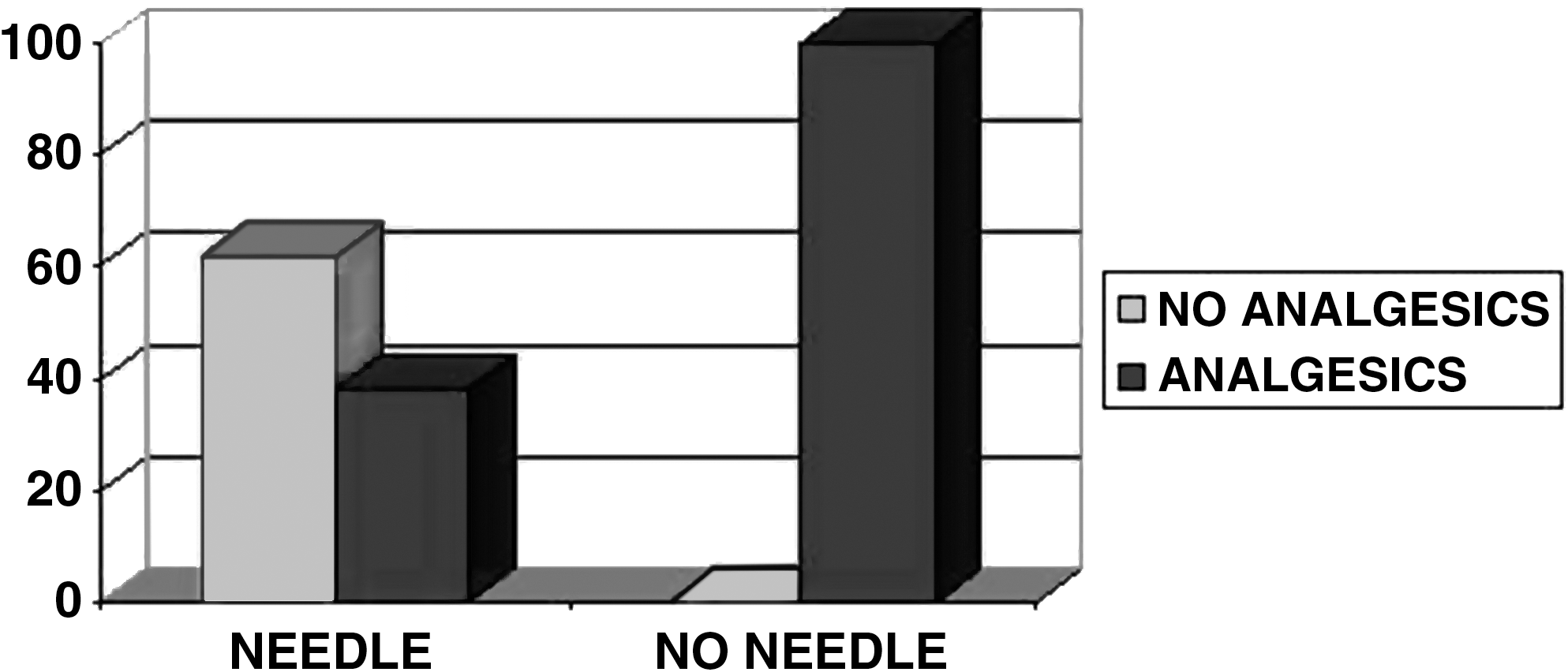
Comparison between acupuncture and no acupuncture regarding need for analgesics.
Women treated with acupuncture expressed a high degree of acceptability of the treatment. In detail, 17/21 patients (80%) defined the acceptability as high, while 4 (20%) defined it as medium. No patient asked for an anticipated termination of treatment.
Discussion
Postpartum is a touchy period for women, both physically and emotionally. Perineal pain relief is very important after childbirth.
The first strategy to reduce perineal pain should be avoiding unnecessary episiotomy, but this practice is still often used in Italy.
In consideration of the frequent use of oral analgesics (100% of women in our sample) and of their side-effects for both the mother and the child, a valid alternative to traditional analgesia is fundamental.
Acupuncture and wrist–ankle acupuncture are very effective in relieving some kinds of pain and discomfort.
This is the first report on the efficacy of this kind of technique in relieving perineal pain after episiotomy. Even if the major limitation of this study is the relatively small number of patients enrolled, it was demonstrated that wrist–ankle acupuncture could have a role in the analgesic therapy of postpartum perineal pain.
On the other hand, one of the main advantages of the technique used in this trial is that it is extremely simple, as it requires the insertion of a single needle, and therefore could be easily taught to physicians without knowledge or experience in acupuncture.
The effectiveness of perineal pain relief of wrist–ankle acupuncture should be verified in a larger sample size trial, possibly with a randomized setting, using a pain scale and a longer follow-up.
Conclusions
Wrist–ankle acupuncture is a simple and effective method of reducing the pain experienced by women due to mediolateral episiotomy after childbirth. The acupuncture that was performed in this study had no adverse side-effects reported and has a high degree of acceptability.
Footnotes
Acknowledgments
The authors are grateful to Dr. Patrizia Adelasco, Milano, and to Professor Qiao Wenlei (Nanjing University, China) for important teaching and support. The authors also thank Dr. Maddalena Incerti for her advice and all the midwives of the delivery ward and of the maternity department of San Gerardo Hospital, Monza.
Disclosure Statement
No competing financial interests exist.