







Abstract
Objectives:
The objective of this pilot study was to determine the effectiveness of a mixture of essential oils (peppermint, basil, and helichrysum) on mental exhaustion, or moderate burnout (ME/MB) using a personal inhaler.
Design:
This was a randomized, controlled, double-blind pilot study. Data were collected 3 times a day for 3 weeks (Monday–Friday). The first week was baseline for both groups, the second week was intervention (aromatherapy or placebo), and the third week was washout.
Settings/location:
Participants used a personal inhaler at home or at work.
Subjects:
The subjects comprised a convenience sample of 13 women and 1 man who each had self-assessed ME/MB.
Interventions:
Participants were randomized to receive a personal inhaler containing either a mixture of essential oils or rose water (as used in Indian cooking).
Outcome measures:
The outcome measures were a 0–10 scale with 10=worst feeling of burnout, 0=no feeling of burnout. There was a qualitative questionnaire rating aroma and a questionnaire listing perceived stressors.
Results:
While both groups had a reduction in perception of ME/MB, the aromatherapy group had a much greater reduction.
Conclusions:
The results suggest that inhaling essential oils may reduce the perceived level of mental fatigue/burnout. Further research is warranted.
Introduction
Aromatherapy is a popular complementary therapy that is often used to reduce stress. While the evidence is mainly anecdotal, some recent research indicates that essential oils such as lavender may reduce stress by inducing relaxation. 4 However, lavender is also used as a sedative 5 and may reduce the ability to concentrate and exacerbate stress due to mental fatigue or burnout. This study focused on two symptoms of burnout: emotional fatigue/apathy as the main symptom and stress/anxiety as the second symptom. A mixture of three essential oils was used: two stimulant essential oils (to address the fatigue) and one balancing essential oil (to address the anxiety). Mentha x piperita (peppermint) essential oil can increase alertness and mental clarity. 6 Ocimum basilicum ct linalol (basil) essential oil reduces mental fatigue and has antidepressant properties. 7 Helichrysum italicum (helichrysum) essential oil is known for its calming and soothing properties. 8 Rosewater was used as the control because it is a very subtle aroma (unlike rose essential oil) and, while rosewater is used in cosmetics and Indian cooking, inhaling diluted rosewater is not known to have any therapeutic effects. This small pilot study explored the effects of a mixture of three essential oils, or diluted rosewater, using a simple plastic personal inhaler, on symptoms of self-assessed mental exhaustion or moderate burnout (ME/MB) in a convenience sample.
Materials and Methods
Fourteen (14) adults (13 females and 1 male) responded to an e-mail sent to friends and colleagues. The e-mail outlined the study and asked for volunteers who had self-assessed ME/MB. Two (2) separate sets of plastic inhalers were filled with (1) the aromatherapy mixture or (2) placebo/rosewater. The aromatherapy inhalers contained 4 drops jojoba oil, 10 drops peppermint, 8 drops basil, and 2 drops helichrysum. The control inhalers contained 4 drops jojoba oil and 20 drops of rosewater. Peppermint and basil essential oils evaporate more quickly than helicrysum, so a higher proportion of them created a lasting balance. The aromatherapy (or control) mixture was dropped onto a cotton insert. The cotton insert was then placed inside the inhaler and the base was plugged with a plastic tab. The inhalers containing the essential oils were then marked with a red sticker, and the control group inhalers were marked with a purple sticker.
Packets including (1) an instruction sheet, (2) a 0–10 score to rate burnout, and (3) a log to track ratings were created and marked with either a purple or red sticker. Packets and inhalers were matched by their colored stickers and then put into plain mailing envelopes. The plain envelopes were shuffled, put into a box, and then randomly selected and mailed to participants so the Principal Investigator did not know who was receiving the aromatherapy or the control.
Participants
The aromatherapy group had 7 participants (one male and 6 females) aged 25–45 years. They included a working mother, a full-time mother, a working father, and a full-time graduate student. Jobs included psychotherapist, special education coordinator, nonprofit executive director, and a fund-raising and development associate. The control group had 7 women. Four (4) were aged 25–45, 2 were 45–65, and 1 was over 65. One (1) participant was a full-time mother with a child under the age of 3 years. One (1) was a full-time graduate student, and 1 was a part-time graduate student who was working part time as well. The remaining 3 participants held jobs as a clinical social worker, developmental specialist, educator, and an office coordinator.
Apparatus
The white plastic personal inhalers were purchased from Birch Hill Happenings Aromatherapy, LLC. The peppermint oil came from SunRose Aromatics, New York. The basil and helichrysum essential oils came from Florahana Distributors, France. The countries of origin were basil (Egypt), helichrysum (France), and peppermint (United States). The rose water (Rose Petals Rosewater) was manufactured by Heritage Products, Virginia Beach, VA and purchased at Whole Foods. The material safety data sheets were supplied by
Demographic data were collected on participants' age, gender, job description, typical work/school schedule, outside work responsibilities (such as caring for children or elderly people), and participants' experience with essential oils. A 0–10-point assessment scale was used to rate mental fatigue or mild burnout. This was aided with descriptors such as no burnout, feeling alert, focused, hopeful, and optimistic=10. At the other end of the scale were descriptors such as extreme burnout, lack of attention at work, negative feelings, lack of focus and drowsiness=0. An easy-to-use log was created so participants could rate their ME/MB throughout the 3-week study. In the log, each participant circled the number on the scale that corresponded to their level of ME/MB at the (1) beginning, (2) middle, and (3) end of each day. A separate form (to rate reaction to the smell or the inhaler) was included that asked if the participant recognized the aroma and if they found it easy to use the inhaler.
Procedure
Each participant signed an informed consent form. As this was a very small pilot study with friends and colleagues, no IRB was completed. Completed forms and questionnaires were returned in a stamped addressed envelope at the end of the study. During the 3-week study, participants were asked to measure their feelings of ME/MB 3 times daily in a log using a 0–10-point scale. A range of 0–3 indicated the participant was feeling “alert, fully focused, mentally sharp, feeling optimistic.” A rating of 4–7 indicated “difficulty focusing, drifting attention, feeling neutral or, just going through the motions of the day.” A rating of 8–10 indicated “drowsy, low attention, feeling of anger/resentment, discouragement.” Each participant was asked to circle one number on the 0–10 scale each time they used the log. Participants were also asked to complete an Impressions Page. This was a list of yes/no questions asking questions such as whether the participants could identify the aroma and whether it brought up memories.
The first week measured baseline. The second week was the intervention: Participants used the inhalers (aromatherapy or placebo). They inhaled 3 times through one nostril and 3 times through the other nostril every hour of their working day; this produced approximately seven uses daily. Participants were asked to keep to the protocol and not use the inhaler at other times. The third week was a washout week when participants logged their feelings of burnout without using the inhaler.
Results
Data were entered into a spreadsheet. The average rate of ME/MB was calculated for each participant for each of the 3 weeks (Fig. 1). Five (5) of the 7 participants in the aromatherapy group rated their burnout average for week 2 as lower than week 1 or 3. However, the control group had the same result, but the aromatherapy group improved by 21.11% while the control group only improved by 11.28% (Table 1). There was a slight difference between the aromatherapy group and the control group in week 3 during the washout period when the aromatherapy group improved 8.73% while the control group improved by 7.06% (possibly suggesting a carryover effect of using the inhalers).
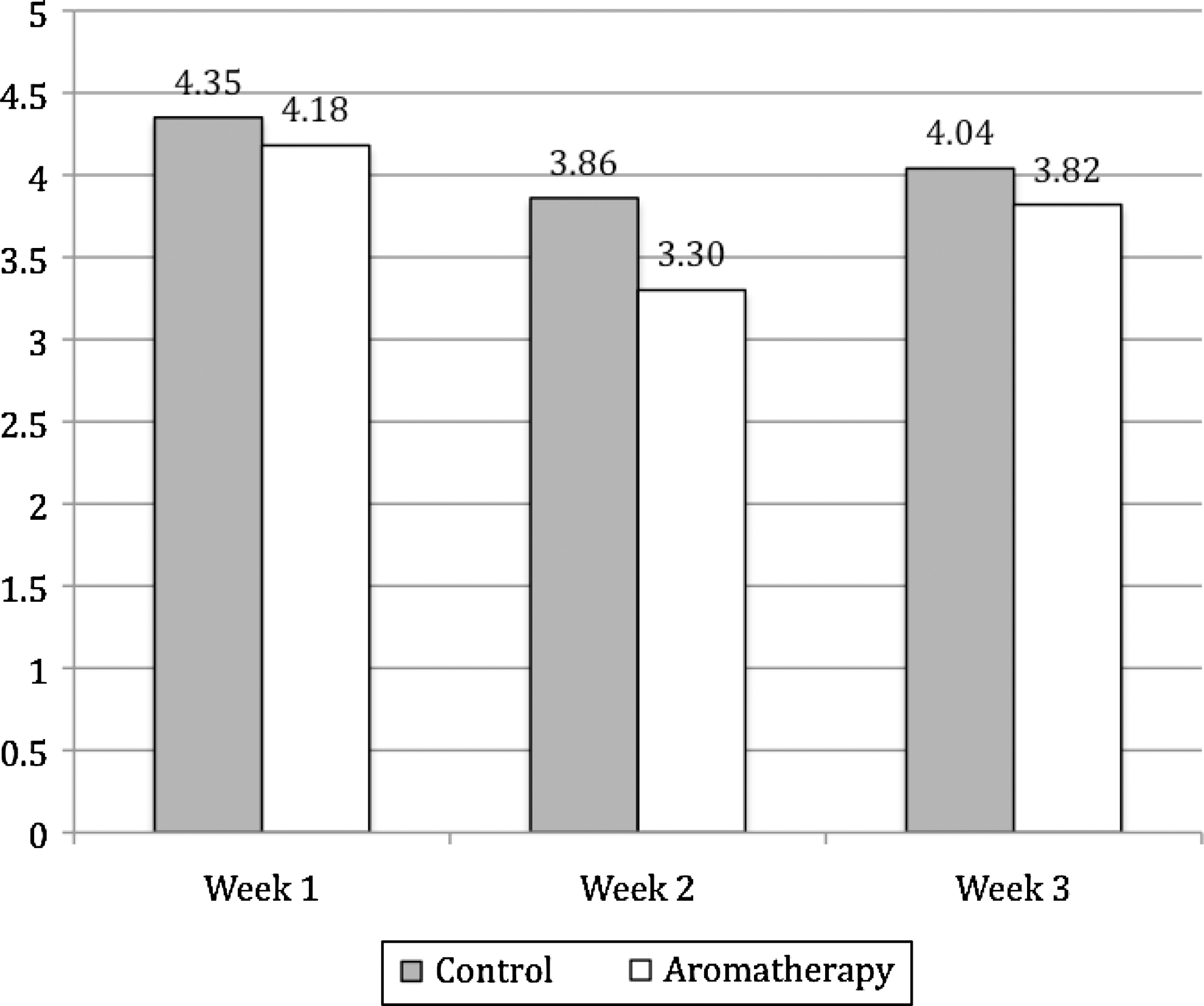
Average rate of mental exhaustion/moderate burnout calculated for each participant for each of the 3 weeks of the study.
% Change from week 1–2: Aroma group=21.11%; Placebo group=11.28%.
% Change from week 1–3: Aroma group=8.73%; Placebo group=7.06%.
Limitations
This was a small pilot study and the participants were mainly white females, so although the results were encouraging, they may not be generalizable. The Impressions Page indicated that very few participants could name peppermint when it was part of a mixture. Very few could identify rosewater either. While rosewater was used as a control, it appeared to have some effects of its own. This could be a placebo response, or possibly inhaling rosewater has some antistress effects. This could be explored in future research. As participants rated their own burnout scores as being in the middle range of the 0–10 scale, this study was looking at moderate burnout rather than extreme burnout. The reduction in symptoms in both groups during the second week could be attributed to participants stopping every hour to take six deep breaths. Indeed, some participants wrote in their “Impressions Page” how helpful it was to breathe and “check in.” Another limitation is that some participants did not use their inhaler every day: Some were sick and others just forgot to use the inhaler. One (1) participant worried about what people would think if they saw her using the inhaler. Finally, two additional testing periods, after a washout when the aroma group received the control (rosewater) and the control group received aroma, would have strengthened the study.
Conclusions
While both groups had a reduction in symptoms during the second (intervention) week, the decrease in symptoms of the aromatherapy group was double the reduction of the symptoms of the control group. Inhaling a mixture of peppermint, basil, and helichrysum essential oils several times a day appears to reduce the symptoms of moderate mental exhaustion and/or burnout. Future studies are warranted.
Footnotes
Acknowledgments
We thank the friends and colleagues who gave their time to take part in this study.
Disclosure Statement
No competing financial interests exist.