







Abstract
Background/Objective:
Plants are the basis of all health care systems. This study sought to inventory the most used medicinal plants in the local therapeutic patrimony of the Ouaddaï (East Chad) through an ethnobotanical investigation.
Methods:
The inventory described the plant parts used, their mode of preparation, and their therapeutic uses.
Results:
Thirty-eight plants species are used for different purposes and diseases. The most used species belongs to the Mimosaceae (eight species), Caesalpiniaceae (four species), and Combretaceae (four species) families. The traditional medicinal uses, as well as the preparations, of these plants are diverse. The used parts are leaves (36.4%), peels (23.7%), fruits (18.2%), roots (10.9%), stems (5.5%), and other (5.3%). These plants are used to treat 16 different illnesses, notably amoebiasis (26.8%), respiratory infections (14.3%), fever (12.5%), kidney stones (7.1%), snake bites (7.1%), tooth decay (5.4%), and leprosy (5.4%).
Conclusion:
The results obtained from this survey constitute the starting point of an inventory of local medicinal plants to be completed by phytochemical, pharmacologic, and toxicologic studies to allow good exploitation of the local medicinal flora.
Introduction
M
Medication consisting of herbs and plants has been used since the dawn of time, and humans continue to select curative plants from their environment. In particular, they have done so since the time of the Babylonian and Chaldean civilizations along the Tigris and Euphrates rivers, as they did in ancient Egypt on the edge of the Nile. Scholars of Egyptian civilization even analyzed these plants, defined drugs, recorded their ways of use, applied them in trials, and prescribed their principles to heal numerous diseases. Traditional medicine is still used by a majority of people in the world and still represents a good strategy for drug discovery. 2
In Africa, researchers have been scientifically studying the medicinal plants used in different regions. Certain uses were confirmed and active ingredients isolated. 3 In addition, over the past three decades numerous African countries have been paying more and more attention to traditional medicine and their medicinal plants. Chad, by its geographic location, offers an important ecologic and floral diversity. However, Chadian pharmacopeia has heretofore been relatively unknown. For this reason, and considering the biodiversity of natural resources (mineral, animal, and vegetal), 4 the present study sought to inventory the healing plants of the regions of Bithéa, Abker, and Goz-Beïda, located, respectively, 35, 82, and 217 km from Abéché, Chad.
Materials and Methods
Study area
The study zone is in the region of Ouaddaï-Biltine (East of Chad) (Fig. 1). It extends between 11 and 16 degrees of latitude in the North and 17 and 20 degrees of longitude. It is limited in the North by the prefecture of Borkou-Ennedi-Tibesti, in the South by the Central African Republic and the prefecture of Salamat, in the East by the Sudan, and in the West by the prefectures of Batha and Guéra. It covers a surface of 123,090 km2. The study zone has an intertropical climate with a dry season and a rainy season.
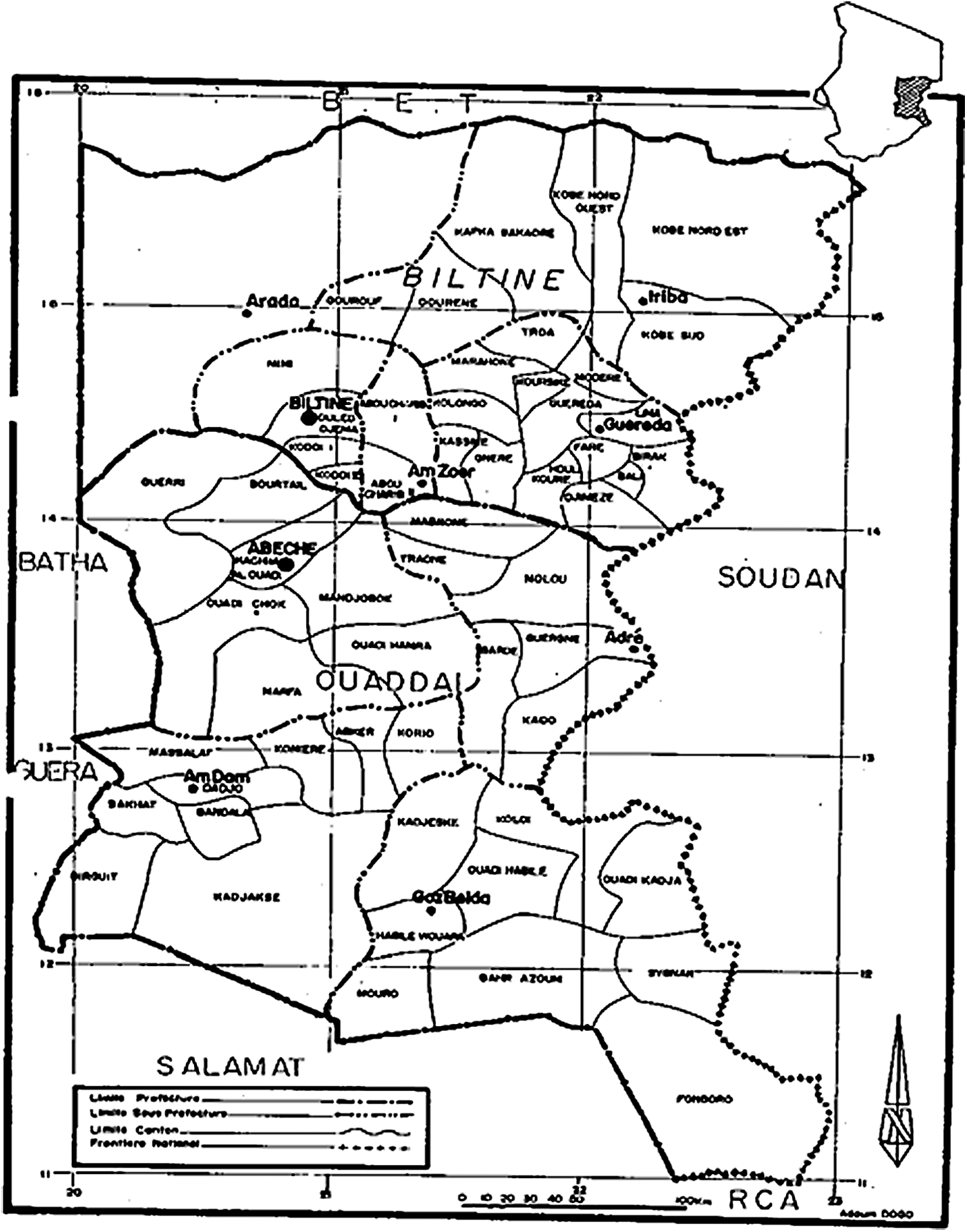
Administrative map of Ouaddaï-Biltine (from TMEP, 1998).
These two seasons are defined by the fluctuations between masses of dry air from the North (harmattan) and masses of maritime wet air from the Southwest (monsoon). Thus, the presence of the intertropical front in this area brings the rain, and its absence is related to the dry season. The annual pluviometry in Ouaddaï-Biltine is between 200 mm for the North and 950 mm for the South.
The vegetation of Ouaddaï appears as follows: Ouadis in the Northwest has a shrubby aspect, often scattered and composed of, among others, Acacia species, Balanites aegyptiaca, Boscia senegalensis, and Salvadora persica. In the forest galleries of the South, one finds Tamarindus indica, Anogeissus leiocarpus, and Combretum glutinosum. On sandy to sandy-clays soils of the bottom of valleys, one finds Acacia seyal along the Ouadi Bithéa toward Oum-Hadjer, and along the road to Am-Zoer. It is a herbaceous area and very diversified but often overgrazed. On clay soils of the South, the vegetation is more wooded. The most typical trees are A. seyal, Albizia amara, and C. glutinosum. Sclerocarya birrea is frequent on the more sandy soils. The herbaceous plant cover is average with 30% of bulk soil. A little bit further south, toward Goz-Beïda, the vegetation is relatively well preserved. 5
The temperature of the region changes according to seasons. In the cold season (December–February), the daily temperatures are between 16 and 35°C; in the dry season (April), they are between 25 and 41°C; in rainy season (August), these temperatures fall and vary between 21 and 31°C. The annual average temperature in Abéché is about 28°C; the maximum is 49°C. 5
The geologic base of Ouaddaï-Biltine is almost completely formed by granite of the Precambrian base, a wrinkled, magmatic metamorphic setgroup that is crossed by intrusions. The granite of calco-alkaline typechap and the magma dominate. The granodiorite and the mica-schists are rare. In the neighborhood of Adré, sandstones of paleozoic age are present. The southern part is characterized by old duricrust, is really hardened, and dates from the end of the Tertiary period. 5
Ethnobotanical survey and study method
A pre-established questionnaire was used to ask 30 traditional healers (average age, 45.3±6 years; men only) were questioned about the plants used, parts of the plants used, the modes of preparation, and the therapeutic and traditional practices. The interviews and discussions were carried out in Chadian Arabic. During this study, the following information was obtained: (1) For every collected medicinal plant, the local or vernacular name was given, as well as the part used, the mode of preparation, as well as the way of administration of the remedy; (2) each traditional healer was individually questioned, and only the species of which more than 50% of these healers make the same use were retained as healing plants of the studied zone.
All in all, three sites in the South of the city of Abéché, namely Bithéa, Abker, and Goz-Beïda (located, respectively, 35, 82, and 217 km of Abéché) were chosen. At every site, prospecting followed by collection of botanical specimens was organized. Any organ taken on the same plant was allocated by the same number. All information taken was then recorded on the survey sheet of the ethnobotanical investigation.
Pictures of all the plants used in the local therapeutic heritage were taken and the collected samples were identified by Aouadalkarim Moussa Chahad. The identities were confirmed by comparison with the herbarium of the Veterinary and Zootechnic Research Laboratory of N' Djaména, the Ecological Museum of the Millennium and the National Herbarium of Yaoundé (Cameroon). Voucher specimens were deposited at the Ecological Museum of the Millennium of Yaoundé (Cameroon), and a voucher number has been assigned to each of them as follows: AB for samples collected around Abker, GZ for Goz-Beïda, and BI for Bithéa. Species collected at the same location were increasingly annotated (Table 1).
Data were handled and analyzed by using Excel software (Microsoft Corp., Redmond, WA).
Intellectual property agreement statement
The traditional healers who provided information during the survey were adequately financially rewarded after a verbal agreement that this research will not be used for commercial purposes.
Results and Discussion
The floral analysis of the realized catalog allowed the identification of 38 botanical species used in traditional medicine in this part of the Chad (Tables 1 and 2). From the botanical point of view, these 38 species are spread into 31 genera and 19 families (according to Cronquist's classification). 6 The most represented families are Mimosaceae (eight species), Caesalpiniaceae (four species), and Combretaceae (four species) and the most represented genera are Acacia (eight species), Zizyphus (two species), and Citrus (two species). The 19 families were spread over 11 orders. The most diversely represented order is Fabales, with 13 species, distributed among the three families (Mimosaceae, Caesalpiniaceae, and Fabaceae). These results relative to the listed botanical families are similar to those reported by Guigma et al. and Zerbo et al. in Burkina-Faso, where the most represented families were Poaceae, Caesalpiniaceae, Mimosaceae, Combretaceae, Rubiaceae, and Anacardiaceae. 7,8
By comparison with literature data, the following species seem to have no therapeutic uses reported in the other parts of Sahelian Africa: Allium cepa, Capsicum annuum, Citrus aurantifolia, Citrus aurantium, Cordia sinensis, and Grewia tenax (Table 2).
Moreover, in Ouaddaï Acacia raddiana and Hyphaene thebaica have diverse therapeutic uses different from those in other areas of Sahel; they are, respectively, used against icterus, rheumatism, and asthma. In contrast, in other areas of Sahel, they are used against intestinal worms, dermatitis, edemas, and bilharzia (Table 2). In addition, from the 30 remaining species whose uses remain the same in Sahelian local medicine, 28 species (93.3%) have at least one therapeutic use identical to that of the other regions of Sahel. 3,9 –11
In addition, this survey reveals that the same species sometimes has multiple therapeutic practices: 23 species out of the 38 inventoried (60%) were used to treat multiple diseases and the symptoms of 16 different pathologic abnormalities, of which amoebiasis and respiratory diseases are treated by this panel of medicinal plants (Table 1). This multiplicity of therapeutic uses shows the richness in active ingredients of these plants, which must be looked after. The same observations have been made by Guigma et al., 7 Zerbo et al., 8 Séreme et al., 12 and Nacoulma-Ouédraogo (1996), 13 who reported that the diversity of plants and the variability of the proposed therapeutic uses could be related to their various properties and could be considered a form of cultural heritage capitalized upon by generations of local populations. The variability of these therapeutic practices was also observed in Burkina-Faso (Nacoulma-Ouédraogo, 13 Thiombiano et al. 14 ), Niger (Wezel 15 ), the Ivory Coast (Koné et al. 16 ), and Mali (Kouyaté 17 ).
In Ouaddaï, the same plant parts are used as in the rest of Sahelian Africa. However, the rate of use differs from one part to another (Zerbo et al. 8 ). Thus, leaves are used in 36.4% of the cases, barks in 23.7%, fruits in 18.2%, roots in 10.9%, stems in 5.5%, seeds in 1.8%, bulbs in 1.8% and thorns 1.8% (Fig. 2). Zerbo et al. 8 also showed in a similar study in Burkina-Faso that leaves are used in 31%, roots in 25%, and trunk barks in 23%. Several types of preparation were described and plant parts were used in fresh or dry state (Table 3), including classical herbal preparations, namely decoctions (35.7%), infusions (22.8%), macerations (11%), and powders (30.5%) (Fig. 3). 7 Of note, no essential oils are used. Identical preparations were also described by Pousset 3 and Salhi et al. 18
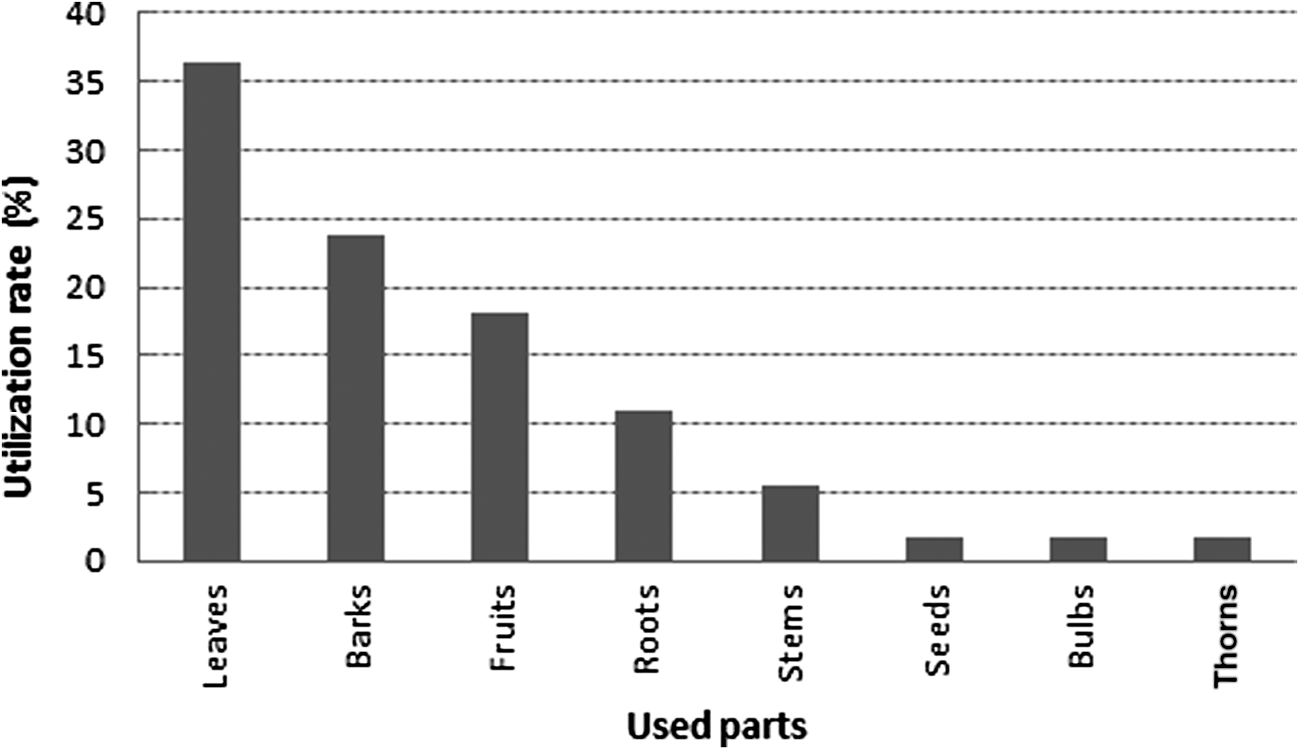
Use rate for parts.
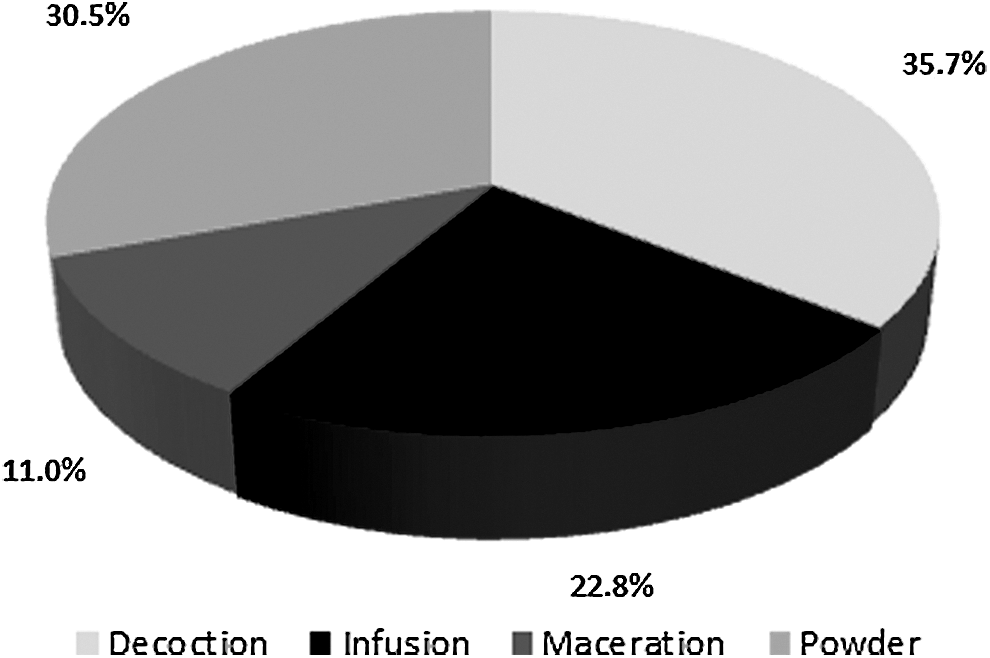
Rate of the different types of preparation modes (in percentages).
The present investigation shows that the most frequently treated symptoms are fever and intestinal disorders (diarrhea, dysentery, intestinal worms) and, to a lesser extent, respiratory diseases (Table 2). This confirms the results obtained in Burkina-Faso by Guigma et al. 7 This is why the species used to treat these recurring conditions must be particularly protected, with the aim of sustainable use and phytochemical analyses as well as pharmacologic evaluations. These species are Psidium guajava, Dalbergia melanoxylon, Mangifera indica, Balanites aegyptiaca, Bauhinia rufescens, Parkinsonia aculeata, Piliostigma reticulatum, Tamarindus indica, Anogeissus leiocarpus, Guiera senegalensis, Diospyros mespiliformis, Allium cepa, Azadirachta indica, Acacia seyal, Dichrostachys cinerea, and Citrus aurantium.
Finally, phytochemical analyses of leaves and barks of Acacia raddiana on the one hand and fruits of Hyphaene thebaica on the other hand are necessary to improve understanding of their effects, respectively, on rheumatism, icterus, and asthma; few data are available on these species.
Conclusion
The present study listed and identified 38 botanical species used in local traditional medicine in Ouaddaï. Through access to the “holders of the knowledge,” with their “know-how on plants,” the study entailed the harvest of the plant samples, their identification, their preparation, and explanation of their therapeutic uses. Thirty-eight studied species belong to 11 orders, 19 families, and 31 genera. With regard to therapeutic application, 32 species were frequently used in all Sahelian Africa, of which 30 are used for at least one indication in almost all of Sahel. From the ethnobotanical and pharmacologic points of view, leaves, barks, and fruits are the parts most used.
This study thus represents the starting point for further phytochemical studies to validate remedies listed by rigorous scientific protocols. It could allow the local sanitary departments to exploit these remedies better in order to cure recurrent conditions. This ancestral knowledge is already approachable in hospitals thanks to the integration of traditional healers. This practice, by becoming widespread, will allow access to additional knowledge in pharmacology and in toxicology.
Footnotes
Acknowledgments
The authors are thankful to the traditional healers, without whose availability this study would not have been possible. The Ministry of French Foreign Affairs, by means of EGIDE (Campus France), financed this study.
Author Disclosure Statement
No competing financial interests exist.