






Abstract
Motion sickness occurs commonly. Existing drug treatments either carry unwanted adverse effects or are insufficiently effective. Scopolamine, one of the major drugs for treating motion sickness, is a natural product found in many members of the Solanaceae family. Two members of this family, Atropa belladonna (belladonna) and Hyoscamus niger (henbane), are discussed as safer whole-plant alternatives to isolated scopolamine. The best studied herbal medicine for motion sickness, Zingiber officinale (ginger), is both safe and effective for many people. A whole host of other plants in the same family as ginger, the Zingiberaceae, are also antiemetic, including Alpinia officinarum (lesser galangal), A. katsumadai (Hainan or Katsumada galangal), Curcuma caesia (black zedoary), C. zedoaria (white zedoary), C. amada (mango ginger), and Renealmia alpinia (ixquihit), which are particularly discussed in this group. Finally, the Lamiaceae or mint family contains many antiemetic herbs. Mentha x piperita (peppermint) and M. spicata (spearmint) are particularly discussed. The novel use of their volatile oils by inhalation as an alternative to other routes of administration in motion sickness is highlighted.
Introduction
Motion sickness (also called kinetosis) is a complicated phenomenon that critically depends on problems with the vestibular system, but also involves the autonomic nervous and digestive systems. Those affected by motion sickness suffer nausea, vomiting, sweating, dizziness, and headache that can last for hours after the initiating motion. Low gravity can also trigger this same phenomenon (though it is usually termed “space adaptation syndrome” or “space sickness” in this setting) as the fluids in the vestibular system do not function normally in such an environment. Motion and space sickness appear to result primarily from a mismatch between visual, proprioceptive, and vestibular cues about motion. With sufficiently strong motion almost everyone will experience motion sickness, but there are strong interindividual differences. 1 One genetic analysis found some evidence that single-nucleotide polymorphisms of genes related to balance and neurological systems were related to susceptibility to motion sickness. 2 For unknown reasons, people of Asian descent are more susceptible to motion sickness than those of European or African descent. 3
Intriguingly, migraine headaches share very similar symptoms to motion sickness and the two processes share many pathophysiologic features in common as well. 4 Two-thirds of migraine sufferers report that they are also susceptible to motion sickness. 5 Genetic testing reveals similar single-nucleotide polymorphisms between migraine and motion sickness sufferers. 2 There is also an overlap in treatment between these two conditions, with at least some of the same herbal treatments used for both conditions.
Current prevention and treatment methods for motion sickness have limitations and problems, especially causing drowsiness. This is particularly a problem for pilots or others who need to maintain mental acuity while being regularly placed in situations that predispose to motion sickness. Interestingly, one of the more widely used treatments, transdermal scopolamine, is a natural product and is discussed more in the section on belladonna below. Most other drugs used to treat motion sickness are either anticholinergics such as scopolamine or antihistamines with anticholinergic properties as well. 6 The antiemetic properties of antihistamines and anticholinergics are a result of activity both in the enteric and central nervous systems, making them particularly helpful for motion sickness. Herbal therapies offer alternatives to existing conventional therapies, including those that are single natural molecules, and will be discussed in depth.
Belladonna, Its Alkaloids, and Related Plants
Solanaceae-family plants, including Atropa belladonna (belladonna), Scopolia carniolica (European scopolia), Datura spp. (jimson weed), and Hyoscyamus niger (henbane) have been used since antiquity.
7
These plants and others contain atropine (a mixture of
No convincing evidence could be found on ancient recognition of the use of any of these plants for motion sickness, despite their frequent use for many other purposes and despite ample evidence that sea sickness was a common problem since ancient times. 10 It is not clear when the concept of using them as treatment for motion sickness developed. Clinical trials of products, including belladonna, for motion sickness appeared in the medical literature in Europe in the 1950s. 11,12 The FDA approved transdermal scopolamine patches for motion sickness in 1979.
Empirically, whole-plant belladonna and henbane are effective for preventing and treating motion sickness. 13 They are less convenient than the transdermal patches, but work much more quickly. At least one clinical trial in fact has used pure oral scopolamine 0.3–0.6 mg as a single dose combined with the patch to get more immediate (within 1 h) effects. 14 The optimal efficacy of the patch is 6–12 h after application. The upper end of total alkaloid content in henbane is 1.5%. 15 Exact quantification of scopolamine was not identified, but it is likely to be 0.1% or less of the total plant. The scopolamine content of belladonna and jimson weed is <1%. 16 At a typical dose of a 1:3 weight:volume tincture of henbane (thus extracting from 300 mg of the original plant per 1 ml of extract), 0.3 mg of scopolamine could potentially be present in 1 ml (25–30 drops). The typical starting dose of such a tincture in an adult is 5 drops (so at most 0.06 mg scopolamine would be expected), though this is generally increased until clinical benefits occur or the patient starts to get a mildly dry mouth and/or dry eyes. Many adult patients have been able to take significantly more than this without adverse effects and with increasing efficacy.
Clear signs of overdose on any of these plants include confusion, pupillary dilation, and blurry vision; the elderly and small children are more susceptible to these effects and so smaller doses must be used with these populations. If any overdose signs occur, then the patient should stop taking the herb, should take activated charcoal to stop further absorption, and should either be closely monitored if symptoms are mild and seem to be passing or sent to the emergency room for treatment if severe or getting worse. Physostigmine is a specific antidote, but is fairly dangerous itself and should only be given in a hospital setting. 17
Whole-plant henbane and belladonna extracts contain a range of alkaloids besides scopolamine as already mentioned. Anisodamine is one such alkaloid that actually shows a cognitive-enhancing effect, even at doses 40 times higher than scopolamine. 18 This likely contributes to the greater safety of whole-plant extracts compared to single-molecular entities such as isolated scopolamine.
Zingiberaceae-Family Plants
Many members of another family, the Zingiberaceae, are also useful for motion sickness. 19 Perhaps the most famous and definitely the best-studied member of the family for motion sickness is Zingiber officinale (ginger). 20 However, many other members of the family are antiemetic, including but not limited to Alpinia galanga (galangal, Thai ginger), A. officinarum (lesser galangal), Elettaria cardamomum (green cardamom), Amomum subulatum and A. costatum (black cardamom), Curcuma caesia (black zedoary), C. zedoaria (white or yellow zedoary, Javanese turmeric, ezhu), Hedychium flavescens (cream ginger-lily) and H. spicatum (spiked ginger-lily), and Renealmia alpinia (ixquihit). These are all tropical plants and have not been studied nearly to the extent that ginger has.
Several clinical trials have assessed the efficacy of ginger rhizome for motion sickness. In one early trial, 36 adults highly susceptible to motion sickness found ginger powder 940 mg superior to dimenhydrinate and placebo in preventing symptoms when placed in a rotating chair. 21 Treatment was given 20–25 min before being placed in the chair. Another set of 13 adults highly susceptible to motion sickness took either 1 or 2 g dry ginger rhizome powder before being placed in a rotating chair in a separate trial. 22 Both doses effectively reduced time to onset of nausea, severity of nausea, gastric hyperactivity, and reduced serum vasopressin levels compared to placebo in this double-blind, randomized trial. The same test system used with 28 adults found that dry ginger rhizome powder 500 or 1,000 mg and fresh ginger 1,000 mg had no benefit in preventing motion sickness or improving gastric motility compared to placebo or scopolamine; the latter was quite effective in this study. 23 At least one other circular motion trial failed to find ginger more effective than placebo. 24
In a real-world double-blind trial, 79 naval cadets not used to heavy seas were randomized to take dry ginger powder 1 g or placebo. 25 Frequency of vomiting and cold sweats were significantly reduced by ginger compared to placebo. The number needed to treat in this study to prevent one case of vomiting and cold sweats was calculated to be 19. 26 This does not support ginger being a particularly strong treatment, but given the safety of ginger it may still be clinically relevant. In another double-blind trial, 1,489 tourists on a whale-watching tour were randomized to cinnarizine, cinnarizine with domperidone, cyclizine, dimenhydrinate with caffeine, ginger root, meclizine with caffeine, or transdermal scopolamine. 27 There was no difference in efficacy or safety between the treatments, though scopolamine showed a tendency toward being the least effective and causing the most adverse effects.
Ginger is antiemetic by multiple mechanisms. In preclinical studies in rabbits, ginger acted by inhibiting central and peripheral muscarinic and histamine-1 receptors. 28 Many other studies show that it is a 5-HT3 receptor antagonist. 29,30 Because these effects are occurring both in the enteric and central nervous systems, they are particularly suitable for motion sickness.
Ginger is extremely safe. Occasionally, it causes heartburn (usually resolved by taking ginger with a little food), but generally there are no other adverse effects at reasonable doses. Patients should take 1 g of powder in capsules or 1–2 ml of tincture 30–60 min before travel begins, and continue taking this same dose every 2–4 h while traveling. It cannot be strongly emphasized enough how much more effective ginger is taken preventatively than once symptoms have commenced, particularly vomiting (which makes it difficult to keep anything down).
Galangal, a word derived from an Arabic form of a Chinese word for Alpinia, liang-tiang (gāo liáng jiāng), is used to describe both Alpinia galanga (galangal, Thai ginger) and A. officinarum (lesser galangal); see Figure 1. The rhizomes of these plants are used and are very similar to ginger, including in appearance, though their flesh is more of a pale white than a golden color. These herbs contribute to the unique taste of many dishes in Thai cuisine, and their widespread use as food attests to their safety.
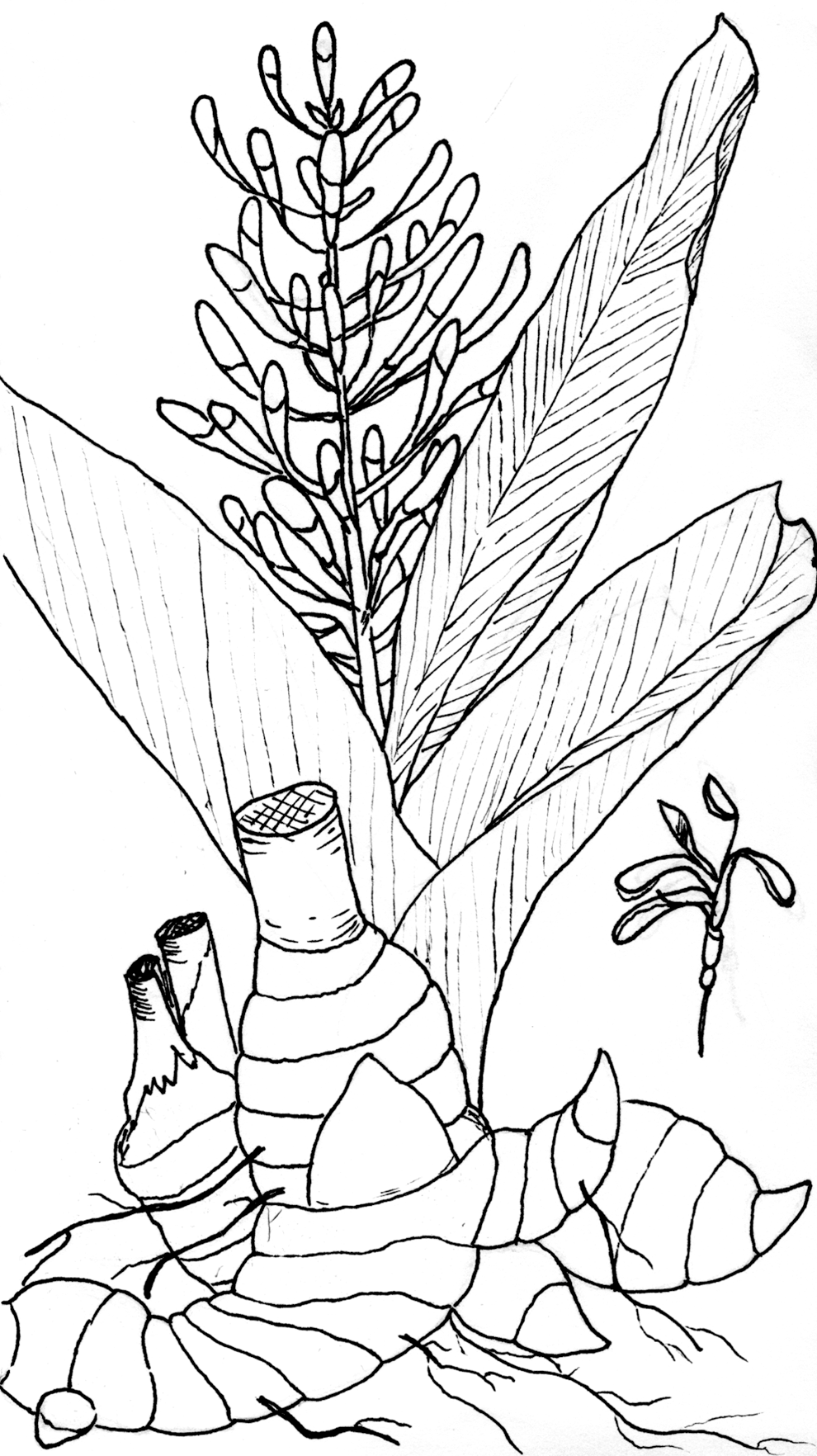
Lesser galangal is a traditional Chinese and indeed Asian medicine widely reputed to alleviate nausea and motion sickness. 31 Diarylhepatonids (curcumin-like compounds), flavonoids, and one sterol compound were all found to contribute to the antiemetic effect of lesser galangal in one animal study. 32 Similar compounds in A. katsumadai (Hainan or Katsumada galangal) and ginger have been shown to have antiemetic properties. 33 No clinical trials were identified regarding the efficacy of any species of Alpinia for motion sickness. Doses of tincture are 1–2 ml taken at least 30 min (and ideally 1 h) before travel commences, repeated every 2–4 h. Optionally, tea can be used, but this is not usually convenient during travel. Capsules are not widely available. Granules could be used to make instant tea; the dose is 1–3 g tid or more frequently as needed.
Many species of Curcuma have potential value for prevention and treatment of motion sickness. Black zedoary, also known as kali haldi (“black turmeric”), is a relative of C. longa (turmeric). Unlike turmeric with its orange rhizome, black zedoary has a blue-black rhizome. It is native to the central and northeastern portions of India. Preclinical studies confirm that a tincture of black zeodary shares the anti-emetic properties seen in so many members of the Zingiberaceae family. 34 Again, clinical trials are lacking, but this promising medicine should be studied further.
White zedoary has white-yellow rhizomes (paler than the bright orange of C. longa) and has a strong traditional use very similar to that of ginger. 35 C. amada (mango ginger) rhizome is used both as a food and multifunctional medicine, including to settle the stomach. 36 No relevant clinical trials were identified, but absence of evidence does not prove absence of activity. Both black and white zedoary can be dosed similarly to ginger.
Renealmia alpinia (ixquihit, naiku, jazmín de monte, misk'i p'anqa) is a medicinal Zingiberaceae species native from Mexico to South America. Though it is famous as a remedy for snakebites, it is also well-known as an antiemetic to traditional healers. 37,38 Its chemistry and mechanisms of action have been little researched, and no clinical trials were identified. The rhizome and leaf are used and are dosed similarly to ginger.
Mints Against Motion
A third botanical family containing many herbs useful against motion sickness is the Lamiaceae or mint family. Mentha x piperita (peppermint), which is a hybrid between M. aquatica (water mint) and M. spicata (spearmint), both Eurasian natives, is one of the most popular and widely available in North America, but spearmint itself is probably just as useful. Other mint-family antiemetics are listed in Table 1.
All herbs should be started 30–60 min before travel and continued every 2–4 h during travel.
Yang Y, Kinoshita K, Koyama K, et al. Anti-emetic principles of Pogostemon cablin (Blanco) Benth. Phytomedicine 1999;6:89–93. bPrakash P, Gupta N. Therapeutic uses of Ocimum sanctum Linn (Tulsi) with a note on eugenol and its pharmacological actions: a short review. Indian J Physiol Pharmacol 2005;49:125–131.
Peppermint steam-distilled volatile oil and (–)-menthol, a primary monoterpenoid in the oil, help relieve motion sickness and other types of nausea and vomiting in part because they are 5-HT3 antagonists and calcium channel antagonists, and by blocking tonic production of acetylcholine in gastric neurons. 39,40,41
Peppermint and other mint-family volatile oils represent a particularly promising approach because they can be inhaled, bypassing the stomach altogether. Oral treatments of even helpful medicine can, if given in too large a volume, trigger stretch receptors in the stomach and trigger nausea. Inhalation therapy avoids this risk. Postoperative inhalation of peppermint oil was as effective as intravenous ondansetron or promethazine suppositories in one preliminary trial in women who had just undergone Cesarean sections and had anesthetic-related nausea. 42 Another large (n=301) randomized trial found that a blend of spearmint, peppermint, ginger, and cardamom volatile oils significantly reduced postsurgical nausea and vomiting, limiting the number of patients who needed rescue medication, compared to an isopropyl alcohol control. 43 Although these are not trials in patients with motion sickness, they do demonstrate a significant effect from inhaled volatile oils and support the empirical observation of the benefits of this treatment in motion sickness.
Oral use of peppermint and spearmint volatile oils is also antiemetic. In one trial of patients undergoing cancer chemotherapy, peppermint or spearmint 2 drops (in capsules filled with sugar) 30 min before and 4 and 8 h after each chemotherapy dose significantly reduced severity and incidence of nausea and vomiting compared to placebo in one trial. 44 Again, these results do not directly prove efficacy in motion sickness, but suggest oral use of mint oils as an alternative to aromatherapy may be effective in that setting.
Typical dosing of peppermint or spearmint starts 30 min before travel. Either the patient should inhale the oil of one of these oils (or a combination of the two) or take 2–3 drops (in a blank capsule or directly in the mouth). This should be repeated every 2–4 h depending on the patient's response. Optionally, tincture can be used at a dose of 1–2 ml of either herb on the same dosing schedule. They are generally very safe, but oral use can trigger or exacerbate heartburn in some patients.
Conclusion
One of the major drugs in the world for motion sickness is scopolamine, a natural product. The whole herbs that contain this and related alkaloids from the Solanaceae family include belladonna and henbane, which are also effective at treating motion sickness, though clinical trials are lacking. The best-studied herbal medicine for motion sickness, ginger, shows great promise and is both inexpensive and safe. Many other members of the Zingiberaceae family are also antiemetic based on historical and current clinical use, though research on them lags behind their utility. Finally, the Lamiaceae (mint) family contains many antiemetic members. Best studied are peppermint and spearmint oils, which can be used by inhalation or oral intake, for all types of nausea and vomiting (trials specific to motion sickness are lacking, but they are empirically valuable). These tools expand the therapeutic armamentarium against this common problem and should be further researched.