







Abstract
Abstract
Background:
Appropriate safety measures need to be implemented during acupuncture treatment to ensure protection of both patients and practitioners.
Objective:
The aim of this article is share information about the safety culture of the Acupuncture Services in the Pain Management Centre of Singapore General Hospital (SGH).
Methods:
Acupuncture-related adverse events are prevented by adopting stringent standards of safety culture and practice with rigorous auditing in the following aspects: patient and staff education; an infection-control protocol; standardization of treatment services delivered by accredited Traditional Chinese Medicine (TCM) physicians; obtaining consent for procedures; proper procedure documentation and record-keeping; and discharge advice and follow-up plans.
Results:
Over the past 14 years, the SGH Acupuncture Services maintains zero incident and adverse-event rates for a total of 68,504 acupuncture treatment sessions. The total number of patients increased from 1822 (1998–2002) to 2195 (2008–2011), and daily patient numbers increased from 10 (1998–2002) to >25 (2008–2011) patients. Besides clinical work, four articles were published in peer-reviewed scientific journals, and four research projects are still ongoing.
Conclusions:
Through robust safety practice and culture with continuing education and staff professional development, the SGH Acupuncture Services ensures minimal adverse events and infection rates while delivering competent clinical services. The authors wish to share their experience with other TCM practitioners, in the hope that some aspects of this report can be incorporated into their every day practices—safe, standardized, and evidence-based TCM.
Introduction
Acupuncture has been practiced as a method of healing from the Zhou Dynasty (the Warring States Period) to the Qin-Han Dynasty (500–200
Acupuncture has been used in Singapore for more than 100 years. Major issues in using acupuncture as a complementary or alternative therapy include a lack of standardization and professional guidelines for acupuncture services. In 1995, the Ministry of Health in Singapore set up an Acupuncture Research Clinic and Committee to evaluate the efficacy and safety of acupuncture. 5 Following that, Acupuncture Units were set up in Singapore General Hospital (SGH) and at National University Hospital in 1998. After the establishment of the Traditional Chinese Medicine Practitioner Board (TCMPB) in 2001, Singapore and China had also signed an agreement to exchange knowledge of acupuncture from China with expertise in health care management from Singapore. Currently there are 200–300 TCM students graduating in Singapore every year. As of TCMPB's report of 2011, there was a total of 2679 Traditional Chinese Medicine (TCM) practitioners registered with the TCMPB Board, with 1198, in registered as both TCM physicians and acupuncturists. The data for 2012 were not issued as of this writing. Less than 1% of these practitioners were working in Western medical hospitals.
In 2010, according to the Singapore TCMPB's annual report, 6 5 complaints against registered TCM practitioners were reported. With the support of statutory declarations or public officers, the TCMPB also looked into 5 complaints deferred from 2009 for decisions. Inquiry regarding 1 case was initiated in 2010 and was continued in 2011. A High Court appeal initiated by a TCM practitioner against the Board's decision in 2008 was concluded in 2010.
SGH is the biggest Western medical hospital in Singapore.The Acupuncture Unit (AU) was set up in 1998 under the purview of the hospital's the Department of Neurology. Based on data from 2008 to 2011 ∼69% of patients (Table 1) referred to this unit had pain conditions, including neck pain, lower back pain, and chronic headaches. Two thirds of the referrals were co-managed with physicians from the hospital's Pain Management Clinic, leading to the merging and establishment of the Pain Management Centre (PMC) in 2007. Other conditions managed include stroke, Bell's palsy, and insomnia.
Other conditions include stroke, weakness, spasticity, insomnia, etc.
The objective of the article is to describe the safety culture practice in the Acupuncture Services Clinic, in the PMC of SGH, with an emphasis on patients and staff education, infection control, consent taking, procedure documentation, discharge advice, and follow-up plans. The goals are to share these experiences with safety culture practiced in an acupuncture service at a tertiary hospital in Singapore with other acupuncturists and TCM practitioners, to assess the risks and help practitioners implement practical strategies for the safety and prevention of complications, and strengthen standardization and modernization of acupuncture, thus, ensuring professional delivery of care and treatment.
Methods
The occurrence of adverse events in acupuncture is extremely low, although life-threatening events can still occur (e.g., pneumothorax.)2,3 With the use of disposable needles, the risk of transmission of bloodborne infections (hepatitis B, hepatitis C, and human immuodeficiency virus) is negligible. In line with the hospital's high safety standards—through various rigorous audits such as that of the Joint Commission International—a stringent safety culture and practice has been maintained. The following sections discuss particular aspects of this safety culture and practice.
Patient Education
Acupuncture pamphlets are available in Chinese and English for providing patients with acupuncture information at the PMC. Patient education on exercises is carried out according to instructions by physiotherapists. Lifestyle advice is also given to patients according to TCM principles.
Staff Continuing Education
All staff members must attend the hospital and department educational courses—including General Orientation, Service Hearts (a program for new staff members that teaches them now to serve patients with “heart”), Quality Mind, Living 5Cs, (Compassion, Committment, Communication, Collaboration, Consistency). Basic Cardiac Life Support (BCLS), Infection Control, and Basic Life Support—within 2 months of their employment. Staff members are also encouraged to attend the hospital's continuing medical education (CME) programs, monthly mortality and morbidity rounds, weekly teaching sessions organized by the department, and national or international medical conferences. Although not a requirement of the TCMPB, SGH's acupuncturists must accumulate at least 25 hours of CME a year.
All staff members must have well-defined job descriptions (Appendix 1). Staff members are tested on their knowledge of how to carry out Services of Acupuncture and Sharps Injury/Blood Exposure (Appendix 2) procedures, and how to withdraw needles correctly according to the Acupuncture Needle Removal Competency Checklist (Appendix 3) to maintain professional standards.
Our acupuncturists must, at all times, maintain an acceptable standard of safety for the benefit of patients, colleagues, and themselves. They will also have to pass a competency assessment. All acupuncturists must meet the safety criteria (2 points) and attain at least satisfactory ratings for all the rest of the criteria (13/21 points).
Newly employed acupuncture assistants and patient care assistants (PCAs), must complete a 6-month health care course and obtain a Workforce Services Quality Certificate in Healthcare Support or the ITE Skills certificate in Healthcare. The course enables PCAs to gain familiarity with the health care environment of the hospital and perform basic health care–related duties for the patients. This includes: applying legal and regulatory procedures in a health care setting; measurement and recording of patient's vital signs; assisting a doctor in physical examinations; giving patients oxygen therapy; and performing cardiopulmonary resuscitation (adult 1-person CPR). One month of work training in the Acupuncture Services is required. This training includes the basics of TCM and provides knowledge of acupuncture and its procedures. PCAs also undergo regular quality checks according to various checklists, such as the Acupuncture Needles Removal Competency Checklist and Job Description.
Infection Control
In addition to using sterilized single-use needles for patients, all staff members must follow the SGH Infection Control protocol strictly. The protocol includes the five moments of hand hygiene, such as: (1) before patient contact; (2) before performing an aseptic task; (3) after body-fluid exposure risk; (4) after patient contact; and (5) after contact with patient surroundings. There are also eight steps for hand hygiene (Appendix 4) with soap and water, and using a 75% alcohol swab to sterilize each patient's skin around the area of acupuncture points before acupuncture treatment. Staff members are also trained to discard used needles into a sharps container immediately and to discard all other waste materials into the appropriate waste bins. Risk Management System reporting must be submitted to the hospital if any staff member is injured by sharp needles, and the staff member must see a doctor, undergo blood tests to prove that he/she is still able to continue clinic work safely. Otherwise he/she will be given further treatment for the injury and any sequlae.
Standardization of Procedures, Protocols, and Service Delivered by a Trained Accredited TCM Practitioner
The acupuncturist must have a Bachelor of Chinese Medicine degree and be a fully registered TCM physician in Singapore with a Certificate of Basic Cardiac Life Support. Any newly employed acupuncturist must finish 6 month of basic acupuncture clinical training. The acupuncturist will then be assessed, via the Competency-Based Assessment (Appendix 5), for working knowledge and ability to ensure that the staff member is able to formulate treatment plans holistically for patients and communicate with them effectively. Competency-Based Assessment is performed once per year, and if competency is not achieved by a staff member, he/she will have to identify and rectify any problem areas. The acupuncturist will then be able resume work only after passing a reassessment.
Obtaining Consent, Procedure Documentation, and Proper Record Keeping
All patients are asked to make an appointment with a referral letter. Referral must be made by a registered doctor, indicating the patient's clinical diagnosis, relevant history, and current medications. Patients are required to book appointments to see the acupuncturist. Patients are also required to register at the counter upon arrival. Each patient's blood pressure (BP), heart rate (HR), and temperature are taken and recorded by the nurse prior to consultation with the acupuncturist. Then the acupuncturist will evaluate the patient, and formulate and discuss a treatment plan with the patient.
Informed consent is obtained prior to treatment, and patients are always fully informed about their treatment options, expected prognosis and, relative risks.2,3,7,8 The acupuncturist will complete the Acupuncture Services Assessment Form, which includes patient information, such as name, address, main complaint, related medical history and previous treatments, current physical examination findings, aggravating and relieving factors, TCM diagnosis, current acupuncture treatment, and treatment plan. The form is then included into the patient's medical record and kept for 3 years.
A course of acupuncture treatments generally involves 5 sessions, with an average of 1–2 sessions per week and 30 minutes for each session. For acute cases, acupuncture treatment may be given more than 2 times per week. During the acupuncture treatment, most patients will receive needling, some will receive electroacupuncture (EA), cupping, and/or heat treatment in addition to needling. During and after treatment, patients are monitored closely by the acupuncture assistant or nurse, who informs the acupuncturist if the patient is experiencing any discomfort. Needles are removed while pressing the areas that were needled gently with sterile cotton balls when treatment is finished. The number of the needles removed is checked to ensure that this number corresponds with the number of the needles inserted. Table 2 shows Acupuncture Workflow and Policy. Upon completion of a course, a patient will be then reviewed to assess the outcome and discuss any further treatment plans. Figure 1 shows the Acupuncture Services Process Map.
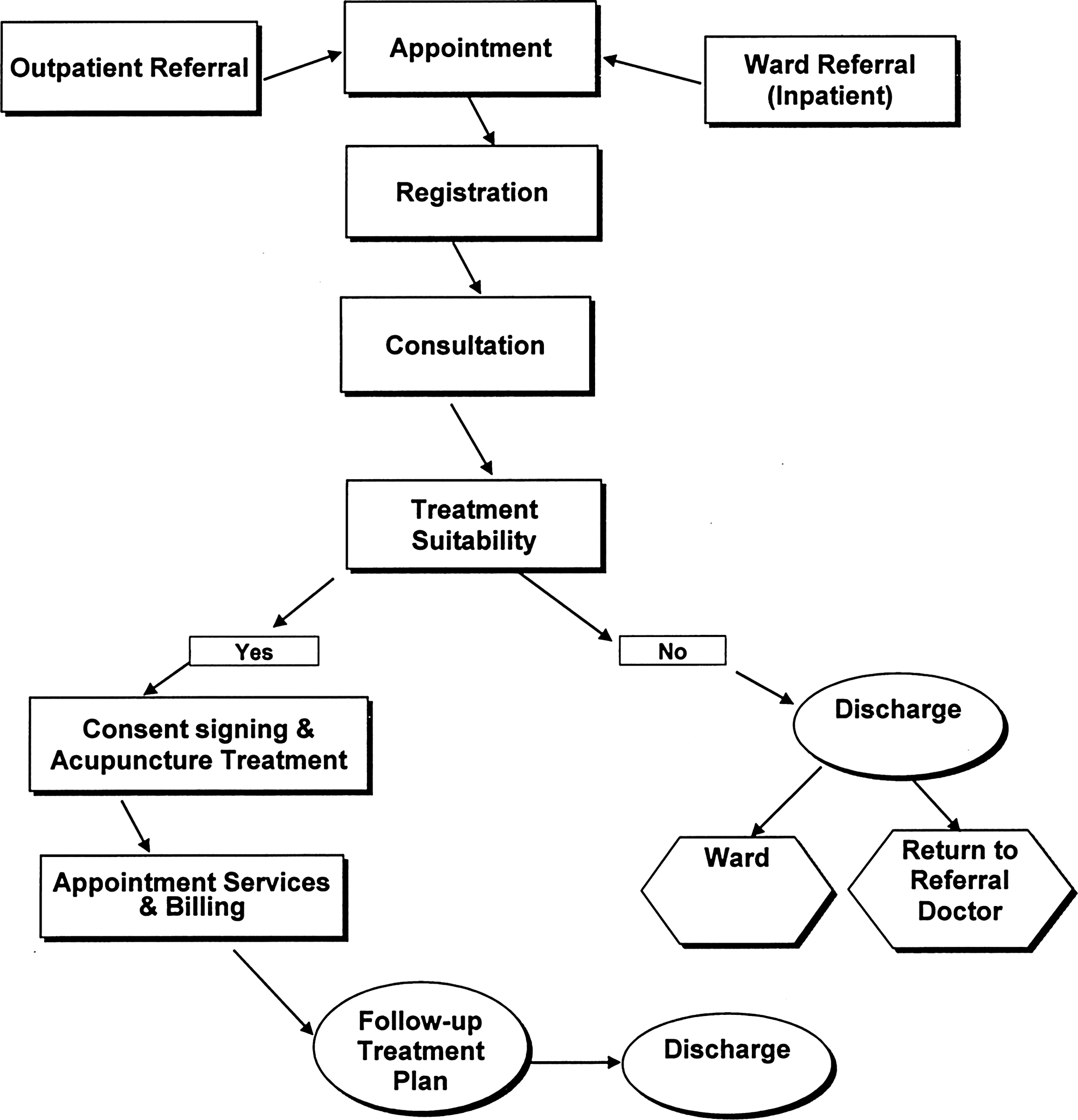
Acupuncture service process map.
SGH, Singapore General Hospital.
Discharge and Follow-Up Plans
Patients are discharged if they meet the following criteria: patient's conditions resolve within 5 sessions, patients' conditions improve significantly after a course; or patients are unable to continue treatment. Examples of conditions for discharge are as follows: absence of pain or reduction of pain of >60%; patients with insomnia sustaining good sleep for >6 hours; and patients with stroke having stabilized conditions and being able walk with some assistance. For patients whose conditions improve after a course, but who still need more treatment, further treatment is arranged. Patients who have no improvement or minimal improvement of <10% after 5 sessions of treatment will be referred back to their doctors or specialists for further treatment options. Patients are scheduled for a review appointment within 1 month after completion of treatment to review their management plans further.
Systems Upgrade and Equipment Safety Maintenance
Since its inception, the Acupuncture Service in PMC continues to also improve its treatment devices and administrative workflow processes. Electronic patients' appointment and reminder systems have been implemented. There are two consultation and four treatment rooms. In each treatment room, there is a Teding Dianchibo Po (TDP, in Chinese; Special Electro-Magnetic Therapeutic Apparatus) lamp* and an EA machine. There are also resuscitation equipment, defibrillators, oxygen delivery outlets, and BP and HR monitoring equipment installed in the same room. Sterilized single-use needles and devices are approved by Health Science Authority and all equipment is checked yearly by the Department of Biomedical Equipment. Measures to ensure patient safety and prevention of infection are also instituted.
Results
Over the past 14 years, 68,504 acupuncture treatment sessions have been carried out in the Acupuncture Services Clinic in PMC. Table 1 shows the results of acupuncture patients from 1998–2011 in SGH. From 2008 to 2011, 2195 patients received acupuncture, Among these patients, 82% were Chinese, 9% were Indian, 4% were Malay, and 5% were others; and 61.5% were females; 97.1% were outpatients; and 2.1% were in-patients. The reasons for referrals included: pain relief (69%), numbness and weakness (post–acute-stroke rehabilitation; chronic spasticity with weakness (16%); and others (14%). For patients referred for pain management, the average pain durations were: >10 years (6%); 5–9 years (15%); 2–5 years (30%); 1 month–1year (37%); and within 1 month (12%). Payment modes were: covered by government (31%); covered by employers (17%); payment covered by insurance (1.2%); and self-payment (51%).
There was a significant trend of an increasing number of patients visiting the Acupuncture Services over time (1998–2002: 1822 patients; 2003–2007: 2685 patients; and 2008–2011: 2195 patients; Table 3). The total number of treatment sessions over the years has also had increasing trend (1998–2002: 18,497 treatment sessions; 2003–2007: 26,621 sessions; and 2008–2011: 23,386 sessions). The daily number of patient cases was also increasing over the years (1998–2002: 10 cases/day; 2003–2007: >20 cases/day; and 2008–2011: >25 cases/day). Although there was an increasing trend of patient load over time, safety was not compromised,as indicted by the data for infection cases, broken-needle cases, adverse events, and needle-injury cases. The occurrence of these adverse events has always been maintained at zero, which has highlighted the safety culture and practice in the PMC.
AEs, adverse events.
In addition to providing clinical services, some acupuncture-related research articles were published in peer-reviewed scientific journals from 2003 to 2010.8–11 Another four research projects are still ongoing, including one project that involves evaluating the effect of acupuncture therapy for improving semen parameters and sperm's fertilizing ability. The preliminary study results have shown a significant linear increase of sperm's fertilizing ability (p<0.001) after treatment (data not shown).
Discussion
Acupuncture is part of TCM and has been an age-old traditional therapeutic method practiced in Singapore. It faces the same problems as TCM, including lack of practice standardization and guidelines.1–4 With the support from the Singapore Ministry of Health, an Acupuncture Research Clinic and Committee was set up in 1995; thus, the efficacy and safety of acupuncture were then evaluated properly in Singapore. In 1998, Acupuncture Units were set up in two Western medical hospitals in Singapore: Singapore General Hospital (SGH) and National University Hospital.
Over the years, being in a Western medical hospital environment, the Acupuncture Services Clinic in SGH has implemented a stringent safety culture and practice, and the practice was continually refined through various rigorous audits such as that conducted by the Joint Commission International. Good treatment outcomes were achieved with respect to adverse events and infection rates kept at very low levels.
In Singapore, there are <1% of the 2540 TCMPB-registered TCM practitioners working in Western medical hospitals. The safety culture and practice standard of TCM clinics varies and did not meet expect standardization criteria. 6 It is therefore important to share the SGH experiences in safety culture and practice with other acupuncturists and TCM practitioners inside and outside Singapore, to emphasize on the importance of assessing safety risks, implementing practical safety strategies, preventing complications, strengthening standardization, modernizing acupuncture, and ensuring professional delivery of care.
The aspects that the SGH safety culture and practice particularly emphasizes are patient and staff education; infection control; standardization of procedures, protocols and services delivered by trained accredited TCM practitioners; obtaining consent and procedure documentation2,7; discharge and follow-up plans; and, finally, systems upgrades and equipment safety maintenance.
Patient education keeps patients well-informed about their conditions and treatments, therefore minimizing possible doubts and queries from patients, allowing acupuncturists to conduct treatment and manage patient confidently. Staff continuing education enables the SGH staff to maintain high professional standards and up-to-date knowledge in terms of not only clinical skills and knowledge, but also service quality and safety. This practice raises and maintains a high level of professionalism among all members of the SGH staff.
Implementing and following strictly the SGH Infection Control protocol plays a major role in reducing infection risks and incidents. This is complemented further by the implementation of standardization of procedures, protocols, and services provided. Standardized protocols ensure that patient treatments are maintained with safety and efficacy. This then translates to safer and better patient experiences as well (see Table 2). SGH acupuncturists are assessed yearly with a Competency-Based Assessment, which encourages them to maintain high levels of competency in their practices consistently.
Detailed documentation of procedures and implementation of discharge and follow-up plans require concise recording of patients' case notes. It is important for treatment efficacy during each follow-up session and also maintains treatment safety by preventing safety-related incidents, such as wrong-site treatment. Such documentation is also important when patients are treated by different acupuncturists for different follow-up sessions; this documentation maintains a high-level of treatment follow-up continuity.
Via consistent systems upgrade, such as electronic patients' appointment and reminder systems, the SGH hospital system facilitates the entire process of treatment and increases patient care efficiency. Equipment is constantly monitored and maintained by regulatory bodies such as the Health Science Authority and the Department of Biomedical Equipment of SGH. These measures ensure that safety is not compromised during treatment.
Utilizing a multipronged approach involving the abovementioned aspects, the SGH Acupuncture Clinic has managed to inculcate and maintain a high standard of safety culture and practice that has become second nature to the staff especially during treatment procedures. The most obvious result was seen in the increasing number of patients and treatment sessions over the past 14 years that SGH had, yet maintaining a zero-incident rate in the Acupuncture Services Clinic, as mentioned in the Results section. This trend of increasing patient and treatment load in our clinic corresponds to the SGH implementation of its safety culture and practice. This possibly suggests that that the SGH approach of safety culture and practice in the acupuncture clinic helps to: (1) facilitate efficient clinical work flow while always maintaining high levels of safety; (2) lead to higher levels of treatment efficacy and efficiency; and, (3) finally, result in increasing patient loads. This also possibly suggests that implementing a good safety culture and practice instills in patients a higher level of trust and confidence in not only the practitioners but the treatments as well, leading to higher levels of patient compliance, therefore, also possibly producing higher treatment efficacy and efficiency.
It is very common for practitioners to find it particularly hard to allocate time for research in their often crowded clinical work schedules. Therefore, maintaining a high standard in safety culture and practice resulting in higher efficiency in the SGH clinical work flow enables the acupuncturists to find time to partake in academic research in addition to their clinical work. Participating in research is key, because it allows the acupuncturists to continually bring new knowledge from the bench to the bedside and vice versa. This also allows them to be continually updated with the latest improvements and updates in the field of acupuncture and medicine which are always ever-changing.
As seen, by implementing a robust safety practice and culture with the emphasis on continuing education, staff professional development, teamwork, and clinical competency has resulted in higher work efficiency and treatment efficacy. In addition, the SGH Acupuncture Services Clinic has evolved, raised, and modernized the professional standards in acupuncture practice more, compared to what has occurred in average TCM and acupuncture clinics in Singapore.
The authors of this report hopes that sharing the successful SGH experience with other TCM practitioners and acupuncturists will be useful. In addition, there are practical solutions and suggestions further improvement:
(1) Implementation of continuing education for staff members (2) Certification of Basic Cardiac Life Support (including Cardiac Pulmonary Resuscitation) and strict licensing standards as a required part of each practitioner's yearly competency assessment (3) Usage of sterile, disposable needles should be made compulsory by government regulations (4) Adoption of full responsibilty on the part of practitioners for evaluation of their treatment services (5) Implementing regular clinical audits conducted by appropriate regulatory bodies, including assessments of patient safety and patient satisfaction (6) Obtaining informed consent from patients and ensuring that patients are fully informed about their treatment options, expected prognoses, and relative risks as well as providing information on safe practices (7) Maintaing appropriate documentation in medical records and retaining such records for 3 years (8) Implementing compulsory standardised health check-ups, especially for bloodborne diseases, such as hepatitis B and HIV infection, for all practitioners.
Conclusions
In the past decade, acupuncture has seen substantial development in several aspects: TCM doctors are adopting a more-scientific approach in their practices; Western doctors and researchers are recognizing that acupuncture can offer an alternative treatment for difficult cases; and patient safety is becoming of paramount importance in acupuncture and TCM.
Acupuncture treatment has been modernized in SGH over the years. With the robust safety practice and culture, plus the emphasis on continuing education and staff professional development, SGH has been able to nurture good teamwork, provide competent service, keep adverse events and infection rates at very low levels, and obtain good treatment outcomes. The authors hope that sharing this information could provide other practitioners and institutions ideas so that some aspects of the practice can be incorporated into their routine work in a more standardized and evidence-based manner, while maintaining the fundamental tenets of this ancient therapy.
Footnotes
Acknowledgments
The authors acknowledge all other staff members of the Department of Pain Management Center at SGH for logistical support and the patients who made this report possible.
Disclosure Statement
The authors declare that no financial or other relationships that might lead to a conflict of interest exist.
Appendix 1
Permission granted to use chart from Singapore General Hospital.
Slight adaptations were made in format.
Appendix 2
Name of Staff:___________________ Date of Audit:_____________________
Clinic:__________________________ Name of Assessor:_________________
Appendix 3
Appendix 4
Permission granted to use chart from Singapore General Hospital.
Slight adaptations were made in format.
Appendix 5
Name of Acupuncturist:______________ Employee Number:_________ Date:________
Supervisor:______________
Case Procedure:____________________________________________________________
♦
Maintained acceptable safety and hygiene standards for patients, colleagues and self at all times:
If
________________________________________________________________________________________________
________________________________________________________________________________________________
________________________________________________________________________________________________
________________________________________________________________________________________________
________________________________________________________________________________________________
If competency is not achieved, identify areas to be improved and reassess in 2 weeks' time
________________________________________________________________________________________________
________________________________________________________________________________________________
________________________________________________________________________________________________
*
An infrared therapeutic device invented in China in 1980.