







Abstract
Abstract
Background:
Gastrointestinal (GI) reactions to chemotherapy affect quality of life (QoL) of patients who have tumors seriously, and commonly used antiemetic drugs cause many adverse side-effects.
Objective:
The aim of this study was to assess the preventive effects of wrist–ankle acupuncture (WAA) plus ginger (Zingiber spp.) moxibustion (GM) on GI reactions to chemotherapy.
Materials and Methods:
Design: Sixty patients with gynecologic tumors were recruited and treated with chemotherapy and randomly divided into treatment and control groups. Intervention:Patients in the treatment group were given WAA plus GM during 3 days of chemotherapy and 2 days after chemotherapy. Patients in the control group were given tropisetron hydrochloride and dexamethasone intravenously, on a daily basis, ∼30 minutes before chemotherapy. Main Outcome Measures: The GI reactions of the two groups were evaluated and compared during 3 days of chemotherapy and 2 days after chemotherapy. Reduction of GI reactions (nausea, vomiting, and constipation) to chemotherapy were evaluated via a scoring system. The two groups were compared on the basis of treatment cost, drug safety, and QoL improvement.
Results:
The frequency of nausea was significantly lower in the treatment group than in the control group on days 2–5 of chemotherapy (P<0.01). The antiemetic effect in the treatment group was better than that in the control group on day 3 of therapy (P<0.05). Moreover, the incidence rate of constipation and the cost of antiemetic measures were significantly lower in the treatment group than in the control group (P<0.01).
Conclusions:
WAA plus GM prevented GI reactions to chemotherapy significantly. This treatment is more safe and economical than antiemetic drugs.
Introduction
C
Acupuncture, a widely used traditional therapeutic method in China, has become a vital area of research in Western countries and has gradually gained acceptance from physicians as an alternative therapy after clinical studies and basic research have demonstrated its efficacy. 8 Scholars, locally and abroad, dedicated themselves to conduct and promote acupuncture, and innovations in routine acupuncture surfaced through the decades; these innovations include treatments for neck pain, 9 chronic knee pain, 10 and pressure ulcers.11,12 Wrist–ankle acupuncture (WAA), a new subcutaneous shallow acupuncture that is retained in the skin, was developed by Professor Xinshu Zhang, LAc in the 1970s. 13 WAA can adjust the nerves on multiple levels to balance or restore normal nerve function and address various problems throughout the body, 14 especially digestive symptoms, although needles are only placed on the wrist and ankle. Ginger (Zingiber spp.) moxibustion (GM), a thermal stimulation performed by burning dry mugwort (Artemisia spp.) on a piece of ginger at an acupuncture point, 15 is typically used on the Shenque (CV 8) acupoint to warm, tonify, and nourish the Qi of the Conception Vessel and the Governor Vessel. This method controls nausea and vomiting, as well as regulating GI function. 16 However, the preventive effects of WAA plus GM on GI reactions to chemotherapy remain unclear to date. Therefore, this study was conducted to assess the alleviating effects of WAA plus GM on the symptoms of GI reactions to chemotherapy.
Materials and Methods
This positive controlled clinical trial had a random, open, and parallel design and was performed in a 10-month period between March 2012 and December 2012 at the Gynecologic Department of Traditional Chinese Medicine, at Changhai Hospital, Second Military Medical University, in Shanghai, China. The aim and methods of this pilot study were explained to the patients before the the experiment was conducted. Voluntary participation was requested, and informed consent was obtained in accordance with local and international guidelines.
A total of 60 female patients ages, 48–70, with gynecological tumors (ovarian, cervical, or endometrial cancer) as demonstrated by pathology or cytology testing were recruited. These participants had Karnofsky scores higher than 60 points, had more than 3 months of expected survival, and had received similar chemotherapy regimens (docetaxel plus carboplatin). Exclusions were patients with functional damage of the liver, kidneys, or heart; diseases (brain metastasis, high intracranial pressure, and digestive-tract obstruction) that can induce vomiting or seriously complicate vomiting; and damaged or inflamed navels or other conditions (mental abnormalities) that rendered the patients unable to follow the treatment. Each enrolled participant was given a random number that had been developed, using the complete randomization of SPSS (version 18.0) software by personnel who were not directly involved in the studay, and then the subjects were distributed into the treatment or control groups at a proportion of 1:1. The trial was open to the patients and doctors but blinded to the statistics personnel.
Patients in both groups received a 3-day chemotherapy regimen, namely, docetaxel (75 mg/m2) and carboplatin to an area under the curve of 5. Glutathione or famotidine was routinely administered intravenously (IV) to protect the function of the liver or stomach, respectively, whereas dexamethasone was administered orally to prevent allergy prior to chemotherapy.
WAA plus GM treatment was performed on the patients in the treatment group (n=30) during the 3 days of chemotherapy and 2 days after chemotherapy. The WAA was performed 30 minutes before chemotherapy. For the WAA, an acupuncture needle (diameter: 0.25 mm; length: 25 mm; Hwato, Suzhou, China) was inserted subcutaneously ∼23 mm deep at a 30° angle and was retained for the entire course of the treatment. Figure 1 shows the acupuncture points at the upper bilateral point 1. GM was administered 5 minutes before chemotherapy. For GM, a piece of ginger (diameter: 5 cm; thickness: 0.5 cm) with several pinholes (diameter: 2 mm) in the center, with a burning mugwort (length: 3 cm) on it (Fig. 2) was fixed on the Shenque acupoint (the navel) of each patient, who was lying in a supine position. The ginger was fixed using a breathable tape and lasted for 12 hours after the mugwort burned out.
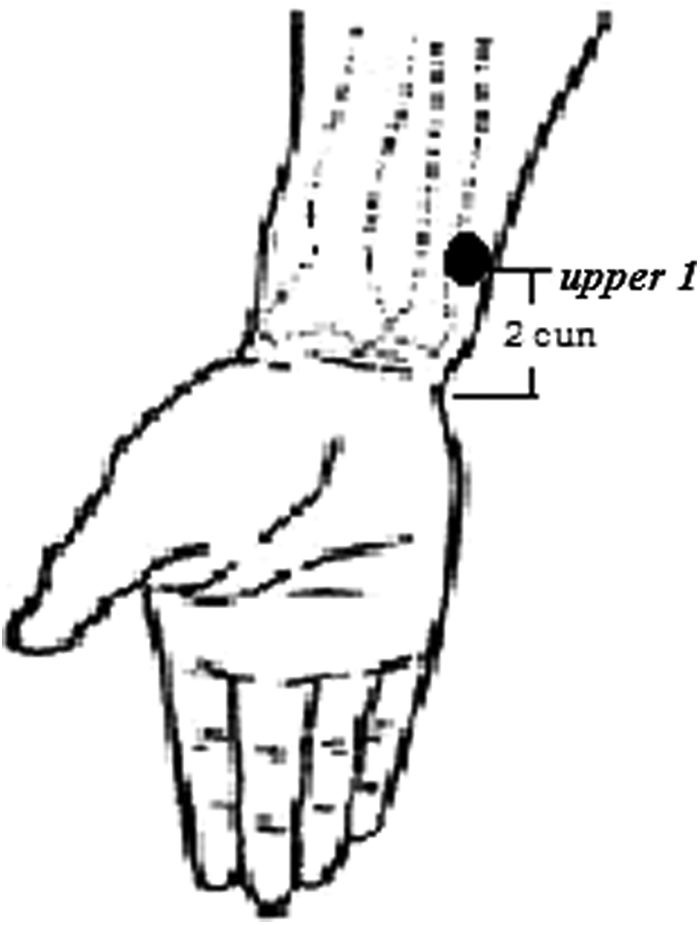
Wrist–ankle acupuncture. The acupuncture points were located at the upper bilateral point 1, referring to the indentations between the ulna near the little finger and the tendon of the ulnar flexor carpi, 2 cun (1 cun=1/3 decimeter) above the bilateral transverse wrise crease.
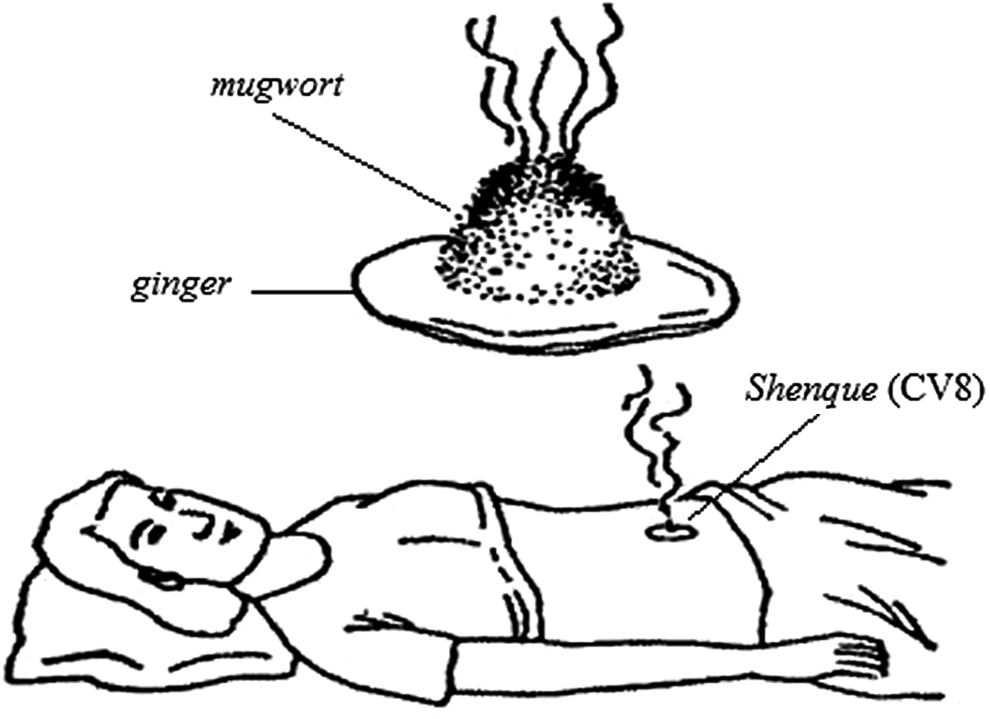
Ginger (Zingiber spp.) moxibustion (GM). GM was performed on the Shenque acupoint (CV 8, the navel) of the patient, using a piece of ginger (diameter, 5 cm; thickness, 0.5 cm) with several pinholes (diameter, 2 mm) in the center and a burning mugwort (Artemisia spp.) (length, 3 cm) on it. Extreme caution was applied to avoid empyrosis during the process and the ginger was fixed with breathable tape and lasted for 12 hours after the mugwort burned out.
The WAA and GM were both administered by professional acupuncturists who had >10 years of practical experience. Extreme caution was applied to avoid some AEs, such as needle sickness and scalding during the process.
Patients in the control group (n=30) were given IV administrations of 5 mg of tropisetron hydrochloride (TH) and 2.5 mg of dexamethasone (DXM) in 100 mL of saline solution on day 1; and 5 mg of TH and 5 mg of DXM on days 2 and 3, ∼30 minutes before each chemotherapy.
Indices of nausea, vomiting, and constipation were obtained in accordance with internationally recognized scoring criteria and were analyzed using SPSS (version 18.0). The unordered categorical variables were between the groups using the χ2 test. The Mann–Whitney U test and the t-test were used to compare the ordinal and numerical categorical variables between the two groups, respectively. Statistical significance was considered to be at P<0.05. Other AEs, such as dizziness, ecchymosis, and abdominal distension, were also observed. The total cost of antiemetic treatment was also compared between the two groups.
Results
None of the participants were rejected halfway through the trial. Baseline data on diagnosis, age, Karnofsky score, body mass index (BMI), and disease cases between the two groups were not significantly different (Table 1). The frequency of nausea on days 2–5 of chemotherapy was significantly lower in the treatment group than in the control group (P<0.01). The difference between the two groups on day 1 was not significant (P=0.655); vomiting was equally reduced in both groups, especially on day 3 of chemotherapy (P=0.013). The treatment group showed a significantly lower incidence of constipation than the control group (1/30 versus 12/30; P=0.002).
SD, standard deviation; BMI, body mass index.
In addition, fewer AEs were observed in the treatment group than in the control group. The treatment group had only 1 case of subcutaneous hematoma after acupuncture treatment (1/30; 3.3%), and the condition of the patient improved after hot compress treatment. In the control group, 3 cases of dizziness (3/30, 10%) and 4 cases of abdominal distension (4/30, 13%) were observed (Table 2).
Nausea scoring (according to NCI-CTC v4.0): "0", no nausea; "I", nausea but not affect the QOL; "II", nausea and significantly affect the QOL; "III", patients who had to remain in bed for rehydration. Vomiting scoring (according to NCI-CTC v4.0): "0", no vomiting; "I", vomiting once or twice daily; "II", vomiting 3 to 5 times per day; "III" for vomiting more than 5 times per day or electrolyte disturbances and dehydration. Constipation scoring (according to Rome III): "I", at least 25% of defecation is taxing; "II", at least 25% of the feces are hard or blocked; "III", at least 25% of the defecation felt endless to the patient; "IV", at least 25% of the defecation made the patient feel an anal or rectal obstruction; "V", at least 25% of the defecation required artificial auxiliary methods; "VI", defecation occurs less than 3 days a week. Treatment group versus Control group, *P-value<0.05.
Notably, the total cost incurred by the treatment group was significantly lower than that of the control group (10.92±0.13 USD versus 51.87±1.53 USD; P=0.000).
Discussion
Despite advancements in research, cancer remains a leading cause of mortality in most countries, and chemotherapy is a principal form of postoperative adjuvant treatment for patients who have tumors.17,18 However, chemotherapeutic medicines produce an array of AEs, including nausea and vomiting. 19 Emetic events reduce appetite and body weight, thereby worsening the QoL of patients, 20 and also affecting the prognosis of the disease. 21 Thus, identifying ways to prevent chemotherapy-induced nausea and vomiting is crucial to considerably improve treatment outcomes in patients with tumors.
Docetaxel and carboplatin, which are cell-cycle nonspecific agents, are moderate and low-risk chemotherapy drugs, respectively, whereas, combination chemotherapy regimens (e.g., docetaxel and carboplatin) may cause emesis according to the Perugia International Antiemetic Consensus Conference in 2004 and American Society of Clinical Oncology guidelines in 2012; combination chemotherapy regimens are administered to treat gynecologic tumors, such as ovarian, cervical, or endometrial cancers.22,23 TH is a 5-hydroxytryptamine receptor antagonist of the vagus nerve or the central nervous system. TH is activated by chemotherapy drugs and is usually administered in combination with DXM to prevent chemotherapy-induced vomiting in clinical treatment. However, these drugs can cause constipation or even intestinal obstruction and increase treatment cost. Thus, available therapies and well-designed studies are required.
Traditional Chinese Medicine, including acupuncture and moxibustion, has very strong clinical and experience bases lasting for thousands of years. 24 In WAA, needles are inserted only in the wrists and ankles where no important organs and vessels are located. Compared with routine acupuncture, WAA is not governed by the traditional Chinese theory of “therapy with syndrome differentiation” and does not induce De Qi. “According to Huangdi's Inner Classic, the twelve cutaneous regions correspond to the body surface distribution of the 12 meridians, and WAA can adjust the function of corresponding meridians and viscera through cutaneous stimulation.” 13
The theory of a neurohumoral mechanism is currently popular. 25 Scholars believe that needling induces the sensory receptors in the skin to generate various potential impulses through the nerve fibers of the brain cortex and adjust the nerves on all levels to balance or restore normal nerve function. 14 Thus, it can be concluded that WAA may reduce the symptoms of the digestive system and glandular secretions caused by vegetative nerve imbalance, thereby preventing vomiting.
GM, which stimulates acupoints by burning mugwort on a piece of ginger, improves human immunity and regulates digestive function. 26 Ginger, a common herbal medicine and food, has a warm nature and may act on the sympathetic and parasympathetic nerves to decrease GI peristalsis.5,27 GM can also facilitate rapid drug absorption by the Shenque (CV 8) acupoint, which is the key pivot of channels and collaterals, as well as the confluent region of Qi. Thus, GM regulates the meridian system of the body. To date, WAA and GM have been widely used in clinics locally and abroad because they are relatively effective, safe, convenient, and quick procedures.
This trial was a clinical study on the combined use of WAA and GM to prevent GI reactions to chemotherapy. The frequency of nausea increased on days 2–5 of chemotherapy as the dose and toxicity of chemotherapy drugs increased. The continuous decrease in the healthy Qi of the body until the upward reversal of the Stomach (Wei) Qi induced nausea in the patients. Compared with Western medicine, WAA plus GM can support vital energy effectively, harmonize Qi and Blood, dredge meridians, harmonize the Stomach, and lower the levels of adverse Qi, thereby relieving the symptoms of nausea.
In addition, the occurrence of chemotherapy-induced vomiting in the treatment group was not significantly different from that in the control group except on day 3. The results suggest that WAA plus GM might be as effective as TH plus DXM for preventing acute vomiting (which occurs within 24 hours after chemotherapy) and prospective vomiting; however, WAA and GM were more effective in preventing late-onset vomiting (occurs between 24 and 48 hours after chemotherapy) than Western medicine. This result may be attributed to the sustained weak stimulation of mini-needles to balance the function of nerves and the diffusion of active ingredients of ginger into the body following GM that harmonizes the Stomach and reduces adverse Qi.
Moreover, the frequency of constipation caused by TH and the cost incurred in Western medicine are much higher than those of WAA plus GM. Thus, WAA plus GM can improve QoL of patients effectively, reduce treatment cost, and ensure high drug safety.
This study was the first clinical investigation on the use of WAA plus GM to prevent GI reactions to chemotherapy. The treatment may help alleviate GI symptoms induced by chemotherapy.
Conclusions
In this trial, WAA plus GM considerably prevented chemotherapy-induced nausea, vomiting, and constipation in patients with tumors. The treatment ensures high drug safety and low treatment cost.
Footnotes
Acknowledgment
This work was supported by National Natural Science Foundation of China (Grant No. 81202963).
Disclosure Statement
The authors state that no conflicting financial interests exist.