







Abstract

E
Using data obtained from an interview and the questionnaire, which included detailing socioeconomic, demographic, and clinical features, we identified this patient as a 54-year-old widowed woman, born in Nampula (Northern Mozambique), who denied any previous blood transfusion or sexually transmitted diseases, and who complained of rheumatic pain. Her blood tested HIV-1/2 negative and HTLV-1 positive in serological assays. 1 All blood samples from Mozambican individuals were collected by fingerprick on filter paper, dried at room temperature, and sent on dry ice to the Instituto Adolfo Lutz, a reference laboratory in human retroviruses in São Paulo, Brazil, for serological and molecular analysis. 1
For HTLV-1 molecular analysis, the sample was eluted from a 6-mm-diameter dried blood punch (containing approximately 10 μl of blood) in 200 ml phosphate-buffered saline (PBS). DNA was extracted from the elute sample using an Invitrogen PureLink Genomic DNA kit according to the manufacturer's instructions. During the DNA extraction procedure, two samples, one containing PBS and the other containing peripheral blood leukocytes from HTLV-seronegative individual, were also extracted and used as controls for DNA contamination. Real-time polymerase chain reaction (real-time PCR) was conducted to detect the pol provirus gene segment of HTLV-1 and human albumin as control, using a protocol optimized in our laboratory, as described elsewhere. 8 The real-time PCR pol confirmed infection with HTLV-1 in the analyzed blood sample (C t=36), along with others Brazilian clinical blood samples that were run at the same time (C t values ranging from 34 to 41; Fig. 1). Taking into account the small amount of the Mozambican blood sample employed for DNA extraction in relation to the Brazilian blood samples (10 μl vs. 5 ml, respectively), we suggested a high HTLV-1 proviral load in the blood of the Mozambican patient.
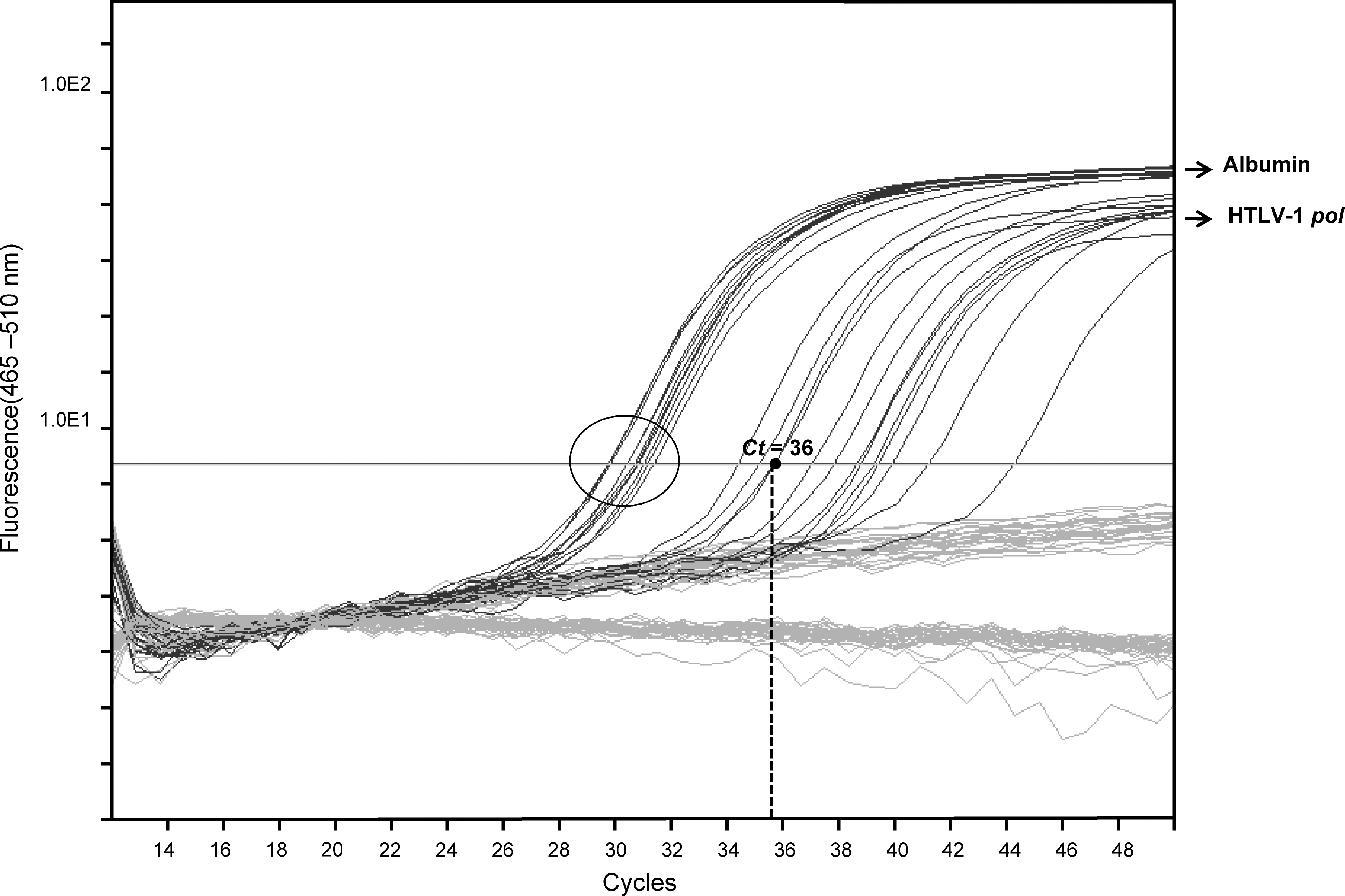
Real-time polymerase chain reaction (PCR) amplification profile for the detection of the human T-lymphotropic virus type 1 (HTLV-1) pol proviral gene and the human albumin gene obtained in HTLV-1-positive and HTLV-1-negative Brazilian blood samples, and in HTLV-1-positive sample from Mozambique. The cycle threshold (C t) value is the cycle number at which the fluorescence generated within a reaction crosses the fluorescence threshold. The C t values for albumin in Brazilian samples clustered in the circle while for HTLV-1 pol, they clustered outside the circle. The same C t value of 36 was detected for HTLV-1 pol and albumin in Mozambican blood sample. Equipment: LightCycler 480 Systems, Hoffmann La Roche, USA.
Because, so far, only six HTLV-1 strains from tropical spastic paraparesis/HTLV-I-associated myelopathy (TSP/HAM) patients, four from Maputo, Southern Mozambique and two from Mozambican immigrants living in Portugal, have been phylogenetically characterized, 6,7 we carried out a molecular analysis of the Mozambican isolate to gain more insight on Mozambican HTLV-1 subtypes. Nested PCR assays for detecting segments of long terminal repeat (LTR) and env genomic regions of HTLV-1 were conducted using protocols previously described. 9,10 The amplified products of the 766-bp LTR region (nucleotides position 57 to 822 according to ATK) and the 763-bp env region (nucleotides position 5547 to 6309 according to ATK) were sequenced in an ABI 3130 automatic sequencer. An LTR sequence of 731 bp and an env sequence of 705 bp were obtained (GenBank accession numbers HM770411 and JF271853). For phylogenetic analysis, these sequences were aligned against a reference set of prototypes and several sequences from Africa. Neighbor-joining (NJ) and maximum-likelihood (ML) trees were reconstructed with PAUP 4.0 software. Bootstrap values were obtained after 1000 replicates. The Mel5 (HTLV-1c) sequence was used as the outgroup. Website Genotyping (NCBI) was employed to verify the subtype.
Phylogenetic analysis showed that this isolate belonged to the HTLV-1a subtype, transcontinental subgroup A, clustering other South African and Mozambican strains together, although with some diversity among them (Fig. 2).
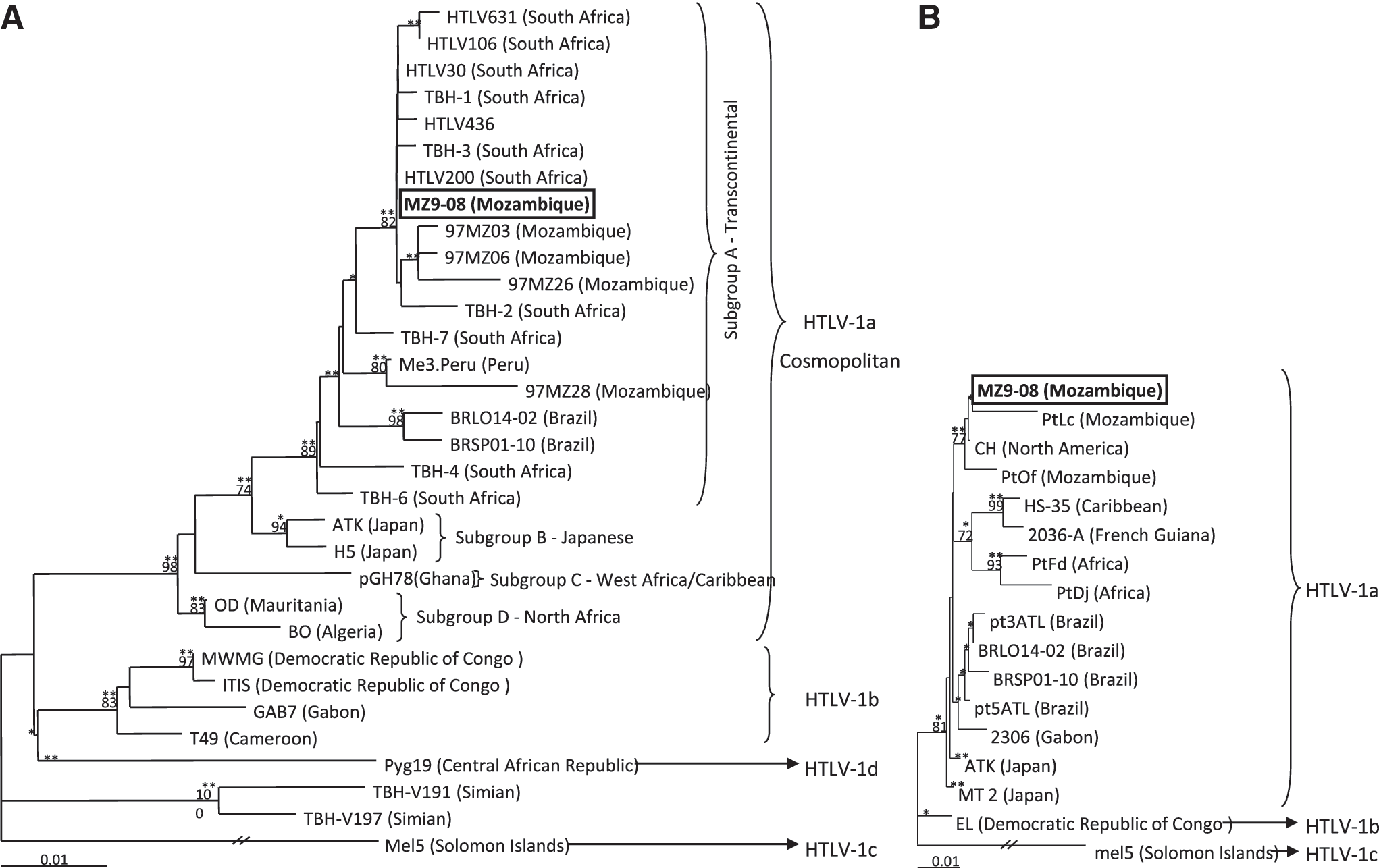
Phylogenetic trees constructed by the neighbor-joining method using the Paup v4b10 software for HTLV-1 isolates, including sequence MZ9-08 (GenBank AN JF271853 for LTR and HM770441 for env) highlighted with a rectangle. Bootstrap values above 70% and zero length using the likelihood ratio test with p<0.001 (**) and p≤0.05 (*) in key branches are depicted. The HTLV-1 mel5 isolate was used as the outgroup.
In conclusion, this is the first characterization of an HTLV-1 isolate from a patient from Northern Mozambique who presented with arthritis. Because arthritis is not a common HTLV-1-associated disease, the phylogenetic analysis of human leukocyte antigen (HLA) alleles could, in the future, provide a basis for ethnic susceptibility to HTLV-1 infection and arthritis, as recently described for HTLV-1 and adult T cell leukemia and TSP/HAM. 11
Sequence Data
The GenBank accession numbers for the HTLV-1 sequences included in the phylogenetic study are as follows:
The GenBank accession numbers of the HTLV-1 fragments sequenced in our laboratory and included in the phylogenetic analysis are as follows:
Footnotes
Acknowledgments
The authors are grateful to the Ministry of Health of Mozambique for allowing the study to be conducted. This study was supported by Ministério da Ciência e Tecnologia/Conselho Nacional de Desenvolvimento Científico e Tecnológico (MCT/CNPq), Brazil (PROAFRICA Grant 490452/2007-8), and a fellowship to A.C.A. (Grant 303328/2009-6).
Author Disclosure Statement
No competing financial interests exist.