







Abstract
HIV-1 CRF02_AG is the most prevalent intersubtype recombinant form worldwide. Six HIV-1 samples from patients living in Rio de Janeiro, Brazil, were subtyped as CRF02_AG at the pol gene between 2004 and 2011. To trace the origin of these viruses, they were compared with 793 CRF02_AG pol sequences of African origin and another four Brazilian CRF02_AG pol sequences previously described. Phylogenetic analysis reveals that there have been at least four introductions of the CRF02_AG clade in Brazil, as signified by the presence of four phylogenetically distinct lineages, probably originated from western African countries (Benin, Ghana, and Guinea-Bissau). At least two CRF02_AG Brazilian lineages were successful in getting established and disseminated throughout the Rio de Janeiro state, with evidence of both horizontal and vertical transmission. Continuous epidemiological surveillance of HIV-1 strains circulating in Brazil is of paramount importance to the early detection of newly emerging viral lineages.
H
The molecular epidemiologic scenario of the HIV-1 epidemic in Brazil is dominated by subtypes B, F1, C, and a large collection of intersubtype recombinant forms among those strains. 2,3 Isolated cases of other HIV-1 group M subtypes have been also described in the country, such as subtype A1 and subtype D. 4 –7 A few cases of the CRF02_AG strain have been also identified over the past years, including four individuals in the state of Rio de Janeiro, 8 –10 two in the state of São Paulo, 11,12 and one in the state of Para (Amazon region). 13 Of note, two CRF02_AG sequences detected in Rio de Janeiro were identified from a married heterosexual couple who never traveled abroad, thus providing the first molecular evidence of autochthonous horizontal transmission of this lineage in Brazil. 10
In this study, we report the identification of six new CRF02_AG pol sequences in the state of Rio de Janeiro, Brazil. These new Brazilian CRF02_AG strains were compared with CRF02_AG sequences of African origin deposited on public databases and with Brazilian CRF02_AG sequences previously described.
The Brazilian CRF02_AG strains identified in the present study were recovered from six chronically HIV-1-infected patients followed at outpatient clinics from the Public Health System distributed throughout the state of Rio de Janeiro, Brazil. Whole-blood samples from patients were sent for genotyping analysis at the Laboratory of AIDS and Molecular Immunology of the Oswaldo Cruz Institute–Fiocruz between 2004 and 2011.
A fragment of around 1250 pb encompassing the whole protease (PR) and part of the reverse transcriptase (RT) regions of the pol gene (positions 2297–3539 of the HXB2 genome) was amplified by using two HIV-1 genotyping systems: ViroSeq HIV-1 Genotyping System (Celera Diagnostic, Abbott Laboratories, USA) and TruGene (Siemens Diagnostics, NY), under conditions recommended by the manufacturers. The new Brazilian CRF02_AG pol sequences and four Brazilian CRF02_AG sequences (three from Rio de Janeiro and one from São Paulo) described previously
9,10,12
were aligned against a set of 793 CRF02_AG reference sequences of African origin gathered from the Los Alamos HIV Database (
The phylogenetic tree was inferred by the maximum likelihood (ML) method under the GTR+I+Γ4 nucleotide substitution model, selected using the jModeltest program. 14 The ML tree was reconstructed with program PhyML 15 using an online web server. 16 Heuristic tree search was performed using the SPR branch-swapping algorithm and the reliability of the obtained topology was estimated with the approximate likelihood-ratio test (aLRT) 17 based on a Shimodaira–Hasegawa-like procedure.
Phylogenetic analysis of the data revealed that the 10 Brazilian CRF02_AG sequences were distributed in four independent lineages (I to IV) that were intermixed among sequences of African origin (Fig. 1). The Brazilian lineages I and II are composed by only one sequence. Lineage I contain the sequence 06BRRJ34 that was collected in 2006 from a 35-year-old women from the city of Rio de Janeiro. This Brazilian lineage branched (aLRT=0.88) with two sequences from Guinea Bissau and one sequence from Senegal (West Africa) (Fig. 1). Of note, Guinea Bissau is a former Portuguese colony that maintains strong cultural and political relationship with Brazil. Lineage II comprises the sequence HM534195 that was collected in 2009 from an antiretroviral treatment (ART)-naive adult patient newly diagnosed in the state of São Paulo. 12 This sequence clustered (aLTR=0.76) with strains recovered from Burkina Faso, Côte D'Ivoire, and Mali (West Africa) (Fig. 1).
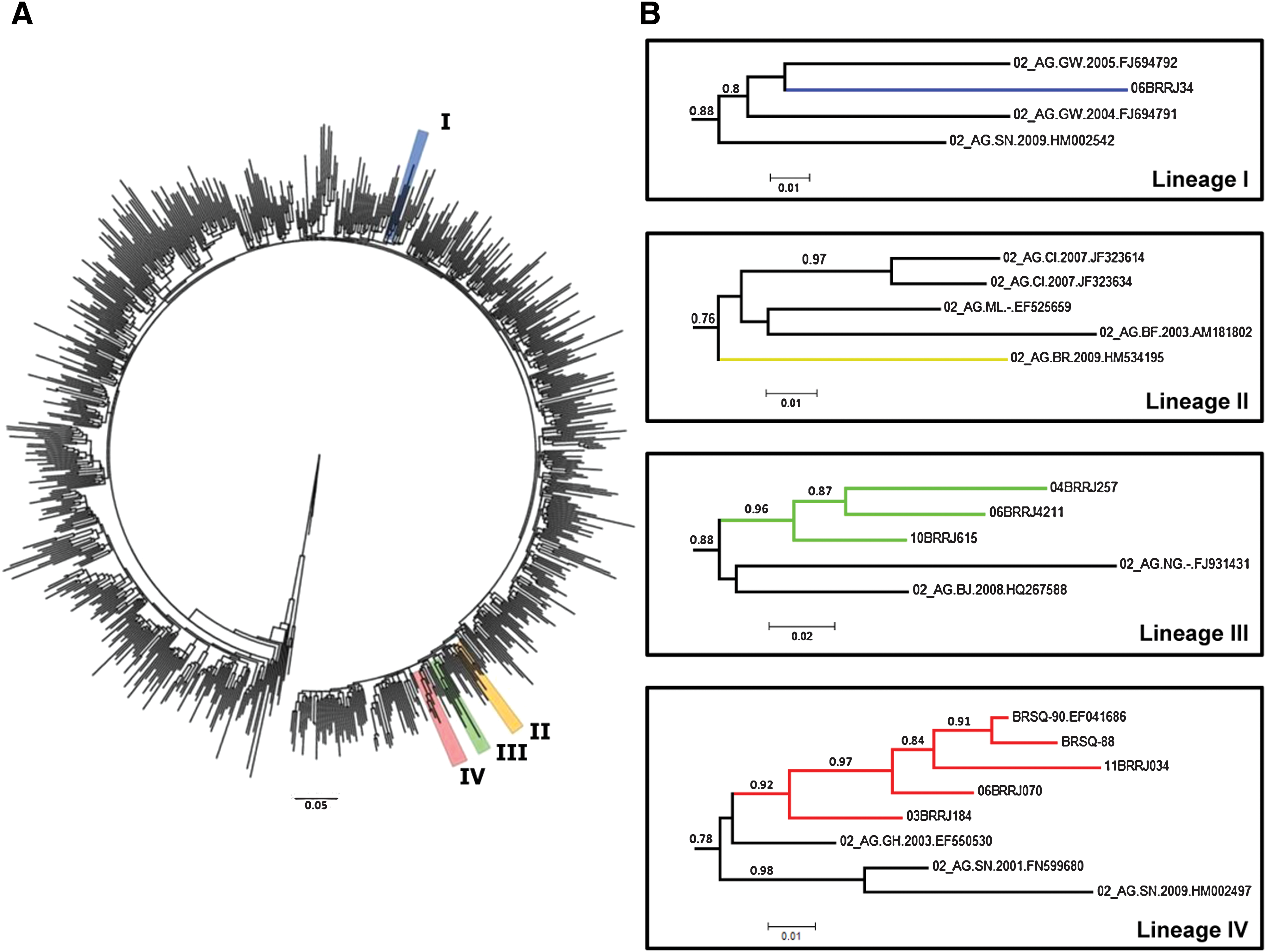
The Brazilian lineage III is composed by three sequences from Rio de Janeiro (04BRRJ257, 06BRRJ4211, and 10BRRJ615) that clustered together with a high support (aLRT=0.96) (Fig. 1). The sequences 06BRRJ4211 and 04BRRJ257 sampled at 2006 and 2004, respectively, segregate in a subcluster within lineage III and correspond to a mother–child pair, providing the first phylogenetic evidence of autochthonous vertical transmission of the CRF02_AG lineage in Brazil. The third sequence, 10BRRJ615, was collected in 2010 from a 24-year-old pregnant woman. This Brazilian lineage branched (aLRT=0.88) with sequences from Benin and Nigeria (Fig. 1).
The other five sequences from Rio de Janeiro (BRSQ-88, BRSQ-90, 03BRRJ184, 06BRRJ070, and 11BRRJ034) branched in a well-supported monophyletic clade (aLTR=0.92), here called lineage IV (Fig. 1). The sequences BRSQ-88 and BRSQ-90 were collected in 2006 from a married heterosexual couple from Saquarema, a small city in the Rio de Janeiro north coast. 10 Patient BRSQ-88 was a 28-year-old male who attributed the acquisition of HIV-1 infection to unprotected sexual contacts in the city of Rio de Janeiro, while his 29-year-old wife (patient BRSQ-90) reported having always lived in Saquarema. The other sequences were collected in 2003 (03BRRJ184) from a 37-year-old man, 2006 (06BRRJ070) from a 34-year-old women, and 2011 (11BRRJ034) from a 22-year-old woman. This Brazilian lineage branched (aLRT=0.78) with sequences from Ghana and Senegal (West Africa).
Although patients from Brazilian CRF02_AG clades III and IV had no known direct epidemiologic relationship (with the exception of patients 04BRRJ257/06BRRJ4211 and BRRQ-88/BRSQ-90), the high support of both clusters (aLTR>0.9) indicates that sequences from each clade were probably recovered from patients who took part in the same chain of viral spread.
Both transmission chains have spread outside the metropolitan region of Rio de Janeiro, reaching small cities located almost 200 km away (Fig. 2). The date of HIV diagnosis (1998–2002) of some individuals from Brazilian clades III and IV reveals that both lineages have been circulating in the state of Rio de Janeiro for over 10 years.
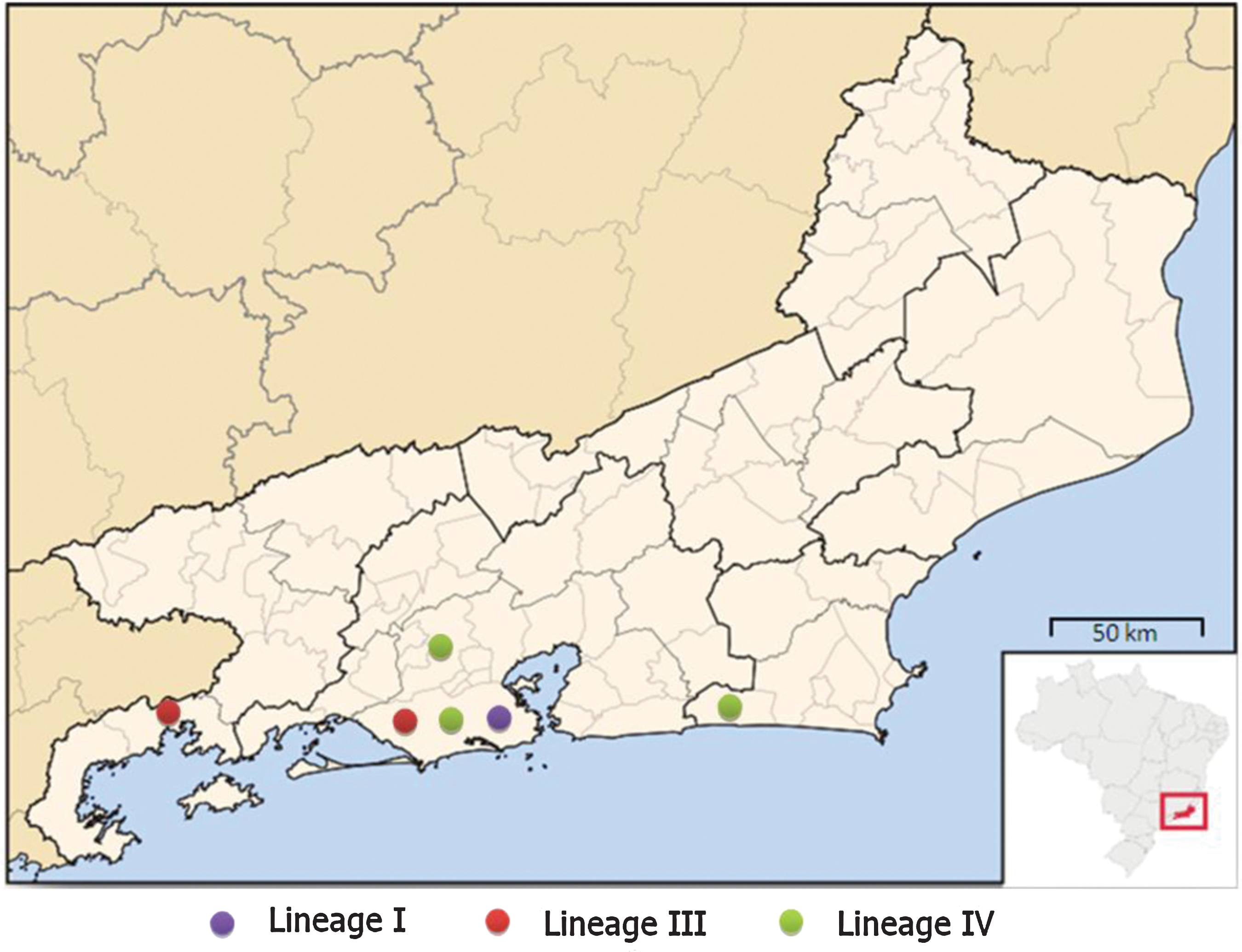
Political map of Rio de Janeiro state, showing the localization of the three HIV-1 CRF02_AG Brazilian lineages circulating in this state. The maximum intercounty distance found in related sequences was about 200 km. Color images available online at
This study demonstrates the existence of at least four independent introductions of the HIV-1 CRF02_AG clade into Brazil, probably from western African countries (Benin, Ghana, and Guinea-Bissau) where this recombinant form is highly prevalent. None of individuals from Rio de Janeiro included in the present study reported a history of travel to African countries, thus indicating that those CRF02_AG infections were acquired in Brazil.
Indeed, we find evidence of the occurrence of at least two autochthonous transmission networks of CRF02_AG, spreading by both horizontal and vertical forms. So far, the dissemination of CRF02_AG seems to be limited to a few individuals in the state of Rio de Janeiro. However, the identification of autochthonous transmission networks involving individuals from different counties with no known direct epidemiologic link demonstrates the potential for larger-scale dissemination of the CRF02_AG variant. These results emphasize the importance of continuous surveillance of HIV-1 genetic diversity to the early detection of newly emerging viral clades in the Brazilian population.
Sequence Data
The GenBank accession numbers of the CRF02_AG HIV-1 Brazilian sequences generated in this study are JQ514094–JQ514099.
Footnotes
Acknowledgments
We thank Carlos Silva de Jesus and Suwellen Sardinha Dias de Azevedo for technical support.
Author Disclosure Statement
No competing financial interests exist.