







Abstract
We report a novel HIV circulating recombinant form (CRF78_cpx) composed mainly of CRF01_AE with inserts from subtypes B and C identified from three epidemiologically unlinked individuals in Yunnan province, China. Two of the subjects are heterosexual men and one is a male intravenous drug user. Sequencing and analyzing the near-full-length genome of these three isolates (YNTC88, YNTC19, and YNTC35) revealed identical recombination breakpoints in all three viruses, but considerable genetic diversity between them, across the genomes, indicating that this is not a newly created CRF, only newly detected. CRF78_cpx differs from previously documented CRF01-AE/B′/C forms in its distinct backbone, inserted fragment size, and breakpoints, and is not related to other described recombinants in the region such as CRF07_BC or CRF65_cpx (also composed of CRF01_AE, B′, and C). Our present findings further enrich the diversity of the prevalent HIV-1 CRFs in Yunnan, which is considered as an epicenter of HIV-1 infections in China.
O
Yunnan lies in southwest China bordering the well-known heroin-producing region. Being the first station of HIV-1 transmission into China from Southeast Asian countries and the worst affected region in China, Yunnan is considered as an epicenter of HIV in China, with the most complex distribution of HIV subtypes and recombinant forms. 5 –8 Multiple HIV-1 forms, including subtypes B, C, CRF01_AE, CRF07_BC, and CRF08_BC, are currently circulating in this area. 9 However, the prevalence of HIV-1 genotypes continues to change with time. 10 –12 The estimated proportion of subtype B′ within the subtype B category increased from 20% in 1994 to 90% in 1998. 10 –12 Subtype C was identified from intravenous drug users (IDUs) in India in the early 1990s, 13 which then cocirculated with B′ in IDUs in western Yunnan in the first half of the 1990s. The cocirculation of HIV-1 subtypes B and C has resulted in the occurrence of many recombinant forms, such as CRF62_BC, CRF64_BC, and CRF65cpx. 2,7,14 –16 CRF01_AE was also found in this region in 1994, 17 and its prevalence has increased with the increasing frequency of HIV-1 sexual transmission. CRF01_AE became one of the predominant forms in 2000. 7,14 Moreover, owing to frequent coinfection with different HIV-1 forms, multiple unique recombinant forms have been identified here in the past decades. In this study, we detected a novel HIV-1 recombinant form (CRF01_AE/B′/C) by near-full-length genome (NFLG) analyses. This recombinant with segments of subtypes B and C inserting into the CRF01_AE backbone is distinct from all CRFs reported thus far.
Samples of YNTC88, YNTC19, and YNTC35 were collected in 2013 from three men diagnosed with HIV-1 infection in 2012, 2007, and 2009, respectively, in Baoshan of Yunnan province. Reported transmission risk factors were intravenous drug using for YNTC88 and heterosexual contact for YNTC19 and YNTC35. There was no epidemiologic link among these three individuals. Viral RNA was extracted from 100 μl plasma using a Viral RNA Kit (Tiangen). The near-full-length HIV-1 genome was amplified separately using reverse transcription (RT)-nested polymerase chain reaction (PCR; Takara). The PCR products were purified by the TIANgel Midi Purification Kit (Tiangen) and then sequenced by an ABI3730XL sequencer using the Big Dye Terminators Kit (Applied Biosystems). The obtained sequences were trimmed and assembled with MEGA version 6.0. BLAST searches against the HIV database were used to ensure that no PCR contamination events had occurred.
After assembling the sequences from five overlapping fragments of each sample, the available length of the NFLG was found to be 8.6 kb from nucleotide 841–9530 in HXB2, but YNTC88 was a little short about 8.2 kb. To determine the subtype, phylogenetic analysis was conducted by the neighbor-joining method with Kimura two parameter models and bootstrap analysis of 1,000 replicates. HIV-1 subtypes A, B, C, G, CRF07_BC, 08_BC, 01_AE, 15_01B, 33_01B, 34_01B, 67_01B, 68_01B, 31_BC, 57_BC, 60_BC, 61_BC, 64_BC, 65_cpx, 69_01B, 71_BF1, 72_BF1, and 74_01B were used as reference trains. 18 To further prove that these three sequences are novel recombinants, we performed HIV BLAST with them as query. The top 10 NFLG sequences in each search were chosen, and 20 NFLG sequences were obtained after deleting the repeated sequences. Phylogenetic analysis revealed that the three strains were separated from any assigned HIV-1 subtype or recombinant form and formed a cluster neighboring CRF01-AE/B′/C and various 01/B recombinant forms (Fig. 1).
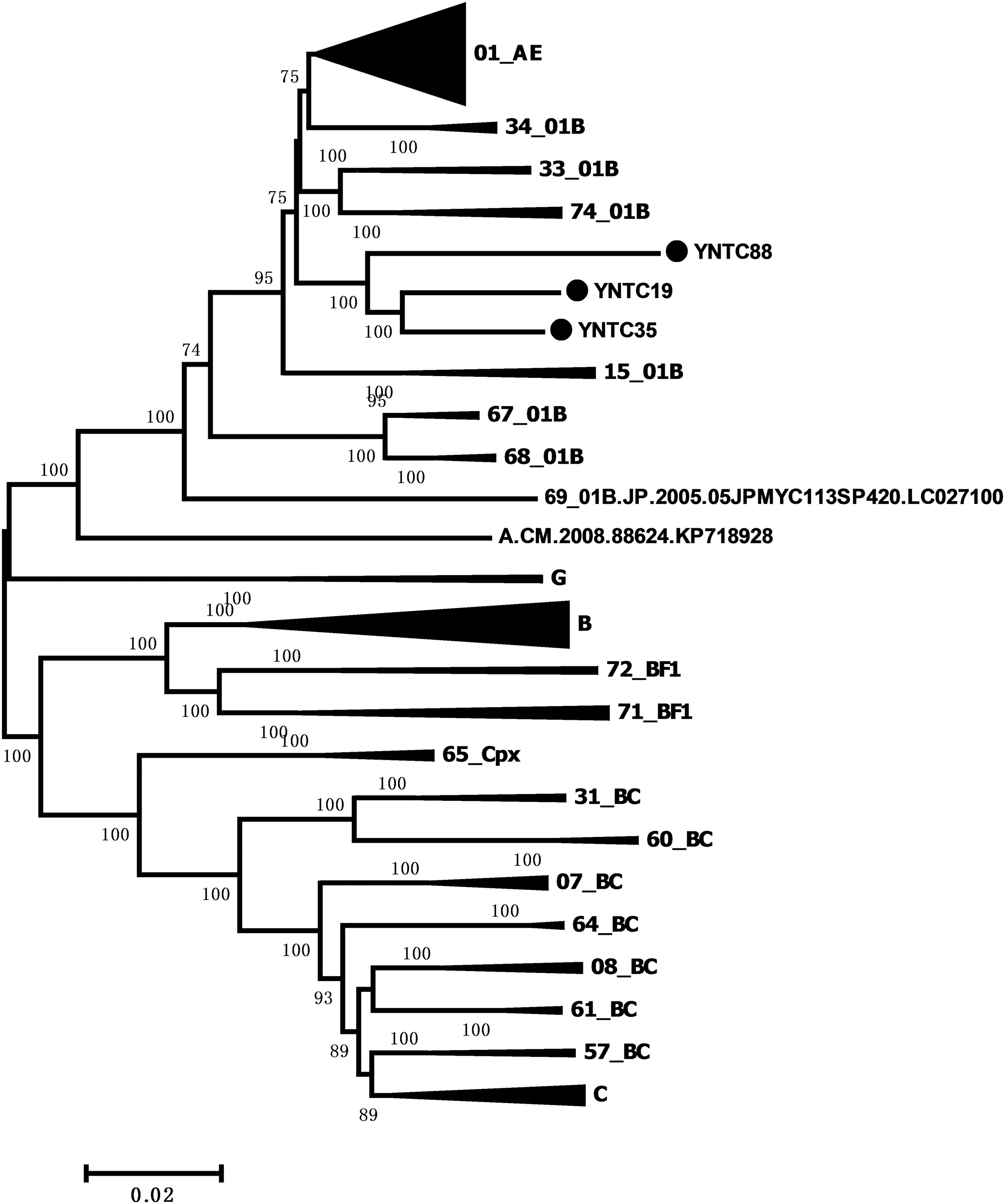
Phylogenetic analysis on the near-full-length genome sequence showing the relationships among three samples collected from Baoshan, Yunnan (YNTC88, YNTC19, and YNTC35), as well as other circulating recombinant forms and subtypes.
The mosaic structure of the CRF01_AE/B′/C recombinant was determined by submitting sequences to the recombinant identification program (
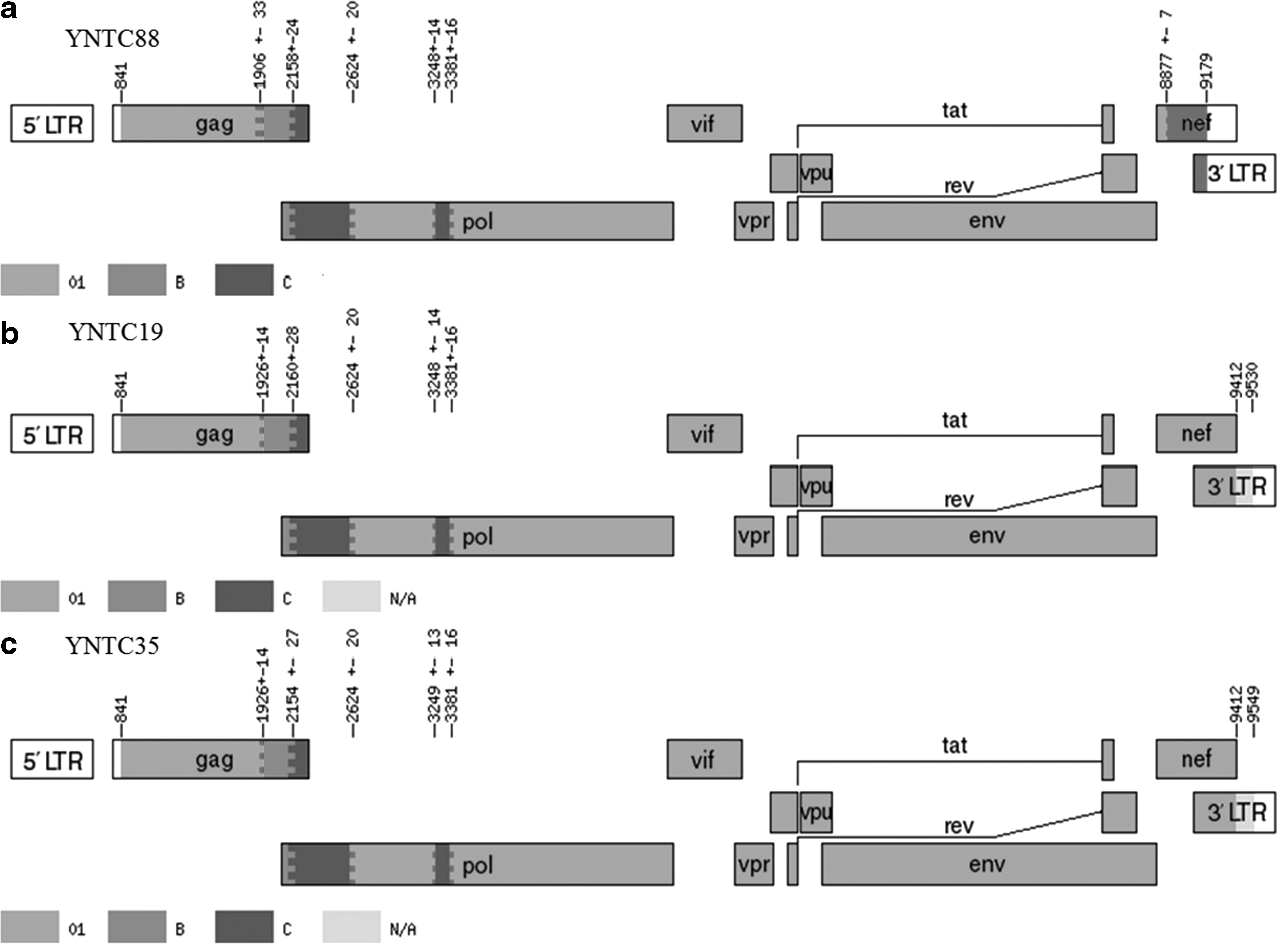
Recombinant identification was analyzed on YNTC88
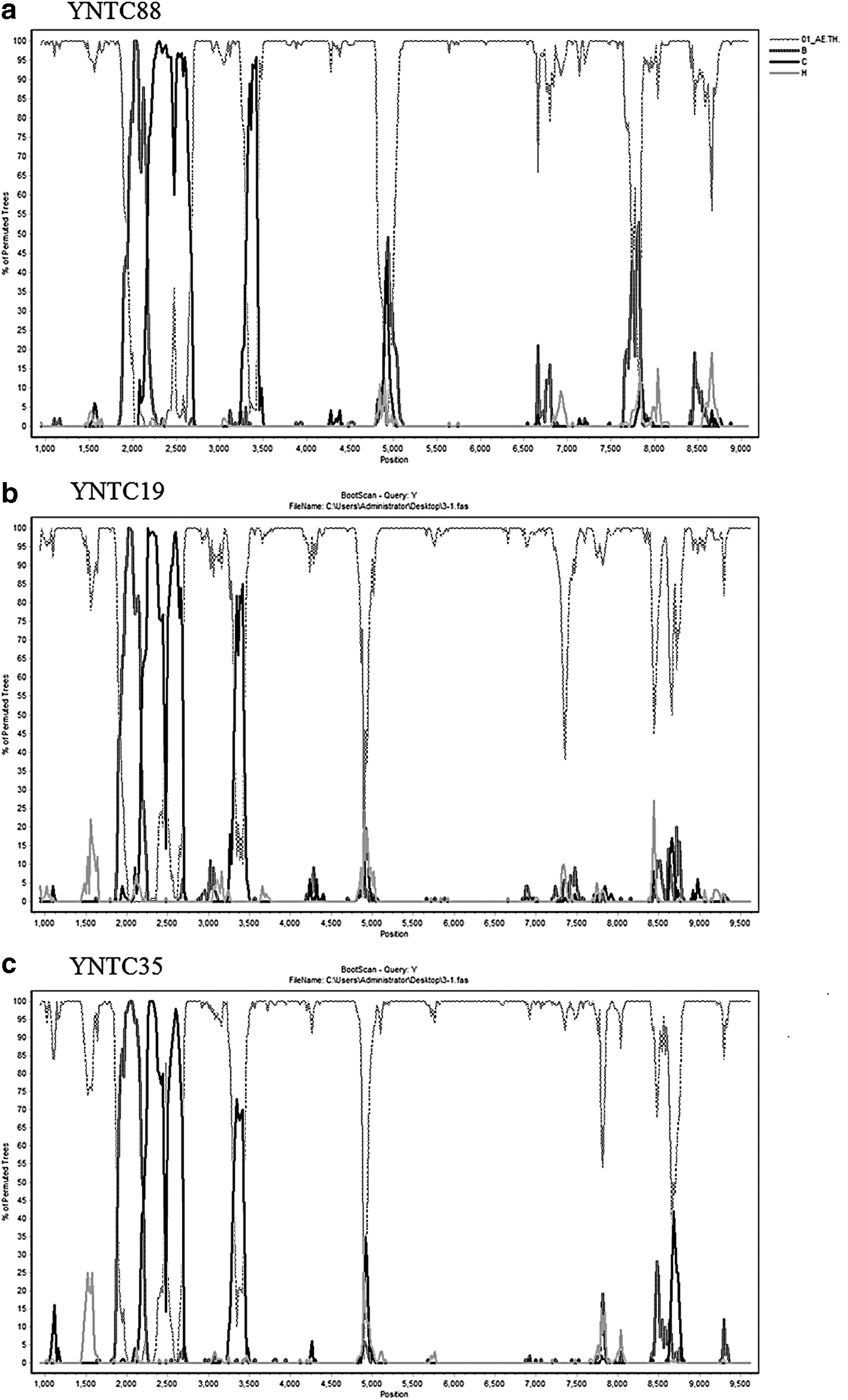
Bootscan was analyzed on the near-full-length YNTC88
To further define the characteristic of these three strains, neighbor-joining trees were reconstructed from the sequence of each segment of the multiple sequence alignment. Each segment clustered well with the corresponding subtype references (Fig. 4). Taken together, the map of this recombinant can be depicted as follows: I CRF01_AE (841–1908), II B′ (1909–2193), III C (2194–2672), IV CRF01_AE (2673–3307), V C (3308–3445), and VI CRF01_AE (3445–9530).
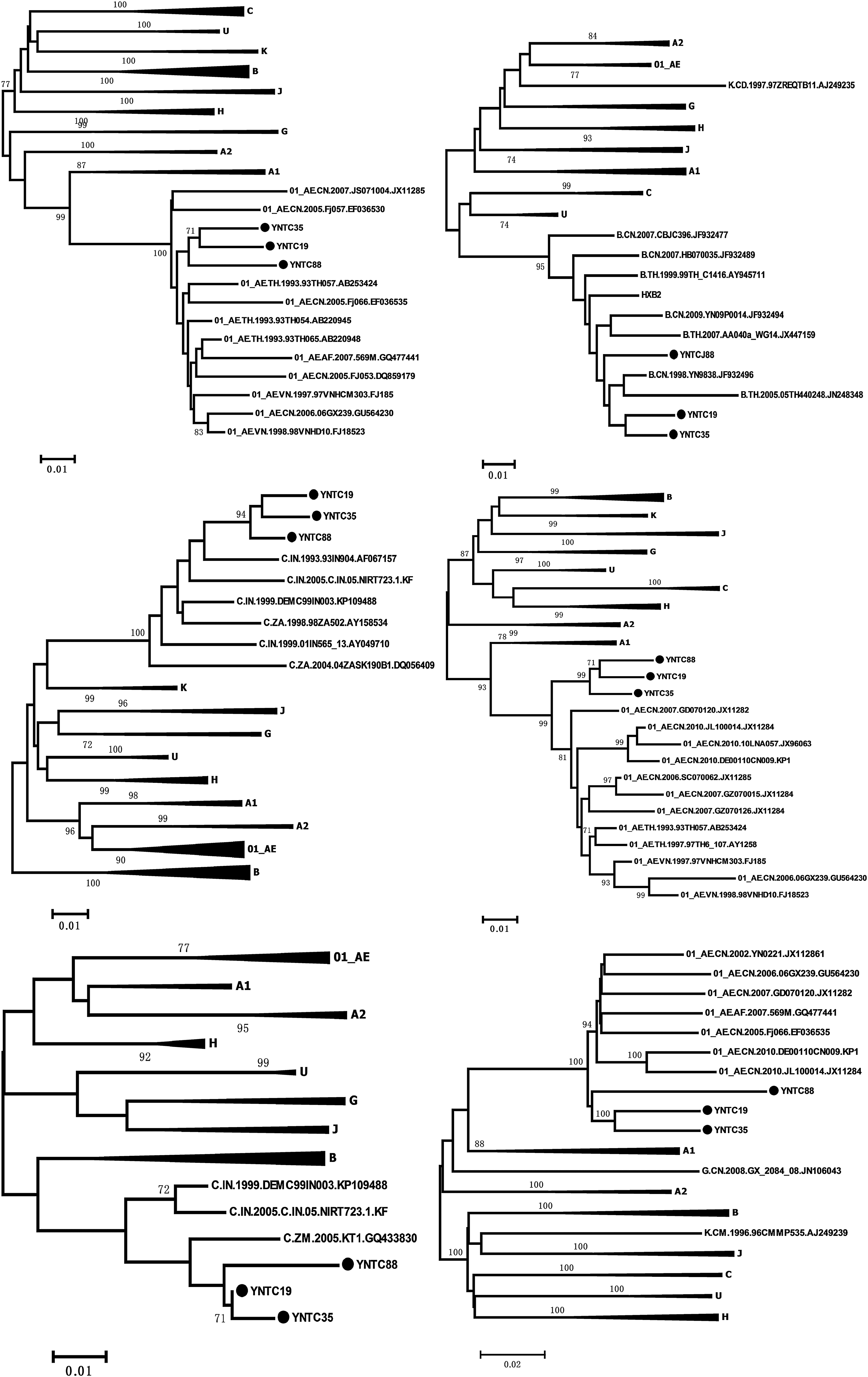
Phylogenetic was analyzed on the sequences of each segment YNTC88, YNTC19, and YNTC35. The analyses were performed based on SimPlot analysis shown in Figure 3. The stability of each node was confirmed by bootstrapping with 1,000 replicates, and only significant bootstrap values >70% are shown at the corresponding nodes. The genetic distance corresponding to the length of the branches is shown by the line at the bottom.
Phylogenetic analyses of each fragment also indicated that the CRF01_AE fragments were related with strains from Thailand (region I) and China (region IV and VI), but distinct from other strains. The inserted fragment of subtype B′ (region II) clustered with the strains from Thailand. Moreover, the inserted fragment of subtype C (region III and V) was related to strains from India. It is noteworthy that diversity between these three strains of CRF78_cpx is roughly equivalent to diversity between strains of any subtype of HIV-1 M group, which indicates that this recombinant form recombined many years ago and has accrued this great diversity over time, while never before being detected. With thousands of infected people in this region and only a few hundred sequences done, it is possible that this viral form has been circulating in Yunnan province for decades. However, it is also possible that the recombination events took place somewhere else, such as Myanmar or India, and then the virus later was introduced into China.
The HIV-1 subtypes B and CRF01_AE have been circulating in China since the 1990s, with a predominance of subtype B among homosexual men and CRF01_AE among heterosexual individuals. 7,19 Subtype C is also highly prevalent in China, especially in Yunnan province. The cocirculation of multiple HIV-1 subtypes and CRFs has formed a pool of diversified HIV-1 genes in the high-risk population in Yunnan, which has resulted in the emergence of CRF62_BC, CRF64_BC, and CRF65cpx. 7,14 –16 In this study, we identified a novel recombinant form consisting of segments from CRF01_AE and subtypes B and C. None of these three sequences shared the same breakpoints as those of the previously reported NFLG sequences of CRF01_AE/B/C, B/C, and CRF01_AE/C.
In the last couple of years, three instances of the CRF_AE/B/C recombinant form have been identified in China. Of them, one strain named JL.RF01, with three insertions of subtypes B′ and C into the CRF01_AE backbone, was revealed from heterosexuals in Jilin, the northeast province of China.
3
A more complex CRF01_AE/B/C strain (BJ.2014.MSM.SP01) with multiple drug-resistant mutations was identified from a homosexual man in Beijing, the capital city of China. Its genome comprised three insertions of subtype C and three insertions of subtype B into CRF01_AE backbone.
2
Cross-border transmission has played an important role in HIV-1 diversification and evolution. The 08mLDTD011 strain, isolated from a long distance truck driver from Myanmar traveling into China, was also classified as a CRF01_AE/B/C recombinant.
20
It contains four CRF01_AE segments, six B segments, and five C segments separated by 14 breakpoints throughout the genome. However, the three HIV-1 strains in the current study, YNTC88, YNTC19, and YNTC35, have a distinct mosaic structure. We confirmed them as novel HIV CRFs, which could be named CRF78_cpx in the HIV database (
The novel CRF01_AE/B′/C recombinant identified in this study had a quite different genomic structure from all recombinant forms reported in earlier studies. A better understanding of the increasing complexity of the HIV epidemic will provide important information for the development of HIV-1 vaccine and novel drug and clearer insights into the evolutionary history of HIV-1. In addition, we strongly advocate the continuous monitoring on HIV prevalence in southwest Yunnan, which will help develop strategies for HIV prevention and control in China.
Sequences Data
The NFLG sequences of isolated YNTC19, YNTC35, and YNTC88 have been deposited in GenBank under accession numbers KU161143, KU161144, and KU161145.
Footnotes
Acknowledgments
This study was supported financially by National Natural Science Foundation of China (nos. 81260248 and 81360247) and funded by Open Research Fund Program of the State Key Laboratory of Virology of China (2014KF009), partially supported by Training Program Foundation for Talent of Kunming University of Science and Technology (KKSY201226104) and Applied Basic Research Projects of Yunnan Province (2013FB031).
Author Disclosure Statement
No competing financial interests exist.