







Abstract
This study determined the prevalence of human immunodeficiency virus (HIV) infection and its associated factors in female sex workers (FSWs) from the municipality of Bragança in the state of Pará, Brazil. A cross-sectional study using a respondent-driven sampling method was used to investigate 137 FSWs. They were interviewed using a questionnaire for the collection of data on their characteristics and risk behavior. Blood samples were collected for serological and molecular testing for HIV. Poisson regression models were used to estimate the reasons of prevalence (RP). The majority was single, young, poorly educated, had a low monthly income, and had worked in the sex trade for more than 7 years. Sexual services were offered either directly (easy identification of FSWs in street markets, town squares, street corners, bars, and gas stations) or indirectly/discretely (more complex identification of FSWs, offering services through a cryptic approach or an intermediary). Overall, 22 (16.06%) FSWs had anti-HIV-1/2 antibodies, and 21 (15.33%) also had complementary DNA-HIV. The use of illicit drugs [adjusted RP (aRP) = 3.13; 95% confidence interval (CI) = 1.27–8.41], unprotected sex (aRP = 4.09; 95% CI = 1.34–11.62), anal sex (aRP = 4.01; 95% CI = 1.37–10.15), the exemption of condoms for clients paying extra (aRP = 4.71; 95% CI = 1.52–10.89), more than 7 years working as a sex worker (aRP = 6.04; 95% CI = 1.20–16.33), low levels of education (aRP = 3.55; 95% CI = 1.15–11.02), and a lack of regular medical or gynecological examinations were all associated with HIV infection (aRP = 5.87; 95% CI = 1.26–15.71). The FSWs who offered their services indirectly suffered significantly less physical and sexual aggression, charged more for encounters, had a significantly higher monthly income, and were more likely to have undergone a medical or gynecological examination within the preceding 12 months. This study identified information relevant to the control and prevention of HIV in FSWs.
Introduction
Human immunodeficiency virus (HIV) is one of the world's most serious social and public health issues, which is spreading in epidemic proportions in high-risk populations worldwide. 1 Female sex workers (FSWs) are considered to be a bridge for the transmission of HIV from high-risk groups to the general population. Unsafe sexual behavior, sexually-transmitted infections (STIs) other than HIV, and illicit drug use are common risk factors in FSWs. 2 –4 Multiple social and structural–environmental factors also play important interacting roles in the stigmatization of FSWs. 2,5 A meta-analysis of nearly 100,000 FSWs from 50 low- and middle-income countries estimated an overall HIV prevalence of 11.8%. 2 This study also found consistent evidence of significantly higher levels of HIV in women involved in the sex trade, with FSWs being 13.5 times more likely to be infected with HIV than women of reproductive age in the general populations of the low- and middle-income countries surveyed. 2
In Brazil, the available studies indicate that HIV is 15 times more prevalent in FSWs than in the general female population, reemphasizing the potential risks of the acquisition and transmission of HIV in this social group. 4 –8 However, epidemiological studies of STIs in FSWs are still scarce, especially in some Brazilian regions, and the many gaps on this risk group restrict the more effective understanding of the epidemiological scenario, which would be necessary for the development of effective public health strategies. In this context, the scenario of the Amazon region is particularly poorly understood and preoccupying. The region has many small- to medium-sized municipalities distributed over a vast area, of a number of million square kilometers, with limited access, but a long intense history of sex trade. 9,10 The Brazilian Amazon has a vast network of roads and waterways, which is subject to little monitoring, and most of the region's human population is affected by a range of social and economic problems, including limited educational opportunities, growing unemployment, precarious infrastructure, and restricted access to essential services. 9 –11
Recent epidemiological studies in the Amazon basin have reported the presence of pathogens in FSWs and illicit drug users involved in the sex trade. High risks of the acquisition and transmission of pathogens and low testing rates have been reported in both groups. 9,12 –15 There is an urgent need to focus efforts on the most vulnerable groups to develop effective controls to prevent epidemics occurring in the Amazon region. Given the scarcity of epidemiological data on HIV infection in vulnerable populations of the Amazon region and the need for a better understanding of the effects of a range of the social and economic problems that affect this region, the present study investigated the prevalence of HIV infection in the FSWs from one municipality in the Brazilian Amazon region and the factors associated with this prevalence.
Materials and Methods
Study area
The municipality of Bragança is located in the northeastern extreme of the Amazonian state of Pará, Brazil (Fig. 1). It is the principal fishery nucleus in Pará, and one of the largest in Brazil, with many industrial fisheries and large numbers of artisanal operations. The municipality has a number of fishing ports dotted throughout its area, which are also the principal focal points for the region's sex trade. The municipality is also an important center for tourism in the region, based on both its natural resources (picturesque scenery, beaches, rivers, and islands), and considerable historical and cultural heritage dating from the period of the Portuguese colonization of the Amazon region. In 2017, the municipality had 124,184 inhabitants in an area of 2,090 km2. 16
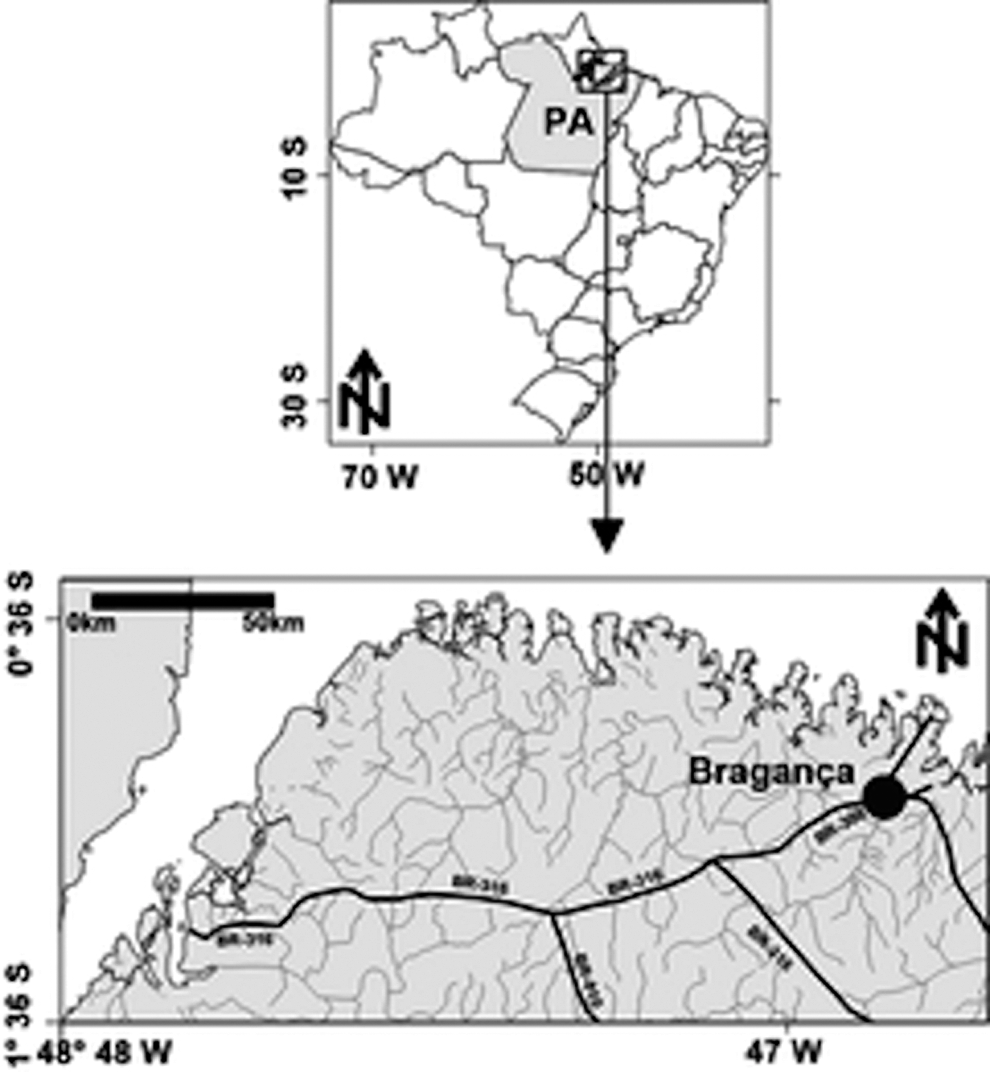
Geographical location of the municipality of Bragança, Pará (PA), Brazilian Amazon.
Study population and sampling method
The study involved FSWs who worked in the municipality of Bragança from January to December 2017. The FSWs were defined as women who exchange sexual services for money. The eligibility criteria were women aged over 17 years who exchanged sex for money within the last 30 days and have worked in the municipality for at least 12 months. Exclusion criteria were being younger than 18 years of age, self-reporting as transgendered, or under the effect of psychotropic drugs at the moment of the encounter with research team (only a rescheduling was performed as an attempt to approach FSWs who used drugs). In January 2017, an extensive mapping of FSW congregation sites was conducted in the municipality of Bragança. The participation of residents was essential for the identification of these sites. The observation of these locations and the contact with some FSWs and their respective clients allowed to identify some characteristics relevant to the development of the recruitment, such as: approximate number of FSWs that frequented each place, days and times of intense flow of possible clients, the offer of sex services, and the identification of some FSW promotion agents.
FSWs were accessed using respondent-driven sampling (RDS). The RDS is a form of referral sampling, and it uses the social networks of the target populations by peer referral methods for recruitment. 17 In this study, eight FSWs were selected as “seeds” during January and February 2017 (Table 1). Apparently, the seeds had a good relationship with their clients and other FSWs (called “famous girls” in the sex trade) and collaborated with relevant information on the sex trade in the municipality of Bragança. Of these eight “seeds,” three meet their clients on the streets in different areas of the municipality, three in nightclubs/bars. Two FSWs selected as “seeds” scheduled programs through digital social networks (Facebook, Twitter, WhatsApp, Telegram, and Messenger). Their age ranged from 21 to 30 years old and their education level ranged from none to secondary level. Two were black, five brown (mixed race), and one white. After obtaining the informed consent and completing the interview, the seeds received three coupons to recruit other FSWs who they knew by name, were aged 18 years or more, who they had encountered in the last 30 days, and who lived in Bragança. The recruits also received the same number of coupons and invited another FSW under the same conditions as before. This procedure was repeated until the desired sample size was achieved. Meetings between FSWs and the research team were held in restricted places and times scheduled in the municipality. A sample size of ∼110 FSWs was calculated considering a 95% confidence interval (CI), 80% power, effect design of 2.0, 18 and prevalence of hepatitis B virus (HBV) and hepatitis C virus of 31.9% and 4.5%, respectively. 19
Characteristics of the “Seed” Female Sex Workers and the Number of Additional Female Sex Workers from Seed During the Present Study
Rural area of the municipality.
FSWs, female sex workers.
Laboratory procedures
Blood samples were collected in vacuum tubes containing ethylenediaminetetraacetic acid and transported to laboratory on the same day. Peripheral blood cells and plasma were obtained after centrifugation at 2000 g and stored at −20°C until analysis. The HIV serostatus of each sample was determined using the enzyme-linked immunosorbent assay (ELISA, Murex HIV-1.2.O kit; DiaSorin, Saluggia, Italy). The RNA was isolated from 200 μL of plasma from the seroreactive samples using the QIAamp Viral RNA Mini Kit (Qiagen, Manchester, United Kingdom) and was reverse transcribed to the complementary DNA (cDNA) using the High-Capacity cDNA Reverse Transcription Kit (Applied Biosystems, Foster), according to the manufacturer's instructions. The confirmatory diagnosis of HIV infection was based on an in-house real-time reverse transcriptase polymerase chain reaction assay, using the available probes and primers. 20
Data analysis
Data related to demographic, socioeconomic, and sex work characteristics were obtained through standardized questionnaires. This data collection tool was successfully used in other epidemiological studies. 4,21 All study data were entered into an Excel database and converted to SPSS, which was used for all statistical procedures and analysis. Ninety-five percent CI was determined to estimate the prevalence of HIV infection. HIV infection was the main outcome measure. Poisson regression models with a strong estimator were used to estimate reasons of prevalence (RP) for each category of the exploratory variables, having as a reference the category of least expected risk. The modeling technique estimated the reasons of raw prevalence for each exploratory variable, using the Wald statistic, with a level of significance of 0.05. Subsequently, adjusted RP were calculated in a regression model that simultaneously included all the variables that presented a value p < .05 using Wald statistic. Data were analyzed using the RDSAT 5.3, Stata 11.0, and SPSS Statistics 18.0.
Ethical aspects
This study was approved by the Ethics in Research Committee of the Tropical Medicine Nucleus of the Federal University of Pará in Belém, northern Brazil.
Results
Sampling method
A total of 324 coupons were issued and 141 returned. Of those, 137 FSWs were eligible and accepted to participate in the study. After scheduling two meetings with the research team, four FSWs were under the influence of psychotropic drugs and were excluded from the study. The median number of waves by seed was three (range: 2–4), and the median of recruits was 16 (range: 7–23). The key variables age and education reached equilibrium at wave three and two, respectively.
Characteristics of FSWs
Participant ages ranged from 18 to 44 years [mean = 24.5 years; standard deviation (SD) ±10.5 years]. The majority of the participants was single (88.86%), heterosexual (94.89%), and had low levels of education (56.93%). In this study, all FSWs who were illiterate (15.33%) or had up to 8 years of schooling (uncompleted elementary schooling) (41.60%) were considered to have low levels of education. Most FSWs (71.53%) reported being born in the state of Pará, but less than half (30.66%) were born in Bragança. Most FSWs reported having monthly income of up to two minimum salaries (R$1,874.00, equivalent to US$552.00), and sex work was declared as their main source of income. Further sociodemographic and economic data are provided in Table 2.
Sociodemographic and Economic Characteristics of the Female Sex Workers Active in the Municipality of Bragança in Relation to Their HIV Infection Status
Calculated by Poisson regression.
RP, reasons of prevalence; CI, confidence interval.
The mean charge for a sexual encounter was approximately R$50.00 (around US$15; SD ± US$30), although prices ranged from R$30 to R$200. Most FSWs claimed that they did not know their clients (first time clients or regular clients), and 45 (32.85%) reported that most clients are tourists or individuals involved in the fishery industry (fishermen, boat owners, and fish merchants). A mean of approximately five clients (SD±7.5 clients) was accepted per week, although some (16.06%) FSWs reported attending more than 10 clients per week. Most (64.23%) FSWs stated that they had been involved in prostitution for more than 7 years (mean = 7.41 years; SD±10.50 years) (Table 3). Most participants (89.78%) reported availability to perform specific sexual practices, such as vaginal, oral, and anal sex, including kissing and caressing, as long as the client paid for these services. Some FSWs did not offer kissing, caressing, and especially anal sex in their sexual services. The physical violence, including sexual abuse, carried out by fixed sexual partners (e.g., boyfriend), family members, and clients has also been reported by many FSWs (64.23%). All FSWs reported having witnessed at least one episode of physical and/or verbal violence involving other FSWs in the municipality of Bragança.
Factors Associated with HIV Infection in One Hundred Thirty-Seven Female Sex Workers in the Municipality of Bragança, Pará, Brazil
Calculated by Poisson regression.
In the preceding 7 days.
In the preceding 12 months.
Sexual services were offered either directly or indirectly/discretely. Most (n = 85; 62.04%) FSWs offered their services directly to clients in street markets, town squares, street corners, bars, and gas stations. The others (n = 52; 37.96%) were more discrete, offering their services indirectly to their clients, either through a cryptic approach or an intermediary. These FSWs were solicited by employees or clients in bars, restaurants, and gas stations near the beach of Ajuruteua or on the municipality's principal highways (BR-308 and PA-458), which have an intense flux of people and cargo.
In addition, 16 of 57 FSWs offering indirect/discreet sexual service used social networks or telephone applications such as WhatsApp. These individuals had outreach agents, who offered the services, negotiated rates, and ensured planning and safe access to the FSW. Apparently, there is a simple level of organization of the service offering: (i) an agent that promotes FSWs to clients in social network or mobile application potentials, preserving the identification and security of FSW as far as possible, being responsible for scheduling the place and time of the sexual encounter, to take and seek FSW at the meeting, and to receive payment for the service; (ii) FSWs are responsible for conducting sexual practices, according to prior scheduling, and divides the value of the sexual program with the agent. In addition, the study identified a variation in this service offer; some FSWs worked as employees of commercial establishments such as bars and restaurants, and another employee or owner of the establishment acted as a promotional agent for FSWs. The research of this subgroup was difficult; the fear of identifying FSWs and their potential clients was the main access barrier. In comparison with the direct group, the FSWs who offered their services indirectly suffered significantly less physical and sexual aggression (χ 2 = 87.06, p < .01), charged more for encounters (χ 2 = 19.97, p < .01), had a significantly higher monthly income (χ 2 = 11.87, p < .01), and were more likely to have undergone a medical or gynecological examination within the preceding 12 months (χ 2 = 43.01, p < .01). The involvement of adolescents in the sex trade was reported by members of the two groups.
HIV infection
Overall, 22 of the 137 FSWs (16.06%, 95% CI: 11.26–20.86) had anti-HIV-1/2 antibodies, based on the results of the ELISA. Of these individuals, 21 (15.33%, 95% CI: 10.73–19.93) also returned positive results for the presence of cDNA-HIV, using real-time PCR. The only sample that tested positive for anti-HIV-1/2 antibodies but negative for cDNA-HIV presented a low ratio between the absorbance of the sample (S) and the mean absorbance of the positive calibrator (CO). In general, an increase in the detection rate of cDNA-HIV was found as the signal of the cutoff (S/CO) ratio increased. The detection of cDNA-HIV was only used to confirm the presence of the virus in the samples provided by the FSWs. The viral load contained in the samples was not the target of this study. All FSWs with HIV were not aware of the carrier status of the virus until participation in this study.
Risk factors
Seven factors were associated with HIV infection based on the Poisson regression models: (i) the use of illicit drugs (injected or inhaled), (ii) unprotected sex (always or sometimes), (iii) anal sex, (iv) the exemption of condoms for clients paying extra; (v) more than 7 years' experience as a sex worker, (vi) low levels of education, and (vii) a lack of regular medical or gynecological examinations (Table 3). Working in the sex trade for more than 7 years was identified as the principal risk factor for HIV infection in FSWs (RP >6.0). The distinct offer of sexual service (direct or indirect/discreet) was not associated with HIV infection. In these analyses, the effect of the following factors regarding the outcome was not significant: received blood transfusion, performed invasive dental treatment, performed surgery, had tattoo, shared use of puncturing/sharp material, performed oral sex, had more than 10 clients, waived condom use for well-known clients, waived condom use when many clients attended per day, and offered directly sexual service (Supplementary Table S1).
Discussion
The vast Amazon region is a relatively isolated and extremely diverse environment, both biologically and socially, with little urban infrastructure and largely inadequate public services. 11 These characteristics contribute to the establishment of distinct epidemiological scenarios that require specific approaches and policies for the control of pathogens and the prevention of epidemics. 9,11,13,14 The adoption of the RDS method provided access to valuable samples and data from the FSWs of Bragança, in the Brazilian Amazon region, which permitted the identification of the most relevant characteristics of this group in relation to the prevalence of HIV infection and the factors associated with this scenario. The majority of the FSWs were single, <30 years old, poorly educated, with a low monthly income, and had worked in the sex trade for at least 7 years. Despite the biological and social diversity of the Amazon region, and the precarious conditions found in this region, the findings of the present study were consistent with those of previous research on FSWs in other regions of Brazil 4 –8,22 and in other low- and middle-income countries in both South America 3,23 and in other continents. 2,24,25
The characteristics of the FSWs observed in the present study may reflect the vulnerability of these women. Youthfulness is a favorable attribute in the sex trade, and many clients are able to interpret the lack of education and the financial needs of these women as enabling them to negotiate unprotected sexual intercourse. 22,24,25 The practice of different sexual activities (vaginal, oral, and anal sex), together with the low value charged for an encounter (approximately US$15), often without the use of condoms, and the large numbers of clients attended, all contribute to an increased risk of the acquisition and transmission of STIs, as demonstrated previously in other regions of Brazil 4,12,22 and in Argentina. 3,23 Physical and sexual violence is often reported by FSWs, and sexual abuse is also associated with STIs. 4,26 In this study, several FSWs reported having already been sexually abused. All these factors may facilitate the acquisition and transmission of pathogens, such as HIV through sexual intercourse, increasing the potential of FSWs to act as reservoirs of STIs over time. This is probably why many studies, including the present one, have found that the risk of STIs increases progressively with the experience of the FSWs in the sex trade. 3,4
The present study also identified two distinct types of sexual service. Most FSWs offered their services directly in public places such as markets, town squares, street corners, bars, and gas stations. In Brazil, FSWs typically adopt a direct approach presenting their bodies to clients in public places and negotiating the value of the encounter. 4,22,27 Many of these FSWs are subject to poor working conditions and numerous health risks, including the acquisition of STIs. 27 The second type of service was more discrete, and it seems likely that the FSWs involved in this type of trade have already identified the stigmas and health risks associated with this activity. These women appear to be adopting alternative strategies in search of greater well-being through self-valorization and self-care, as indicated by the lower rates of cases of physical and sexual violence they undergo, the higher monthly income (higher prices), and regular medical and gynecological examinations. If this strategy also guaranteed the use of condoms during all types of intercourse, it could contribute to a future reduction in the number of cases of STIs in FSWs, including HIV infection. Two studies (quantitative and qualitative) on the characteristics and health impact of FSWs who participate in these different ways of offering sexual services are being conducted in the municipality of Bragança and should provide more details on this complex scenario in the future.
In the present study, 22 (16.06%) of the FSWs had anti-HIV-1/2 antibodies. Among these women, the genomic fragment of HIV was detected in 21 FSWs. This is the highest prevalence of HIV infection ever detected in FSWs in South America. Epidemiological studies of Brazilian FSWs have reported a seroprevalence of HIV between 1.0% and 8.8%. 4 –8 The seroprevalence of HIV infection among FSWs in the countries of the Andean region (Venezuela, Colombia, Ecuador, Peru, and Bolivia) and the Southern Cone (Chile, Argentina, Uruguay, and Paraguay) is around 1.2%, with the highest values being recorded in Argentina (4.5%) and Paraguay (2.6%). 3,23
These findings should serve as a warning to local, regional, and national public health authorities for the urgent implementation of actions to prevent and control HIV infection in Bragança and other municipalities of the Brazilian Amazon region, especially in vulnerable groups, such as the FSWs. Measures that can reduce the transmission of HIV include the regular monitoring of infections in vulnerable groups, programs that distribute condoms and disposable syringes, easier access to screening and counseling centers, training for health professionals to receive members of vulnerable groups, and the better treatment and monitoring of infected individuals. 12,28
The present study also identified the use of illicit drugs as a risk factor for HIV infection. A number of studies have shown that the use of illicit drugs (injected or inhaled) is associated with HIV infection, as this may contribute to unsafe sexual practices. 3,22,24 The need to acquire resources for the purchase of drugs may also contribute to the practice of unprotected sex. 9,13,14,22 In the state of Pará, illicit drug use and prostitution have been shown to be factors associated with infection by the HBV 9 and Treponema pallidum. 13
The present study has a number of limitations that should be considered for the interpretation of the results. One factor was the age limit criterion applied to the selection of participants, given that the involvement of adolescents in the sex trade was reported frequently, and the majority (six out of eight) of the seeds reported their recruitment into the trade during their adolescence. A second factor was the restriction of the study to the municipality of Bragança, which, despite sharing many characteristics with the rest of the Amazon region and other Brazilian populations, may not necessarily be representative of the sex trade in other localities in the state of Pará and in Brazil. In addition, while the RDS sampling method was judged to be appropriate to the population and the location, other complementary approaches, such as take-all sampling, systematic random sampling, and time location sampling, could also have been used. As the interview data are self-reported, some information, such as condom use, may be subject to problems of inaccurate recall and/or deliberate concealment. Finally, the cross-sectional design of the study limits its capacity to establish causality.
Conclusions
The present study is the first epidemiological report of HIV infection in FSWs in a municipality of the Brazilian Amazon, which revealed a high prevalence of infection, as well as identifying factors that may contribute to the development of effective measures for the prevention and control of HIV infection by local and regional public health authorities. The vulnerability of FSWs to HIV infection has been associated with a range of socioeconomic factors and the use of illicit drugs, which facilitates the practice of unprotected sex, making these women a potential health risk for the general population. The study also recorded two different types of sex trade, one of which indicated a greater concern with self-care and self-valorization by the sex workers. The findings indicate that immediate actions are needed to control the transmission of pathogens, such as HIV, and also to care for and promote the health of the FSWs in the Brazilian Amazon. Neglect of actions related to active search, adequate care, and effective treatment of people with HIV may be facilitating the emergence of new cases in the population.
Footnotes
Acknowledgments
The authors thank Antonio Silva, Ivanildo Gomes, Natalia Cavalcante, Rodrigo Silva, and Wellison Brito for their help with the recruitment of the FSWs included in this study. This work was supported by the Fundação Amazônia Paraense de Amparo à Pesquisa (ICAAF No 154/2014). L.M.d.C. and P.C.R.F. received scholarships from the Ministério da Educação-Brazil (MEC). N.C.R. and B.L.A.L. received scholarships from the Conselho Nacional de Desenvolvimento Científico e Tecnológico (PIBIC-CNPq).
Author Disclosure Statement
No competing financial interests exist.
Supplementary Material
Supplementary Table S1
References
Supplementary Material
Please find the following supplemental material available below.
For Open Access articles published under a Creative Commons License, all supplemental material carries the same license as the article it is associated with.
For non-Open Access articles published, all supplemental material carries a non-exclusive license, and permission requests for re-use of supplemental material or any part of supplemental material shall be sent directly to the copyright owner as specified in the copyright notice associated with the article.
