






Abstract
The medical demand imposed by COVID-19 has distracted proper care of other illnesses. Herein, we report the impact on new diagnoses of HTLV-1, HTLV-2, and HIV-2 in Spain, where these infections are mostly driven by immigration flows from endemic regions. As expected, case reporting declined for all three retroviral infections with respect to prior years. Furthermore, late presentations were more common. The two major reasons for these observations were significant declines in the arrival of foreigners from endemic regions and a shift in medical resources to prioritize COVID-19.
The rapid surge and global spreading of SARS-CoV-2 infection during year 2020 was accompanied by an overwhelming demand on hospitals and medical care systems in many countries. The stressful activity for COVID-19 negatively influenced the regular care given for other illnesses, with frequent delays in diagnosis and treatment. This effect has been well reported for medical conditions such as cancer, 1,2 but it is uncertain for less frequent diseases, including some neglected infections such as HTLV-1 and HIV-2. These retroviruses circulate in Europe mostly in association with migration flows from Africa and Central/South America. 3,4 Until the surge of COVID-19, the identification of infected carriers often relied on a high clinical suspicion and/or in universal screening procedures at blood banks.
In Spain, a nationwide register exists for persons infected with retroviruses other than HIV-1 for over three decades. 5,6 Herein we report trends over time in new diagnoses and falling incidence experienced during 2020 accompanying the surge of the COVID-19 pandemic.
During year 2020, a total of 17 new cases of HTLV-1 infection were reported in Spain. Interestingly, 7 (40%) presented for the first time with classical clinically associated manifestations, including lymphoma/leukemia (n = 3), subacute myelopathy (n = 3), and Strongyloides stercoralis infestation (n = 1). Asymptomatic individuals were diagnosed as result of being blood donors (n = 4), or as part of screening made on foreigners from endemic regions complaining other symptoms. Overall, 15 were Latin Americans (8 from Peru), 1 was from Guinea-Bissau, and 1 was a native Spaniard. Diagnosis had been made in Barcelona (n = 9), Madrid (n = 6), Almeria (n = 1), and Valladolid (n = 1).
To highlight that symptomatic HTLV-1 illness had been more common at presentation during the COVID-19 pandemic, we examined prior years. In brief, whereas 7 (40%) out of 17 new HTLV-1 diagnoses during year 2020 presented with symptoms, there had been only 5 (25%) out of 20 new cases in year 2019 presenting with either myelopathy or leukemia associated with HTLV-1. In contrast, the national register since 1990 until 2019 shows that symptomatic illnesses at presentation had been recorded in 79 (20.3%) out of 389 diagnoses of HTLV-1. 6
With respect to HTLV-2, only three new cases were diagnosed during year 2020, two in Zaragoza and one in Madrid. One HTLV-2 carrier was coinfected with HIV. Interestingly, the remaining two HIV-negative individuals with HTLV-2 were young Latin Americans from Peru and Ecuador, respectively. One of them was a first-time blood donor.
Finally, HIV-2 was newly diagnosed in nine individuals during year 2020 in Spain, of whom six were West Africans. They were identified in Mallorca (n = 3), Barcelona (n = 2), Almeria (n = 1), the Canary islands (n = 1), Zaragoza (n = 1), and Madrid (n = 1). One presented with cerebral toxoplasmosis. All but one of the remaining asymptomatic individuals tested for plasma HIV-2 RNA had undetectable values.
According to the Instituto Nacional de Estadística (INE), the Spanish population was 47,332,614 in early 2020, of whom 5,226,906 were foreigners (Latin Americans 1,371,598; and Africans 1,034,164). 7 Overall, the immigration flow to Spain declined significantly during year 2020 although a peak was noticed during the last 2 months of the year, mainly as a result of illegal African immigration. We hypothesize that national confinement implemented for halting the COVID-19 pandemic and medical care prioritization for SARS-CoV-2 have both contributed to explain the reduction in case reporting for HTLV-1, HTLV-2, and HIV-2 during year 2020 compared with prior years, as shown in Figure 1.
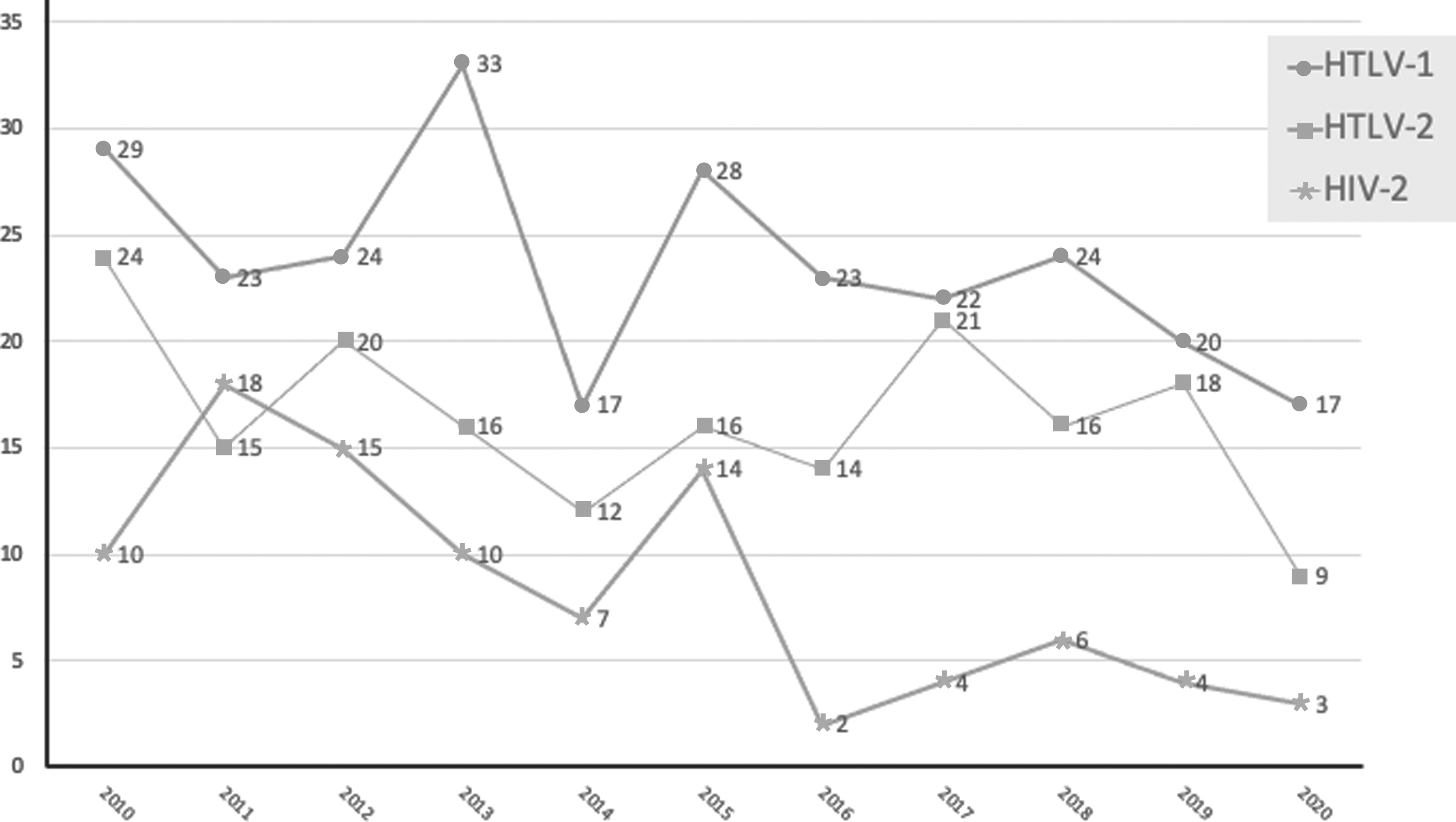
Yearly new diagnoses of HTLV and HIV-2 in Spain.
Given that most infections due to these retroviruses either does not cause symptoms (HTLV-2) or develop in <10% of carriers (HTLV-1) 8 or after several decades (HIV-2), 3 our recognition of a low case reporting during year 2020 suggest an “iceberg” phenomenon. We found a disproportionate high rate of symptomatic patients (i.e., 7 out 17 HTLV-1 carriers), suggesting that misdiagnosis has been frequent, and more pronounced during the COVID-19 pandemic.
The updated cumulative number of persons infected with retroviruses other than HIV-1 in Spain is of 406 for HTLV-1, 810 for HTLV-2, and 402 for HIV-2. Given that infection with any of these viruses is lifelong and that preventive measures are effective, it seems worth to remind about the convenience for excluding these infections at least once in life in persons coming from endemic regions or acknowledging sexual relationships with them. In the particular case of HIV-2, misdiagnosis would avoid false negative viral load results and guide exclusive antiretroviral treatment choices and resistance testing. 9,10
Footnotes
Authors' Contributions
V.S. and C.d.M. designed the study. V.S. wrote the draft. J.M.E., S.R., E.C., V.S., C.d.M., and R.B. provided the main clinical data. C.d.M. did the statistical analyses and produced the graph. All authors revised the article and contributed with comments before submission.
Acknowledgments
We thank all members of the Spanish HTLV and HIV-2 Networks.
Author Disclosure Statement
No competing financial interests exist.
Funding Information
The study was partially funded by grants from project GLD-19_112 and Mutua Madrileña, as well as UNIR projects TRAPES and SEVERITYGEN.