






Abstract
Introduction:
Olive leaf extract (OLE) possesses potent antioxidant properties crucial for safeguarding sperm, especially during cryopreservation. However, its limited solubility in aqueous solutions hampers optimal protective effects. This study aimed to optimize the extraction technique for OLE and enhance its solubility through the utilization of cyclodextrins.
Methods:
The optimized extraction conditions were characterized, with a primary focus on solubility. Subsequently, the impact on both sperm motility protection and the antibacterial potential effect was assessed.
Results and Discussion:
The optimal conditions involved using 20 g of olive leaves with an agitation duration of 60 minutes, yielding 368.509 EAG/mg dry extract of phenolic compounds. Encapsulation of OLE in cyclodextrins not only demonstrated an enhanced antibacterial effect but also showed a significant positive influence on sperm motility after 48 hours of preservation.
Conclusion:
This study highlights the effectiveness of cyclodextrin preparation as a viable strategy to improve OLE solubility, offering significant protection to spermatozoa during cryopreservation, along with an enhanced antibacterial effect.
Introduction
Medicinal plants hold significant value due to their abundant reservoir of therapeutic phytochemicals. 1 Olive leaves, harvested from the Olea europaea tree of the Oleaceae family, have a long history of traditional medicinal use in regions bordering the Mediterranean Sea and its adjacent islands. The chemical composition of olive leaves is subject to variations influenced by factors such as olive variety, climatic conditions, tree age, agricultural practices, genetics, temperature, and extraction methods.
Furthermore, the quantity and quality of phenolic compounds present in olive leaves are contingent on the biological cycle of the olive tree. Owing to their widespread availability and cost-effectiveness, olive leaves possess the potential to serve as a valuable source for the production of high-value-added products. These leaves contain bioactive compounds, including oleuropein, verbascoside, rutin, tyrosol, and hydroxytyrosol, known for their antioxidant, antimicrobial, and antiproliferative properties. 2
However, these bioactive compounds exhibit certain limitations, notably their hydrophobic nature and susceptibility to physical and chemical instabilities. To overcome these limitations, various strategies have been proposed, including the utilization of polymers such as polyethylene glycol, poly (lactide-co-glycolide), polycaprolactone, 3 o-carboxymethyl chitosan, and cyclodextrins (CDs). 4 Cyclic oligosaccharides, such as cyclodextrins, are characterized by a (1→4) glycosidic bond that connects their glucose units. There are three naturally occurring types of cyclodextrins as follows: α-cyclodextrin (α-CD), β-cyclodextrin (β-CD), and γ-cyclodextrin (γ-CD), composed of 6, 7, and 8 units of glucopyranoses, respectively. Cyclodextrins possess a hydrophobic interior and a hydrophilic exterior. 5 These molecules are known for forming inclusion complexes with hydrophobic host molecules, thereby enhancing the solubility and stability of these compounds in aqueous solutions or biological media. 6
The literature review has shown a notable gap in the existing body of knowledge regarding the formulation of olive leaf extract (OLE) encapsulated in cyclodextrins, especially in the context of animal or human sperm cryopreservation. To address this significant research gap, this study represents a pioneering effort.
The primary objectives of this research are to optimize the extraction process of OLE collected from various regions in Algeria and to assess the influence of different cyclodextrins, namely α-CD, β-CD, and PMβ-CD, on the solubility of the extracted material, utilizing a phase diagram approach. Moreover, the study aims to create cyclodextrin/OLE inclusion complexes and thoroughly characterize these complexes. Subsequently, the focus shifts to the practical application of these inclusion complexes in enhancing the preservation of epididymal sheep semen, making it a pioneering endeavor with potential implications in both animal and human reproductive health and cryopreservation.
Materials and Methods
Materials and reagents
Olive leaves were collected from different regions across Algeria, encompassing Bejaia (including Akfadou, Amalou, Kherrata, Seddouk, and Sidi Aich), Bouira, and Tizi Ouzzou. Subsequently, the leaves were meticulously washed, subjected to drying in an oven at 40°C, and finely pulverized using an electric grinder. Chemical reference standards for caffeic acid, gallic acid, and quercetin were purchased from Sigma–Aldrich. All chemicals and reagents employed throughout this research were of analytical grade and were acquired from Sigma–Aldrich and VWR chemicals.
Methods
Preparation of OLE
Olive leaf powder was extracted through two distinct methods, specifically ultrasound-assisted (using 50 Hz, 220 V) and agitation-based at 25°C 7 utilizing either ethanol or water as the chosen solvents. In a succinct description of the procedure, 10 grams of olive leaf powder were introduced into 100 mL of distilled water or 70% ethanol. The resulting mixtures underwent either sonication or stirring for a duration of 60 minutes and were preserved at 4°C for further use. Subsequently, the quantification of phenolic compounds within each extract was carried out.
Characterization of OLE
Estimation of total phenolic compounds
The extracts acquired through both methods were filtered. The ethanol filtrates were concentrated under vacuum below 45°C in a rotary evaporator (Heidolph, Germany), and the aqueous extracts were freeze-dried. The quantification of the total phenolic content within each extract was executed using the Folin–Ciocalteu method. In this method, 20 µL of the extract solution was blended with 1.16 mL of distilled water and 100 µL of Folin–Ciocalteu reagent. Subsequently, 300 µL of Na2CO3 solution (20%) was added to the mixture within 1 to 8 minutes.
The resulting solution was incubated in a shaking incubator at 40°C for a duration of 30 minutes, and the absorbance was measured at 760 nm. The standard used for this analysis was gallic acid. 7 The phenolic content was expressed as µg gallic acid equivalents per mg of DE using the following linear equation: Y = 0.00114X (R2 = 0.9964). Where Y is the absorbance and X is the concentration of gallic acid.
Determination of flavonoids
The total flavonoid content of the plant extracts was estimated using the method of aluminum trichloride (AlCl3). Briefly, 3 mL of ethanol and 500 µL of an AlCl3 solution (2%) were mixed with 500 µL of the sample. The blank consisted of 500 µL of AlCl3 and 3.5 mL of ethanol. The absorbance was measured using a spectrophotometer at 540 nm after 10 minutes of incubation. 8 Quercetin was used as a standard. The flavonoid content was expressed as µg quercetin equivalents per mg DE using the following linear equation: Y = 0.01X, (R2 = 0.99). Where Y is the absorbance and X is the concentration of quercetin.
Determination of tannins
The determination of condensed tannins in plant extracts was carried out using the following method: briefly, 500 µL of the sample was mixed with 3 mL of a 4% sulfuric vanillin solution. The mixture was incubated for 15 minutes, and the absorbance was measured at 510 nm. Condensed tannin concentrations were calculated from calibration ranges established with catechin and expressed in µg of catechin equivalents per mg of dry extract. 9 Quercetin was used as a standard, and tannins were expressed as µg of catechin equivalents per mg DE using the following linear equation: Y = 0.01X, (R2 = 0.99).
Where Y is the absorbance and X is the concentration of catechin.
Optimization of the extraction process using the experimental design method
Factorial design was employed to optimize the extraction process of OLE. Two critical factors, weight and time, were selected, while the yield of phenolic compounds served as the response variable. These two independent factors were assessed at two different levels: high (+1) and low (−1), with real values ranging from 5 to 20 and 40 to 60, as presented in (Table 1). The polynomial equation generated by this experimental design is Yi = b0 + b1 X1 + b2 X2 + b12 X1 X2 + b11 X2 + b22 X2, where Yi is the dependent variable, b is the arithmetic mean response, and bi is the estimated coefficient for the factor Xi. The main effects (X1 and X2) represent the independent variables, while the interaction terms (X1X2) show the response when two factors are simultaneously changed. The polynomial terms (X12 and X22) are included to investigate nonlinearity. The polynomial equation is used to draw conclusions after considering the magnitude of the coefficient and the mathematical sign it carries (i.e., positive or negative) (Table 1).
Experimental Design for the Optimization of Extraction Conditions of Olive leaves Haut du Formulaire
Phase solubility studies
Solubility diagrams were constructed following the method outlined by Higuchi and Connors, 1965. Excess of extract was introduced into 10 mL tubes with increasing concentrations of α-CD, β-CD, or methyl-β-CD (M β-CD). After allowing equilibrium to be reached over a period of 7 days, a sample was drawn and filtered through a 0.45 µm syringe filter. A portion of the sample was diluted and subjected to spectrophotometric analysis at 540 nm to quantify the concentration of dissolved quercetin. 10
Preparation of the inclusion complex
To determine the optimal encapsulation ratio, three concentrations were prepared, maintaining the following ratios: 1:1, 1:2, and 2:1 (extract/α-CD).
Dissolution test
The dissolution test for the aqueous inclusion complexes and OLE in the buffer solution was conducted using a paddle dissolution apparatus. At time intervals of 5, 10, 15, 30, 75, and 100 minutes, 2 mL of each solution was filtered and analyzed. Absorbances at 510 nm were measured using a spectrophotometer.
Fourier-transformed infrared spectroscopy (FTIR)
FTIR analysis was carried out using a SHIMADZU-IR Affinity instrument to investigate the chemical structure and identify functional groups of the compounds. Powdered olive leaves, their extract (OLE), and inclusion complex were mixed with 80% KBR pressed into pellets using a hydraulic press, and then subjected to FTIR scanning over a range from 4000 to 400 cm−1. 11
Antioxidant activity of OLE and complexes
The antioxidant activity of the OLE was assessed following the procedure outlined by Lopez-Lutz et al. The scavenging assay for the OLE samples was conducted using the free radical DPPH (1,1-diphenyl-2-picrylhydrazyl). Briefly, 2.5 mL of each sample was combined with a methanolic DPPH solution, left at room temperature for 30 minutes, and their absorbances were measured at 517 nm. 12
Biological analysis
Antibacterial activities of OLE and complexes
The agar well diffusion method was employed to assess the antimicrobial activities of the aqueous OLE. The procedure involved pouring 20 mL of Mueller Hinton Agar (Merck, Germany) onto agar plates. Pathogenic strains: E. coli (ATCC8739), B. cereus, C. albicans, and S. aureus (ATCC6538) were adjusted to a density of 109 CFU/mL by adding sterile water and evenly spread on the surface of the Mueller Hinton Agar. Wells with a diameter of 7 mm containing extract (alone and encapsulated) were cut into these agar plates. The culture plates were then incubated at 37°C for 24 hours, and the antibacterial activity was determined by measuring the diameter of the inhibition zone in mm. 13
Sperm motility analysis
Sperm motility properties were assessed using computer-aided sperm analysis (CASA; sperm class analyzer, SCA Microptic, S.L., Version 3.2.0). To facilitate image capture and prevent the overlap of spermatozoa cells, the sperm samples were diluted to achieve a concentration of less than 40 × 106 sperm/mL. Five µL of each sperm sample was loaded into a Makler® chamber (Sefi Instrument) previously equilibrated to 37°C and observed using a phase-contrast microscope (Nikon E200®-LED microscope). Images were captured using a video camera (Digital Basler A312fc) at a magnification of x10 (negative phase contrast). The measured parameters included straight-line velocity (VSL), curvilinear velocity (VCL), and average path velocity (VAP).
Results
OLE preparation and characterization
Significant quantities of polyphenols, flavonoids, and tannins were identified in olive leaves, with ethanol and agitation proving more effective in extracting diverse chemical families compared with distilled water and ultrasound (Tables 2).
Ethanolic and Aqueous Extraction by Agitation (Agit) and Ultrasound (Ult) Methods
The region exhibiting the highest secondary metabolite yield was Sidi Aich (323.02 ± 0.6 µg EAG/g DE), followed by Tizi Ouzou (300.69 ± 0.7 µg EAG/g DE), Kherrata (300.69 ± 0.7 µg EAG/g DE), Bouira (258.32 ± 0.3 µg EAG/g DE), Seddouk (233.75 ± 0.9 µg EAG/g DE), Amalou (223.05 ± 0.6 µg EAG/g DE), and Akfadou (216.5 ± 0.5 µg EAG/g DE).
OLE optimization
The impact of olive leaf weight and extraction time, as determined through three full factorial designs, is summarized in Table 3, with the ethanol volume (100 mL) held constant across all experimental batches.
Optimization of Extraction Process Using D-Optimal Design
Model quality assessment utilized two key metrics: the percentage of variability explained by the model response (R2) and the percentage of response variability predicted by the model (Q2). R2 signifies the percentage of variability clarified by the model response, while Q2 denotes the percentage of response variability foreseeable by the model. The obtained values for R2 (0.9922) and Q2 (0.9405) indicate a well-fitted and predictive model. Phenolic compound yield values across different batches exhibited substantial variation, ranging from a minimum of 241 µg/g AG to a maximum of 370 µg/g AG (Table 4).
Numerical Values of the Statistical Analysis
Data were analyzed statistically by ANOVA (Table 5). The polynomial factorial equation for the yield of phenolic compounds was generated by multiple linear regressions.
Optimum Values of the Extraction Yield
Yield of phenolic compounds = 265.789 + 48.83 weight + 13.33 time + 33.02 weight 2 – 1.47 time 2 + 9 weight*time
Phase solubility studies
Solubility diagrams were constructed following the method outlined by Higuchi and Connors, 1965. 10
Phase solubility studies using α-CD
In the obtained profile view (Fig. 1a), an initial linear increase in polyphenol concentrations with the α-CD concentration is evident, followed by a positive deviation from linearity. As per Higuchi and Connors classification, the curve for (polyphenols-α-CD), displaying a positive deviation from linearity, indicates the existence of an AL profile.
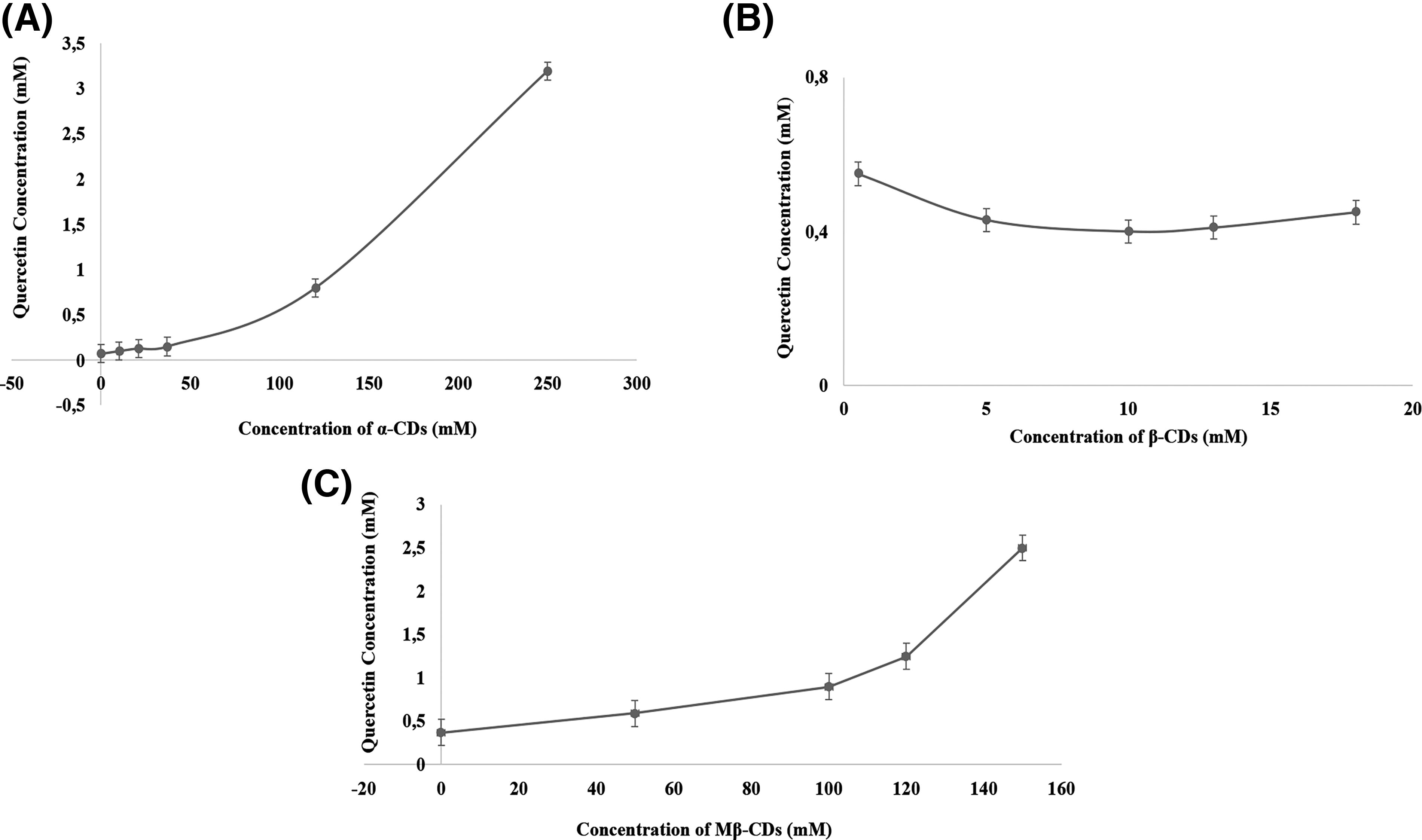
Phase solubility diagram of OLE in the presence of
Phase solubility studies using β-CD
From the curve (Fig. 1b), a decrease in polyphenol concentration is observed, followed by a slight increase at a specific β-CD concentration. The profile for (amount of polyphenols-β-CD) is classified as Bi type.
Phase solubility studies using Mβ-CD
According to the solubility profile (Fig. 1c), there is an initial linear increase in polyphenol concentration with the concentration of Mβ-CD, followed by a positive deviation in the concentration (extract-Mβ-CD) compared to linearity. As per Higuchi and Connors, the observed curve for polyphenol concentration-Mβ-CD, with a positive deviation from linearity, indicates an AL profile, 10 where Mβ-CD is proportionally more effective at higher concentrations.
Dissolution test
We decided to follow quercetin dissolution because it is a phenolic compound that is not soluble in our solvent.
It was chosen to monitor quercetin dissolution as it is a phenolic compound with limited solubility in our solvent. The graph in (Fig. 2) illustrates an increase in quercetin concentration within the complex (extract/α-CD) over dissolution time, varying across different ratios.
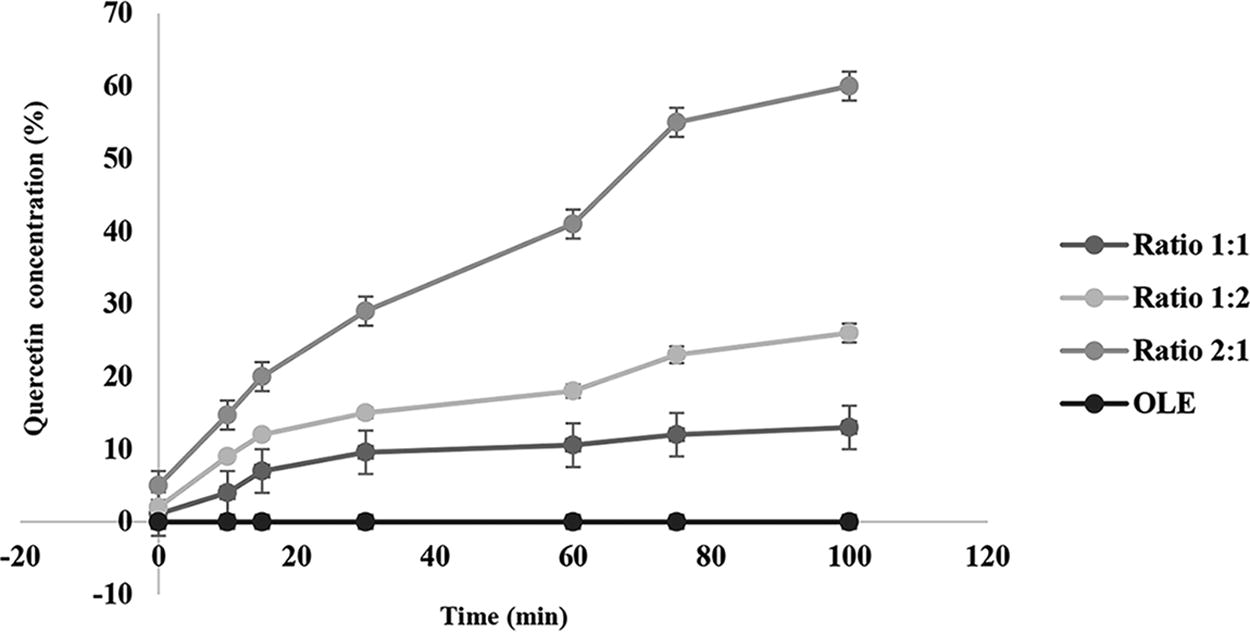
The dissolution profile of free OLE and encapsulated in α-CD. OLE, olive leaf extract.
Antioxidant activity
The free radical scavenging method (DPPH) was used to evaluate the antioxidant activity of optimum OLE and its encapsulation by α-CDs; it is characterized by a slightly stronger DPPH radical scavenging activity of 77.67% and 87.32%, respectively.
The results obtained show that the extract encapsulated with CD gives a better antioxidant activity; this means that our CD has well solubilized the insoluble groups and therefore consequently releases their beneficial effect.
Biological analysis
Antibacterial activities of OLE and complexes
The antibacterial activities of OLE and its inclusion complex with α-CDs were evaluated, and the results are presented in Table 6. The findings indicate that both OLE and OLE-α-CDs exhibit superior antibacterial activities against the tested bacteria compared with the control (DMSO solvent). The inclusion complex, in particular, demonstrated the highest activities, with the most significant inhibition observed against E. coli, followed by B. cereus, S. aureus, and C. albicans, with inhibition diameters of 30 ± 0.5, 22 ± 0.6, 21.5 ± 0.4, and 14.4 ± 0.7 mm, respectively. OLE alone also displayed noteworthy inhibition diameters, and the ranking of bacterial susceptibility remained consistent, albeit with slightly lower activities compared with the inclusion complex (25 ± 0.9, 18 ± 0.8, 16 ± 1.1, and 11 ± 0.6 mm).
Inhibition Zones of Growth Bacteria of Olive Leaf Extract and Its Complex
(—) absence of antibacterial activity.
Sperm motility analysis
The impact of OLE and OLE-α-CDs on sperm motility is illustrated in (Fig. 3). Mobility parameters, including VAP, VSL, and VCL, were assessed at different time points of cryopreservation (0, 1, 2, 3, 24, and 48 hours) for each sample. The results depicted in (Fig. 3) reveal a noticeable improvement in mobility parameters when sperm is treated with OLE, indicating a positive effect on sperm motility. However, the most significant enhancement is observed in sperm treated with OLE-α-CDs, demonstrating consistently higher motility parameters at every incubation time. Both OLE and OLE-α-CDs treatments exhibit significantly higher motility compared with the control. Notably, after 48 hours of incubation, the results indicate that both total and progressive motility are markedly increased in sperm treated with OLE-CDs.
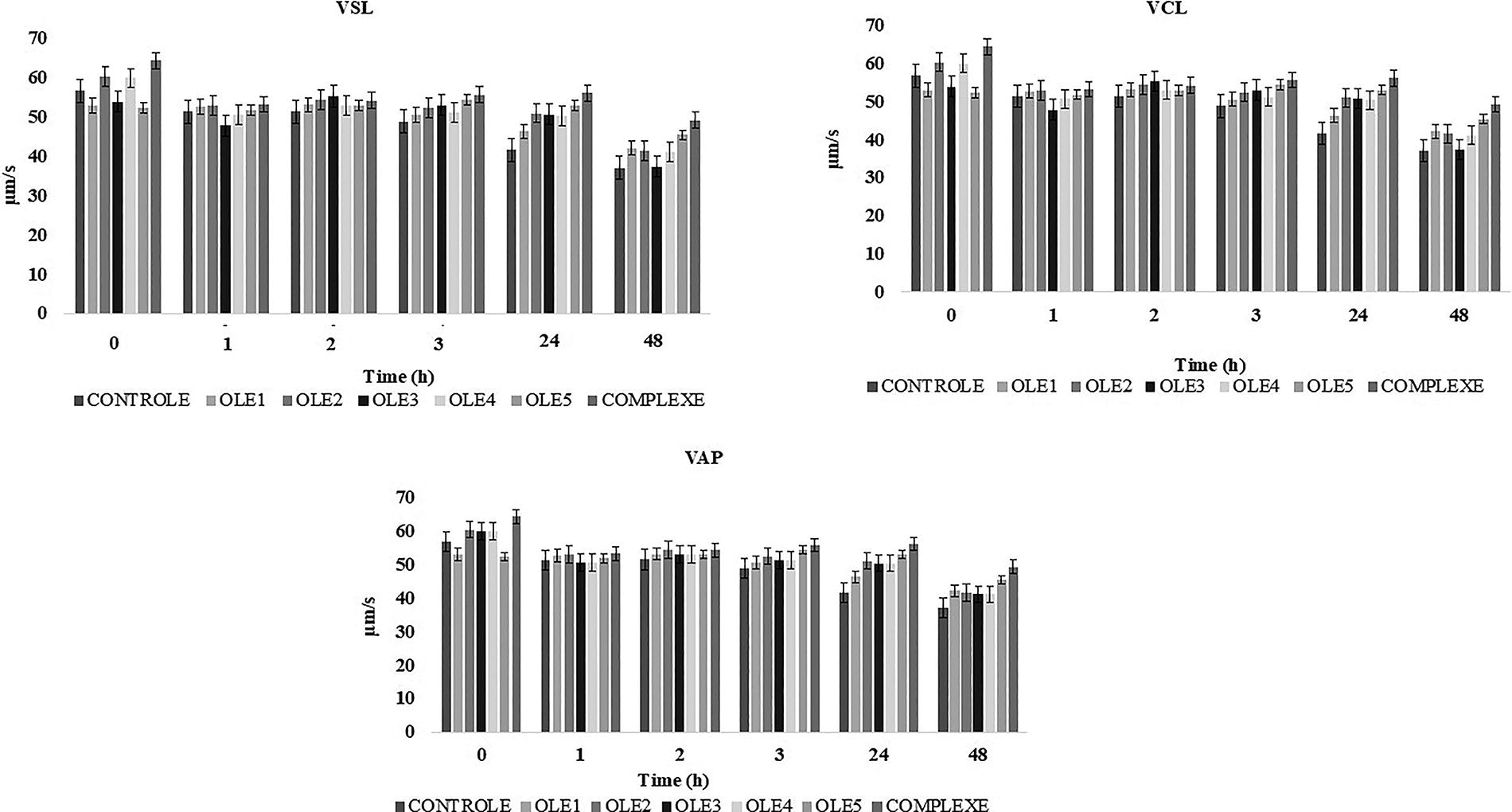
Values of curvilinear velocity (VCL), straight linear velocity (VSL), and average path velocity (VAP), after 48 hours of preservation at 4°C of bovine sperm in the control group and groups treated with OLE and OLE/α-CD (complex). OLE, olive leaf extract.
Discussion
Olive leaves demonstrated a higher concentration of bioactive phenolic compounds compared with olive oil and fruits, influenced by various factors, such as climatic conditions, genetic heritage, harvest period, plant development stage, and extraction method.14–16 It is crucial to note that the quantification method used can impact total phenol and flavonoid content estimation. This comprehensive characterization reveals the potential of olive leaves as a rich source of valuable phytochemicals, emphasizing their versatility and applicability in various industries. The effectiveness of ethanol and agitation highlights their role in maximizing the extraction of beneficial compounds from olive leaves, providing a foundation for further exploration and utilization.
In the initial phase of the study, ethanol (5.2 polarity) and water (9.0 polarity) were employed as solvents for phenolic compound extraction, with ethanol constituting 30% of distilled water. Tables 2 highlights the variation in polyphenol and total flavonoid contents relative to the extraction solvent’s polarity. Results underscore the significant impact of solvent extraction power on phenolic compound yields, with the mixed solvent (ethanol 70%) exhibiting the highest efficacy, followed by aqueous extracts. The agitation method emerges as a positive factor enhancing phenolic compound extraction yield. This effect is attributed to its role in maintaining suspension, homogenizing the medium, reducing resistance to solute transfer at the solid-liquid interface, and increasing the transfer coefficient. 17 These findings align with previous research emphasizing the effectiveness of mixed solvents in polyphenol extraction. 18
The observed results of the optimization process emphasize the influence of the chosen variables on the yield of phenolic compounds, as evidenced by the considerable range of coefficients. Significant coefficients were identified for b1, b2, and b11, and b12, while b22 demonstrated nonsignificance. This implies that the interaction term b22 does not play a substantial role in predicting the yield of phenolic compounds. The findings suggest that elevated values of X1 and X2 lead to a decrease in the yield. To summarize, the extraction of phenolic compounds from olive leaves is contingent on both weight and time. The optimal conditions yield approximately 368.509 ± 0.9% µg EAG/g DE.
The phase solubility profile of α-CD is notably more effective at higher concentrations. This observation suggests the concurrent formation of soluble inclusion complexes with varied stoichiometries, signifying a weak interaction between polyphenols and cyclodextrin. The phenomenon of β-CD is attributed to the low aqueous solubility and the extract. The literature suggests that β-CD tends to form complexes with limited solubility, especially with very poorly water-soluble guests. 19 The profile of Mβ-CD suggests the simultaneous formation of soluble inclusion complexes with different stoichiometries, signifying a very weak interaction between the polyphenols of the extract and cyclodextrin. On the contrary, the results highlight that α-CD serves as the most effective solubilizing agent for OLE, leading to its selection for the subsequent stages of our study.
The dissolution profile revealed a concentration increase in quercetin within the complex over time, displaying variability among different ratios. Our findings highlight the pronounced ability of the α-CD inclusion complex to elevate OLE concentration in the buffer solution, thereby enhancing its solubility. This augmentation optimizes the efficacy of bioactive compounds within the CD-encapsulated extract. The observed concentration variation among ratios emphasizes the superiority of the (2:1) ratio in enhancing solubility. This effectiveness is attributed to the favorable structure of the α-CD internal cavity for such encapsulation. 19
Consistent findings have been reported by various researchers investigating the efficacy of CDs encapsulation for different compounds. Fatmi et al. (2015) and Fatmi et al. (2021) demonstrated similar outcomes in their study on the encapsulation of camptothecin.20,21
The antioxidant activity of the optimal OLE and its encapsulation complexes (OLE-α-CDs) was assessed using the free radical scavenging method (DPPH). The encapsulated extract exhibited a slightly enhanced DPPH radical scavenging activity, measuring 87.32%, compared with 77.67% for the nonencapsulated extract. These findings suggest that the CDs effectively solubilized the insoluble groups present in the extract, leading to improved antioxidant activity. The observed increase in scavenging activity indicates the successful release of beneficial effects attributed to the encapsulated compounds. 22
The antimicrobial effects observed can be attributed to the chemical composition of the OLE, particularly the high content of oleuropein and other identified phenolic compounds. Hydroxytyrosol and oleuropein, among other phenolic compounds, are known to inhibit or impede the growth of various human intestinal or respiratory tract pathogens. 23 The combined antibacterial action reported in this study aligns with previous findings, emphasizing the effectiveness of OLE against bacteria such as Klebsiella and Pseudomonas, which are notorious for their resistance to antibiotics.24,25
Spermatozoa are known to be sensitive to natural product compounds, with documented spermicidal effects. However, in vivo investigations suggest a positive impact on animal reproduction parameters, including sperm mobility and viability. In this investigation, we hypothesized that encapsulation could enhance the application of OLE in bovine semen cryopreservation by addressing challenges such as limited water solubility, volatility, and sensitivity to oxygen and light, which could otherwise reduce the bioavailability of OLE. Indeed, our findings demonstrate that the OLE-CDs complex is well-suited for bovine sperm preservation, exhibiting superior effects compared to OLE alone.
Taouzinet et al. (2022) explored the effectiveness of cyclodextrin and liposome encapsulation for vitamin E on bovine sperm cryopreservation, while Toutou et al. (2023) investigated the encapsulation of propolis and demonstrated the protective effect of the complex (extract-CD) on beef sperm during cold chilling, both corroborating the positive impact of cyclodextrin in enhancing the performance of encapsulated natural compounds.22,26
Conclusion
In the present study, we have investigated the interest of α-CDs to enhance the solubility of OLE and their impact on cryopreserved bovine sperm. The results of a 32 full factorial design revealed that the weight and time significantly affect the dependent variable, yield of phenolic compounds. Thus, it is concluded that by adopting a systematic formulation approach, optimum results can be reached in a short time with minimum efforts. The best yield was obtained when using 20 g of olive leaves powder in 100 mL of ethanol at 70% during 60 minutes.
The results of a 32 full factorial design underscored the significant influence of weight and time on the dependent variable and the yield of phenolic compounds. It was deduced that adopting a systematic formulation approach could yield optimal results with minimal effort, exemplified by the superior yield achieved.
The current results showed that these positive effects of OLE are more patented in the presence of CDs, which suggests that encapsulation in CDs could promote the beneficial effect of OLE on bovine sperm during storage at 4°C and increase the antibacterial effect. However, more studies are required to understand deeply the underlying biological and biochemical mechanisms behind this beneficial effect.
Footnotes
Acknowledgments
The authors thank “LMPA, Department of Process Engineering, Faculty of Technology, Université of Bejaia,” “Associated Laboratory in Marine Ecosystems and Aquaculture, Faculty of Nature and Life Sciences, University of Bejaia,” “Technology Pharmaceutical and Bio pharmaceutics Laboratory, UFR Medicine and Pharmacy, Rouen University,” and “FATMI quality control laboratory” for all the support provided.
Authors’ Contributions
I.H. and S.F. wrote the article. I.H., N.C., Z.T., L.T., A.I.-I. and M.L.-S. carried out the data analyses. S.F., M.S., and I.M. designed the study. All the authors have read the final article and approved submission.
Author Disclosure Statement
No potential conflict of interest was reported by the authors.
Funding Information
The authors declare that no funds, grants, or other support were received during the preparation of this article.