







Abstract
The evolution of Earth-like habitable planets is a complex process that depends on the geodynamical and geophysical environments. In particular, it is necessary that plate tectonics remain active over billions of years. These geophysically active environments are strongly coupled to a planet's host star parameters, such as mass, luminosity and activity, orbit location of the habitable zone, and the planet's initial water inventory. Depending on the host star's radiation and particle flux evolution, the composition in the thermosphere, and the availability of an active magnetic dynamo, the atmospheres of Earth-like planets within their habitable zones are differently affected due to thermal and nonthermal escape processes. For some planets, strong atmospheric escape could even effect the stability of the atmosphere. Key Words: Terrestrial planets—Atmosphere evolution—Geophysics—Habitability. Astrobiology 10, 45–68.
1. The Formation and Evolution of Terrestrial Planetary Atmospheres
The primordial atmosphere was replaced by a secondary, slightly reducing neutral atmosphere of CO2, H2O, and H2S (with minor amounts of other gases such as CH4, CO, N2) (e.g., Walker et al., 1983; Kasting, 1993; Kasting and Catling, 2003). This atmosphere was mainly produced by volcanic outgassing, as well as by volatiles imported via comets, meteorites, and micrometeorites. Studies of the noble gas Xe suggest that, by 4.35 Gyr, the amount of H, C, and N in the surface reservoirs of Earth was similar to that of today (Kramers, 2003). However, this latter study also indicates that a significant part of the present atmosphere is a remnant of loss, rather than the product of later degassing.
The origin of Earth's volatile elements can be summarized by the following four main hypotheses (Drake and Righter, 2002): The planetesimals from which Earth accreted were essentially dry, and most of the volatiles were brought in during the Hadean epoch (the late veneer) via volatile-rich carbonaceous chondrite meteorites (e.g., Morbidelli et al., 2000). Wet accretion with little or no exogenous volatile source (e.g., Drake and Righter, 2002): Dauphas et al. (2000) and Robert (2001) estimated that between 50–90% of the volatiles originated from these “wet” planetesimals. The volatiles had a predominantly cometary origin (e.g., Delsemme, 1998; Owen and Bar-Nun, 2000).
One problem with the third theory is that the isotopic ratio of D/H that was measured in three comets is twice that of Earth's oceans (Robert, 2001). Therefore, Owen and Bar-Nun (2000) suggested that the cometary component only represented about 30% of the volatile source. The fourth hypothesis about the origin of Earth's volatiles, proposed by Maurette et al. (2001) is as follows:
The existence of large amounts of Hadean-age zircons implies that there must have been liquid water at the surface of Earth that hydrated the oceanic crust (through infiltration and weathering). The earliest hypotheses suggest that, at least by 4.4 Gyr, there were oceans at the surface. Modeling of the evolution of the Sun has indicated, however, that the early Sun was about 25% weaker than it is today (e.g., Sagan and Chyba, 1997; Guinan and Ribas, 2002). Water could remain liquid at the surface of Earth, even under conditions that included weaker radiation from the Sun, if either the concentration of CO2 in the atmosphere was much higher (6–10 bar) or the atmosphere contained another greenhouse gas, such as CH4 (e.g., Nisbet and Sleep, 2001; Pavlov et al., 2001a, 2001b). If the CH4 originated from volcanic outgassing, this would indicate reduced upper mantle conditions, which was clearly not the case (Delano, 2001).
Kasting et al. (2001) hypothesized a microbial origin from methanogenic bacteria for the CH4, at least during the Late Archean. This hypothetical hydrocarbon smog could also have protected Earth's surface and the biota from DNA-damaging UV radiation. Considering the fact that we have no rock record from the Hadean, we also have to address the possibility that early Earth was covered with ice. This would have affected the weathering rate of any exposed land, whether (proto-) continents or portions of exposed oceanic spreading ridges. A frozen planet does not produce CO2-rich rain that can corrode the exposed minerals.
On the other hand, early Earth was more volcanically active than it is now because of the higher heat flux from the mantle (Franck, 1998). This means that weathering or alteration of the submarine fresh lava could have continued to take place even if there was an ice crust a couple of kilometers thick covering the surface of the oceans. Submarine alteration of oceanic crust produces carbonate minerals and clays that can be removed from the system by plate tectonics.
The detection and spectroscopic analysis of the atmospheres of terrestrial planets inside the habitable zones of Sun-like stars with different ages, by future space observatories such as Darwin and the Terrestrial Planet Finder Coronagraph and Terrestrial Planet Finder Interferometer, will certainly provide a better understanding of how atmospheres form and evolve (e.g., Cockell et al., 2009).
The observation of planetary systems and terrestrial planetary atmospheres at different evolutionary stages should yield great improvements for understanding how Earth and its atmosphere evolved.
2. The Habitable Zone
The habitable zone (HZ) around a star, as shown in Fig. 1, is defined as the zone around a star within which the starlight is sufficiently intense to maintain liquid water at the surface of a terrestrial planet without initiating runaway greenhouse conditions that dissociate water and sustain the loss of hydrogen to space (see Kasting, 1988). Three temperatures are of importance to determine the habitability of a planet: the effective temperature based on a blackbody having the same surface area and the same total radiated thermal power; the surface temperature at the interface between any atmosphere and the solid surface; the exosphere temperature in the upper atmosphere, which controls the thermal escape of atmospheric species.
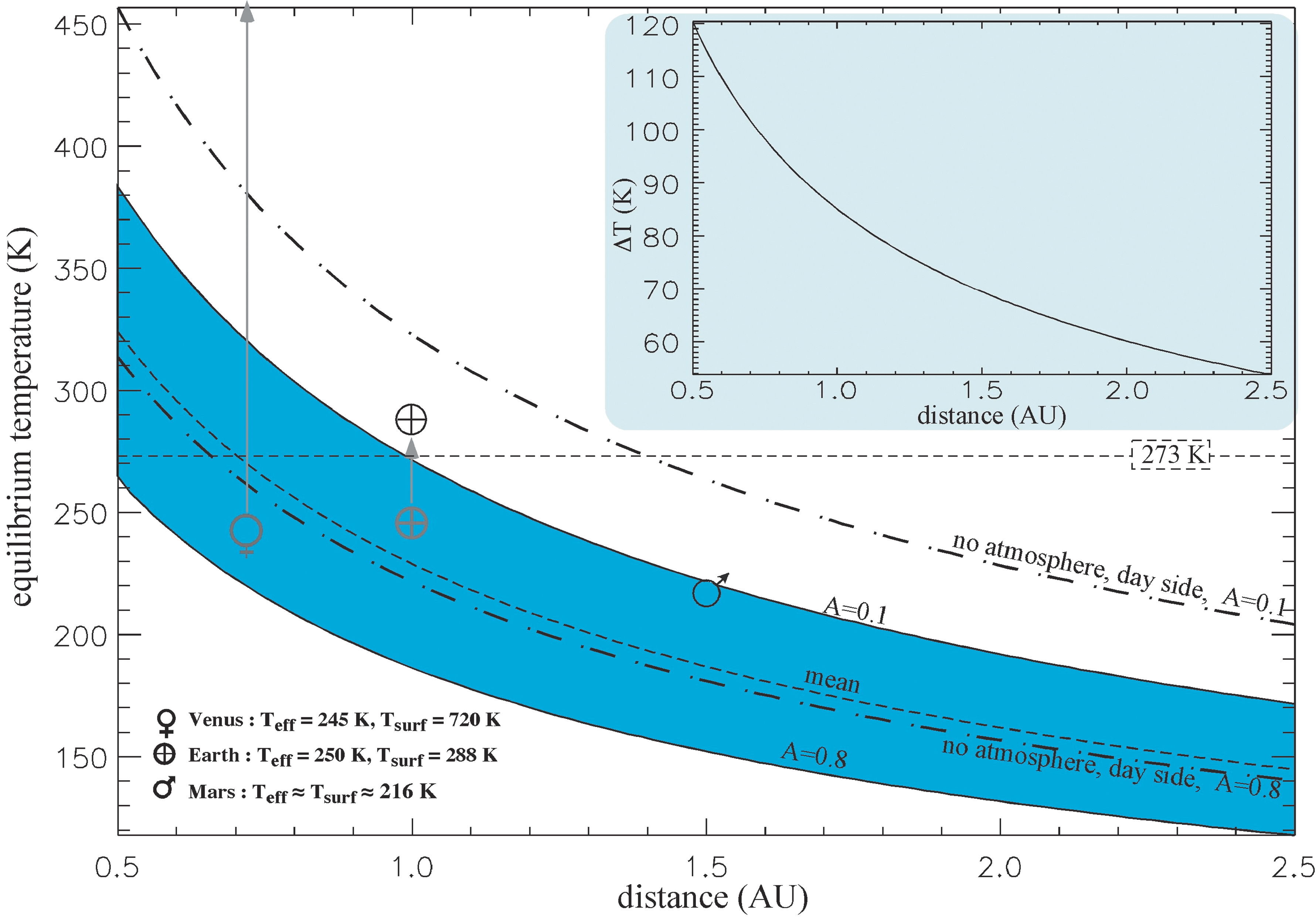
Equilibrium temperature and albedo. The orbital distance of a planet and its albedo (the fraction of the incoming light reflected to space) determine an equilibrium temperature, T eq, corresponding to the temperature of a blackbody that reemits all it absorbs. The solid curves give T eq for two extreme albedos observed in the Solar System (0.1 and 0.8) and delimit a blue area of possible values of T eq (the dashed line shows the average of them). The dotted-dashed lines represent the dayside temperature of an atmosphere-less planet. T eq for Venus, Earth, and Mars is indicated with a light gray symbol. The black symbols show the measured surface temperature on these planets (for Venus this is too high to appear). The surface of Earth, and especially of Venus, is heated by the greenhouse effect of the atmosphere: these two planets have very different albedos but a similar effective temperature, T eff (the temperature associated with the radiated IR flux). However, their surface temperatures differ by more than 400 K. The graph in the upper-right part shows the uncertainty on T eq (i.e., the difference between the two solid curves). One can see that the orbital distance by itself is poorly indicative of the surface temperature of a planet (courtesy of F. Selsis).
If a greenhouse effect evolves, the surface temperature will be warmer than the effective temperature. The planet's effective temperature
depends on the temperature T Star and thus the brightness of the star, the distance to the star d, and the planet's albedo A.
Although necessary conditions for the emergence, survival, and evolution of life are still unknown, two main requirements are widely accepted as an unavoidable necessity: long-time stability of planetary atmospheres, liquid water.
The presence of liquid water, far from being a sufficient requisite for biology (Lammer et al., 2009a), allows the identification of potential extraterrestrial habitats or, more rigorously, exclusion of dry environments where the presence of life-forms as we know them may be ruled out. In the Solar System, beyond Earth, liquid water is expected in the subsurface of Mars, in the jovian moons Europa and Callisto, and in the venusian clouds, which does not imply that life is likely to be found in these regions, but that life is absent elsewhere (e.g., Lammer et al., 2009a, and references therein). In the context of future terrestrial planet-finding and characterizing missions, it is important to distinguish between surfaces, as opposed to interior habitability.
Indeed, if life is, or was, present in the interior of Mars or some icy satellites, remote sensing would not allow for detection of biomarkers* in their atmospheres from Earth or from interplanetary space probes. Only an extended and productive biosphere, which is able to process the atmospheric and superficial material, can be indirectly detected.
For space missions designed to search for life spectroscopically in exoplanetary atmospheres, planets of interest should be those whose surface conditions are such that stable liquid water is present over geologically long periods of time. If it is assumed that water and volatiles are abundant enough in terrestrial planets to form dense atmospheres and oceans, then a circumstellar region can be defined within which the radiative energy received by a planet allows for the existence of liquid water.
As seen in Fig. 1, the average surface temperature of a terrestrial planet is not a direct consequence of the orbital distance. Indeed the albedo, A,
the fraction of incident energy reflected to space, and the greenhouse warming due to the IR opacity of the atmosphere
are complex wavelength-dependent parameters, which are determined by the nature of the atmosphere (pressure, composition, cloudiness) and the surface (Selsis, 2004).
2.1. CO2 cycling and climate regulation
On a terrestrial planet, the partial pressure of CO2 is controlled by the carbonate-silicate cycle and kept at a value that maintains the average surface temperature slightly above 273 K. This self-regulation by the CO2 cycle (Walker et al., 1981) relies on the fact that the formation of carbonates from atmospheric CO2 requires liquid water. If the CO2 level is too low to maintain substantial amounts of running water, carbonate formation is stopped while volcanic release of CO2 keeps feeding the atmosphere. On the contrary, very high CO2 levels stimulate carbonate formation by enhancing the humidity of the lower atmosphere and the water cycle. These two feedback mechanisms work as long as there is release of CO2.
2.2. The inner edge of the HZ
Close-in habitable worlds are influenced by two major factors. First, there is a limit to the IR flux that can escape from a moist atmosphere (F
max). Second, if an incident energy above this limit is deposited into the atmosphere (i.e., if all oceans are evaporated, and the surface temperature rises above 1400 K, radiating the energy excess in the near IR and visible range (e.g., Kasting, 1988).
The distance at which this occurs is uncertain due to the effect of clouds on the albedo. For a clear-sky atmosphere, it starts at 0.85 AU for the present solar luminosity; but, with highly reflecting clouds, this limit could be as small as 0.5 AU. However, even when runaway greenhouse conditions are not reached, the loss of hydrogen to space is strongly enhanced by the temperature profile of the atmosphere, which becomes nearly isothermal when the runaway threshold is approached. The resulting loss of water is substantial and affects the water content of the planet at orbital distances closer than 0.95 AU. The long-term habitability of a planet between this distance and the runaway threshold depends on the water reservoir and the time it takes to lose it completely.
2.3. The outer edge of the HZ
At any orbital distance from the host star, the amount of atmospheric CO2 required to provide a mean surface temperature of about 273 K can be estimated. This amount increases with the orbital distance of a terrestrial planet, until the outer limit of the HZ is reached. The existence of an outer edge is due to the increase of both IR opacity and albedo,
with increasing values of An outer limit of the HZ of about 2.4 AU can be obtained, however, with the present solar luminosity (Mischna et al., 2000). The main uncertainties of this estimation come from the process of cloud formation, the radiative properties of CO2-ice particles (Colaprete and Toon, 2003), and collision-induced absorption by CO2 at high pressure for which, at present, laboratory data are scant.
2.4. Habitable zones around main sequence stars
For terrestrial planet-finding missions, the search for Earth-like planets will not be limited to Sun-like G-type stars but can be extended to other low-mass star types like M, K, and F. By using the present HZ of the Sun, which ranges from 0.85 to 2.4 AU, as a reference, evolution models for the luminosity of other main sequence stars can be used to infer the boundaries of the HZ for any star at any age, as shown in Fig. 2.
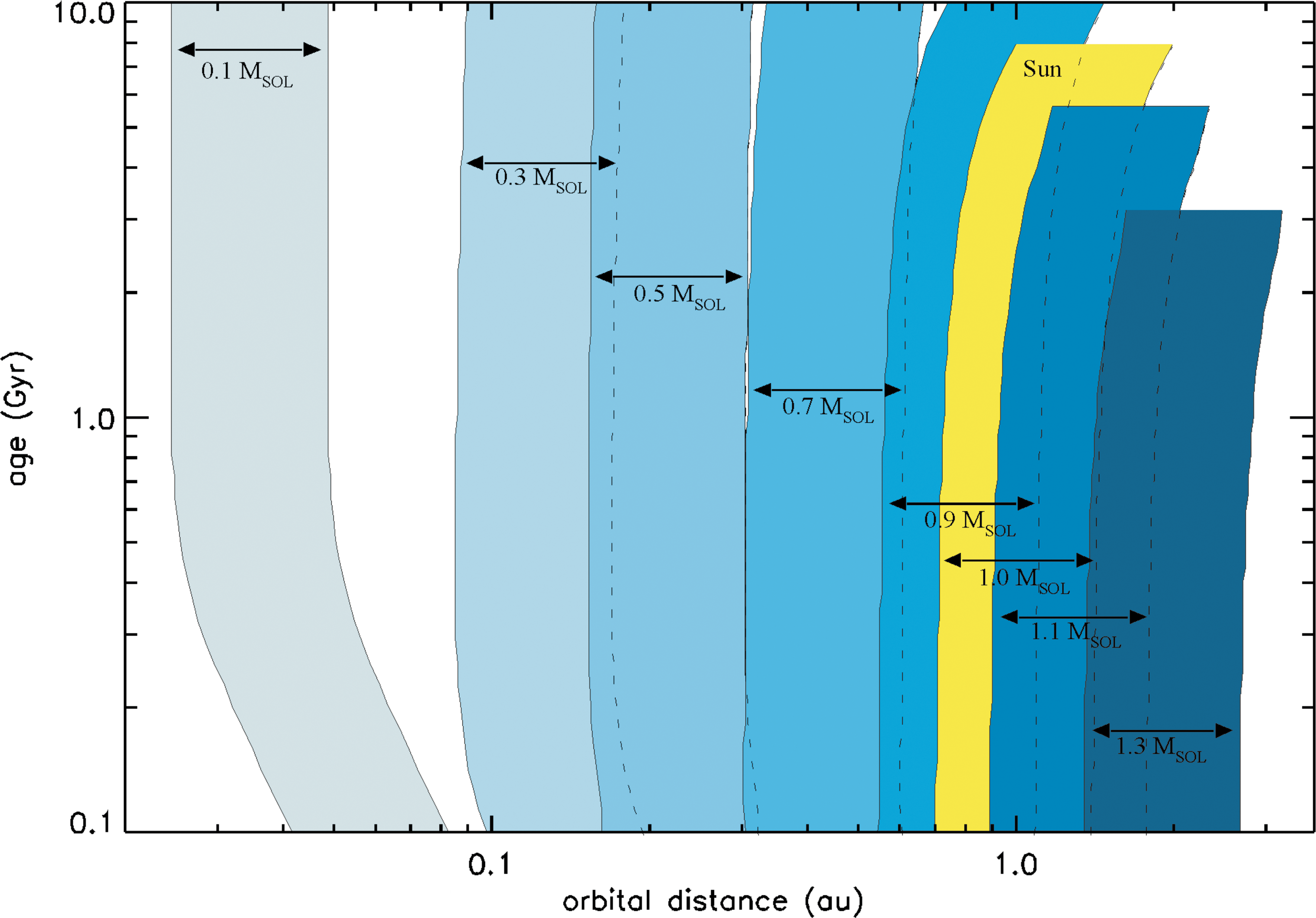
Examples of boundaries of the HZ for main sequence stars of different masses, as a function of the stellar age. For stellar masses above 0.9 M Sun, the main sequence lasts less than 10 Gyr. For G and F stars, the limits of the HZ move away from the star in response to the increase of luminosity. The evolution of stellar luminosity is taken from Baraffe et al. (1998).
It can also be assumed that the spectral shape of the stellar emission and the mass of the planet do not change the limits of the HZ significantly. The boundaries of the HZ move throughout a star's lifetime as the stellar luminosity evolves. This evolution is significant for very low–mass stars during the first hundreds of millions of years and for G and F stars, where the luminosity increases during the whole main sequence.
2.5. A wider HZ?
Paradoxically, a habitable world where climate is controlled by abiotic CO2 cycling can be very different from an inhabited world where the biosphere is involved in the fixation, cycling, and emission of atmospheric compounds. If the main warming gas was CH4 during part of Earth's history, before the rise of O2 and after the emergence of methanogenesis (Pavlov et al., 2000), regulation of the climate would be influenced by life itself, and some complex coupling could arise. Therefore, a widespread and active biosphere may make a planet habitable outside the previously defined HZ boundaries.
A CH4 atmosphere sustained by biological activity and made of CO2, CH4, nitrogen oxides, and, for instance, SO2 compounds may be opaque in most of the thermal IR range and habitable farther out than the currently defined outer edge of the HZ. Mid-IR telescopes with low resolution power would be able to see any active greenhouse gas, including those that are biogenic.
It can be seen from this example that the concept of the HZ should not be based solely, a priori, on the properties of CO2. However, because CO2 is the only efficient greenhouse gas compatible with an oxidizing atmosphere, the previously defined HZ can be restricted to biologically O2 enriched atmospheres (Selsis, 2002).
2.6. Size and mass for habitable planets
An important question arises: how can habitable planets be recognized? A good method is the study of the IR emission of a planet, which will tell a great deal about the potential habitability of a discovered terrestrial planet.
First: the variation of the IR flux from the planet throughout its orbit and its correlation with the phase will reveal the thermal inertia due to a dense atmosphere or, on the contrary, the absence of an atmosphere (Selsis, 2004).
Second: with a low resolution power, the blackbody envelope of the spectrum in the atmospheric windows will give the brightness temperature of the emitting layer.
This layer can be the surface, a mixture of surface and clouds, a global cloud cover, or even the atmosphere itself, if it is optically thick at all wavelengths, as in the case of an atmosphere that experiences a runaway greenhouse effect.
The spectral shape and its variability should allow investigators to relate this temperature to the surface temperature. If the wide H2O bands show up in the spectrum, while the mean surface temperature is moderately above the freezing point of water, a habitable candidate would be identified.
Another important characterization of a terrestrial or Earth-like planet has to do with its size and mass. If a planet is small, it will probably behave not like Earth but in a way more characteristic to the large moons in the Solar System, for example, Europa, Callisto, Ganymede, Io, or Titan, to mention the largest. These bodies have a much lower average density than terrestrial planets, presumably because of a different mode of formation. Earth's own moon may have been formed through a collision between young Earth and a Mars-sized planetary embryo called Thetys (e.g., Kasting and Catling, 2003). The impact destroyed Thetys, and the heavy elements sank to the Earth's core, while light materials were blasted into an orbital ring surrounding Earth, where they congealed into the Moon.
Moreover, for reasons of formation modes, an Earth-like planet is defined as having a minimum radius of about 0.5 Earth radii (R Earth).
A maximum radius is harder to define, but at some point, according to current models, a terrestrial core starts to accumulate a dense gas envelope and turn into a gas-giant planet. This limit is believed to be somewhere around 10–15 Earth masses (M Earth), which leads to a radius of about 2 R Earth as an upper limit for terrestrial planetary densities (Léger et al., 2004; Selsis et al., 2007).
It should be noted that this number does not put any constraints on terrestrial planet-finding missions. The next important factors are the planetary emissivity and albedo. The latter factor is mainly important when attempting to detect reflected light. In the baseline design of the Darwin mission, the mid-IR between about 5 μm and ≥18 μm will be chosen. Thus, the definition of habitable terrestrial planets in orbits inside the HZ of main sequence stars is Terrestrial planet definition: A minimum of 0.5 R
Earth and a maximum of 2 R
Earth. Earth albedo, Earth emissivity, effective temperature between 273 and 373 K. A density between 3 and 7 g cm−3,
and, for giant planets, Giant planet definition: A planet with a mass larger than 15 M
Earth.
Future terrestrial planet characterization missions like Darwin or the Terrestrial Planet Finder Coronagraph or Terrestrial Planet Finder Interferometer should have the capacity to detect terrestrial planets inside the HZ with radii between 0.7 and 2.4 AU scaled by the square root of the stellar luminosity (L Sun = 1).
3. Stellar and Geophysical Influences on Planetary Habitability
Stable orbits inside the HZ are a requisite for terrestrial planets to be habitable, but these planets also need to satisfy other necessary conditions. For example: The water content of a terrestrial planet may be extremely variable from one planet to another, because it is likely to be brought by a few massive impactors rather than a continuous veneer.
Recent studies indicate that the orbital parameters of giant planets in an outer system may strongly influence the water abundance of the inner planets (Levison and Agnor, 2003). Giant planets with eccentric orbits can result in dry terrestrial planets, while systems with low-mass giant planets or no giant planets can be associated with low-mass terrestrial planets (Raymond et al., 2004, 2007).
Toxic environments may prevent life from appearing on a planetary surface. Atmosphere-surface interaction processes on terrestrial planets that have Mars-like environments can produce toxic surface layers and soils that are hazardous to life-forms. Several analyses were performed in the frame of the Viking Mars landers in their program for the search for life on Mars. No clear biological signals were found; but, instead, the surface soil samples and samples from beneath the surface were found to be chemically reactive (Klein et al., 1976). An oxygen release was observed due to humidification (Oyama and Berdahl, 1977). Decomposition of induced isotopically labeled organic nutrient solutions, due to contact with the soil samples, gave further evidence for oxidative reactions (Levin and Straat, 1977).
These negative results may be consistent with the hypothesis that there is one or more reactive oxidants present at the martian surface (Klein, 1977). Adsorbed superoxide ions (
These electrons are incorporated in free oxygen, which forms
Nearly unattenuated irradiation of surface layers would induce photocatalytical reactions such as described above. The result would be a harsh oxidizing surface environment. However, a humid climate and higher overall pressures and O3 contents in the upper atmosphere would prevent generation of strong oxidizing agents at the planetary surface (Patel et al., 2003; Rontó et al., 2003). Planets that evolve into Mars-like bodies may develop surface environments hostile to life.
If a past presence of abundant water on such planets is assumed, then early life such as methanogenic bacteria may still survive in deep subsurface permafrost aquifers, so that CH4 would be the most likely biomarker in the atmosphere. Whether space observatories like Darwin observe the minimum amount of biologically produced CH4 in the atmosphere on such planets depends on our understanding of how much CH4 might be present on uninhabited planets. A detailed analysis of the sources of the recently observed CH4 in the martian atmosphere (e.g., Formisano et al., 2004; Krasnopolsky et al., 2004) may offer an answer to this question in the near future.
Further constraints on planetary habitability of terrestrial planets may be mass, obviously an important parameter that influences the fate of a planet
Planetary mass determines the evolution of the internal heat flux and, thus, the source of atmospheric gases and the stability of the atmosphere against gravitational escape. It is difficult to infer a minimum mass for habitability. Mars was apparently not massive enough to maintain surface habitable conditions. As Mars orbits in the outer part of the HZ, where gravitational escape is less efficient, it seems reasonable to assume that the minimum mass for habitable terrestrial planets is above the mass of Mars. obliquity changes on terrestrial planets without a big moon
Planets without a moon or with a low-mass moon may experience periodic obliquity changes like Mars, which result in dramatic climate change such that the evolution of life-forms will be strongly affected but not eliminated (Laskar et al., 1993; Kasting and Catling, 2003). Other important effects that set constraints on planetary habitability are related to partially or totally tidally locked terrestrial planets in close-in HZ orbits of low-mass M and K stars.
3.1. Tidally locked terrestrial planets: implications for habitability
Planets in close orbits around their host stars are subject to strong tidal interaction with the central body. This interaction can lead to many different effects that influence directly the habitability of the planets. For planets in close-in HZs, strong tidal dissipation in the planet leads to gravitational locking on a very short timescale.
The timescale for synchronous rotation
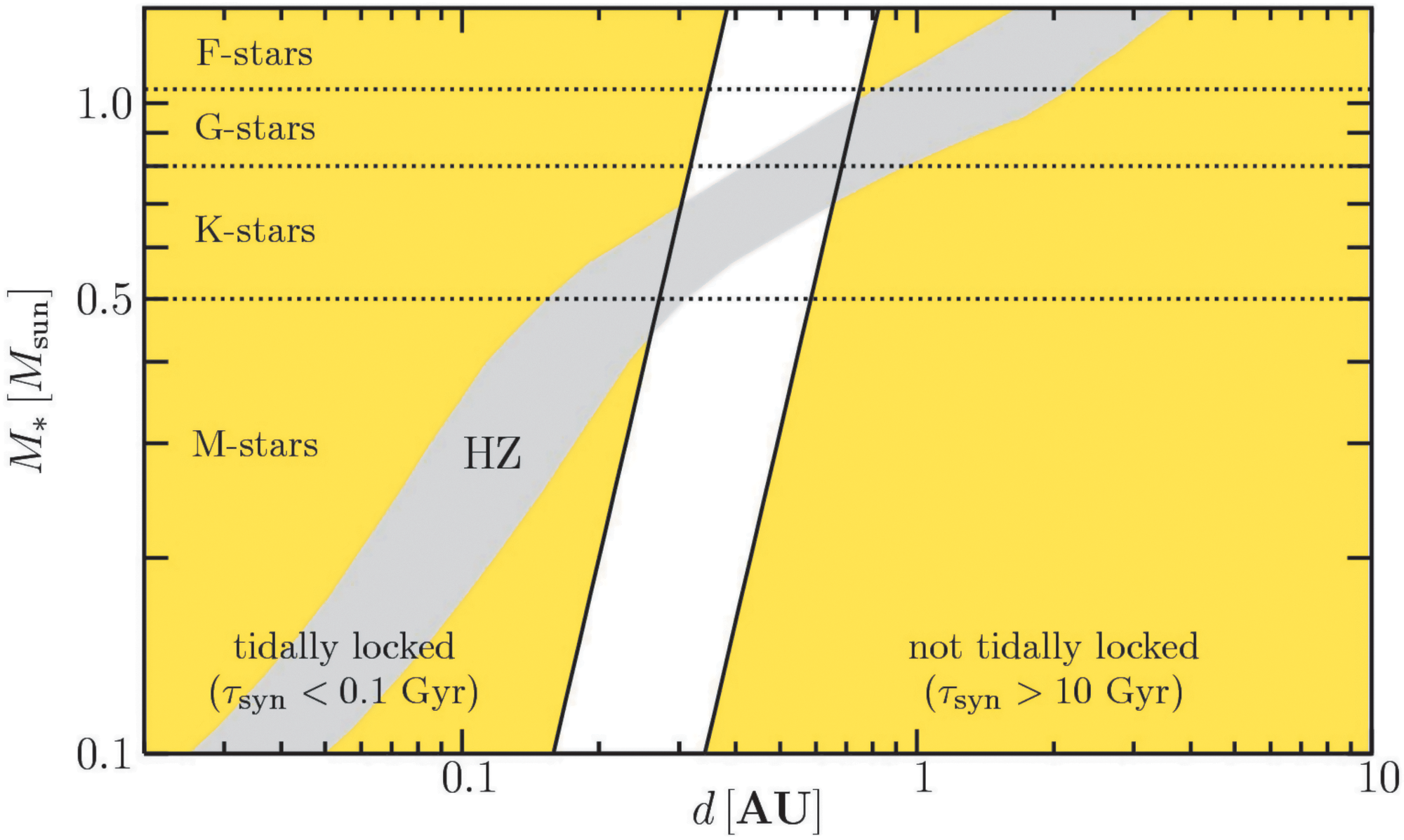
Tidally locked (left) vs. freely rotating (right) regime as a function of orbital distance d for Earth-like planets around stars of different spectral types. Earth-sized planets become synchronized after 0.1, 1, and 10 Gyr. The area shaded in gray gives the location of the HZ (courtesy of F. Selsis and J.-M. Grießmeier).
Therefore, additional questions regarding planetary habitability have to be considered:
3.1.1. Climate
The consequences of such a situation on climate can be dramatic: Joshi et al. (1997) showed that only a thick enough atmosphere (1.5–2 bars of CO2) can provide a homogeneous warming that prevents the condensation and collapse of an atmosphere on the planet's night side. However, a follow-up study with a global circulation climate model by Joshi (2003) indicated that the atmospheric stability of a terrestrial planet orbiting an M star depends on the landmass and the available amount of water, so that scenarios may be expected in which thinner atmospheres with pressure values <1.5 bar may be stable as well. However, the atmosphere has to be formed before the tidal locking of the planet and maintained throughout its entire lifetime. Moreover, other questions remain to be answered: Are there unknown feedback processes that can stabilize the atmospheric pressure in the inner part of the HZ? Is a tidally locked planet able to recover from a snowball event, as Earth may have done several times during its history?
Further, CO2 weathering or loss to space during the early active period of the young star may reduce the surface pressure to levels <1.5 bar.
3.1.2. Plate tectonics
The cycling of volatiles by plate tectonics helps to regulate the composition of the Earth's atmosphere, including the greenhouse gas CO2, and, hence, the surface temperature and planetary habitability (Kasting et al., 1993; Sundquist, 1993; Franck et al., 2000a, 2000b; Wolstencroft and Raven, 2002). Plate tectonics is also important to life on Earth by the creation of land surfaces and enhancement of biodiversity through evolution on isolated continents, and it is an important factor that allows for the generation of intrinsic planetary magnetic fields that protect the atmospheres from solar wind erosion and the deflection of high energetic cosmic rays (e.g., Ward and Brownlee, 2000). The controls on plate tectonics are not known with certainty, but the minimum requirements may be
Both are likely essential. Venus, for example, has an Earth-like mass but a lack of water, which probably explains the lack of plate tectonics (Jakosky and Phillips, 2002). Water affects the evolution of a planetary mantle and the planetary tectonic engine. First, it makes the lithosphere deformable enough for subduction of the crust to occur. Second, it both reduces the activation energy for creep and the solidus temperature of mantle rock, thereby enhancing the cooling of the interior and the efficiency of volcanic activity.
Water reservoirs in the mantle and on the surface interact. The mantle loses water and other volatiles like CO2 through volcanic activity and therefore helps to sustain the atmosphere. On the other hand, water and CO2 are recycled together with subducting crustal rock (e.g., Breuer et al., 1996, 1997). Crust recycling through plate tectonics keeps the crust thin.
A thin crust seems to be mandatory for plate tectonics to operate. If the crust is too thick, the lithospheric plate that comprises the crust will be too buoyant to be subducted. Finally, plate tectonics helps to cool the interior efficiently, which must occur in order to maintain a strong magnetic dynamo action for several billions of years.
Figure 4 illustrates the different evolution of terrestrial planets where plate tectonics is active over evolutionary time periods (Earth) compared to a similar terrestrial one-plate planet.
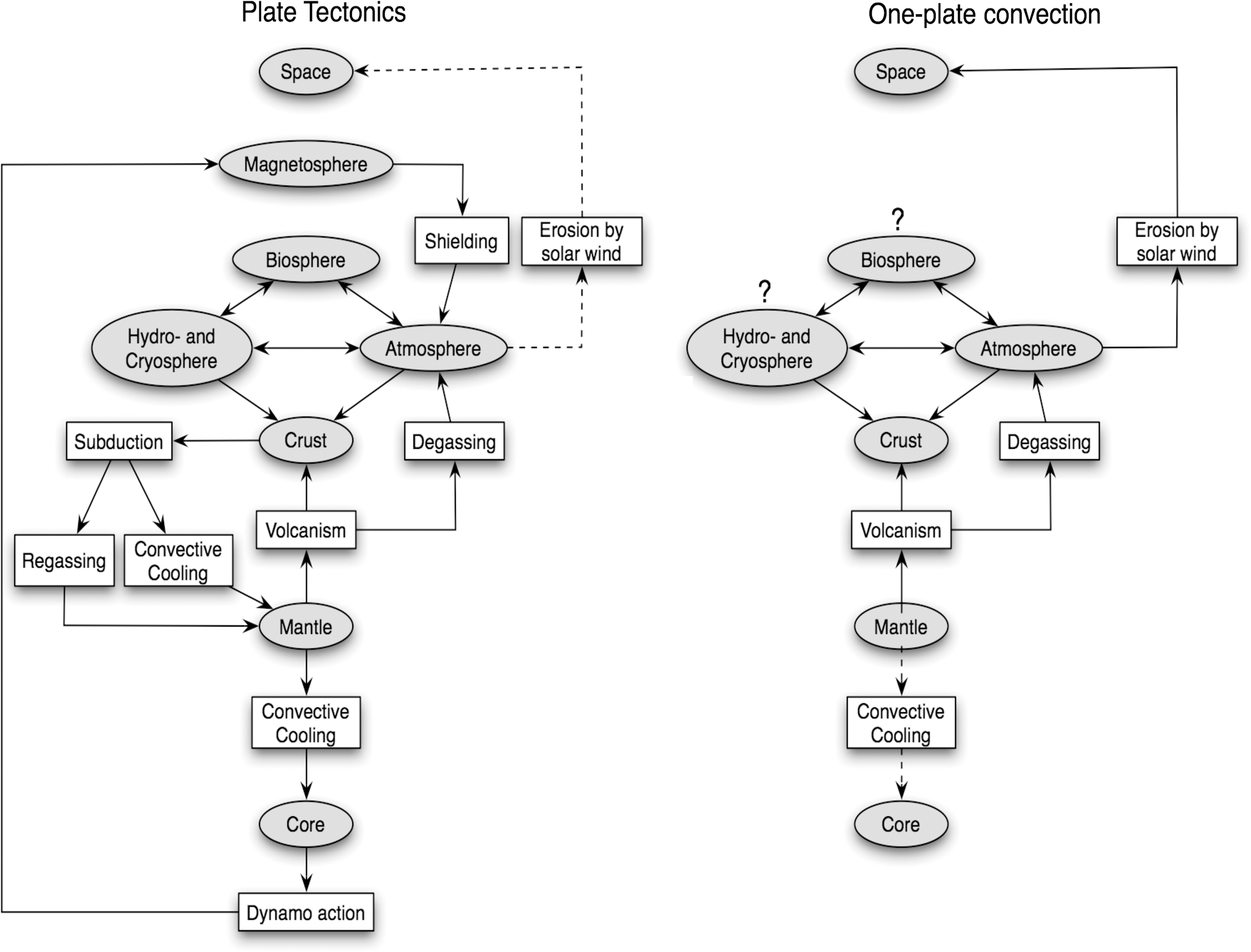
Sketch comparing the possible relationships between interior, surface, and atmosphere of a planet with plate tectonics, on the one hand, and a planet with convection underneath a single plate, on the other hand. Dashed arrows denote low efficiency mechanisms. By promoting very complex and global geological cycles, plate tectonics tends to generate conditions favorable for life. In the case of a one-plate planet (no subduction), the geological interactions between the different subsets are reduced and more localized. Such a planet may not be able to sustain its internal magnetic field and recycle volatiles into the mantle; finally it evolves toward a planet with either an atmosphere that is too thin (Mars) or too thick (Venus), being quite probably uninhabitable at the present time. Understanding all these coupled processes requires an integrative look at the planet as a system (courtesy of T. Spohn and D. Breuer).
There has been little assessment as to possibility of plate tectonics on planets that are tidally locked. Tidal locking could also have a significant influence on large-scale convection in the planetary mantle and may partially, or completely, inhibit plate tectonics.
It seems likely that there are relatively few terrestrial planets with plate tectonics within the tidal lock radius. However, this possibility requires detailed modeling. Tidally locked planets that do not develop plate tectonics may produce various life-frustrating scenarios, such as periodical outbreaks of Venus-type super volcanoes (hot plumes) and different atmosphere-surface interaction processes that may have an impact on the CO2 cycle of a terrestrial planet.
Weak or a lack of planetary magnetic moments can have a strong effect on a planetary atmosphere as well. Commonly employed scaling laws for planetary magnetic moments yield rapidly decreasing moments with decreasing rotation rates. This is why small magnetic moments seem likely for close-in exoplanets. It has to be noted that the existence of a magnetic dynamo seems to be plausible for most terrestrial planets with size and mass ≥ M Earth.
The signatures of the magnetic fields of Mercury, Venus, Earth, Mars, and Earth's moon are extremely different. Earth has a dipole-like magnetic field with a surface strength of about 30,000 nT. The surface field of Mercury is about 340 nT. Venus has no planetary magnetic field, and Mars and the Moon have crustal fields with local maxima up to about 1000 nT and 100 nT, respectively.
At first glance, a uniform generation mechanism for magnetic moments seems absurd, but it is likely that there is a uniform mechanism that acts presently in different phases for the individual planets (Russell, 1993). This basic mechanism is surely a dynamo process related to necessary conditions like liquid regions, convection, and conductive materials.
Energy sources may vary, and the thermal history is certainly different already through the different sizes of the bodies. Three different phases of magnetic activity can be observed today: a pre-dynamo phase (Venus), a dynamo phase (Earth, Mercury), a post-dynamo phase (Mars, Moon).
Terrestrial planets consist primarily of material that condenses at high temperatures as metallic iron, oxides, and silicates of iron. The bodies form metallic iron-rich cores. These cores are at least partially liquid even after 4.5 Gyr of cooling. One prerequisite for dynamo action to take place is convection with a conducting fluid (Stevenson, 1983, 2003).
Convection requires that the Coriolis force have a large effect on the flow. This, however, is easily satisfied, even for the case of slowly rotating planets like Venus (Stevenson, 1983, 2003). Thus, the question is not whether the planets can sustain a dynamo but whether the dynamo can produce a field that is strong enough. There are several analytical models from which an estimate for a planetary magnetic dipole moment parallel to the rotation axis can be gained.
These models yield scaling laws (Busse, 1976; Stevenson, 1983; Mizutani et al., 1992; Sano, 1993) that depend on the radius of the dynamo region (frequently also called the core radius), the mass density in the dynamo region, and the conductivity and the rotation of the planet around its axis as well as convection by internal heat forces.
It can be seen in Table 1 and Fig. 5 that a tidally locked planet will have a much smaller magnetic moment than a rapidly spinning one (i.e., a planet keeping its initial angular velocity); and Table 1 compares expected magnetic moments for three configurations: no tidal locking, tidal locking at 0.045 AU around a Sun-like star (M
star = M
Sun), and tidal locking at 0.045 AU around a low-mass M-class star with M
star = 0.2 M
Sun. For a Jupiter-like tidally locked planet HD209458b in an orbit of a Sun-like star, a magnetic moment of 0.005
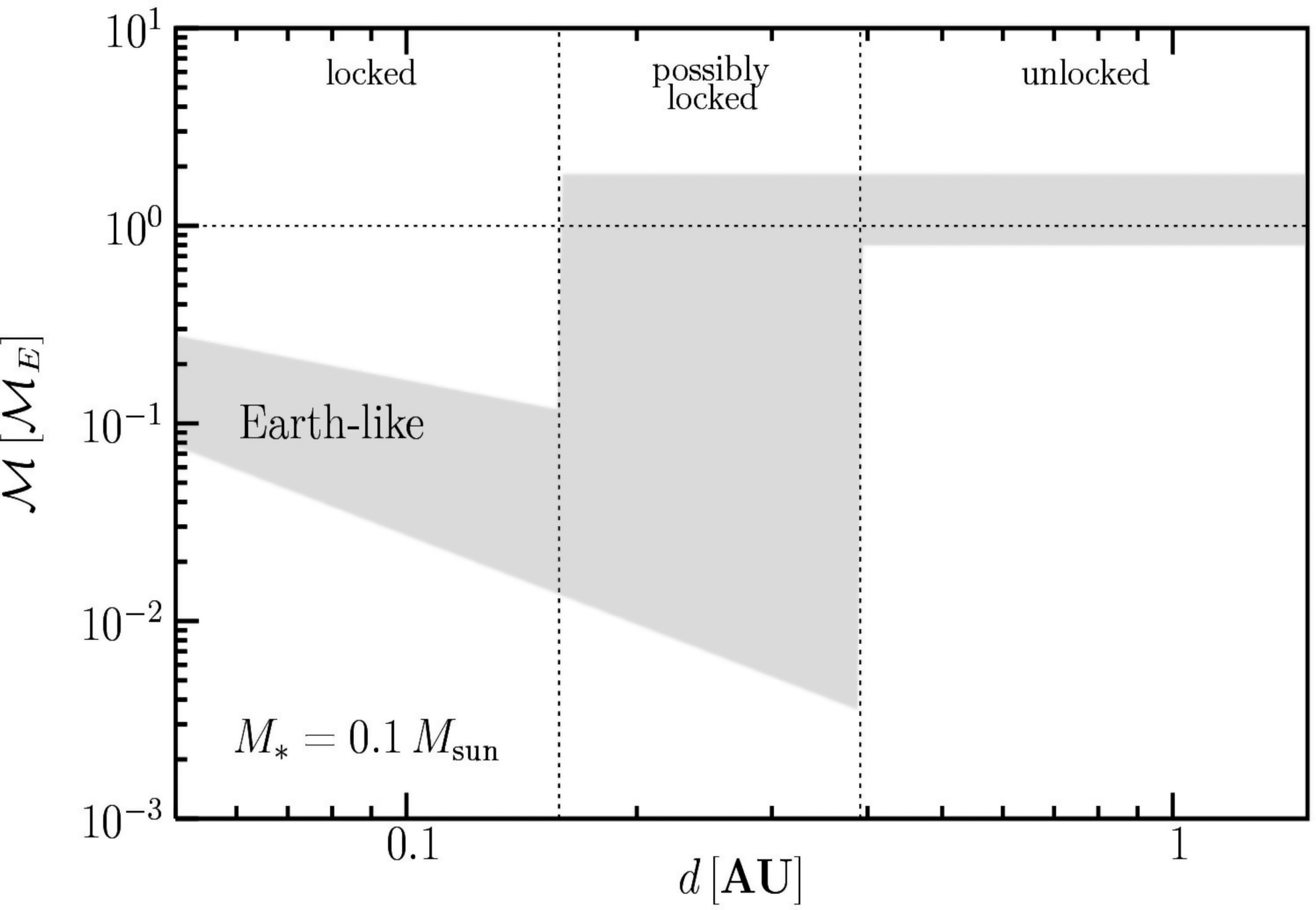
Calculated magnetic moment (lower and upper limit) of an Earth-like exoplanet around M stars with stellar mass of 0.1 M Sun. The shaded area shows minimal and maximal possible magnetic moments as a function of orbital distance. Left, tidally locked planets; right, unlocked planets (courtesy of J.-M. Grießmeier and U. Motschmann).
For a tidally locked planet in a close-in HZ, both the semi-major axis of the planet and the mass of its host star will influence the rotation around the planet's axis and thus the resulting magnetic moment
3.1.3. Magnetospheric compression by strong stellar winds and coronal mass ejections
The stellar wind can be considered as the expanding atmosphere of a star, which can be treated as an ideal fluid if only the large-scale features generated in encountering planetary obstacles in its path are investigated. The boundary between the stellar wind and the planetary magnetosphere, which protects an atmosphere from stellar wind erosion processes, is called the magnetopause. The precise location and shape of the magnetopause are determined mainly by the stellar wind parameters and the planetary magnetic field strength. The protection of an atmosphere is a matter of pressure balance between the ram pressure of the stellar wind and the magnetic pressure generated by the magnetic moment of the planet, and the magnetic field due to magnetopause currents.
By taking into account both the planetary magnetic field and the magnetic field created by the magnetopause currents, the magnetopause stand-off distance, R
s, at the subsolar point can be written as (Grießmeier et al., 2004, 2005, 2009):
where μ0 is the magnetic permeability, f
0 = 1.16 is a dimensionless form factor,
The most crucial parameters that constitute the stellar wind–planetary interaction are the stellar wind density and velocity, which are highly variable with stellar age and depend also on the stellar spectral type. Observations of younger Sun-like stars indicate that a young G- or K-type star has a much denser and faster stellar wind compared with our present Sun.
The stellar mass loss and its resulting stellar wind were estimated recently by Wood et al. (2002, 2005) by using Hubble Space Telescope high-resolution spectroscopic observations. They studied the H Lyman-α absorption features of several nearby main sequence G and K stars, which reveal neutral hydrogen absorption associated with the interaction between the stars' fully ionized coronal winds and the partially ionized local interstellar medium. These absorption features were used to determine the estimated coronal mass loss rates for G and K main sequence stars.
The analysis of the small sample of observed Sun-like stars revealed that the mass loss and, therefore, the stellar wind mass flux increase with stellar activity and stellar age. Wood et al. (2002, 2005) found a correlation between the mass loss rates and the X-ray surface flux, which indicates an average solar wind density up to 1000 times higher than today during the first 100 Myr after a G or K type star reaches the zero-age main sequence.
Figure 6 shows that a strong stellar wind, as estimated by Wood et al. (2002), can compress the magnetopause of an Earth-like exoplanet at orbits inside the HZs of low-mass K and M stars to planetocentric distances, which are comparable to the ionopause (see Khodachenko et al., 2007; Lammer et al., 2007). The main reason for the strong magnetopause compression is a reduced magnetic moment caused by tidal locking.
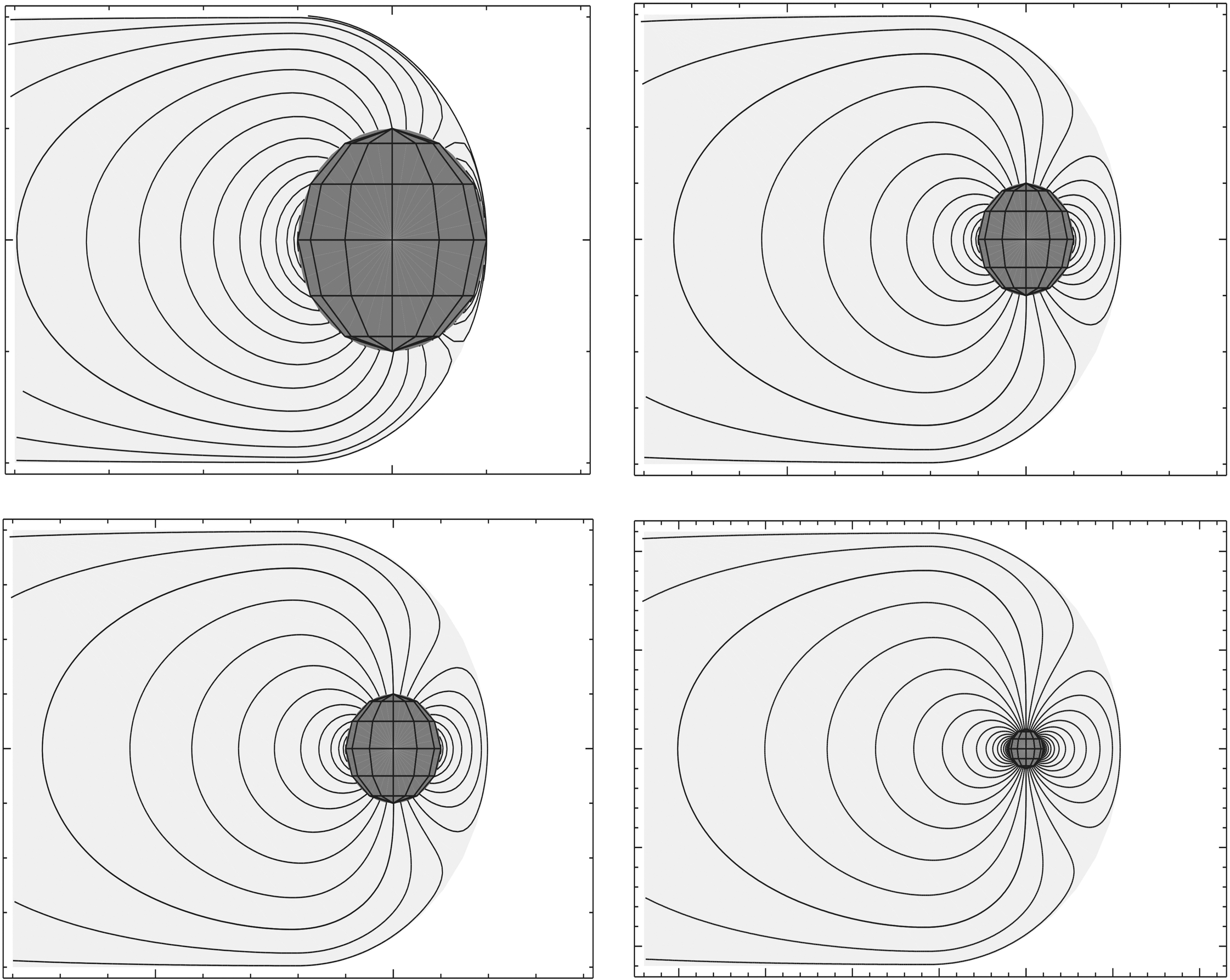
Illustration of a terrestrial exoplanet with same size and magnetic moment as Earth inside the HZ of a K star at an orbital distance of 0.2 AU. The left figures show the planet with the magnetic moment–reducing effect of tidal locking for a strong early stellar wind (Wood et al., 2002) and for present stellar wind conditions (4.6 Gyr G or K star). The right figures show the same planet without the tidal locking effect. One can see that tidal locking can reduce the magnetic moment of terrestrial exoplanets so that the strong stellar wind of young stars may heat the upper atmospheres and even erode the atmosphere due to ion pickup, sputtering, and viscous processes during the active period of the host star (courtesy of A. Stadelmann).
However, it is important to note that the observations of Wood et al. (2002, 2005) contained only a few K and G stars; therefore, more observations are needed before a detailed representation of the stellar wind mass flux and mass loss of young stars can be attained.
Further, it is known from observations of our Sun that strong eruptions called coronal mass ejections 1 (CMEs) occur and propagate as dense plasma structures through interplanetary space (see Fig. 7). Dense plasma ejections, like CMEs, may strongly affect the atmospheres and magnetospheres of terrestrial exoplanets at close-in HZs at orbit locations <0.1 AU around low-mass M stars (Khodachenko et al., 2007; Lammer et al., 2007). Because M stars are very active in X-rays, they are expected to have a high flare rate; hence CMEs should be common (e.g., Smith et al., 2004; Khodachenko et al., 2007; Scalo et al., 2007, and references therein). It should be noted that an Earth-like planet at about 0.05 AU would have its location totally inside the white active area in Fig. 7.

CMEs may prevent the formation of an atmosphere of an Earth-like planet close to its host star. CME observed in August 1999 by LASCO C3. The dark disk blocks the Sun so that the LASCO instrument can observe the structures of the corona in visible light. The white circle represents the size and position of the Sun (SOHO/LASCO).
Therefore, future studies should investigate whether CMEs can even prevent the formation of an atmosphere of terrestrial planets at such close orbital distances. This is an important subject and is crucial to the study of planetary habitability of Earth-like exoplanets in HZs of low-mass K and M stars at orbital distances <0.1 AU.
4. Atmospheric Escape and the Evolution of Planetary Water Inventories
The known terrestrial planets with substantial atmospheres in the Solar System are Venus, Earth, Mars, and, as a special case, Saturn's large satellite Titan. The major atmospheric gases on the three classical early terrestrial-type planets Earth, Venus, and Mars were most probably CO2, H2O, and N2. Most of Earth's CO2 may have been transformed into carbonates by chemical weathering in a wet and warm planetary environment. Venus lost most of its water so that CO2 remained. The martian atmosphere may have been eroded by impacts due to large meteoroids during the first 500 Myr of the planet's origin. From the current knowledge of our own terrestrial planets, one can suggest that for a water-bearing terrestrial planet at a dynamically stable orbit inside a HZ to evolve into a habitable world like Earth it needs to survive as such during the following critical phases: the early period of heavy bombardment by asteroids and comets; the active X-ray and extreme ultraviolet (EUV) period of the young or active host star—depending on the spectral type of the star; the efficient stellar wind–atmosphere interaction of early or active host stars.
4.1. Impact erosion of planetary atmospheres
Over the last few decades, it has become clear that impacts of asteroids and comets played a fundamental role in the evolution of terrestrial planets and their atmospheres. Impacts are a primary mechanism of planetary accretion and are responsible for the delivery of water and organic matter to young planetary bodies. Large impactors may have also inhibited the formation of life in the early history of planetary formation. Thus, the impact of a planetesimal can erode a part of an existing atmosphere, or it can add volatiles to it. The balance on delivery and loss from an atmosphere depends on the composition of the impactor and the mass of the growing planet.
When Venus and Earth attained their present masses and escape velocities, impact erosion became very inefficient. Mars, with its smaller mass, was rather vulnerable and still would be if the impact population had not essentially died out (e.g., Pham et al., 2009, and references therein).
It can be seen in Fig. 8 that Mars-type bodies can lose a CO2 atmosphere between 1 and 3 bar due to impact erosion over the heavy bombardment. Giant planets like Jupiter in orbital distances beyond the HZ are an important factor for the protection of terrestrial planets, because they influence the trajectories of asteroids and comets such that the inner part of a system is safer from collisions.
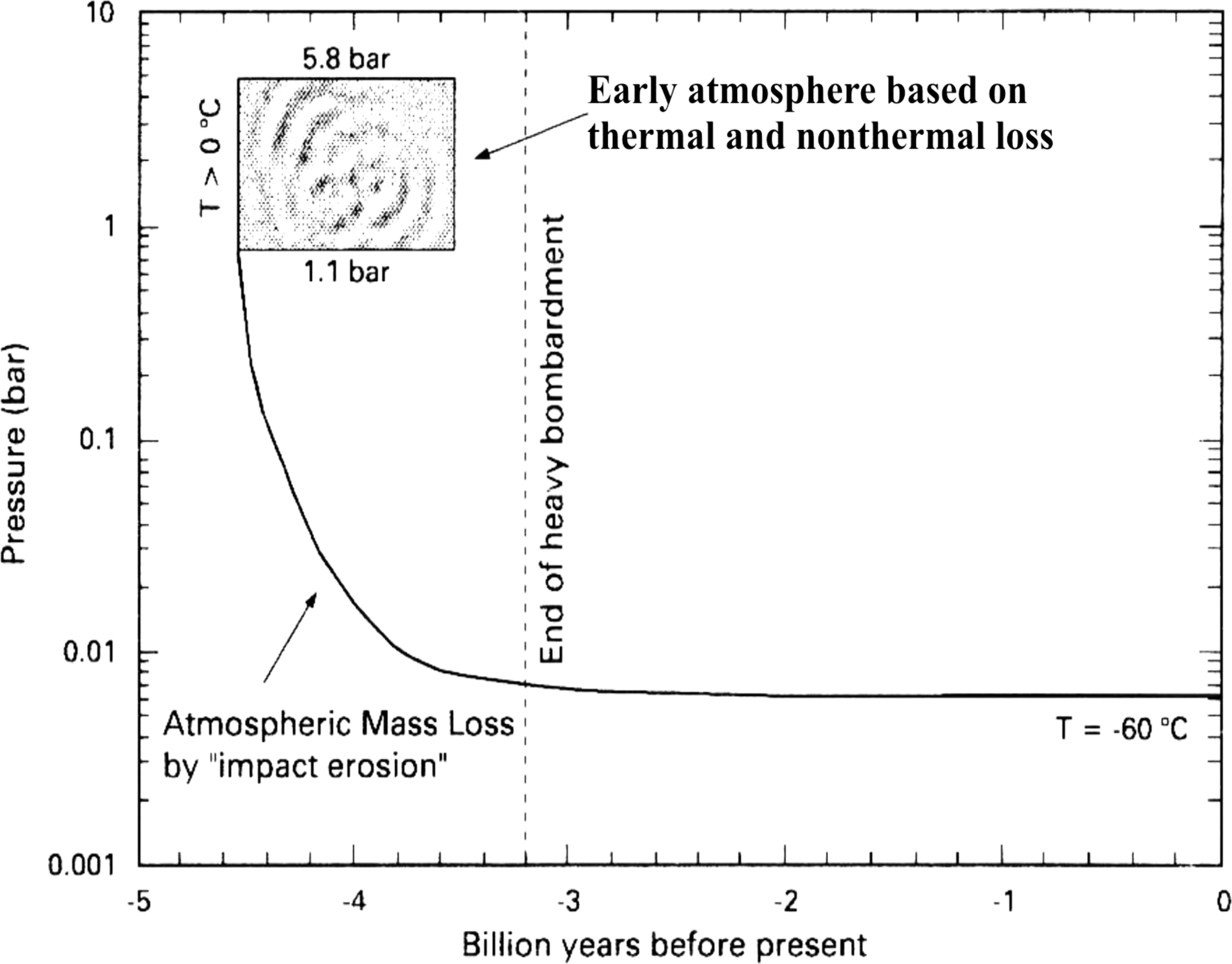
Simulation of the loss of an atmosphere of a Mars-sized body due to impact erosion during a heavy bombardment phase after its origin (courtesy of S. J. Bauer).
4.1.1. The impact history of early Earth
The early history of Earth was strongly influenced by late-stage cataclysmic impact events. Two scenarios have been proposed, both based on comparison with the lunar cratering record but with different interpretations. The first hypothesis proposes a gradual decline in the intensity and size of impactors between the time of formation of Earth and about 3.8 Gyr (e.g., Hartmann et al., 2000).
The second hypothesis proposes that the late-stage impacts were concentrated in a period of 20–200 Myr between 4.0 and 3.85 Gyr (Kring and Cohen, 2002; Ryder et al., 2000; Valley et al., 2002). One of the pre-3.85 Gyr impactors produced the giant Aitken Basin at the south pole of the Moon. It has been calculated that between zero and six extraterrestrial bodies (bolides) of the size of that which produced the Aitken Basin, or even larger, probably hit Earth in the Hadean. At a minimum, impacts of this size would have evaporated the upper 200 m of Earth's oceans; at maximum, they would have completely evaporated all the surface volatiles and sterilized the surface of Earth (Sleep et al., 1989).
Geochemical analysis of the remains of the impactors from the Apollo landing sites on the Moon indicated that they originated from differentiated asteroids but not those that are particularly carbon-rich or from comets. These conclusions appear to support the accretion of a wet Earth with a late veneer addition from carbonaceous chondrite meteorites or comets, or they could support the Maurette hypothesis of micrometeorite importation.
A further implication of the hypothesis regarding a short, relatively late cataclysm is that Earth was very likely to have been resurfaced by the attendant destruction and volcanic activity (Kring and Cohen, 2002). The fact that there are no supracrustal remnants older than 3.8–3.75 Gyr may reflect a period of pre-existing global resurfacing. The present consensus seems to be moving toward acceptance of the first hypothesis and no late giant, Earth-sterilizing, volatile-destroying impacts.
4.2. Atmospheres under extreme stellar X-ray and EUV radiation exposure
A water-bearing terrestrial planet at a dynamically stable orbit inside the HZ has the potential to evolve into a habitable world like Earth if it can endure as such throughout the early period of heavy bombardment and the active X-ray and EUV period of the young or active host star. The relevant wavelengths for the heating of upper atmospheres are the ionizing ones ≤1000 Å, which contain only a small fraction of the stellar spectral power but can lead to a planetary wind triggered by hydrodynamic conditions.
It is generally accepted, in view of SNC isotope studies, that hydrodynamically driven outflow could be responsible for the heavy isotope enrichment on both Earth and Mars. In such a case, atmospheric loss must be treated like a hydrodynamic process that involves the atmosphere as a whole (e.g., Sekiya et al., 1980, 1981; Watson et al., 1981; Pepin, 1991, 1994, 1997, 2000).
Two stages of hydrodynamically driven outflow would have had to occur to fractionate Xe (primordial). Then the lighter noble gases, like Kr and Ar, would have outgassed after the first stage of escape (secondary). The second stage of hydrodynamic outflow would, however, have been of moderate magnitude to avoid the fractionation of Kr, whose pattern is nearly Sun-like. Finally, nonthermal escape would have taken over during a later stage and led to the presently observed pattern for major gases (Jakosky et al., 1994; see also the review paper by Jakosky and Jones, 1997).
The most important heating and cooling processes in the upper atmosphere of Earth can be summarized as follows (e.g., Gordiets et al., 1982; Kulikov et al., 2006, 2007): heating due to N2, O2, and O photoionization by stellar/solar X-ray and EUV radiation (λ ≤ 1027Å); heating due to O2 and O3 photodissociation by solar UV radiation; chemical heating in exothermic reactions with O and O3; neutral gas heat conduction; IR cooling in the vibrational-rotational bands of CO2, NO, O3, OH, NO+, 14N, 15N, CO, O2, etc.; heating and cooling due to contraction and expansion of the thermosphere (to model the thermosphere diurnal variations); turbulent energy dissipation and heat conduction.
When a large amount of EUV energy is deposited at the top of an atmosphere, heated atoms (preferred are light constituents, while a high CO2 content may prevent hydrodynamic conditions due to IR cooling) can overcome the planetary gravity field and expand into interplanetary space.
Figure 9 shows the change of the upper atmospheric temperature of Earth as a function of various EUV fluxes and CO2 levels. It can be seen that CO2 IR cooling against high-EUV fluxes is very efficient in the atmospheres of terrestrial planets. The dashed line shows the blowoff temperature of atomic hydrogen for an Earth-mass, Earth-sized planet, which indicates that atmospheres with low CO2 contents may lose much water during high stellar EUV conditions due to “diffusion-limited 2 ” hydrodynamic escape. On the other hand, recent studies that coupled a hydrostatic thermospheric model with a dynamic flow model on an Earth-like planet have shown that, if the exobase temperature reaches values larger than about 8000 K, the hydrostatic equilibrium is no longer valid and heavy atoms like O or N start to expand the exobase up to several planetary radii (Tian et al., 2008). In such cases, one would expect extreme solar wind–induced or stellar wind–induced nonthermal loss rates from such expanded atmospheres. Lammer et al. (2009a) showed that the stellar winds may remove the initial nitrogen reservoirs of nitrogen-rich Earth-like exoplanets if their upper atmospheres are exposed to high X-ray and EUV fluxes of active stars.
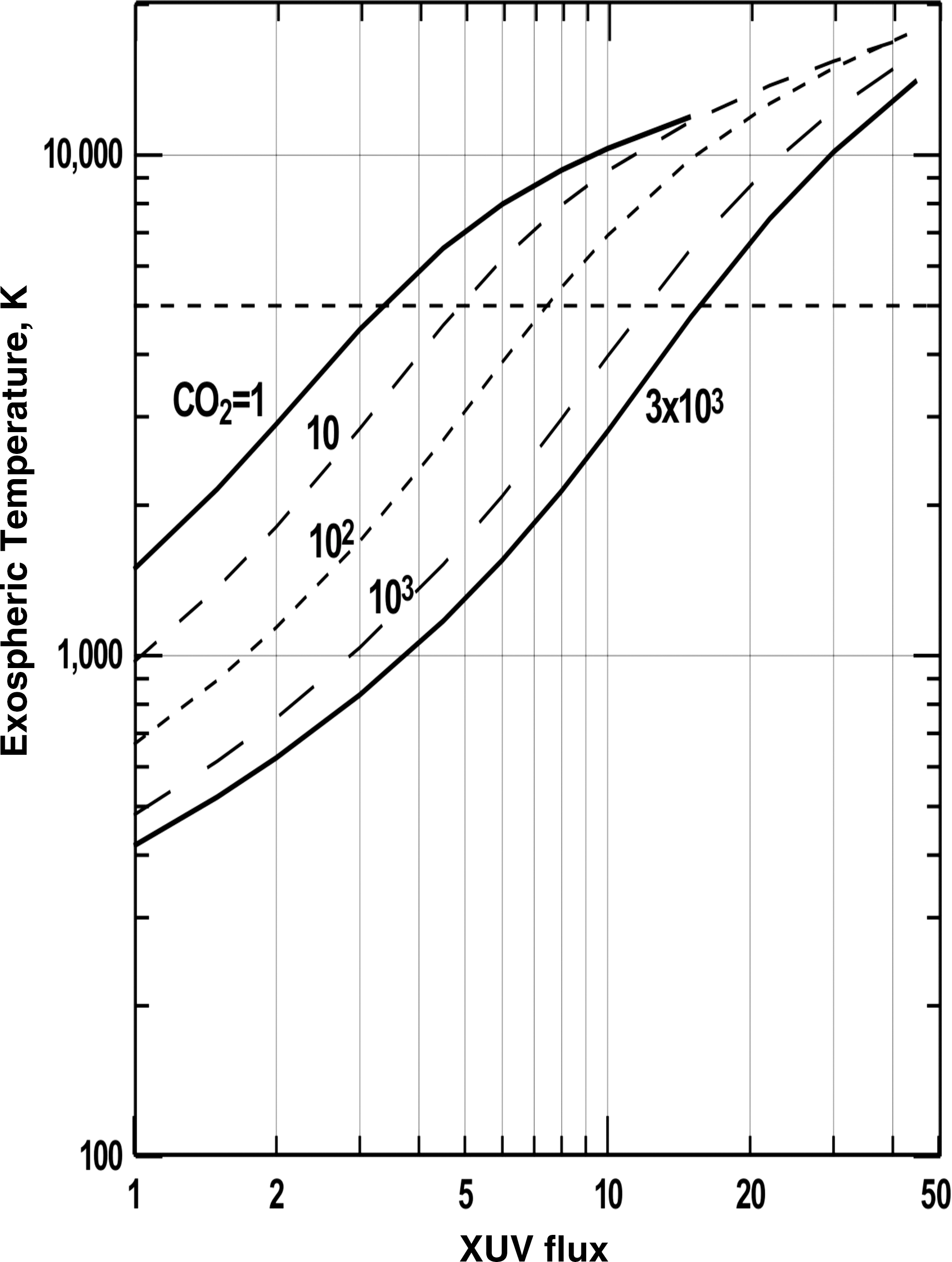
Temperature profiles in an Earth-like exosphere for different levels of CO2 abundance in the lower atmosphere and solar EUV flux values. The numbers on the curves correspond to CO2 volume mixing ratios expressed in present atmospheric level (PAL). 1 PAL for CO2 = 3 × 10⁻⁴, 10 PAL = 0.3%, 100 PAL = 3%, 1000 PAL = 30%. Atmospheric levels of the N2, O2, and O content are specified to be 1 PAL for all of them. Only the 15 μm CO2 cooling is activated in this simulation. The horizontal dashed line shows the “blowoff” temperature of atomic hydrogen. IR cooling by other constituents is neglected, and cooling due to adiabatic flow at high exobase temperatures are neglected. Note that for temperatures above 8000 K adiabatic cooling due to expansion becomes relevant (Tian et al., 2008)—an important effect neglected in this figure (courtesy of Yu.N. Kulikov).
The importance of a high amount of CO2 for cooling a thermosphere can also be found in the work of Kulikov et al. (2006, 2007), who demonstrated that, for a 96% Venus-like atmospheric composition, the exobase temperature is lower than about 8000 K for even a 100 times higher EUV flux and thus hydrostatic equilibrium is maintained and extreme expansion due to hydrodynamic flow may not occur. However, high EUV fluxes may ionize and dissociate CO2 molecules so that less available IR cooling molecules are available, which could also result in larger expansion of the thermosphere (Tian et al., 2009).
Recent studies on K0V stars have shown that they stay at active emission levels for a longer time and then decrease, by following a power law relationship characteristic of G stars. Interestingly, M0–M5 stars seem to have these conditions up to ≥1 Gyr and then decrease in an analogous way to G and K stars (Scalo et al., 2007, and references therein). Observations indicate that early K stars and early M stars may have EUV irradiances that are about 3–4 times and about 10–100 times higher, respectively, than Sun-type G stars of the same age. As a consequence, CO2-poor terrestrial planets, depending on mass and size, may lose or undergo significant modification to their entire atmospheres or water inventories during these critical periods (Lammer et al., 2009a).
The theory of hydrodynamic outflow of hydrogen and heavier species, which are dragged off along with the light species, was developed by Hunten (1973) and applied to mass fractionation of planetary atmospheres by Zahnle and Kasting (1986) and Hunten et al. (1987). Hydrodynamic outflow consists of a global, cometary-like expansion of the atmosphere. These conditions happen when a very large amount of EUV energy is deposited at the top of an atmosphere, which allows heated atoms to overcome the gravity field of the planet and to flow into interplanetary space.
One can introduce a nondimensional escape parameter:
X
c > 1.5: corresponding to present conditions at the top of planetary atmospheres.
The corresponding escape is called Jeans escape. The Maxwellian distribution is depleted slowly, in a quasi-steady-state way: only atoms in the far energetic wing of the distribution may escape.
for example, in the following cases: primordial H2/He atmospheres, reduced atmospheres with high CH4 and NH3 content, which, due to photodissociation of the molecules, produces a high hydrogen content in the upper atmosphere, and outgassed H2O-rich atmospheres during an episode of a runaway greenhouse effect, a wet greenhouse effect, or both.
If a progressive increase of solar EUV flux from present conditions (1 EUV) to 10 times the present EUV flux is assumed (as would be the case going back to the 10 EUV epoch of a Sun-type G star), then the following conditions would have occurred about 4 Gyr ago: First step: the upper atmospheric temperature would have increased, with a subsequent increase of the altitude of the exobase. Second step: at a certain level of the EUV flux, there would have been no more (quasi-) static solution, and the altitude of the exobase would have undergone a divergent increase up to infinity. There would have been no way to convert solar EUV energy into thermal energy; the excess thermal energy would have been directly converted into kinetic energy and hydrodynamically driven outflow would have occurred.
The result of this expansion would be a strong decrease in the temperature of the expanding flow due to adiabatic cooling (see also Tian et al., 2008). Whereas Jeans escape occurs when only a very small fraction of atoms in the energetic wing of the velocity Maxwellian distribution are lost to space (in quasi–steady state), hydrodynamic outflow results in a rapid depletion of the full distribution, which cannot be repopulated over sufficiently short timescales. After an upper atmosphere becomes instable due to hydrodynamic conditions of the light species (H, H2), a planetary wind can drag heavy species with the flow.
In such a case, a heavy species [2] of mass m
2 and mixing ratio Y
2 is dragged off along with a light-escaping constituent [1] (H or H2) of mass m
1 and mixing ratio Y
1, according to the following law (Hunten et al., 1987)
where Fi
are the fluxes and m
c = m
1 + (kTF
1/bgY
1) is the so-called “crossover mass” (b is the product of the density by the diffusion coefficient of [2] in [1], and g is the gravitational acceleration of the planet). If m
2 < m
c, the heavy species [2] can escape with the hydrodynamically driven light species [1].
If it is assumed that all the EUV flux is consumed in escape (energy-limited rate), then it is possible to calculate the crossover mass for present solar EUV conditions: 1.5 atomic mass units (amu) for Earth, 5 amu for Mars.
Chassefière (1996a) assumed a period of hydrodynamically driven outflow conditions extended over the first Gyr of a planet's lifetime, where the EUV flux is supposed to vary with time t, as (t 0/t)5/6 and t 0 is the present solar EUV flux. The crossover mass m c can be assumed to vary with time due to the decrease of solar EUV flux, according to the energy-limited approach denoted by a parameter μ = m 2/m c = 16/m c, where species [2] is atomic oxygen. R is the ratio of O lost amount to 2 times H lost amount (cumulated over the first Gyr); the relationship between R and log(1/μ) is shown in Fig. 9 for different bodies: Ceres-type asteroid, Moon, Mars, Venus, Earth, and a large terrestrial exoplanet with a size of 2R Earth. The ratio R 1 between the H amount lost, assuming O is dragged off together (which requires 17 times more energy than if H alone is lost), and the H amount lost with no related O escape is also plotted. Plausible log(1/μ)-ranges are shown for the different considered bodies at t = 1 Gyr.
It can be seen in Fig. 10 that small bodies, including Mars, may lose much of their oxygen through a runaway greenhouse-type primitive episode, but the loss is only partial for Venus and Earth and not effective for a larger and more massive terrestrial-type exoplanet. A consequence of this calculation for large terrestrial exoplanets is that a primitive runaway greenhouse may generate a massive abiotic oxygen atmosphere, provided the planet is large enough (>1.5R Earth) for its gravitational field to overcome hydrodynamic oxygen escape.
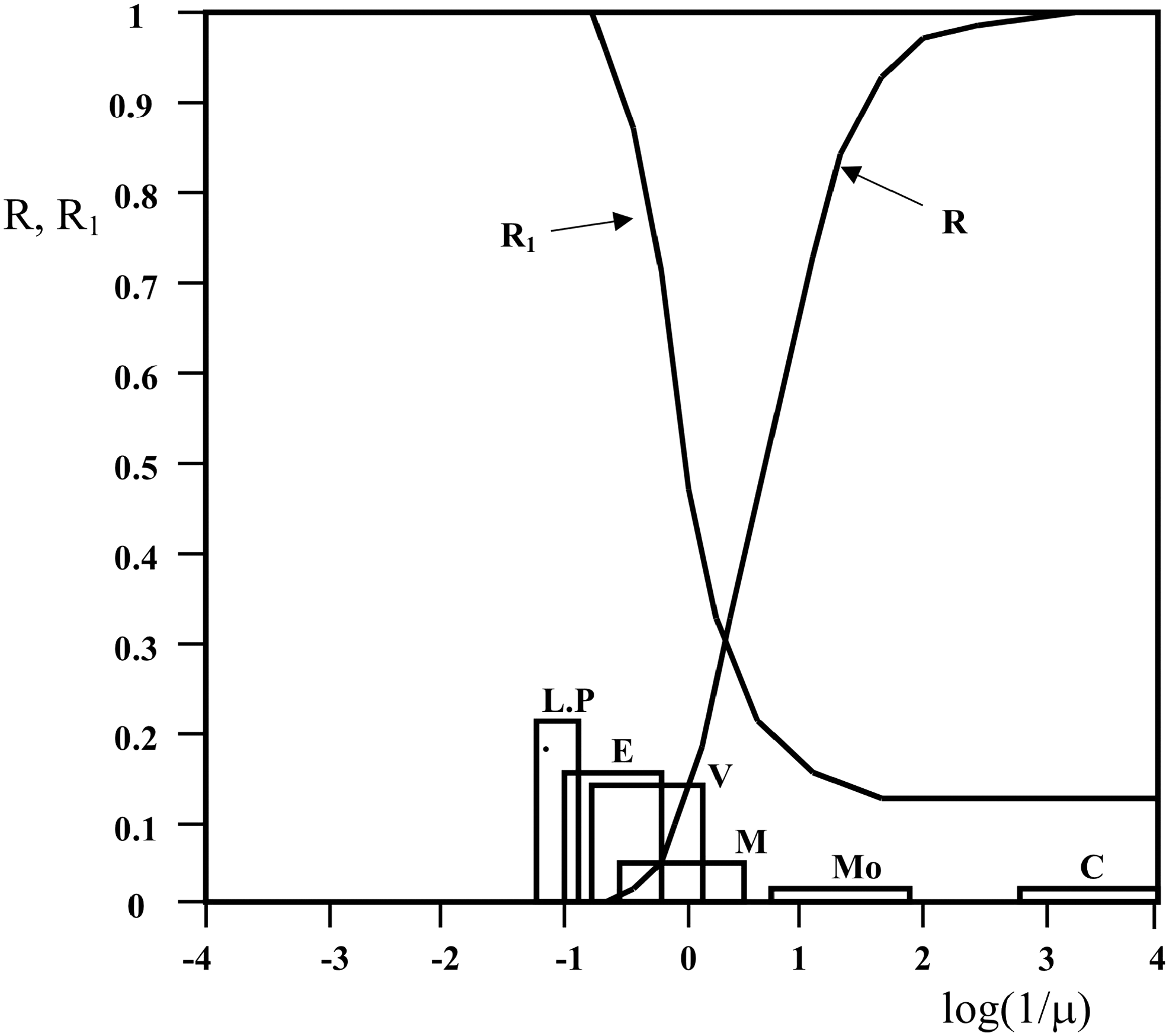
Ratio R of O lost amount to twice H lost amount as a function of a crossover mass-related parameter: log(1/μ) (from Chassefière, 1996a).
From a theoretical point of view, a planet that loses its hydrogen through this process and keeps its oxygen, assuming that its gravity field is large enough to counteract oxygen frictional escape, may retain a massive abiotic oxygen atmosphere.
It should be noted, however, that oxidation of the crust, if the planet is tectonically active with fresh mantellic material regularly brought to the surface, may result in partial or total disappearance of this oxygen atmosphere. If additional water is brought in during late epochs by meteoritic bombardment, such an oxygen-rich atmosphere may well coexist with liquid water.
As outlined above, dense CO2 atmospheres may protect the atmospheres and water inventories of terrestrial exoplanets from evaporation during active host star EUV periods but may cause a problem for the remote detection of biomarkers and other gases by terrestrial planet-finding missions because the strong CO2 spectrum may overlap other atmospheric signals.
Because hydrodynamic conditions can affect the evolution of planetary water inventories and very likely whole atmospheres as well, the evolution of the EUV radiation during the first million and billion years of potential target stars for terrestrial planet-finding missions is of high importance! It should be noted that hydrodynamic escape could have been energetically powered, at least partially (in addition to the EUV flux), by
4.3. Cores of hot Jupiters and Neptunes
Recent studies on EUV heating of the upper atmospheres of short-periodic hydrogen-rich giant exoplanets have indicated that these planets experience hydrodynamic expansion and high loss rates close to energy-limited escape rates in the order of about 1011 to 1012 g s−1 (Lammer et al., 2003a, 2003b, 2009a, 2009b; Vidal-Madjar et al., 2003, 2004; Yelle, 2004, 2006; Lecavelier des Etangs et al., 2004; Tian et al., 2005; García Muñoz, 2007; Penz and Micela, 2008; Penz et al., 2008a, 2008b).
In contrast to terrestrial planets, where hydrogen is a minor atmospheric constituent and supplied by diffusion from lower altitudes, hydrogen-dominated giant planets do not have a source from below until they shrink to their core sizes or heavier constituents become dominant.
This process opens an interesting perspective for future terrestrial planet-finding and characterization missions, because Neptune-class exoplanets with small initial masses may evolve into volatile-rich large terrestrial planets (see Fig. 11). The remaining cores of such evaporated planets may outgas a secondary atmosphere after their hydrogen is hydrodynamically lost (Kuchner, 2003; Lammer et al., 2003b; Lecavelier des Etangs, 2007; Penz et al., 2008b; Lammer et al., 2009a).
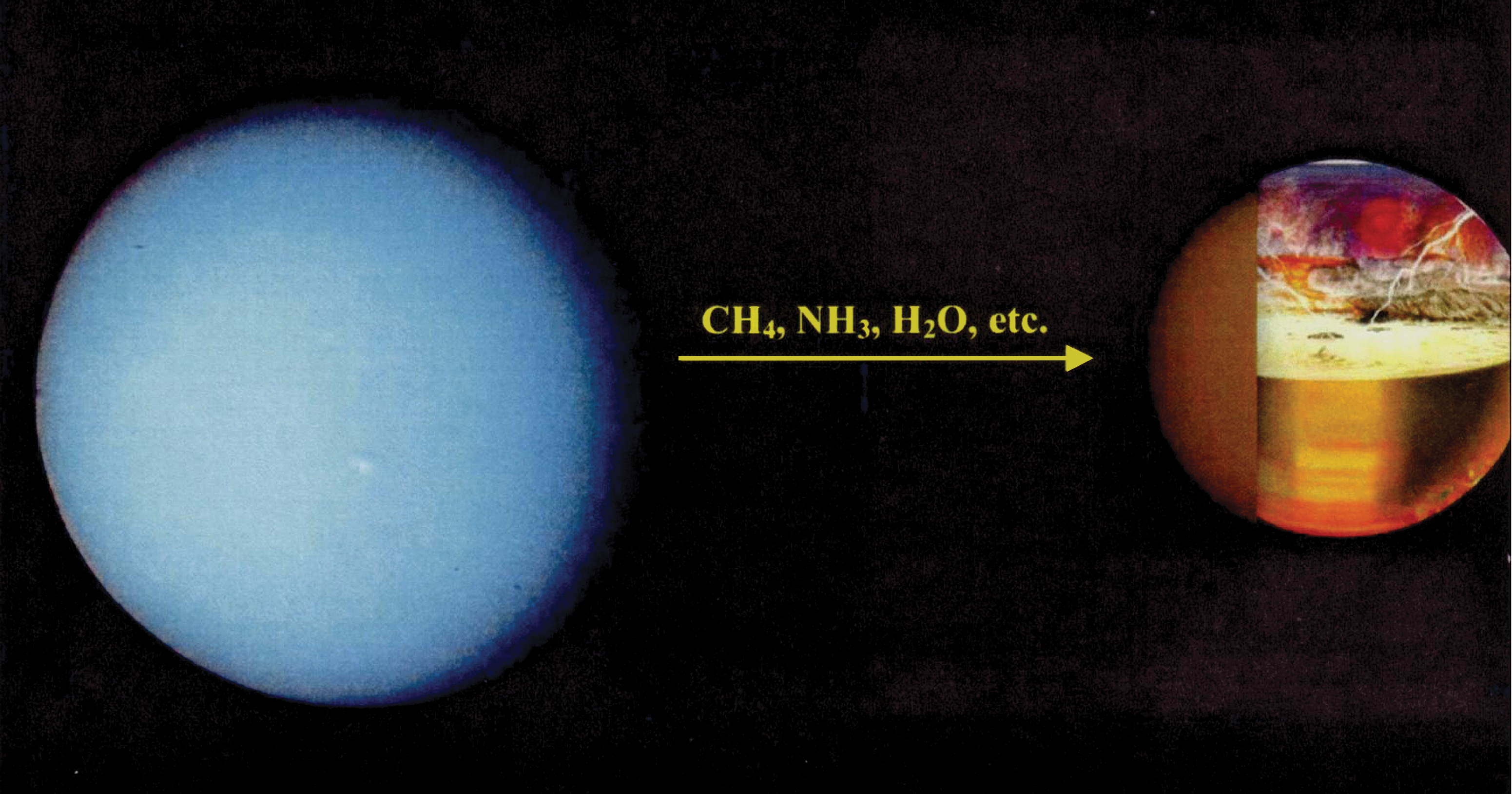
Migrating Uranus-class exoplanets may lose their dense hydrogen atmospheres due to EUV-driven hydrodynamic escape (Kuchner, 2003; Lammer et al., 2003b, 2009a; Lecavelier des Etangs, 2007; Penz et al., 2008b). The remaining cores of these bodies may melt and outgas volatiles like CH4 and NH3, which are trapped inside the ice and may evolve to large Titan-like “terrestrial exoplanets” with reduced atmospheres.
After these bodies have lost their dense hydrogen atmospheres due to energy-limited loss, heavier species, which may be present in deeper atmospheric altitude levels, can be outgassed from icy-rocky cores of Uranus-class bodies (if the primary planet migrated) and will decrease the energy-limited hydrogen loss rates, because the light hydrogen gas must diffuse through the heavier constituents.
Although the composition of the material in deep layers of Uranus and Neptune is not well known, it must be much denser than hydrogen or He, though not as dense as the Mg-Si and rocky iron material that compromise terrestrial planets, which formed in the inner Solar System. It is commonly believed that this material may largely consist of abundant ices that contain H2, CH4, and NH3 and rock that is a solar mix of these elements and, moreover, the major constituents of rock on Earth (Podolak et al., 1991; Hubbard et al., 1995, 2002; Marley et al., 1995). The compositions of this rock may be 38% SiO2, 25% FeS, and 12% FeO (Hubbard et al., 1995) or 39% SiO2, 32% Fe, 27% MgO, and 2% Ni (Podolak et al., 1991).
Thus, the cores of Uranus-class exoplanets are similar to a terrestrial rocky planet that is covered with an ice layer, where CH4 and NH3 are trapped in clathrate. If the dense hydrogen atmosphere is lost into space due to hydrodynamic escape, the ice may melt in the event that the remaining core orbits inside the HZ of its host star and the trapped CH4, NH3, and other volatiles are outgassed and build up a secondary atmosphere.
Because the remaining cores of Uranus-class bodies are at closer distances to their host stars, surface temperatures may reach the melting point of the ice, so that the new evolving terrestrial exoplanets may become interesting bodies for the search for biomarkers. Remnant cores of giant exoplanets orbiting close to their host stars may be detectable for the first time with space observatories like CoRoT and Kepler.
The search for hydrodynamic escape around short-periodic giant exoplanets is also of high relevance and interest, because it should allow, on one hand, insight into the chemical composition of these planets and, on the other hand, the capacity to constrain models of hydrodynamic escape on these planets, which would help in modeling hydrodynamic escape on young Earth-like planets.
4.4. Surface weathering of CO2 atmospheres on terrestrial planets
The fate of CO2 in the atmosphere of a terrestrial planet is related to its geological history, which differs from planet to planet, and is related to the original composition of the planetesimals that made up the planet, depending on how wet or volatile rich the original planetesimals were, the size of the planet, how rapidly the planet cooled, whether the planet reached the stage of plate tectonics, and the planet's distance from the Sun (i.e., atmospheric temperatures).
If the atmosphere of early Earth was rich in CO2, what happened to these species? The conventional theory is that carbon in the form of H2CO3 was removed by reaction with exposed continental rocks to produce carbonate alteration products that were, in turn, transported to the oceans through rain and river runoff for final burial in deep-sea sediments. Ultimately, the latter would be removed into the mantle by subduction of the sediment-coated oceanic crust (see Fig. 12).
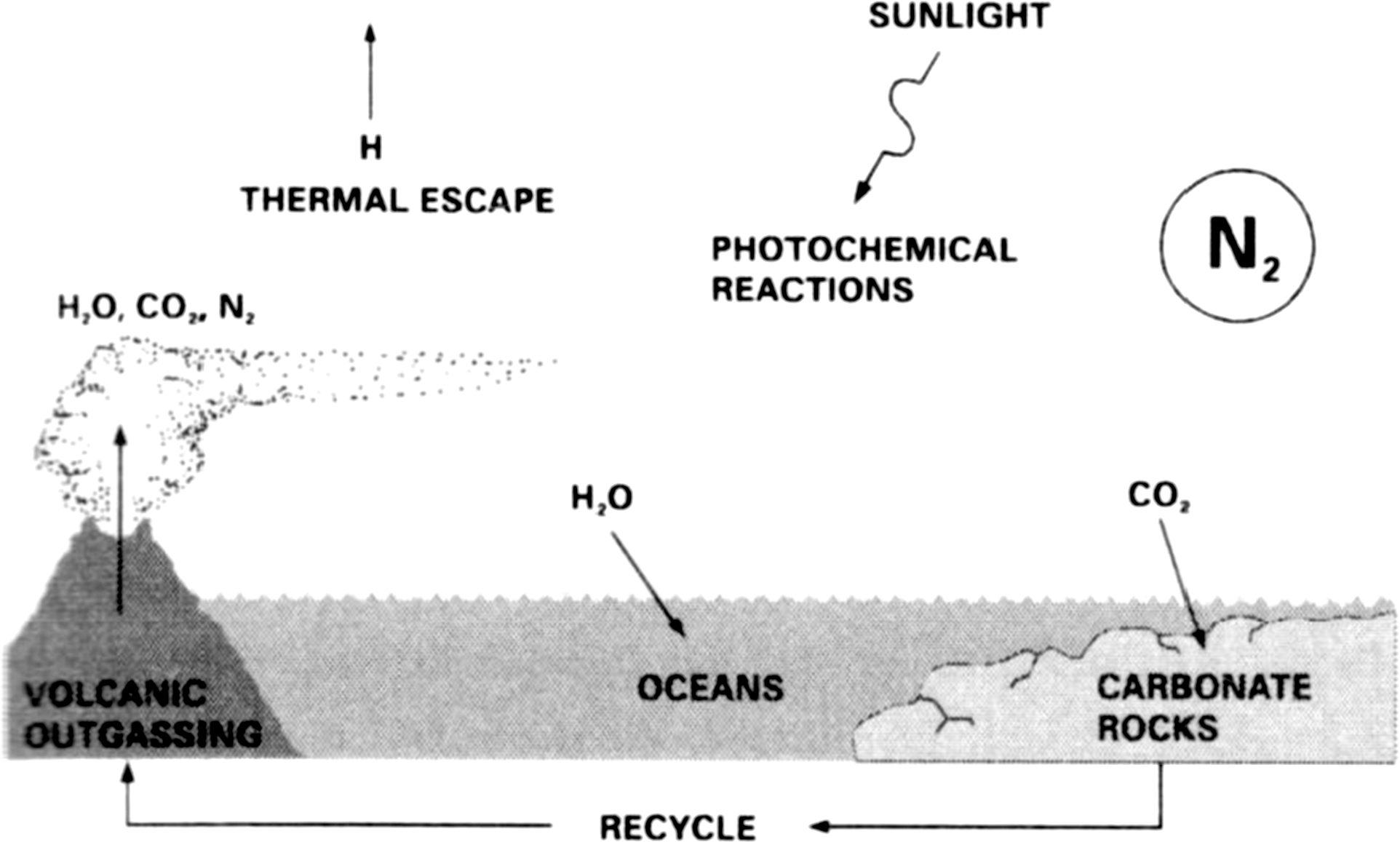
CO2 atmospheric-surface weathering, carbonate formation, and volcanic outgassing on an Earth-like active terrestrial planet (courtesy of S.J. Bauer).
On early Earth, continental landmasses, if they existed, would have been few and far between. Moreover, the older portions of the 3.5–3.2 Gyr Barberton and Pilbara greenstone belts clearly show that much of the (proto-) continental land mass was actually submerged.
Subaerial weathering of volcanic islands and exposed portions of incipient mid-ocean ridges would have contributed to the removal of CO2 from the atmosphere by weathering. This would have been especially efficient given the high ambient temperatures (>85°C: Kasting, 1993; 50–80°C: Knauth and Lowe, 2003) and the highly reactive nature of the volcanic rocks. However, in the absence of large extents of exposed landmass, probably the most important sink for CO2 would be provided by subaqueous carbonate alteration (carbonatization) of newly formed oceanic basalt. Substantial amounts of subaerial continental landmasses are necessary for this weathering process.
Dissolved CO2 would undergo chemical reaction with the vast amount of freshly formed volcanic material produced by the hotter and volcanically more active Earth. This phenomenon has been described from the early Archean greenstone belts in the Pilbara, Barberton, and Isua. The carbonates produced by this process would have been recycled together with the oceanic crust, thus leaving little record. In this way, plate tectonics plays a very important role in the recycling of CO2 in the atmosphere; the subducted carbonate is resupplied to the atmosphere through volcanic eruptions.
As outlined before, terrestrial planets in close-in HZs of low-mass M and K stars will be affected by tidal locking, which can have a negative effect on plate tectonics and, thus, on the CO2 recycling processes as outlined in this section.
It appears, however, that the continued subduction of CO2 in the form of carbonate alteration products over large periods of geological time has not been matched, in the case of Earth, by its resupply to the atmosphere. Gradually during the Archean, the preservation of exposed continental landmasses became more important with the first sediments directly derived from the weathering of granites being deposited after about 3.3–3.2 Gyr. This means that there was more material exposed for weathering and more carbonates being produced; thus more CO2 was removed from the atmosphere.
4.5. CO2 removal by biological activity
Late Archean-Proterozoic-age continents were surrounded by broad, stable continental platforms that served as sinks for large amounts of carbonate sediment. The simultaneous widespread development of cyanobacteria also contributed to the carbonate sink since carbonate is precipitated as a result of their metabolic activity. Cyanobacteria live in shallow water, since they are photosynthetic microorganisms. In fact, the late Archean and Proterozoic epochs are well known for carbonate stromatolitic microbial buildups. This implies an increase in the rate of CO2 trapping in carbonates, as well as the trapping of CO2 as carbon by a growing biomass. Hence, burial of this material in the mantle started to exceed its resupply to the atmosphere via volcanic eruptions. The removal of CO2 from the atmosphere was balanced by the simultaneous production of O2 by the oxygenic photosynthetic activity of the cyanobacteria.
4.6. Comparative CO2 planetology of Venus and Mars
Like Earth, Venus and Mars, in their early development, were characterized by high heat flow owing to the decay of unstable, short-lived isotopes. The origin of their volatiles would have been the same as that of volatiles on Earth—partly from the degassing of wet planetesimals, partly from the accretion of volatile-rich extraterrestrial materials (comets, meteorites, micrometeorites). Both planets would thus have had a CO2-rich atmosphere early in their histories.
Once the planetary surfaces cooled sufficiently, water could condense on the surface. There is plenty of geomorphological evidence for the existence of water at the surface of Mars early in its history (e.g., Carr, 1996; Baker, 2001; the latest Mars Exploration Rover results), and Venus probably had some water very early in its history. However, the geological evolution of these planets differs considerably from that of Earth. Venus became overheated because of its vicinity to the Sun, its lack of plate tectonics, and because continued volcanic activity pumped CO2 into the atmosphere, which led to what is known as the runaway greenhouse effect (Kasting, 1988).
The vast amount of CO2 in the atmosphere was not controlled by solvation in bodies of liquid water and resulting precipitation of carbonate salts. The planet now has surface temperatures of about 700°C, which are incompatible with life. If Venus did have water early in its history, then some alteration of lavas to form carbonate minerals could have occurred.
These deposits would have been covered by the continued volcanic activity and probably completely recycled back into the atmosphere by that same activity. Mars, on the other hand, is farther away from the Sun and basically froze over.
In fact, without either a very heavy CO2 atmosphere or the addition of a greenhouse gas, the surface of Mars should have been frozen very early in its history (Kasting, 1997). However, the freezing of the planet was not simply a function of distance from the Sun but was also related to the size of the planet and its geological evolution.
Mars is much smaller than either Venus or Earth. Although it had a magnetic field very early in its history, remnants of which were recently discovered (e.g., Connerney et al., 2001), the planet was too small to sustain an internal dynamo that produced the magnetic field (Zuber, 2001). About 4 Gyr ago, Mars therefore lost its magnetic field and, with it, protection from the solar wind. The martian CO2 atmosphere may have been basically destroyed by attrition from the early solar conditions and impact erosion.
However, some removal of the CO2 atmosphere would have occurred through the alteration of lava surfaces by CO2-rich water to produce carbonate minerals, as happened on Earth. However, no large-scale carbonate deposits should be expected on Mars because, as was the case on early Earth, such deposits only started to appear in the late Archean, and their existence is related to the geological evolution of the planet, which led to the formation of continents with shallow water platforms on which the carbonates could be deposited (Bibring et al., 2005). Mars did not undergo the tectonic evolution that Earth saw and apparently never had stable liquid large-scale oceans on its surface over hundreds of millions years.
Any carbonate deposits would be represented by small alteration zones at the surfaces and in cracks in the surfaces of those lava flows that were in contact with water. As one can see, several geological and also biological processes are relevant for the removal of dense secondary CO2 atmospheres on terrestrial planets. As outlined before, compared to nitrogen, CO2 is a better protector of the upper atmospheres of terrestrial planets from EUV heating during active stellar periods due to IR cooling.
Therefore, the CO2 removal time from an atmosphere compared with the active EUV period of the host star is a crucial factor, which is very relevant for the planet's long-time habitability and the evolution of its water inventory.
4.7. Atmospheric erosion by strong stellar winds
The flow of the solar wind around planetary obstacles with no or weak magnetic fields in the Solar System has been studied extensively by using gas dynamic convection magnetic field models (e.g., Spreiter et al., 1966; Spreiter and Stahara, 1980), semi-analytical magnetohydrodynamic flow models (Biernat et al., 2001), or so-called hybrid models (e.g., Terada et al., 2002). The model results have been compared with data for several planets in our Solar System, so that similar studies can be applied for the estimation of mass loading processes on terrestrial exoplanets for various orbital distances, star types, and stellar wind plasma parameters.
The magnetic obstacle of terrestrial planets in close-in HZs of low-mass M and K stars can be strongly compressed during active stellar periods due to weak magnetic moments caused by tidal locking.
In such cases, Venus- or Mars-like atmospheric interaction processes and particle heating of the upper atmospheres may occur. This results in large atmospheric and water loss rates so that planetary habitability can be strongly affected (Khodachenko et al., 2007; Lammer et al., 2007).
4.8. Ion pickup
Neutral atoms and molecules above the ionopause 3 can be transformed to ions via charge exchange with solar- or stellar-wind particles, EUV radiation, or electron impact. These newly generated planetary ions are accelerated to higher altitudes and energies by the interplanetary electric field and gradually guided by the solar, or stellar, wind plasma flow around the planetary obstacle, where they can be removed from the planet (e.g., Spreiter and Stahara, 1980; Lundin et al., 1989, 1990, 2004; Lichtenegger and Dubinin, 1998; Biernat et al., 2001; Terada et al., 2002, 2009; Lammer et al., 2003c; Liu et al., 2009).
Figure 13 shows the atmospheric erosion of a planet with the size and mass of Mars for present times (1 EUV) and 3.5 Gyr ago, where the EUV flux of a Sun-like star is about 6 times larger than at present. This result shows that planets with no, or weak, magnetic fields should be strongly affected by stellar wind erosion during active stellar wind periods of their host stars.
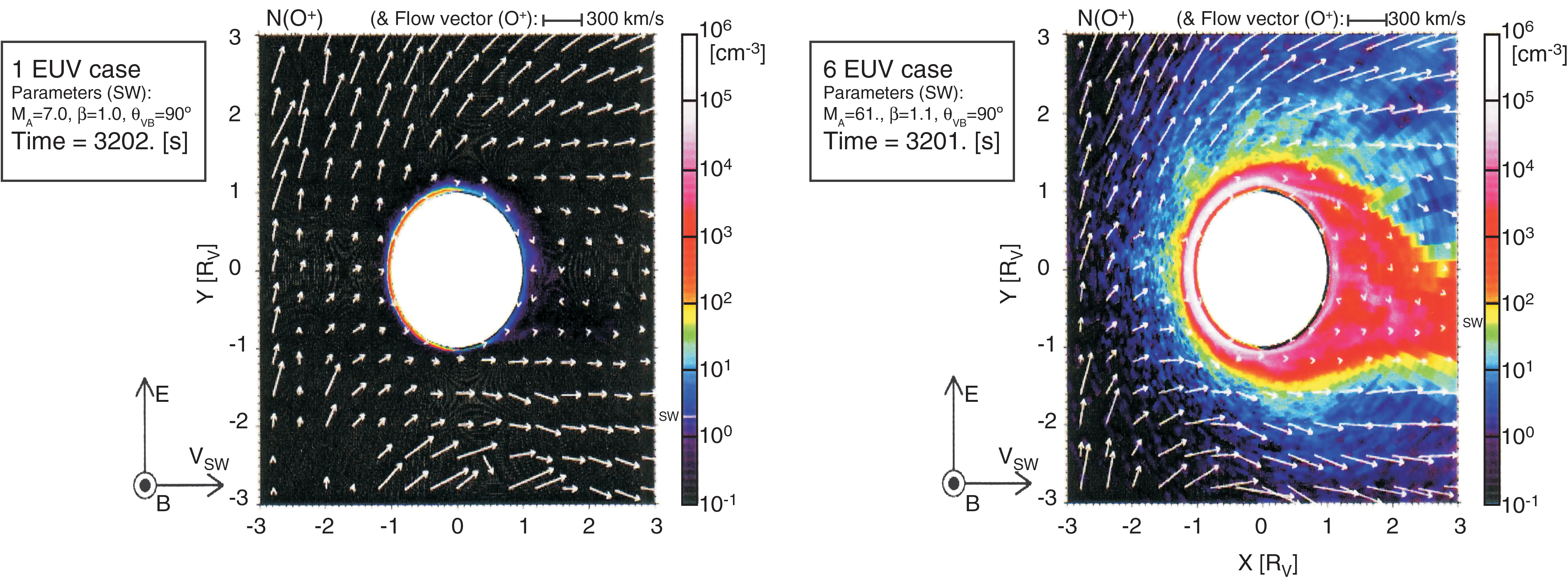
The entire martian–solar wind interaction region is simulated by including the ionosphere, ionopause transition layer, and the magnetosheath for solar activity periods at present (1 EUV) and 3.5 Gyr (6 EUV) ago, by applying boundary-fitted coordinates to a particle-in-the-cell code. The arrows correspond to flow vectors of picked-up planetary O+ ions. One can see that the atmosphere of a Mars-like planetary body can be efficiently eroded by the solar/stellar wind and is strongly affected by viscous processes during active stellar periods (courtesy of N. Terada).
Another important effect of pickup ions is that a part of them can be directed back to the planet, where they collide with the background gas so that the collision partners can be accelerated by sputtering to energies above the escape energy of a terrestrial planet.
4.9. Atmospheric sputtering
Sputtering refers to a mechanism by which incident energetic particles (mostly charged particles) interact with a planetary atmosphere or surface and produce the ejection of planetary material (see Fig. 14). The most studied type of sputtering is the interaction of energetic particles with an atmosphere.
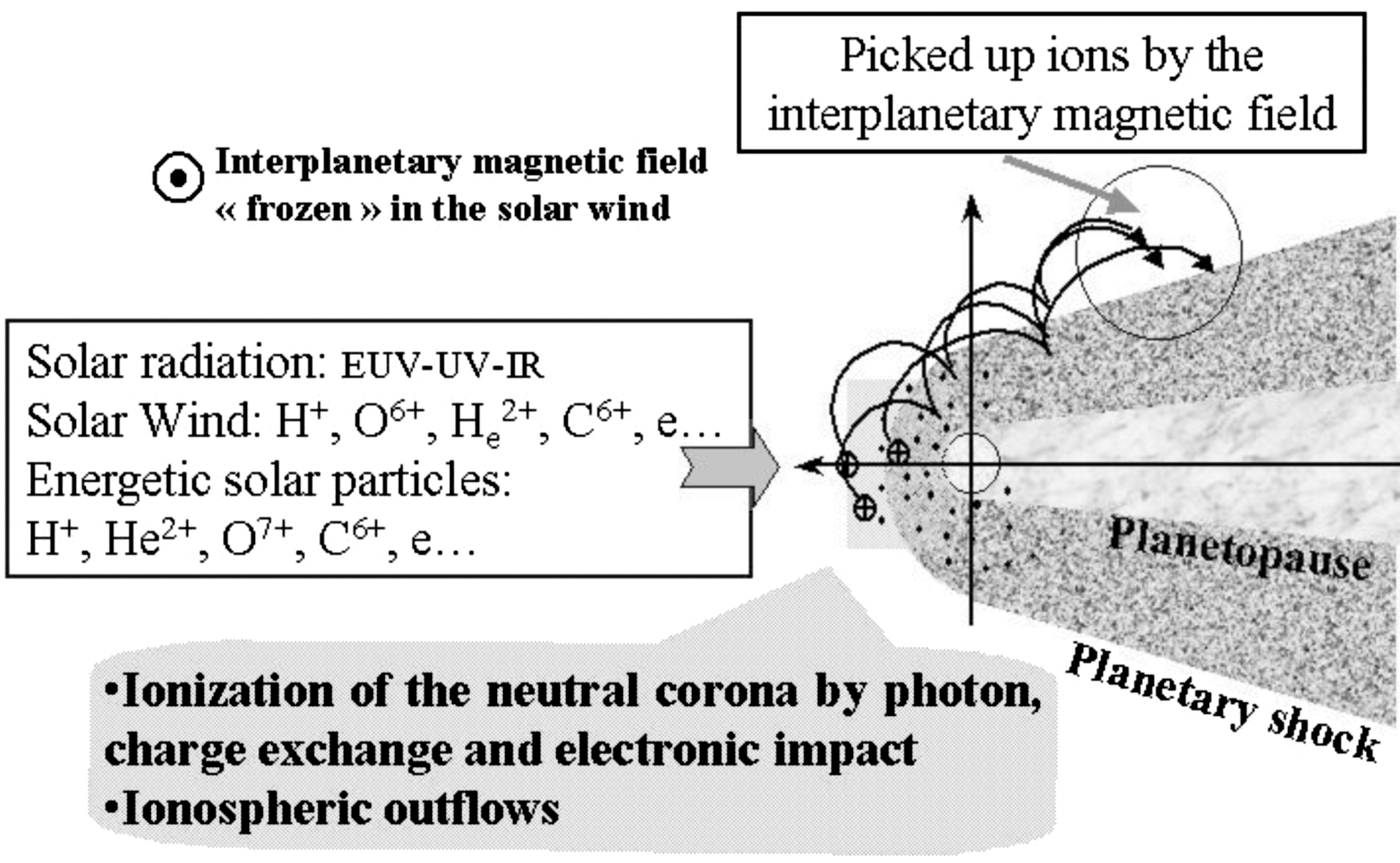
Illustration of picked-up planetary ions, which are directed backward to a planetary atmosphere, which is not protected by a strong magnetic field, so that they can act together with solar/stellar wind particles as sputter agents (courtesy of F. Leblanc).
Sputtering has been recognized as an important source of atmospheric loss in the case of Mars and of lesser importance for bigger planets like Venus (Luhmann and Kozyra, 1991). In the case of Mars, sputtering is thought to have had significant influence on the escape of martian water to space, particularly in the early phase of the Solar System (Luhmann et al., 1992; Kass and Yung, 1995, 1996; Johnson et al., 1996, 2000; Luhmann, 1997; Leblanc and Johnson, 2001, 2002; Lammer et al., 2003c; Chassefière and Leblanc, 2004).
In the case of Mars, atmospheric ejection induced by these planetary particles probably started to be significant after the collapse of the intrinsic martian magnetic field about 3.7 Gyr ago (Acuña et al., 1998). The main difference between Venus, Mars, and Earth is that a large flux of incident energetic particles interacted with the atmospheres of those planets that lacked a significant intrinsic magnetic field.
Solar/stellar wind and energetic particle sputtering (associated with flares and CMEs) are small at the planets in the Solar System with respect to pickup ion sputtering but could have been much more important in the early time of the Solar System or on planets that are located closer to their host stars.
The direct atmospheric loss by the sputter process can be very efficient on smaller terrestrial planets with a surface <1/2 S Earth. For larger planets with the mass of Venus or Earth, sputtering accelerates atmospheric particles to high altitudes where they can also be lost due to ionization and stellar wind by the pickup process.
4.10. Atmospheric erosion due to plasma instabilities and momentum transfer
The study of the solar wind interaction with the martian and venusian atmospheres by Mars Express and Venus Express is very important, because it allows for the acquisition of quite general results, which can also be applied to terrestrial exoplanets with highly compressed magnetospheres caused by strong stellar winds, given that such a planet's magnetopause may merge with the ionopause, and atmospheric loss due to plasma instabilities may occur. Measurements by the Pioneer Venus Orbiter spacecraft revealed a number of characteristic ionospheric structures that may be signatures of solar wind–ionosphere interaction processes (e.g., Brace et al., 1982; Russell et al., 1982).
Among these interaction processes are wavelike plasma irregularities, observed at the top of the dayside ionosphere and plasma clouds observed above the ionopause, primarily near the terminator and farther downstream. The detailed analysis of several detached plasma clouds has shown that the ions within the clouds themselves are ionosphere-like in electron temperature and density (Brace et al., 1982). When such plasma clouds were seen far above the ionosphere, they were clearly separated by an intervening region of ionosheath plasma. This large separation in a direction perpendicular to the ionosheath flow suggests that the ionospheric plasma in the clouds must have originated in the ionosphere upstream on the dayside, which indicates that plasma instabilities may occur at the venusian ionopause.
In the magnetic barrier, plasma is accelerated by a strong magnetic tension directed perpendicular to the magnetic field lines. This magnetic tension forms specific types of plasma flow stream lines near the ionopause, which are orthogonal to the magnetic field lines. This process favors the appearance of Kelvin-Helmholtz and interchange instabilities that can detach ionospheric plasma in the form of detached ion clouds from a planet (Biernat et al., 1999; Arshukova et al., 2002).
The Kelvin-Helmholtz instability at a planetary obstacle for one-fluid, incompressible magnetohydrodynamic equations can be modeled. In studies related to terrestrial exoplanets, one can treat the stellar wind flow past the planetary obstacle in a magnetohydrodynamic approximation, which was applied successfully for the case of the solar wind flow around Venus and Mars (Penz et al., 2006). By knowing the wavelength of the maximum instability growth rate, the total ion loss rate can be estimated by scaling the clouds on Venus, as observed by Brace et al. (1982) and on Mars by Mars Express' ASPERA-3 and, in the near future, by Venus Express' ASPERA-4, to the situation of terrestrial exoplanets with no, weak, or highly compressed magnetospheres in close-in HZs of M and K stars.
While the Kelvin-Helmholtz instability is more pronounced far away from the subsolar point, Arshukova et al. (2004) showed that the atmosphere-ionosphere environment of a Venus-type planet may also be affected by the so-called interchange instability, which can also evolve in the vicinity of the subsolar region. The equilibrium of the subsolar ionopause is provided by a pressure balance where the ionospheric plasma pressure is equal to the solar wind dynamic pressure. The plasma pressure has a specific non-monotonic behavior from the bow shock toward the ionosphere: first it decreases to a minimal value in the magnetic barrier; then it increases again to a large value corresponding to the ionosphere. This is the case where the interchange instability has to grow.
This instability is similar in nature to the Rayleigh-Taylor instability in classical hydrodynamics, where the magnetic stress plays the role of an effective gravitational force. The interchange instability modes grow when the magnetic tension acts in the direction of the gradient of the plasma pressure in the layer. The instability analysis by Arshukova et al. (2004) was applied to the subsolar stagnation region of the planet's magnetosheath. In particular, for a length scale of about 100 km, the growth time of the instability is less than the timescale of magnetic barrier formation. Ionospheric plasma perturbations caused by the interchange instability may be amplified by Kelvin-Helmholtz wave propagation from the subsolar region along the planet's ionopause toward the terminator, where plasma clouds from the planet's atmosphere can be detached.
Furthermore, the appearance of the interchange instability at the ionopause of a terrestrial planet can also be responsible for the penetration of magnetic flux tubes from the magnetosheath into the ionosphere where they may contribute to thermospheric heating and, as a result, enhanced thermal escape. Atmospheric erosion due to nonlinear phenomena like plasma instabilities and viscous processes may play an important role for the evolution of terrestrial exoplanets and their water inventory at orbits within the HZ of low-mass M and K stars. This is because such planets may possess no, or weak, magnetic moments due to partial or total tidal locking.
Footnotes
Acknowledgments
The authors acknowledge the Helmholtz-Gemeinschaft, as this research has been supported by the Helmholtz Association through the research alliance “Planetary Evolution and Life,” the International Space Science Institute (ISSI, Bern, Switzerland) and the ISSI teams “Evolution of Habitable Planets” and “Evolution of Exoplanet Atmospheres and Their Characterization.” The authors also acknowledge fruitful discussions during various meetings related to the Europlanet N2 activities as well as within the N2 Discipline working groups DWG 4 and DWG 5. Furthermore, we acknowledge support by the Austrian Academy of Sciences, “Verwaltungsstelle für Auslandsbeziehungen,” and by the Russian Academy of Sciences (RAS), Russian Federation. We thank also NASA for support via NAG5-13045 at the Harvard Smithsonian Center for Astrophysics, USA. Furthermore, we acknowledge the Austrian FWF (Wissenschaftsfond) for supporting this work via the following projects: P20145-N16 and FWF-RFBR I 199-N16; N6, 09-02-91002-ANF-a.
Abbreviations
amu, atomic mass units; CMEs, coronal mass ejections; HZ, habitable zone; PAL, present atmospheric level; EUV, extreme ultraviolet.
*The term biomarker is used here to mean detectable atmospheric species or set of species whose presence at significant abundance strongly suggests a biological origin.
1
Coronal mass ejections or CMEs are huge bubbles of gas threaded with magnetic field lines that are ejected from the Sun over the course of several hours.
2
Diffusion-limited escape means that all atoms, especially the light ones, that diffuse through the surrounding heavy gas to the upper atmosphere can escape from the planet. Energy-limited escape occurs if only one species (i.e., hydrogen) is available in large amounts in the upper atmosphere and its bulk flow velocity overcomes escape velocity.
3
The ionopause is the ionized atmospheric obstacle in a planetary atmosphere, where the stellar wind plasma flows around the planet. The atmosphere below the ionopause region is protected against erosion, while neutral gas above can be ionized and picked up by the solar/stellar wind.