







Abstract
What would SETI beacon transmitters be like if built by civilizations that had a variety of motives but cared about cost? In a companion paper, we presented how, for fixed power density in the far field, a cost-optimum interstellar beacon system could be built. Here, we consider how we should search for a beacon if it were produced by a civilization similar to ours. High-power transmitters could be built for a wide variety of motives other than the need for two-way communication; this would include beacons built to be seen over thousands of light-years. Extraterrestrial beacon builders would likely have to contend with economic pressures just as their terrestrial counterparts do. Cost, spectral lines near 1 GHz, and interstellar scintillation favor radiating frequencies substantially above the classic “water hole.” Therefore, the transmission strategy for a distant, cost-conscious beacon would be a rapid scan of the galactic plane with the intent to cover the angular space. Such pulses would be infrequent events for the receiver. Such beacons built by distant, advanced, wealthy societies would have very different characteristics from what SETI researchers seek. Future searches should pay special attention to areas along the galactic disk where SETI searches have seen coherent signals that have not recurred on the limited listening time intervals we have used. We will need to wait for recurring events that may arrive in intermittent bursts. Several new SETI search strategies have emerged from these ideas. We propose a new test for beacons that is based on the Life Plane hypotheses. Key Words: SETI—METI—Microwave—Power beaming—Beacons—Radio astronomy—Array antennas—High-power microwaves. Astrobiology 10, 491–498.
1. Introduction
A
The traditional targeted SETI strategy had much to recommend it. The background noise minimum in the “water hole” region near 1 GHz seemed plausible, as did the assumption that the altruistic radiator would beam forth steady, targeted signals of very narrow bandwidth to make detection easy.
Recent developments have lessened the power of these early views.
1.1. The galactic habitable zone
There is a growing sentiment within the astrobiology community that we are not typical members of the suite of galactic civilizations because we live among the outer regions of a galactic habitable zone (Kasting et al., 1993; Trimble, 1997; Gonzalez et al., 2001). In papers such as Lineweaver (2001) and in popularizations such as Rare Earth (Ward and Brownlee, 2000), a view emerged that stresses the difficulties facing intelligent life in our galaxy. Lineweaver (2001) argued that early, intense star formation toward the inner Galaxy provided the heavy elements necessary for life, but the supernova frequency remained dangerously high there for several billion years. Later, stars orbiting between the crowded inner bulge and the barren outer Galaxy were born into a habitable zone, starting about 8 billion years ago. The habitable zone expanded with time as metallicity (driven by supernovas) spread outward in the Galaxy and the supernovae rate decreased. They argued that ∼ 75% of the stars that harbor complex life in the Galaxy are older than the Sun and that their average age is ∼ 1 billion years older than the Sun.
This implies that most advanced societies should lie much farther inward toward the Galactic Center, at distances >1000 ly. Listening to relatively local star systems (SETI's primary strategy for decades) misses most of the possible civilizations (for a contrary view, see Vukotic and Cirkovic, 2007) and does not follow the Galactic Center strategy we describe below. Such distances imply, for the beacon builder, rather different motives than those that have to do with nearby emitters.
2. Cost of Alien Beacons
We recently studied how, for fixed power density in the far field, a cost-optimum interstellar beacon system could be built on Earth (Benford et al., 2010). Here, we consider how to search for a signal from a beacon produced by an extraterrestrial civilization. That is, we apply our arguments, based on terrestrial cost-determined design techniques, to alien societies. But are there any galactic social universals? Possibly there are none in common between alien civilizations and ours, so why should any arguments inspiring SETI have any weight? SETI assumes the opposite—that we can have similar motives.
High-power transmitters might be built for wide variety of goals other than two-way communication driven by curiosity. For example: a civilization announces its existence, pleas for help, emits leakage radiation from high-power projects (Benford and Benford, 2006), and so on.
We advocate that we know nothing of motives. Given beacon ranges >1000 ly, high powers are needed, suggesting that all possible motivations will succumb to economics. Is cost/benefit analysis arguably universal?
2.1. Parsimony and beacons
Traditional SETI research takes the point of view of receivers, not transmitters. This neglects the implications for what signals should look like in general, and especially the high emitting costs, which a receiver does not pay.
We shall assume, like conventional SETI, that microwaves are simpler for planetary societies, since they can easily outshine their star in microwaves. Microwaves are probably better for beacons (Tarter, 2001).
Literature from various different scientific fields supports our approach of thinking of extraterrestrial intelligence in economic terms. Whatever the life-form, evolution will select for economy of resources, an established principle in evolutionary theory (Williams, 1966). Further, Minsky (1985) argued that a general feature of intelligence is that it will select for economy of effort, whatever the life-form. Tullock (1994) argued that social species evolve to an equilibrium in which each species unconsciously carries out “environmental coordination,” which can follow rules like those of a market, especially among plants. He gives many such examples. Economics will matter.
A SETI broadcaster will face competing claims on resources. Some will come from direct economic competition. Standing outside this, SETI beaming will be essentially altruistic, that is, that extraterrestrial intelligence might broadcast for the benefit of younger civilizations, since replies will take centuries if not millennia. SETI need not tax an advanced society's resources. The power demands in our companion paper are for average powers ≤GW, far less than the 17 TW now produced globally (Hoffert et al., 2002).
But even altruistic beacon builders will have to contend with other competing altruistic causes, just as humans do (Lemarchand and Lomberg, 1996). They will confront arguments that the response time for SETI is millennia and that, anyway, advanced societies leak plenty of microwaves, and so on, into deep space already. We take up these issues below. It seems clear that, for a beacon builder, only by minimizing cost/benefit will their effort succeed. This is parsimony, meaning “less is better,” a concept of frugality, economy. Philosophers use this term for Occam's Razor, but here we mean the press of economic demands in any society that contemplates long-term projects like SETI. On Earth, advocates of Messaging to Extraterrestrial Intelligence (METI) will also face economic constraints (Benford et al., 2010).
Note that parsimony directly contradicts the Altruistic Alien Argument that the beacon builders will be vastly wealthy and make everything easy for us. An omnidirectional beacon, radiating at the entire galactic plane, for example, would have to be enormously powerful and expensive, and so not be parsimonious. One of the SETI pioneers, B. Oliver, calculated a cost minimization for both sender and receiver together, but Oliver's conceived sender and receiver were not part of the same economic system, and indeed did not know each other, so there is no reason for cost to be minimized between them.
Parsimony has implications for SETI. For transmitting time τ, receiver detectability scales as τ 1/2. But at constant power, transmitter cost increases as τ, so short pulses are economically smart (cheaper) for the transmitting society. A 1-second pulse sent every 10 minutes to 600 targets would be 1/600 as expensive per target, yet only ∼ 1/25 times harder to detect. Interstellar scintillation limits the pulse time to >10−6 s, which is within the range of all existing high-power microwave devices. Such pings would have small information content, which would attract attention to weaker, high-content messages. This general scaling seems clear, but of course the crucial issue is what frequencies and timescales are best.
Finally, even if economics such as is characteristic of Earth work similarly in other technological societies, why should it apply to their transmitting beacons? Even on Earth, larger goals often override economic dictates, such as military security, aesthetics, religion, and so on. But two aspects of SETI undermine this intuition: (1) SETI assumes long timescales for sender and receiver. But while cultural passions can set goals, economics determines how they get done. Many momentary, spectacular projects such as the pyramids of Egypt lasted only a century or two then met economic limits. The Taj Mahal so taxed its province that the second, black Taj was never built. The grand cathedrals of medieval Europe suffered cost constraints and, to avoid swamping local economies, so took several centuries of large effort. Passion is temporary, while costs constrain long-term projects. (2) The optimum cost strategy leads directly to a remarkable cost insensitivity to the details of economic scaling. The ratio of costs for antenna area and system power depends on only the ratio of exponents (Benford et al., 2010, Eq. 13)—and not on the details of the technology. That ratio varies on Earth by only a factor of 2. Both these costs may well be related principally to labor cost; if so, it cancels out. This means fashions in underlying technology will matter little, and our experience perhaps robustly represents that of other technological societies.
3. Consequences for SETI Strategy
If there are cost-optimized beacons, we argue that they can be found by steady searches that watch the galactic plane for times on the scale of years. Of course, SETI literature abounds with consideration of the trade-offs of search strategy (range vs. EIRP vs. pulse vs. continuous (continuous wave, CW) vs. polarization vs. frequency vs. beamwidth vs. integration time vs. modulation types vs. targeted vs. all-sky vs. Milky Way). But, in practice, search dwell times are a few seconds in surveys and 100–200 seconds for targeted searches (Tarter, 2001). Optical searches usually run to minutes. And integration times are long, of order 100 s, so short pulses will be integrated out. Recent discoveries of transient signals (Hyman et al., 2007) have sparked renewed interest in shorter observation times. With such searches becoming more common, detection of short-pulse beacons becomes more likely.
3.1. Bandwidth and frequency
At distances >1000 ly, Doppler adjustment to offset relative motions, as nearby SETI searches do, becomes pointless; with many stars in the field of view, none is especially addressed. Further, distortion of signals from >1000 ly arises from interstellar scintillation. Such “twinkling” of the signal comes from both the dispersion of differing frequencies and delays in arrival time for pulses moving along slightly different pathways, due to refraction. Temporal broadening probably would limit bandwidth to >1 MHz, as we know from the broadening of pulsar signals.
3.2. Have we seen beacons?
Behind conventional SETI methods lies the assumption that altruistic beaming societies will send persistent signals. In searches to date, confirmation attempts, when the observer looks back at a target, in practice usually occur days later (or for data found in the SETI At Home program, years). Such surveys have little chance of seeing cost-optimized beacons.
For example, Shostak (2009) argued that a beacon would need to dwell on ∼ 105 stars to have a reasonable chance of getting through to a working receiver. He bases this on a strawman calculation that assumes 10,000 transmitting societies in the Galaxy with an average lifetime of 10,000 years, implying a mean separation of 1,000 ly. His crucial assumption is that, to give the receiver a chance to confirm, the beacon should remain on target for a week, a confirmation time based on experience and typical in contemporary sky surveys (Tarter, 2001). Thus, it would take 2,000 years to dwell on the 105 stars. A group of 105 stars is, for example, a large sample of the nearby stars that would be thought of as likely productive targets. A better strategy would be to dwell on many stars for the emitting time of the high-power device, perhaps a minute or even less than a second. Then repeat the dwell pattern, perhaps after a week. An observer would then have a chance to confirm the contact by looking back at likely events for times of days. Somewhere in that time the signal would reappear, perhaps a brief burst with coded pointers to a lower-power, high-content signal.
Why would 1-second dwells make sense? Certainly enough information can be conveyed in a second to be a beacon and definitively non-natural. On our nomograph (Fig.11, Benford et al., 2010), taking a typical (for Earth technology) 10−4 radian beam, a second dwell time means F ∼ 10−4, so from Eq. 6 repeat time is only a day. If one chooses to argue that it would be better to dwell for, say, an hour, then one revisits every 10 years.
What does a cost-optimized, pulsed, broadband, narrow-focus beacon emission imply? Distant, cost-optimized beacons will appear for much less time than as assumed in conventional SETI. Earlier searches have seen pulsed intermittent signals resembling what we (in this paper) think beacons may be like, and may provide useful clues. We should observe the spots in the sky seen in previous work for hints of such activity but over year-long periods. Natural radio source variability does extend down at least to the ∼ month timescale, so intelligent civilizations will perhaps be looking for signals relevant to month-long revisit times. Perhaps newer search methods, directed at short transient signals, will be more likely to see the beacons we have described (Cordes et al., 2007; Lazio et al., 2009; Siemion et al., 2010).
The opposite strategy is, if you really wanted to be heard by a known—or suspected—extraterrestrial civilization, that you could spend a large fraction of your time on them, dwelling for months. The nomograph indicates that this strategy works well for revisit times of order a year. (In our nomograph, this is the “continuous beaming” quadrant.) With resources and technology appropriate to our current capabilities, our optimized beacon beamwidth would be such that the number of civilizations we could look at would be a few per year. An active and stable SETI program could provide good new targets at such a rate, based on the occurrence of interesting signals seen over recent decades. This strategy is the inverse of the above: the targets are not random but are preselected based on existing observational information. Potentially biased, yes, but based on some knowledge—hence more likely to be worth the investment of time broadcasting to them.
A provocative example is Sullivan et al. (1997). This survey lasted about 2.5 hours, with 190, 1.2-minute integrations. They “recorded intriguing, non-repeatable, narrowband signals, apparently not of man-made origin and with some degree of concentration toward the galactic plane.” Similar searches also saw one-time signals, not repeated (Shostak and Tarter, 1985; Gray, 1994; Gray and Marvel, 2001; Tarter, 2001). These searches had slow times to revisit or reconfirm, often days (Tarter, 2001). Overall, few searches lasted more than hour, with lagging confirmation checks (Horowitz and Sagan, 1993).
Another striking example is the “Wow” signal seen at the Ohio SETI site. The check-back time was fairly long, and subsequent studies observed for short times. However, the system rejected signals greater than 10 kHz wide at 1.5 GHz, that is, no more than Δf/f ∼ 10−5. A broadband high-power microwave source would usually have Δf/f ∼ 10−3 (Benford et al., 2010 Appendix B), so the Ohio search may have simply missed events. Further, the total time spent by all later searches of the Wow signal site, directly toward the Galactic Center, is about 1% of a year. This fact illuminates the constraints that a Galactic Center search strategy imposes: a year-long campaign will require more effort than has been put forth for SETI over the last half century.
These are two examples among many set forth in the SETI Institute's database (
3.3. Is GCRT J17445-3009 a beacon?
As an example of using cost-optimized beacon analysis for SETI purposes, consider in detail the puzzling transient bursting radio source, GCRT J17445-3009, which has extremely unusual properties. It was discovered in 2002 in the direction of the Galactic Center (1.25° south of Galactic Center) at 330 MHz in a Very Large Array observation and subsequently reobserved in 2003 and 2004 in Giant Metrewave Radio Telescope (GMRT) observations (Hyman et al., 2005, 2006, 2007). It is a pulsed coherent source, with the “burst” lasting as much as 10 minutes, with 77-minute period. Averaged over all observations, Hyman et al. give a duty cycle of 7% (1/14), although since some observations may have missed part of bursts, the duty cycle might be as high as 13%.
What is it? Candidate explanations include masers, flare stars, extrasolar planets, periodic or precessing radio pulsars, double neutron star binary pulsars, white dwarf pulsars (Echevarría et. al., 2008), and ultracool brown dwarfs. Nothing fits well, and observations continue. Could this source be a beacon?
We take this case because, unlike the spotty potential SETI sightings like the “Wow” event, GCRT J17445-3009 has been seen repeatedly. Any true SETI source will face similar scrutiny and analysis.
For METI, experience shows an optimum trade-off, depending on transmission frequency and on antenna size and power (Benford et al., 2010). This emerges by minimizing the cost of producing a desired EIRP, which in turn determines the maximum range of detectability of a transmitted signal. Costs of pulsed cost-efficient transmitters were estimated from these relations by using current cost parameters ($/W, $/m2) as a basis. The result is that galactic-scale beacons demand effective isotropic radiated power >1017 W, emitted powers are >1 GW, with antenna areas ∼ km2. Thrifty beacon systems would be large and costly, have narrow “searchlight” beams and short “dwell times” when the beacon would be seen by an alien observer at target areas in the sky. They may revisit an area infrequently. The natural corridor to broadcast is along the galactic spiral's radius or along the spiral galactic arm we are in.
Applying this approach to GCRT J17445-3009, the observed flux density is about 1 jansky at 330 MHz, and the bandwidth is at least 30 MHz (Hyman et al., 2007). This implies a minimum power density of S = 3 × 10⁻¹⁹ W/m2. As the source is very close in angle to the Galactic Center, we begin by assuming that GCRT J17445-3009 is a beacon located there, R GC = 26,000 ly from Earth.
The power density S of a beacon at range R is determined by W, the effective isotropic radiated power (EIRP), the product of radiated peak power P and aperture gain G,
and gain is given by area and wavelength:
Here ɛ is aperture efficiency (this includes factors such as phase, polarization, and array fill efficiency), and we have collected constants into the factor k. From Eq. 1, W = 2.3 × 10²³ W, a large beacon.
Such a high-power radiator would be extremely expensive, so we use our analysis of beacon cost (Benford et al., 2010), which shows that the optimum power and antenna area for producing the power density S is
Here we minimize the cost by assuming linear scaling dependence of cost on the peak power and antenna area, a well-established method in industry. Coefficients describe the dependence of cost on area a ($/m2), which includes cost of the antenna, its supports and subsystems for pointing and tracking and phase control, and microwave power p ($/W), which includes cost of the source, power supply, cooling equipment, and prime power:
Using rough estimates of costs on Earth (1000 $/m2, $1/W), antenna efficiency 60%, one can estimate features of beacons. From Eq. 3 and the observed 330 MHz frequency, P opt = 3.2 TW, A opt = 9500 km2, and the optimum antenna diameter D opt = 110 km. The minimized cost is C opt = $19 trillion for $3/W microwave tubes, $10,000/m2 antennas. For solid-state costs, we use the scaled estimates (Scheffer, 2005 Table 3) and find the cost is about the same, about $20 trillion. So they could use either of the technologies available to us, longer wavelengths (solid state) or shorter (electron beam tubes).
The angular width θ of the optimized beacon beam is set by the antenna area and frequency:
For this case, θ = 9 × 10⁻⁶ sr. The dwell time when the beacon beam falls on the receiver of a listener τ
d is related to the revisit time or cycle time τ
r that the beacon with optimal emitting angle θ
o takes to broadcast across a segment of the galactic plane A
G. F is the fraction of the sky A
G covers, as seen from the beacon:
For the GCRT J17445-3009 observations, dwell time is 10 minutes, and revisit time is 77 minutes. The fraction F of the sky the scanning beacon covers is 4 × 10⁻¹¹. The beam spot at Earth is θR GC = 0.24 ly. At our local star density of 0.2 star/ly3, the beam illuminates at most one star at our distance. The beam in the 26,000 ly path to Earth illuminates ∼ 100 stars (Sullivan and Mighell, 1984).
If the beacon, with 7% duty cycle, is painting 14 such 0.24 ly areas then repeats 77 minutes later, then the total illuminated area is a circle 1 ly in diameter, and the beam illuminates ∼ 1 star in a 1-light-year-diameter sphere.
If the beacon is closer, it is smaller and cheaper: For R = 1000 ly, W = 3.4 × 10²⁰ W, still a large beacon, P opt = 4.7 GW, A opt = 366 km2, D opt = 22 km. The minimized cost is C opt = $730 billion, θ = 4.7 × 10⁻⁵ rad, the beam spot is θR = 4.7 × 10⁻² ly. At our local star density of 0.2 star/ly3, the beam illuminates at most one star at our distance.
From the above, GCRT J17445-3009 probably is not a beacon. But if it is a cost-optimized beacon, it must be targeting because the field of stars covered is so small. It is trying to talk to our star system. Perhaps the beacon is in fact much closer and targets our region in part because they have detected signs of life in Earth's atmosphere such as out-of-equilibrium chemistry (oxygen, ozone). Or the beacon can have a hierarchy of timescales, illuminating one part of its sky intensively then moving on to another promising region, returning to us years later.
Another possibility is that a cost-optimized beacon is engaged in communication along the natural radial corridor from the Galactic Center, knowing that astronomical races will study the center preferentially (Fig. 1). In the event we just happen to be in their beam and have intercepted an interstellar communication link, we should Radial interstellar beacons radiating along different galactic radii in the Milky Way (along gray-highlighted radii). A radial search strategy in SETI would seek beacons along the galactic radius as defined here by one square degree of sky along the Milky Way's center-anticenter axis, a special direction shared by any civilizations among the 108 stars contained in the beam. A long-term, continuous search by SETI observers along this radius has an improved chance of detecting any beacons transmitted by other minds who see the radial strategy as a way of significantly simplifying the task faced by beacon seekers. Art copyright Jon Lomberg 2009. (1) Stare at the direction of GCRT J17445-3009 at higher frequencies as both cost optimization and higher information-carrying ability argue. Another information-bearing signal could be at the optimum high frequencies, ∼ 10 GHz. A temporal analysis should be conducted to search for structure in the bursts, since measurements to date have not looked for any message content. (2) Look in the opposite direction, 180 degrees from the center, to see if there is another beam communicating toward GCRT J17445-3009.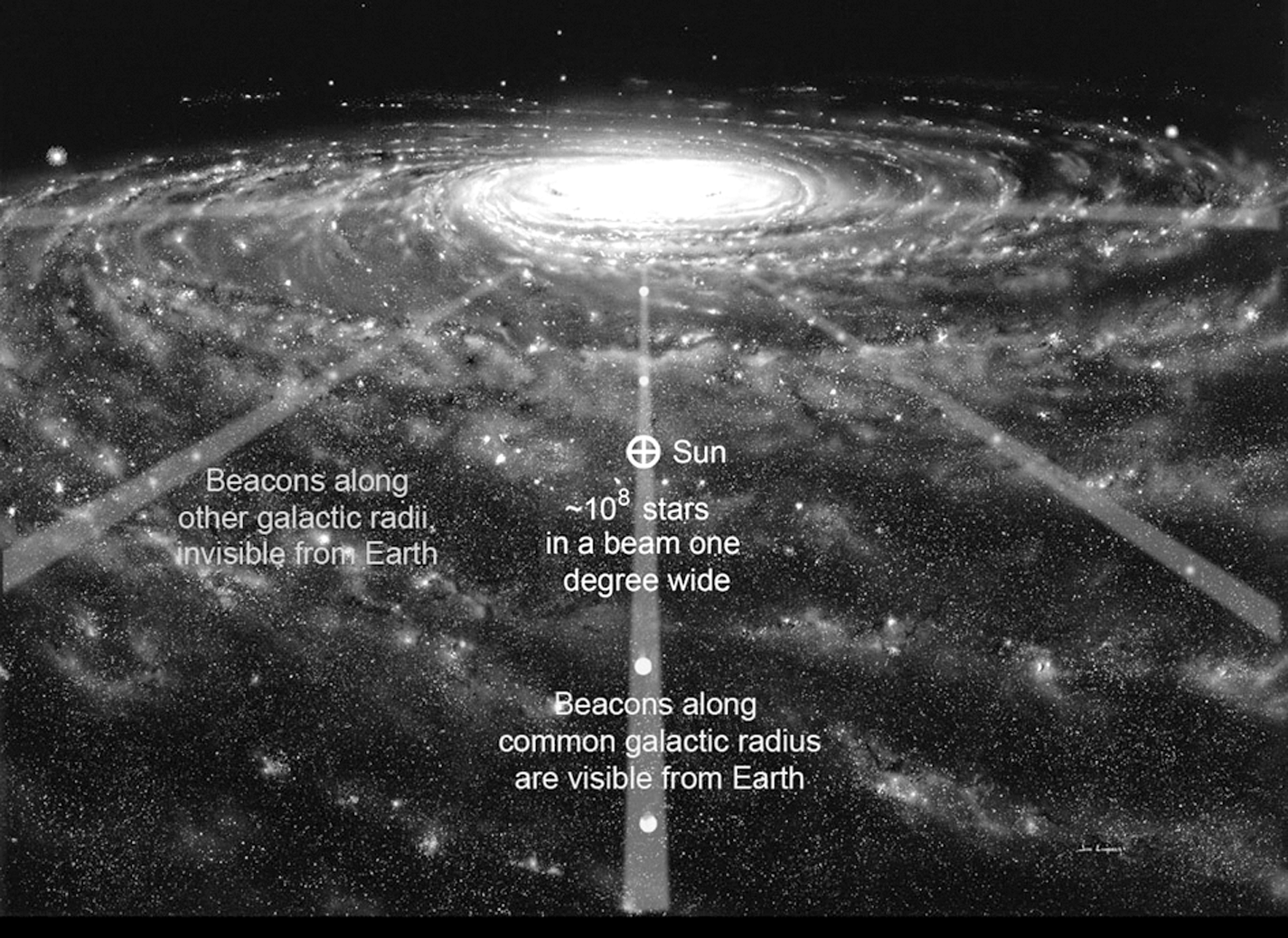
Why would a beacon be at such a low frequency as 0.33 GHz, which is not cost optimum? Those seeking to reach emergent technological societies may want to go to lower frequencies, because the seemingly natural evolution of electromagnetic technology is from long wavelengths, then, at later times, to shorter ones. Long-wavelength engineering is easier, as Marconi first showed; radio astronomy started at low frequencies. The same technology path means that the first radio astronomy observations will be at low frequencies (as for Jansky) and detect the strongest sources. If our own experience is typical, it supports the above assertion.
3.4. A Galactic Center search strategy
To see beacons as we envision them, we should search in the plane of the spiral disk. From Earth, 90% of the Galaxy's stars lie within 9% of the sky's area, in the plane and hub of the Galaxy. This suggests a limited sky survey. We will need to be patient and wait for recurring events that may arrive in intermittent bursts. Special attention should be paid to areas along the Galactic Disk where SETI searches have seen coherent signals that are non-recurring on their limited listening time intervals. Since most stars lie close to the galactic plane, as viewed from Earth, occasional pulses at small angles from that plane should have priority.
Whatever forms might dwell further in from us toward the center, they must know the basic symmetry of the spiral. This suggests the natural corridor for communication is along the spiral's radius from the Galactic Center or toward it, a simple direction known to everyone. (A radius is better than aiming along a spiral arm, since the arm curves away from any straight-line view. On the other hand, along our nearby spiral arms the stars are roughly the age of ours.) This avenue maximizes the number of stars within a telescope's view, especially by staring at the galactic hub. Thus, a beacon near the center should at least broadcast outward in both directions, while societies at the far reaches may save half their cost by not emitting outward, since there is much less chance of advanced societies there. Radiating into the full disk takes far more time and power, so beams may only occasionally visit any sector of the radial plane. We listeners fairly far out (and fairly young) should look inward, within a narrow angle (∼ 10 degrees) toward the constellation Sagittarius. Listening outward seems less efficient, since the galactic habitable zone model says life is less likely out there (Kasting et al., 1993; Trimble, 1997; Gonzalez et al., 2001).
Life sites like ours will also know two rough timescales—a year and a day—from constraints on planetary habitable zones and biosphere mechanics. Observing every day over a year span might afford a better chance of seeing intermittent bursts that revisit our part of the sky on a yearly timescale. To lower costs and have the best viewing range, sites near the equator seem optimal. The Indian GMRT group observes in meter wavelengths, up to 1.5 GHz, can see the Galactic Center year-round, and is well placed in a low-noise area. The GMRT cannot observe at the higher frequencies we advocate. Parkes radio telescope in Australia is better situated at latitude −33, where the Galactic Center passes nearly overhead, and can see high frequencies.
3.5. A Life Plane strategy
The 2004 discovery (Rohde and Meuller, 2005) that marine life biodiversity follows a 62-million-year cycle suggests that a Life Plane may exist in our galaxy. To explain this observation, Medvedev and Melott propose that the cycle arises from modulation of cosmic ray flux by our Sun's vertical oscillation (∼ 62-million-year period) above and below the galactic plane (Medvedev and Melott, 2007). They argue that the Galaxy's bow shock, formed as it moves northward toward the Virgo cluster, enhances cosmic ray flux when our star is ∼ 250 ly north of the galactic plane. The galactic halo/wind/termination shock ram pressure due to the galactic motion accelerates particles, amplifying the flux by a factor ∼4.6 at the northern peak of our oscillation above the galactic plane, damaging the biosphere.
If even higher fluxes (and thus larger oscillation heights) suppress advanced life-forms, this may define a plane near the center of the galactic 1000-light-year-thick disk that favors life, including intelligent life. Within this volume, stars oscillating vertically within perhaps <500 ly would be favorable for civilizations, so beacons would cluster about the plane, as would targets. Interestingly, the highest power transient sources observed by Horowitz and Sagan (Horowitz and Sagan, 1993) also lie close to the galactic plane.
If these Life Plane ideas are true, they could influence a beacon builder's strategy. For example, confining the beacon to the Life Plane simplifies the emitting pattern. (Note that our 230 ly amplitude oscillation about the plane is a small excursion. The scale length for the fall of star density going away from the plane is 650 ly. So the angle for our system seen from the Galactic Center is ∼ 10−2 radians.) Beacons with galactic ranges will be of narrow angle. The number of separate shots needed to illuminate the cylindrical surface at distance R and of height h(R), given an emitting angle θ, is
Here the distance R 0 and height h 0 are scaling distances in the galactic plane. A beacon following the Life Plane strategy then can target into narrower layers as R increases. For example, if h 0 = 500 ly, R 0 = 1000 ly, at R = 4000 ly, for θ = 2.5 × 10⁻⁴, Nh = 8 × 10⁶. If the beacon sends a short signal to all spot sizes within θ in an Earth day, each shot appears in the receiver's sky for 10−2 s. If the beacon elects to illuminate only once a year, the signal appears for 4 s. For longer ranges R, N drops, so pulses can last longer. The Life Plane strategy may be optimal, with less time spent at higher angles from the plane.
If life is clustered near the galactic plane, and if alien beacons are following this strategy, then beacons will be seen to cluster near the plane. If Medvedev and Melott are right, a new test for SETI beacons is possible: compare the distribution of the observations described in Section 3.2 to the distribution of stars about the plane. If they differ, and, in particular, if they are more tightly clustered toward the plane than all stars, it could be indirect evidence that some of the observations are of beacons of the type we describe.
3.6. Transit-targeted search strategy
Nussinov (2009) suggested that inhabitants of star systems that lie close to the plane of Earth's orbit around the sun could detect eclipsing by our annual transit across the face of the Sun. That would tell them that Earth lies in a liquid water stable habitable zone (Corbet, 2003). Through spectroscopic analysis of our atmosphere, they might see traces of chemistry indicating that Earth likely bears life, particularly the prominent ozone line.
The more numerous distant observers of eclipsing would be at the intersections of the solar ecliptic with the galactic plane (in Taurus and Sagittarius), which are inclined at 60 degrees. They could target our system with a transmitting beacon, so that is a preferred direction for us to search. The fraction of the sky that intersection fills is F ∼ 10−4. If they were to use a microwave beacon, from Eq. 6 the dwell time would increase, the revisit time substantially shorten, or some combination of both. We can get a rough idea of such a beacon in the table of beacon examples in our METI paper (Benford et al., 2010); the short-pulse 1000-light-year-range beacon could appear in our sky for 35 s three times a day, thus would be readably observable.
Targeted lasers would be the transmitters of choice, although they would not penetrate atmospheres of planets or hot-Jupiter moons with substantial atmospheres (Venus, Titan). Further, if they are used as an optical targeted laser beacon, they would preferably emit at times whereby the signal arrives when Earth is on the nearest (to the sender) half of its orbit, arriving on our night side. This gives a time-dependent term to an optical listening agenda.
3.7. Implicit cooperation between beacons and receivers
Beacon builders who cost-minimize will expect receiving societies will have worked through the same calculations, as we now have, even if they do not build beacons, as we have not. This implicit collaboration can insure that the receiver will invest in microwave antennas that maximize chances of detection while minimizing their costs. This dictates a large receiving-phased array antenna, optimized to capture brief signals that can occur at any time. If the receiver follows a radial strategy, preferentially looking toward the Galactic Center, favoring the ∼ 10 GHz region, the two parties maximize their chances of a connection. An alternative is a collection of smaller, perhaps privately operated, antennas around our planet, watching continuously for short-pulse beacons.
Further, a brief SETI signal will plausibly carry information. If a candidate brief pulse carries a signal, this resolves the issue of whether it is a beacon. Whatever coding strategy a signal uses, saving the phase information gathered by the receiver is essential. Radio astronomers typically measure frequency spectra, but keeping phase and frequency information should be added to our strategy for identifying SETI beacons.
4. Conclusions
We conclude that SETI searches may have been looking for the wrong thing. SETI has largely sought signals at the lower end of the cost-optimum frequencies. They also may have taken needless care adjusting Doppler shifts, since broadband beacons will need none. Searches have seen coherent signals that are non-recurring on their limited listening time intervals. Those searches may have seen beacons but could not verify them because they did not steadily observe for more than short periods.
We should reconsider SETI search strategies to enhance use of higher frequencies and make systematic scans of the entire galactic plane, with special attention to the Galactic Center. Searches for such signals might best be done in midlatitude southern sites. We propose a new test for SETI beacons, based on the Life Plane hypotheses. This requires steadily observing over periods of years.
We summarize the implications of these cost-minimized beacon results as strategies: (1) Revisit the locations of the transient, powerful bursts seen in past surveys in a systematic way. Since we know these locations, a search every day or even more often would be inexpensive. (2) Scan the region pointing directly toward and away from the Galactic Center. (3) Scan the entire plane of the Galaxy often throughout the year. (4) Since the highest nearby density of stars lies along the nearby galactic arm, listen in that direction for occasional, transient pulses. (5) Assume the Life Plane strategy of the beacon builder. Observe a narrow range above and below the galactic plane daily.
Footnotes
Acknowledgments
We thank Paul Davies, Jill Tarter, Frank Drake, Paul Shuch, and Seth Shostak for enlightening conversations and Jon Lomberg for the figure.
Author Disclosure Statement
No competing financial interests exist.
Abbreviations
EIRP, effective isotropic radiated power; GMRT, Giant Metrewave Radio Telescope; ly, light-years; METI, Messaging to Extraterrestrial Intelligence; SETI, Search for Extraterrestrial Intelligence.