







Abstract
Aerosol phase elements such as phosphorus (P), sulfur (S), and metals including iron (Fe) are essential nutrients that could help sustain potential biodiversity in the cloud deck of Venus. While the presence of S and Fe in the venusian cloud deck has been broadly discussed (Zasova et al., 1981; Krasnopolsky, 2012, 2013, 2016, 2017; Markiewicz et al., 2014), less attention has been given to the presence of P in the aerosols and its involvement in the multiphase chemistry of venusian clouds and potential sources of P deposition in the venusian atmosphere. A detailed characterization of phosphorus atmospheric chemistry in the cloud deck of Venus is crucial for understanding its solubility and bioavailability for potential venusian cloud microbiota (Schulze-Makuch et al., 2004; Grinspoon and Bullock, 2007; Limaye et al., 2018). We summarize our current understanding of the presence of P in the clouds of Venus and its role in a hypothetical atmospheric (bio)chemical cycle. The results of the VeGa lander measurements are put into perspective with regard to nutrient limitation for a potential biosphere in venusian clouds. Our work combines the results of the VeGa measurements and focuses on P as an inorganic nutrient component and its potential sources and chemical behavior as part of multiple transformations of atmospheric chemistry. The VeGa data indicate that a plentiful phosphorus layer exists within a layer that reaches into the lower venusian clouds and exceeds minimum P abundances for terrestrial microbial life. Extreme acidification of airborne phases in the atmosphere of Venus may facilitate P solubilization and its bioavailability for a potential ecosystem in venusian clouds. Further sampling and P abundance measurements in the atmosphere of Venus would improve our knowledge of P speciation and facilitate determination of a bioavailable fraction of P detected in venusian clouds. The previous results deserve further experimental and modeling analyses to diminish uncertainties and understand the rates of atmospheric deposition of P and its role in a potential venusian cloud ecosystem.
1. Introduction
One of the key requirements for past or present life in Venus' habitable cloud layer is the availability of key elements or mineral nutrients in the atmosphere. The main elements required for Earth-type life are carbon, hydrogen, nitrogen, oxygen, phosphorus, and sulfur (CHNOPS). Carbon dioxide is the dominant constituent of Venus' atmosphere, with nitrogen making up most of the rest (up to 5.0% at 64 km according to Peplowski et al., 2020). Minor constituents include water vapor and other trace species such as carbon monoxide, sulfur dioxide, carbonyl sulfide, carbon disulfide, among others (Oyama et al., 1980). Sulfur (S), iron (Fe), and phosphorus (P) in Venus' atmosphere were detected by the VeGa-1 and VeGa-2 landers during their descents through the clouds (Andreychikov et al., 1987).
The cloud/haze covers a large vertical extent of the atmosphere from about 47 km at the base to an altitude of at least 90 km altitude in low and midlatitudes (Titov et al., 2018), with the cloud tops reaching about 70 km to about 65–57 km in polar latitudes (Ignatiev et al., 2009). Submicron-sized particles (∼0.2 μm radius) form the high-altitude haze layer. The global cloud cover can be characterized as three continuous layers, the top one (∼ 57–70 km) merging into the submicron haze which decreases in the middle layer (∼ 51–57 km). The lowest layer (∼ 48–51 km) contains some larger particles (Knollenberg and Hunten, 1980; Knollenberg et al., 1980; Zhulanov et al., 1987a). The dominant cloud particles in all three layers are ∼1 μm radius sized droplets of sulfuric acid with concentrations that increase from ∼75% at the top to ∼85% in the lower cloud layer and are assumed to be spherical (Knollenberg et al., 1980). The composition and size of the larger particles found in the lower cloud layer are yet unknown (Esposito et al., 1983; Toon et al., 1984). The Venus International Reference Model (Kliore et al., 1985) includes a description of the venusian clouds based primarily on the Pioneer Venus Multiprobe results (Ragent et al., 1985), the essential characteristics validated by the subsequent Venera and VeGa missions (Ekonomov et al., 1984; Gnedykh et al., 1987; Zhulanov et al., 1987b). McGouldrick (2017) modeled variations in the cloud particle size distribution and considered the effects of coagulation and photochemistry.
There is no liquid water on Venus' surface at present, but the potential presence of liquid water on ancient Venus has been inferred from the deuterium/hydrogen ratio in the atmosphere (Donahue et al., 1982; Donahue and Hodges 1993) below 64 km. Above the cloud layer (Fedorova et al., 2008), the ratio is higher, which suggests the continuing loss of water. Liquid water could have been stable at Venus' surface for a very long time, and there is the potential for Venus to have been the first habitable planet in the Solar System (Way et al., 2016; Way and Del Genio, 2020), which are consistent with recent inferences from the planet's tectonic evolution (Weller and Kiefer, 2020). The possibility of Earth-like life in Venus' clouds was suggested long ago (Morowitz and Sagan, 1967) and has recently been addressed in a number of studies (Schulze-Makuch and Irwin, 2002; Schulze-Makuch et al., 2004; Limaye et al., 2018, 2021). The physicochemical constraints at the boundaries between the lower and middle venusian atmosphere could be permissive for terrestrial extreme biology (Cockell, 1999; Izenberg et al., 2021). Venus' cloud layers have been proposed as potentially habitable environments due to the availability of S/Fe compounds as an energy source, as well as carbon dioxide, moderate temperatures, and favorable pressures (Kotsyurbenko et al., 2021; Limaye et al., 2021). Additionally, the presence of sulfuric acid vapor in the atmosphere and in clouds (75–98%) makes this environment highly acidic with a pH range of -1.5 to 0.5 (Grinspoon and Bullock, 2007). While the lowest pH -0.06 was observed for two hyperacidophilic archaea, Picrophilus oshimae and P. torridus (optimal growth at pH 0.7) (Schleper et al., 1996), few other terrestrial acidophilic forms of life are known to survive at the pH range of 0–1.0 (Tyson et al., 2005; Angelov et al., 2011; Gómez et al., 2019; Kotsyurbenko et al., 2021). Extremely low pH environments have been reported for various ecosystems on Earth (Merino et al., 2019), with current limits (pH -3.6) observed at Iron Mountain (Shasta County, CA, USA) (Merino et al., 2019; Nordstrom et al., 2000). Defining an effective pH of extremely high acid fractions has been debated in terms of which method would be suitable for the venusian clouds (Seager et al., 2021). Schulze-Makuch (2021) discussed several possible adaptations of microbial life to the challenging hyperacidity of the venusian cloud environment (e.g., protection by elemental sulfur and mild microenvironments).
Thus, it is important to consider whether life could have evolved on Venus, given the presence of volcanoes and liquid water in the past, and life could have survived within the atmosphere's habitable zone to the present. For life to have evolved and survived, one key requirement would be the availability of nutrients. On Earth, P availability commonly defines the limit for bioabundance and diversity, as P is essential for the formation of nucleic acids and adenosine triphosphate (ATP), which is an energy depot and supplier for all cellular processes. On Earth, the availability of P strongly limits the fixation of inorganic carbon into cellular biomass by photosynthetic and chemolithotrophic organisms (Rychter and Rao, 2005; Mackey and Paytan, 2009). P supply is a major factor that governs the productivity of ecosystems, especially during long-term ecosystem development (Benitez-Nelson, 2000; Tipping et al., 2014).
In the present study, we focus on P and discuss its role in supporting potential life in the clouds of Venus. A potential ecosystem based on utilization of an inorganic carbon source would require a continuing supply of P. Here, we attempt to fill the gap of P chemistry in the venusian clouds by integrating knowledge of P presence in the clouds of Venus, its solubility and bioavailability for a potential venusian cloud biosphere. Our analysis is based on earlier results from VeGa-1 and VeGa-2 measurements (Andreychikov, 1987; Andreychikov et al., 1987) on P cloud chemistry and on multiphase chemistry at the geosphere-atmosphere interface. Below, we summarize the P measurements reported in the work of Andreychikov (1987), who discussed potential P sources on Venus, analyzed microbial P acquisition and strategies for life in P-poor environments, and provided insights into potential P chemistry in low-lying venusian clouds.
2. VeGa-1 and VeGa-2 Measurements of Phosphorus
Aerosol chromatography experiments carried out by the VeGa-1 and VeGa-2 landers during their descent through the atmosphere to the surface showed that sulfuric acid is present in the aerosols that comprise the venusian clouds, but is not the only aerosol component (Gelman et al. 1986). The X-ray fluorescence experiments on the two VeGa landers provided information on the altitude distribution of chemical elements in Venus' cloud aerosol and their mass load (Andreychikov et al., 1987). The X-ray instruments were designed to collect measurements for only 540 s, during which time the two landers descended from 61 to 46 km in altitude, covering the lower portion of the upper cloud to the lower cloud layer. The aerosols were collected on filter paper, and the filter deposits were analyzed by X-ray fluorescence.
VeGa lander X-ray measurements provided the elemental composition and not the molecular content. The layered structure in the abundances of S-, P-, and Fe-bearing compounds seen in the VeGa lander data show that a characteristic feature of the cloud profile is an interconnected change in the aerosol elemental composition—an increase in the sulfur content is accompanied by a decrease in the chlorine (Cl) elemental content and vice versa (Andreychikov et al., 1987). In the altitude range of 61–63.3 km (upper cloud layer), a Cl-containing aerosol and a S-containing aerosol were deposited on the filter (Figs. 1 and 2; Andreychikov et al., 1987). As the VeGa landers descended, the mass of the Cl-containing aerosol began to increase sharply, and the S-containing aerosol decreased in the middle cloud layer. At an altitude of 54.4 km, the aerosol deposits on the filters were dominant in Cl-containing aerosol. Cl-rich material was the main component in the aerosol at 52.2 km, S-rich material was the component at 51.8 km, and P-rich material was the component at 50.9 km (lower cloud layer). Fine structure was apparent in the aerosol layering as can be seen in Fig 1. At an altitude of 47.6 km, the mass abundance of P-containing aerosol began to decrease, which lasted up to 47.1 km, at which point its mass began to increase again. Similar layers were also seen in the vertical profile of the UV absorber from the ISAV instrument data on the VeGa landers (Zhulanov et al., 1987a; Bertaux et al., 1996).
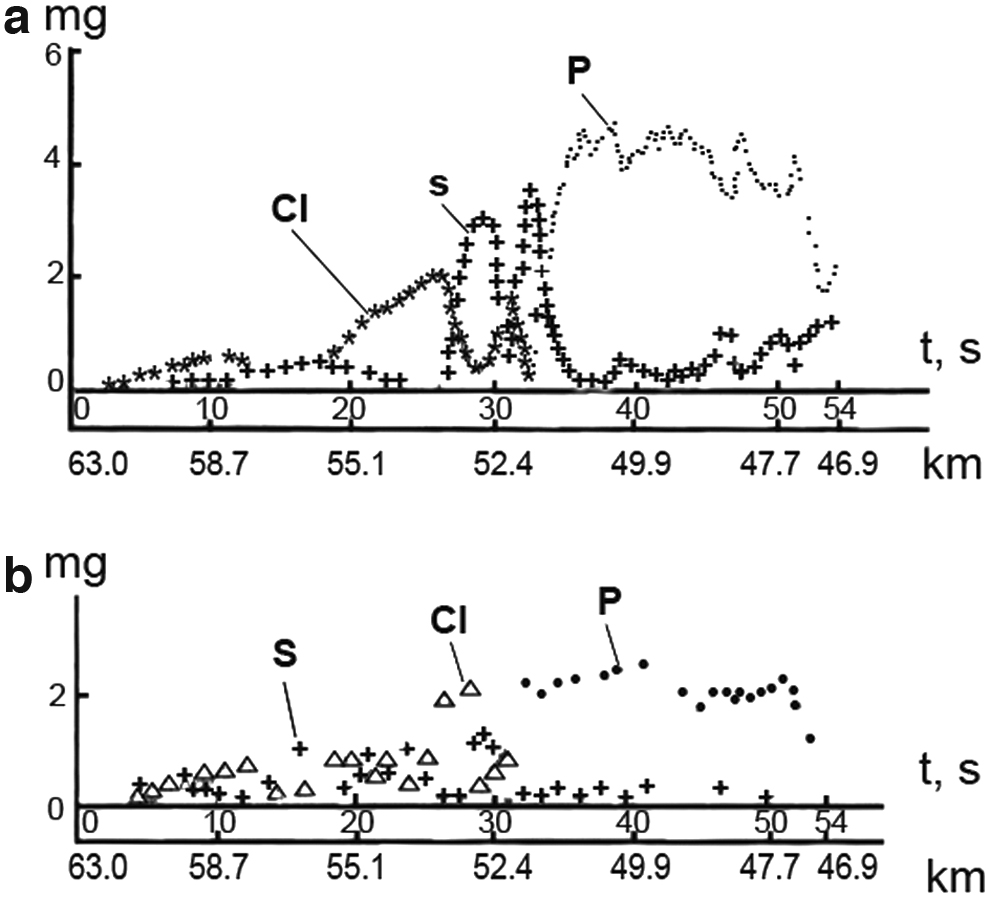
Accumulation of S, Cl, and P on the filters of the X-ray radiometric devices during the VeGa-2 (
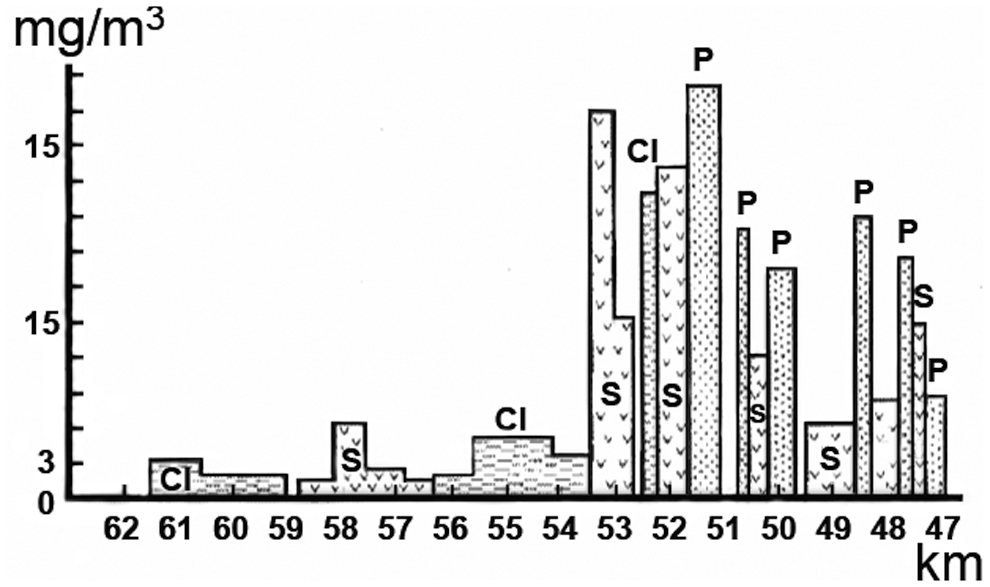
Profile of the mass loads of the chemical elements S, Cl, and P in venusian clouds based on the data from the X-ray radiometric device on the VeGa-2 (Andreychikov et al., 1987).
From the VeGa-1 and VeGa-2 data, it can be inferred that cloud aerosols at the measurement sites consist mainly of S- and Cl-containing components in the altitude range of 62–51.5 km (Table 1, Fig. 2; Andreychikov et al., 1987). The aerosols in altitude range 51.5–47 km contain significant P (up to 33 mg/m3 mass load) and S-containing aerosols (with peak mass load of 13 mg/m3 sulfur). This was the first detection of a P-containing aerosol by the VeGa-1 and VeGa-2 missions in Venus' clouds. Interestingly, no heavy (atomic number Z > 15) chemical elements were found in quantities sufficient to form chemical compounds with the detected P abundance (Andreychikov et al., 1987). P-containing ligands (e.g., PO4 3-) are well known to efficiently sequester heavy chemical elements, including heavy metals (Martinez et al., 2014); here, at least a 1:1 metal-to-phospholigand ratio would be necessary to form such complexes. According to the same data, detectable amounts of Si, Al, Mg, and Na are unlikely in the aerosol; however, the presence of lighter chemical elements is possible. Andreychikov (1987) proposed that the most likely P compounds in venusian aerosols are elemental phosphorus, phosphorus oxides, and phosphoric acids. Krasnopolsky (1989) inferred from the same VeGa lander measurements that the cloud particles from 51.5 to 47 km contain phosphoric acid (H3PO4,) as a P-bearing species, and proposed a P mixing ratio of ∼2 ppm.
Structure of Venusian Clouds Analyzed by VeGa-2 (Andreychikov et al., 1987)
The symbol ± represents range of the values.
Andreychikov (1987) discussed differences in cloud structures on Venus' nightside and dayside. On the dayside, cloud formation is controlled by photochemical processes. According to Andreychikov (1987), the dayside's photochemistry will include the reaction
from which Cl- ions form COCl2 and flow downward. This compound dramatically changes the structure of the phosphorus (phosphoric acids)–bearing aerosol layer and consumes phosphoric acids (expressed as P pentoxide, anhydride form of phosphoric acid) via the reaction
Andreychikov (1987) proposed that this reaction goes to completion on Venus' dayside, thus completely removing phosphoric acid from the aerosols. We note that a diurnal difference in the cloud composition was also discussed in the work of Florenskij et al. (1978) in the context of ammonia under disequilibrium conditions.
3. Phosphorus Sources in Venus' Clouds
Phosphorus must enter the “habitable” cloud layer, either from above or below, from sources external, or indigenous, to Venus. Below, we consider several of these sources, as currently envisaged (Fig. 3).
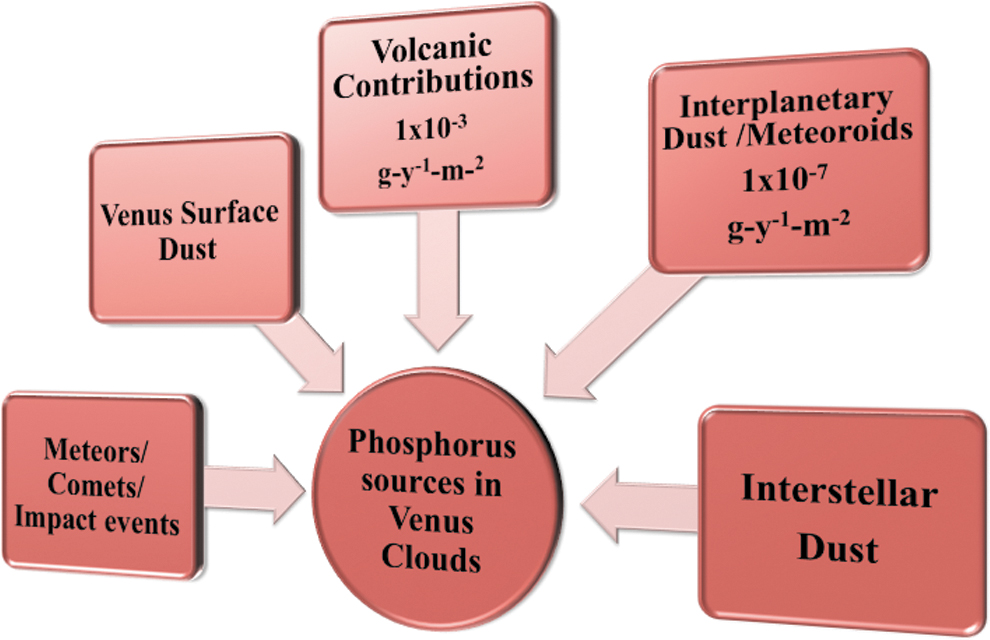
Phosphorus sources in venusian clouds. Potential external and surface supply P sources contributing to the total P flux of venusian atmosphere are represented.
3.1. Volcanic contributions
Volcanic eruptions could conceivably have injected significant quantities of P into Venus' atmosphere. On Earth, the global volcanic flux of P into the atmosphere is ∼0.006 Tg·y−1, nearly all of which is in aerosols and ash particulates (Mahowald et al., 2008). Andreychikov (1987) invoked such volcanic plumes, which are rich in steam, to explain the P-containing aerosol he reported in Venus' lower cloud deck. Venus' surface is dominated by volcanic plains and central volcanos (Basilevsky et al., 2012), which could source such P-bearing plumes. Indeed, it is possible (based on crater counts) that up to 80% of Venus' volcanic surface formed fairly recently (< 1 × 10⁹ years) (Way and Del Genio, 2020). The current, thick CO2 venusian atmosphere could have originated from volcanic emissions during these global resurfacing events (Way and Del Genio, 2020). To assess volcanic contributions as a P source to the cloud layer, we need to address the frequency of explosive volcanic injections into the middle atmosphere over time, the mass flux of S injected by volcanos into the middle atmosphere, the ratio of P to S in the injected material, and whether quiescent emanations of volcanic gas contribute phosphorus to the middle atmosphere.
3.1.1. Eruption vigor
The surface of Venus is covered with volcanoes and lava plains; however, it is not clear whether their eruptions could loft material up to the middle atmosphere. The atmospheric pressure at the surface of Venus is high, ∼93 bar, which would suppress explosive eruptions from all but the most gas-rich magmas. However, the venusian atmosphere is very dry, which suggests that its magmas contain little water, the most important volatile in Earth magmas. Similarly, there is little geomorphic evidence of explosive volcanic eruptions on Venus (Ghail et al., 2015; Campbell et al., 2017). These are topics of active debate (Esposito, 1984; Thornhill, 1993; Glaze, 1999; Glaze et al., 2011; Airey et al., 2015; Ghail and Wilson, 2015; Campbell et al., 2017). Observed from the above, it should be possible to detect the influences of volcanic eruptions in Venus' middle atmosphere, notably in ultraviolet images. Long-term monitoring of Venus from the Pioneer Venus orbiter (1978–1983), Venus Express (2006–2014), and Akatsuki (2016 to the present) has shown significant changes in the ultraviolet albedo (Lee et al., 2019, 2020), but explosive volcanism plumes generally do not reach the ultraviolet cloud tops as inferred (Glaze et al., 2011). On the other hand, varying abundances of sulfur in Venus's upper atmosphere suggest fairly frequent volcanic eruptions (see below).
3.1.2. Eruption frequency
For volcanism to be a biologically significant source of phosphorus in Venus' clouds, eruptions would have to be relatively frequent to offset deposition to the surface. A growing body of indirect evidence suggests that Venus is volcanically active today and that volcanic emanations do enter the cloud layers. Early evidence for active volcanism came from the Pioneer Venus Project, which showed periodic rapid spikes of the SO2 abundance in Venus' clouds (Esposito, 1984; Esposito et al., 1988). Later observations from Venus Express showed similar spikes in SO2 abundances (Marcq et al., 2013). Both cases were interpreted as injections from the lower atmosphere by volcanic eruptions. Eruptions of this scale occur on Earth less frequently than once per century (Esposito, 1984); from the short record we have of SO2 in Venus' atmosphere, one can estimate that Venus has such eruptions more frequently, approximately every 25 years (Marcq et al., 2013) or four per century. Smaller-scale eruptions may also inject material into the venusian atmosphere by way of gravity waves triggered by the surface topography. Another less direct line of evidence is that lava flows in the Idunn Mons area show varying degrees of weathering over time, that is, time of reaction with the atmosphere (Smrekar et al., 2010). Smrekar et al. (2010) estimated the rate of basalt-atmosphere reaction and suggested that the least weathered basalt flows were emplaced within the last 25,000 years. These flows could be even younger, laboratory experiments having shown that surface weathering could have caused the observed changes in near-infrared emissivity in only years (Cutler et al., 2020; Filiberto et al., 2020). Similarly, Grindrod and Hoogenboom (2006) put forth radar imaging evidence that some of Venus' volcano-tectonic coronae may be geologically active today (Gülcher et al., 2020). Thus, the likelihood of current volcanism on Venus allows for the possibility that its plumes currently affect the middle atmosphere.
3.1.3. Volcanic flux—sulfur
Although basaltic volcanic rocks occur across the venusian surface, we consider initially only explosive eruptions that inject volcanic gas and aerosols into the middle atmosphere, that is, those that could cause spikes in the SO2 abundance of the middle atmosphere (Esposito, 1984; Esposito et al., 1988; Marcq et al., 2013). Esposito (1984) estimated that, for Venus, each such eruption injects 1014 g or more of SO2 into the middle atmosphere. For comparison, the El Chichon 1982, Pinatubo 1991, and Tambora 1815 eruptions on Earth are estimated to have released ∼2 × 10¹³, ∼5 × 10¹³, and ∼1–2 × 10¹⁴ g SO2, respectively (Kohno et al., 1998; Guo et al., 2004; Self et al., 2004); the Krakatau 1883 eruption emitted an order of magnitude less. For the present study, we assume that venusian volcanic activity injects ∼5 × 10¹⁴ g SO2 as aerosols and gas (Esposito, 1984) into Venus' middle atmosphere every ∼25 years (Marcq et al., 2013). This implies a long-term global average of flux of volcanic SO2 into the middle atmosphere of ∼5 × 10⁻² g y−1 m−2, or 20 Tg y−1.
3.1.4. Volcanic flux—phosphorus
To constrain the volcanic flux of P into the venusian cloud layer, we constrain the abundance ratio P/S in volcanic gases and aerosols. Unfortunately, there is very little data on phosphorus in volcanic gases or aerosols (Stoiber, 1995; Mahowald et al., 2008), in part because P is not abundant and in part because it is not detectable by many common methods of trace-element analysis (see, e.g., Crowe et al., 1987). On Earth, the global volcanic flux of P into the atmosphere is ∼0.006 Tg y−1 and almost entirely from aerosols and ash particles (Mahowald et al., 2008). The aerosols and ash typically are enriched in phosphorus compared to the parent magma (e.g., Bukowiecki et al., 2011; Obenholzner et al., 2003). There have been analyses for arsenic and phosphorus in some volcanic gases (Mambo et al., 1991), but sulfur abundances were not measured simultaneously.
Darzi and Winchester (1982) reported the best constraint, to date, on simultaneous P and S abundances in volcanic emanations on Earth in conjunction with their analysis of volcanic aerosols from the Kilauea volcano, Hawai‘i for P, Cl, and S. The aerosols were not directly from eruptions but likely from fumarolic sources near the summit. They found that particulates of all sizes (<0.25 μm to 5 μm) had abundance ratios P/S of ∼1/30 gram/gram (their Fig. 3). Boldly applying this ratio to Venus and using the S flux estimated above, these authors purported that the average volcanic flux of P into the middle atmosphere could be ∼1 × 10⁻³ g y−1 m−2, or ∼0.5 Tg y−1. This value is significantly larger than the ∼0.006 Tg y−1 estimated from the composition of gas produced by basalt-water interactions (Mahowald et al., 2008), which is of limited relevance to Venus today.
3.2. Cosmic dust and meteoroids
3.2.1. Interplanetary dust
A potentially significant P source in the cloud layer is interplanetary dust particles (IDPs)—fragments from asteroids, comets, and other sources that are smaller than ∼300 μm in diameter (volume of < ∼1 × 10⁻¹⁰ m3 or mass < ∼3 × 10⁻⁴ g). Particles this small are carried by Poynting-Robertson drag toward the Sun (Dermott et al., 2001), so they impact the inner planets including Venus. IDPs come from a range of sources, which are generally divided into five groups: asteroids, Jupiter-family comets (JFCs), Halley-type comets, Kuiper-Edgeworth belt objects, and interstellar. IDPs are significant to cloud habitability because they are a continuing and time-invariant source of nutrient elements (Flynn et al., 2016). This provides a continuity of environmental conditions that are critical to the maintenance and evolution of life that other exogenous element sources (like asteroids and comets) cannot provide. IDPs contain potentially significant P proportions; in this section, we derive the rate at which IDPs contribute to the P load of Venus's atmosphere and the cloud layer.
The mass flux of IDPs for Earth is well known. The flux of IDPs onto Earth is estimated to be approximately 2 × 10¹⁰ g y−1, 1.0 ± 0.5 × 10¹⁰ g y−1, and 1.6 ± 0.5 × 10¹⁰ g y−1. Of this, ∼80% derives from JFCs. With regard to mass per area of planetary surface (i.e., column flux), the middle value here gives ∼3 × 10⁻⁵ g y−1 m−2.
One might expect that Venus receives a similar high mass flux of IDPs, considering that it is the same size as Earth. Indeed, estimates bear out this prediction. We calculate that Venus receives a total of ∼1.1 ± 0.7 × 10¹⁰ g y−1 (31 ± 18 metric tonnes per day, of which 68% is from JFCs), slightly more than Earth (see above). Borin et al. (2017) estimated a slightly smaller influx, ∼7 × 10⁹ g y−1, or 0.007 Tg y−1. In terms of mass per area of planetary surface (i.e., column flux), the mean of the two estimates implies ∼2 × 10⁻⁵ g y−1 m−2 of IDP material.
3.2.2. Interstellar dust
Interstellar dust is an insignificant source of nutrient elements in planetary atmospheres. The overall flux of interstellar grains into the Solar System is ∼2 × 10⁻⁹ g y−1 m−2 (Grün et al., 1994; Altobelli et al., 2005). Solar radiation pressure prevents the smallest grains (< ∼0.3 μm) from reaching the inner Solar System, but there is minimal variation in the mass flux with timing in the solar cycle. The mass flux of interstellar dust is approximately four orders of magnitude lower than that of interplanetary dust and will not be considered further.
3.2.3. Meteoroids
Meteoroid fragments larger than IDPs fall onto Venus as they do Earth. The bulk of meteorite and meteor mass available continuously comes from particles smaller than ∼1 g, and approximately half of that mass flux is from IDPs (Flynn, 2002; von Zahn, 2005). Thus, one can infer that the total continuous P flux into the venusian atmosphere from extraterrestrial material is approximately twice that of IDPs alone, or ∼4 × 10⁻⁵ g y−1 m−2.
3.2.4. Chemical compositions
Interplanetary dust is not homogeneous, as it represents material from a variety of sources that include multiple sorts of asteroids, JFCs, Halley-group comets, Kuiper-Edgeworth family bodies, and Oort-cloud comets (Flynn et al., 2016). Most of these have relatively primitive chemical compositions characteristic of our solar system, that is, elemental abundances near that of the Sun itself (minus H and He). Most of the IDP materials collected by Earth are similar to this composition, that is, CI and CM chondritic (Flynn et al., 2016). Their abundances of moderately volatile elements, including P, are typically enriched compared to CI chondrites. Abundances of P in IDPs range from an approximately CI-chondritic relative to more refractory elements like Ca or Si (Arndt et al., 1996), to enriched to about 3-fold over nominal CI (Flynn et al., 1996). CI chondrites average ∼0.12% of P (Anders and Grevesse, 1989); one can estimate that the IDP infall to Venus contains ∼0.1–0.3% P. As mass flux, then, Venus receives ∼1 × 10⁻⁷ g y−1 m−2 of P from IDPs and meteoroids (0.1 microgram of P per year per meter squared).
3.2.5. Atmospheric processing
Interplanetary dust (inside and outside the Solar System) can be strongly modified on entry to a planet's atmosphere. Depending on atmospheric density, impact velocity and angle, and dust composition, a particle can survive relatively unaltered, can melt and partially vaporize, or vaporize completely (Carrillo-Sánchez et al., 2020; Plane et al., 2018). The potential P bioavailability obviously depends on which of these paths is experienced. For Venus, it is calculated that 39% of the IDP infall is as unmelted material, 20% is melted to form glassy spherules, and 41% is ablated to vapor (Carrillo-Sánchez et al., 2020). P from vaporized IDPs would be incorporated into cloud particles of sulfuric acid as phosphoric acid (H3PO4) and its anhydride (Krasnopolsky, 1989, 2006) and thus be available for whatever biology might be present. The remaining 59% of IDP infall, which remains as solid particles, will encounter cloud particles rich in sulfuric acid and presumably react chemically with them. However, the size distribution of surviving IDPs is not known, nor is their residence time in the middle atmosphere or how quickly these react with Venus' atmospheric aerosols. In any case, it seems likely that P from IDPs could become bioavailable.
3.3. Venus' surface dust
Dust can be the largest component of atmospheric aerosols, with mass emissions to the atmosphere several orders of magnitude higher than other aerosol components. The fine dust particles can be transported for long distances after being lifted from the surface, especially under storm events. Dust appears to be a major source of trace elements, which originate from minerals, especially P and Fe. Obviously, the total P mass content may vary depending on dust mineralogy. On Earth, volatile-bearing apatite appears to be the most abundant primary natural P source in soils (Newman, 1995), compared to other low solubility P forms such as organic phosphate and secondary metal phosphate precipitates. Dissolution of terrestrial apatite minerals under acidic atmospheric conditions (pH 2) has been proposed as a mechanism of dust solubilization. Acidic dust dissolution explains the observed soluble inorganic phosphate levels at the desert surface-atmospheric interface over the eastern Mediterranean, which is a typical region of interaction between Saharan dust and polluted air masses from the Middle East and Europe (Nenes et al., 2011). Indeed, the acid (or H+) can react with PO4 3- and the OH or F groups of apatite (calcium phosphate minerals with high concentrations of OH-, F-, and Cl- ions, Ca5(PO4)3(F,Cl,OH)) at the crystal surface, thus weakening the Ca2+ bonds and mobilizing PO4 3- from the crystal surface (Christoffersen and Christoffersen, 1981). In general, low pH greatly favors liberation of phosphoric acid species from specific solid dust/minerals. Normally, P in solid mineral phases is not soluble except in acidic media. At near neutral pH, the amount of P dissolved from solid sediments and mineral phases is negligible; at pH below 2.1, soluble orthophosphates can become the dominant form, which are rapidly absorbed and bioavailable.
It has been demonstrated that atmospheric acid processes greatly influence solubilization of P, efficiently increasing the amount of bioavailable P species (Stockdale et al., 2016). P solubilization in Earth atmospheric aerosols is found to increase with the acidity of the aerosol and cloud water (Theodosi et al., 2010; Stockdale et al., 2016). Experiments on laboratory dust solubilization (pH 0–5.5) have shown that solubilization of P depends on the amount of H+ in the dust aerosol water, with a maximum release of dissolved phosphate at pH 0 (Stockdale et al., 2016). Observations have shown that dust aerosols freshly emitted from the surface of Earth contain significant amounts of insoluble trace elements, in particular Fe and P, but only a very small fraction of these are in a readily bioavailable soluble form (Tagliabue et al., 2017). Naturally, such a small fraction of bioavailable P in Earth's atmosphere can be attributed to spatial occurrence of acidic conditions, mostly over the polluted areas. On Earth, estimated ranges for total P dust emissions, omitting super-coarse particles, range from ∼1.1 to 3.8 Tg P y−1 (Brahney et al., 2015; Myriokefalitakis et al., 2016).
On the surface of Venus, fine dust particles have been detected in at least one location. The surface images obtained by Venera 13 during its ∼1 h of operation on the surface show some dust settling on the landing ring of the probe raised during its impact on the surface (Garvin, 1981). Although chemical compositions of venusian minerals are unknown (lacking samples from Venus), the general geochemistry of Solar System basalts suggests that apatite is likely Venus' dominant primary mineral host of P (Treiman et al., 2016). Like other minerals, small grains of apatite (containing hydroxyl, fluorine, or chlorine) could be lifted and transported as dust and then react chemically with the atmosphere. Again, taking into account that Venus is the same size as Earth, we may assume that Venus receives a similar P mass flux as that of Earth. It is logical to expect that the fraction of bioavailable P in Venus' atmosphere is higher than that in Earth's atmosphere due to the warm and acidic conditions prevailing in the venusian cloud deck.
3.4. Meteors/Comets/Impact events
In addition to dust and volcanic eruptions, meteoroids, micrometeoroids, and meteors can deliver P to the atmosphere, which can also be potentially available to putative biota in the venusian clouds. A meteorite that enters the thick venusian atmosphere will affect the local chemistry. However, because of the thick atmosphere, only the larger objects impact the surface. Less than 1000 impact craters have been identified from the global radar images, and all of them appear to have been recent due to the resurfacing of Venus by lava flows. The smallest impact crater detected on the surface in Magellan radar data is about 1.5–2 km. Any meteoritic fragments surviving the entry and fall onto the planet's surface also provide chemical input to the atmosphere as a result of weathering, thus contributing to the P chemistry at the level of the atmosphere–surface contact. Meteorites can be an abundant source of P-bearing minerals. For instance, iron meteorites rich on schreibersite (iron-nickel phosphide) could have brought more phosphorus to Earth than occurs naturally, facilitating the evolution of life as we know it on Earth (Pasek et al., 2013). Meteoritic P-bearing minerals could be the ultimate bioavailable P source necessary for life in warm and acidic environments (Pasek and Lauretta, 2005, 2008; Pasek et al., 2013).
4. Potential Phosphorus Bioavailability to Sustain Putative Biosphere in Venusian Clouds
Here, we consider how phosphorus can be consumed by a microbial cell in terrestrial environments and in conditions of the venusian lower cloud layer.
4.1. Microbial phosphorus acquisition in phosphorus-poor terrestrial environments
As a nutrient element essential for microbial growth and metabolism, P is utilized in the fully oxidized (P5+), soluble, and hydrated form, for example, orthophosphates generally termed as inorganic phosphate (Pi) (H2PO4 -, HPO4 2-, and PO4 3-). Microorganisms use Pi as the preferred source of P and can accumulate an excess of Pi in the form of polyphosphate (polyP) (Hirota et al., 2010). Various microorganisms have evolved complex molecular capacities to survive under Pi starvation conditions in extreme environments with limited Pi availability (Fig. 4). Ultra-oligotrophic tropical lakes with dissolved Pi concentrations <4 μg L−1 (< 129 nM) can serve as exemplary ecosystems with limited Pi content. For instance, the water of Lake Matano of South Sulawesi, Indonesia, is chronically P-limited, with soluble phosphate concentrations below 50 nM (Crowe et al., 2008).
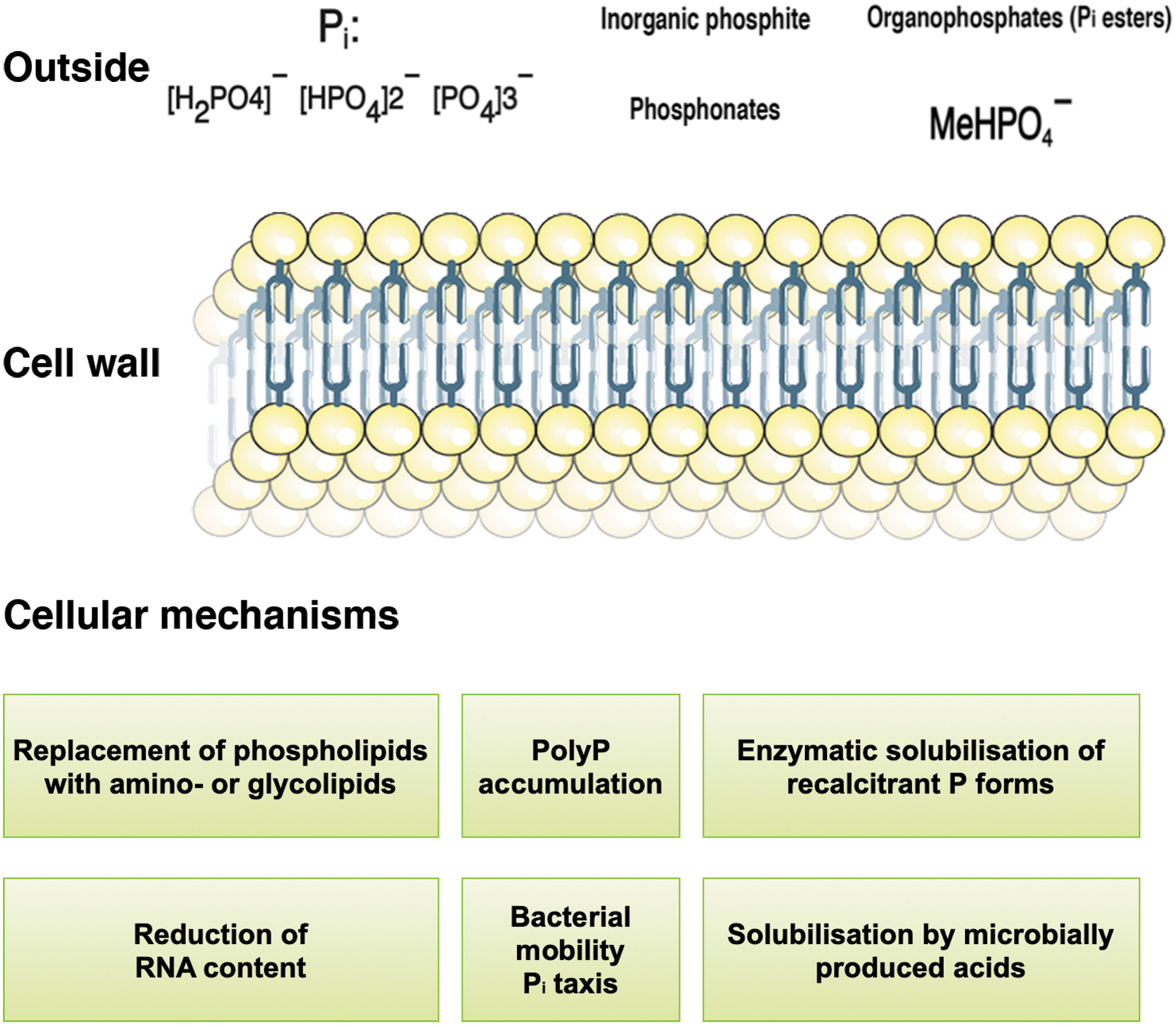
Microbial phosphorus acquisition and strategies for life in phosphorus-poor terrestrial environments.
Microorganisms in such oligotrophic ecosystems with scarce nutrients develop a C:N:P ratio substantially greater (Steinman and Duhamel, 2017) than Redfield organic matter stoichiometry: C:N:P = 106:16:1 (Redfield et al., 1958). For freshwater benthic algae, Pi deficiency is suggested if C:P values exceed 369 and N:P values exceed 32 (Kahlert, 1998). The C:N:P ratios of benthic algae in lakes show great variety under P limitation (Kahlert, 2002). In conjunction to this, bacterial isolates from ultra-oligotrophic Lake Matano developed a low Pi demand and remarkable flexibility in the P content of their lipid and RNA pools (Yao et al., 2016). Reduction of RNA content and replacement of phospholipids with amino- or glycolipids have been described as bacterial characteristics that make growth more efficient in the chronically P-limited Lake Matano (Yao et al., 2016).
On a molecular level, under Pi starvation conditions, the microbial Pi-specific transport (Pst) system is activated, and this molecular multicomponent machinery serves as a major scavenger of Pi (Hirota et al., 2010). Additionally, in case of Pi starvation, polyP functions as a Pi reservoir and P source for the biosynthesis of nucleic acids and phospholipids (Kornberg, 1995). Bacterial motility helps achieve chemotactic responses upon Pi starvation (Pi taxis) and facilitate bacterial survival in the natural environments with limited nutrient concentrations (Kato et al., 1992, 2008). Furthermore, microorganisms are known to harbor efficient metabolic/enzymatic capacities to improve the bioaccessibility (solubilization) of recalcitrant P forms in terrestrial ecosystems with limited P sources (Rodríguez et al., 2006; Richardson and Simpson, 2011; Alori et al., 2017). When Pi is not available, microorganisms can utilize inorganic phosphites, phosphonates (organophosphorus compounds containing C-P bonds), and organophosphates (Pi esters) as alternative P sources (Hirota et al., 2010). Most of these compounds are not transportable across a cell wall, and Pi must be released from such recalcitrant complexes before being incorporated by the microbial cell. Various specific enzymes produced by microorganisms, for example, acid phosphatase (encoded by olpA), phytase (appA), alkaline phosphatase (phoD), phosphonatase (phnX), and carbon-phosphor lyase (phnJ) are capable of releasing soluble orthophosphate from recalcitrant organic P forms (Rodríguez et al., 2006; Richardson and Simpson, 2011; Alori et al., 2017). In addition to this efficient enzymatic pull, recalcitrant inorganic P forms are solubilized by a rich variety of microbially produced organic acids (citric, formic, gluconic, malic, and oxalic acids) (Goldstein, 1995; Rodríguez et al., 2006; Richardson and Simpson, 2011; Alori et al., 2017). Recently, the gcd gene of novel phosphate-solubilizing bacteria, encoding a major enzyme that is responsible for the production of gluconic acid and intermediation of inorganic P solubilization, has been proposed to enhance soil P cycling in heavily degraded ecosystems, such as abandoned mined lands (Liang et al., 2020). Only a few studies related to Pi uptake have considered acidophilc microorganisms, but one could anticipate that H2SO4 produced by those microbes enhances solubilization of recalcitrant P forms. In addition to direct microbial-derived P solubilization, it has been demonstrated that certain microorganisms can transport metal phosphate (MeHPO4 -) complexes only in acidic conditions (Fristedt et al., 1999).
4.2. Phosphorus chemistry in venusian lower cloud layer
Possible external and venusian surface supply sources (Fig. 3) contain a large variety of minerals, main group elements, and metals, most of them in insoluble form. However, to be bioavailable to potential ecosystems in Venus' clouds, elements have to be either in soluble form, in nanoparticles of a diameter smaller than 200 nm (Lead et al., 2018), or accessible via biologically mediated weathering (Uroz et al., 2009). In contrast to Earth, Venus' cloud deck provides extreme acidic conditions. Primarily, it is sulfuric acid that contributes to Venus' atmospheric acidity and controls chemistry of venusian clouds (Mills et al., 2007; Marcq et al., 2018). Here, similar to Earth (Christoffersen and Christoffersen, 1981; Nenes et al., 2011), dissolution of venusian apatite (Treiman et al., 2016) and other P-bearing minerals under acidic atmospheric conditions can serve as a mechanism of P solubilization to deliver soluble Pi levels to Venus' cloud deck.
The VeGa-1 and Vega-2 X-ray data from Andreychikov (1987) suggest that the main forms of P in the atmosphere of Venus are P oxides and phosphoric acids. Being chemically active, they can participate in redox reactions with other components of the atmosphere, which can contribute to their mixing. Andreychikov (1987) proposed that the ratio of P oxides is apparently determined by the reaction with the participation of molecular hydrogen, the most powerful reducing agent, which, due to its high mobility, is probably also uniformly distributed in the atmosphere, at least to the level of clouds. Krasnopolsky (1989) also considered the presence of P oxides in the atmosphere, of which the most abundant are the dimers P4O6 and P4O10. Andreychikov (1987) pointed out that the sulfur-containing components affect the distribution of P oxides in the atmosphere:
Equation 4 shows that, under the presence of SO2, the balance of P oxides would be shifted toward P2O5 (as long as there is an excess of SO2 in the atmospheric layers). This can be compared to the collisions of P2O3 molecules with sulfuric acid droplets (Fig. 5) that results in formation of phosphoric acid (Krasnopolsky, 1989):
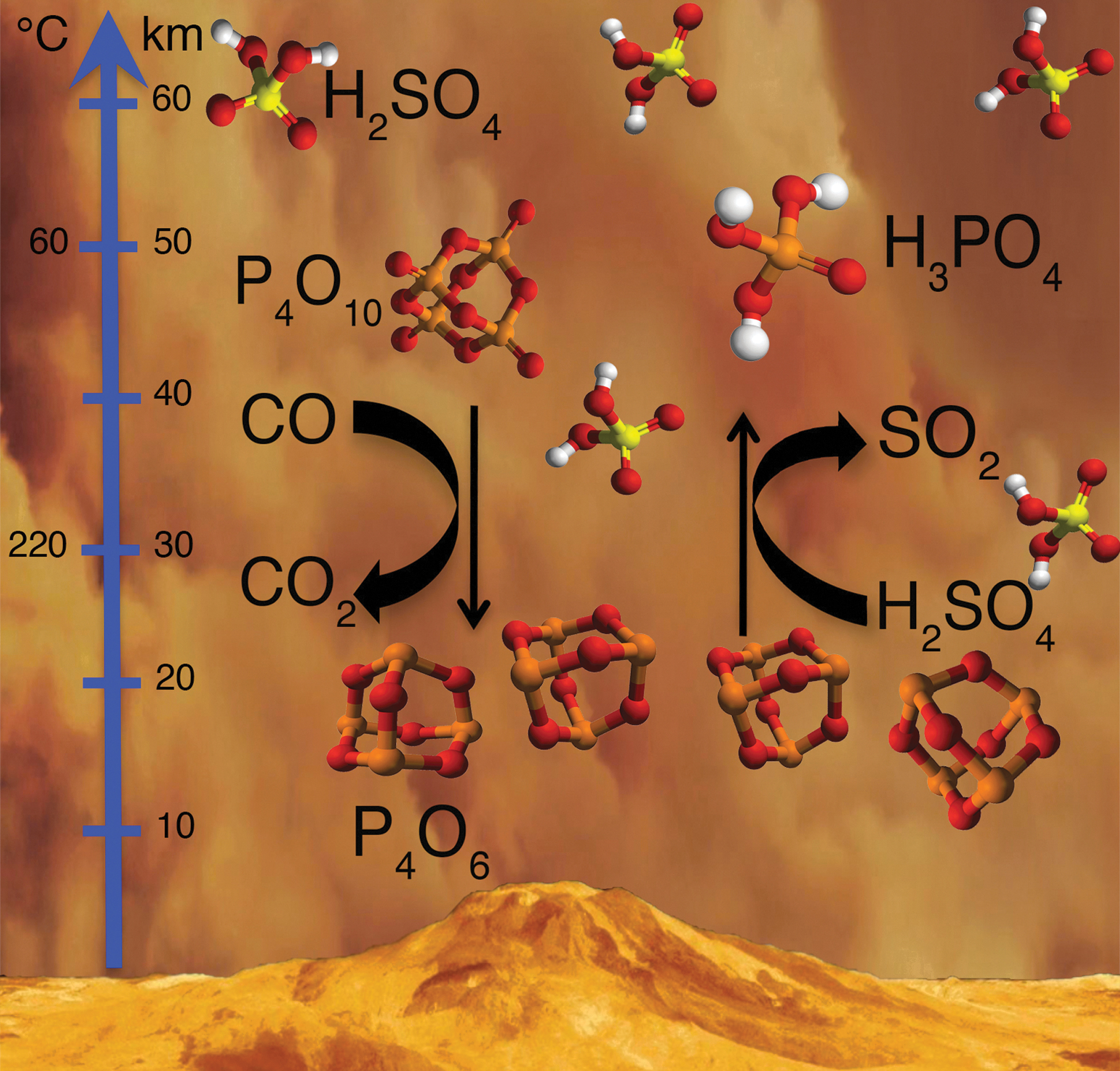
Phosphorus chemistry in venusian low clouds layer. The scheme contains major events in P cycle based on VeGa-1 and VeGa-2 measurements. The atmospheric P cycle relies on phosphorus oxides transformation followed by the formation of phosphoric acid H3PO4. The formation of phosphoric acid is ensured by extreme acidic and warm conditions in venusian clouds.
The efficiency of Reaction 5 increases with increasing temperature and, conversely, decreases with decreasing temperature (Krasnopolsky, 1989). Relying on the VeGa-2 measurements (Surkov et al., 1987), Krasnopolsky (1989) suggested the presence of 70–75% P2O5 for a water vapor mixing ratio of 700 ppm (partial pressure of 0.4–0.8 torr). This corresponds to undiluted H3PO4 (Krasnopolsky, 1989). Andreychikov (1987) described a layer of a mixture of phosphoric acids at the altitude range of 50.5–51.7 km, possibly corresponding to the P2O5 solution in concentration range of 82–90%. According to the work of Andreychikov (1987), the phosphoric acid layer ends with a high mass load layer of a highly concentrated P2O5 solution.
Based on mass load correction, Krasnopolsky (1989) critically assessed data derived from VeGa-1 and VeGa-2 instrumental measurements and proposed 2 ppm concentration of P assuming that H3PO4 is the P-bearing species in the droplets of venusian clouds (51.7–47 km). Moving down in the atmosphere below 46 km, these P-bearing droplets gradually lose their water and then dry to phosphoric anhydride. The X-ray fluorescence radiometers of VeGa missions were switched off below 46 km. However, Krasnopolsky (1989) suggested that the phosphoric anhydride aerosol should extend to 25 km. This relies on the data of particle size spectrometer and nephelometer measurements, which show the abundant aerosol down to 33 km. Accordingly, a dense aerosol below the nominal lower cloud boundary near 47 km can be an indication of phosphoric anhydride. Insoluble phosphoric anhydride formed at the altitudes of 46–25 km potentially restricts the availability of biologically accessible P. Naturally, the presence of water phase is crucial to facilitate P solubilization. Water vapor in the venusian clouds is known to be present in the cloud layer with values ranging between 40 and 200 ppm (Donahue et al., 1982; von Zahn and Moroz, 1985; Tsang et al., 2010; Barstow et al., 2012). Additionally, highly hydroscopic sulfuric acid droplets, which are abundantly present in the venusian atmosphere, provide a reservoir of water in a phase potentially accessible as a solvent to a hypothesized form of life in the clouds (Limaye et al., 2018).
A schematic representation (see Fig. 5) summarizes major steps of P atmospheric cycle discussed here and presents explicit solubilization of P under acidic conditions in the low venusian clouds proposed and modeled in the works of Andreychikov (1987) and Krasnopolsky (1989). However, VeGa-1 and VeGa-2 X-ray and nephelometer measurements were not suited to provide explicit information regarding the exact speciation of soluble P fraction detected in venusian clouds. The presence of P-bearing compounds has also been recently reported in a new interpretation of the Pioneer Venus Large Probe Neutral Mass Spectrometer data (Mogul et al., 2021). Further sampling and measurements in Venus' atmosphere would improve our knowledge of P speciation (Cockell et al., 2021; Limaye et al., 2021). Assuming the above-proposed formation of phosphoric acid H3PO4 in the low venusian clouds, it is necessary to note that intact H3PO4 molecules are not a typical source of readily bioavailable Pi. However, upon contact with an excess of water phase and/or at neutral pH, H3PO4 rapidly dissociates with a formation of ionic species H2PO4 -, HPO4 2-, and PO4 3-, which in turn are 100% bioavailable (Fig. 4). pH conditions of the upper cloud layer of Venus are not favorable for H3PO4 dissociation and only slightly provide the possibility of its hydrolysis. Intracellular pH of microbial life-forms, including acid-loving species, is around the neutral range, and it can be assumed that, upon passive or active transport across the cell wall and contact with a neutral intracellular environment, molecules of H3PO4 can rapidly be ionized and deliver Pi that would meet microbial needs. Under this scenario, a microbial cell needs to be well equipped with an efficient proton pump mechanism to promote ATP-dependent H+ extrusion and/or other pH homeostasis mechanisms (e.g., enzymatic and chemical proton sequestration). This is exactly the case for those acidophilic microorganisms (Baker-Austin and Dopson, 2007; Krulwich et al., 2011) that may potentially constitute an airborne ecosystem in the venusian clouds (Schulze-Makuch and Irwin, 2002; Schulze-Makuch et al., 2004; Limaye et al., 2018; Kotsyurbenko et al., 2021). Further, phosphoric acid may react with metal salts, for example, chlorides, with the formation of metal phosphates/hydrophosphates (e.g., MeHPO4 -). Such MeHPO4 - complexes have been shown to be transported inside microbial cells via a Pho transporter system and serve as a predominant Pi source (Fristedt et al., 1999).
Similar to P, the portion of bioavailable atmospheric Fe is also increased by acidic atmospheric processes, although Fe solubilization is much slower than solubilization of P-bearing particles (Myriokefalitakis et al., 2016; Stockdale et al., 2016). Uptake of Fe, the fourth most abundant element in Earth's crust, by living organisms is limited because it is mainly present in the form of insoluble Fe oxides. Fe solubilization occurs principally in wet aerosols at low pH. The breaking of Fe–O bonds at the mineral surface controls the rate of dissolution of Fe, which increases as pH decreases. Fe requires far more acidic conditions than P to be solubilized (Stockdale et al., 2016). When the aerosols are activated in clouds at lower pH, Fe is likely to re-precipitate as nanoparticles. P does not re-precipitate. It can be assumed that the removal of P will only occur through consumption by hypothetical ambient venusian microbiota or precipitation as phosphorus anhydrate (Krasnopolsky, 1989) under the absence of H2SO4 and any other acidity in low cloud layer.
5. Conclusion
In the lower cloud layers of Venus, the ubiquitous availability of sulfuric acid together with other environmental parameters such as elevated temperature and humidity can control the degree of soluble P, reaching as minimum as 2 ppm (6 mg/m3) of soluble P-bearing species in the clouds (if calculated in accordance to mass load correction as proposed by Krasnopolsky [1989]). Original VeGa-1 and VeGa-2 measurements described by Andreychikov et al. (1987) indicate a maximum P mass load of 22–34 mg/m3 in lower and middle clouds, which would correspond to ∼7–11 ppm of soluble P species (Table 1). When subjected to phosphate starvation, microorganisms are known to develop various strategies that help them inhabit even “ultra-oligotrophic” environments with scarce Pi content (lower than 50 nM). Pi content of 1.5–3 μM (0.047–0.093 ppm) has been reported as a “limited P” concentration in several cultivation-dependent studies of pure cultures and natural systems (Cotner et al., 2010; Reaves et al., 2012). Thus, in both cases, considering the originally reported and corrected mass loads of P in venusian clouds and what we know about critical P concentrations for terrestrial microbial life, we may assume that P abundance is not a limiting factor for a potential ecosystem in venusian low cloud layers. Furthermore, preliminary analysis of potential external and surface supply sources that contribute to the total P flux of the venusian atmosphere allows an estimation of a part-per-million-range of values of atmospheric P (only from volcanic contributions Venus is expected to receive 1 mg of P per year per meter squared, see Fig. 3).
However, further experimental and modeling studies are needed to provide accurate quantification of P sources and the degree of its bioavailability for potential ecosystems of venusian clouds. In particular, in situ measurements and measurements in remote locations are needed. X-ray fluorescence measurements that led to the detection of P in aerosols on Venus have been made so far only by two entry probes (around midnight) at the near equatorial latitudes. More sampling in the atmosphere at different altitudes and local times would be useful for characterization of rough global and local time variations. It should also be noted that trace amounts of other elements besides P (Mo, Mn, V, Mg, Cu, Co, etc.) that are required by microorganisms have not been measured by missions that have explored the chemistry of the venusian atmosphere. Naturally, to target all these trace, though bioessential, elements (Lingam and Loeb, 2018), a sample return analysis would be the best option. Currently available cutting-edge techniques allow for a comprehensive laboratory analysis of metal-microbial interfaces down to nanoscale and atomic resolution (Milojevic et. al., 2019a, 2019b, 2021). Nanoclusters of single atoms consumed by a microbial cell can be detected with presently applied nanoanalytical tools (Blazevic et al., 2019). In the long term, such nanodetection should be employed on returned samples from venusian clouds.
There is also the need for a thorough characterization of P association with other chemicals present in atmospheric venusian aerosols. Here again, sample return missions would be invaluable for the understanding of atmospheric processing and coordination chemistry of P in venusian aerosols. Furthermore, in this study we focused explicitly on the abiotic processing of P. However, the dual role of microorganisms in the atmosphere cannot be neglected: (i) microorganisms can utilize P as a nutrient that contributes to potential bioaerosols and (ii) microorganisms can function as bioagents in increasing or reducing the bioavailability of this nutrient in the cloud environment (e.g., phosphate-solubilizing bacteria). Separate and intriguing lines of investigation should be devoted to the potential spectral signatures of any P-bearing compounds associated with abiotic or biotic processes. These approaches may be helpful in addressing a comprehensive and reliable atmospheric (bio)chemical cycle of P in order to connect external and surface supply as P precursors with proxies as soluble and bioavailable P in the cloud deck of Venus. The relationship between P, S, Fe, and any other light elements should be targeted in future studies as well as sample return missions, which might help further our understanding of P chemistry and bioavailability for potential venusian cloud ecosystems.
Footnotes
Acknowledgments
T.M. is grateful to the University of Vienna. A.H.T. and S.L. acknowledge support from NASA SSW 80NSSC17K0766 and NASA Akatsuki Participating Scientist NNX16AC79G grants. The authors are thankful to anonymous reviewers for valuable suggestions.
Author Disclosure Statement
No competing financial interests exist.
Associate Editor: Timothy Lyons