







Abstract
In situ instrumentation that can detect amino acids at parts-per-billion concentration levels and distinguish an enantiomeric excess of either
1. Introduction
The search for evidence of extant or extinct life beyond Earth has been a major goal in space exploration for decades. Recently, there has been great interest in Ocean Worlds (e.g., Europa, Enceladus, Triton) (Sephton et al., 2018; Hendrix et al., 2019) due to their potential habitability and the increased viability of future in situ missions. The search for extinct or extant life of Ocean Worlds requires the identification of organic biomarkers. This includes molecular signatures that are unique to biotic samples—not known to form merely through abiotic chemical reactions—and are related to the metabolism, growth, and reproduction of life (Neveu et al., 2018). Key classes of organic biomarkers include, but are not limited to, lipids, nucleobases, and amino acids (Sephton and Botta, 2008; Neveu et al., 2018).
Of the polar organic compounds commonly considered to be biomarkers, amino acids are particularly interesting because they have key features that help distinguish whether they originate from a biotic source or are formed by abiotic reactions.
The first of these features is the chiral distribution of the amino acids in the sample. The enantiomeric excess is high, and the
Second, the relative abundances of the various amino acids in the sample can be used to gather more information about whether the source is biotic or abiotic in nature. In general, lower molecular weight amino acids such as glycine and alanine and amino acids with anionic side-chains such as aspartic acid and glutamic acid are found in much higher abundances in abiotic samples (Glavin et al., 2012, 2020). Higher molecular weight species such as phenylalanine, tryptophan, and tyrosine, particularly amino acids with cationic side-chains such as lysine, histidine, and arginine exist in higher relative abundance in biotic samples compared with abiotic samples (Glavin et al., 2020). The cationic amino acids have so far not been found in meteorites or in Miller spark discharge experiments (Glavin et al., 2020).
Special weight has been given to histidine as an indicator of life in The Ladder of Life Detection (Neveu et al., 2018), because of reported prebiotic synthesis routes for lysine and arginine (Patel et al., 2015); however, to our knowledge no abiotic pathway toward histidine has been reported. Determination of the chirality and abundance of amino acids in a sample can help distinguish biotic versus abiotic samples.
Past chemical analysis techniques that have aimed to detect organic biomarkers, including amino acids, on planetary missions have occasionally led to undesirable reactions during pyrolysis (Navarro-González et al., 2010; Montgomery et al., 2019), contamination caused by leaking solvents and derivatization reagents (Glavin et al., 2013; Leshin et al., 2013; Ming et al., 2014; Freissinet et al., 2015), terrestrial contamination (Eigenbrode et al., 2013; Miller et al., 2015), and mechanical issues with obtaining samples (Di Lizia et al., 2016).
The Cometary Sampling and Composition experiment (COSAC) onboard Philae, which accompanied the Rosetta spacecraft, included the first instrumentation intended to detect amino acids and to determine enantiomeric compositions (Rosenbauer et al., 1999; Goesmann et al., 2014). The amino acid-specific methodology featured a one-pot wet chemical processing, where a solid sample was added to a solution containing all necessary reagents without any further addition of solution or manipulations besides heating. This one-pot derivatization method was used to volatilize the compounds for chiral detection by gas chromatography (GC)–mass spectrometry (MS) in a single step (Meierhenrich et al., 2001). Philae did not collect any solid sample due to the unintentional lateral orientation of the probe after landing on the comet (Di Lizia et al., 2016).
Sample Analysis at Mars (SAM) onboard the Curiosity rover also employed a one-pot methodology followed by GC-MS nonchiral separation and detection of amino acids (Mahaffy et al., 2012; Stalport et al., 2012). Unfortunately, one of the cups containing derivatization reagent on SAM leaked and contaminated the instrument, and adversely affected data interpretation and detection limits (Glavin et al., 2013). The Rosalind Franklin rover, scheduled for launch in 2022 and carrying the instrument suite Mars Organic Molecule Analyzer (MOMA), employs similar methodology for derivatizing amino acids (David et al., 2016; Goesmann et al., 2017).
An alternative to GC-MS that is also being considered for space applications for the specific detection of (chiral) amino acids is capillary electrophoresis coupled to laser-induced fluorescence detection (CE-LIF) (Creamer et al., 2017). Although CE-LIF seems to be a promising analytical technique for the detection of amino acids, it requires derivatization of the analytes and the use of organic solvents and organic additives to enable sensitive detection and separation, respectively.
Derivatization, in particular when using the one-pot approach, is very prone to matrix effects, such as reactions between the derivatization reagent and native minerals (Stalport et al., 2012; Bernardo-Bermejo et al., 2020). Some derivatization reagents readily react with water to form new compounds that result in increased background signals and lower derivatization efficiencies of amino acids (Leshin et al., 2013; Goesmann et al., 2017). Practically all derivatization reagents form side-products that interfere with amino acid detection at low concentrations (Lau et al., 1998; Stalport et al., 2012; Creamer et al., 2017).
Given the limitations of analysis methods that use derivatization, including mineral matrix effects and the formation of by-products, an ideal candidate for investigating amino acids in Ocean Worlds would be a technique that does not require derivatization. A comparison of the performance of our method with methods based on GC-MS and CE-LIF is given in Section 4.2 (also see Supplementary Table S-1).
Here, we present an online solid-phase extraction (SPE) and liquid chromatography–mass spectrometry (LC-MS) method for the chemical analysis of the proteinogenic amino acids, which are present in both abiotic and biotic samples. Furthermore, this method allows for enantiomeric separation, which is crucial for determining the nature of the sample. The extraction, separation, and detection instrumentation discussed here is completely free of organic solvents and derivatization reagents, making it a potentially attractive instrument for planetary applications.
2. Materials and Methods
2.1. Materials
Standard stock solutions with 19 of the 20 (isoleucine excluded) racemic (both
Proteinogenic Amino Acids Used in This Study
Values normalized from Sereda et al. (1994) that estimated relative hydrophobicity based on retention times in reversed-phase LC.
LC = liquid chromatography.
2.2. Samples and sample preparation
2.2.1. Standards
Stock solutions of each amino acid were prepared by dissolving them in pure water to concentrations of 1000 mg/L solution with the exception of tyrosine and tryptophan that were dissolved at 500 mg/L and acidified to ∼0.1 M HCl to enable dissolution at these high concentrations. Stock solutions were prepared weekly, and diluted solutions were prepared daily with a newly opened LC-MS grade water bottle. Beakers and multiuse items were thoroughly rinsed with LC-MS grade methanol and LC-MS grade water and were covered with aluminum foil until use.
2.2.2. Yellowstone National Park samples
Environmental samples were collected at two sites in Yellowstone National Park over February 27–28, 2019, to serve as natural Ocean World analogues for testing our instrument (Nixon et al., 2019). These were collected under permit YELL-2019-SCI-8094 (PI Conor Nixon).
The first analog site, Great Fountain Geyser, with a pH of ∼9, was surrounded by a 2 m high snowbank at a distance of ∼25 m as measured from the center of the geyser. It underwent active eruptions approximately twice per day during our sampling period with temperatures ranging from 8°C to 31°C. The eruptions provided for the surface expression of communities of chemotrophic microbes living in the vent chamber and conduits of the subsurface hydrothermal system. After an eruption of the geyser and deposition of the microbes on the surface of the fresh snow, a layer (∼2 mm thick) was collected directly into a vial from the edge of the snowbank due north of the geyser's center. The winds were primarily moving from the south to the north during the eruption, so surface samples were collected from the same area where the plume ejecta was being deposited.
A field blank consisting of ∼10 mL of LC-MS grade water was poured directly into a sample vial in the field, stored on dry ice, and transported along with the other samples back to the Jet Propulsion Laboratory (JPL), where they were maintained at temperatures less than −65°C for the duration of storage. Just before analysis, the samples were allowed to melt, and the liquid was injected for analysis by our instrument.
The second site, Lemon Spring, was a geothermal spring ∼3 m in diameter. At the time of sample collection, Lemon Spring had a pH of 8.2 and a temperature of 62°C. A small solid sample consisting of siliceous sinter formed by microbe-mediated mineralization (spicular sinter) that contained remnants of microbial cells (Cady and Farmer, 1996) was collected with sterile forceps from the edge of Lemon Spring for our analysis, ∼0.5 m upstream from the pool's edge. This spicular sinter sample was transported back to JPL on dry ice and stored under the same conditions as the snow samples (less than −65°C freezer) until ready for analysis. The solid sample was allowed to come to room temperature before it was cut into pieces of approximately <3 mm in diameter and was placed directly into our extraction vessel.
2.3. Instrumentation
Amino acid analysis was performed by using a system with online SPE, LC, and electrospray ionization (ESI) quadrupole MS. The instrument consists of five conceptual parts: solvent supply, extraction, preconcentration, separation, and detection (Fig. 1).
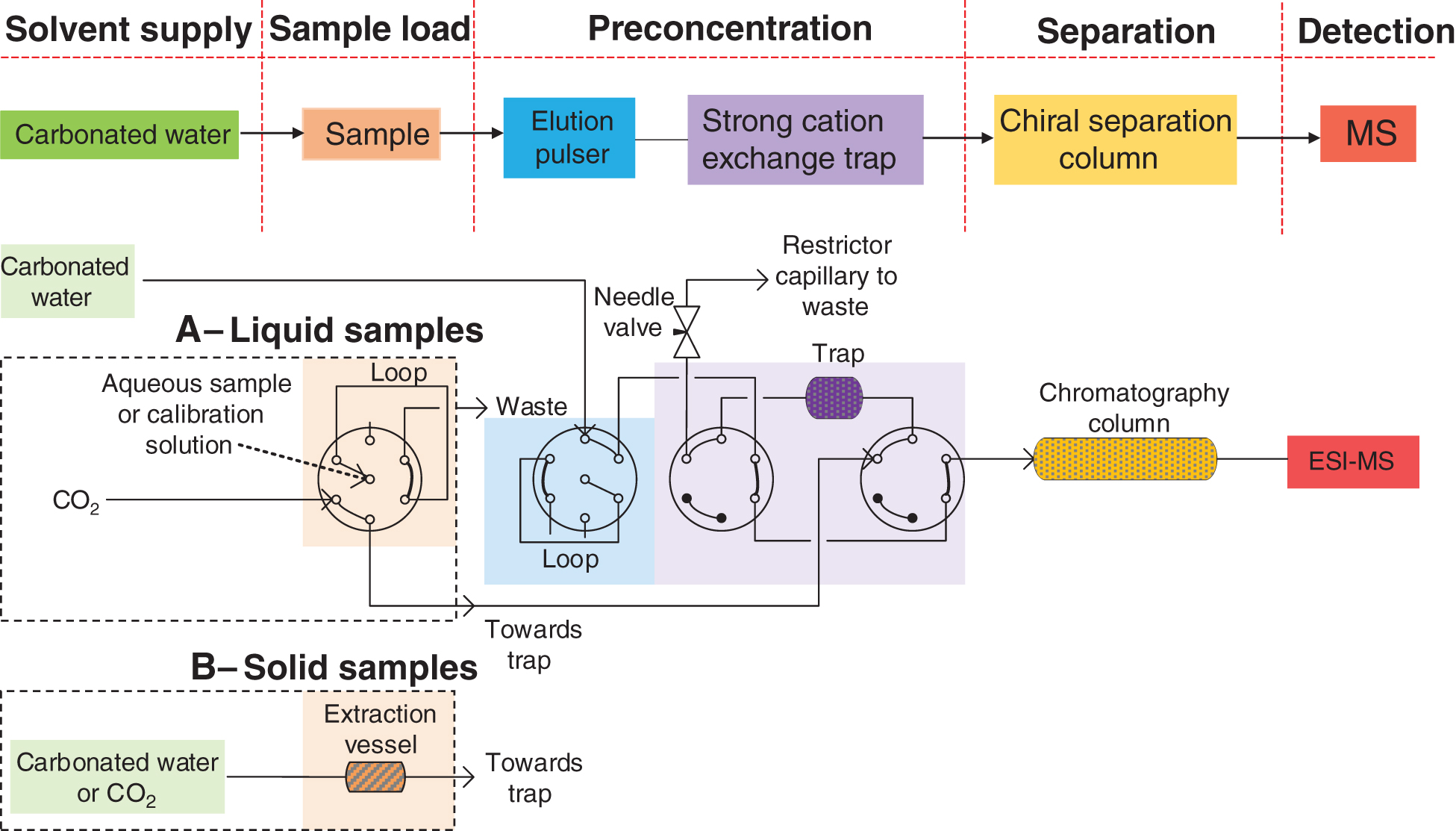
Concept schematic of the instrumentation that performs online SPE/LC-MS analysis of liquid or solid samples. Two configurations were used in this work. Configuration A was used for liquid samples. The sample loading module was swapped for the analysis of solid samples, while the rest of the system remained the same. All valves were two-position type valves, which allows for the system to first load analytes onto the trap column for preconcentration and then release them for separation and detection. LC-MS, liquid chromatography–mass spectrometry; SPE, solid-phase extraction. Color graphics are available online.
The fluid management system contains parts of a commercial LC system (JASCO Corporation, Tokyo, Japan), which consisted of two switching selector valves (HV-2080-01) and an isocratic HPLC pump (PU-4180). Two manual Rheodyne (IDEX Corporation, Oak Harbor, WA) 7725i injector valves were equipped with a sample loop, where one valve was used to introduce liquid samples and the other one was used to introduce either calibration solutions or ammonium hydroxide for the elution of trapped amino acids. A 1 mL extraction vessel (JASCO Corporation) was used for solid samples. An Advion (Ithaca, NY) expression® Compact Mass Spectrometer-L (single quadrupole) with ESI was used for MS detection.
2.3.1. Solvent supply
The solvent supply refers to the mobile phase (carbonated water) that is used both for the extraction and for the chromatography. Carbonated water was prepared by filling a double-ended 150 mL pressure sample cylinder (316L-50DF4-150; Swagelok, Solon, OH) mounted with a siphon, with water and pressurizing it with CO2. For the analysis of amino acids, carbonated water (∼5 wt % CO2) was chosen as a solvent due to its low pH (∼3 at 6 MPa and 25°C) (Peng et al., 2013; Andersson et al., 2018), volatility, and the fact that it is nonorganic. A low pH mobile phase is necessary for the protonation of the amino group of the amino acids and maintaining the amino group's positive charge, which plays an important role in the trapping of the analytes with strong cation-exchange (SCX) columns (Delgado-Povedano et al., 2016; Hu et al., 2017).
The mobile phase must also be volatile to be compatible with the ESI source to avoid a severe decrease in sensitivity due to ion suppression. Furthermore, a low pH mobile phase increases the signal of amino acids in the positive mode for ESI by maintaining the positive charge on the analytes (Piraud et al., 2003). Besides CO2, the only volatile pH modifiers are organic acids such as formic acid or acetic acid, which were not desirable in our organic-free method for extraction and separation of chiral amino acids. By avoiding organic solvents and organic modifiers that are typically used in LC, the risks of contamination in our instrumentation are reduced.
2.3.2. Extraction
Aqueous samples and calibration solutions were introduced through an injector valve with a sample loop. The liquid was pushed through the trap column with CO2 at cylinder pressure (∼6 MPa). A narrow capillary (20 cm length, 50 μm I.D) was used as a flow restrictor for the effluent leading to the waste to ensure that the incoming sample was acidified with CO2 before arriving to the trap column (Fig. 1). An excess of CO2 was passed through the trap column to remove remaining sample solution.
Solid samples were placed in a 1 mL extraction vessel wrapped with a flexible polyimide heater, accompanied by a temperature sensor. The extraction temperature was controlled at 150°C to balance desorption of amino acids without substantial degradation or racemization (Csapá et al., 1997; Sato et al., 2004). A static extraction (45 min at 150°C) was performed first with a needle valve closed downstream from the extraction vessel. A dynamic extraction was performed afterward at a flow rate of 0.1 mL/min for 10 min with the needle valve opened while the restrictor capillary maintained the pressure in the extraction cell. Then, the remaining extraction solvent was flushed out with CO2.
2.3.3. Preconcentration
Preconcentration, or trapping, refers to the retention of sample analytes in a liquid on a solid stationary phase and their subsequent elution, also known as SPE. SCX is a type of SPE mode that can be used for the extraction of amino acids from aqueous solutions. Here, the aqueous solution is either the pure liquid samples or the solvent from the solid sample's liquid extraction. The SCX trap (10 μL, 1.5 × 5 mm) was purchased from Optimize Technologies (Oregon City, OR), and it contained a polystyrene sulfonic acid resin (10 μm particle size and 1000 Å pore size).
Initially, the permanent negative charge of the sulfonate functional groups attracts the positively charged amino group of the amino acids to extract the analytes from the acidic solvent and trap them onto the stationary phase. The polystyrene backbone also contributes to hydrophobic interactions, which further increases retention, especially of hydrophobic amino acids (also see Supplementary Fig. S-3).
Once the solution has passed through the trap and the analytes have been retained, the next step is to elute the analytes. This is accomplished by increasing the pH and the ionic strength through the addition of a small amount (5 μL) of dilute ammonium hydroxide (200 mM NH4OH). The small addition, or pulsed elution, using NH4OH was accomplished by using an injector valve with a sample loop of 5 μL. The increased pH leads to deprotonation of the amino group, and the increased concentration of NH4 + leads to competition for the negatively charged sulfonate groups, which results in the elution of amino acids in a concentrated and narrow band.
Basic (pH >8) mobile phases are typically not compatible with chiral stationary phases or even silica-based stationary phases at pH >10 due to rapid degradation of the stationary phase. Therefore, it was not an option to use a basic mobile phase. Pulsed elution was used to enable elution of amino acids from the SCX-trap column without adversely impacting the chromatography or the mass spectrometric detection, since the narrow band of high pH is neutralized before it reaches the chromatography column. Pulsed elution is rather unconventional but allows for time decoupling as the analytes do not diffuse while adsorbed onto the stationary phase, and thus it maintains the sharp analyte bands necessary for high-resolution separation (Jakobsen et al., 2017).
2.3.4. Separation
Chiral separation by chromatography was performed on core-shell particles functionalized with teicoplanin (TeicoShell, 2.1 × 100 mm, 2.7 μm) from AZYP LLC (Arlington, TX). Solid-core particles with a porous shell offer higher chromatographic efficiencies and lower backpressure than conventional fully porous particles used in chromatography (Gonzalez-Ruiz et al., 2015). Teicoplanin has a few important characteristics that make it ideal for enantiomeric separation, and it has been used in the chiral stationary phase for the successful enantiomeric separation of both derivatized and native amino acids (Desai and Armstrong, 2004; Xiao et al., 2006). It contains a cationic site (-NH3
+), an anionic site (-COO−), and three polar groups with sugar moieties (Peter et al., 1998). The
2.3.5. Detection
MS was used to detect the analytes since it is compatible with the chromatography method and the solvent and can resolve analytes with identical retention times as long as the m/z is different.
The ESI was operated in positive mode. The capillary voltage and temperature were kept at 180 V and 170°C, respectively; source voltage offset, 14 V; source voltage span, 5 V; source gas temperature, 200°C; ESI voltage, 1800 V; and with a nebulization gas flow of 5 L/min. A source gas temperature >200°C resulted in a decreased signal due to amino acid degradation. All detection was performed in selected ion monitoring (SIM) mode of [M+H]+ (monitored m/z listed in Table 1).
2.3.6. Online analysis
The setup as shown in Fig. 1 has one configuration for liquid samples and one for solid samples. Liquid samples were loaded by way of the injection valve mounted with a sample loop of known volume and were transported through the trap column by using CO2. To elute the trapped amino acids and start the separation, the two 2-position selector valves were rotated, so that the trap column would be in the flow path of the mobile phase. Simultaneously, the pulse injector valve was rotated to introduce the 5 μL of 200 mM NH4OH. The mobile phase during the chromatography step was run at a rate of 200 μL/min. The method was systematically optimized in regard to enantiomeric resolution and signal-to-noise ratio by iterative designs of experiments with pulse amplitude (concentration NH4OH), pulse volume, flow rate of the mobile phase, mixing volume (post-trap), and bed volume of the trap as process parameters. Details are given in Supplementary Data (Supplementary Figs. S-1 and S-2).
Solid samples were analyzed in a similar manner with the exception that the samples were introduced into an extraction vessel. After the extraction vessel was sealed, it was pressurized with carbonated water to ∼10 MPa and was heated to 150°C and maintained at this temperature without any flow for 45 min by keeping the needle valve closed. Subsequently, the needle valve was opened, and 0.1 mL/min of carbonated water was pushed through for 10 min. The remaining fluid in the extraction vessel was forced out by using CO2. The analysis then proceeded the same way as for liquid samples.
Peak area subtraction using an instrument blank was applied to calibration standards and the solid samples that were extracted using carbonated water. This only applied to
The reported separation resolution (Rs
) is given by Equation (1):
where t is the retention time and wh is the peak width measured at half the peak height for peak 1 and peak 2, respectively.
3. Results
3.1. Lower limits of detection
Of 18 enantiomeric amino acids, 5 enantiomeric pairs were separated with a resolution >1.5 and 12 pairs with a resolution >0.7 (Fig. 2). The method was validated in terms of lower limits of detection (LODs). The LODs were established by loading the trap column with 20, 50, 100, or 1000 μL of racemic amino acid mixtures at 500 ng/L, 1, 5, 10, 50, or 500 μg/L. Signals >3.3 times the noise qualified as the LOD. In majority of cases, higher loading volumes resulted in improved LOD (Table 2). This was particularly true for hydrophobic amino acids and amino acids with positively charged sidechains (Table 1). The hydrophobic analytes are retained by the nonpolar polystyrene of the SCX trap, and the amino acids with a positively charged sidechain are more strongly retained due to the interactions with the sulfonic acid functional group of the SCX.
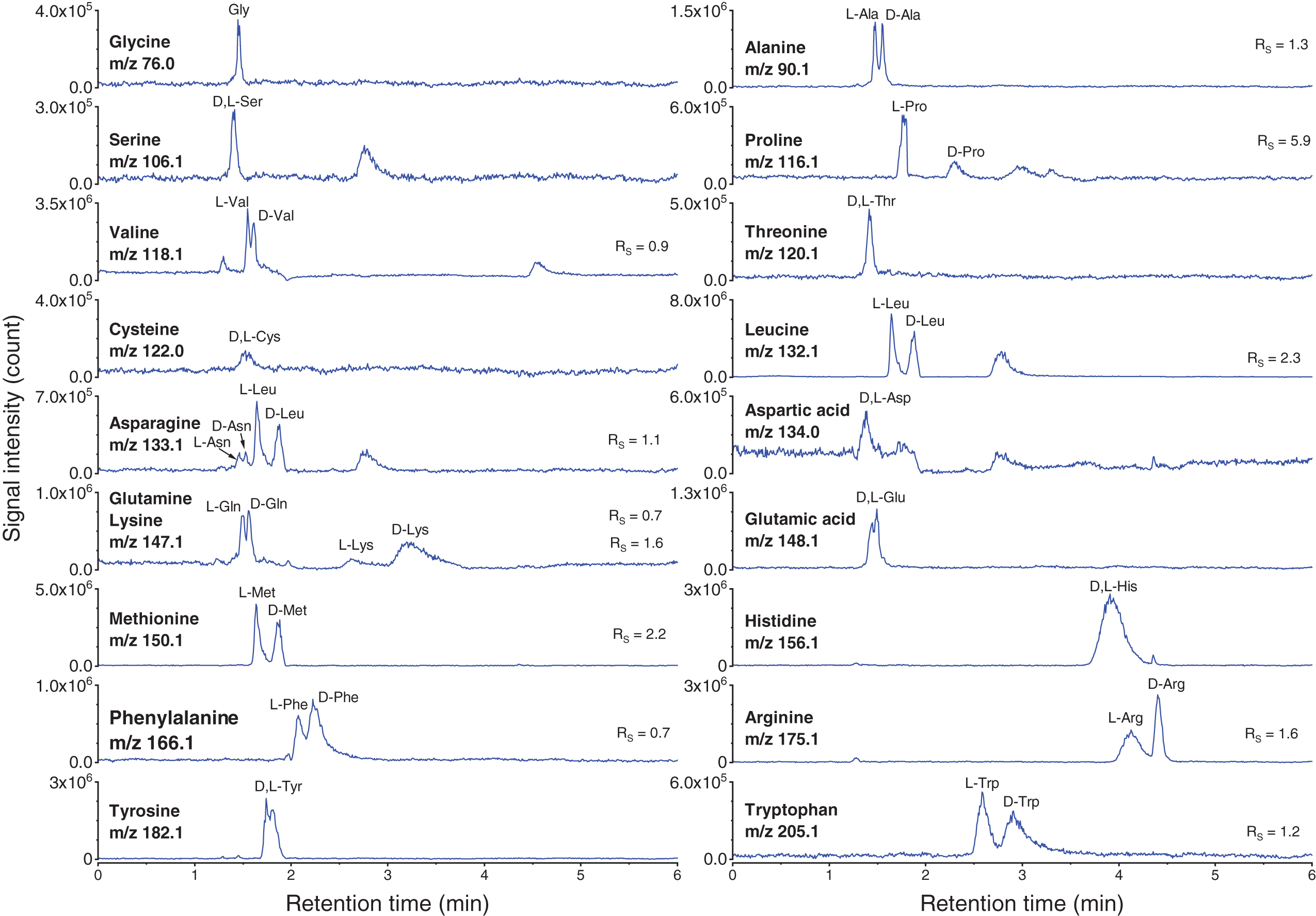
SPE/LC-MS analysis of a standard with 19 proteinogenic amino acids at 50 μg/L, except for cysteine that was prepared at 500 μg/L. The resolution (Rs ) is given for separated enantiomers. Rs is a measure of the separation between two peaks, and any value of Rs > 1.5 indicates sufficient separation for symmetrical and equality sized peaks. Color graphics are available online.
Determined Lower Limits of Detection (μg/L, ppb)
LODs given in parentheses are estimated by extrapolation as a result of contamination present in the LC-MS grade water.
LC-MS = liquid chromatography–mass spectrometry; LOD = lower limit of detection.
The experimentally verified LODs ranged between 0.25 and 50 μg/L with the exception of cysteine that had a LOD of 500 μg/L for all tested loading volumes. The median LODs of the amino acids were 50, 10, 5, and 2.5 μg/L, for 20, 50, 100, and 1000 μL, respectively. Due to low levels of
3.2. Quantification of amino acids in sample analogues
Three samples from Yellowstone National Park were analyzed: one snow sample exposed to geyser ejecta, one solid sample of spicular sinter containing live and silicified microbes, and one field blank sample (Table 3). The raw chromatograms are shown in Supplementary Figure S-5. No amino acids were detected in the field blank sample. Several amino acids such as glycine, glutamic acid, and histidine were detected in both the snow sample and the spicular sinter. The individual amino acid concentrations were low (<15 μg/L) in the collected snow sample containing the ejecta. The analyzed spicular sinter contained several amino acids, where glycine (133 ± 9 μg/kg) and aspartic acid (220 ± 30 μg/kg) were the most abundant.
The Concentrations [μg/kg (ppb) ± Standard Deviation] and l-Enantiomeric Excess (Lee, % ± Standard Deviation) of Amino Acids in Yellowstone National Park Samples Were Quantified (n = 3)
Values are reported when the signal-to-noise ratio was >10 (LOQ) for all replicates. Not quantified is reported for concentrations where all replicates were above LOD but below LOQ.
—, Not detected, below LOD.
N.Q., not quantified, above LOD but under LOQ.
LOQ = limit of quantification.
4. Discussion
4.1. Reducing risks for in situ amino acid analysis
The main benefit of the proposed methodology is the circumvention of complex sample preparation that typically includes multiple solvents, derivatization reagents, high temperatures (>200°C) that induce racemization or degradation, etc. The minimization of organic additives simplifies the fluid management design and reduces the number of solvent reservoirs, but more importantly, it removes potential sources for contamination.
Each additional organic solvent or additive has a nonzero chance of generating contamination that could affect the analysis during an in situ spaceflight mission. Exposure of organic additives to heat or radiation, or derivatization reagents unintentionally reacting with sample matrix components or even reacting with itself, could generate a wide range of unpredictable by-products and confound the results [c.f., data from in situ measurements at Mars by Glavin et al. (2013) and Eigenbrode et al. (2018)]. Although the risk of this occurring in any given mission may be low, the prior Mars issues have demonstrated that the impact on the science return can be substantial. Minimization of contamination risks is of particular importance when targeting very low concentrations (ppb or ppt-levels) of organics.
In this work, only carbonated water is used as a solvent, and a small volume (5 μL per analysis) of dilute ammonium hydroxide (200 mM) is used to elute adsorbed amino acids. Many of our results demonstrated 100%
Risks are further reduced by not including any organic solvents, buffers, or other organic additives. An example of such a risk is the contamination of the SAM instrument suite onboard Curiosity that leaked N-tert-butyldimethylsilyl-N-methyltrifluoroacetamide (MTBSTFA) and dimethylformamide (DMF) (Glavin et al., 2013). The derivatization reagent formed various side-products and appeared in both blanks and samples, and greatly complicated analysis on Mars (Glavin et al., 2013; Leshin et al., 2013; Ming et al., 2014; Freissinet et al., 2015).
Derivatization adds additional risk to so-called nontargeted analysis, when target analytes are not necessarily known or defined beforehand. For example, MTBSTFA reacts with a wide variety of functional groups, including carboxyl, hydroxyl, primary amines, secondary amines, and thiol functional groups, and can thus be utilized for nontargeted analysis. Derivatization reagents form side-products that may interfere with analysis of chromatograms or electropherograms due to coelution or comigration with analytes of interest (Freissinet et al., 2010; Stalport et al., 2012; Creamer et al., 2017).
Although emphasis is given on detection of
4.2. Performance characteristics
Our proposed amino acid method is able to separate more enantiomers and has as low or lower LODs than the current state-of-the-art instrumentation in development for space applications (Supplementary Table S-1 and Supplementary Fig. S-4). The proposed method successfully analyzed 19 proteinogenic amino acids (isoleucine was not included because the m/z and the retention time overlapped with leucine) without using any derivatization or organic solvents. It successfully resolved 12 of the 18 chiral pairs (glycine is nonenantiomeric), which were separated with resolutions between 0.7 and 5.9. For comparison, the method utilized by MOMA can only distinguish the enantiomers of 9 of 19 proteogenic and enantiomeric amino acids, with similar resolutions ranging from 0.6 to 6.59 (Freissinet et al., 2010). CE-LIF has reported successful separation of five enantiomeric amino acid pairs, and the possibility of an additional two amino acids by utilizing two different methods (Creamer et al., 2017).
Our determined LODs are ∼2 orders of magnitude more sensitive than the GC-MS analysis of DMF dimethylacetal derivatized amino acids utilized onboard MOMA. The proposed LC-MS method's experimentally verified LODs are in the range of 0.25–50 μg/L (excluding cysteine with a LOD of 500 μg/L), with a median LOD of 2.5 μg/L (including cysteine). The reported LODs for the GC-MS method utilized by MOMA range from 80 to 1300 μg/L, with a median LOD of 180 μg/L (Freissinet et al., 2010). A fair comparison with the MTBSTFA/DMF-based derivatization followed by GC-MS as onboard SAM is not possible due to a lack of reported validation data, and the fact that it is not a method for chiral separation. LODs reported for CE-LIF range from 0.4 to 110 μg/L with a median LOD of 1.6 μg/L, which is in the same order of magnitude as our experimentally determined LODs (Creamer et al., 2017). The number of detectable amino acids and their lower LODs are important figures of merit, and 1 ppb (Mahaffy et al., 2012; Pappalardo et al., 2013) has been mentioned as specifications for Mars and Europa missions.
A single quadrupole mass analyzer was used in this study, which can be used in SIM mode for high sensitivity or full-scan mode for acquisition of full spectra. Since ESI is a soft ionization technique, the protonated molecular ion ([M+H]+) of amino acids is almost exclusively generated, and hence only limited additional information would be gained by obtaining full spectra. SIM was ultimately used to achieve the best possible detection limits. However, future work geared toward developing a portable instrument will utilize an ion trap mass spectrometer that will facilitate full-scan mode and reduce uncertainty in identification by MS/MS analysis.
4.3. Analysis of ppb-levels of amino acids in Ocean World analogues
Plumes have so far been tentatively identified at Europa (Jia et al., 2018; Paganini et al., 2019) and confirmed at Enceladus (Goguen et al., 2013; Postberg et al., 2018), where organic macromolecules have been detected from the plume vapor by the orbiting Cassini spacecraft (Postberg et al., 2018), and the detection of H2 in this vapor suggests the presence of a hydrothermal system (Waite et al., 2017). Currently, there is no confirmed lander mission to either of the two icy moons. However, two natural scenarios can be envisioned where either sampling is performed directly in the plume environment or sampling of ejecta grains on the surface (Hendrix et al., 2019). The plumes could indirectly provide insight into the liquid ocean beneath the surface, where any present organic molecules are transported to the surface.
One geyser site (Great Fountain Geyser) and one geothermal spring site (Lemon Spring) in Yellowstone National Park were selected as analogues to demonstrate the viability of the proposed methodology for Ocean Worlds. A layer of surface snow was collected downwind from the center of the geyser immediately after an eruption and was analyzed in the liquid form in our instrument after allowing it to melt. The geyser ejected contained live and dead cells of the subsurface chemotrophic microbial community. A solid deposit consisting of siliceous sinter formed by microbes mediating the deposition of the silica, also known as spicular sinter, was collected from the edge of Lemon Spring for our analysis. This spicular sinter sample was placed in the extraction cell of the instrument, and analysis was performed completely online. Several amino acids were found in both snow and spicular sinter analog samples, and no amino acids were found in the field blank that was acquired.
It is important to note that no extraction optimization was performed for the superheated water extraction of amino acids from solid samples due to limited sample amounts. However, several studies have been performed showing the importance of heat to desorb amino acids from solid samples (Amashukeli et al., 2007, 2008; Kehl et al., 2019). It has also been demonstrated that performing superheated water extraction with an acidic solvent using hydrochloric acid improves analyte recovery (Noell et al., 2018). In this work, we demonstrate that an acidic extraction solvent can be achieved by using carbonated water instead of hydrochloric acid. This is beneficial because hydrochloric acid is not compatible with ESI-MS, while carbonated water is.
The relative composition of the detected amino acids in both the precipitated ejecta and the spicular sinter samples indicates that they are from a biotic source, based on the relative abundances, the detection of
The
An enantiomeric
Compositional characteristics of Ocean Worlds such as Enceladus or Europa are still not well constrained, and future tests of ruggedness are needed at a range of potential pH and salinity values and at a variety of cell densities to demonstrate this method for samples in a wider range of potential Ocean World environments. We confirm that our methods are effective in analyzing dilute environmental samples and samples where some of the cells are fully or partially encased in a mineral matrix.
4.4. Path toward an in situ instrument for space applications
Superheated water extraction, or subcritical water extraction, is already in development for space applications, with demonstrations with analog sample matrices, field studies, and prototype hardware (Aubrey et al., 2008; Bada et al., 2008; Kehl et al., 2019). Although more studies are needed to determine extraction conditions and the influence of various matrices on recovery of relevant analytes, the technique is steadily becoming more mature.
LC-MS has recently been suggested as a valuable addition to in situ organic-detection instrumentation for space applications and is a viable technique for detection of both organic (Southard et al., 2014) and inorganic analytes (Shelor et al., 2014) of astrobiological relevance. The main lingering challenge in miniaturization of LC has been the difficulty of developing and manufacturing robust and reliable pumps that are able to deliver sufficiently high pressure to utilize the high performance associated with small particles (<5 μm) (Lynch et al., 2018).
We are currently developing a portable instrument that combines supercritical fluid extraction and chromatography for nonpolar analytes (Abrahamsson et al., 2019) and superheated water extraction and LC for polar analytes. The system features a combined fluid delivery system that does not use a conventional mechanical pump and that is able to provide pressures >30 MPa. By only using CO2 and water as solvents for both the extraction and the chromatography, the complexity of instrument is greatly reduced.
In this work, superficially porous particles (2.7 μm) were used in chromatographic columns that inherently generate a lower backpressure than conventional stationary phases, and ultimately enables efficient separation at a reasonable pressure (<22 MPa). Future work will involve smaller chromatographic columns (i.e., ≤1 mm I.D.) to further reduce solvent consumption in the separation step. These enhancements will improve performance and lower the instrument's mass, power, and size and will make future LC-focused spaceflight applications more attractive.
5. Conclusions
A novel method was developed for analysis of chiral amino acids from aqueous and solid samples at parts-per-billion level or lower. The method is completely online, meaning that all steps are integrated and automated after the point where the aqueous or solid sample is introduced to the instrument. Superheated water extraction was used to extract amino acids in solid samples. Analytes in either the extraction solvent or the aqueous sample were preconcentrated before the chiral LC coupled with ESI-MS. Of 18 chiral proteinogenic amino acids, 5 enantiomeric pairs were separated with a chromatographic resolution >1.5 and 12 pairs with a resolution >0.7. The median LOD of amino acids was 2.5 μg/L, with the lowest experimentally verified as low as 0.25 μg/L, which is ∼2 orders of magnitude lower than the GC-MS method for chiral analysis onboard MOMA.
The developed methodology is completely free of organic solvents, organic additives, and derivatization reagents, which reduces the risk typically associated with in situ wet chemistry laboratories. Several risks are retired, including the risk of contamination and false negatives due to matrix effects or interferents caused by side-products from derivatization reagents.
Ocean World analog samples were analyzed in regard to chiral amino acids, represented by one snow sample with precipitated ejecta from the Great Fountain Geyser and one spicular sinter sample from Lemon Spring in Yellowstone National Park. Features such as relative abundance of amino acids and enantiomeric excess provide evidence of biotic synthesis of amino acids. These results highlight the viability of an organic-free instrumentation for chiral amino acid analysis performed in situ on planetary bodies in our solar system.
Footnotes
Acknowledgments
I.K. acknowledges support from NASA Astrobiology Institute-Icy Worlds Program. The assistance in experiments and data collection provided by Amy Zhai and in fieldwork by Mary N. Parenteau (NASA Ames) was greatly appreciated. We thank Annie Carlson, Research Coordinator in the Research Permit Office, Yellowstone National Park, for helping us facilitate field research and acquisition of samples. We also thank Conor Nixon and the other Yellowstone team members Mary N. Parenteau, Tilak Hewagama, Dina M. Bower, Aaron B. Regberg, and Alexander E. Thelen, and JPL for supporting this field work with internal funding.
Author Disclosure statement
No competing financial interests exist.
Funding Information
The research described in this article was carried out at the Jet Propulsion Laboratory, California Institute of Technology, under a contract with the National Aeronautics and Space Administration (NASA), and was supported by a grant from NASA's Concepts for Ocean worlds Life Detection Technology (COLDTech) Program.
Supplementary Material
Supplementary Data
Supplementary Figure S-1
Supplementary Figure S-2
Supplementary Figure S-3
Supplementary Figure S-4
Supplementary Figure S-5
Supplementary Table S-1
Abbreviations Used
Associate Editor: Christopher McKay
References
Supplementary Material
Please find the following supplemental material available below.
For Open Access articles published under a Creative Commons License, all supplemental material carries the same license as the article it is associated with.
For non-Open Access articles published, all supplemental material carries a non-exclusive license, and permission requests for re-use of supplemental material or any part of supplemental material shall be sent directly to the copyright owner as specified in the copyright notice associated with the article.
