







Abstract
The potential energy surface for the formation of protonated uracil (UH+) from urea and HC3O+ was explored by performing quantum chemical complete basis set-QB3 calculations. A barrierless pathway was found for the formation of UH+, which was estimated to occur in the interstellar medium (ISM) much faster than the timescale of chemical revolution of typical dense interstellar clouds. Investigation of further reactions of UH+ formed through the obtained pathway led to the conclusion that uracil could be produced on icy grain surfaces but not in the gas phase of the ISM.
Introduction
Whether building blocks of life, including nucleobases, amino acids, and sugars, were synthesized in space is an interesting research topic with regard to the origin of life. Although these building blocks have not been detected in the interstellar medium (ISM), the fact that some of them have been discovered in carbonaceous meteorites strongly suggests their prebiotic syntheses in space. Most previous simulation studies in this area were devoted to experimental prebiotic syntheses under environmental conditions of the early Earth, that is, since the Miller–Urey experiment (Miller, 1953), which has been reviewed recently (Pearce and Pudritz, 2015; Kitadai and Maruyama, 2018; Kobayashi, 2019).
Nucleobases are classified into two groups, namely purines and pyrimidines. Adenine and guanine belong to purines that have two rings, whereas cytosine, thymine, and uracil are pyrimidines that have six-membered rings. Adenine, guanine, cytosine, and uracil appear in RNA, whereas uracil is replaced by thymine in DNA. Of these five nucleobases, three (adenine, guanine, and uracil) have been discovered in carbonaceous meteorites (Pearce and Pudritz, 2015). Many experimental studies have been performed with the intent to synthesize these five nucleobases under prebiotic terrestrial conditions since adenine was first synthesized by Oró (1960, 1961) from an aqueous solution of ammonium cyanide.
However, experiments simulating extraterrestrial conditions have only been conducted recently. Ultraviolet (UV) irradiation of purine (C5H4N2) or pyrimidine (C4H4N2) in interstellar ice analogs that contain H2O, NH3, or CH4 has led to the formation of nucleobases (Nuevo et al., 2009, 2012, 2014; Materese et al., 2013, 2017, 2018). It has been suggested that radicals or cations such as C5H3N2 •, C4H3N2 •, C5H4N2 +•, C4H4N2 +•, H•, •OH, •NH2, H2O+•, and NH3 +• formed by UV absorption participate in the syntheses of nucleobases (Bera et al., 2010, 2016, 2017). Nucleobases have been synthesized by UV irradiation of acetylene in an ice matrix that contained H2O and urea (Menor-Salván and Marín-Yaseli, 2013). UV irradiation of an interstellar ice analog that contained H2O, CO, NH3, and CH3OH at 10 K (Oba et al., 2019) and an interstellar ice analog that contained H2O, NH3, and CH3OH (Ruf et al., 2019) resulted in the formation of nucleobases.
Theoretical investigations into the mechanisms of prebiotic nucleobase syntheses have been conducted for reactions in the gas phase, unlike experiments performed with ice matrices. Several water ice models have been adopted in theoretical studies on glycine synthesis (Zamirri et al., 2019). However, explicit solvent models have not yet been applied to nucleobase synthesis studies. Previous quantum chemical studies on syntheses of nucleobases or their precursors include reactions that start from two molecules, a radical–molecule, or an ion–molecule. Bimolecular reactions between two neutral molecules that generally have high activation energies are inadequate for the syntheses in interstellar molecular clouds at 10–20 K, where many molecular species exist that can be reactants. For example, the calculated activation energy for dimerization of HCN, 2HCN → HN = CHNC, which has been suggested as the first step in the formation of adenine by HCN polymerization, is around 300 kJ mol−1 (Smith et al., 2001; Yim and Choe, 2012; Jung and Choe, 2013).
Even when considering the reaction on a water ice mantle, the activation energy is still as high as ∼150 kJ mol−1 (Choe, 2017, 2019). For a bimolecular thermal reaction to occur at 10–20 K without additional excitation within the timescale of chemical revolution of typical dense interstellar clouds in the gas phase, the activation energy should be zero (Herbst, 2001) or at most a few kJ mol−1 (Yim and Choe, 2012; Jung and Choe, 2013; Zamirri et al., 2019). Therefore, those mechanisms suggested for nucleobase syntheses starting from two neutral molecules (Roy et al., 2007; Wang and Bowie, 2012; Jung and Choe, 2013; da Silva and de Araujo, 2017; Choe, 2018, 2020a) are inappropriate with regard to simulating reactions in molecular clouds of the ISM.
Radicals or ions formed from molecules in the ISM by interaction with cosmic rays, electrons, and UV photons can react with neutral molecules in the first steps of nucleobase syntheses. Free radicals have been used as reactants for nucleobase syntheses in theoretical investigations (Bera et al., 2010, 2016, 2017; Jeilani et al., 2013, 2015, 2016; Nguyen et al., 2015; Kaur and Sharma, 2019; Lu et al., 2021). Ionic species have been used for the same purpose in our previous studies (Jung and Choe, 2013; Choe, 2018, 2020b, 2021) and studies by others (Bera et al., 2010, 2016, 2017; Gupta et al., 2013). Figure 1 summarizes pathways for the formation of protonated nucleobases proposed in our laboratory.
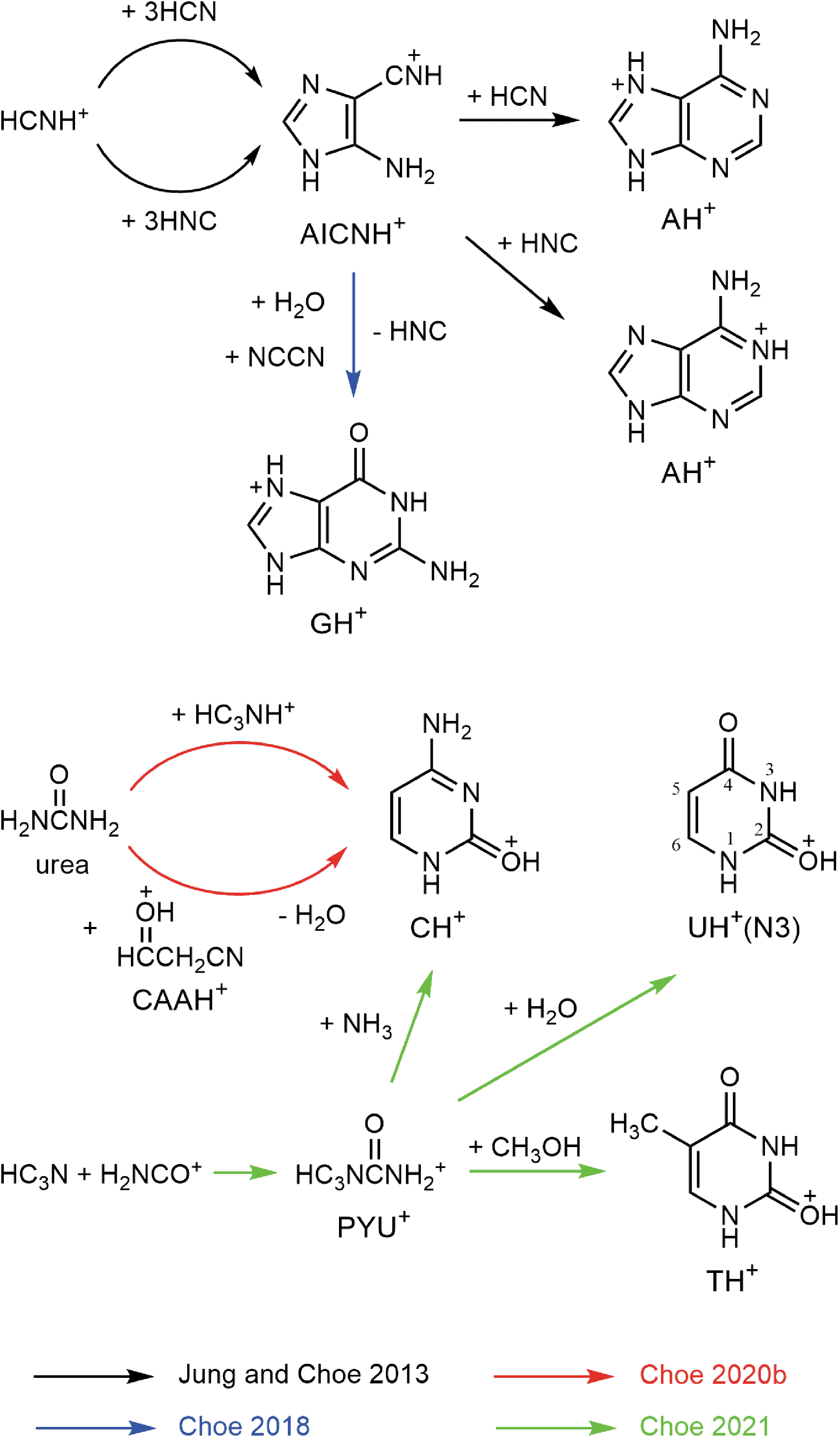
Summary of reactions for the formation of protonated nucleobases, for which theoretical mechanisms have been previously proposed. All reactants except CAAH+ have been detected in space. AICN, CAA, and PYU+ stand for 4-aminoimidazole-5-carbonitrile, cyanoacetaldehyde, and 1-(prop-2-ynylidyne)uranium, respectively. AH+, GH+, CH+, UH+, and TH+ stand for the protonated species of adenine, guanine, cytosine, uracil, and thymine, respectively.
All reactants, except the protonated cyanoacetaldehyde (Fig. 1), have been detected in the ISM. Calculated overall activation energies for the formation of protonated adenine (AH+) and protonated guanine (GH+), starting from HCNH+, were 59–156 kJ mol−1 (Jung and Choe, 2013; Choe, 2018). The reported activation energy for the formation of protonated cytosine (CH+) from urea and HC3NH+ is 31 kJ mol−1, whereas barrierless pathways for other reactions to form CH+, protonated uracil (UH+), and protonated thymine (TH+) in Fig. 1 have been proposed (Choe, 2020b, 2021). Deprotonation of a protonated nucleobase can occur in the ISM by dissociative recombination with electrons or by proton transfer to molecules such as NH3.
In the present study, we explored the potential energy surface (PES) for the formation of UH+ from urea and HC3O+ by performing quantum chemical calculations.

Recent discovery of urea in the hot core Sgr B2(N1) (Belloche et al., 2019) and giant molecular cloud G + 0.693–0.027 (Jiménez-Serra et al., 2020), along with the discovery of HC3O+ in the cold dense core TMC-1 (Cernicharo et al., 2020), prompted us to investigate the above reaction. We tried to find a barrierless pathway for reaction 1, which can occur as a thermal reaction at low interstellar temperatures without additional energy sources. From the obtained PES, the possibility of uracil synthesis in the gas phase or on icy grain surfaces of the ISM is discussed.
The PESs for examined reaction in the gas phase were obtained by performing molecular orbital quantum chemical calculations using the Gaussian 16 suite of programs (Frisch et al., 2016). Geometries and energies of reactants, intermediates, products, and transition states (TSs) were obtained by the complete basis set (CBS)-QB3 model calculation. The CBS-QB3 model is a compound method, in which energies at the CCSD(T), MP4, and MP2 levels are calculated with the geometry optimized at the B3LYP/6-311G(d,p) level and are used for corrections to the MP2 energy (Montgomery Jr et al., 1999). Additional corrections, such as the zero-point energy, spin contamination, CBS extrapolation, and empirical term, are included in the method. TS geometries were checked by calculating intrinsic reaction coordinates at the B3LYP/6-311G(d,p) level. The PESs presented here were constructed from CBS-QB3 energies at 0 K.
Results
Reaction pathway for the formation of UH+ from urea and HC3O+ (reaction 1)
The best PES obtained for reaction 1 in the gas phase is shown in Fig. 2. The first intermediate, INT1, was formed by association of urea and HC3O+ without a barrier. The absence of a barrier was confirmed by performing a scan calculation of the Gaussian program. No saddle point was found on the PES calculated by increasing the C − O bond distance of INT1 to 3 Å in steps of 0.05 Å with optimization of all other coordinates. INT1 is rearranged to other adduct of urea and HC3O+, INT2, by a C–O bond cleavage, a C–N bond formation, and a rotation around another C–N axis.
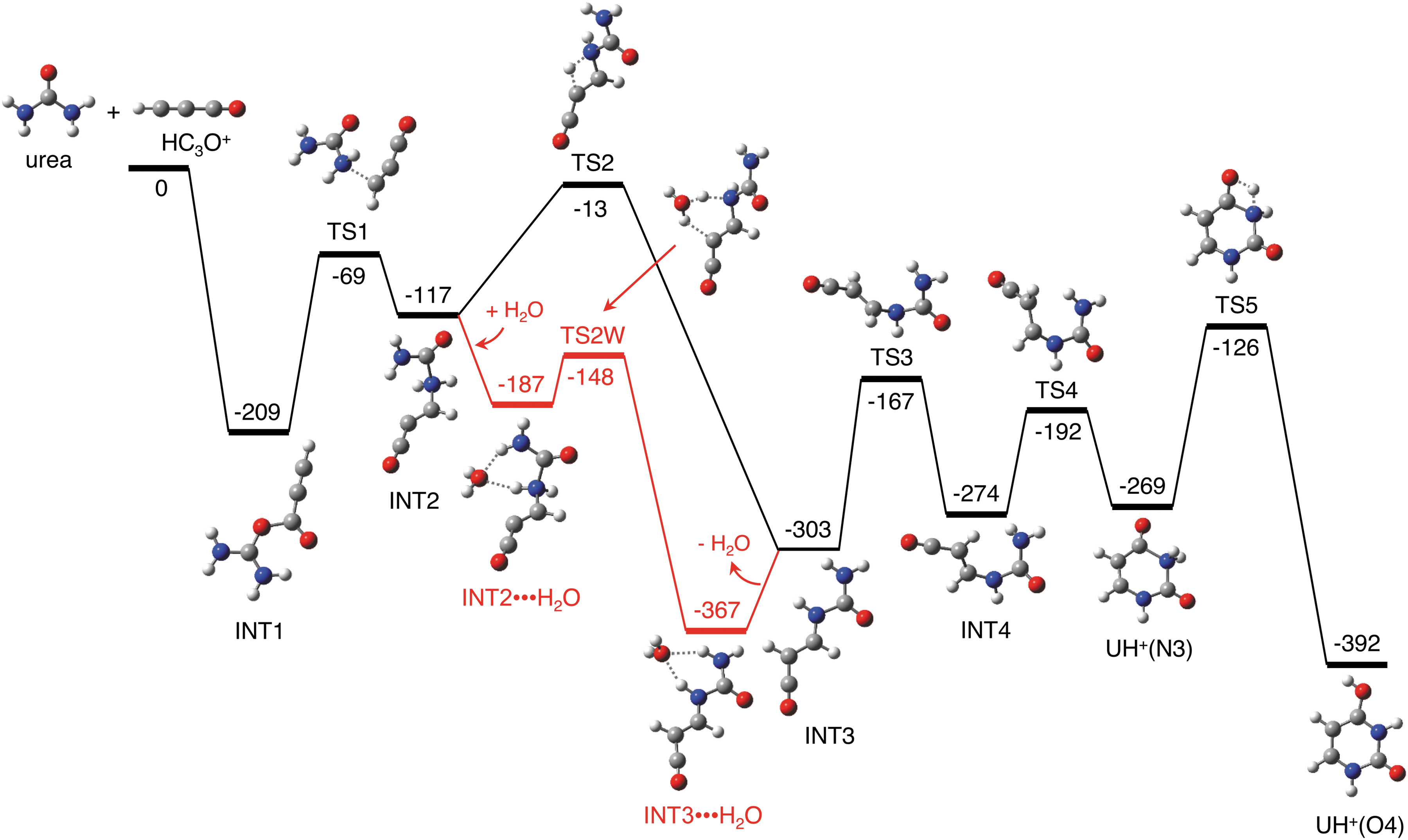
Potential energy (kJ mol−1) diagram for the formation of UH+ from urea and HC3O+ derived from CBS-QB3 calculation. Energies of TS2W, INT2•••H2O, and INT3•••H2O are relative to the sum of energies of urea, HC3O+, and H2O. CBS, complete basis set.
INT2 tautomerizes to INT3 by a 1,3-H shift through a four-membered ring TS, TS2 located highest among TSs but lower by 13 kJ mol−1 than the sum of energies of urea and HC3O+. After a subsequent rotation to INT4, N3-protonated uracil, UH+(N3), is formed, which finally tautomerizes to the most stable UH+ isomer, O4-protonated uracil, UH+(O4) (see Fig. 1 for numbering convention of uracil). The overall activation energy of the present pathway was zero, indicating that reaction 1 occurred rapidly once urea and HC3O+ reacted to form INT1.
Alternatively, other adduct of urea and HC3O+, INT5, can be formed as shown in Fig. 3. After an isomerization to INT6, a ring-closure reaction may occur by a 1,4-H shift through TS7 to a derivative of protonated oxazole, protonated 2-amino-5-methyleneoxazol-4(5H)-one (OxH+). However, this reaction would hardly occur at low temperatures in the ISM. Because TS7 lies 95 kJ mol−1 higher than the reactants, INT6 would rapidly re-dissociate to the reactants, urea and HC3O+, before the formation of OxH+.
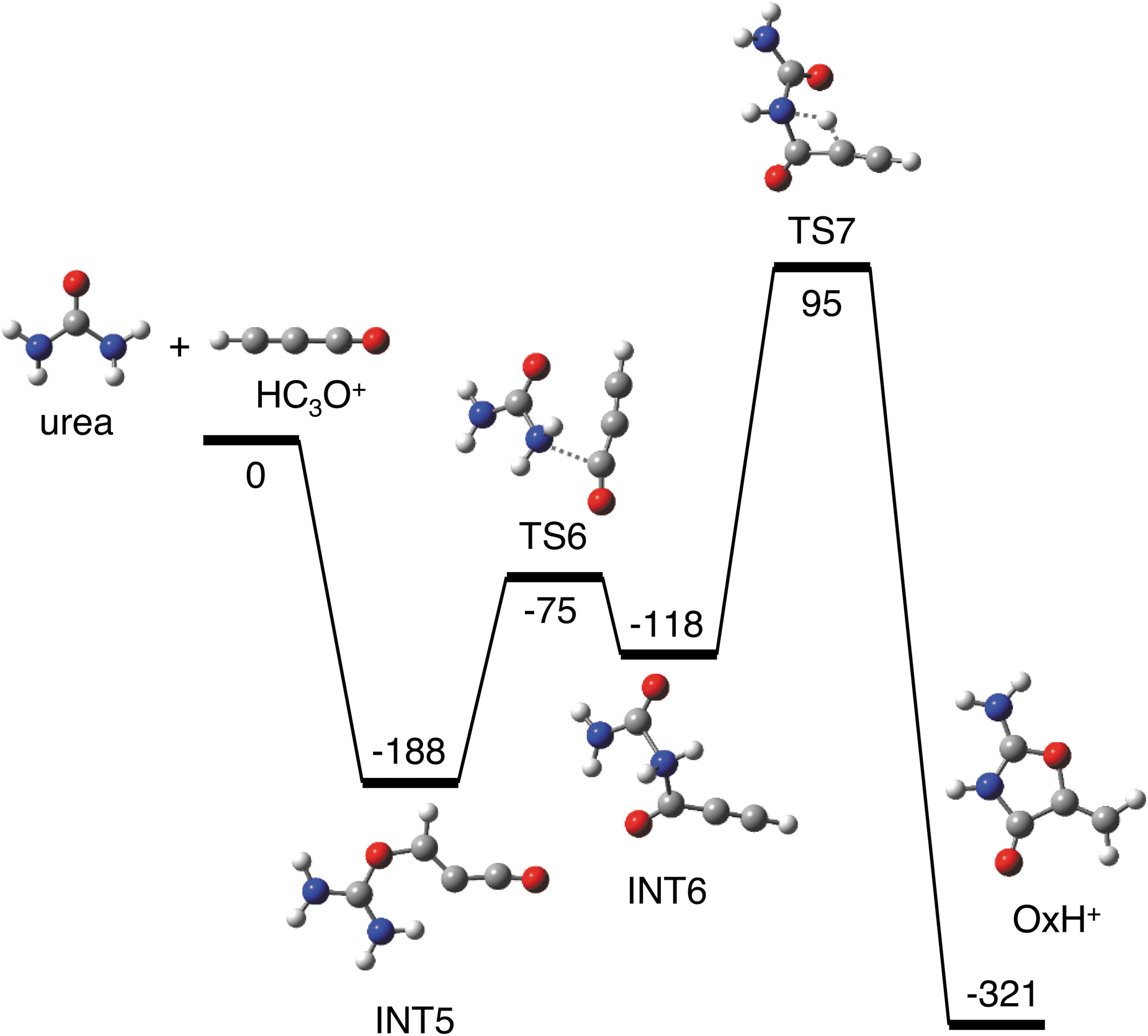
Potential energy (kJ mol−1) diagram for the formation of OxH+ from urea and HC3O+ derived from CBS-QB3 calculation.
Reactions for the formation of uracil or UH+ from several reactants, for which mechanisms have been proposed previously using quantum chemical calculation, are summarized in Table 1. In addition to reaction 1, activation energies of reactions 2 and 3 in Table 1 are also zero. Such barrierless reaction pathways are adequate for thermal reactions that can occur in the ISM without additional energy sources. Reaction 1 has an advantage over reaction 2 (Choe, 2021) that is also shown in Fig. 1 in that one association reaction can lead to the formation of UH+ in the former, whereas two association reactions are involved in the latter.
Computed Overall Activation Energies (E
0) for the Formation of Uracil (U) or UH+ in the Gas Phase Extracted from the Previously Proposed Mechanisms
Computed Overall Activation Energies (E 0) for the Formation of Uracil (U) or UH+ in the Gas Phase Extracted from the Previously Proposed Mechanisms
Activation Gibbs energy at 298 K.
Activation Gibbs energy at 100 K.
Reaction having the lowest activation Gibbs energy among examined reactions containing one or two reactants formed by loss of one or two •H from H2CCHCN or H2NCHO (Lu et al., 2021).
CBS = complete basis set.
A disadvantage of reaction 1 is that urea and HC3O+ do not coexist in space according to studies to date, whereas all three reactants in reaction 2 have been detected toward Sgr B2. Although a barrierless pathway for reaction 3 has been proposed (Jeilani et al., 2016), the occurrence of the reaction in the ISM with an extremely low gas density is highly questionable because 20 association steps are required to ultimately form uracil from many reactants. Other reactions, reactions 4–10 shown in Table 1, are inadequate for thermal synthesis of uracil in cold interstellar clouds due to activation energies of tens to hundreds of kJ mol−1.
Interestingly, uracil and cytosine are isoelectronic. Using HC3NH+ instead of HC3O+ in reaction 1, CH+ can be formed (Fig. 1), of which the proposed mechanism (Choe, 2020b) is very similar to the pathway shown in Fig. 2. The formation of CH+ (ΔE = −411 kJ mol−1) is more exoergic than reaction 1 (ΔE = −392 kJ mol−1), which suggests a barrierless pathway also for the former reaction. However, its calculated overall activation energy was 31 kJ mol−1, indicating that CH+ could hardly be synthesized in cold interstellar clouds even if the association reaction of urea and HC3NH + occurred. The main difference between the two pathways is that the intermediate formed in the first association step is much more stable in reaction 1. INT1 is more stable by 209 kJ mol−1 than reactants in reaction 1, whereas the corresponding intermediate is more stable by 118 kJ mol−1 than reactants in the formation of CH+.
As mentioned above, the formation of UH+ occurs rapidly once INT1 is formed by association of urea and HC3O+. For successful prebiotic UH+ synthesis in space, the association reaction should occur within the timescale of chemical revolution of typical dense interstellar clouds, 106 years. In our previous study on the formation of CH+ from urea and HC3NH+ (Choe, 2020b), the half lifetime of HC3NH+ against the formation of CH+ in Sgr B2, which only depends on the concentration of urea when [urea] >> [HC3NH+], has been estimated to be ∼5 years. Similarly, the half lifetime of HC3O + against the formation of UH+ in Sgr B2 would also be ∼5 years if it is assumed that HC3O+ coexists with urea in Sgr B2 and [urea] >> [HC3O+].
However, the UH+ ion formed from urea and HC3O+ is highly excited with an internal energy of 392 kJ mol−1, ignoring internal energies possessed by reactants before association. This energized UH+ ion can dissociate or be stabilized by radiative or collisional relaxation. Collisional stabilization in the gas phase of the ISM is ineffective due to an extremely low gas density. Rate constants for typical radiative relaxations of vibrationally excited ions are 101−103 s−1 (Herbst, 1985; Dunbar et al., 1996; Smith et al., 2001; Wakelam et al., 2010). According to previous experimental and theoretical studies on the dissociation of UH+, the loss of NH3 is the lowest energy channel (Sadr-Arani et al., 2014; Molina et al., 2016).
A computed pathway for the loss of NH3 (Choe, 2021) is shown in Fig. 4. To estimate the dissociation rate constant, the statistical Rice–Ramsperger–Kassel–Marcus calculation (Marcus and Rice, 1951) was performed with a method described elsewhere (Baer and Hase, 1996; Yim and Choe, 2011; Choe and Kim, 2019). The rate constant calculated by assuming one-step dissociation through TS9 was 2 × 10⁶ s−1. Considering other parallel dissociation channels, the total dissociation rate constant would be larger than the calculated one. This suggests that the energized UH+ ion would dissociate rapidly in the gas phase of the ISM before vibrational or collisional relaxation.
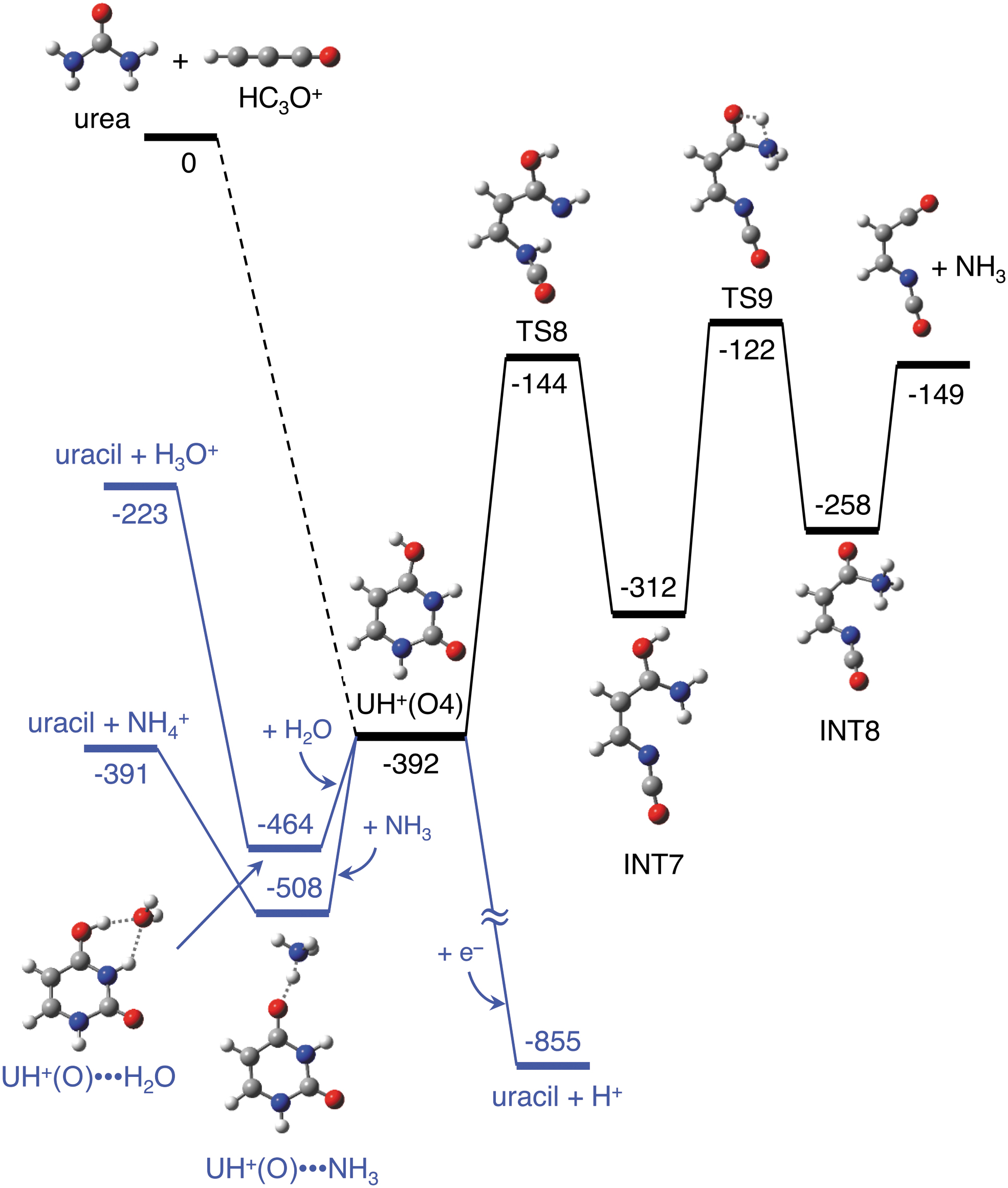
Potential energy (kJ mol−1) diagram for reactions of UH+(O4) derived from CBS-QB3 calculation. For proton transfer reactions, the energy of each added reactant is summed to the reference energy.
However, when a reaction occurs on an ice surface, the chance of stabilization of the energized species is greatly increased. Stabilization may occur through energy transfer to phonon modes of the lattice or through dipole–dipole or ion–dipole interaction with receptor modes of neighboring species (Tielens, 2021). For example, H2O2 formed from the reaction of 2H• and O2 having an internal energy of 3.7 eV dissociates mainly to 2•OH in the gas phase (Tielens, 2021).
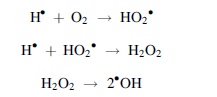
On ice surfaces, however, H2O2 has been detected together with H2O formed from the reaction H2O2 + H• → H2O + •OH, indicating stabilization of the energized H2O2 (Ioppolo et al., 2008, 2010; Miyauchi et al., 2008). Similarly, an energized UH+ ion might be stabilized before dissociation when reaction 1 occurs on interstellar ice mantles. Then, a stabilized UH+ ion can be protonated to form uracil by dissociative recombination with an electron or proton transfer to main constituents of icy grain mantles, such as H2O and NH3. Their energetics are shown in Fig. 4. Of three possible pathways, proton transfer to H2O is the least likely due to a high endoergicity (ΔE = 169 kJ mol−1). The UH+ ion stabilized, but with low vibrational internal energy, can finally produce stable uracil by proton transfer to NH3 because ΔE≈0.
The reaction occurring with a catalytic H2O is another possible route. H2O can assist a certain step of reaction 1 that occurs on ice mantles that contain H2O. For example, INT2 can react with H2O to form INT2•••H2O that consequently rearranges to INT3•••H2O through TS2W and loses H2O to form INT3, as shown in Fig. 2. Thus, the 1,3-H shift step from INT2 to INT3 through the highest barrier (TS2) can proceed without a barrier by the assistance of H2O. More importantly, the energy of INT3 formed with catalytic H2O is less than that of INT3 formed without catalytic H2O because excess energy of the reaction INT2 + H2O → INT3 + H2O, 303 kJ mol−1, is partitioned to internal energies of INT3 and H2O and their translational kinetic energies.
INT3 ions that have internal energies in the range of 136 − 177 kJ mol−1 then isomerize to UH+(N3) through TS3 and TS4, but not to UH+(O4). UH+(N3) ions thus formed do not have enough energies to dissociate. Hence, they can produce uracil by dissociative electron recombination or proton transfer to NH3. INT3 ions that have internal energies in the range of 177 − 181 kJ mol−1 isomerize to UH+(O4) through TS3−TS5. UH+(O4) ions thus formed can produce uracil by dissociative electron recombination or proton transfer to NH3 as described above without dissociation.
For the uracil formed in the ISM to be delivered to Earth, it must survive radiation. According to experimental studies on destruction of uracil by radiation with UV (Peeters et al., 2003), X-ray (Pilling et al., 2011), γ-ray (Hammer et al., 2019), and protons (Gerakines et al., 2022), uracil is stable enough to be delivered to Earth once it is formed in the ISM.
A barrierless pathway for the formation of UH+ from urea and HC3O+ was proposed by constructing PES using CBS-QB3 calculation. Assuming that [urea] >> [HC3O+], the formation of UH+ was estimated to occur in the ISM within the timescale of chemical revolution of typical dense interstellar clouds. However, UH+ ion thus formed is highly excited. Hence, it would dissociate rapidly before stabilization in the gas phase of cold interstellar clouds. On icy grain surfaces, UH+ ions that have energies less than dissociation threshold can be formed by involving catalytic H2O or by stabilizing highly excited UH+ ion through energy transfer to molecules that are main constituents of ice. Subsequent dissociative electron recombination or proton transfer to NH3 can produce uracil that is stable enough to be delivered to Earth. Future studies using explicit solvent models for ice surfaces will help to further our understanding of the investigated reaction.
Footnotes
Author Disclosure Statement
No competing financial interests exist.
Funding Information
This study was supported by the National Institute of Supercomputing and Network/Korea Institute of Science and Technology Information, with supercomputing resources including technical support (KSC-2021-CRE-0397).