







Abstract
The mode of tectonics that governed early Earth is controversial. This makes it challenging to infer surface environments relevant to the origin of life. The majority of the literature published in the past two decades was inclined to favor the appearance of plate tectonics sometime around the mid-Archean (∼3 Ga), with the operation of stagnant lid convection (or its variants) dominant in the earlier part of Earth’s history. However, the available and increasing geological record from early Earth is actually equivocal, and there is no theoretical basis to prefer stagnant lid convection over plate tectonics. In fact, such a delayed onset of plate tectonics would inhibit the emergence of life in the Archean, let alone in the Hadean. On the contrary, rapid plate tectonics in the early Hadean, enabled by the fractional crystallization of a magma ocean, could quickly transform inclement young Earth into a habitable planet, with formation of multiple surface environments potentially conducive to abiogenesis.
Introduction
“A new scientific truth does not triumph by convincing its opponents and making them see the light, but rather because its opponents eventually die and a new generation grows up that is familiar with it.” (Planck, 1950).
The earliest microfossil evidence of life is found in low-grade, ca. 3.5 Ga metasediments from Western Australia (e.g., Schopf et al., 2007; Van Kranendonk et al., 2019), which leaves open the possibility that life emerged during the early Archean or Hadean. Understanding surface environments across that time span is potentially a way to further constrain when life emerged, should evidence show, for example, periods characterized by conditions inconsistent with terrestrial habitability. This is true even if life originated elsewhere and was brought to early Earth (e.g., Kirschvink and Weiss, 2001; Scharf and Cronin, 2016), because we would still need to discuss the survival of such an extraterrestrial life-form on early Earth. Reconstructing early Earth environments is, however, extremely challenging. Compared with the Proterozoic Eon (0.54 to 2.5 Ga), it is much more difficult to find rocks from the Archean Eon (2.5 to 4 Ga), and it becomes virtually impossible to find rocks from the Hadean Eon (4 to 4.5 Ga). In terms of surface exposure, only ∼8% of the present-day continental crust is of Archean ages (Goodwin, 1996), and rocks with Eoarchean ages (≥3.6 Ga) comprise less than a millionth of the current crust. By far the largest known region is the Itsaq Gneiss Complex (∼3000 km2) in Greenland (Nutman et al., 1996), with other localities worldwide of much more limited extent such as the Acasta Gneiss Complex (∼20 km2) in the Slave Craton in Canada (Bowring and Williams, 1999; Iizuka et al., 2007) and the Nuvvuagittuq Greenstone Belt (∼10 km2) in Canada (Cates and Mojzsis, 2007; O’Neil et al., 2012). The spatial distribution of the localities that yield Hadean zircons is even more limited (Harrison, 2020), with most documented Hadean zircons coming from just one locality, that is, Jack Hills in Western Australia (Compston and Pidgeon, 1986; Maas et al., 1992).
When inferring global conditions on early Earth, the key question is whether plate tectonics was already operational in the Eoarchean and Hadean. Plate tectonics today affects virtually all aspects of modern geological processes, so discussing potential early Earth environments is impossible without answering this question first. Establishing the onset time of plate tectonics using observations from the geological record is difficult because plate tectonics continually erases the evidence of its operation by subduction and associated recycling. Some preserved indicators of plate tectonics, such as evidence for accretionary prisms and paired metamorphic belts, can provide information on the minimum age that plate tectonics was operational (e.g., Condie and Kröner, 2008). For example, based on the interpretation that a ∼3.6 Ga suture zone in the Itsaq Gneiss Complex was formed by horizontal plate motions, Nutman et al. (2002) suggested that plate tectonics was already operational by 3.6 Ga. Based on the geochemistry of Hadean zircons and mineral inclusions within them, Hopkins et al. (2010) suggested that subduction zones similar to modern convergent margins already existed in the Hadean. These plate tectonics indicators, however, tend to be more controversial in the deeper past (Korenaga, 2013), and it is also unclear whether inference on the global scale is permissible with the aforementioned limited spatial extents of relevant localities.
In contrast to the spatially limited and often ambiguous nature of deep-time geological data, theoretical studies on the style of early global tectonics are, in principle, more straightforward. We know that plate tectonics takes place on present-day Earth, and by building a suitable geodynamic model, we can ask under what conditions plate tectonics becomes nonviable. In essence, it is just a matter of physics. Of course, such models appear too simplistic compared with geological realities, but they may still remind us of important physical constraints on the dynamics of Earth. In this mini-review, therefore, we first approach the question as to the nature of early Earth from a theoretical perspective. We then turn to geological observations pertinent to the early tectonic mode and discuss their robustness. We summarize these theoretical and observational considerations by providing two alternative syntheses on the surface environments of early Earth, and we close by discussing some future research directions in geodynamics and geology. Note that, in this article, the term “plate tectonics” refers to the mode of mantle convection that allows the continuous subduction of surface plates (Korenaga, 2021a), and we do not require more detailed specifications such as one-sided subduction, narrow plate boundaries, or the rigidity of plates (cf. Brown et al., 2020). The continuous wholesale recycling of surface plates, or the top boundary layer of mantle convection, allows two-way mass transport between the surface and the interior, and the occurrence of deep geochemical cycles is what critically distinguishes plate tectonics from stagnant lid convection, in which mass transport is essentially one way, from the interior to the surface.
Theoretical Considerations
Surface water seems to have already existed on very early Earth, as suggested by the oxygen isotopes of Hadean zircons (Mojzsis et al., 2001), and the operation of plate tectonics is often assumed to require the presence of surface water (Gerya et al., 2008; Katayama, 2021; Korenaga, 2010; Mian and Tozer, 1990; Moresi and Solomatov, 1998; Regenauer-Lieb et al., 2001). Thus, a good starting point would be to ask what would prevent plate tectonics from operating on early Earth, even in the presence of surface water.
Even with similar surface conditions as today, the mantle was likely to be hotter in the past (e.g., Herzberg, 2022; Herzberg et al., 2010). Given the temperature dependence of mantle viscosity, convective stresses expected from a hotter weaker mantle may not have been sufficiently high to break the lithospheric lid and initiate subduction. This is the argument put forward by O’Neill et al. (2007) and Moore and Webb (2013). Temperature difference between the present-day mantle and the Hadean mantle is, however, thought to be only ∼200–300K, which is too small to lead to a notable difference in convective stress (Korenaga, 2017; Solomatov, 2004). Numerical simulations in the studies by O’Neill et al. (2007) and Moore and Webb (2013) appear to show a transition from stagnant lid convection to plate tectonics with declining radiogenic heating, but as previously noted (Korenaga, 2021a), the modeling of O’Neill et al. (2007) is compromised by the lack of control on the heating mode of convection. Their setup of numerical modeling resulted in inadvertent suppression of core heat flux and thus convective stress when internal heating was increased, thereby overestimating the effect of internal heating on convective stress. The modeling of Moore and Webb (2013) is flawed to a similar degree by the use of an unrealistic dosage of radiogenic heating (Korenaga, 2021a, section 2.6). Another argument in favor of the lack of (continuous) plate tectonics on early Earth is that, with a hotter mantle, slabs would be too weak to sustain continuous subduction (van Hunen and van den Berg, 2008). Such a situation is possible, but its likelihood depends on the details of lithospheric rheology (e.g., Billen, 2008). If we consider the effect of mantle melting, such as dehydration stiffening (Hirth and Kohlstedt, 1996; Karato, 1986), for example, a hotter mantle would instead result in thicker stronger slabs (Korenaga, 2003).
An entirely different possibility is the “bistability” of the tectonic mode. By running a series of convection simulations with increasing and decreasing lithospheric strength, Weller and Lenardic (2012) found that it was possible to have two different tectonic modes, that is, stagnant lid convection and plate tectonics, even with the same set of model parameters, including the Rayleigh number, mantle rheology, and internal heating. This apparent nonuniqueness of mantle convection is concerning because it would limit the usefulness of physical models in ascertaining aspects of Earth’s history. Motivated by this, Lenardic et al. (2016) proposed that Earth and Venus took different evolutionary paths not because their conditions (e.g., their heliocentric distances) are different but because these two planets happened to take different but equally possible solutions. They further suggested that the bistability of the tectonic mode allows bifurcation; that is, the physical state of a planetary mantle jumps from one solution to the other by small perturbations. In this line of thinking, it is not unreasonable to expect the operation of stagnant lid convection in the Hadean even with similar surface conditions.
However, being able to obtain two different tectonic modes with the same set of model parameters does not necessarily mean that a planet can freely pick a tectonic mode during its evolution. Two “equally possible” solutions in the claimed bistability are characterized by considerably different heating modes, as well as average internal temperatures. The solutions in the plate tectonic mode generally have lower internal temperatures and higher core heat fluxes, compared with their stagnant lid counterparts (e.g., Ferrick and Korenaga, 2023b; Weller and Lenardic, 2012). This means that going from one mode to another mode requires substantial modifications of the heat content of the planetary mantle, which occurs on the order of a billion years (Korenaga, 2017, section 2.2). Thus, the kind of bistability of the tectonic mode reported by Weller and Lenardic (2012) and in subsequent studies (Lenardic and Crowley, 2012; O’Neill et al., 2016; Weller et al., 2015) does not allow the bifurcation of planetary evolution.
It is worth commenting on the troubling aspect of the series of articles that advocate the bistability of the tectonic mode. Lenardic et al. (2016) state that the notion of bistability is supported by both theory and numerical experiments, but there is no connection between the cited theoretical effort (Crowley and O’Connell, 2012) and the numerical ones (Lenardic and Crowley, 2012; Weller and Lenardic, 2012). As noted above, the bistability in these numerical simulations is characterized by different degrees of mixed heating (i.e., different combinations of internal heating and core heat flux), but the scaling theory of Crowley and O’Connell (2012) is developed for purely internal heating (i.e., no heat flow from the core). In addition, the modes of mantle convection treated by Crowley and O’Connell (2012) do not include stagnant lid convection; their “active-lid” convection and “sluggish-lid” convection modes are both variants of plate tectonics, with the latter characterized by internal convection faster than surface plate motion. Thus, the apparent tectonic bistability of the numerical experiments (plate tectonics vs. stagnant lid) has nothing to do with the cited theory. We also need to be cautious about the scaling theory of Crowley and O’Connell (2012) itself. A scaling theory always involves a fair number of assumptions, the validity of which can only be assessed by fully dynamic calculations (e.g., Ferrick and Korenaga, 2023a; Korenaga, 2010; Solomatov and Moresi, 2000). Such numerical verification is lacking for the scaling of Crowley and O’Connell (2012). In fact, their assumption on energy dissipation in plate bending already conflicts with results from numerical experiments (Rose and Korenaga, 2011), which lends diminishing credibility to their scaling hypothesis. The same concerns apply to the work of Al Asad et al. (2023), which extends the theory of Crowley and O’Connell (2012) to mixed heating, as well as its application to thermal evolution (Al Asad and Lau, 2024), since there is no verification of the proposed scaling based on fully dynamic calculations. Moreover, there is still no connection between the bistability in the numerical studies of Lenardic and colleagues and that in the theory of Al Asad et al. (2023), because stagnant lid convection is out of the scope of the latter hypothesis.
As noted above, it is not easy to conduct a theoretical study that can be useful to better understand early Earth geodynamics. Even though it is in principle just a matter of physics, unaffected by the paucity of early geological data, theoretical work on the evolution of Earth suffers from its own inherent difficulty. Studies on mantle convection used to be more straightforward in the 1980s and the 1990s. At that time, speculating on early Earth was deemed too premature, so most people focused on understanding the nature of steady-state solutions for mantle convection. Convection models were usually run to reach (statistically) steady state, thereby limiting the influence of the initial conditions on the outcome (e.g., Bercovici et al., 1989; Bunge et al., 1996; Christensen, 1984; Jarvis and Peltier, 1982; Puster et al., 1995; Tackley, 1996; Zhong and Gurnis, 1993) [an important exception was the work of Davies (1992), who suggested that plate tectonics was unlikely prior to ∼1 Ga based on the then available scaling of mantle convection; see section 4.1 of Korenaga (2006) for why this suggestion is now considered moot]. To understand how mantle dynamics may have evolved through time, however, we need to go beyond such a steady-state approach and address the fact that mantle convection is fundamentally transient in nature. Internal heating by radiogenic heating steadily decreases with time, the core heat flux decreases with time because the core becomes colder, and the mantle also cools down. This transient nature of mantle convection, when combined with its mixed heating mode, makes it challenging to study evolving mantle convection with numerical simulations. In his tutorial, Korenaga (2017) provided a list of seven common pitfalls to avoid, and minding these pitfalls should help geodynamic modeling retain its relevance as a means to evaluate the evolution of a planetary mantle.
Another major stumbling block in modeling mantle convection is how to implement mantle rheology, which is as important as correctly handling the heating mode. Details relevant to this issue were reviewed rather extensively by Korenaga (2020, see section 3). One of the more recent modeling studies that suggest a non-plate-tectonic regime in early Earth proposes that the secular cooling of the mantle naturally led to a change in the tectonic regime, from stagnant lid convection to plate tectonics (Gunawardana et al., 2024). However, the parameterization of mantle rheology in that model is inconsistent with our current understanding of rock rheology (Karato, 2008; Paterson and Wong, 2005). First, the temperature dependence of mantle viscosity, which determines the ductile strength of the mantle, is parameterized with the so-called “pretended” Arrhenius rheology (Korenaga, 2020), the use of which fails to reproduce the strong temperature dependence that characterizes the viscosity of silicate rocks, even with a realistic activation energy. Second, their specification of yield stress, which determines the brittle strength of the mantle, is also inappropriate. They use an unrealistically high surface yield stress of 200 MPa, with a yield stress gradient of 35 MPa km−1. Thus, the brittle strength of their model lithosphere is on the order of 1 GPa, which is supposed to be too high to initiate subduction; the maximum yield strength for plate tectonics to happen in numerical simulations is usually around 100 MPa (e.g., Moresi and Solomatov, 1998; Richards et al., 2001; Stein et al., 2004). The fact that their models were nevertheless able to exhibit plate tectonics is consistent with the fact that their lithosphere is already unreasonably weakened by the pretended Arrhenius rheology. The governing equations for mantle convection include not only the conservations of mass, momentum, and energy but also the constitutive relation, which is about mantle rheology. Although we do not provide a detailed account of every recent modeling effort, it is worth noting that when modeling mantle convection, it is prudent to ground simulations in the laws of physics and realistic material properties, as straying from these foundations can lead to results of limited scientific value.
Given the arguments made in the existing literature, there is no theoretical basis for a reduced likelihood of plate tectonics on early Earth. At the same time, there has long been a theoretical demand for rapid plate tectonics in the Hadean (Sleep et al., 2001, 2014; Zahnle et al., 2007). After the Moon-forming giant impact (Canup et al., 2023), Earth was likely in the state of global magma ocean, and because of its limited solubility in magma, carbon dioxide must have been mostly degassed into the atmosphere (Pan et al., 1991; Papale, 1997), with a partial pressure of 100–200 bar (Abe, 1993). This situation persists after magma ocean solidification, and the only plausible way to remove such a large amount of atmospheric carbon is to sequester it by the carbonation of oceanic crust and its subduction (Sleep et al., 2001). Because the geological record suggests that the partial pressure of carbon dioxide (pCO2) was likely to be lower than 1 bar by ∼3.8 Ga (Catling and Zahnle, 2020; Sleep et al., 2014), the operation of plate tectonics in early Earth is required to reduce pCO2 by two orders of magnitude. A recent theoretical study suggests that to achieve such drastic carbon sequestration, just having plate tectonics is not enough (Miyazaki and Korenaga, 2022). Plate tectonics on Earth is likely to have been more sluggish when the mantle was hotter in the past, as indicated by a range of observations (e.g., Korenaga, 2018a), and this counterintuitive behavior has been attributed to the effect of mantle melting on the tempo of plate tectonics. A hotter mantle starts to melt deeper beneath mid-ocean ridges, and this creates a thicker depleted lithosphere, which in turn slows down plate tectonics (Korenaga, 2003). Even if plate tectonics was operating from the beginning of the Hadean, then, it would take more than one billion years to sequester atmospheric carbon (Fig. 1). This is too slow to be compatible with the geological record. However, the mantle after magma ocean solidification is unlikely to be chemically homogeneous because of fractional crystallization (Boukaré et al., 2018; Maurice et al., 2017; Miyazaki and Korenaga, 2019), and Miyazaki and Korenaga (2022) suggested that the melting of a chemically heterogeneous mantle does not create a thick depleted lithosphere, thereby allowing rapid plate tectonics and efficient carbon sequestration (Fig. 1).
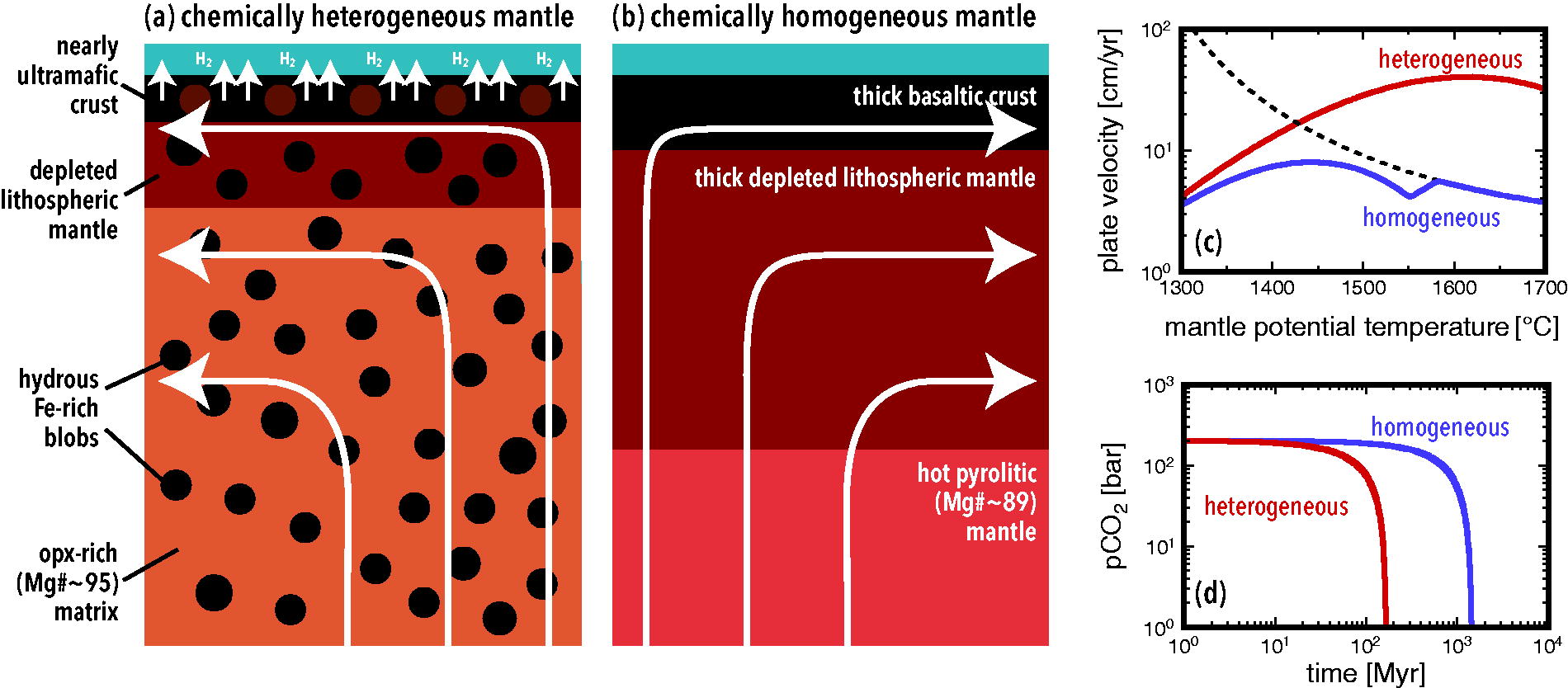
Schematic illustrations for
Hadean geodynamics does not exist in isolation. It has to inherit what is left with magma ocean solidification and transition into Archean geodynamics. The components of the Earth system do not exist in isolation, either. The mode of mantle convection has consequences on the atmospheric composition and thus surface environments, along with crustal evolution and geodynamo. Even with plate tectonics, the surface temperature would be well above 200°C until the mid-Archean, if we assume a normal pyrolitic mantle (Miyazaki and Korenaga, 2022). With stagnant lid convection in early Earth, the situation would be much worse. If plate tectonics started at ∼3 Ga, as many geologists have speculated (e.g., Brown et al., 2020; Cawood et al., 2022; Condie et al., 2015; Debaille et al., 2013; Palin et al., 2020; Shirey and Richardson, 2011; Tang et al., 2016; Van Kranendonk et al., 2007), the surface temperature would have been above 200°C until ∼2 Ga because, with standard plate tectonics, it would take one billion years to sequester ∼100 bar of atmospheric CO2. Such evolution of surface environments is in conflict with the geological record, let alone the history of life.
As noted in the Introduction, although Archean terranes are globally distributed, their degree of preservation is highly variable, and their spatial extent is extremely limited. In addition, the interpretation of these limited field data is hardly unique. For example, the stagnant lid and heat pipe interpretation of the Itsaq Gneiss Complex (Ramirez-Salazar et al., 2021; Webb et al., 2020; Zuo et al., 2021) is contested by Nutman et al. (2021), and the stagnant lid interpretation of the Superior Province (Bédard, 2006, 2018) is questioned by Windley et al. (2021). Both Nutman et al. (2021) and Windley et al. (2021) argue that field data are most consistent with the operation of plate tectonics by the Eoarchean. Paleomagnetic evidence for plate tectonics based on paleolatitude data exists back to ∼3.25 Ga (Brenner et al., 2020, 2022). Based on the zircon-based estimates of the geomagnetic field intensity, Tarduno et al. (2023) recently suggested the operation of stagnant lid tectonics from the Hadean to the Paleoarchean, but according to Fu et al. (2024), Archean zircon paleointensities do not provide evidence for or against plate tectonics before 3.4 Ga.
Besides the nonuniqueness of geological interpretations, the literature on early Earth tectonics has also been confounded with demonstrably incorrect data interpretations. An example is the continental growth model of Dhuime et al. (2012), based on which the authors suggested that plate tectonics started at ∼3 Ga. Repeatedly advanced through a series of review articles written by Chris Hawkesworth’s group (Cawood et al., 2013, 2018; Dhuime et al., 2017; Hawkesworth et al., 2016, 2017; Kemp and Hawkesworth, 2014), this model has been quite popular. However, their growth model, which is based on the procedure originally developed by Belousova et al. (2010), has no logical connection to continental evolution. Belousova et al. (2010) proposed that one could estimate crustal growth by processing the U-Pb crystallization ages and hafnium (Hf) depleted mantle (DM) model ages of zircons in a certain way, but their procedure is logically and mathematically flawed. The procedure of Belousova et al. (2010), hence that of Dhuime et al. (2012), has repeatedly failed when synthetic crystallization ages and DM model ages generated for a variety of crustal growth models have been tested (Korenaga, 2018b, 2021a); their procedure always returns a growth model similar to that proposed by Dhuime et al. (2012), even when a true growth model has no resemblance to it. Nevertheless, Hawkesworth and colleagues continue to write similar review articles without acknowledging this fact and, to date, they have not addressed the findings of other studies that contradict their growth model (Cawood et al., 2022; Hawkesworth et al., 2019, 2024; Mulder and Cawood, 2025). Thus, confusion with continental growth and its implications for early tectonics will likely persist for some time (e.g., Reimink et al., 2023; Zhu et al., 2023). The reader is encouraged to read a thorough review on this issue by Korenaga and Spencer (2025).
Numerous publications that advocate for stagnant lid convection or its variants on early Earth surely give the impression that it is the dominant view in the geology community or is even its consensus (e.g., Bauer et al., 2020; Bédard, 2018; Brown et al., 2020; Cawood et al., 2022; Condie et al., 2015; Debaille et al., 2013; Johnson et al., 2014; Moore and Webb, 2013; O’Neill et al., 2007; Palin et al., 2020; Piper, 2013; Rozel et al., 2017; Shirey and Richardson, 2011; Smit et al., 2019; Stern, 2018; Tang et al., 2016; Tarduno et al., 2023; van Hunen and Moyen, 2012; Van Kranendonk et al., 2007). This situation is puzzling given the conflicting interpretations of the early geological record and the total lack of theoretical support. Mark Harrison attributes the status quo to “a persistent groupthink that discourages creativity and individual responsibility” (Harrison, 2023), and he suggests that “the sooner we tell young scientists that this is not a solved problem—but that there are multiple working hypotheses with which to address it—the sooner we can harness their brainpower” (Harrison, 2024). This view echoes Planck’s principle quoted at the beginning of this mini-review and offers some hope for the future (e.g., Keller and Harrison, 2020; Keller and Schoene, 2018; Spencer, 2020; Spencer et al., 2022).
The remainder of this section will focus on the Hf isotope data of Hadean and Archean zircons, which have been used to argue for the absence of massive continental crust (e.g., Fisher and Vervoort, 2018; Salerno et al., 2021), as well as the operation of stagnant lid convection (e.g., Bauer et al., 2020; Drabon et al., 2022), both before ∼3.8 Ga. As explained below, these arguments are based on an unrealistic assumption of mantle convection, which has long been entrenched in the geochemical literature. Some basics of the Lu–Hf isotope system are given first. During the partial melting of silicate rocks, Hf is generally more incompatible than Lu, so the Lu/Hf ratio of the crust (i.e., the solidified melt) is decreased and that of the mantle residue is increased, with respect to that of the source mantle. One of the isotopes of lutetium, 176Lu, decays to 176Hf with a half-life of ∼36 billion years, so 176Hf/177Hf of the mantle residue (177Hf is a nonradiogenic stable isotope) becomes greater compared with the chondritic uniform reservoir (CHUR), whereas the 176Hf/177Hf of the crust becomes smaller. These deviations from the reference CHUR evolution are usually expressed with the ε-notation (εHf(t) ≡ [(176Hf/177Hf)sample(t)/(176Hf/177Hf)CHUR(t)−1] ×104) where t is the age of the sample. Thus, if a massive amount of continental crust was created at, for example, 4.5 Ga, it would have created a corresponding DM, the εHf of which becomes more and more positive as time proceeds (Fig. 2, “4.5 Ga DM evolution (instantaneous mixing)”). Crustal rocks or zircons with positive initial εHf values are usually considered to represent the Hf isotope evolution of the DM, and as one can see in Fig. 2, zircon εHf values become unambiguously positive only after ∼3.8 Ga. Based on this observation, Fisher and Vervoort (2018) concluded that, as far as the Hf isotope record is concerned, there was no record of early Earth mantle depletion on a planetary scale before 3.8 Ga, which requires the volume of continental crust produced during the time of early Earth to be very modest.
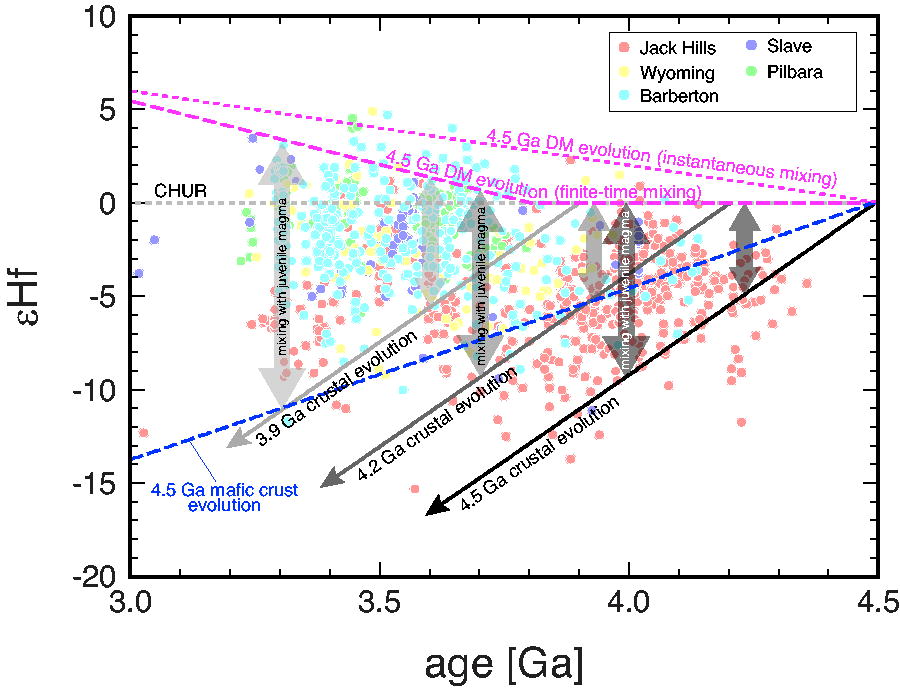
The Hf isotope data of igneous and detrital zircons from several Archean cratons: Jack Hills (red circle), Slave (purple), Wyoming (yellow), Pilbara (green), and Barberton (blue) (Amelin et al., 1999, 2000; Bauer et al., 2017; Bell et al., 2014; Drabon et al., 2022; Frost et al., 2017; Gardiner et al., 2017; Harrison et al., 2008; Iizuka et al., 2009; Kemp et al., 2010, 2015; Mueller and Wooden, 2012; Petersson et al., 2019a, 2019b; Reimink et al., 2016, 2019). Also shown are the CHUR evolution line (gray dashed), the 4.5 depleted mantle evolution lines (thin-dashed for instantaneous mixing and thick-dashed for finite-time mixing), the trajectories of felsic crust formed at 4.5 Ga, 4.2 Ga, and 3.9 Ga (different shades of arrow), and the evolution of mafic crust formed at 4.5 Ga. Thick vertical arrows depict the effect of crustal reworking by juvenile magmas. CHUR = chondritic uniform reservoir.
This isotopic inference on the evolution of mantle depletion assumes, however, that the effect of continental crust extraction is instantly reflected in the isotopic composition of the DM. This assumption has its origin in the traditional geochemical box models of crust–mantle differentiation (e.g., DePaolo, 1980; Jacobsen and Wasserburg, 1979; McCulloch and Bennett, 1994), which aim to track the average isotopic composition of the DM. When a piece of continental crust is formed, it is of course reflected instantly in the average mantle composition, but this does not mean that such a change in mantle composition is immediately observable. When the mantle undergoes partial melting, its melt product, which has a low Lu/Hf ratio, erupts and becomes crust, which is in principle immediately accessible. But the corresponding mantle residue, which has a high Lu/Hf ratio, is chemically depleted and thus is unable to produce further igneous products that carry its depleted signature. To observe the signal of mantle depletion in the form of igneous products, therefore, this mantle residue has to mix with more fertile components such as the primitive mantle or recycled crust so that it can impart its isotopic signals to melt products, and the rate of this mixing is regulated by the vigor of mantle convection (e.g., Davies, 2002; Olson et al., 1984; Tackley, 2015). Recently, by modeling the Hf and Nd isotope evolution with the thermal evolution of the mantle, Guo and Korenaga (2023) were able to constrain the timescale of mantle mixing to be ∼700 million years in early Earth. Thus, the appearance of positive εHf signals at ∼3.8 Ga is entirely consistent with the formation of a massive amount of continental crust during the early Hadean [Fig. 2, “4.5 Ga DM evolution (finite-time mixing)”], and such large-scale crust–mantle differentiation likely requires the operation of plate tectonics (e.g., Campbell and Taylor, 1983; Korenaga, 2021a). In fact, because of this finite-time mixing effect, starting to form a large volume of continental crust at 3.8 Ga, as suggested by Fisher and Vervoort (2018), would result in the appearance of positive εHf signals only from ∼2.5 Ga (Guo and Korenaga, 2023), which grossly contradicts the observation.
This finite-time mixing effect also has important implications for how to interpret the Hf isotope signal of crustal rocks. By compiling the Hf isotope data of igneous and detrital zircons sampled from various Archean cratons, Bauer et al. (2020) showed a secular shift to higher εHf after ∼3.8 to ∼3.6 Ga; from this, they proposed that the global shift in the Hf isotope signals reflects a gradual transition from stagnant lid convection to plate tectonics. Their reasoning is that the Hf isotope data before the shift reflect continental crust formation by internal reworking of long-lived mafic protocrust, whereas those after the shift need input of more juvenile magmas (i.e., with higher εHf values), which were likely produced from the melting of subducted oceanic lithosphere. However, given that the evolution of continental crust generally involves continuous reworking of preexisting crust by juvenile magmas (e.g., Farmer and DePaolo, 1983; Iizuka et al., 2010; Patchett and Arndt, 1986), the global shift in the crustal εHf signal can also be explained by the aforementioned delay in the appearance of positive εHf signals in juvenile magmas (Fig. 2). Thus, the Hf isotope data alone do not require a transition in global tectonics. More recently, Drabon et al. (2022) reported a similar shift in εHf also in detrital zircons from the Barberton Greenstone Belt, South Africa, and they also showed that, based on the classification scheme developed by Grimes et al. (2015), the trace element signatures such as U/Nb and Sc/Yb of these zircons were consistent with a transition from mid-ocean ridge or plume-derived environments to subduction arc environments at 3.8 Ga. The interpretation of such trace element signatures is, however, less straightforward compared with isotope signals, and it is still in a state of flux (cf. Jiang et al., 2024).
As reviewed in the previous two sections, there is no strong requirement to assume stagnant lid convection in early Earth, either theoretically or observationally, despite its continued popularity in the literature. Nevertheless, it is still worth entertaining the possibility of stagnant lid convection when speculating on early Earth environments, to facilitate discussion on prebiotic environments and their potentials for the emergence of life. In this section, therefore, surface environments expected for stagnant lid convection are discussed first, followed by those for plate tectonics.
As noted in Section 2, the efficient sequestration of atmospheric carbon is not possible with stagnant lid convection, so early Earth would have been covered by a Venus-like, dense CO2-rich atmosphere, as a result of magma ocean solidification (Fig. 3a). Because of this atmosphere, the surface temperature would exceed 200°C, and the ocean would be very acidic; note that, even with this high surface temperature, a water ocean could still exist because of high atmospheric pressure (Abe, 1993). Without plate tectonics, magmatic activities would be limited to those by mantle plumes, the presence of which is nearly guaranteed through Earth’s history (Bada and Korenaga, 2018), so the surface would have been covered by mafic protocrust. Some authors suggested that the delamination of hydrated mafic crust could result in the formation of continental crust (Johnson et al., 2014; Piccolo et al., 2019; Rozel et al., 2017). However, the timescale of such delamination is shown to be too long to be effective (Mondal and Korenaga, 2018), and the part of the protocrust that would be subject to delamination was unlikely to be hydrated to begin with (Roman and Arndt, 2020), thereby undermining this mechanism.
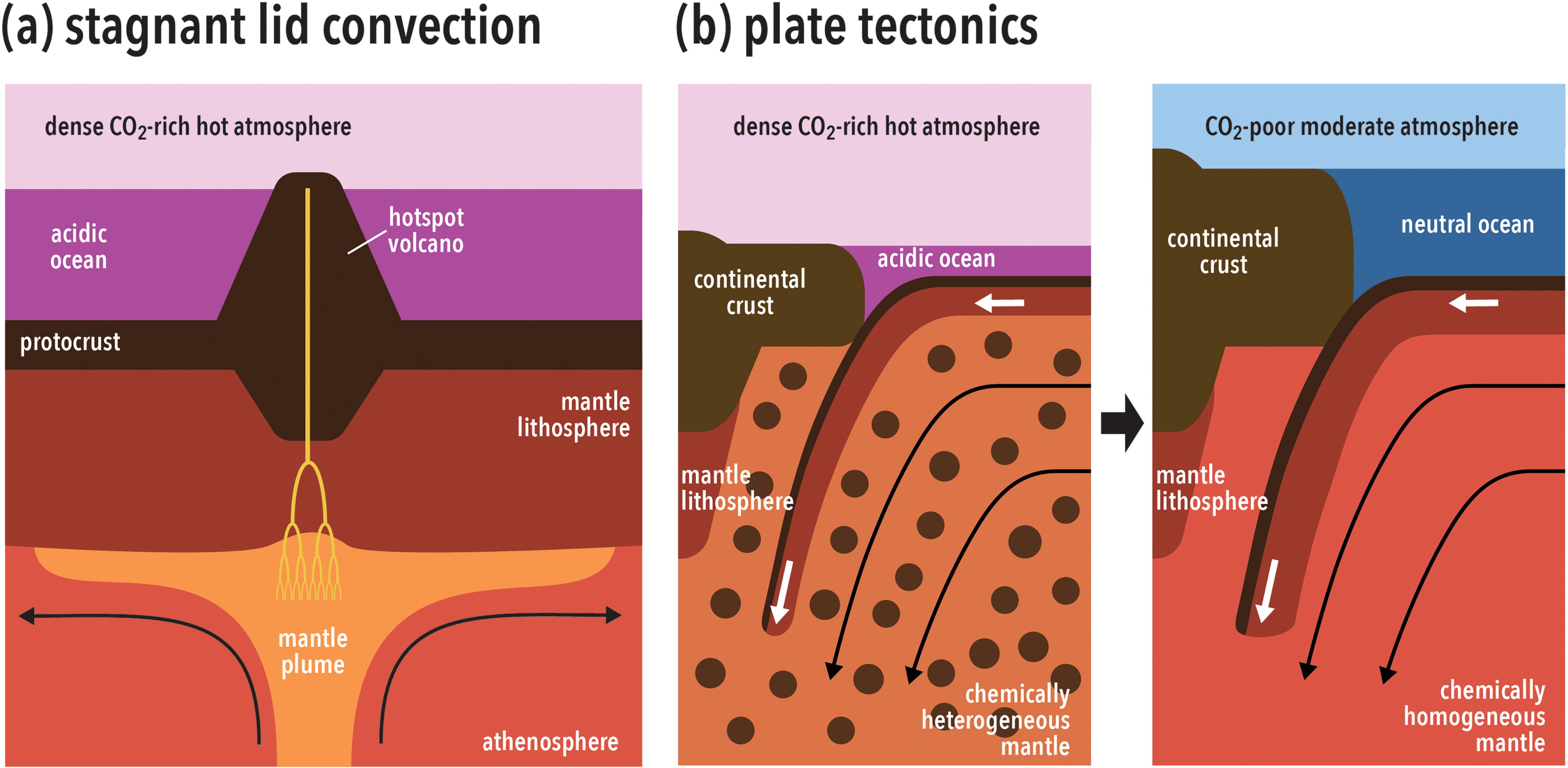
Schematic illustrations for likely early Earth surface environments expected for
Is there any way to avoid having this dense CO2-rich atmosphere after magma ocean solidification? If a magma ocean was sufficiently reduced, most carbon would exist as graphite or diamond in the magma ocean (Hirschmann, 2012; Keppler and Golabek, 2019), but such a situation would be difficult to achieve, because Earth’s magma ocean would be easily oxidized by its interaction with the metallic components of a giant impact (Armstrong et al., 2019; Deng et al., 2020; Kuwahara et al., 2023; Sossi et al., 2020). Another possibility is late accretion impacts, that is, the bombardment of leftover planetesimals after the Moon-forming giant impact (e.g., Marchi et al., 2014; Raymond and Morbidelli, 2021), as they could potentially blow off a large fraction of the preexisting atmosphere (e.g., Ahrens, 1993; Melosh and Williams, 1989). But such impacts would also bring their own volatile budgets to early Earth (e.g., de Niem et al., 2012; Sinclair et al., 2020), and the net effect of late accretion on the atmospheric mass is likely to have been small; Venus is still covered by a dense CO2-rich atmosphere, despite that it probably experienced more intense late accretion than Earth (Marchi et al., 2023).
If rapid plate tectonics can take place on early Earth, on the other hand, it is possible to sequester a large amount of atmospheric carbon into the mantle, within a few hundred million years. During this carbon sequestration, drastic changes would be expected in surface environments (Fig. 3b); the surface temperature would drop from >200°C to potentially below the freezing point of water (Zahnle et al., 2007), the ocean volume would increase because of mantle degassing (Miyazaki and Korenaga, 2022), the acidic ocean would become neutral (Guo and Korenaga, 2025; Sleep and Zahnle, 2001), and a large volume of continental crust would form, some of which could emerge above sea level (Korenaga, 2021b). A chemically heterogeneous mantle, resulting from the fractional crystallization of a magma ocean, would not only enable rapid plate tectonics but also help create locally reducing marine environments (Miyazaki and Korenaga, 2022), which may have been important for the abiotic synthesis of organic molecules (e.g., McCollom, 2013; Russell and Hall, 2006). Rapid plate motion also means spatially expansive mid-ocean ridge hydrothermal systems around the globe. This initially heterogeneous mantle would have gradually been mixed back to a familiar, homogeneous pyrolitic mantle, and the tempo of plate tectonics would have settled down to the modern level (Fig. 1c). These transitions in surface environments could have allowed Earth to experience prebiotic chemistry under a vast range of physical and chemical conditions.
Similarly drastic changes in surface environments would still be possible even with stagnant lid convection, because of late accretion impacts (e.g., Benner et al., 2019; Maher and Stevenson, 1988; Sleep et al., 1989; Zahnle et al., 2020). A large late accretion impact could create a nearly global magma ocean (e.g., Citron and Stewart, 2022; Marchi et al., 2018) and heat up the core substantially (Marchi et al., 2023). The effect of core heating is particularly important for stagnant lid convection, because without late accretion, core heat flux under stagnant lid convection could be too low to generate a geomagnetic field, even though a geomagnetic field may have been essential for shielding high-energy cosmic rays from the young Sun (Griessmeier et al., 2005). Smaller impactors are likely to have been less consequential, but the size-frequency distribution of late accretion impacts is such that the cumulative effect of small impactors could be substantial for surface environments, including the atmosphere (e.g., Schlichting et al., 2015). A holistic evaluation of late accretion impacts on early Earth environments, especially with rapid plate tectonics as a background state, is critically needed.
As reviewed in Section 2, there is no theoretical reason to prefer stagnant lid convection over plate tectonics on early Earth. This does not mean, however, that the operation of plate tectonics is guaranteed throughout Earth’s history. It is just that the existing arguments that favor stagnant lid convection are flawed. There may still exist sound theoretical justifications waiting to be discovered, and it is hoped that the critiques presented in this mini-review will help fuel such future theoretical efforts. Another important theoretical task is to further our understanding of the relation between the growth of continental crust and the tectonic mode. At the moment, it appears nearly impossible to keep generating a large amount of continental crust as estimated by recent continental growth models (e.g., Guo and Korenaga, 2020, 2023) without invoking plate tectonics. This is because other mechanisms proposed for the generation of continental crust, such as the melting of hydrated crust by reheating (e.g., Annen et al., 2006; Petford and Gallagher, 2001) or delamination (e.g., Bédard, 2006; Johnson et al., 2014) and the interaction between hydrated peridotite and basaltic melt (e.g., Borisova et al., 2021a, b), do not seem capable of continuously generating felsic magma at a sufficiently high level. But again, this may also simply reflect the limitation of our imagination. For example, the magmatic consequences of stagnant lid convection with a chemically heterogeneous mantle are yet to be investigated. This is actually a good topic for stagnant lid enthusiasts to work on, because it is not easy to have a chemically homogeneous mantle after magma ocean solidification (Miyazaki and Korenaga, 2019).
Although the early geological record is and will remain to be of highly regional nature, it is still possible to infer some global characteristics of early Earth by identifying commonalities among different regions (e.g., Bauer et al., 2020) and by utilizing proxies that are likely to reflect something global such as the presence of surface water (Mojzsis et al., 2001), the oxidation of the mantle (e.g., Trail et al., 2011), and the degree of mantle depletion and degassing (e.g., Bennett et al., 2007; Caro et al., 2017; Pujol et al., 2013; Rizo et al., 2012; Roth et al., 2014). Given the interconnectedness of the Earth system (Section 2), new constraints on the physical and chemical states of early ocean and early atmosphere would be extremely useful. The existing constraint on the atmospheric CO2 abundance in the early Archean is rather indirect, depending on an atmospheric photochemistry model for the mass-independent isotope fractionation of sulfur (Catling and Zahnle, 2020; Farquhar et al., 2001). The early ocean pH has been controversial, with estimates ranging from strongly acidic to alkaline (e.g., Friend et al., 2008; Kempe and Degens, 1985; Macleod et al., 1994), and the ocean pH is strongly coupled with the atmospheric CO2 level (e.g., Guo and Korenaga, 2025; Halevy and Bachan, 2017; Sleep and Zahnle, 2001). Fluid inclusions in Archean hydrothermal quartz suggest no significant temporal change in seawater salinity (Marty et al., 2018), although the geochemical budget of halogens suggests that the salinity of the very early ocean could have been thrice higher than the present-day level (Guo and Korenaga, 2021).
From the perspective of prebiotic chemistry, the case of stagnant lid convection is probably still worth considering. Late accretion could potentially create a transient situation favorable for the emergence of life, although long-term surface environments would eventually bounce back to their scorching background state inhospitable for life. Without plate tectonics, it would be difficult to generate a large amount of continental crust, which is a prerequisite for a spatially expansive exposed landmass (Korenaga, 2021b), which in turn would be favorable for the warm little pond hypothesis of abiogenesis. The lack of plate tectonics, however, is not advantageous to the submarine hydrothermal origin of life, either, because the ocean would have been globally hot (>200°C). In contrast, rapid plate tectonics on early Earth, along with the effects of late accretion impacts, offers a vast physical and chemical parameter space to explore. The origin of life does not have to be restricted to one particular tectonic locality (e.g., Baross et al., 2020; Stüeken et al., 2013), and evolving plate tectonics (Fig. 3b) can host a diverse range of environments. The details of each of these environments, as well as their possible interactions in space and time, are yet to be investigated.
Footnotes
Acknowledgments
The author thanks Tim Lyons, Karyn Rogers, Loren Williams, and Ram Krishnamurthy for their kind invitation to contribute to this special issue. The author thanks three anonymous reviewers for their constructive comments, which helped improve the accuracy and clarity of the article.
Author Disclosure Statement
No competing financial interests exist.
Funding Information
This research was supported, in part, by the US National Aeronautics and Space Administration under Cooperative Agreement No. 80NSSC19M0069 issued through the Science Mission Directorate.
Associate Editor: Jack Mustard