







Abstract
Securing meaningful employment is a priority for many autistic people. In this innovative knowledge translation study, we developed and piloted an online employment platform about the needs of autistic job seekers using feedback from autistic job seekers, caregivers, and employment professionals throughout the process. Development of the online platform unfolded iteratively and based on the feedback provided. In Phase I, we conducted focus groups with 29 participants (7 autistic job seekers, 6 parents, and 16 employment professionals) about employment-related barriers (e.g., concerns with traditional hiring practices). They suggested how the content and design of an online platform could ultimately support employment success for autistic job seekers. The preliminary user-informed website functioned as a resource repository and an active community-maintained section for website members to post and answer employment-related questions, job postings, and related events. In Phase II, we surveyed nine participants (eight autistic job seekers and one caregiver of an autistic job seeker) about their website experiences. We incorporated their feedback into the redesigned website. In Phase III, we asked 14 participants (7 autistic job seekers and 7 supporters of autistic job seekers) to test the redeveloped website. We articulate how the feedback from autistic job seekers, caregivers, and employment professionals was used to develop an online platform. We describe their input and how it was embedded throughout the study, an approach future researchers should prioritize when initiating projects to serve a particular community’s needs.
Community Brief
Why was this program developed?
We developed an online employment platform because many autistic people are looking for work and may go online to find information and resources. It is important that they find resources and tools that meet their needs and the needs of those supporting them.
What does this program do?
This online platform curates employment information and provides the opportunity for autistic people and other community members to share information about employment.
How did the researchers evaluate the new program?
We ran focus groups with autistic self-advocates, mothers, and employment professionals about autistic job seekers’ employment needs. We used their recommendations to build an online platform. In Phase II, eight autistic self-advocates and one caregiver of an autistic job seeker, and in Phase III, seven autistic self-advocates and seven supporters of autistic job seekers tested the website and provided feedback about their experiences. We used their input to redesign the website. Given the role employer attitudes and caregiver support play in helping autistic people find work, we included different people’s opinions when developing and piloting the platform.
What were the early findings?
Participants recommended how to tailor a website to meet autistic people’s needs and the types of content they wanted to see. Participants provided suggestions for how to design a website that was accessible (e.g., including a mix of images, text, and video), interactive (e.g., a community-driven section with community-generated content; opportunities to interact with others), and organized according to different member priorities (e.g., employers and those supporting autistic people to find work). We used this information to develop an employment website. We showed the website twice to different groups of autistic people and their allies and received feedback. We kept the things people liked and tried to revise the website for identified areas of improvement.
What were the potential weaknesses in this project?
We collected less information about our focus group research participants (e.g., age, work experience) than we would have liked. Another potential area for improvement in our study was the small number of research participants who provided feedback on the website. If more people had participated, additional feedback could have helped us make different decisions about the website. We did not ask employers what they thought of our website, which may be something other researchers do in the future. Some autistic people may not like that other voices (e.g., caregivers) were included in developing this resource.
What are the next steps?
We are working toward partnering with a community agency to oversee the online platform’s management and help it grow by adding more content. There will be continued data collection about how the platform is used to help understand who uses it and what they need for job-seeking. Participants actively seeking employment described employment-related barriers and provided recommendations for future avenues of development.
How will this work help autistic adults now or in the future?
Overall, this project adds to the research emphasizing the importance of including autistic people and different supporters and advocates (e.g., family, friends, and professionals) in developing products and resources for autistic people. These results may help autistic adults in other locations and future studies by adding to our understanding of user-informed resources to support autistic people interested in employment.
Introduction
Many autistic people have identified vocational and employment success as one of their top priorities; unfortunately, many of these individuals experience high unemployment and underemployment despite their motivation to secure meaningful work opportunities.1–4 Because finding and maintaining employment can be challenging for autistic people, increased attention has been paid to addressing the barriers they face in finding and securing employment and ensuring they have the prerequisite employment skills, such as punctuality and communication, deemed necessary for workplace success. 5
Most employment interventions for autistic people have focused on developing pre-employment training programs, including in situ job coaching during secondary school education (e.g., cooperative or job placement programs) and improving the transitional planning support they receive when leaving secondary school.5,6 However, factors such as the short duration and long waitlists for these programs have created access barriers, which may limit the effectiveness of these options for autistic people.7–12 Therefore, finding novel ways to support existing employment programs and services or new ways to provide employment support at crucial junctures is vital for positively impacting the employment experiences of autistic people. 13
Emerging Practice
Autistic people and caregivers increasingly rely on online resources to find information about various topics and solutions to problems as they arise.13,14 Some online resources to help autistic people find and maintain employment exist; however, relatively little attention has been paid to how these resources and tools are provided to autistic job seekers and others supporting them and how these perspectives have been involved in the development process.
There is a need for practical employment support that addresses the unique obstacles to successful work among autistic people, especially prevocational skills. 5 Furthermore, employment-focused autism research on what autistic people need to enter, secure, and maintain work, including the role of family members or other support people, is also sorely needed. 15 While online resources may help in the job-seeking process, we know relatively little about autistic job seekers’ needs regarding online employment supports to help prepare them to market their job skills, network with employers, and ultimately secure work opportunities. While online resources for employment exist, and some are autism-focused, an empirically informed platform does not exist. For example, Mentra (https://www.mentra.com/) is a U.S.-based online platform that uses artificial intelligence to help neurodiverse job seekers find work. In Canada, the Autism Resource Centre (https://www.autismresourcecentre.com/) is an organization in Saskatchewan offering person-centered programming to empower the autistic community, including employment programs (e.g., work readiness, supported employment). Another Canadian organization, Ready Willing & Able (https://readywillingable.ca/), aims to increase the national labor force participation of autistic people and those with intellectual disabilities by connecting employers with employees. A course-based site, Autism Career Connections, provides autistic job seekers with a free course to develop skills associated with successful employment (https://www.autismontario.com/seekers). While existing models such as the ones described are available and may be helpful to many autistic job seekers and their supporters or allies, a systematic study of the unique needs of autistic job seekers that informs an online employment platform appears to be an underexamined area of research.
Finding ways to promote and increase the inclusion of autistic people in research and developing resources designed for them have experienced tremendous growth in recent years. In scholarly arenas, integrated knowledge mobilization, a form of engaged scholarship, has expanded the inclusion of autistic people in consultative or advisory roles to collaborative roles as integrated research team members contributing to the design and operations. 16 While several models have been put forward to increase the inclusion of autistic people in research, the desire to ensure autistic people have influence over the process and outcomes remains at the heart of all these initiatives. Furthermore, projects adopting inclusive strategies have demonstrated how input from autistic people can improve the quality of research design, ensure results are contextualized within the real world, and promote end-user adoption.
Given that these trends are influencing the lives of autistic people, the purpose of this article is to describe the development of an online platform using the feedback of autistic people and community members supporting autistic job seekers. The following questions informed the processes associated with this project:
From the perspectives of autistic people, caregivers, and employment professionals, what employment needs for autistic job seekers could be addressed using an online delivery platform (Phase I)? What are autistic people’s and caregivers’ experiences of a preliminary user-informed online employment platform (Phases II and III)?
Project Overview
The purpose of the project was to create an iteratively developed, localized online employment platform that autistic people and other community members supporting autistic job seekers in Ontario, Canada, could use. This project was completed in three phases. In Phase I, we held focus groups for autistic people and supporting community members, such as caregivers and employment professionals, to share their perceptions of the practical job-seeking needs of autistic people and how these needs could be delivered through an online platform. The results from these discussions were used to develop an employment website for autistic people and other community members (e.g., caregivers and potential employers). In Phases II and III, we shared a beta version of the online platform. We solicited feedback from autistic people and other community members who support autistic job seekers about the website design and content, incorporating their input into subsequent revisions.
Community Involvement
Consistent with an integrated knowledge translation framework, we prioritized the perspectives of autistic people and community members supporting autistic job seekers (e.g., caregivers and employment professionals) regarding what is needed for employment success for autistic people throughout the knowledge creation process and to create an online platform. 17 In each phase, we grounded our project decisions in the feedback from autistic job seekers, family members, and other supporters, and employment professionals.
Phase 1 Evaluation Methods
Participants
A purposeful and convenient sample of 29 autistic people, parents, and employment professionals (e.g., job coaches and case managers) interested in or attempting to help autistic people secure meaningful employment participated in one of five focus groups. Participants included 7 autistic young people (6 male and 1 female autistic participants), 6 mothers, and 16 professionals. All autistic people described getting help from another person for job-seeking, including help from parents, job placement agencies, and autism organizations. Autistic participants also identified experiencing several barriers to employment, including difficulties generalizing classroom learning to the workplace, only being offered seasonal or temporary/contract work, and no on-the-job support (e.g., for completing workplace safety training). Autistic focus group participants reported they were looking for a job or a new job. Additional demographic data were not recorded.
Procedures
Following institutional research ethics clearances (Brock University REB:19-043 and Hamilton Integrated Research Ethics Board REB Project #: 7837), we recruited participants by posting physical study flyers and distributing electronic study flyers across local autism organizations, agencies, and academic institutions in Ontario, Canada. Interested participants contacted the lead research assistant (J.P.), who explained the study’s parameters, collected informed consent, and organized which focus group they would participate in.
We conducted five focus groups ranging in size from four to nine participants. The first four focus groups were conducted in person, and the fifth focus group was conducted virtually due to the COVID-19 pandemic. The in-person focus groups were held in community organization meeting rooms made available by community research team members. The virtual focus group was held on Lifesize, a secure videoconferencing platform. Focus group durations ranged from 41 to 62 minutes, with an average duration of approximately 50 minutes. Two facilitators from the research team led each focus group.
We followed a semi-structured interview guide consisting of closed- and open-ended questions to understand what the participants believed were the employment needs and experiences of autistic people. The interview guide was used flexibly, and the facilitators asked the main questions relevant to the project’s goals and followed up with probes (e.g., “Could you tell us more about X?”) for additional participant insights when appropriate. During each focus group, participants were asked about their experiences with job-seeking, job-seeking support, online job-seeking tools or resources, and input on tools and resources needed to help people on the spectrum prepare for work. The primary questions asked during focus groups are in the Supplementary Data. At the end of each focus group, facilitators invited all participants to share any additional feedback with the research team following the research session.
Data analysis
The focus group discussions were audio recorded and transcribed verbatim. L.W. and C.B. checked the transcripts and audio recordings to ensure accuracy. We used NVivo 12 (QSR International, 2019), a qualitative data management software, to organize and analyze the data from the focus groups into codes, subthemes, and themes. Following an initial read of all transcripts, J.P., L.W., and C.B. developed a codebook, including code labels and definitions, to support the coding process. 18 The research team worked together to finalize the codebook details. 19
We analyzed the transcript data following Braun and Clarke’s thematic analysis steps. 20 This approach was selected because it is flexible and not associated with a particular theoretical orientation. 20 Research team members (P.B.R., J.P., L.W., and C.B.) reviewed the transcripts. J.P., L.W., and C.B. generated the initial codes from the data. Then, the research team met to review the initial codes and sort them into subthemes and themes that suggested how to organize the website, areas of interest to autistic job seekers, and gaps and barriers in existing resources for autistic job seekers. During discussions about the platform development’s next steps, we considered each participant group’s recommendations (i.e., autistic job seekers, parents, and professionals). We also used the information generated from deductive (i.e., analyzed responses by question) and inductive (i.e., analyzed responses irrespective of the interview questions) analyses.
Data quality
To establish data dependability and credibility, we included strategies, such as the research team codeveloping a codebook, thick descriptions, and investigator triangulation.19–21 As described above, during data analysis, we developed a codebook to support a systematic approach. 18 We also ensured a thick description of the themes developed from the analyses by ensuring they included multiple exemplars and insights from multiple participants. 21 Finally, we incorporated investigator triangulation, in that author subteams conducted focus groups (e.g., P.B.R. and J.P. conducted two focus groups, and J.P. and L.W. conducted a focus group), and all authors were involved in analyzing and interpreting the data. 21
Phase I Results
Focus group participants provided ideas on what content autistic job seekers need and how to tailor an online employment site for autistic people. Overall, participants identified that different groups (e.g., autistic people, caregivers of autistic job seekers, employers) have different needs and suggested that an online employment platform should include audience-specific information and resources. Participants also emphasized the importance of sharing existing employment resources with others and providing the opportunity to hear from others with similar experiences on the platform. They suggested that the online platform include connections, community, and networking opportunities. These recommendations were observed within and across the focus groups. Sample quotes for each participant group can be found in Table 1.
Themes from Phase 1 Focus Groups with Autistic People, Mothers of Job Seekers, and Employment Professionals
Autistic job seekers
Autistic participants emphasized the importance of creating content on an online employment resource that (1) provides employer-focused information about flexible and transparent employment practices and (2) is an engaging and community-informed online platform. Regarding the online platform content, autistic participants identified that employers needed information about adopting flexible recruitment and hiring processes. This included being open to different application submissions beyond the standard cover letter and résumé and providing autistic job applicants with different interview modality options (in-person, online, phone) that worked best for them. Participants also identified that employers needed assistance to communicate their expectations and limitations regarding employment upfront and how to provide specific, concrete feedback to autistic employees about their performance. For example, one autistic person suggested that if an autistic job seeker is unsuccessful in securing the posted position, the interviewer should clearly explain why the autistic applicant was unsuccessful and suggest specific skills that might help them in future job searches.
Regarding the design of the online platform, autistic participants suggested it needed to be engaging. They described the importance of interactive engagement and multiple modes of information delivery. Some suggested ways of engaging autistic users included videos, checklists, guides, and practice or application exercises that provide demonstration and opportunities for skill rehearsal. Autistic participants also described the value of including a networking forum on the platform to help build a job-seeking community. In this networking section, job seekers could contribute information and resources and support one another by sharing experiences and ideas about what worked well and what did not. A user-engaged section could provide a general sense of connection with other members of the autistic job-seeking community.
Mothers of autistic job seekers
Mothers of autistic job seekers suggested that an online platform would benefit from organizing content according to sections for (1) employers, (2) caregivers, and (3) autistic job seekers. They identified that each of these parties has different roles in the employment of autistic people and, therefore, requires different information. For example, one mother identified that employers might benefit from hearing about how similar companies accommodated autistic people, which is distinct yet equally important as the practical strategies that autistic people need for job-seeking and job maintenance. Mothers described how employers needed resources detailing the benefits of hiring an autistic person. They suggested how employers could accommodate employed autistic people and demonstrate flexibility in their hiring practices. Mothers also stated that they needed information to help them support their children through the job-seeking process. This included tools and information about how to help the autistic person explore and cultivate possible interests and strengths that might lead to employment or suggest alternative forms of employment (e.g., self-employment). Mothers also advised that they would benefit from a networking option, enabling them to connect online with others and share experiences or resources. Finally, mothers discussed the need to include information on whether autistic job seekers should self-disclose autism in the workplace and during interviews, employee rights, and self-advocacy at work.
Employment professionals
Employment professionals described (1) the social and structural barriers to employment success, (2) limitations of existing online job-seeking resources, (3) concerns about the transferability of in-person supports and resources to an online environment, and (4) suggested online platform features to support autistic job seekers. First, professionals described how social and systemic barriers limited the employment opportunities for autistic job seekers. For example, they explained how traditional employment hiring practices (e.g., online application forms, standard resume practices, and interview formats) created barriers for autistic people. They also described how differences in potential employers’ organizational attitudes, values, and culture regarding diversity and inclusion in the workplace impacted autistic people. Specifically, they discussed how differences in potential employers’ knowledge about autism and how to accommodate autistic people and experiences hiring autistic workers could shape willingness to hire and retain autistic employees. They identified that, in turn, these differences affect autistic job seekers’ decision to disclose their diagnoses and need for accommodations, which could influence success once employed. Professionals also identified limitations in existing job-seeking supports and resources for autistic people, including the barriers to accessing employment services (e.g., inclusion criteria), which meant that some autistic people and parents had to incur expenses associated with in-person employment services. They suggested that an online platform with resources and information would be a cost-effective way to support autistic job seekers and parents trying to support these endeavors. Professionals also identified that many existing employment resources (including websites) were not autism-friendly and have been difficult and frustrating for both autistic people and employment professionals to navigate.
While professionals endorsed an online platform to support autistic people and those assisting them in seeking employment, they also expressed concerns about the limits of this resource. Professionals identified that they used numerous strategies to support autistic people in finding and sustaining employment and expressed concern about whether these strategies would translate well to an online modality. Specifically, they identified that they provided real-time support (i.e., immediate feedback), which was critical for job success and could serve as an important protective role for the autistic person in seeking or maintaining employment.
Finally, professionals made several recommendations for an online employment platform. They emphasized the importance of the platform being of no cost to users. They also discussed the importance of including resources and content for both autistic people and the people supporting the autistic job seeker (e.g., employment professionals, employers, caregivers, family members) on the platform. Professionals felt an online platform should include job-related skills training, such as how to dress for an interview. When asked about the utility of the forum, professionals suggested that a support chat option would be helpful, as would a voice-to-text service that could aid autistic participants in using the site. Finally, employment professionals described the benefits of building a network and integrating a job exploration element into the platform where autism-friendly job postings could be shared and viewed.
Initial Website Development of the Ready2Work Website: Preliminary Features and Functionality
Design, structure, and base content
Using the findings from Phase I, we developed the first iteration of the online platform. N.K. led the website’s development, given his expertise in software development. We incorporated basic black-and-white tones into the website’s aesthetic and the imagery throughout our first website iteration. The main landing page included a navigation bar with the following options: Resources, Jobs, Events, Discussions, and Register. See Figure 1 for an image of the website’s original main page.
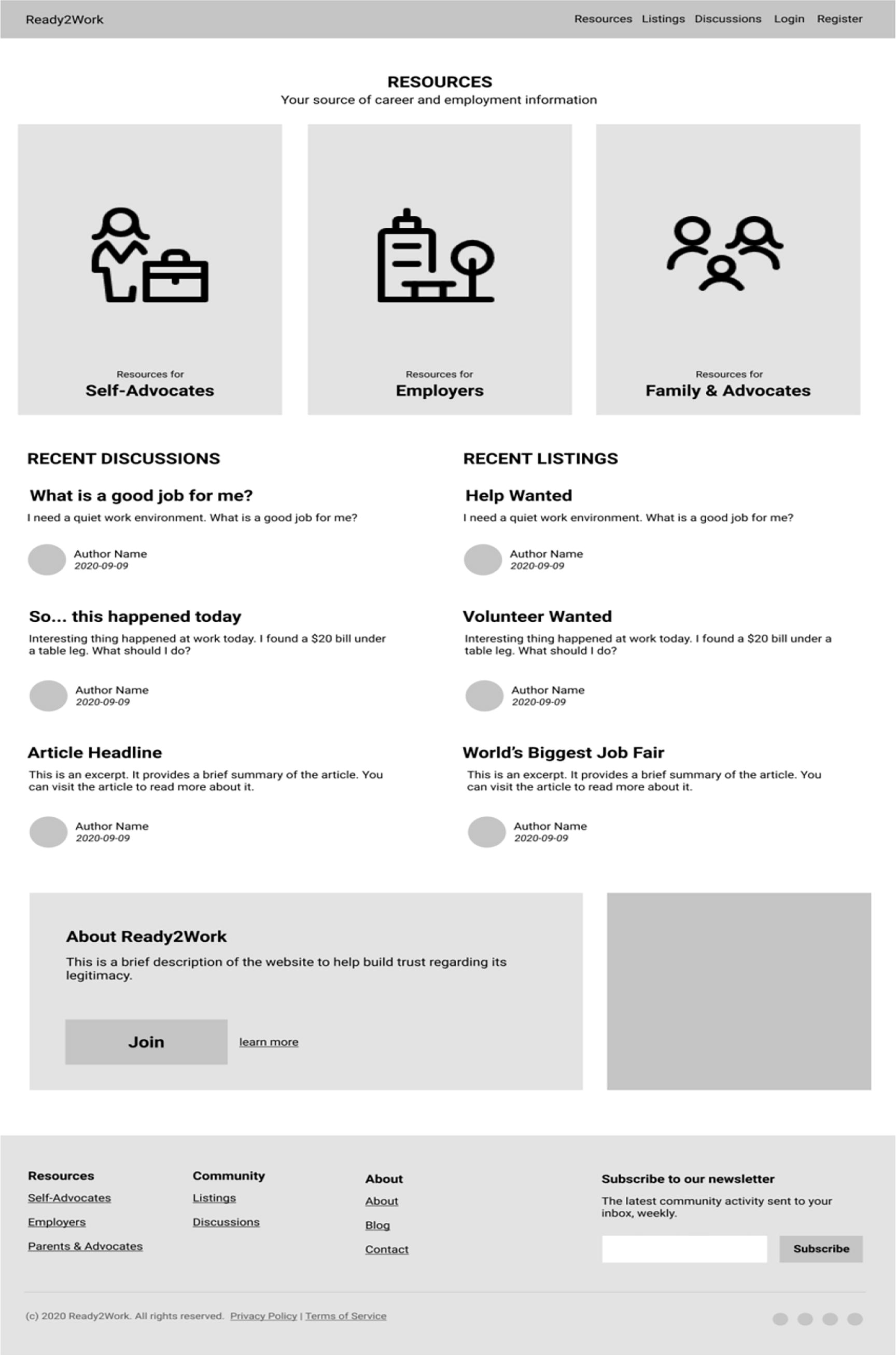
Ready2Work landing page after Phase I.
Based on the recommendation from autistic people and caregivers, the online platform was designed to serve a dual function for site visitors: (1) provide employment resources and information and (2) initiate a community-driven online engagement opportunity through the employment discussion forum and job listings page.
The Resources section, accessible from the main page, was intended for users to access employment-related information. This section included links to existing job-seeking content with a summary of what could be found in the link. We used icons to differentiate between the summarized content of a resource linked to an external site versus content created by research team members. All three participant groups recommended developing an online platform with information for different user types. As such, the website landing page permitted visitors to filter Resources content according to user type: (1) autistic job seekers, (2) potential employers, and (3) family and advocates.
The main page also included Listings and Discussions sections in response to the recommendation to engage users by creating networking and interactive opportunities between community members. We developed the Listings sections to curate active job postings, employment network opportunities, job fairs, and related events across the province. Postings in these sections were organized chronologically, with the most recent active posts at the top of the page. These sections were searchable, and website visitors could filter postings based on specific search parameters (e.g., part-time, full-time, paid, volunteer). The Discussions section was comparable with the Listings section and was designed to provide opportunities for autistic people to ask questions and discuss employment-related topics. Users could read others’ posts, reply to posts, and upload their own discussion content.
Finally, in the Discussions and Listings sections of the website, we included a feature that would enable job seekers to mark discussion posts and job listings as favorites through their registered accounts.
Phase I participants described the importance of developing a platform with engaging content (e.g., videos, pictures, text). Research team members populated the major sections of the website (i.e., Resources, Discussions, Listings) with content and topics expressed during the focus groups and other relevant employment resources (text-based content, videos, checklists) located via online searches. Content within each section was preliminary and used to provide a model for the remaining project phases and gather additional participant input on our beta test site. To further promote engagement, we included two columns on the landing page listing recent website activity (i.e., trending posts) from the Discussions and Listings sections as a way for website users to quickly identify posts that website users were accessing and engaging with. See Figure 2 for the Phase III iteration of our landing page.
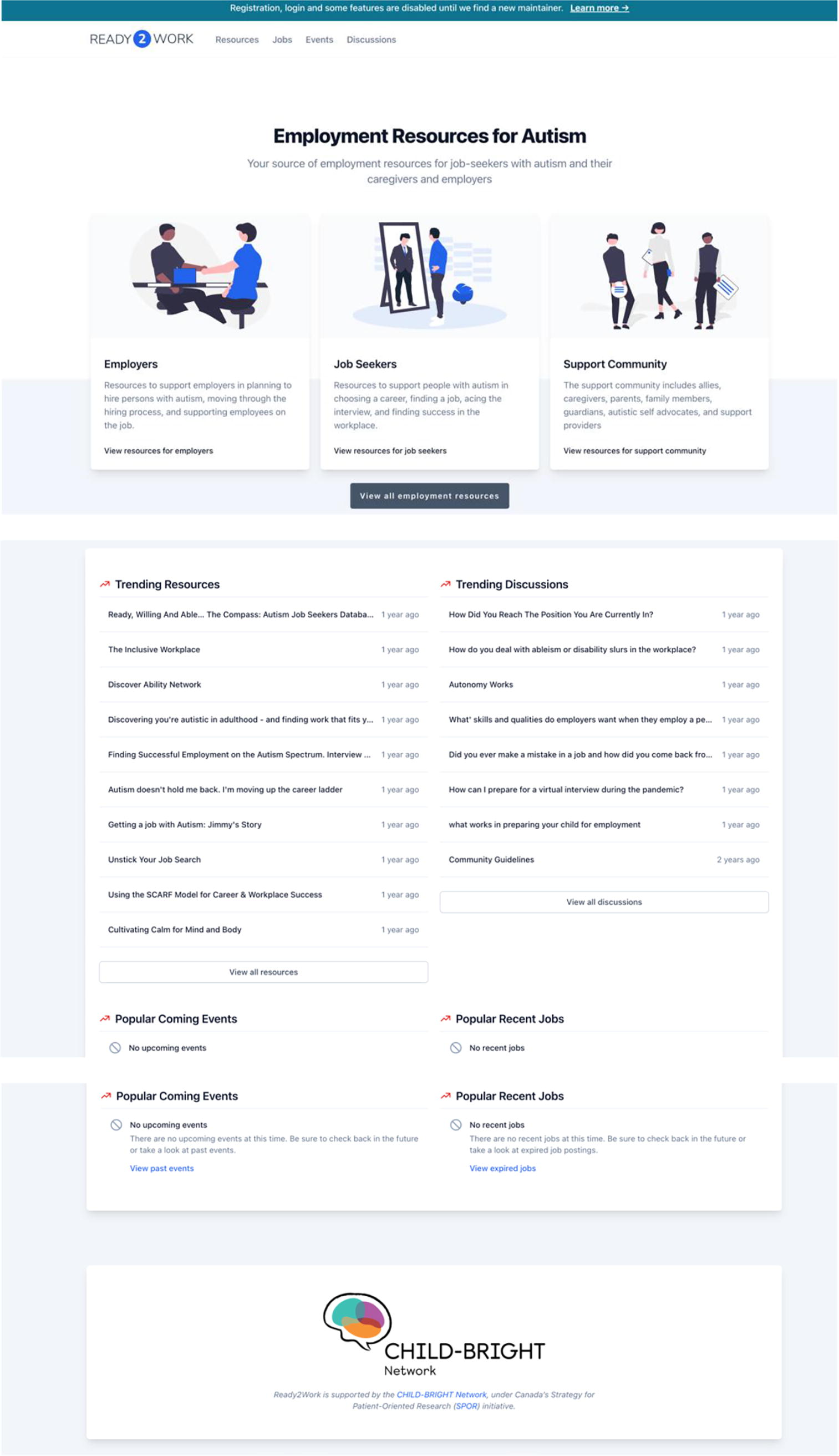
Ready2Work landing page for Phase III.
Online safety
The research team discussed the need to ensure community safety, particularly against predatory or spam postings, and our two project consultants, employment professionals working with autistic people, corroborated this concern. Therefore, as an additional safeguard, the research team decided that users were required to create an account and log in to participate in the Ready2Work community (e.g., submit resources and post questions and updates in the discussion forum) even though this was not a recommendation made during the focus group. Administrators (i.e., the researchers) approved website registrants and monitored posts to maintain community safety.
Phase II and III Evaluation Methods
To assess whether the site met the recommendations made by focus group members and addressed some of the concerns about employment for autistic people, Phase II and Phase III participants were given the opportunity to use the online platform and provide feedback. Because the procedures used for Phases II and III were the same, their methods are described here together.
Participants
Phase II
We recruited eight autistic people and one caregiver to use the website and provide their feedback. Given the project’s iterative nature and potential user-engaged goals, Phase I participants who expressed interest in continuing their involvement in subsequent study phases were first invited to participate. Of those invited, three autistic people from Phase I agreed to participate in Phase II.
Among our nine Phase II participants, one autistic participant and one caregiver did not complete the demographic questionnaire. For the seven other participants (all autistic self-advocates), four (57.1%) identified as male, two (28.6%) as female, and one (14.3%) as nonbinary. These participants were between 22 and 45 years old (mean [M] = 29, standard deviation [SD] = 8.37) and reported attaining, at minimum, a high school diploma or equivalent. Over half (n = 4) the respondents reported that they either did not have a job and were either seeking initial employment or were employed at the time of the study and were looking for a new job. Additional available demographic characteristics are presented in Table 2.
Demographic Characteristics of Participants
Seven of the nine participants in Phase II completed the demographic survey.
Participants were instructed to select all responses that applied to them.
SD, standard deviation.
Phase III
We recruited 14 participants, including seven autistic participants and seven supporters of autistic job seekers (i.e., parents and friends), to test the redeveloped website and provide additional feedback. Four participants participated in Phase II. Among the seven autistic participants, three (42.9%) identified as male, two (28.9%) identified as female, one participant identified as genderqueer, and one participant preferred not to specify. Autistic participants were between 23 and 45 years old (M = 28, SD = 7.62). Three autistic participants (42.9%) had completed their high school diploma or equivalent, and four (57.1%) pursued additional education (college diploma, certificate program) or other training. Regarding occupation, four autistic participants (57.1%) were employed either part-time (paid) or self-employed; three were unemployed at the time of the study. Three autistic participants (42.9%) had jobs at the time of the study, two of whom were looking for new ones. Additional available demographic characteristics are presented in Table 2.
Among the seven supporter participants, six (85.7%) were parents, and one was a friend (14.3%). Most supporter participants were employed (85.7%), and one was a full-time caregiver (14.3%). Regarding education levels achieved, one participant (14.3%) completed their high school diploma or equivalent, two participants (28.6%) had college diplomas, two participants (28.6%) completed undergraduate degrees, and two supporter participants (28.6%) completed Master’s degrees. Three supporter participants (42.9%) reported being part of a group that connects people supporting autistic job seekers to relevant employment resources. One supporter participant (14.3%) reported taking a formal training or course to support the autistic job seeker in their life.
Procedures
We invited Phase I and Phase II participants who expressed interest in continuing their study involvement to participate by emailing them directly with the recruitment materials. New participants were recruited by posting physical study flyers and distributing electronic flyers across local autism organizations, agencies, and academic institutions. Interested participants were asked to contact the lead research assistant.
We invited participants to attend research sessions independently or, if preferred, with another person (e.g., a support person or caregiver) on Lifesize. During the session, we asked participants to perform simple tasks on the website and an open exploration of the site before completing an online survey composed of rating scales and open-ended questions to assess their perceptions and experiences of the website. The survey questions can be found in the Supplementary Data. We also obtained consultative support from two employment professionals from a local autism organization specializing in adult employment support to help us contextualize the interview findings and make recommendations. During this phase, these professionals volunteered an hour to meet with P.B.R. and J.P. and provide additional input on the website, which was shared with the research team.
Data analysis
We analyzed the survey data descriptively using SPSS Version 25. The means of the participants’ ratings were calculated for the website’s form and functionality (e.g., clarity, utility, ease). The responses to the open-ended questions were aggregated and analyzed according to the question. More specifically, open-ended responses were content analyzed, 22 by which responses were categorized according to feedback type (positive feedback, negative feedback, suggestions for improvement). Research team members reviewed the aggregated survey responses and determined the technological feasibility of addressing or incorporating the recommendation or idea into revamping the website. This resulted in a prioritized list of tasks needed to update the website.
Phase II Results
All participants rated having a positive experience of the online platform on the survey and provided promising and constructive comments in open-ended questions about their engagement with the website. Overall, participants rated the initial website iteration favorably. Eight of the nine participants (88.8%) rated the website information as either “somewhat useful” (n = 4) or “very useful” (n = 4). Furthermore, eight participants (88.8%) indicated that the website met or exceeded their expectations and that they would likely revisit the website for employment resources. That said, one autistic participant identified that while some resources met a need for job-seeking, some of the other resources made them feel anxious about the job-seeking process. They stated, “…The resources that I found most helpful on the website were concerning disclosure and self-advocacy, but the interview tips made me more anxious about finding a job instead of less.”
Regarding the usability of the website, five participants (55.6%) found the site “easy,” and three participants (33.3%) found the site “very easy” to navigate. Three participants (33.3%) indicated they believed the website would be “somewhat useful” and four participants (44.4%) indicated they believed the site would be “very useful” to support their employment needs. In support of these ratings, one autistic participant said, “The [user interface] is very streamlined, easy to navigate, and understandable.” Another autistic participant stated, “I felt that the site is easy to use and has many wonderful features that I had no idea about.” While participants in Phase II provided positive ratings and feedback for the site, they also identified challenges in its use. For example, one autistic participant identified that some clarity was needed to get started on the website; specifically, they said, “I was confused at first and needed to ask for help.”
Six participants (67%) reported that they would likely post on the website, and eight (88.8%) indicated they would likely revisit it for employment information. See Table 3 for additional participant feedback. Combined, these results suggested that users liked the online platform’s content and format but felt that greater clarity and direction about using the website were needed. These results were subsequently incorporated into the website’s second iteration.
Phases II and III Website Usability Results
(1 = unclear to 3 = clear).
(1 = not at all useful to 5 = very useful).
(0 = strongly disagree to 7 = strongly agree).
(1 = very unlikely to 5 = very likely).
(1 = very difficult to 5 = very easy).
(1 = did not meet my expectation to 3 = exceeded my expectations.
(1 = not useful at all to 5 very useful).
(1 = very unlikely to 5 = very likely).
M, mean; SD, standard deviation.
Refinement of the Ready2Work Website: Updated Features and Functionality
The research team members discussed potential modifications in detail based on the results and recommendations from our Phase II participants and consultation with two employment professionals. N.K. updated the website to address participants’ recommendations for improving engagement and content streamlining. To address autistic participants’ requests to highlight and see what others found helpful, we added a popularity voting system where users could “upvote” favorite resources, jobs, events, or discussions. A list of recently upvoted items was added to the website’s home page so regular visitors could quickly see what was recently upvoted. We also addressed participants’ concerns about clarifying how to use the site by streamlining the Resource page and removing the comment feature. We also added the comment feature to the Discussions page to help organize and facilitate discussions and to provide direction to users about where it was appropriate to engage in conversation (i.e., in the community discussion forum).
We made additional changes to improve the website’s functionality and user interface. Many of these revisions were made to filter posts that may be irrelevant or unhelpful to the user, and that would help streamline users’ ability to find what they were looking for. For example, we integrated additional filtering options that allowed users to filter resources by cost (i.e., free vs. paid resources). We also asked registered members about the expiration date of job postings and events so that they would be hidden after their expiration date, yet they could still be searched for and viewed after they had expired. To further enhance community safety, we included a footer message on the website referencing a provincial external community contact that could connect people to community programs and support if needed. Figure 2 depicts the website’s reworked landing page.
Phase III Results
Similar to Phase II, participants in Phase III rated their experiences with the website as positive on the survey and provided both promising and constructive comments in open-ended questions about their engagement with the website. Ten of the 14 participants (71.4%) rated the site as “somewhat useful” (n = 5) to “very useful” (n = 5). All participants reported that the website was “easy” or “very easy” to navigate. All participants in this phase commented positively about the website. One autistic participant commented, “It was clear, well organized, and easy to read,” while a supporter participant remarked that it was easy to view because of the “white background” and “non-crowded” appearance. One supporter participant was pleased “that it exists! That there are people trying to help improve the situation for autistic people looking for work.”
Thirteen participants (92.9%) indicated that the website met or exceeded their expectations, and 12 participants (85.7%) reported they would likely revisit the website for employment resources. Nine participants (64%) reported that they would likely post on the website, and 12 participants (85.7%) indicated that they would likely revisit the website for employment information. See Table 3 for additional participant feedback. Phase III participants also provided constructive feedback about the website, primarily about the need for more information and resources on the platform. For example, one autistic participant stated, “Some parts seem lacking in content-like no jobs on the job seekers, but perhaps that is because the website is still in the creation stage.” Similarly, a supporter participant commented, “Few job opportunities, no replies to Forum topics.”
Discussion
There is increasing recognition of the importance and value of including end-users and people within their support systems in research and user experience design to ensure that the end goals or product reflects the user’s needs.16,17 This article describes using an integrated knowledge translation framework to iteratively develop an online platform to support the employment of autistic people. This project was completed in three phases, including focus groups that informed the content and format of the online platform and two phases of feedback from different groups that improved and refined the website. Results from this process highlight the importance of including autistic people and members of their networks in the development of resources targeting them.
Lessons learned
The research team valued the insight participants provided throughout the development of the online platform and felt it confirmed the importance of working with autistic people when developing products for them. The research team initially set out to create an online platform targeting autistic people; however, results from the focus group suggested that an online platform should consider multiple groups (i.e., autistic people, caregivers, and employers) requiring different resources and information to support autistic job seekers. Receiving this information early in the development process played a critical role in shaping the design of the online platform. Furthermore, the positive comments received during Phases II and III indicated what we were doing well. In contrast, the constructive feedback provided opportunities to realign development with participants’ desires. The research team discussed how this project’s framework could be used by future researchers interested in developing a “product” for autistic people to address a different need (e.g., housing or dating) or replicated in other locales.
That said, there is also considerable discussion about representativeness and autism and the challenges of creating a product to address the needs of a diverse group of individuals. These discussions included the challenges associated with including caregivers and professionals in describing the experience of autism and the reliance on autistic people who speak to communicate for a relatively heterogeneous group. 23 From these discussions, we identified the need to evaluate how the platform is used by different users, including autistic people who may have different support and accommodation needs.
As the platform’s development continued, the research team recognized the missed opportunities to collect demographic data from our focus group participants, which could have been helpful in further understanding the characteristics of those who participated and contextualizing participants’ identified needs as job seekers and employees. We discussed how this information may have helped to refine the platform content and features further. For example, we identified that participants’ aspirations and goals may have shaped their responses and needs for an online platform. We discussed how having more information about participants, including demographic information, descriptions of aspirations and past job-seeking experiences, and accessed and desired job-seeking resources, would have helped to contextualize their recommendations.
Despite several attempts by all research team members to recruit participants, another limitation was the relatively small sample sizes in Phases II and III. Having more participants would have provided a richer understanding of the user experience and more feedback about the strengths and limitations of the website. Given that most of this project occurred during a global pandemic, difficulties associated with or exacerbated by COVID-19 may have partially accounted for the relatively low response rate. 24
As researchers continue to understand the needs of autistic people in securing meaningful and rewarding employment, a more thorough understanding of the needs of employers in hiring autistic employees is warranted. In the present study, our results highlighted the need for employers to develop their professional repertoires in understanding the strengths of hiring autistic people in their organizations. Although we included two employment consultants in the later development stages of our project, we did not recruit employers in our sample. Future research in which employers are engaged to understand their perceptions, needs, and experiences may further enhance the connections, support, and strong and mutually beneficial relationships between employers and autistic employees.
Finally, the research team discussed the importance of continued user feedback in future site developments. The participants in this study echoed the research team’s concerns about the importance of developing up-to-date and maintained resources. Ongoing evaluation is required to understand the effects of an online platform that primarily relies on user-created content and to evaluate the uptake of the platform by different users. This includes assessing whether the platform’s content reifies unhelpful stereotypes about autistic people in general and in the workplace. Research team members aimed to promote the website’s sustainability when approached by a local community organization familiar with the project and interested in further developing the platform to promote its use for autistic job seekers and their supporters. Unfortunately, unexpected financial constraints experienced by the organization prevented this collaboration from developing further. As such, our research team is in the process of confirming a partnership with another autism organization committed to relaunching our site within their organizational site. In the meantime, N.K. created an archived static version of the site to preserve its structure and content until a new host is secured.
Providing resources to autistic job seekers
The helpful suggestions and positive feedback from participants throughout the development of this online employment platform suggest it can help fill the gaps in employment services for autistic people. This online platform can help supplement existing resources and provide opportunities for those not receiving employment support either due to waitlists or lack of access. Furthermore, an online platform allows autistic people and other users to receive curated information about employment that is relevant to them. That said, the resources need to exist to be curated on the platform. Similar to research identifying that the number of employment resources for autistic people is limited, the development team and the participants in this study identified that one of the barriers to an online platform is having enough resources to populate the site, suggesting that more work needs to be done to modify existing employment resources or to create training programs tailored for autistic people. 25
Research has also identified that the attitudes of employers, coworkers, and customers toward disability and autistic behaviors in the workplace can also serve as barriers and challenges to employment success that also need to be addressed. 26 Therefore, ensuring others have the ability, tools, and resources to accommodate and support autistic people plays an important role in the workplace success of autistic people. 15 Given focus group members expressed the utility for an online employment platform to provide resources for different users, including potential employers, suggests the need for more research about the relationship between employer attitudes and employment status, as well as interventions required in workplaces to promote more inclusive workplace environments for autistic people. 27
Conclusion
Findings from developing an online employment platform for autistic people contribute to the dearth of information about how integrative knowledge translation can be used to build resources to support employment for autistic people empirically. Our innovative approach focused on engaging different participant groups throughout the research process. We encourage future researchers and product developers to consider embedding a community engagement process that includes various participant groups in projects intended to serve a particular community’s needs.
Authorship Confirmation Statement
The authors confirm their contribution to the article as follows: Study conception and design: P.B.R., L.W., N.K., C.B., W.R., B.D., N.W., and J.S. Data collection: P.B.R., J.P., L.W., C.B., and J.S. Analysis and interpretation of results: P.B.R., J.P., L.W., N.K., C.B., and Q.W. Draft article preparation: P.B.R., L.W., N.K., and Q.W. All authors reviewed the results and approved the final version of the article. The article has been submitted solely to Autism in Adulthood.
Footnotes

References
Supplementary Material
Please find the following supplemental material available below.
For Open Access articles published under a Creative Commons License, all supplemental material carries the same license as the article it is associated with.
For non-Open Access articles published, all supplemental material carries a non-exclusive license, and permission requests for re-use of supplemental material or any part of supplemental material shall be sent directly to the copyright owner as specified in the copyright notice associated with the article.
