







Abstract
Background:
Autistic women and non-binary people experience higher rates of abuse, including sexual abuse, with different negative repercussions for their mental health. This study aimed to analyze the risk factors that lead autistic women and non-binary people to become victims of sexual abuse.
Methods:
We conducted semi-structured interviews with seven women and two non-binary people, all of them Spanish and with a late diagnosis of autism. We analyzed the data using reflexive thematic analysis.
Results:
We generated four main themes as follows: (1) crossing their own boundaries to belong to a group, (2) maintaining the relationship at all costs, (3) abuse by their relationships, and (4) relationships today. We highlight a gradient of severity of the abusive behavior that includes the transgression of boundaries in the first phases of the relationship to fit in with the group, which results in the normalization of abusive behaviors and a lack of identification of these. This escalation of violence by their partners leads them, in most cases, to experience sexual abuse, which they become aware of sometime later.
Conclusion:
We must address abuse as a social issue and a process of awareness in the population so that autistic people are not pressured to alter their authentic selves to gain acceptance within society.
Community Brief
Why was this study conducted?
We conducted this study because when we talked with autistic women and gender dissidents, they told us many stories about how they did not know how to set boundaries, which often led others to manipulate or even abuse them. Currently, little is known about this subject, and even less so in Spanish culture.
What was the purpose of this study?
This study aimed to explore the experiences of autistic women and gender dissidents regarding the transgression of boundaries and abuse by their “friends” and partners.
What did the researchers do?
We used a semi-structured interview that autistic professionals, researchers, and collaborators created, ensuring that it respects the autistic community. Nine participants told us about their experiences, which we transcribed and analyzed. We observed and searched for patterns in all the data to identify common themes across the participants.
What were the results of this study?
We generated four major patterns (themes) that ranged from the least severe experiences (the transgression of boundaries) to the most severe (abuse). Concerning boundary transgressions, we found that some participants reported acting in a certain way to please others or avoid conflicts, for example, always doing what they were told, even though it did not seem right to them. Concerning abuse, we found very distressing stories of manipulation and sexual abuse.
What do these findings add to what was already known?
As far as the authors know, this is the first study that attempts to understand how autistic Spanish population perceive harm, manipulation, or abuse by friends or partners, highlighting the important things that they wanted to tell us. In addition, we underline how Spanish culture normalizes behaviors such as kissing, touching, or hugging, which participants identified as one of the first transgressions of boundaries.
What are the potential weaknesses in this study?
It was not the objective of this work; however, we did not investigate other types of violence in other contexts, such as bullying or mobbing.
How will these findings help autistic people now or in the future?
Researchers are listening, and these findings can guide future research, social movements, and campaigns to raise awareness of this issue. We hope this serves as a first step for society to know about what is really happening, to reduce the prevalence of abuse and help autistic people to recognize boundaries and abusive relationships.
Background
Gender-based violence is a global problem, and after COVID-19, the number of cases has increased. According to the World Health Organization, one in three women is a victim of physical or sexual violence, and moreover, experts estimate that one in four women between the ages of 15 and 24 who have had an intimate relationship will experience violent behavior from an intimate partner by the time they turn 25. Data indicate that around 641 million women worldwide are victims of violent acts perpetrated by the said intimate partner. 1 While research on gender-based violence has primarily focused on cisgender women, there is a growing recognition that it also deeply impacts a diversity of gender identities, particularly transgender and other gender-dissident individuals 1 such as non-binary, genderfluid, agender, and genderqueer, among others (individuals whose gender does not always correspond to the sex they were assigned at birth).2–4 In fact, stigma, discrimination, harassment, and violence compound for gender-dissident people with additional vulnerabilities, such as autism, often making them targets of hate crimes. 5 In this regard, it is important to note that transgender and other gender-dissident individuals have, on average, elevated rates of autism, compared with cisgender individuals (individuals whose gender corresponds to their sex assigned at birth). 6
Within the autistic community, research mainly highlights that autistic women have a higher risk of receiving some type of violence in general, 7 experiencing higher rates of harassment and physical violence in comparison with non-autistic women. 8 This type of violence is not the only one. The multiple forms of violence experienced can range from child abuse, bullying, and cyberbullying to sexual abuse or intimate partner violence.9,10 Furthermore, autistic people perceive themselves as an “easy target” for all this violence they experience because of the difficulties they present in identifying dangerous situations or the abuse they are subjected to. 11 Often, people they know cause such violence, which can make it difficult for them to recognize that they are in an abusive relationship.9,12
In the study by Cazalis and colleagues, they found that 9 out of 10 autistic women experienced sexual violence. 13 Likewise, in the systematic review prepared by Dike et al., 7 they observed that not only were there greater amounts of sexual abuse in autistic women but that people of non-binary gender were also at risk. Both groups reported experiencing sexual violence, unwanted sexual behavior, and regretting certain sexual experiences. However, studies that include autistic non-binary people are limited and underrepresented. Similarly, it would be valuable to investigate whether, as Pearson and colleagues found in autistic women, autistic gender-dissident individuals may also face challenges with setting boundaries (e.g., saying no) or recognizing others’ manipulative intentions—all from a qualitative perspective—as lived experiences among autistic individuals are limited. 12
The consequences of this abuse on the mental health of victims can be observed at different levels. Autistic women are more likely to suffer from anxiety, depression, and psychological disorders, such as generalized anxiety disorder and post-traumatic stress disorder, and to have lower life satisfaction.14,15 Likewise, there is a greater presence of suicidal ideology, suicide attempts, and self-injurious behaviors. 16
For all these reasons, it is necessary to identify the risk factors that can lead to autistic women experiencing sexual abuse, listening to their own relational experiences to reduce this prevalence. In addition, gender-dissident individuals, who these events particularly affect, must participate in these studies. Consequently, the present study included a sample of women and non-binary people who narrated their first-person experiences of abuse within intimate friendships and romantic bonds, ranging from childhood to adulthood.
Methods
Participants
We recruited a total of nine participants (seven women and two non-binary people). The ages of the participants ranged from 23 to 41 years (M = 31.11, SD = 6.31); all were of Spanish nationality and had a late diagnosis of autism, made within the last 2 years. This trend reflects the broader pattern of autism diagnoses in Spain, where individuals are often diagnosed late, due to difficulties and obstacles Spanish women and gender-dissident individuals face in accessing a diagnosis (e.g., see participants in Spanish recent studies).17,18 Inclusion criteria were that they identified as either a woman or gender-dissident, had a diagnosis of autism, and spoke Spanish. See Table 1 for more information.
Sociodemographic Information of the Participants
Measurements
The research group—comprising mostly autistic members, including students, professionals, researchers, and collaborators—developed a semi-structured interview. Different professionals in the field of gender identity, abuse, and autism reviewed the questions, and autistic women and gender-dissident individuals contributed to the research by providing valuable insights and assistance to the group. The interview was structured into three main blocks: diagnosis, relationships, and motherhood.
For this study, the data collected were extracted from the “Relationships” section, which consisted of 12 general questions, spanning relationships from childhood to adulthood. Depending on the degree of specificity that the participant required, the participant could explore each question more deeply. The following are examples of general, specific, and very specific questions.
General question: How were your relationships during adolescence? Specific question: Did you have any problems with any of your relationships? Very specific question: With this relationship, did you ever feel pressured to do something?
The questions were prepared in an open way to allow the participants to express themselves freely and relate what they considered most relevant from their experiences. There was no time limit, so each interview lasted between 61 and 102 minutes.
Procedure
The Universitat Jaume I Ethics Commission granted ethical approval for this research. Most of the sample was collected through associations in the province of Castelló, Valencian Community. We contacted the participants via email, where the informed consent was attached, explaining the philosophy of the group and outlining interview options based on their preferences, as data quality may be compromised if participants do not feel comfortable. These options were face-to-face (n = 4), synchronously online via video call (n = 3), or asynchronously through written messages on a messaging platform (n = 2). Before the interview, the participants could choose which blocks to answer or not and were told that they could modify or delete their story at any time. Participants had the option to stop the interview at any time. During the interviews, they could have their fidgets (weight blanket, sensory cube) to afford a safe environment (n = 3), as well as a friend to support them (n = 2). The interviews were recorded and subsequently transcribed. A copy was given to each of the participants who requested it so that they could edit their answers if they considered it necessary. Only one sentence was modified. An expert in gender-based violence was contacted to provide information or assistance to participants—and researchers—after the interview, and the main researcher (I.G.-M.) maintained communication with participants through written messages for weeks following the interview.
We analyzed the transcripts using Braun and Clarke’s19,20 reflexive thematic analysis, in an inductive and essentialist way to develop thematic patterns through the data collected. The coding and development of the themes were directed by the content of the data itself, reporting an assumed reality evident in the data, offering a view based on participants’ experiences of being underprivileged that captures real disparities (standpoint theory).
For this purpose, A.B.G. became familiar with the data and notes written during the interviews (emotions, impressions), and they were coded in ATLAS.ti software. Both authors discussed the codes with the whole team, refining and organizing them within the themes. In addition, the more significant quotes were highlighted to maintain a narrative appropriate to what the participants wanted to highlight. Most team members approved the final article presentation before submission.
We changed the names of the participants to numbers throughout the Results section to preserve their anonymity.
Results
We categorized results into four main themes that correspond to the chronology of the participants’ experiences. See Figure 1. Most participants narrated experiences that were included in all the subthemes, with participation rates of 7/9 or 8/9 for each subtheme.
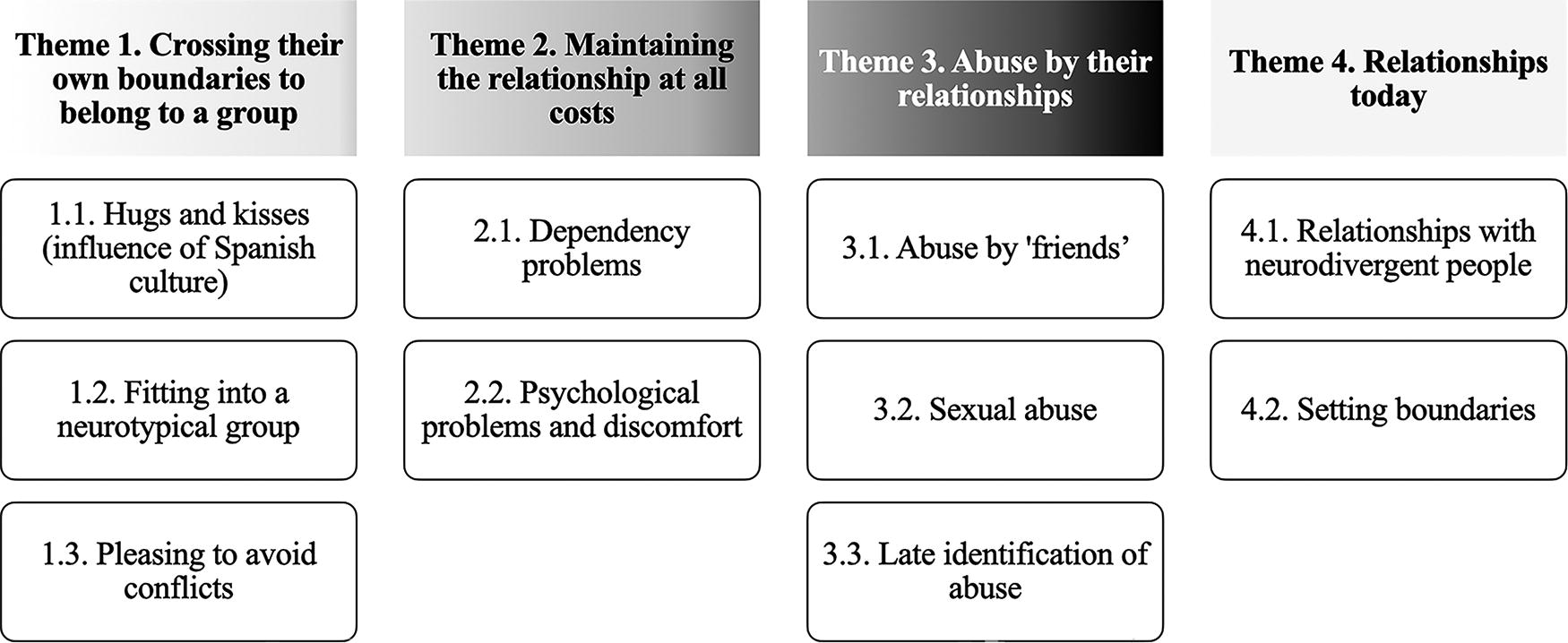
Themes and subthemes (with a grayscale gradient according to severity).
The color gradient of the first three themes was developed along a gradient of severity, ranging from boundary transgression as the mildest state to abuse as the most serious consequence, creating a continuum.
Theme 1. Crossing their own boundaries to belong to a group
This theme shows how one’s own boundaries are exceeded by the need to establish relationships with the peer group and to avoid conflicts with their social groups.
Subtheme 1.1. Hugs and kisses (influence of Spanish culture)
We see how, based on Spanish culture, autistic people are “forced” to cross physical boundaries to form part of the cultural group and avoid conflict—using camouflaging strategies of masking and assimilation for relational reasons—such as kissing or hugging to greet each other. The initial feeling of guilt emerges, as individuals push themselves to avoid seeming rude:
If I’m out, and someone comes to hug me, and I don’t feel in the least bit like being hugged, maybe because I’m feeling very overwhelmed. They come to give me a hug and I want to die, but I’m not going to tell someone I’m not close with “Don’t touch me,” I’m not going to be rude like that, I just put up with it. (P5)
However, a more constructive approach would be to simply ask and respect each other’s preferences:
That is, like things that are taken for granted. Such as everyone is going to like being hugged or, like, everyone is going to like being given two kisses. Well, it would be good to ask them. (P6)
Subtheme 1.2. Fitting into a neurotypical group
All participants reported difficulties in establishing relationships, especially in childhood and adolescence. In adolescence, which is when people have a greater need to establish a group with their peers, the participants explained how they were forced themselves to camouflage, crossing their own boundaries to fit into a group generally composed of neurotypical people and pretending to be accepted.
(In adolescence) I have to start going out at night with my friends partying. I am forced to do it because it is cool. One night I had I don’t know how many drinks […], they were inviting me, and I said yes to everything, because I wanted to be cool, and I ended up in an alcoholic coma. (P1)
I spent my time trying to understand the codes and what was it that I had to do. Well, now we have to go to that party, so you go. Well, no, now we have to … I don’t know, you know? It’s like trying to follow the social norms to fit in.” (P6)
They even started romantic relationships with other people to have greater social acceptance: “I actually started dating that boy because it was in my interest socially.” (P3), even when they did not particularly like their partner:
(Speaking of starting a relationship with a boy who she was not interested in and who was also marginalised at school) since I am an outcast, then the logical thing to do is be a couple, I reckon. (P7)
Subtheme 1.3. Pleasing to avoid conflicts
The participants, to avoid conflict with the social group, transgress their own boundaries and allow others to transgress them, subtly revealing, through their words, a sense of feeling like a burden or inconvenience to others:
I never had conflicts with anyone, never. Never get angry to please others. Always, always, always, be the good girl, even as an adult. If they tell me, you have to do this, even if it doesn’t seem right to me, I obey the orders. (P2)
(After finding out that a school friend wrote nasty things about her in her diary, one night she slept at her house) I don’t know even if I spent the night there to avoid disturbing her. (P3)
Theme 2. Maintaining the relationship at all costs
After the first establishment of the relationship, the problems increase, for fear of being left alone. During the maintenance of the relationship, the small camouflages become more and more demanding, which has an impact on the mental health of the participants and the quality of their relationships.
Subtheme 2.1. Dependency problems
Participants expressed difficulties in ending toxic or abusive relationships, for fear of being left alone. This must be understood taking into account the previous section, where they have become accustomed to relinquishing their needs to establish these relationships:
(Regarding a friend from adolescence) In the end, I felt very uncomfortable in that relationship, but I didn’t have anything else either. Then, she said: It is what it is and I put up with it until, well … we had a fight … and since I’m not one to go and resolve conflicts and she didn’t do it, then that’s where it ended. (P5)
Even going so far as to neglect their own needs (lacking the power to make decisions) or to do whatever was necessary out of fear of losing those “friendships”:
I don’t know how to make decisions because, to this day, I haven’t made decisions. Basically, my life is to do what I am told, how I am told, and when I am told. (P7)
What I had started to do was simply to put up with things that I didn’t like for fear that they would turn away from me. (P8)
Within couple relationships, there is also this dependency and maintenance of relationships, even if they were not comfortable in them:
I was with a boy for a year and a bit, it didn’t last a year and a half, but things didn’t work very well, to be honest. What happened was that, of course, as he was the only boy who had paid me any attention, I tried to extend the relationship as long as I could. (P7)
Subtheme 2.2. Psychological problems and discomfort
Having to invest so many resources in maintaining relationships, problems of burnout and fatigue appear that affect their well-being.
You end up feeling terrible because you do things you don’t want to do to please people … you go wherever, and you are exhausted. You do things because you don’t know how to say no to that person, or you take on burdens that don’t correspond to you to try to relieve them as if you didn’t also have your own mental boundaries. Well, in the end, it’s a horrible burnout, you can’t take it anymore and on top of that, you don’t know how to accept support because that’s being a burden. I don’t like to give people anything negative; everything has to be positive so that everything comes up roses. (P5)
Other consequences of this wear and tear when maintaining relationships manifested in different symptoms at the psychological level (emotional distress, eating disorders [EDs], anxiety, depression).
I was finding it harder to be with other people and I was withdrawing more and more into myself, until the suicidal thoughts began to appear. (P2)
I had an ED […], I think there was a lot of dysregulations, having an environment so far out of my control that I needed to control something. And that something was my body. (P6)
Since I was 14 years old, I have had many autistic crises, meltdowns, and anxiety attacks … Practically every day or several times a week; and at 17 I had depression. (P8)
In some cases, these anxiety problems manifested at the somatic level.
That’s when they started, especially migraines. At that age (adolescence) I began to have pain, to have severe headaches, daily, and tiredness. (P1)
Theme 3. Abuse by their relationships
The constant transgressions of boundaries of autistic people create a pathway for different types of abuse to be inflicted upon them. Both within their friendships and at the relational level, it could lead to a case of rape within the couple.
Subtheme 3.1. Abuse by “friends”
These constant transgressions of boundaries lead to different types of abusive behaviors exercised by their social ties, such as those people who pretend to be their friends—but they are actually their main aggressors:
Many people have taken advantage of me … I was a bit desperate to find someone to get close to and maybe they would order me to do things. They took advantage of me a little, to try to manipulate me. (P8)
She told me to go up to their house. Her brothers were waiting for me there. I remember that they insulted me, they made me cry. They laughed. I don’t remember much else but then I had bruises. I remained her friend for at least another year. (P9)
Subtheme 3.2. Sexual abuse
At the level of affective/romantic relationships, this abuse can escalate to rape. These aggressions are hidden under the core of what is considered normative in a couple or are even felt to be the participants’ fault:
As for relationships, sometimes, in order to be socially included, relationships are often maintained that are not consensual, or if they are, since you are trying to be socially accepted, you think that they are all right because other people who are normal are doing it, […] you think that this is all right and you don’t know … you do not know how to decipher whether they are right or wrong (the sexual relations). (P1)
Autistic women are more exposed to rape. Because of pressure, because you don’t know what is expected of you … it happens to all of us. Or by deception, they even emotionally deceived me to have (sexual) relations with me. (P3)
I didn’t want to, I told him not to do it, but he pretended he didn’t hear me. I thought I was stupid, that my voice was so soft that he couldn’t hear me. I blamed myself … And he did it, without protection. I was blocked for several hours. I didn’t understand what had just happened. (P9)
Subtheme 3.3. Late identification of abuse
The victims of these rapes are not aware of what happened at the time; however, they manage to identify this abuse sometime later. Sometimes, after receiving a diagnosis, some understanding of the abuse emerges, whereas for others, it takes time before this realization occurs:
After a while, when you start to understand how you have related as an autistic woman, […] you realise what harassment, abuse, and all these things that you had normalised are, and that you also thought were quite cool because you were normal at last. This happened to me in the diagnosis. I mean, I’ve started to know things about myself and I’ve started to understand that they had abused me. (P1)
And after (the sexual abuse) they apologised to me, and I didn’t know why they did that … and then I say: if you started crying it is because you are very bad, you knew you were doing it very badly. (P3)
On the way home, on the underground, I remember looking at my reflection and not recognising myself. I didn’t understand what had just happened. So, were we a couple? Three or four years later, reading testimonies from other women on social media, I understood: I had been raped. (P9)
This violence leaves emotional wounds in the victims, such as feelings of guilt and shame.
The hard thing about this is, that when you realise and go through this process of ridicule, that you have been ridiculed and you didn’t know it … Then, that’s pretty hard … The guilt. (P1)
Theme 4. Relationships today
In adult life, relational dynamics change once the diagnosis has been made. Participants are now learning new ways to set boundaries and create emotional connections with others who understand their needs.
Subtheme 4.1. Relationships with neurodivergent people
Autistic people choose to establish relationships with other neurodivergent people. These give them a safe space in which to express their needs and be who they are without the need to use camouflage, feeling more understood.
I’m starting to bond with people my age, that are either autistic or highly gifted. […] With people my age who are not neurodivergent, it’s hard for me. (P6)
(The diagnosis) has helped me to understand myself better and thus be able to look for tools that help me in my day-to-day life, to punish myself less for not acting as a neurotypical person is expected to act, and to find other autistic people. (P8)
These last two years I have been making more friends/bonds […] I surround myself with quite a few neurodivergent people. (P8)
Subtheme 4.2. Setting boundaries
In addition, being more aware of their needs, they more frequently set boundaries in their social and family circles, allowing them to carry out social activities without the mental exhaustion they previously experienced.
(I have managed) to learn to dose relationships, that is, when I want to be with someone and when I don’t. Learning to say no, that is, instead of masking and holding on and holding on and holding on … and exploding. Or having a block for trying to be someone you’re not, for trying to be socially accepted. (P1)
Now I say: that’s enough. I’ve learnt that I don’t have to be with everyone, if not, it’s because I don’t feel like it, it’s because I don’t want to. Now I know how to say no. (P2)
Furthermore, they develop strategies that allow them to carry out those activities and social approaches that possess a more cultural character, such as going to eat at their parents’ house on Sundays.
Learn to maybe not go every Sunday to eat with the family, but go once a month, which is what I can do. (P1)
Discussion
The present study sought to understand how autistic women and gender dissidents recognize acts of boundary transgression and abuse—whether in intimate relationships with friends or partners.
Already, in the reflexive stories about childhood and adolescence, we observed that the transgression of boundaries is a risk factor that could trigger abusive situations against autistic women and non-binary people. Initially, these boundaries were disregarded due to participants’ need for social connection and group acceptance, leading them to employ increasingly demanding camouflaging strategies, such as forcing themselves to engage in physical contact or feigning social understanding. 21 Over time, they normalized minor behaviors that eventually triggered greater violence from acquaintances, a pattern that appears to peak in adulthood when they have become accustomed to sacrificing their own needs to maintain these relationships.21,22 Hence, as the experiences illustrate, there is a “dual pathway”: failing to establish boundaries can lead to a spiral of escalating abuse, whereas setting boundaries helps protect and safeguard them—a shift that often occurred after they received their diagnosis.
At this point, we should highlight the cultural issue, 22 since Spanish culture can be different from others (e.g., English culture), in which there is the obligation (and inertia) to kiss or hug strangers to introduce or greet acquaintances, and in which pleasing is a behavior associated with the “good” Spanish girl or woman. For example, behaviors like remaining silent, being subordinate to men, and allowing family members or partners to control their mobility or access to friends are still present today.23–25 Such behaviors may also indicate a higher risk of severe intimate partner violence (seen in 79.7% of cases in Badenes-Sastre and colleagues’ study). 26
As argued, in the long term, the maintenance of abusive relationships, achieved over time through the transgression of boundaries, causes different degrees of dependence and psychological discomfort. Mainly, as the participants narrate, these problems would be related not only to anxiety and depression14,15 but also to EDs and suicidal ideation. 16
At the end of the gray-colored gradient—more severe—there is the abuse. Autistic women and non-binary individuals are in a state of vulnerability to sexual abuse. 13 The main factors that seem to increase this risk are, first, this gradual exposure to violence that causes abusive behavior to be normalized, and consequently, the identification of sexual abuse does not occur at the time. This seems to be in line with the findings of Douglas and Sedgewick, 27 as well as Gibbs and Pellicano, 11 which indicate that repeated exposure to interpersonal violence had “desensitized” our participants, establishing a pattern in which violence and abuse became normalized in future relationships. This phenomenon of repeated victimization aligns with criminological literature, described as “desensitization to violence”—the process through which individuals become less sensitive to violence due to repeated exposure and are more likely to be revictimized11,28—or “learned helplessness”—a condition in which individuals believe they have no control over their circumstances after experiencing repeated failures or adverse events. 29 It is worth emphasizing that, in addition to all of this, autistic participants did not receive an autism diagnosis until later in life. Consequently, they often lack access to essential support that would help them understand they are not “broken” and that responsibility lies with the aggressor.
Finally, the diagnosis of autism—understood as knowing oneself—seems to act as a protective factor, as it affords people a greater knowledge of their needs, for example, negotiating relationships and facilitating transition from being self-critical to self-compassionate. 30 Thus, they can establish boundaries and connect with neurodivergent people who understand and respect these needs. 17 Therefore, an early diagnosis is necessary to help women and gender-dissident individuals better understand themselves, shed the need for masking or camouflage, navigate relationships with greater confidence and safety, 30 and access to appropriate support—all of which enable them to develop mechanisms to reduce the risk of sexual abuse and other forms of victimization.
Nonetheless, what is more crucial is to raise awareness in society about these people’s reality. This includes raising awareness among the population and reducing the violence they exert against the autistic community, with special emphasis on women and gender-dissident population. However, without a change at the societal level, autistic people will continue to be in a process of marginalization and will have to employ camouflaging strategies to fit into society—an effort that can be exhausting and negatively impact their mental health.21,30,31
Limitations and future directions
Although we have tried to represent gender-dissident individuals, as well as different sexual orientations, the group is indeed quite homogeneous in terms of ethnicity (Caucasians). Future studies should aim to increase the diversity of participants, particularly by including individuals from a broader range of ethnic backgrounds. In addition, researchers may wonder whether incorporating a control group of neurotypical women and gender-dissident individuals could enhance the validity of the findings by allowing for comparisons of responses to the same questions—our research group believes that responses of autistic individuals are valid in their own right, and comparisons may not be necessary to appreciate the richness of their experiences. In addition, although a range of behaviors that involve transgressions to a lesser or greater degree have been highlighted, certain types of violence have not been investigated. Future research could expand the scope of behaviors explored to include other forms of violence, such as domestic violence, bullying, and mobbing.
Conclusion
As far as the authors know, this is the first study in the Spanish population of autistic women and gender-dissident people that explores their experiences of transgression of boundaries and abuse. Some cultural issues—very strong in Spanish culture (e.g., having the obligation to hug or kiss strangers)—which can imply great sensory and camouflage challenges for autistic people, are highlighted. The obligation and romanticization of this type of act (when they clearly transgress the boundaries of the child) are the cornerstone where the normalization of abusive behaviors, which can lead to future abuse of power, begins, added to the problems for the victim to say “no” to certain behaviors. As indicated in Fox, 31 these issues of abuse toward autistic women should be addressed as a complex social (and not individual) issue. In this regard, more research and social campaigns are needed to address and raise awareness of the various types of abuse and discrimination autistic people face. These efforts aim to foster a shift in societal attitudes that, on one hand, reduces the prevalence of abuse directed at autistic people and, on the other, ensures that autistic people are not pressured to suppress or alter their authentic selves to gain acceptance within society.
Footnotes
Acknowledgments
The authors are profoundly grateful to the participants of this study, who wanted to participate in this work from the word go, they wanted these stories, told by Spanish autistic women and non-binary people, to finally come to light, and for Spanish society to begin to be aware of what is happening around them.
Authorship Confirmation Statement
A.B.G. engaged in the conceptualization and data analysis and wrote the initial draft. I.G.-M. engaged in the conceptualization (supporting) and data analysis, conducted the research, provided the analysis tool, supervised A.B.G., and wrote the final article. Both the authors revised the article and approved of the final version for publication. The article has been submitted solely to this journal and is not published, in press, or submitted elsewhere.
Author Disclosure Statement
The authors have no conflicts of interest to disclose.
Funding Information
The authors did not receive any funding for this study.
1
The term “gender-dissident” is used in line with the preferences of our participants.