






Abstract
Introduction
Kaiser's Richmond Medical Center is in the East Bay area, one of four healthcare facilities offering bariatric surgery for the region. The other three are located in South San Francisco, Freemont, and Fresno. When the program performed its first two gastric bypass surgeries in March 2003, it became the second of these four institutions to offer this service. Today, Richmond performs more than 400 bariatric procedures each year. The program has been fully approved as an American College of Surgeons' Accredited Bariatric Surgery Center since 2007. “We are also a provisional Center of Excellence through the American Society for Metabolic and Bariatric Surgery (ASMBS),” adds Stephen R. Brook, the program's department manager. “We are just waiting for them to do a site visit.”
A Reflection of National Trends
Instrumental in the expansion of bariatric services in the northern California region is David Fisher, MD, who serves as chief of bariatric surgery for Kaiser Northern California. He was one of the first surgeons to perform bariatric surgery for Kaiser and has ensured that local access to bariatric surgery is available to members. “We've been offering bariatric surgery at our South San Francisco facility for several years,” Fisher points out. “The demand for this surgery began increasing here along with national demand. We felt there was enough volume to open up another site in northern California at Richmond.”
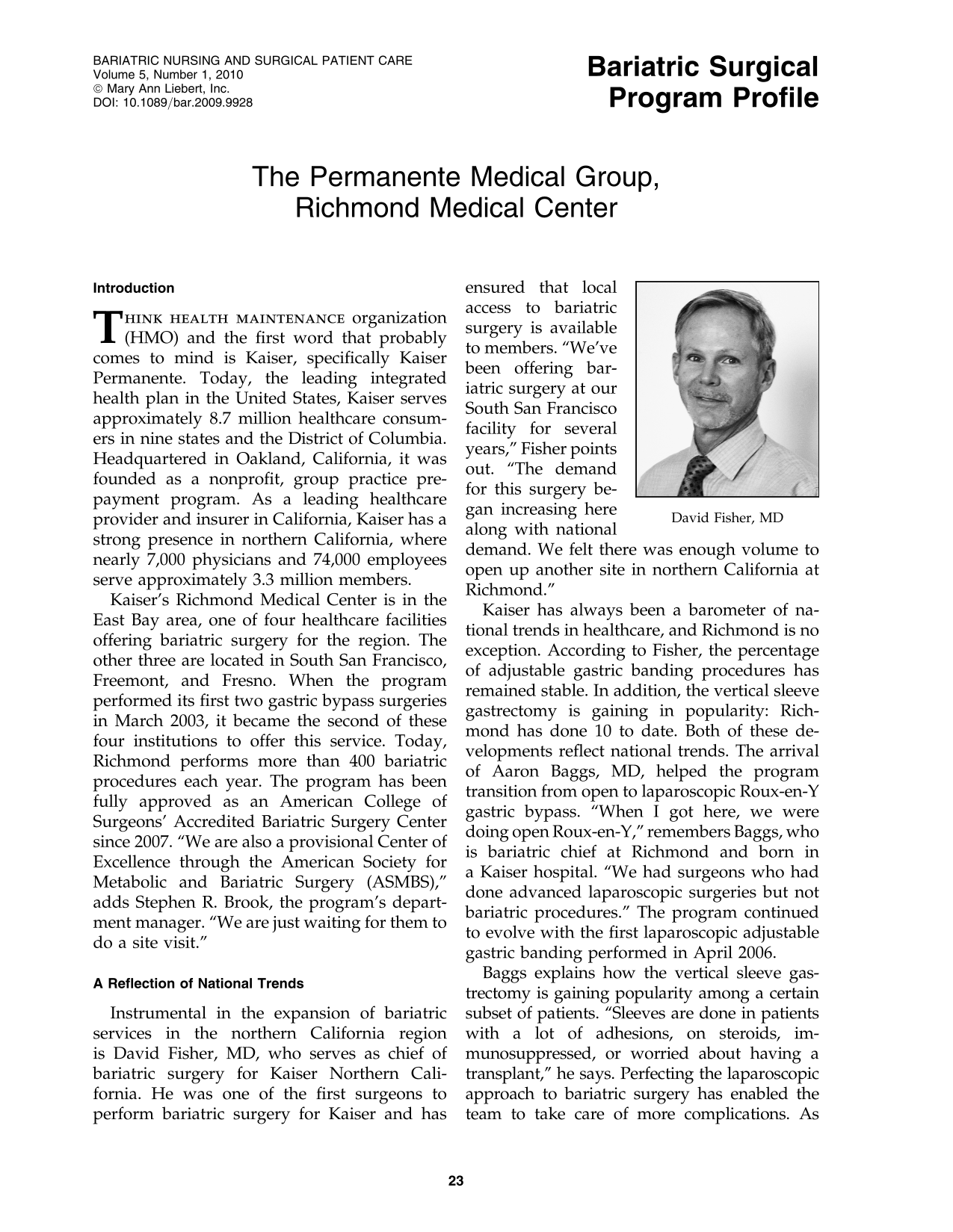
David Fisher, MD

Kaiser has always been a barometer of national trends in healthcare, and Richmond is no exception. According to Fisher, the percentage of adjustable gastric banding procedures has remained stable. In addition, the vertical sleeve gastrectomy is gaining in popularity: Richmond has done 10 to date. Both of these developments reflect national trends. The arrival of Aaron Baggs, MD, helped the program transition from open to laparoscopic Roux-en-Y gastric bypass. “When I got here, we were doing open Roux-en-Y,” remembers Baggs, who is bariatric chief at Richmond and born in a Kaiser hospital. “We had surgeons who had done advanced laparoscopic surgeries but not bariatric procedures.” The program continued to evolve with the first laparoscopic adjustable gastric banding performed in April 2006.
Aaron G. Baggs, MD

Baggs explains how the vertical sleeve gastrectomy is gaining popularity among a certain subset of patients. “Sleeves are done in patients with a lot of adhesions, on steroids, immunosuppressed, or worried about having a transplant,” he says. Perfecting the laparoscopic approach to bariatric surgery has enabled the team to take care of more complications. As with national trends, Richmond is also seeing more patients with these and other complications from earlier bariatric surgeries. “Patients come in with hernias, adhesions, obstructions, and perforations,” Baggs notes. “Just a few years ago, these would have required another open operation.” In addition, Fisher, Baggs, and the other surgeons are also becoming more aware of vitamin deficiencies and addressing them immediately once they occur.
An Emphasis on Education and Knowledge
As with other HMOs, Kaiser places special importance on the primary care physician to provide the necessary referrals for specialty services and care. Once a patient is suggested for bariatric surgery, their physician submits a referral to the Richmond team. A surgeon then reviews this request from the primary care physician using the National Institutes of Health (NIH) criteria for bariatric surgery. If this initial review is positive, an appointment is made for the patient to attend a mandatory orientation session, which takes place three to four times each month. “Our goal is to get patients into orientation within a month of their referral,” says Elizabeth McLaren, RN, who is the assistant manager of the program at Richmond. “We ask that they learn something about the surgery.”
At these orientation sessions, a surgeon reviews the various surgical options and shows videos of each surgery. Also, McLaren and Chris Powell, RN, the case manager, speak about how the program works, what patients can expect, and the type of appointments scheduled as part of the process. Robin Rodriguez, MS, RD, the dietitian, also talks to attendees about how to prepare nutritionally for surgery and outlines the postoperative diet and vitamin regimen. During the 4-hour orientation session, patients are also weighed.
On Call
The Permanente Medical Group
Richmond Medical Center
Bariatric Surgery
901 Nevin Ave.
Building B, Third Fl.
Richmond, CA 94801
(510) 307-2915
web site: www.permanente.net
Chief, Bariatric Surge0ry, Kaiser Northern California
Bariatric Chief and Surgeon
Bariatric Surgeon
Bariatric Surgeon
Assistant Manager
Program Case Manager
Psychologist
Dietitian
Department Manager
Program Coordinator
Data Operator
At the conclusion, they are offered their next appointment, a one-on-one session with the surgeon. During this time with the patient, the surgeon engages in a higher level discussion of the risks and benefits of each procedure and recommends an appropriate surgery. “Sometimes, the surgeons need the patients to lose some weight to decrease their intraoperative risk,” says McLaren. “We also want them to have their preventive healthcare screenings done, such as Pap smears and mammograms, in order to be up-to-date with them. They have anything they need to be safe, surgical candidates.” Unlike some other insurance carriers, Kaiser does not require its members to undergo a period of supervised clinical weight loss. Although the Richmond facility does not have a bariatrician or a formal medical weight-loss program, patients can avail themselves of dietary counseling.
Once seen by the surgeon, patients are evaluated by Lorraine Schnurr, PhD, the program psychologist. If everything goes well, the patient is assigned to a case manager for a one-on-one appointment. During this time, they talk about lifestyle changes and how to get ready for surgery, and they receive a binder of information to review. “We also give them a multiple-choice test to make sure they understand everything,” McLaren explains. “You can't really flunk the test; it is open book. We want to make sure they have the knowledge they need so that they can continue to be safe.” All of this is part of the informed consent process Richmond employs for patients undergoing bariatric surgery.
Two more sessions are required before patients ever see the inside of the operating room. One of these is a preoperative class instructing patients how to use a spirometer to prevent pneumonia and how to spot any complications that may arise. Another in-depth session on diet and vitamins is scheduled right after this class on the same day. Patients are asked to bring in the vitamins they have already bought. During this time, the case manager and dietitian review everything, including the postoperative diet, portion control, and problem solving. As McLaren likes to say about this session, “We want to make sure they are good to go before they get there!” She sees bariatric surgery as more than just an operation. “It is a true commitment to making behavioral and lifestyle changes. They need to make good decisions every time they approach food.” By the time a patient hits the operating room, the Richmond program has given them a lot of knowledge in order to obtain a high level of understanding and commitment.
Program History and Achievements
Although not mandatory, most patients attend a bariatric lifestyle group. Often led by the dietitian or psychologist, these sessions are more structured than a typical support group and are held twice a month. Speakers include patients who have had the surgery. All patients are welcome to attend. Postoperative patients break out for part of the meeting. “The group offers ways to manage what life is going to look like after surgery and how patients can practice what they have learned,” points out McLaren.
A Unique Approach to Follow-Up Visits
Whatever type of surgery they are having, all patients have the procedure done in the hospital operating room. According to Vivian Ochiagha-Nwosibe, MSN, who manages the care of patients on the floor, most patients stay overnight, although some band patients are discharged the same day. “The nursing staff is trained to specialize in the care of these patients,” says Ochiagha-Nwosibe. “We are lucky to have the surgical team very close by on the same floor as us.” For transfers and the early ambulation of patients, the floor nurses use the Patient Mobility Team (PMT), a hospital-wide dedicated lift team.
Statistics at A Glance
Surgeons performing bariatric procedures: 4
Cases performed annually: 400
Types of cases performed:
Laparoscopic Roux-en-Y gastric bypass: 75%
Laparoscopic adjustable gastric banding: 25%
Vertical sleeve gastrectomy: 10 sleeves to date
Average length of stay: 1.2 days for bypass; overnight for banding
Average overall weight loss at 1 year: 2/3 of excess body weight for bypass; 1/2 for banding
Team composition: 4 surgeons, 2 nurse managers, 1 psychologist, 1 dietitian, 1 program manager, 2 support staff
Gastric bypass patients return to see their surgeon 4 to 6 weeks after surgery. In the interim, they have a couple of telephone appointments with the dietitian, who contacts them about their progress. After that, patients return at 3 months, 6 months, and then at 1 year. A unique feature of the Richmond program is the way they handle these follow-up visits. Although the first appointment is a one-on-one with the surgeon, the subsequent 3- and 6-month visits are conducted in a group setting consisting of 10–12 patients. “At these classes, the dietitian, surgeon, and I review the patients' medical records to make sure there are no issues,” explains McLaren. “All three of us speak to the group as a whole and have a discussion.” Patients can also receive vitamin adjustments from the dietitian at this time. Throughout the first year, patients also see their primary care physician on a regular basis. After 1 year, patients are followed annually for their lifetime.
Given the nature of the procedure, band patients are seen during individual appointments. “They come in about once a month to meet with the dietitian and the surgeon, who does any needed fills,” McLaren says. Monthly appointments are continued for 6 months, at which point they return again at the end of 1 year. Then they are seen annually for life.
Kaiser patients who undergo bariatric surgery can also communicate with their healthcare providers through secure Internet messaging. Hospitals in the Kaiser system have fully embraced health information technology that includes electronic medical records (EMR) and web-based communication portals. According to McLaren, e-mail allows patients to communicate with their providers in an uncompromised format and to have remote care visits. “From their home, patients can e-mail me to ask a question about vitamins or anything else,” she points out. The technology is now being used to send postop patients feedback questionnaires. With the EMR, patients living in remote areas can have laboratory testing done near their homes and have it posted to their medical record immediately.
Mission/Purpose Statement
The Bariatric Surgery Department provides specialized, quality healthcare to Kaiser Permanente Health Plan's morbidly obese members in the northern California region.
By providing physical and emotional support, education, surgical services, postop care and follow-up to our members and families, we will help them and the communities they reside in to manage and improve their health, decrease their need for medical intervention of their comorbid conditions, and enjoy a better quality of life.
We strive to—and will become—a “Bariatric Surgery Network Center” for bariatric care, thus maintaining and improving Kaiser Richmond's reputation for excellent service and help make Kaiser Permanente the healthcare provider of choice.
Conclusion
The Richmond team is keeping a prudent eye on the future, fully aware that the Kaiser system is a microcosm of national trends. According to Fisher, the percentage of bands versus bypass procedures performed has remained stable. “Now with the sleeve, the number of bands will decrease,” he says. “This is what we are seeing nationally as well.” Dr. Baggs is becoming more aware of vitamin deficiencies in patients. “The most common complications we see are iron and vitamin D deficiencies,” Baggs notes. “This will become a significant issue nationwide—picking these up preoperatively.”
Although the Richmond program is not involved in any clinical trials, it is eager to begin publishing outcomes data. According to Brook, sophisticated database systems will help. “We just installed another system that we are using,” he explains. “We will be publishing a paper on our outcomes data in the near future.” Also hoping to do some retrospective reviews is Fisher. “With the EMR, we feel like we are in a contained system,” he explains. “It is an ideal situation for a retrospective study.” Just as Kaiser will remain a national leader in healthcare, so too will Richmond continue to lead its efforts in bariatric surgery.