







Abstract
Background:
Human milk potentially includes probiotic Lactobacillales, an order of gram-positive bacteria that have the ability to ferment sugars to lactic acid. These bioactive agents may be affected by maternal dietary patterns. This study aimed to find out significant dietary patterns and their relation with the current presence of available Lactobacillales levels in breast milk.
Materials and Methods:
This comparative study was done in a clinic in Isfahan, Iran. A total number of 345 healthy mothers were assessed for major dietary patterns. Among identified patterns, two main patterns (synbiotic, n = 41; Western, n = 132) were selected for comparison. Lactobacillales colonies were then counted in the breast milk samples. Analysis of covariance test was used to analyze the association between dietary patterns and breastfeeding.
Results:
Two significant dietary patterns (synbiotic and Western) were identified through the factor analysis method. These patterns accounted for 34.41% of the cumulative variance in food groups (synbiotic pattern, 12.77%; Western pattern, 21.64%). Synbiotic dietary pattern (syn.patt) was related to higher Lactobacillales counts (5.3 ± 1.4 log CFU/g), whereas the lower number of Lactobacillales were detected from Western dietary pattern (West.patt) (3.3 ± 1.9 log CFU/g; p < 0.05).
Conclusion:
Syn.patt and West.patt can affect the Lactobacillales population; so, probiotic strains especially Lactobacillales may be improved by healthy syn.patt. This association should be confirmed by clinical trials.
Introduction
Human milk provides all essential nutrients for infant and helps to protect the infant against contagious diseases, 1 although some of them are dependent on maternal supplementation and seasonal variations. 2 This impact might be a consequence of the mixed activity of breast milk elements, such as maternal living, activated leukocytes, and immunoglobulins (e.g., IgA) or a number of beneficial microbes that improve gut microbiota. 3 Natural components of human milk called “probiotics” are bacteria (principally in the Lactobacillales family) that aid in the development of the recipient infant's immune system. 4 Once these bacteria are mixed with indigestible fibers (prebiotics) they are termed “synbiotics”. 5 These agents may cause a reduction in eczema in infants. 6
An additional way to normalize intestinal microflora is synbiotics administration, a combination of probiotics and prebiotics with synergic effects. These compounds beneficially impact the host through the development of metabolism and increasing the population of the health-promoting bacteria and, therefore, enhancing the host well-being. 7 The most commonly used probiotic strains are Bifidobacterium, Lactobacilli, Saccharomyces boulardii, and Bacillus coagulans. Prebiotics such as fructooligosaccharides, galactooligosaccharides, and inulin are also more available. 8
“It is better to provide synbiotics from the diet”; this sentence has been repeated by some authors. The term “functional foods” refers to these agents. 9 Dairy products, especially milk and yogurt, and nondigestible carbohydrates present in fruits, vegetables, and legumes are the most important components of synbiotics. 5 In more detail, some characteristics of synbiotics have been published. “Dietary-based milk oligosaccharides selectively enhance the growth of B. infantis. 10 This strain can reduce intestinal inflammation in infants.” 11 “Some therapeutic effects of yogurt, including the enhancement of immune response, reduction of constipation, better lactose digestion and improvement of diarrheal diseases, have been suggested 12 ; especially in infants.”13,14 Based on these positive effects of synbiotics, the mothers and their babies can benefit from a “synbiotic dietary pattern (syn.patt).” Novel properties of this pattern may appear in breast milk as Lactobacillales strains. So, in this comparative study, we tried to identify major dietary patterns and find the associations between them and Lactobacillales levels in breast milk.
Materials and Methods
Subjects and recruitment method
This clinic-based comparative study was performed between September 23, 2017 and July 21, 2018 in Isfahan city, Iran. A sample size of 345 healthy breastfeeding females was planned through simple random sampling. In the beginning, a consent form was filled by each volunteer and research goals were explained briefly. The study protocol was written based on Helsinki principles 15 and authorized by the Ethics Committee of Isfahan University of Medical Sciences, Iran.
Inclusion criteria were as follows: healthy mothers aged 18–40 years old vaginally delivered, and having full-term pregnancy. Mothers who had perinatal issues (perinatal depression, anxiety, obsessive-compulsive disorder, mastitis) or present and previous autoimmune and chronic disorders (gestational diabetes mellitus, eclampsia), and who were taking antibiotic therapy (at least 4 weeks ago) were excluded from the study. Mothers with any type of chronic disease such as a congenital malformation, heart disease, or hematological disorder were also excluded. The diseases were diagnosed by the medical history, the physical examination, and laboratory tests.
The main data collection process was done by a gynecologist, a pediatrician, and a microbiologist in addition to two nutritionists; before that, a questionnaire consists of sociodemographic information (age, level of education, job status, household income per month, family history of obesity in first and second pregnancy [if exists]) were filled by researcher during face-to-face interview.
Dietary intake assessment
A validated 168-item semiquantitative Food Frequency Questionnaire, 16 including a list of foods with standard Iranian serving size, was used. 17 The consumption rate for each food item was collected on a daily, weekly, or monthly basis; the portion sizes were then converted to grams using household measures. 18 Thirty-two food groups were then determined (Table 1).
Food Groups Used in the Dietary Pattern Analysis
A low-fat fermented dried yogurt paste used in Iranian diets.
A beverage produced by the action of lactic acid bacteria, yeasts, and acetic acid bacteria on milk.
An Iranian sweet made of oil, flour, and sugar.
Anthropometric and physical activity measurements
Body weight was recorded to the closest 0.1 kg (in minimum clothing and without shoe status). Height was assessed by SECA body meter to the nearest 0.1 cm. Body mass index (BMI) was determined by dividing the weight (kg) by the square of height (m2).
The validated self-report questionnaire was used to calculate the physical activity level as metabolic equivalents of tasks (METs; hours/day) during past year 19 ; sedentary lifestyle was defined as a waking activity that has METs of ≤1.5 while sitting or reclining such as screen viewing, reading, and riding in an automobile 20 and active state (moderate-to-vigorous activities such as house works, walking >20 minutes per day, and sports) was classified as METs >1.5. 21
Milk sampling procedure
First we instructed participants not to breastfeed their babies for just 1 hour before milk sampling in the morning (at first 6 months of lactating). After providing a private location for participants, the nipple and mammary areola were cleaned with soap and sterile water and then disinfected with chlorhexidine. 22 The breast milk sample was collected (10–15 mL) in a clean sterile glass tube by hand pump. The first drops (∼1 mL) were discarded to avoid chlorhexidine contamination. Again, a swab was obtained from the nipple and mammary areola to assess the actual efficacy of the antiseptic usage. Sterile tube samples were fixed in dried ice for transportation to the laboratory (lasted about 2 hours).
Bacterial isolation and identification
The culturing amount of samples (1,000 μL) was coated straight (technique used to isolate bacteria; obtained samples from the resulting colonies can then be taken and be transferred on a new plate so that the organism can be identified, studied, or tested). As well, serialized dilutions were coated on three particular culture sites, including Man Rugose Sharp agar with two replications. For much better isolation of lactic acid bacteria (mesophilic facultative heterofermentative Lactobacilli strains), 0.5% glucose (Merck), and 0.25%
Statistical analysis
Exploratory factor analysis with varimax rotation was used to identify major dietary patterns. 23 Based on the total variance explained, scree plot and the interpretability of the components, the main factors were determined.
Categorical data were expressed as number and within-group percent; related comparisons were done by chi-square (χ 2 ) test. Associations between dietary patterns and quantitative variables (age, energy intake, and family history of obesity in first and second pregnancy) were evaluated by Student's t-test; related data were reported as mean ± standard deviation.
Lactobacillales levels in breast milk samples across dietary patterns were compared by using analysis of covariance (ANCOVA) test; this analysis adjusted for confounders, including age, level of education, job status, household income per month, family history of obesity in the first and second pregnancy, and energy intake. All analyses were conducted with SPSS24 (SPSS, Inc., Chicago, IL). p < 0.05 was considered as the level of significance.
Results
General information
The sociodemographic characteristics of participants toward dietary patterns are presented in Table 3. The mean age of the participants was 29.8 ± 10.33 years. They mostly reported their job status as “housewife (unemployed)” and had <$300 household income per month (in U.S. dollars). More than 60% of participants were not adequately active; their calculated METs were <1.5. Based on anthropometric measurements, the mean BMI was 26.0 ± 1.85; this was concurrent with mean energy intake value (2,132 ± 95 kcal/day). About 14% of mothers reported a family history of obesity in first pregnancy; notably, this was higher in second pregnancy.
Dietary patterns
According to the factor loading matrix of food groups present in Table 2, two main patterns were selected for comparison due to majority adherence. These factors accounted for 34.41% of the cumulative variance in food items. The Kaiser–Mayer–Olkin (KMO) was >0.6, a marker that indicates adequate sampling (KMO = 0.734, p < 0.01).
Factor Loading Matrix for Two Major Dietary Patterns
Factor loading values <0.20 for both patterns were excluded for simplicity.
syn.patt (n = 41) mostly consisted of fermented dairy products and fibers, whereas higher amounts of refined cereals and sweets, as well as meat products, represented Western dietary pattern (West.patt; n = 132).
Association of dietary patterns with covariates
As seen in Table 3, the percentage of participants with BMI >24.9 was significantly higher in West.patt, in comparison with syn.patt (p < 0.018). The differences between daily energy intakes toward dietary patterns were also statistically significant (p < 0.024). There was no significant association for the other variables, maybe because of matching procedure at the study sampling.
General Characteristics of Participants
Bold refers to *p-value < 0.05.
Results obtained by chi-square test and Student's t-test (only for age and the last three variables in table).
Evaluations were done based on METs; 1 MET = energy expenditure of sitting quietly or ∼1 kcal/kg of body weight per hour. Active = METs >1.5, sedentary = METs ≤1.5.
Within group percent.
METs, metabolic equivalents of tasks; SD, standard deviation; syn.patt, synbiotic dietary pattern; West.patt, Western dietary pattern.
Association of dietary patterns with Lactobacillales levels in breast milk
After counting Lactobacillales, a larger population (5.3 ± 1.4 log CFU/g) was seen in syn.patt-related samples. Compared with West.patt (3.3 ± 1.9 log CFU/g), the difference was statistically significant (p < 0.05). the mentioned results belonged to ANCOVA test, so, confounders (age, level of education, job status, household income per month, family history of obesity in the first and second pregnancy, and energy intake) had been controlled for increasing precision (Fig. 1).
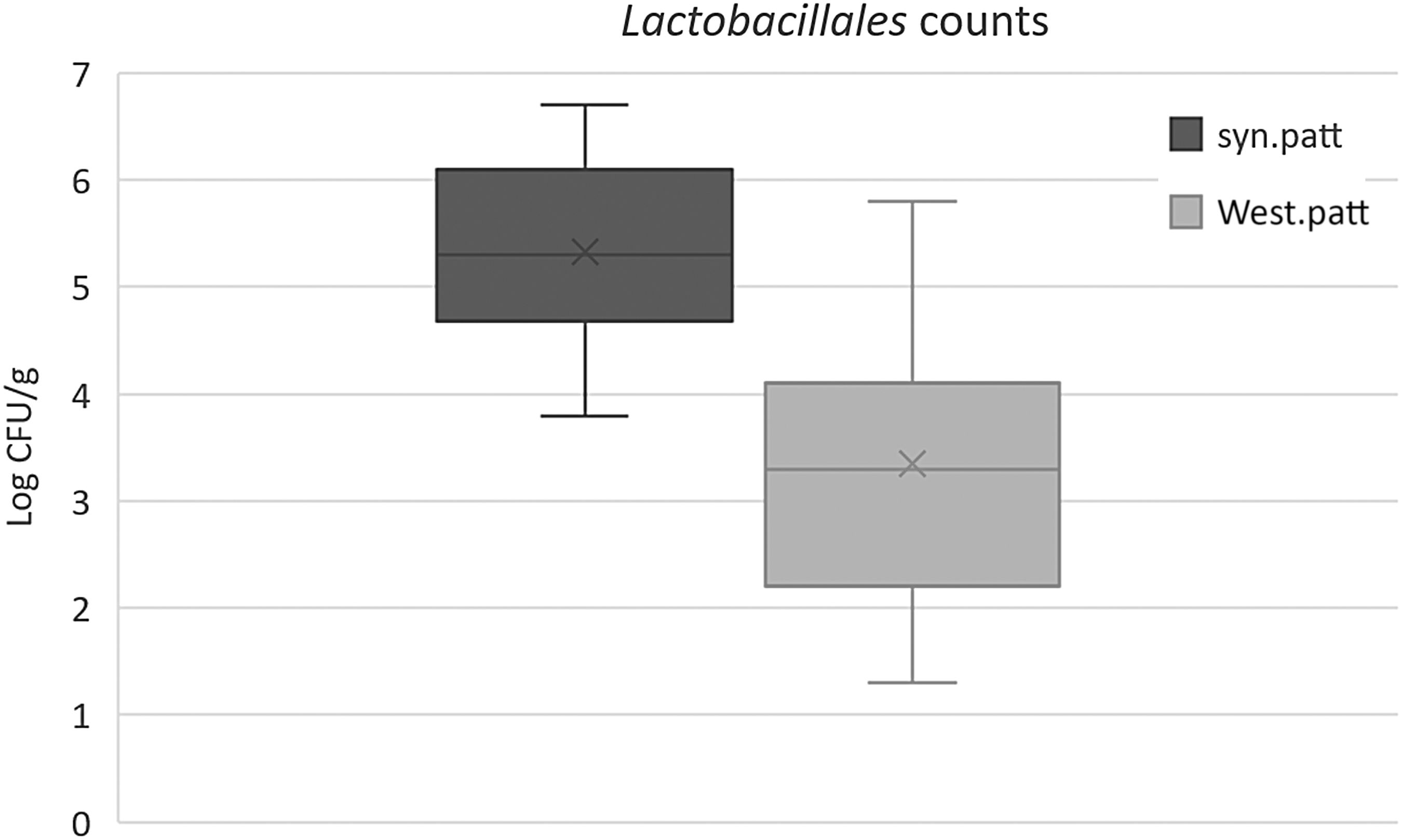
Lactobacillales counts presented in breast milk samples in two major identified maternal dietary patterns (CFU; syn.patt [n = 41]), West.patt (n = 132); difference was significant at level of p < 0.05 determined by ANCOVA test; adjusted for age, level of education, job status, household income per month, family history of obesity in first and second pregnancy, energy intake). ANCOVA, analysis of covariance; CFU, colony forming unit; syn.patt, synbiotic dietary pattern; West.patt, Western dietary pattern.
Discussion
In this comparative cross-sectional study, 345 healthy mothers were randomly selected for dietary intake assessment; two major dietary pattern—synbiotic based (n = 41) and Western based (n = 132)—were detected. As a result, adherence to syn.patt could enhance Lactobacillales levels in breast milk.
Maternal dietary pattern identification has been the center of attention in today's scientific works; more specifically, dietary-related associations with birth outcomes 24 and infant's immune system 25 are the newest scientific projects in developed countries. Generally, breast-fed infants have fewer allergic disorders than formula-fed infants. In fact, breast milk is significantly affected by maternal nutrition, 26 especially bioactive agents such as probiotics and prebiotics compounds 27 ; probiotics, as bacterial agents that promote immunity and prebiotics—indigestible carbohydrates with anti-inflammatory properties—play an important role in mother and infant's health. 28 Lactobacillus salivarius CECT5713, 29 Lactobacillus gasseri CECT5714, 29 Lactobacillus reuteri, 30 Lactobacillus rhamnosus, 30 Lactobacillus plantarum, 30 Lactobacillus acidophilus, 31 and Lactobacillus fermentum CECT5716 32 are identified as probiotic species in human breast milk. Some clinical evidence has been published on the effects of probiotics in children and infants. Lactobacillus administration showed to be useful in children with chronic immune disorders, such as asthma. 33 Results of a prospective double-blind randomized study with four groups (Lactobacillus paracasei, L. fermentum, their combination, and placebo) showed lower asthma severity. 34 Contrary, a meta-analysis determined that L. rhamnosus GG was ineffective in the suppression of atopic dermatitis. 35 Final conclusions need further investigation.
Isolation of lactic acid bacteria from breast milk has been done in some studies. Solís et al. reported a high frequency of lactobacillus strains in breast milk, but they did not assess affecting factors such as dietary intake of mothers. 36 In contrast, maternal dietary patterns were evaluated in some investigations, but based on our knowledge, this is the first study that compares the Lactobacillales levels (presents in breast milk) across the identified maternal dietary patterns. In a recent study, Paknahad et al. found three major dietary patterns; the high fiber pattern had an inverse relation with gestational diabetes mellitus (GDM) risk (p < 0.05), whereas high carbohydrate-lower fat dietary pattern was more associated with GDM. 37 In addition, there are some literatures investigating interactions between maternal diet and breast milk composition. In a comprehensive review consisting of 59 observational and 43 interventional studies, Keikha et al. reported that fatty acids and some micronutrients, including fat-soluble vitamins, vitamin B1, and vitamin C levels in the breast milk are related to maternal dietary intake, whereas they did not find any link between mothers' diet and lactic acid bacteria in breast milk. 38 Another study emphasized on docosahexaenoic acid levels dependence to maternal diet. 39 In an observational study conducted by Amezcua Lopez et al., 70 breast milk samples from Mexican mothers were evaluated. They concluded that lactic acid bacteria levels were completely affected by the mother's food intake. 40
Western diet—characterized by high-salt low-fiber refined cereals and animal-based foods, high-fat dairy, and frequent consumption of sweets—has been shown to decrease the level of lactobacillus strains in the gut flora, but there has not been any investigation about the effects of this diet on breast milk bacterial composition. For example, Miranda et al. reported that a high-salt diet can reduce lactobacillus strains in the intestine and enhance the proinflammatory genes such as Rac1, Map2k1, Map2k6, and Atf2. 41
Other aspects of the scientific findings about dietary patterns and lactobacillus interactions–especially in women—are of interest. Based on previous studies, the microbiome of mammary gland tissue shifts on lower Lactobacillus counts in malignant breast cancer states. 42 Surprisingly, Shively et al. after 31-month administration of Western (high fructose-low fiber) and Mediterranean diet (MeD; low fructose-high fiber and omega 3 fatty acids) found that Mediterranean diet can boost Lactobacillus colonies in mammary glands of female monkeys (Macaca fascicularis). 43
The term syn.patt was used for the first time in this article. The nature of this pattern comebacks to high-fiber high-dairy diets. Kefir, as one of the most important ingredients in this pattern, may act a key role due to the huge capacity of Lactobacillales. 44 As well, according to the newest finding, maternal soluble fiber feeding in piglets resulted in the improvement of Lactobacillus spp. population in the gut independently. 45 Actually, prebiotic properties of soluble fibers able them to enlarge the size of Lactobacillales.
This research had some limitations. First, the selection bias was inevitable. We minimized this issue by matching the pattern groups through age, education level, household income, and physical activity level. Second, recall bias may happen when answering dietary questions. Also, this research could not evaluate the long-term impacts of other factors on Lactobacillales such as maternal mood status. Unfortunately, we did not evaluate the microbiome of mammary glands and fecal samples due to the financial issues' limitations. Ultimately, the sample size was relatively small and the research was just performed on individuals living in Isfahan city. This can restrict the generalization of research results toward the whole Iranian population. Causality could not be diagnosed due to the observational nature of the study.
Conclusion
Despite the mentioned restrictions, this is actually the first research to introduce syn.patt and determines its impacts on Lactobacillales population in breast milk. We found two major dietary patterns from 345 healthy Iranian mothers; syn.patt was related to higher Lactobacillales colonies isolated from breast milk samples. On the contrary, Western-based pattern was related to lower Lactobacillales counts. The main question that future researches should answer is “How does syn.patt improves Lactobacillales population in breast milk?”
Footnotes
Authors' Contributions
Study concept, design, sampling, and monitoring the visiting procedure were done by Bahreini Esfahani. Analysis and interpretation of data and critical review of the article for important intellectual content were by Moravejolahkami.
Acknowledgment
We thank all the participants who cooperated in this study.
Disclosure Statement
No competing financial interests exist.
Funding Information
This research was supported by Isfahan University of Medical Sciences, Isfahan, Iran (Grant No. 393152).