






Abstract
Today's biobanks must work to take full advantage of collected samples, while maximizing sample quality and minimizing costs to sustain operations for a long period of time. This is a tall order that will require collaboration and compromise for both end-users and collection sites. This article discusses the efforts of the Génome Québec—Centre Hospitalier Affilié Universitaire Régional de Chicoutimi Biobank to fractionate blood samples for the simultaneous preservation of plasma and DNA-containing layers while minimizing resources required for shipping and transport. This article also describes methods for successful reproducible application of the plasma-depleted blood sample to GenPlates (GenVault, Carlsbad, CA).
Introduction
It is most cost-effective to send samples from collection sites in batches at a determined frequency instead of every day. Unfortunately, proteins and biomarkers in WB may degrade over time if plasma is not separated promptly from the blood cells and stored at −80°C.8,9 To easily overcome this issue, collection sites can be asked to fractionate blood by a simple centrifugation step, leading to a plasma layer and a second layer of plasma-depleted blood containing primarily red and white blood cells, the red blood cell concentrate (RBCC). After fractionation, the plasma layer is stable for frozen transport. 10 In the present study, we simulated delays in shipping or processing and characterized how storage conditions would affect the RBCC fraction and subsequent DNA yields. We demonstrate that storage and transport of RBCC is possible for up to 10 days at 4°C, without a significant decrease in DNA yield. We also evaluated the impact of RBCC storage over sample viscosity and the downstream challenge this may pose to perform reproducible pipetting steps. We show that the ability to accurately pipette samples is essential for decreasing variance in DNA yield following recovery.
Materials and Methods
Eight 10-mL K2 ethylenediaminetetraacetic acid (EDTA)–coated tubes of WB collected from a single donor were purchased from BioMed Supply Inc. (Carlsbad, CA) (Fig. 1). Upon receipt, 480 μL of WB was applied to GenPlates (GenVault, Carlsbad, CA) and cured for 2 weeks at room temperature according to the manufacturer's instructions. The remainder of WB was centrifuged at 1,200g for 10 min at 4°C. The plasma layer was removed carefully, aliquoted in cryovials, and frozen at −80°C. Approximately 1 cm of plasma was left on top of the white blood cell layer. The remaining RBCC tubes were labeled as 1, 2, 3, 4, 5, 6, 7, and 8 and submitted to different storage conditions. Tube 1 was shaken gently on a mechanical rocker at room temperature for 1 h. An aliquot (A) was transferred to a microtube and left undiluted. A second aliquot (B) was diluted with an equal volume of phosphate-buffered saline (PBS) (1:1). A third aliquot (C) was diluted 1:0.5 with PBS. The 3 aliquots were then applied to GenPlates as per manufacturer's procedure. Briefly, 10 μL of homogenized sample was pipetted to the center of each element. Unsealed GenPlates were dried in a GenVault Drying Station for 12 h. GenPlates were then sealed and cured for 2 weeks at room temperature in a GenVault Archiving system. Tubes 2–7 were stored at 4°C for 2, 3, 4, 7, 8, and 10 days, respectively, prior to being processed as described for tube 1. Tube 8 was placed in a −20°C freezer for 10 days, then thawed completely, and treated as described for tube 1.
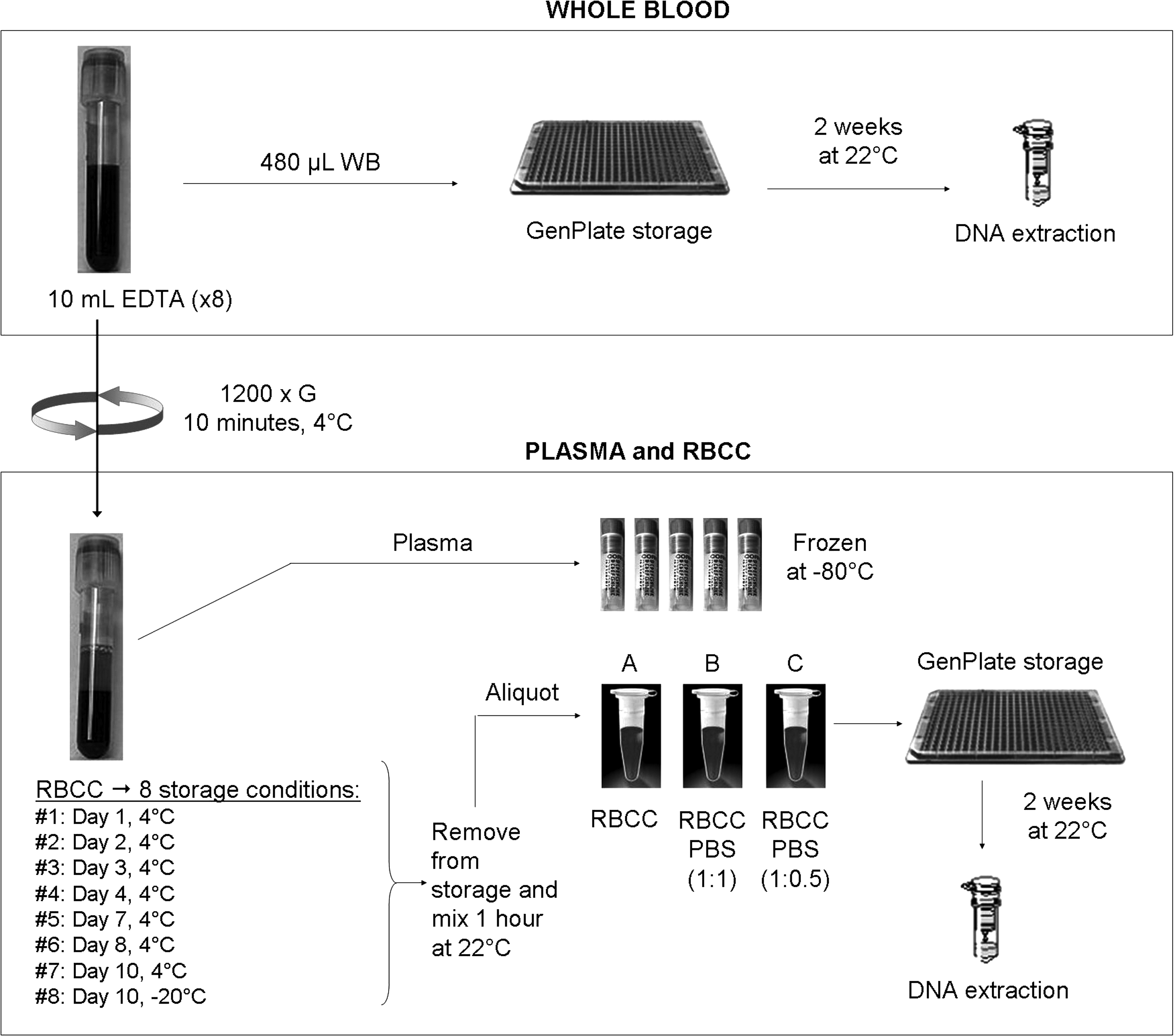
Experimental setup. Blood tubes processing setup: Eight 10-mL ethylenediaminetetraacetic acid–blood tubes were used to evaluate the effect of storage conditions on DNA. Control whole blood (WB) was immediately spotted on GenPlates and DNA was extracted once the GenPlates were cured. Remaining blood was centrifuged to fractionate the plasma and the red blood cell concentrate (RBCC) layers. Plasma was aliquoted and frozen. The RBCC was submitted to 8 different storage conditions. At determined time points, RBCC sample was removed from storage, mixed, and aliquoted to 3 tubes as (A) undiluted RBCC, (B) RBCC diluted with phosphate-buffered saline in a 1:1 ratio, and (C) RBCC diluted with phosphate-buffered saline in a 1:0.5 ratio. RBCC aliquots were spotted on GenPlates, from which DNA was recovered 2 weeks later.
Viscosity of RBCC aliquots A, B, C, and WB control was assessed qualitatively as samples were pipetted onto GenPlates (Table 1). When no pipetting difficulties were encountered, samples were described as “not viscous”; samples difficult to pipette because of the overall thickening of RBCC were described as “slightly viscous”; samples difficult to pipette because of thickening of RBCC and presenting stringy clumps were described as “very viscous.”
Viscosity of RBCC aliquots A, B, and C and WB control as a function of time and storage conditions was assessed by qualitative observations. Samples were described as “not viscous” (−) when no pipetting difficulties were encountered; samples difficult to pipette because of either the overall thickening of the RBCC or the presence of stringy clumps were described as “slightly viscous” (+); samples very difficult to pipette because of thickening of the RBCC and presence of stringy clumps were described as “very viscous” (++).
Abbreviations: RBCC, red blood cell concentrate; N/A, data not available; PBS, phosphate-buffered saline.
Cured GenPlates were then subjected to DNA extraction. DNA was recovered from 9 GenPlate elements (6-mm discs of FTA paper) for each condition using GenSolve (GenVault), followed by semiautomated DNA purification with a QIAamp-96 blood kit. All samples were processed at the same time to minimize variables. All kits were utilized according to the manufacturers' instructions. Purified DNA was quantified in triplicate using PicoGreen dsDNA quantitation assay (Invitrogen, Carlsbad, CA). Assay samples were read on a Tecan Genios plate reader.
Yield data from the day-to-day study did not have a normal distribution and displayed unequal variances both within and between days. Therefore, a nonparametric method was used to determine significant differences between means. The method used was a Wilcoxon/Kruskal–Wallis test in JMP software. 10
Results
We evaluated the viscosity of the RBCC samples that were stored for 1, 2, 3, 4, 7, 8, and 10 days at 4°C or 10 days at −20°C and then thawed (Table 1). Fresh WB control was used as a nonviscous sample reference. Viscosity of RBCC became substantial after 3 days of storage at 4°C. Increased viscosity made pipetting of aliquot A (undiluted RBCC sample) onto GenPlates very difficult. The overall viscosity of samples was reduced when RBCC were diluted with PBS (aliquots B and C), allowing easier, more reproducible pipetting of the RBCC sample onto GenPlates. The RBCC sample stored frozen for 10 days at −20°C was not viscous after thawing and was therefore easily dispensed onto GenPlates.
To maximize each blood sample collected, it is critical for biorepositories to achieve the highest DNA yields possible from each aliquot and to determine the best technique to ensure reproducibility. We compared the DNA yields for RBCC aliquots A, B, and C (Fig. 2) following DNA extraction from GenPlate elements. The WB control was used to establish an accepted level of DNA yield for this particular donor's samples. Particular interest was paid to the variability in DNA yield as a function of storage condition and time. In general, the undiluted RBCC samples (aliquot A, Fig. 2) showed a high variability in DNA yields as a function of storage condition. In fact, we noted a greater variability within replicates of undiluted RBCC sample (aliquot A) stored for 3–10 days at 4°C than for samples stored for a shorter period of time (1–2 days). This is in line with the observed increase in RBCC viscosity over time of storage at 4°C. Therefore, we can suppose that increased sample viscosity makes the sample more difficult to pipette, causing volume errors and subsequent variability on the amount of DNA obtained.
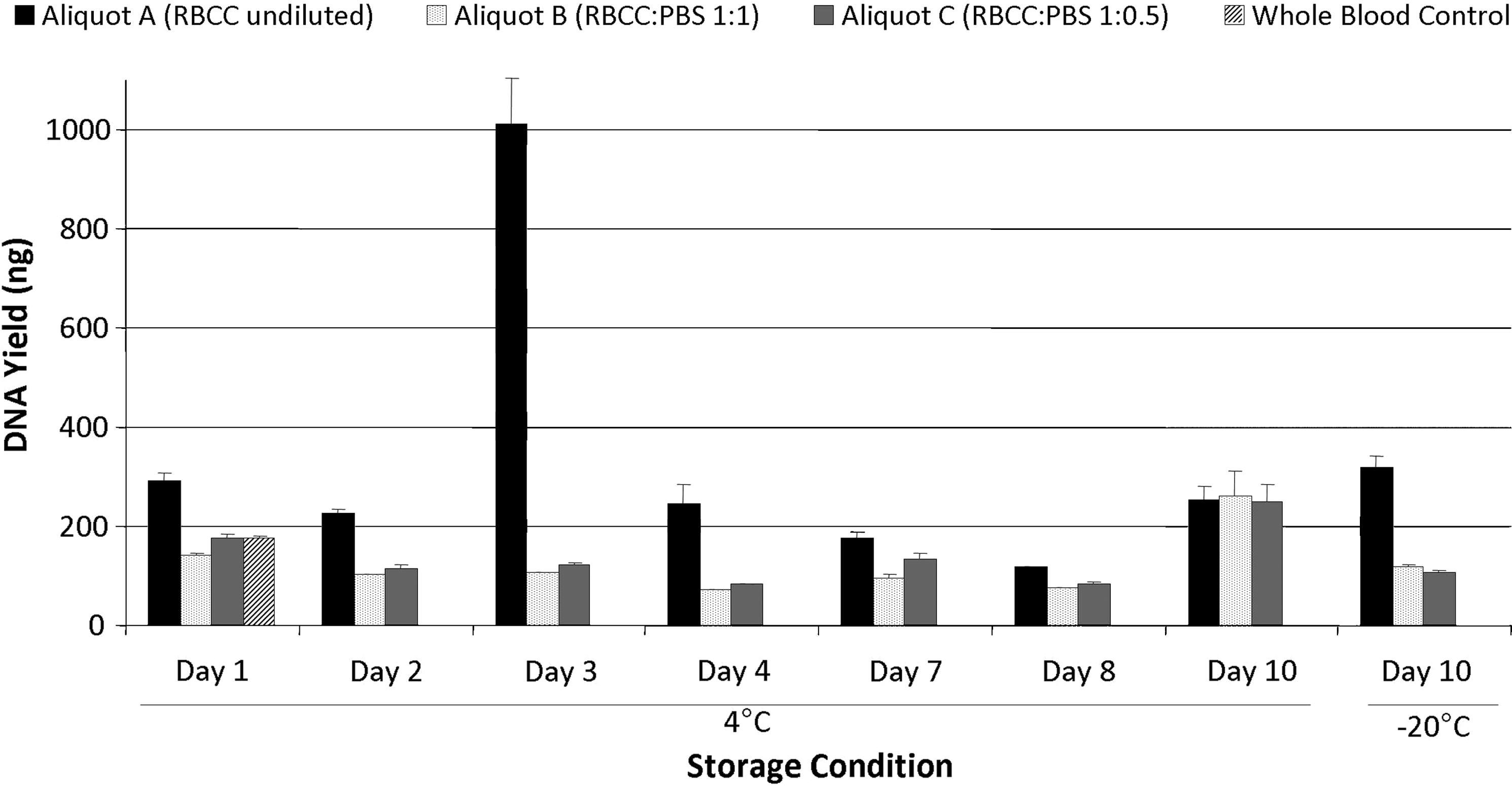
DNA recovery yield as a function of storage condition. Bar graph shows DNA yield (ng) as a function of storage condition. DNA was recovered from GenPlate elements previously spotted with either WB or RBCC aliquots A, B, or C as described in the Materials and Methods section. Extracted DNA was quantified by fluorescence. WB control was used as a reference. Data show average of 9 replicates with standard deviation error bars.
Diluting the RBCC with PBS 1:1 (aliquot B, Fig. 2) clearly reduced variability in DNA yield as a function of storage time and condition, with the exception of the day 10 sample stored at 4°C, which demonstrated a high variability in DNA yields among replicates. However, we observed a general trend of decreased DNA yields for diluted samples when compared with undiluted RBCC sample. Therefore, diluting the RBCC sample with PBS allows for a better reproducibility but lower DNA yields.
The RBCC diluted 1:0.5 in PBS (aliquot C, Fig. 2) demonstrated a slightly higher variability in DNA yields as a function of storage time when compared with more diluted samples, but the variability was still greatly reduced when compared with the undiluted samples. Again, the day 10 samples stored at 4°C exhibited a high variability in DNA yields. These results suggest that diluting RBCC samples with PBS prior to GenPlate application could facilitate pipetting and spotting of samples by an automated robotic platform. Although diluting RBCC samples with PBS lowered downstream DNA yields, it allowed for better reproducibility and less variability, resulting in more consistent and predictable yields.
Discussion
Today's biobanks must balance sample quality with other practical needs such as maximizing the utility of all sample fractions and minimizing costs associated with shipping and operations. With this in mind, one should also consider the need to standardize sample handling at collection sites to protect the quality of materials banked in repositories. This work highlights the importance of storage conditions of RBCC to obtain high and reproducible DNA yields.
The RBCC, because of its concentrated cellular and hemoglobin content, presents a greater viscosity than WB. Cellular agglutination as well as lysis of RBCs over storage time at 4°C may also contribute to an increased viscosity. We characterized viscosity of RBCC samples stored for up to 10 days at 4°C. Viscosity was assessed as the ease to pipette sample. We observed that RBCC samples stored at 4°C for 2 days became slightly viscous and that viscosity became an issue for proper pipetting after 3 days of storage. We then evaluated if the viscosity issue could be overcome by diluting RBCC samples with PBS. We observed that diluting RBCC samples with PBS reduced viscosity and allowed better, more accurate pipetting. We noted a greater ease to pipette when RBCC samples were diluted with a 1:1 factor with PBS (aliquot B) than a 1:0.5 factor (aliquot C). Another important observation was that freezing the RBCC prior to processing resulted in a loss of sample viscosity, making RBCC easy to pipette. Therefore, if the RBCC can not be processed within 48 h, we suggest freezing the RBCC. Alternatively, if freezing is not possible, we found that diluting the RBCC with PBS could be a solution to overcome sample viscosity issue and downstream difficulties to pipette the sample.
We next established whether the impact of viscosity on consistent pipetting would influence downstream DNA yields. We showed that there is a greater variability in DNA yields in samples where viscosity was initially observed. In fact, very viscous RBCC samples (3–10 days of storage at 4°C) with the presence of stringy clumps are not homogeneous, resulting in uneven volumes pipetted and unequal leukocyte content dispensed in GenPlate wells. Our data suggest that this challenge may be overcome by diluting the RBCC fraction with PBS prior to applying the sample to GenPlates. DNA yields obtained from RBCC diluted with PBS showed greater reproducibility within replicates. Comparing the 2 dilution factors, no statistically significant difference in DNA yields was observed for RBCC aliquots B or C. As samples were easier to pipette when diluted with a 1:1 factor in PBS (aliquot B), we would recommend using this dilution factor. Also, more consistent DNA yields were observed for all diluted samples, independent of the number of days of storage at 4°C when compared with undiluted RBCC samples. However, the observed general trend in lower DNA yield as a function of storage time for diluted RBCC samples was confirmed by a nonparametric Wilcoxon/Kruskal–Wallis test. Freezing RBCC samples for 10 days did not significantly affect DNA yields as the amount of DNA obtained were comparable to freshly processed (day 1) samples. Nevertheless, one has to consider that diluting the RBCC will result in lower, although more reproducible, overall DNA yields when compared with undiluted RBCC.
The use of EDTA-coated blood collection tubes is recommended and widely used for downstream DNA analysis.9,11 The viscosity observed in EDTA-RBCC samples can be explained by the time-dependant lysis of RBCs and cellular component agglutination at 4°C. Several other factors can affect EDTA sample viscosity, namely improper mixing following blood draw, insufficient EDTA (usually caused by overfilling the vacuum tube), poor solubility of the EDTA, improper blood draw technique leading to an excess of thrombin release, etc.12,13 This highlights the need for standardized procedures at collection sites to minimize downstream variability in results.
In conclusion, this article shows that it is possible to store and/or transport the RBCC layer at 4°C for up to 10 days instead of immediate freezing. The subsequent possible viscosity issue can be overcome by either diluting sample with PBS or freeze–thawing the sample prior to applying it to GenPlate. This finding will enable more flexibility at the collection site as well as minimize sample transport costs. Biobanks have a big challenge in reaching out to collection sites to ensure that sample quality is maintained without adding a burden to collection site operations and without adding substantial costs to the project. Demonstrating that fractionation of blood into plasma and RBCC and further short-term refrigerated storage of RBCC are feasible will enable biobanks to reduce the amount of sample that must be drawn as well as sample transport costs.
Footnotes
Author Disclosure Statement
No competing financial interests exist.