







Abstract
The study aimed to evaluate the effect of powdered coconut water-based diluent (ACP-101c) associated with extra virgin coconut oil (CO) as an external cryoprotectant in the conservation of cryopreserved buck sperm. For cryopreservation, the ejaculates from four bucks were pooled and divided into three aliquots and diluted at 37°C for treatments T1 (ACP-101c + 2.5% egg yolk +7% glycerol), T2 (ACP-101c + 2.5% CO +7% glycerol), and T3 (ACP-101c + 5% CO +7% glycerol). Then, the samples were packaged and cooled at a rate of 1.07°C/min decrease. Upon reaching 4°C, the samples were stored in a refrigerator at 4°C for 30 minutes for stabilization. After this period, the straws were frozen in nitrogen vapor for 15 minutes and then immersed and stored in liquid nitrogen at −196°C. After thawing, the samples were evaluated for sperm kinetics, plasma membrane integrity, acrosomal integrity, membrane functionality, mitochondrial activity (MA), and sperm morphology. In this study, no statistically significant differences were observed between the three treatments regarding the kinetic parameters (p > 0.05; Table 1). However, in relation to the velocities, a reduction was observed beyond the expected. There were no statistically significant differences between the diluents T1, T2, and T3 for the three velocities (curvilinear velocity [VCL], linear velocity [VSL], average path velocity [VAP]). Furthermore, no statistically significant differences were observed (p > 0.05) among treatments regarding the evaluation of membrane integrity, the functional membrane, MA, and sperm morphology after thawing. In conclusion, the use of CO in concentrations of 2.5% and 5.0% is effective in maintaining goat sperm quality, presenting itself as an alternative diluent for international programs of artificial insemination and embryo transfers.
Kinetic Parameters (Mean ± SEM) of Post-Thaw Buck Sperm Cryopreserved in Powdered Coconut Water Base Medium (ACP-101c) Different superscript lowercase letters in the same row means that there was a statistical difference among treatment evaluations (p < 0.05). T1 = ACP-101c + 2.5% EY +7% glycerol; T2 = ACP-101c + 2.5% CO +7% glycerol; T3 = ACP-101c + 5% CO +7% glycerol. CO, coconut oil; EY, egg yolk; MT, total motility;
Parameters/treatments
T1 (control)
T2
T3
MT (%)
35.20 ± 4.50a
36.87 ± 4.72a
42.13 ± 4.32a
VCL (μm/s)
43.59 ± 5.20a
40.58 ± 3.64a
50.17 ± 9.32a
VSL (μm/s)
24.72 ± 5.29a
18.98 ± 3.71a
26.48 ± 9.53a
VAP (μm/s)
32.98 ± 5.42a
26.52 ± 8.98a
35.80 ± 10.10a
Introduction
In the goat species, seminal cryopreservation has proved to be a highly effective technology. However, during the cryopreservation process, post-thaw sperm motility and membrane integrity are reduced due to cold shock and stress. 1 Thus, to preserve sperm against cryoinjury during the freezing process, the egg yolk (EY) egg has been commonly used in mammalian sperm diluents. 2
The requirement in relation to the replacement of EY as a cryoprotectant in the seminal diluent has been intensified due to the difficulty of containing substances that impede the breathing of the spermatozoa, which may lead to a decrease in their motility. In addition, the EY increases the risk of microbial contamination, which can cause the production of endotoxins that can reduce the fertilization of sperm and increase the risk of disease transmission, making it difficult to commercialize these cryopreserved doses. 3
Another disadvantage regarding the use of EY is due to the fact that the considerable variability of its composition makes it difficult to prepare diluents. In addition, in goats there is also the problem attributed to an enzyme originated by the bulbourethral gland, called Egg Yolk Coagulating Enzyme (EYCE), where the interaction between the EY and this enzyme can be prejudicial to spermatozoa. 4
Therefore, the search for extenders free of animal products has intensified. Several studies with the use of coconut water, oil, and plant products such as argan oil and coconut oil (CO) have been carried out.5–7
Coconut water has shown positive results in maintaining the viability and fertilizing power of sperm in vitro and in vivo experiments, making possible its use in biotechnological processes, such as artificial insemination, without the high costs of imported diluents. 8
The above results have spurred interest in the use of CO, obtained from the pulp of fresh ripe coconut (Cocos nucifera L.), composed of saturated fatty acids (more than 80%) and unsaturated fatty acids. The saturated fatty acids present in CO are: caprylic, capric, lauric, myristic, palmitic, and stearic; and the unsaturated ones are oleic and linoleic. These fatty acids are the same as those observed in the seminal plasma of small ruminants. 9
Studies have demonstrated that vegetable oils affect lipid peroxidation and antioxidant parameters and can result in favorable changes in lipid status. In a study with rats, it was demonstrated that the administration of extra virgin CO in food increased the antioxidant enzyme activity and reduced the lipid peroxide content. 10 Therefore, the objective of the present study was to evaluate the effect of powdered coconut water-based diluent (ACP-101c) associated with extra virgin CO as an external cryoprotectant in the conservation of cryopreserved buck sperm.
Materials and Methods
Location of the experiment
This research was carried out after evaluation and approval by the Ethics Committee for the Use of Animals at the State University of Ceará, Fortaleza, Ceará, Brazil, under protocol n° 1845940/2016.
The experiment was carried out at the Laboratory of Caprine and Ovine Sperm Technology (LTSCO), within the Integrated Nucleus of Biotechnology (NIB) at the Ceará State University (UECE). The NIB is located in the city of Fortaleza, in the State of Ceará, Brazil, with a latitude of 3°43′47″ south and longitude of 38°30′37″ west and altitude of 16 m above sea level. The climate of the region, according to the Köppen classification, is hot and humid, with thermal averages ranging from 26°C to 27°C, maximum of 30°C and minimum of 19°C.
Animals and sperm collection
Four adult goat breeders were used with an average age of 4 years, kept in individual stalls, fed with Tifton hay (Cynodon sp.) and a commercial concentrate with 18% crude protein, in addition to mineral salt and water at will. Sperm collections were performed using an artificial vagina, once a week, making 6 collections per animal, totaling 24 ejaculates. After each collection, the ejaculates were evaluated for volume, concentration, mass motility, percentage of mobile sperm, and vigor, using only ejaculates with a volume greater than 0.5 mL, minimum sperm concentration of 3 × 10⁹ sperm/mL, minimum score of 4.0 for mass motility, and 3.0 for vigor, percentage of mobile sperm greater than 80%. 11 To assess mass motility, an aliquot of 10 μL of semen was placed on a slide preheated to 37°C and evaluated under microscopy with a 100 × magnification. The analysis is expressed on a scale of 0 to 5, where zero means the absence of turbulence, and five means the maximum value given to an accentuated mass movement. To assess the concentration, a Neubauer Chamber was used, 10 μL of semen was diluted in 4 mL of saline formaldehyde solution. There were five squares on each side of the chamber, diagonally, without considering the sperm whose heads were on the left and bottom lateral borders. The total was multiplied by 10,000,000, and the concentration was obtained in 1 mL. 11
Sperm cryopreservation
For sperm cryopreservation, the diluent ACP-101c was prepared according to the manufacturer's recommendation (ACP Biotecnologia, Fortaleza, Ceará, Brazil), divided into three aliquots which were added with 2.5% EY, 2.5% CO, and 5% CO. The three aliquots were added with 7% glycerol, and for all diluents, 40 mg of gentamicin was added for each 100 mL of diluent.
In each collection, the ejaculates were pooled and divided into three aliquots and diluted at 37°C in treatments T1 (ACP-101c + 2.5% EY +7% glycerol; control), T2 (ACP-101c + 2.5% CO +7% glycerol), and T3 (ACP-101c + 5% CO +7% glycerol), obtaining a final concentration of 400 × 106 sptz/mL. Then, the samples were packaged in 0.25 mL straws and cooled to 4°C in 45 minutes, with a decrease of 1.07°C/min. Upon reaching 4°C, the samples were stored in a refrigerator at 4°C for 30 minutes for stabilization. After this period, the straws were frozen in nitrogen vapor for 15 minutes, at a height of 5 cm from liquid nitrogen, and then immersed in liquid nitrogen at −196°C and stored in cryogenic cylinders.
Post-thawing sperm evaluation
To evaluate the cryopreserved sperm, two straws per treatment were thawed in a water bath at 37°C for 30 seconds, placed in microtubes, and incubated for 5 minutes in a water bath at 37°C.
The samples were evaluated after thawing for sperm kinetics, plasma membrane integrity (PMI), acrosomal integrity (AI), membrane functionality, mitochondrial activity (MA), and sperm morphology.
Sperm kinetics evaluation
For the evaluation of sperm kinetics, aliquots of 250 μL of the samples were placed in microtubes, diluted in the base diluent (ACP-101c) to a concentration of 40 × 106 sptz/mL, and kept in a water bath at 37°C. Subsequently, 10 μL of each diluted sample was analyzed individually in a Makler chamber preheated to 37°C. The images were obtained and processed in a phase contrast microscope coupled to a digital camera and analyzed in a Computer-assisted Sperm Analysis system, using the Sperm Class Analyzer® software (SCA®, Microptic SL, Barcelona, Spain) according to the following configuration of the parameters: contrast—100; Brightness—100; Image/second—24; Optic—Ph+; Chamber—Makler; Scale—10 × ; Particle size—10 < 70 (μm2); Slow >10 μm/s; Medium >45 μm/s; Rapid >75 μm/s; Circular 50% of Linearity (LIN); Velocity on the average path points—5; Numbers of image—25. The following kinetic sperm parameters were evaluated: total motility (MT%); curvilinear velocity (VCL, μm/s); linear velocity (VSL, μm/s), and average path velocity (VAP, μm/s).
Sperm morphology evaluation
The morphology was evaluated by the smear staining technique using the dye eosin-nigrosine (eosin 1 g, nigrosine 2 g, sodium citrate 3.57 g, and distilled water q.s.p. 100 mL). 12 Smears were made on a preheated slide at 37°C using 5 μL of the eosin-nigrosine dye plus 5 μL of the rediluted sperm. Two hundred sperm cells were counted and classified as normal, major and minor defects, head defects, middle piece defects, tail defects, and presence of cytoplasmic drop.
Plasma membrane functionality evaluation
The samples were submitted to a hyposmotic solution at 100 mOsmol/L, formulated by the combination of sodium citrate and fructose in distilled water. Aliquots of 10 μL of each sample were placed in microtubes containing 90 μL of the hyposmotic solution and kept in a water bath at 37°C for 60 minutes. Two hundred sperm cells were evaluated, and sperm that were reactive to the test showing tail folding reaction were considered viable. 11
PMI, AI, and MA evaluations
PMI was evaluated using the propidium iodide (Sigma-Aldrich, St. Louis) and bisbenzimide H33342 (HOECHST 33342; Sigma-Aldrich) fluorescent probes, evaluating AI using the fluorescein isothiocyanate probe conjugated to Pisum sativum agglutinin (FITC-PSA; Sigma-Aldrich) and the MA to the 5.5', 6.6'-tetracloro-iodide fluorescent probe 1,1', 3,3'-tetraethylbenzimidazolylcarbocyanine (JC-1, T4069; Sigma-Aldrich).
The thawed samples were diluted in phosphate buffered saline (PBS) to a concentration of 50 × 106 sptz/mL, added 6 μL of IP (0.5 mg/mL in PBS), 3 μL of H33342 (0.5 mg/mL in solution modified buffered saline—DPBS), 12 μL of JC-1 (153 μM in dimethyl sulfoxide), and 50 μL of FITC-PSA (100 μg/mL in PBS) all at the same time to the sample and incubated at 37°C for 10 minutes in the dark.
After incubation, sperm were immediately evaluated using Nikon Eclipse Ci (Nikon, Tokyo, Japan) phase contrast fluorescence microscope with blue, green, and red filter attached to DS-Fi3 camera (Nikon) and NIS-Elements software (Nikon) at 400 × magnification, and each fluorescent probe was evaluated separately. Sperm with damaged plasma membranes were stained red by IP and sperm with intact membranes stained blue by HOECHST. Spermatozoa with an intact acrosome exhibited green fluorescence throughout the acrosomal region by FITC-PSA; acrosomes with an irregular border or loss of the acrosomal outer membrane were considered damaged. The middle pieces of the sperm were stained by the fluorescent probe JC-1 in orange or green and classified into high or low MA, respectively (Fig. 1).
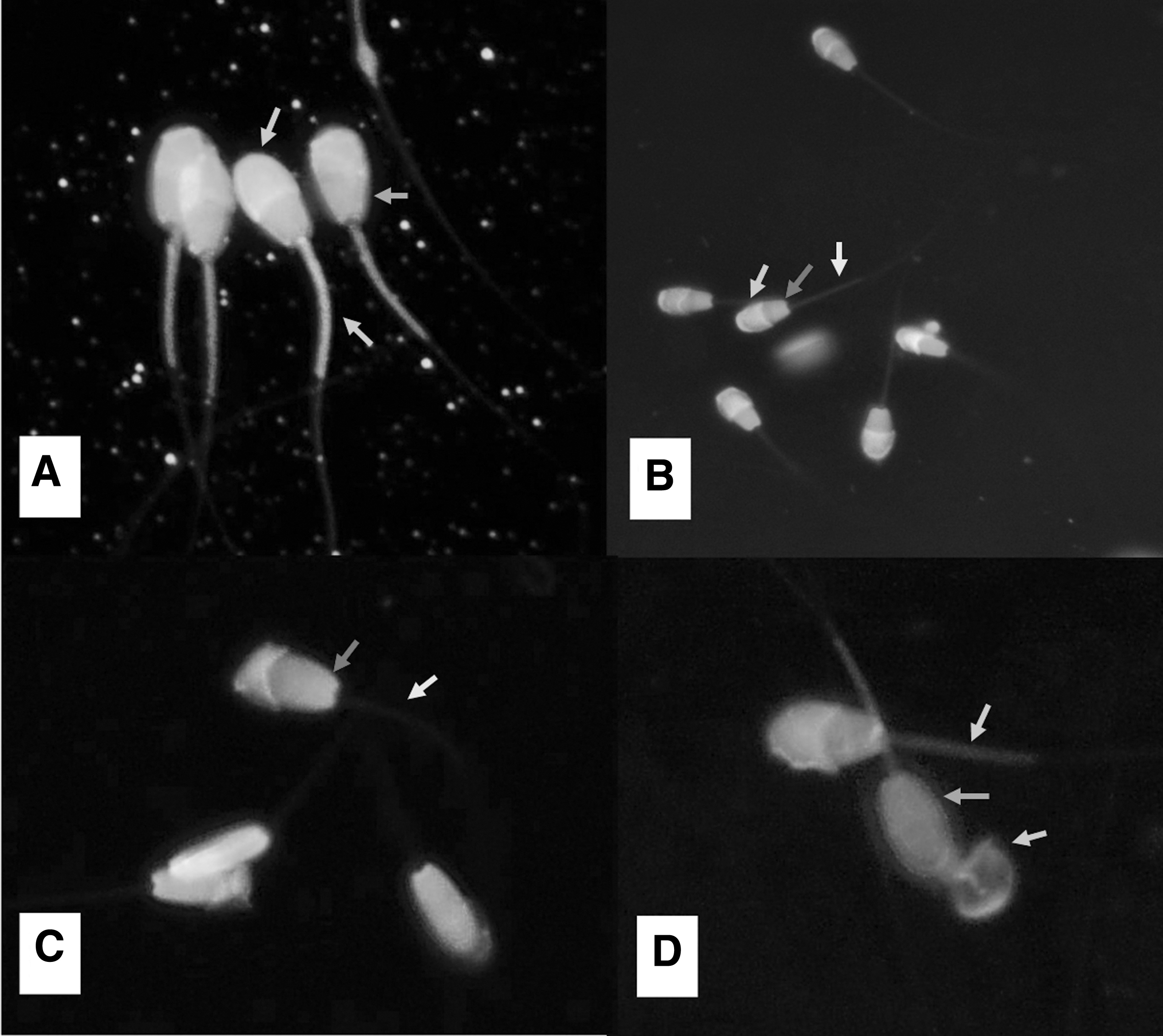
Plasma membrane integrity, acrosomal integrity, and MA of post-thaw buck sperm cryopreserved in powdered coconut water base medium (ACP-101c) added extra virgin CO.
Experimental design and statistical analysis
Statistical analysis was performed using the GraphPad Prism software version 5.0 (GraphPad Software, Inc., San Diego, CA). The experiment was conducted using a completely randomized design, and the results were expressed as mean ± standard error and verified for normality (Kolmogorov–Smirnov test) and homoscedasticity (Bartlett's test). To evaluate the effect of the diluent on thawed sperm, data were submitted to analysis of variance (ANOVA) followed by the Tukey test (p < 0.05) when parametric and the Kruskal–Wallis test when nonparametric (p < 0.05).
Results
In the present study, no statistically significant differences were observed between the three treatments (T1/control—2.5% EY, T2—2.5% CO, and T3—5% CO) regarding the kinetic parameters (MT, VCL, VSL, and VAP) (p > 0.05; Table 1). However, in relation to the velocities, a reduction was observed beyond the expected. However, there were no statistically significant differences between the diluents T1, T2, and T3 for the three velocities (VCL, VSL, VAP).
In the evaluation of membrane integrity (PMI and AI), plasma membrane functionality, and MA evaluated after thawing, no statistically significant differences were observed (p > 0.05; Table 2). Regarding the evaluation of sperm morphology, similar to the other parameters, there were also no statistically significant differences after thawing (p > 0.05; Table 3).
Plasma Membrane Functionality (HOST), PMI, AI, and MA (Mean ± SEM) of Post-Thaw Buck Sperm Cryopreserved in Powdered Coconut Water Base Medium (ACP-101c)
Different superscript lowercase letters in the same row means that there was a statistical difference among treatment evaluations (p < 0.05).
T1 = ACP-101c + 2.5% EY +7% glycerol; T2 = ACP-101c + 2.5% CO +7% glycerol; T3 = ACP-101c + 5% CO +7% glycerol.
AI, acrosomal integrity; HOST, hyposmotic test/membrane functionality; MA, mitochondrial activity; PMI, plasma membrane integrity.
Morphological Evaluation (Mean ± SEM) of Post-Thaw Buck Sperm Cryopreserved in Powdered Coconut Water Base Medium (ACP-101c)
Different superscript lowercase letters in the same row means that there was a statistical difference among treatment evaluations (p < 0.05).
T1 = ACP-101c + 2.5% EY +7% glycerol; T2 = ACP-101c + 2.5% CO +7% glycerol; T3 = ACP-101c + 5% CO +7% glycerol.
In the present study, for the motility and membrane integrity parameters, values greater than 30% were obtained and for sperm morphology values greater than 90% were obtained. And, as for MA, more than 50% of the cells showed high MA.
Discussion
Sperm motility is an important seminal characteristic for evaluation of the sperm fertility potential. In this study, for the motility variable, no statistical differences were observed between treatments, suggesting that addition of CO in concentrations of 2.5% and 5% was effective in maintaining sperm quality. In addition, it is worth mentioning that, in all treatments, the averages were higher than 30%, a value recommended for the species. 11 These data corroborate with the study in which it also observed a cryoprotective action with the addition of 10% of CO to the diluent ACP-102c in ram sperm, obtaining results similar to that of the diluent ACP-102c added with 20% EY. 13
A study evaluating the effect of adding CO in a preservation medium based on powdered coconut water (ACP-101c) in cryopreserved buck sperm in concentrations of 2.5%, 4%, 10%, and 20% did not obtain results superior to the preservation medium containing the EY as a cryoprotectant. However, it was observed that the oil presented a possible cryoprotective potential when the concentrations of 2.5% and 4% were added, suggesting further studies in relation to the ideal concentration of CO, which would be between 2.5% and 5%, 7 as was also observed in the present study.
It is important to mention that, during the analyses, it was observed that the treatments containing CO showed a variation between the straws of the same collection in terms of motility. This can be justified by the difficulty of homogenizing the oil, which may have caused a variation in the oil concentration between the straws, justifying the high standard error observed in the diluents added with CO in the evaluation of sperm kinetics. In addition, it is believed that reduced velocities are also associated with this difficulty in homogenization, where oil droplets may be preventing the physiological movement of the sperm cell.
Regarding membrane integrity and MA, the data from this study also corroborate the study in which the treatments added with CO were similar to the treatment containing EY. 13 These data demonstrate that CO is effective in maintaining PMI, AI, and MA, suggesting that CO prevents the action of reactive oxygen species (ROS), acting simultaneously as a cryoprotectant and antioxidant, since ROS are one of the main causes of degradation in sperm membranes. 14
As for sperm morphology, it is known that the high frequency of morphologically abnormal sperm can reduce fertility. In the present study, in addition to the fact that there was no difference between the treatments containing CO and the control (EY), the percentage of sperm with normal sperm morphology observed was above the minimum recommended value for the goat species, and the percentage of spermatozoa with larger defects, which are of spermatogenic origin, was significantly lower than the maximum value recommended for the species. 11 Therefore, the extender and cryoprotectants used did not cause any injurious effects and were effective in maintaining the morphological integrity of sperm cells exposed to cryopreservation.
These cryoprotective and antioxidant actions can be justified by the fact that CO has a composition rich in fatty acids and has, in its majority, the same lipids of the seminal plasma of small ruminants. 9 Studies suggest that the strong bonds of exogenous lipids occur on the membrane surface, which would promote a physical barrier to freezing and thawing damage, preventing the membrane separation phase by influencing packaging, thus decreasing the lipid transition temperatures and maintaining the membrane integrity and organization. 15
Thus, it is concluded that the use of CO in concentrations of 2.5% and 5.0% is effective in maintaining the buck sperm quality, presenting itself as an alternative diluent for international programs of artificial insemination and transfers of embryos.
Footnotes
Acknowledgments
The authors thank the Laboratory of Caprine and Ovine Sperm Technology at the Ceará State University, the Physics Department at the Ceará Federal University, and the ACP Biotecnologia company.
Author Disclosure Statement
The authors have stated that there are no competing interests. None of the authors has financial or personal relationships that may influence or distort the content of the article.
Funding Information
We would like to thank these funding agencies for financial support: National Council for Scientific and Technological Development (CNPq): Public call n° 12/2017, and Cearense Foundation to Support Scientific and Technological Development (FUNCAP): Public call n° 03/2019.