







Abstract
The present study analyzes the effects of different disaccharide concentrations and two thawing temperatures on the characteristics of ultrarapid frozen (URF) bovine sperm, compared with conventional slow-frozen (CF) sperm. For URF sperm, samples were diluted in media comprising 2% bovine serum albumin (BSA) and various nonpermeable cryoprotectants. Five groups were compared: control (without cryoprotectant), sucrose 0.15 M, sucrose 0.3 M, trehalose 0.15 M, and trehalose 0.3 M. In addition, the influence of warming temperatures, 37°C and 65°C, was analyzed. The aspect of different diluents (by drops) immersed in liquid nitrogen was also evaluated. Sperm quality was assessed by measuring motility, viability, acrosome status, and membrane lipid peroxidation (LPO). Moreover, the cryoresistance rate (CR) was determined. The drops immersed in liquid nitrogen showed that crystallization occurred, but not vitrification. CF sperm exhibited significantly higher scores for total motility (TM) and progressive motility (PM), viability, and acrosome integrity, in contrast with URF samples. Cryoprotectants for URF sperm showed a significant (p ≤ 0.05) influence on the TM and PM, viability, acrosome integrity, and CR, but not on LPO. Sperm viability was reduced after ultrarapid freezing, and the control samples were observed to have significantly lower values than those treated with disaccharides. Samples supplemented with 0.3 M sucrose exhibited higher LPO when they were thawed at 37°C. In short, a limited number of spermatozoa were able to maintain their motility and other functional attributes after ultrarapid freezing, but disaccharides showed a moderate protective effect. Samples with trehalose and sucrose at 0.15 and 0.3 M, respectively, showed higher sperm quality than samples containing only BSA. In sum, the function of spermatozoa was moderately maintained when disaccharides were used for ultrarapid freezing, although motility was significantly reduced. In addition, thawing temperatures did not modify the sperm values, suggesting that the easier procedure, that is, 37°C for 30 seconds, can be used.
Introduction
Artificial insemination (AI) using frozen–thawed sperm is the technique most widely employed in the cattle industry to improve genetic quality. Conventional slow freezing has been demonstrated to be a successful procedure for bovine sperm cryopreservation, and the results are influenced by aspects such as correct sperm management before freezing (assessment, temperature, cryoprotectants, etc.), the equilibration time, or the freezing–thawing schedule.
In recent years, new alternative procedures for sperm cryopreservation have been explored; in particular, ultrarapid cooling (a term that involves nonvitrifying and vitrifying protocols when ice crystals or a glass-like state is formed, respectively) has offered encouraging results1–3 and it is an easier, cheaper, and less time-consuming technique than conventional slow freezing. 4 However, the physical–chemical processes occurring during different ultrarapid cooling procedures (i.e., ultrarapid freezing or vitrification) should be elucidated. 5
For rapid cooling, sperm requires an extremely rapid fall of temperature, usually achieved by plunging a sample directly into liquid nitrogen (LN2), and a highly viscous medium for containing the spermatozoa, which may be achieved by addition of high concentrations of cryoprotectant agents (CPAs), such as disaccharides, even though they induce toxic damage to the spermatozoa.
To reduce this problem, it is recommended to promote very rapid cooling and warming, using an extremely small sample. 6 Low-volume sperm samples, protected by nonpermeable CPAs, are able to conduct heat more rapidly, favoring an easier transition from the liquid to vitreous state, called vitrification, which theoretically protects the spermatozoa due to reduced ice crystal formation. However, crystallization instead of a glass-like state is usually induced despite the use of nonpermeable CPAs. 7
On the other hand, the thawing/warming temperature might induce cellular injuries during the recrystallization process. 8 In this regard, various warming temperatures and exposure times have recently been evaluated for other species, ranging between 38°C and 70°C for 5–20 seconds.9–12 The findings of these previous studies have been inconclusive, however, and indeed sometimes in mutual conflict.
Ultrarapid freezing of spermatozoa has been reported in domestic9,13 and wild ruminants. 7 Nevertheless, it has been poorly explored in bull samples, reporting nonviable results when vitrification with dimethyl sulfoxide and ethylene glycol was carried out. 14 Based on the literature, it is pertinent to hypothesize that nonpermeable CPAs could be feasible for ultrarapid freezing of bull sperm, although the optimum procedure remains to be investigated.
Therefore, the present study evaluates the quality parameters of bovine spermatozoa after ultrarapid freezing (based on dropping of spheres into LN2), testing two disaccharides (sucrose and trehalose) and two thawing temperatures (37°C and 65°C). A previous trial examined the appearance of the spheres after their immersion into LN2 to check if crystallization or vitrification occurs.
Materials and Methods
Chemicals and diluents
The BioXcell® diluent was obtained from IMV Technologies (L'Aigle, France). Sucrose was acquired from Panreac (Barcelona, Spain) and trehalose from Acros Organics (Geel, Belgium). A LIVE/DEAD® sperm viability kit and C11-BODIPY581/591 were purchased from Molecular Probes (Leiden, The Netherlands). Bovine serum albumin (BSA) and peanut agglutinin conjugated with fluorescein isothiocyanate (PNA-FITC) were obtained from Sigma-Aldrich (St. Louis, MO).
Animals and semen collection
A total of 12 healthy Limousin bulls (3 to 7 years old), located in Cadiz (Spain), were involved in this study. The sperm samples were collected by electroejaculation during November and December; to remove the extragonadal reserves, semen was also collected 2 weeks before the experiment. The animals were restrained, the rectum was manually emptied, and the electrode (Electro Jack 5; IDEAL Instruments, Lexington, KY) was introduced. An automatic setting based on electrical impulses every 10 seconds for a maximum of 32 cycles was used for electrical stimulation. Semen samples were (1:1, v:v) diluted with BioXcell and transported to the laboratory at 5°C within the following 6 hours.
The sperm samples were collected in accordance with the European Union regulations (2010/63), as transposed into Spanish legislation (RD 53/2013). Authorization from the Ethics Committee on Animal Experimentation of the University of Cordoba (Spain) was obtained (No. 2022PI/20).
Experimental design
The fresh sperm samples were analyzed at the laboratory. Inclusion criteria were concentration >500 million spz/mL, total motility (TM) >70%, and normal morphology >70%. The sperm samples were then split for conventional slow-frozen (CF) or ultrarapid frozen (URF) sperm analysis.
To evaluate the influence of different CPAs on the URF sperm, five groups were established as follows: control (C: BioXcell +2% BSA, 323 mOsm/kg), sucrose 0.15 M (S0.15: C + 0.15 M sucrose, 514 mOsm/kg), sucrose 0.3 M (S0.3: C + 0.3 M sucrose, 522 mOsm/kg), trehalose 0.15 M (T0.15: C + 0.15 M trehalose, 692 mOsm/kg), and trehalose 0.3 M (T0.3: C + 0.3 M trehalose, 692 mOsm/kg).
Before sperm samples were processed by ultrarapid freezing, an experiment was conducted to evaluate aspects of the 10- and 50-μL droplets containing different concentrations of CPAs (from 0.15, 0.3, and 1.2 to 2.4 M of sucrose or trehalose) after their immersion into LN2. It was found that the droplet color turns milky white and opaque when crystallization occurs, and the transparent aspect suggests that vitrification has occurred.15,16
Ultrarapid freezing/thawing of sperm
The sperm aliquots were centrifuged for 10 minutes at 600 g and then resuspended in the BioXcell extender to reach a final concentration of 100 × 106 spz/mL. A volume of 25 μL of semen and 25 μL of each concentration of CPA were mixed immediately followed by plunging a 50-μL drop (50 × 106 spz/mL) directly into LN2. The sperm spheres were inserted into cryotubes containing 300 μL of LN2 and stored at −196°C until their evaluation.
For thawing, sperm spheres were individually immersed in 0.5 mL of thawing medium (BioXcell +1% BSA) at 65°C (5 seconds) or 37°C (30 seconds), depending on the protocol, and then maintained at 37°C for 3 minutes. Four spheres per sample were warmed and mixed, and the final sample was centrifuged at 300 g for 10 minutes, with the final pellet being resuspended with 70 μL of thawing medium and adjusted to a final concentration of ∼10 × 106 spz/mL.
Conventional slow freezing/thawing of sperm
Semen was diluted in BioXcell to achieve a concentration of 20–30 × 106 sperm per straw, and equilibration at 5°C for 3 hours was carried out during transportation of samples to the laboratory. Diluted sperm were packed into 0.25-mL straws under cooling conditions and placed horizontally on a rack 4–5 cm above the LN2 surface for 15 minutes.
Finally, the straws were immersed in LN2 and stored at −196°C pending analysis. The straws were thawed at 37°C for 30 seconds in water.
Sperm quality assessment
Sperm motility was analyzed using ISAS software, v.1.2 (Proiser, Valencia, Spain). Sperm at a final concentration of 25 × 106 spz/mL were loaded into ISAS D4C20 chambers (Proiser) for assessment. A total of 25 digital images per second were obtained and spermatozoa were selected when the head area ranged between 10 and 70 μm2. They were considered as motile when VAP was >10 μm/s and progressively motile when straightness was >75%. The percentages of TM and progressive motility (PM) were assessed.
Flow cytometer analyses were performed 17 using the FACSCalibur flow cytometer (BD Biosciences, San Jose, CA) armed with a 488-nm argon blue laser and a 12.0 ± 3 μL/min flow rate. Events were gated using forward scatter and side scatter in linear mode, counting around 10,000 events per sample. An FL1 photodetector (530/30 band-pass filter) was used to read SYBR-14, PNA-FITC, and C11-BODIPY581/591 fluorescence, while propidium iodide (PI) was read with an FL2 photodetector (585/42-nm band-pass filter).
Sperm viability was assessed with a LIVE/DEAD kit, which combines SYBR-14 and PI. 18 Nonsperm or alien particles were in the SYBR-14-/PI quadrant and as they did not contain DNA, they were corrected. 19 The results are reported as the percentage of spermatozoa with intact plasma membranes.
Evaluation of acrosome status was performed using the combination of PNA-FITC and PI. 20 Alien particles responsible for overestimating results (PI and PNA-FITC events) were corrected. 19
Lipid peroxidation (LPO) was evaluated using C11-BODIPY581/591. A volume of 100 μL of semen (2 × 10⁶ spz/mL) was mixed with 1 μL of C11-BODIPY581/591 (2 mM) and incubated for 30 minutes at 37°C in darkness. After incubation, the sample was centrifuged at 600 g for 8 minutes. The supernatant was removed and 1000 μL of cytometer buffer was added for analysis. C11-BODIPY581/591 levels were measured as the mean fluorescence intensity. 21
Cryoresistance rates (CRs) for TM and PM, sperm viability, and acrosome status were determined in conventional and URF samples as follows:
Sperm values (TM, PM, sperm viability, acrosome integrity, and LPO) obtained for URF samples containing different cryoprotectants and thawed at 37°C or 65°C were plotted on a radar chart.
Statistical analyses
Sperm data were tested for normality using the Kolmogorov–Smirnov test and they showed a nonparametric distribution. Data were arcsine transformed and results of fresh, CF, and URF sperm were compared. For URF sperm samples, the fixed factors of CPAs (control, 0.15 M sucrose, 0.3 M sucrose, 0.15 M trehalose, and 0.3 M trehalose), thawing temperatures (37°C and 65°C), and their interactions with TM and PM, membrane integrity (viability), and acrosome status were determined using a generalized linear model (GLM).
Significant differences were analyzed using a least significant difference test. Values were considered to be significant if p ≤ 0.05. To evaluate sperm cryoresistance in URF samples, a GLM analysis was conducted, and CPAs and thawing temperatures (and their interactions) were studied.
The data are expressed as mean ± standard error of the mean. All data analyses were carried out with SPSS 25.0 software (Chicago, IL).
Results
The appearance of sucrose and trehalose droplets (from 0.15 to 2.4 M) immersed in LN2 revealed a white opaque aspect. Only when the drop's volume was reduced to 10 μL and the concentration reached 2.4 M, the aspect was transparent (Fig. 1).
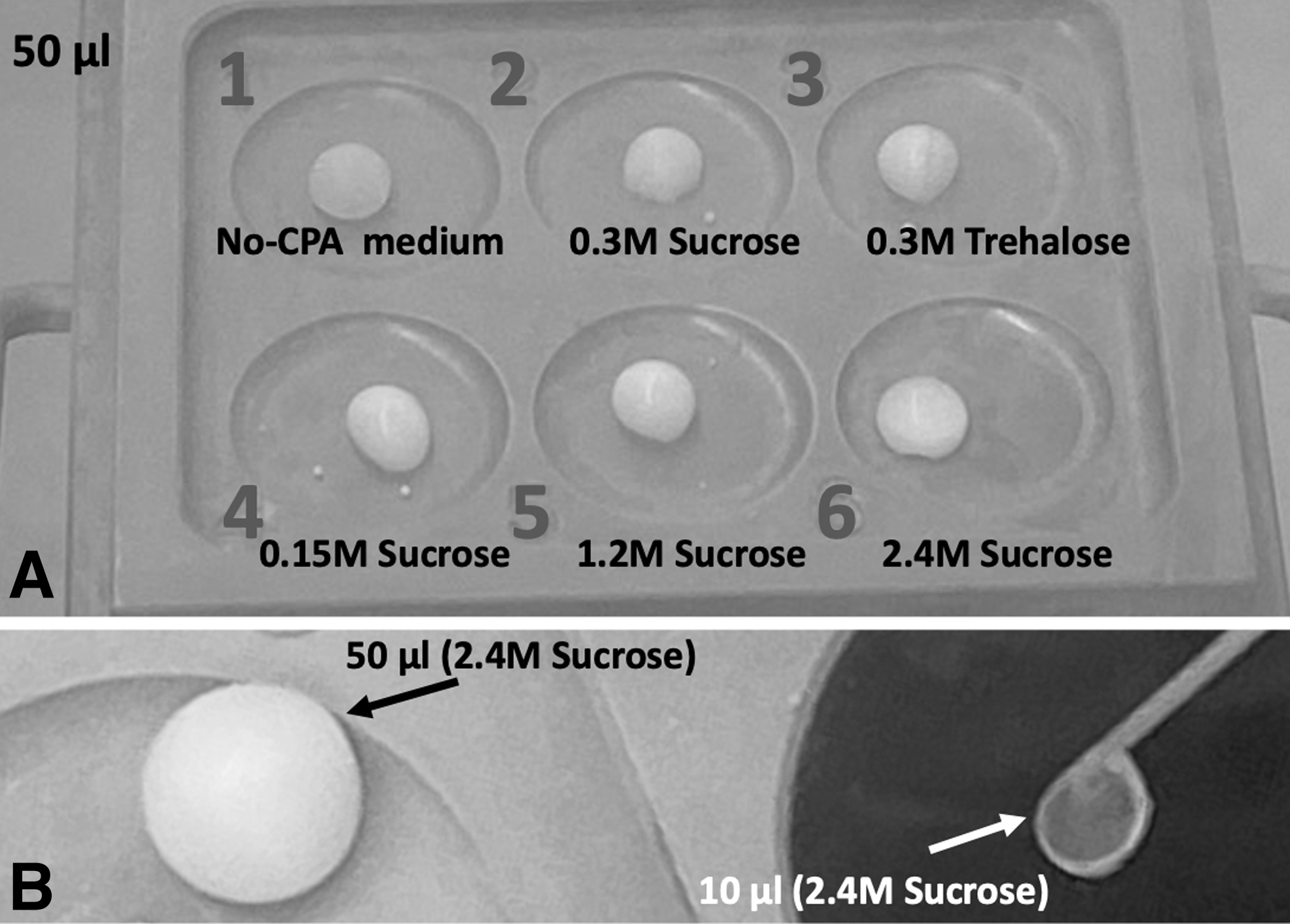
Aspect of droplets containing different concentrations of sucrose and trehalose after immersion into LN2 (droplets were placed on a CVM solid surface block for taking photos).
The sperm characteristics obtained for fresh, CF, and URF spermatozoa are shown in Tables 1 and 2. A significant (p ≤ 0.05) reduction in motility, viability, and acrosome status was observed in URF sperm in comparison with fresh and CF samples. Fresh samples showed lower LPO (p ≤ 0.05) than cryopreserved samples. Significant differences for some sperm parameters were noted between the control group and those supplemented with sucrose or trehalose (Tables 1 and 2).
Bovine Sperm Parameters Obtained from Fresh, Conventional Slow Frozen, and Ultrarapid Frozen (Thawed at 37°C) Samples
The values are expressed as mean ± SEM.
Different letters (a–e) within a row indicate significant differences (p ≤ 0.05).
CF, conventional slow frozen; LPO, lipid peroxidation; PM, progressive motility; S0.15, sucrose 0.15 M; S0.3, sucrose 0.3 M; SEM, standard error of the mean; T0.15, trehalose 0.15 M; T0.3, trehalose 0.3 M; TM, total motility; URF, ultrarapid frozen.
Bovine Sperm Parameters Obtained from Fresh, Conventional Slow Frozen, and Ultrarapid Frozen (Thawed at 65°C) Samples
The values are expressed as mean ± SEM.
Different letters (a–d) within a row indicate significant differences (p ≤ 0.05).
CF, conventional slow frozen; LPO, lipid peroxidation; PM, progressive motility; S0.15, sucrose 0.15 M; S0.3, sucrose 0.3 M; SEM, standard error of the mean; T0.15, trehalose 0.15 M; T0.3, trehalose 0.3 M; TM, total motility; URF, ultrarapid frozen.
TM and PM were significantly higher in URF samples containing disaccharides than in the control group (for both 37°C and 65°). LPO in URF samples was not influenced by CPAs, but samples with 0.3 M sucrose at 37°C showed significantly (p < 0.001) higher values than samples thawed at 65°C (Table 3).
Results of Analysis of Variance Performed Using the Generalized Linear Model to Analyze the Effect of Cryoprotectant Agents and Thawing Temperature, and the Interactions, on Sperm Variables Assessed in Ultrarapid Frozen Sperm Samples
CPA, cryoprotectant agent; CRACRO, cryoresistance rate for acrosome status; CRPM, cryoresistance rate for progressive motility; CRTM, cryoresistance rate for total motility; CRVIA, cryoresistance rate for sperm viability; Tp, thawing temperature.
The addition of disaccharides for URF samples significantly increased the CR (by around 6%, 4%, 14%, and 16% for TM, PM, viability, and acrosome integrity, respectively) compared with the control group (containing only BSA) (Fig. 2). The CR rates for sperm viability and acrosomes were also significantly lower in URF samples, although they reached rates of around 20% and 30%. These rates were significantly higher for CF sperm (Fig. 2).
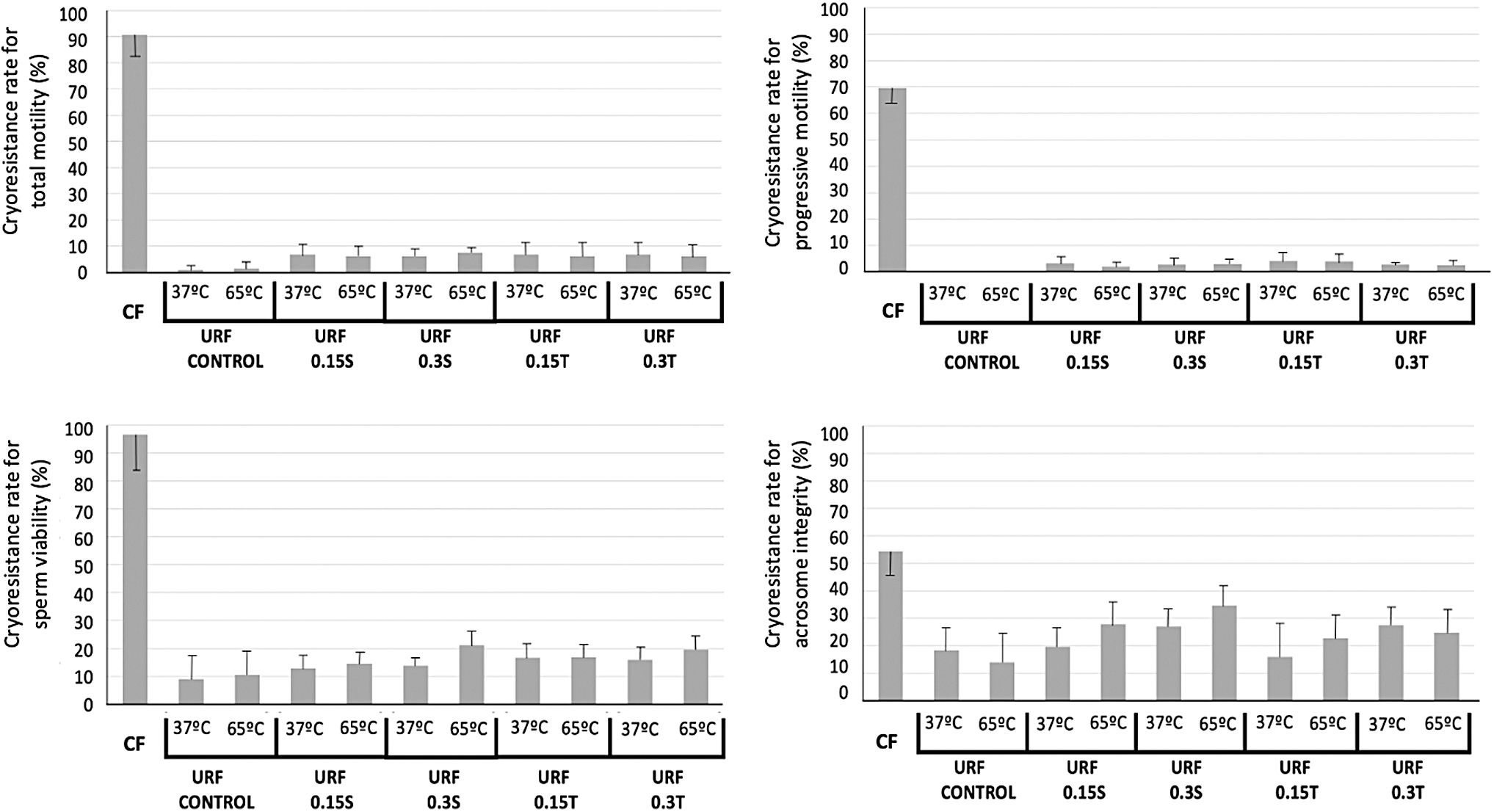
Cryoresistance rates for TM and PM, sperm viability, and acrosome status in CF and URF bovine sperm samples. Data are expressed as mean ± SEM. CF, conventional slow frozen; PM, progressive motility; SEM, standard error of the mean; TM, total motility; URF, ultrarapid frozen.
Sperm parameters assessed in URF samples containing different disaccharide concentrations and thawed at 37°C or 65°C were plotted in a radar chart (Fig. 3). CPAs improved TM, PM, sperm viability, and acrosome integrity; in contrast, LPO values were really close to those obtained for control samples, and no improvement was observed for the mentioned parameter. Media showing a higher area in the radar chart suggest better cryoprotectant activity.
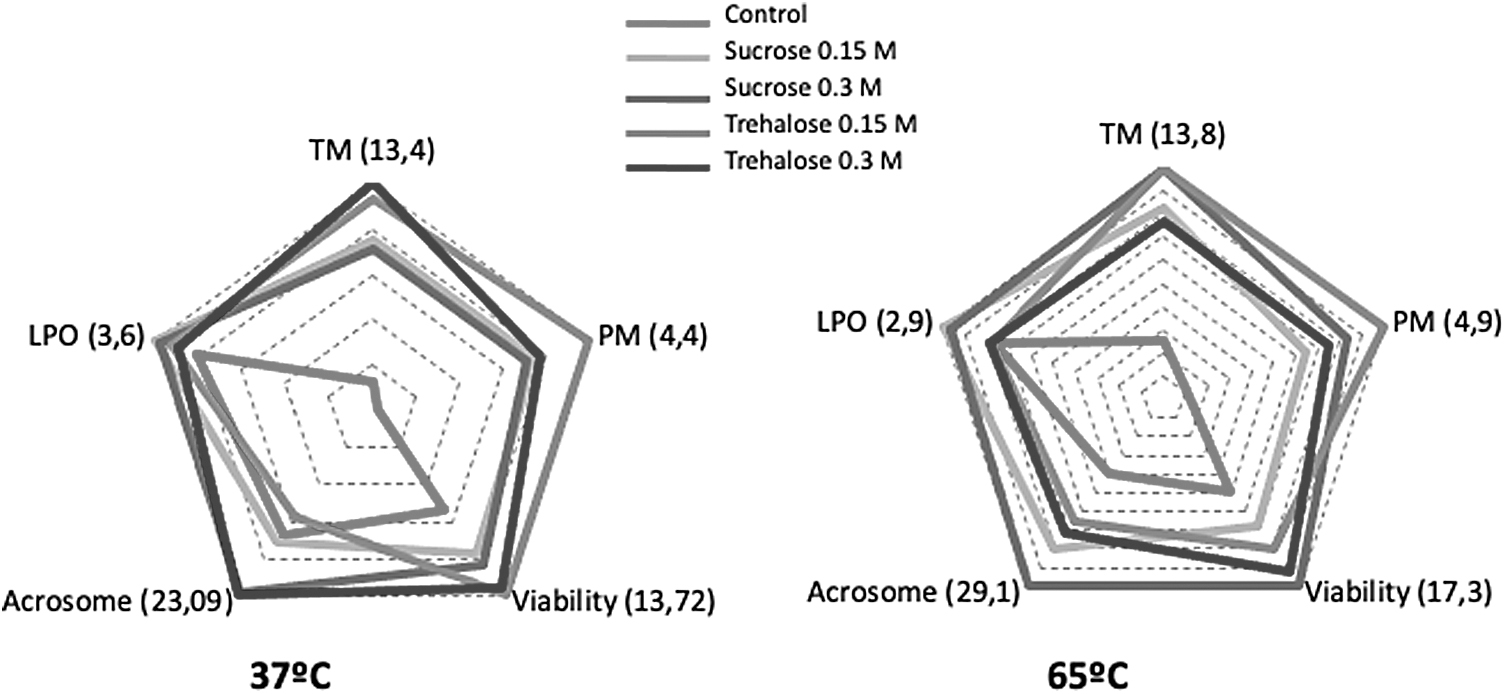
Radar chart showing the variation of different sperm parameters in URF samples using different cryopreservation media (control, sucrose 0.15 M, sucrose 0.3 M, trehalose 0.15 M, and trehalose 0.3 M). The values obtained after thawing at 37°C and 65°C are shown. The axis for each sperm parameter was constructed to include the maximum observed overall value (indicated between parentheses). LPO, lipid peroxidation.
Table 3 shows that CPAs exert a significant influence on sperm motility, integrity, and acrosome status, but not on LPO, while the thawing temperature only showed significant effects on LPO. No significant interactions between CPAs and thawing temperatures were observed. In contrast, the thawing temperature (and interactions between CPAs and temperatures) did not influence the CR in URF samples.
Discussion
The results obtained in the present study revealed that bovine spermatozoa cryopreserved by ultrarapid freezing (as spheres with disaccharide CPAs) showed lower resilience than spermatozoa cryopreserved by conventional slow freezing. Although only a small percentage of spermatozoa retain their quality following ultrarapid freezing, it should be regarded as the basis for improving this cryopreservation procedure and acquiring a better understanding of bovine sperm behavior under the mentioned conditions.
The use of sucrose and trehalose for URF samples provided a moderate degree of protection to the sperm plasmatic membrane and acrosome, parameters which are associated with sperm functionality.7,22 However, sperm motility was drastically reduced (in contrast with CF spermatozoa), which could be linked to mitochondrial damage,7,9 impeding their use in AI.
Studies about ultrarapid freezing of ejaculated sperm have shown very low motility in contrast to epididymal samples.7,23 It has been argued that the contact between spermatozoa and seminal plasma (which occurs in ejaculated sperm) could negatively affect sperm survival during the cryopreservation process as a consequence of the higher pH and greater Na++ and Cl− content.
Then, it might be suggested that the semen collection method could alter the sperm/seminal plasma ratio and modify the quantity and quality of seminal plasma,24–26 negatively impacting sperm freezability. 27 The early maturation status of epididymal spermatozoa and the absence of interaction between sperm and seminal plasma might favor URF spermatozoa.
Disaccharides protect sperm membranes after conventional slow freezing of bull samples. 28 It is suggested that trehalose forms strong hydrogen bonds with the phospholipid head group of synthetic membranes and improves stabilization of sperm membranes during cryopreservation. 29 However, in addition, due to the hyperosmotic properties conferred to the media, trehalose might minimize intracellular ice formation. Highly concentrated disaccharides are currently the most favored CPAs for ultrarapid sperm cooling.
Sucrose and trehalose at 0.15 and 0.3 M protect rapidly cooled spermatozoa in stallion, 20 ram, 9 human, 30 and dog 10 samples. In ovine samples, the use of sucrose at 0.4 and 0.6 M for ultrarapid cooling only achieved 7.2%–8.4% TM and 2.0%–3.4% PM. 9 These low scores are in line with those obtained in the present study in bull samples and are considered unsuitable for AI.
A recent study in equine sperm reports a significant motility reduction below 20% when cells are exposed to a concentration higher than 100 mM sucrose. 22 Similarly, a toxicity test carried out in ovine sperm showed a motility drop up to 20% when 400 mM sucrose solutions were used, although motility was zero when the sucrose concentration reached 600 and 800 mM. 9 In contrast, other authors found no detrimental motility impact when 100–300 mM sucrose concentrations were used for rapid sperm cryopreservation.11,31
It is interesting to observe the physical changes occurring when different sperm cryopreservation procedures are used since ice formation (size and shape) influences sperm resiliency to these processes. Mathematical algorithms have been developed for modeling and simulation of heat transfer during vitrification of droplets containing different CPAs. 22 In addition, cryo-scanning electron microscopy has recently allowed observation of ice crystals formed after rapid cooling in sperm samples containing 100 mM sucrose. 7
Another approach for determining if vitrification or crystallization occurs is based on the condition of the liquid after cooling/freezing. When a milky white color appears, it is considered that ice crystals are formed, while when the aspect is transparent, vitrification has occurred.15,16,22 In the present study, 50-μL drops containing sucrose and trehalose solutions (from 0.15 to 2.4 M) and immersed in LN2 showed a milky opaque aspect, suggesting crystallization instead of vitrification after the rapid cooling process, according to previous studies.15,16,22
Only when a drop's volume was reduced to 10 μL, a transparent aspect was achieved in the solution containing the highest disaccharide concentration (2.4 M) (Fig. 1). Vitrification could occur when very high CPA concentrations are used, but they are incompatible with sperm survival.
It has been reported that addition of low BSA concentrations offers sperm membranes protection by means of a slight increment in osmolarity of the media and reduction in LPO. 32 However, media containing only 2% BSA had lower TM than those including sucrose or trehalose, highlighting the positive effect of disaccharides on URF sperm.
In the present study, the URF bovine spermatozoa showed significant plasma membrane damage. It was observed that only 17.3% of spermatozoa were alive after ultrarapid freezing (in samples supplemented with 0.3 M sucrose and warmed at 65°C), while CF samples reached a percentage of 79.5%, in contrast with the study by Caturla-Sánchez et al. 10
No significant differences were detected when URF sperm samples were thawed at 37°C or 65°C, in agreement with studies in vitrified equine sperm. 11 However, others have described the influence of warming temperature on sperm quality.10,33 Although it has been posited that rapid thawing/warming helps to prevent the recrystallization that might occur in sperm cells, the present study suggests that the two temperatures used for thawing do not affect the bull sperm quality after ultrarapid freezing.
Bovine sperm showed greater acrosome integrity in the present study when samples were ultrarapidly frozen using disaccharides, as described in equine sperm. 20 Complete or partial acrosome loss, the presence of swollen or vesiculated membranes, heterogeneous content, and increased thickness in the subacrosomal area are reported in ultrarapidly cooled spermatozoa. 34 Results reported for equine and dog sperm after vitrification show higher acrosome integrity compared with bull sperm.1,10
During cryopreservation, LPO usually damages the sperm membranes as a consequence of large amounts of polyunsaturated fatty acids, which make membranes more sensitive to peroxidation. 35 Nevertheless, results of the present study showed that there were no differences between samples subjected to conventional slow freezing and ultrarapid freezing, suggesting that LPO is unlikely to represent a sign of cryopreservation-induced damage per se. 36
In sum, recent studies about URF sperm in domestic and wild animals have stated new assertions in this field such as the higher cryoresistance of epididymal spermatozoa,1,23 the importance of sperm refrigeration before rapid cooling, 9 the protective action of disaccharides, 18 or the evidence that no vitrification occurs when low CPA concentrations are used.7,22 However, few of these approaches have been applied in bull sperm cryopreservation.
Conclusions
An opaque white aspect was observed when 50-μL sperm drops containing 0.15 and 0.3 M disaccharides were immersed in LN2, which has been associated with crystallization. The results obtained for bovine sperm preserved by ultrarapid freezing procedures (by droplets immersed in LN2) are in accordance with those reported for other species, although significantly lower than those obtained by conventional slow freezing.
The use of sucrose and trehalose during ultrarapid freezing provided higher acrosome protection, plasma membrane integrity, and TM and PM than samples diluted only in BSA. The CR was also higher when disaccharides were added to diluents, in contrast to the control group.
Bull sperm quality after ultrarapid freezing was not influenced by the thawing temperature, so it is advisable to use whichever protocol is simpler and more viable, which in the present case was 37°C for 30 seconds. The characteristics of rapid frozen sperm in this study did not meet the minimum values needed for use in AI, and further studies should be conducted to enhance the efficiency of this technique in bull sperm.
Footnotes
Acknowledgment
The authors acknowledge the collaboration with Jandavet Veterinary Services (Medina Sidonia, Cádiz, Spain) who provided the semen samples.
Author Disclosure Statement
No conflicting financial interests exist.
Funding Information
This research received no specific grant from any funding agency in the public, commercial, or not-for-profit sectors.